

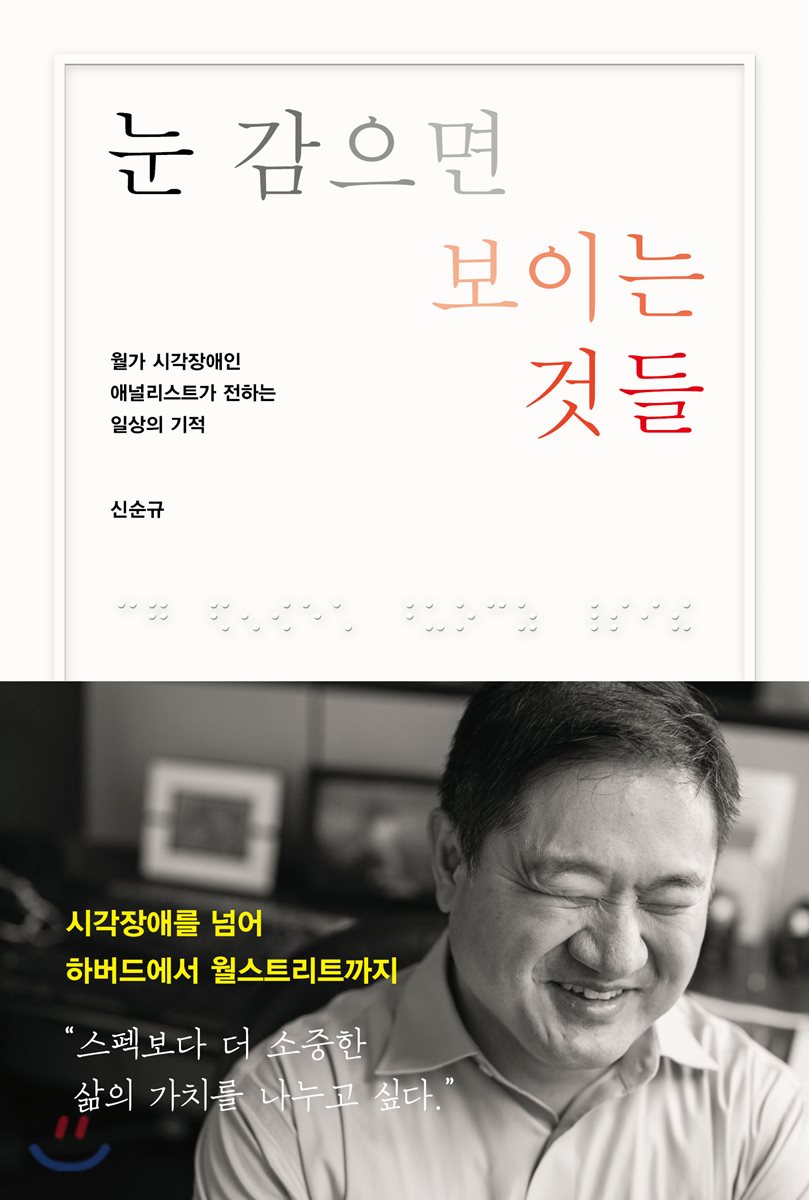
Things you see when you close your eyes
 |
Description
Book Introduction
“Dreams, work, family, seeing…
It's just an ordinary thing for some people
“It’s a miracle to me”
Shin Soon-kyu, a visually impaired Wall Street analyst, reports:
Precious things we must not forget as we live
Beyond Blindness: From Harvard to Wall Street
Sharing the value of life, which is more precious than specs
Shin Soon-kyu, a visually impaired Wall Street analyst, has published an essay titled "Things You See When You Close Your Eyes," which conveys the value of everyday life to busy modern people.
A first-degree blind person who lost his sight completely at the age of nine, a graduate of prestigious universities such as Harvard and MIT, a veteran analyst who worked at JP Morgan and Brown Brothers Harriman for over 20 years, the world's first blind Chartered Financial Analyst (CFA)... Rather than these grand titles, the author, who has been faithful to his roles as someone's husband, father, friend, and colleague and has constantly strived to live an ordinary life, shares the simple wisdom of life that he was able to gain from his blindness and the moments of emotion he feels in everyday life.
The passionate sincerity of this book, written over the past three years using a Braille computer to share these amazing 'everyday miracles' with the world, breathes through every page.
It's just an ordinary thing for some people
“It’s a miracle to me”
Shin Soon-kyu, a visually impaired Wall Street analyst, reports:
Precious things we must not forget as we live
Beyond Blindness: From Harvard to Wall Street
Sharing the value of life, which is more precious than specs
Shin Soon-kyu, a visually impaired Wall Street analyst, has published an essay titled "Things You See When You Close Your Eyes," which conveys the value of everyday life to busy modern people.
A first-degree blind person who lost his sight completely at the age of nine, a graduate of prestigious universities such as Harvard and MIT, a veteran analyst who worked at JP Morgan and Brown Brothers Harriman for over 20 years, the world's first blind Chartered Financial Analyst (CFA)... Rather than these grand titles, the author, who has been faithful to his roles as someone's husband, father, friend, and colleague and has constantly strived to live an ordinary life, shares the simple wisdom of life that he was able to gain from his blindness and the moments of emotion he feels in everyday life.
The passionate sincerity of this book, written over the past three years using a Braille computer to share these amazing 'everyday miracles' with the world, breathes through every page.
- You can preview some of the book's contents.
Preview
Into the book
Then he asked me why I wanted to marry him.
Geunju told me three things.
I thought he was someone I could communicate with, someone I could trust, and someone who would always be on my side.
To the same question, I said this:
Above all, I liked Geunju's confidence.
Geun-ju was never embarrassed by the stares he received as he walked along, especially from Koreans.
After revealing our relationship to people, Geun-ju was proud of dating me and acted like it.
When I was worried about my job, Geun-ju told me that even if he earned enough money on his own, we could both live comfortably.
I cherished that kind of confidence.
Looking back, when I was dreaming of and preparing for marriage, I had to make two wish lists.
It was important to have a list of what kind of person I wanted my spouse to be, but more importantly, it was important to write and prepare a list of what kind of person I wanted my spouse to be.
Geun-ju gave me confidence with her confidence, and I gave her the confidence that we would be together for the rest of our lives.
- We can also see with our hearts: What kind of people should we be to those we love? --- p.38
I fixed the place where I would stand and the target for shooting the bow, and placed the classroom desk straight in front of me so that I would not be looking at it from the wrong angle.
I stood behind the desk and tried to keep my shoulders straight.
So that when I raise my head and look straight ahead, my face is pointed straight at the target.
Then I put an arrow in my bow, aimed it at the target in front of me, and shot it.
I shot and shot again, and when my archery classmates gave me arrows, I kept shooting again.
When an arrow hit the target, my classmates would shout and clap loudly, but of course, I didn't hear that sound very often.
What I learned from these experiences wasn't archery.
Rather, what I desperately gained was the wisdom to free myself from the everyday thought that “there are many things in this world that people who can’t see can’t do.”
- Don't Be Blinded by Prejudice: Things That Distort the World--- p.44
Of the five human senses, vision provides the most, fastest, and generally most accurate information.
I lost that vision when I was nine years old.
However, I think that in modern times, there is not much that we can take in visually, especially through screens, that is helpful to us.
A blind person is a person who has lost the right to see through his or her eyes.
But most modern people seem to live voluntarily giving up the freedom to reject things they don't need to see.
So, we don't see the things we really need to see: the eyes of children longing for their parents' love, the sad expression of a mother who can't hide it even when she's angry, the face of a spouse darkened by loneliness.
In today's world, where it's easy to be caught up in mass media and social networks, if we take our eyes off them and look closely and more often at the faces of our loved ones, wouldn't we be able to escape the "noise" of the world and live a life more conscious of the "signals" that are precious to us?
- Seeing Less Can Help You See What's Precious: Distinguishing the 'Signal' from the 'Noise' --- p.53
As you go along the road, there are times when you have to turn back and times when you have to change direction.
There are times when you have to change your destination entirely.
The important thing is to keep going until you reach your destination.
If we accept that the road ahead will be full of constant curves, steep ups and downs, and dangerous obstacles, we will be able to maintain confidence and hope even on the rough road.
- The path can be retraced at any time: from a school for the blind to a regular school, from a pianist to a doctor--- p.75
One day I asked Dad this:
There are so many people in the world who need help, so how do we decide who to help?
With this answer, Dad painted a picture in my head that will remain forever.
It is said that countless starfish covered the beach.
Perhaps it was accidentally washed in by the tide.
Two people were walking along the beach, and the person in front of them started picking up starfish one or two at a time and throwing them into the sea.
The person walking behind asked the person in front.
What is the point of saving only a few starfish out of over a thousand?
Then the person in front answered like this.
Wouldn't it have a great meaning for these few who return to the sea?
- We must teach children how to relate to the world: On the role of fathers--- p.121
Many people believe that love is something that two people do.
So, two people date and two people get married.
But we believe that true love, truly deep love, requires at least three people.
When you raise a child or children born from the love of two people together, you can experience all the joy, pain, pleasure, and sadness that come from love.
True love is something that at least three people share: The meaning of having a child--- p.132
There seems to be no best answer to the question of how to live as a person of faith.
These three messages were the most meaningful to me as I tried to find the answer.
A life of believing in God, who knows me better than I know myself, a life of gratitude for everything, a life of training for spiritual growth, and a life of not only receiving grace but also giving it.
If I had to choose only one of these three, I would choose grace.
A life of gratitude and spiritual training is for me, but for someone who has experienced grace to live a life of giving back, it means living a life that helps others rather than living just for themselves.
- A Life of Giving Back: Three Messages That Changed My Life
Geunju told me three things.
I thought he was someone I could communicate with, someone I could trust, and someone who would always be on my side.
To the same question, I said this:
Above all, I liked Geunju's confidence.
Geun-ju was never embarrassed by the stares he received as he walked along, especially from Koreans.
After revealing our relationship to people, Geun-ju was proud of dating me and acted like it.
When I was worried about my job, Geun-ju told me that even if he earned enough money on his own, we could both live comfortably.
I cherished that kind of confidence.
Looking back, when I was dreaming of and preparing for marriage, I had to make two wish lists.
It was important to have a list of what kind of person I wanted my spouse to be, but more importantly, it was important to write and prepare a list of what kind of person I wanted my spouse to be.
Geun-ju gave me confidence with her confidence, and I gave her the confidence that we would be together for the rest of our lives.
- We can also see with our hearts: What kind of people should we be to those we love? --- p.38
I fixed the place where I would stand and the target for shooting the bow, and placed the classroom desk straight in front of me so that I would not be looking at it from the wrong angle.
I stood behind the desk and tried to keep my shoulders straight.
So that when I raise my head and look straight ahead, my face is pointed straight at the target.
Then I put an arrow in my bow, aimed it at the target in front of me, and shot it.
I shot and shot again, and when my archery classmates gave me arrows, I kept shooting again.
When an arrow hit the target, my classmates would shout and clap loudly, but of course, I didn't hear that sound very often.
What I learned from these experiences wasn't archery.
Rather, what I desperately gained was the wisdom to free myself from the everyday thought that “there are many things in this world that people who can’t see can’t do.”
- Don't Be Blinded by Prejudice: Things That Distort the World--- p.44
Of the five human senses, vision provides the most, fastest, and generally most accurate information.
I lost that vision when I was nine years old.
However, I think that in modern times, there is not much that we can take in visually, especially through screens, that is helpful to us.
A blind person is a person who has lost the right to see through his or her eyes.
But most modern people seem to live voluntarily giving up the freedom to reject things they don't need to see.
So, we don't see the things we really need to see: the eyes of children longing for their parents' love, the sad expression of a mother who can't hide it even when she's angry, the face of a spouse darkened by loneliness.
In today's world, where it's easy to be caught up in mass media and social networks, if we take our eyes off them and look closely and more often at the faces of our loved ones, wouldn't we be able to escape the "noise" of the world and live a life more conscious of the "signals" that are precious to us?
- Seeing Less Can Help You See What's Precious: Distinguishing the 'Signal' from the 'Noise' --- p.53
As you go along the road, there are times when you have to turn back and times when you have to change direction.
There are times when you have to change your destination entirely.
The important thing is to keep going until you reach your destination.
If we accept that the road ahead will be full of constant curves, steep ups and downs, and dangerous obstacles, we will be able to maintain confidence and hope even on the rough road.
- The path can be retraced at any time: from a school for the blind to a regular school, from a pianist to a doctor--- p.75
One day I asked Dad this:
There are so many people in the world who need help, so how do we decide who to help?
With this answer, Dad painted a picture in my head that will remain forever.
It is said that countless starfish covered the beach.
Perhaps it was accidentally washed in by the tide.
Two people were walking along the beach, and the person in front of them started picking up starfish one or two at a time and throwing them into the sea.
The person walking behind asked the person in front.
What is the point of saving only a few starfish out of over a thousand?
Then the person in front answered like this.
Wouldn't it have a great meaning for these few who return to the sea?
- We must teach children how to relate to the world: On the role of fathers--- p.121
Many people believe that love is something that two people do.
So, two people date and two people get married.
But we believe that true love, truly deep love, requires at least three people.
When you raise a child or children born from the love of two people together, you can experience all the joy, pain, pleasure, and sadness that come from love.
True love is something that at least three people share: The meaning of having a child--- p.132
There seems to be no best answer to the question of how to live as a person of faith.
These three messages were the most meaningful to me as I tried to find the answer.
A life of believing in God, who knows me better than I know myself, a life of gratitude for everything, a life of training for spiritual growth, and a life of not only receiving grace but also giving it.
If I had to choose only one of these three, I would choose grace.
A life of gratitude and spiritual training is for me, but for someone who has experienced grace to live a life of giving back, it means living a life that helps others rather than living just for themselves.
- A Life of Giving Back: Three Messages That Changed My Life
--- p.218
Publisher's Review
“80 percent of what we see is useless.”
- Simple wisdom that can be obtained without being seen
In this day and age where we are bombarded with a flood of information, the human eye plays a crucial role in obtaining information.
The author, who has worked as an analyst for over 20 years, has a primary job of sifting through the flood of information to analyze the value of securities.
However, due to the fundamental limitation of visual impairment, I had to develop the ability to select and obtain only the information I absolutely needed or "primary sources," and this became the driving force that allowed me to maintain my balance without being swayed by the flood of news, rumors, or claims or recommendations from those in positions of power that could shake the market.
The author states, “Just as the intrinsic or long-term value of securities is determined by invisible and surprisingly simple things, the important things in life are also invisible and are determined and maintained by a few simple things.”
In other words, people living in today's world, surrounded by flashy, stimulating, and attractive things, tend to forget the simple, fundamental principles of life, and end up living without seeing what is precious due to the difficult reality right in front of them.
Ultimately, the central message of this book is that, in order to avoid being seduced by the illusion of this reality, we must not miss out on the precious things in life.
In fact, the author was able to overcome the numerous challenges life presented to him because he never forgot those precious things.
The five precious things he chose in this book (seeing, dreams, family, work, and sharing) may seem trite and obvious to some, but to him, they were all things he had to fight for and gained through hardship, and they have sustained his life more firmly than the studies he received at Harvard or MIT or the career he built at a Wall Street firm, so they hold a special meaning.
Through this book, which contains the honest life of a man and the values that life alone proves, readers will have the opportunity to look back on precious things that they have long forgotten and lived with.
“The puzzle of life doesn’t fit together in one go.”
- A deep resonance that awakens us from our routine daily lives.
Author Shin Soon-kyu lost his sight completely at the age of nine due to glaucoma and retinal detachment, but he learned to experience, think, and feel the world in new ways. [Seeing] From piano to studying, from a school for the blind to a regular school, from a doctor to an analyst, he cultivated the ability to flexibly transform his dreams rather than giving up whenever he encountered obstacles in reality. [Dream] From a young age, he constantly worried that he would not be able to marry and start a family with the person he loved. He also experienced setbacks in his relationships with the opposite sex. However, each time, he reminded himself of the simple truth: "Marriage is about loving each other for a long time, until death, and love is not a feeling, but a decision." [Family] At work, he strives to be the best in his profession, yet never forgets that his work is a means to achieving what he loves most. [Work] He believes that his success is not due to his exceptional abilities, but to the countless help he has received from others, and he lives a life of giving back to the world. [Sharing]
The five values that the author presents in this book become the story of his life.
It is a list of the frustrations he has experienced, but at the same time, it is also a list of miracles he desperately wanted.
Other episodes that cannot be left out include the vivid story of the 9/11 terrorist attacks while working on Wall Street (p. 133) and the story of how, as the first visually impaired person in the world to pass the Chartered Financial Analyst (CFA) exam, he had to change the examination system based on the standards for non-disabled people (p. 84).
This book goes beyond "a touching success story that overcame adversity." It will serve as a mirror that reflects our daily lives, which often drift along dull and dull, steeped in routine. It will also offer readers the warm comfort and courage to pursue happiness even in difficult circumstances, as well as the profound wisdom and resonance of life that only a genuine person can convey.
- Simple wisdom that can be obtained without being seen
In this day and age where we are bombarded with a flood of information, the human eye plays a crucial role in obtaining information.
The author, who has worked as an analyst for over 20 years, has a primary job of sifting through the flood of information to analyze the value of securities.
However, due to the fundamental limitation of visual impairment, I had to develop the ability to select and obtain only the information I absolutely needed or "primary sources," and this became the driving force that allowed me to maintain my balance without being swayed by the flood of news, rumors, or claims or recommendations from those in positions of power that could shake the market.
The author states, “Just as the intrinsic or long-term value of securities is determined by invisible and surprisingly simple things, the important things in life are also invisible and are determined and maintained by a few simple things.”
In other words, people living in today's world, surrounded by flashy, stimulating, and attractive things, tend to forget the simple, fundamental principles of life, and end up living without seeing what is precious due to the difficult reality right in front of them.
Ultimately, the central message of this book is that, in order to avoid being seduced by the illusion of this reality, we must not miss out on the precious things in life.
In fact, the author was able to overcome the numerous challenges life presented to him because he never forgot those precious things.
The five precious things he chose in this book (seeing, dreams, family, work, and sharing) may seem trite and obvious to some, but to him, they were all things he had to fight for and gained through hardship, and they have sustained his life more firmly than the studies he received at Harvard or MIT or the career he built at a Wall Street firm, so they hold a special meaning.
Through this book, which contains the honest life of a man and the values that life alone proves, readers will have the opportunity to look back on precious things that they have long forgotten and lived with.
“The puzzle of life doesn’t fit together in one go.”
- A deep resonance that awakens us from our routine daily lives.
Author Shin Soon-kyu lost his sight completely at the age of nine due to glaucoma and retinal detachment, but he learned to experience, think, and feel the world in new ways. [Seeing] From piano to studying, from a school for the blind to a regular school, from a doctor to an analyst, he cultivated the ability to flexibly transform his dreams rather than giving up whenever he encountered obstacles in reality. [Dream] From a young age, he constantly worried that he would not be able to marry and start a family with the person he loved. He also experienced setbacks in his relationships with the opposite sex. However, each time, he reminded himself of the simple truth: "Marriage is about loving each other for a long time, until death, and love is not a feeling, but a decision." [Family] At work, he strives to be the best in his profession, yet never forgets that his work is a means to achieving what he loves most. [Work] He believes that his success is not due to his exceptional abilities, but to the countless help he has received from others, and he lives a life of giving back to the world. [Sharing]
The five values that the author presents in this book become the story of his life.
It is a list of the frustrations he has experienced, but at the same time, it is also a list of miracles he desperately wanted.
Other episodes that cannot be left out include the vivid story of the 9/11 terrorist attacks while working on Wall Street (p. 133) and the story of how, as the first visually impaired person in the world to pass the Chartered Financial Analyst (CFA) exam, he had to change the examination system based on the standards for non-disabled people (p. 84).
This book goes beyond "a touching success story that overcame adversity." It will serve as a mirror that reflects our daily lives, which often drift along dull and dull, steeped in routine. It will also offer readers the warm comfort and courage to pursue happiness even in difficult circumstances, as well as the profound wisdom and resonance of life that only a genuine person can convey.
GOODS SPECIFICS
- Date of publication: October 27, 2015
- Page count, weight, size: 228 pages | 410g | 145*215*16mm
- ISBN13: 9791158880194
- ISBN10: 1158880197
You may also like
카테고리
korean


korean

![GQ KOREA Mark (Monthly): December [2025]](http://librairie.coreenne.fr/cdn/shop/files/8ef265dbbfbf186523ed75ba7319009d.jpg?v=1765340328&width=3840)


