

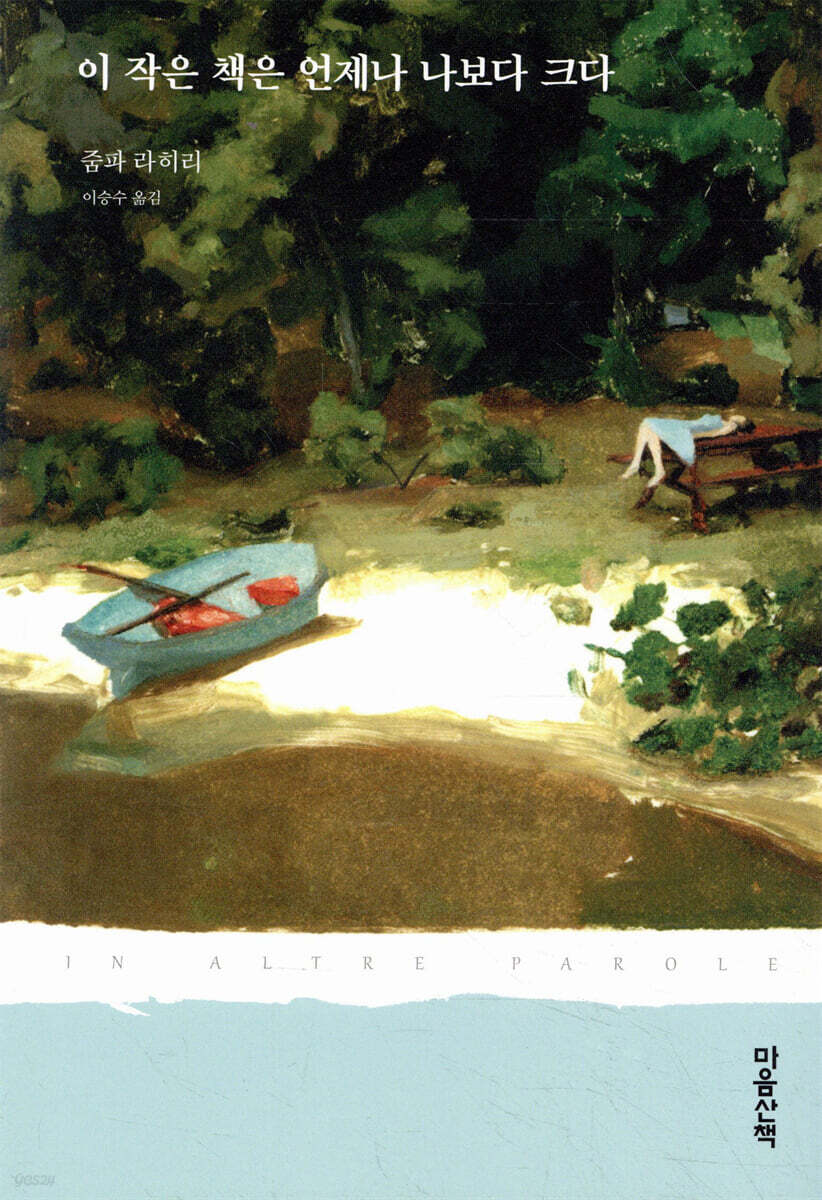
This little book is always bigger than me.
 |
Description
Book Introduction
National Humanity Medal winner Jhumpa Lahiri's first prose collection
A literary adventure in Italian
Jhumpa Lahiri, an Indian-American writer, won the Pulitzer Prize at the age of 33 for her first collection of short stories, not a novel, and for her work that addressed the question of identity as a "person living in America" rather than the identity of an "American."
She has swept many prestigious awards, including the Pulitzer Prize, the O. Henry Award, the PEN/Hemingway Award, and the Frank O'Connor International Short Story Award, with her novels 『Blessed Home』, 『Love Behind the Name』, 『Just a Good Person』, and 『The Lowcountry』, and has established herself as a representative American writer who is trusted and loved by both critics and readers, recording national bestsellers.
On September 10, 2015, he was awarded the National Humanities Medal by U.S. President Obama.
This medal is a humanities medal awarded once a year to individuals or groups who have contributed to the development and expansion of the humanities.
Past winners include Joyce Carol Oates, Toni Morrison, Philip Roth, Robert Dalton, John Updike, and Steven Spielberg.
This collection of essays chronicles Jhumpa Lahiri's journey in Rome, from discovering, studying, and exploring the Italian language to becoming an Italian writer, with her characteristically concise prose and profound reflections.
Among the 23 prose pieces of exquisite refinement are two short stories she wrote in Italian.
"This little book is always bigger than me" are Jhumpa Lahiri's metaphors of extreme love for the Italian language.
A literary adventure in Italian
Jhumpa Lahiri, an Indian-American writer, won the Pulitzer Prize at the age of 33 for her first collection of short stories, not a novel, and for her work that addressed the question of identity as a "person living in America" rather than the identity of an "American."
She has swept many prestigious awards, including the Pulitzer Prize, the O. Henry Award, the PEN/Hemingway Award, and the Frank O'Connor International Short Story Award, with her novels 『Blessed Home』, 『Love Behind the Name』, 『Just a Good Person』, and 『The Lowcountry』, and has established herself as a representative American writer who is trusted and loved by both critics and readers, recording national bestsellers.
On September 10, 2015, he was awarded the National Humanities Medal by U.S. President Obama.
This medal is a humanities medal awarded once a year to individuals or groups who have contributed to the development and expansion of the humanities.
Past winners include Joyce Carol Oates, Toni Morrison, Philip Roth, Robert Dalton, John Updike, and Steven Spielberg.
This collection of essays chronicles Jhumpa Lahiri's journey in Rome, from discovering, studying, and exploring the Italian language to becoming an Italian writer, with her characteristically concise prose and profound reflections.
Among the 23 prose pieces of exquisite refinement are two short stories she wrote in Italian.
"This little book is always bigger than me" are Jhumpa Lahiri's metaphors of extreme love for the Italian language.
- You can preview some of the book's contents.
Preview
index
Crossing
dictionary
Like being struck by lightning
exile
conversation
refusal
Reading with a dictionary
Pick up words
diary
snippet
Short story_ Change
Fragile Shelter
impossibility
Venice
imperfect past
hairy youth
Second expulsion
wall
triangle
Transformation
Explore
construction scaffolding
Short story_ Dusk
Acknowledgements
Translator's Note
dictionary
Like being struck by lightning
exile
conversation
refusal
Reading with a dictionary
Pick up words
diary
snippet
Short story_ Change
Fragile Shelter
impossibility
Venice
imperfect past
hairy youth
Second expulsion
wall
triangle
Transformation
Explore
construction scaffolding
Short story_ Dusk
Acknowledgements
Translator's Note
Detailed image
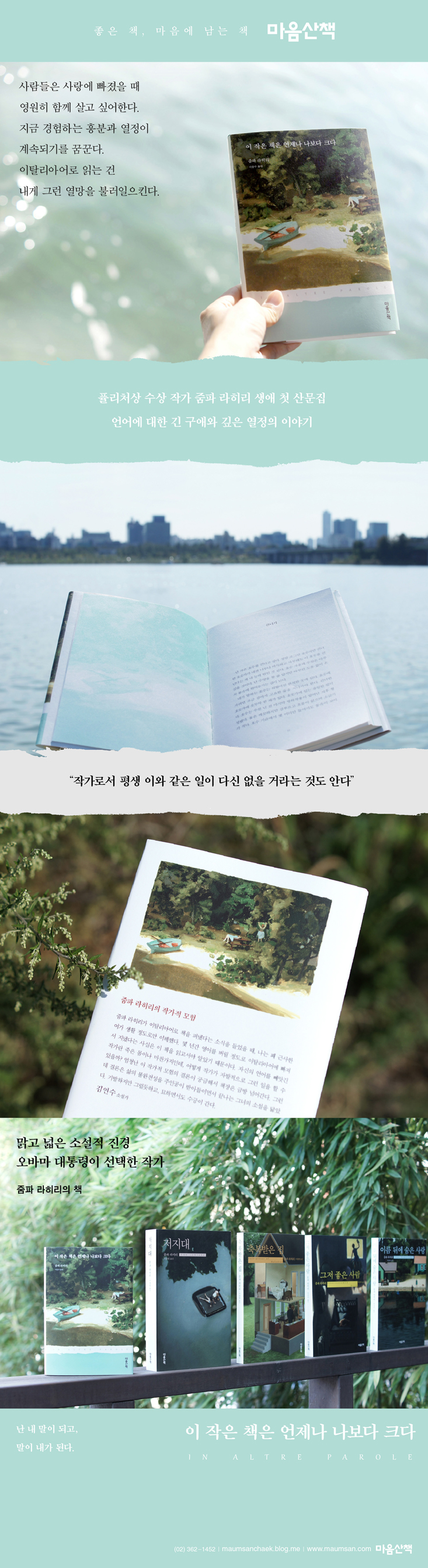
Into the book
The dictionary becomes both a map and a compass.
If you don't have a dictionary, you might get lost.
They seem like such strong parents that I can't go out without them.
I feel like the dictionary is like a Bible containing secrets and revelations.
--- p.16
Now this little dictionary is more like a brother than a parent.
It still needs me and still guides me.
The dictionary is full of secrets.
This little book is always bigger than me.
--- p.18
There was no need for me to learn Italian.
I never lived in Italy and I never had Italian friends.
I just longed for Italian.
But in the end, longing is no different from a mad desire.
As with many passionate relationships, my infatuation with Italian would become an attachment, an obsession.
There will always be something that makes you lose your mind and doesn't respond.
I'm in love with Italian, but the object of my love is indifferent to me.
Italian would never have wanted me.
--- p.22
I loved this journey.
I left home, leaving the rest of my life behind.
I never thought about writing a piece.
For a few hours I forgot the languages I knew.
It felt like I was making a little escape every time.
Only one important place awaited me, Italian.
It was my refuge where a new reality unfolded.
--- p.34
I was going to Rome to change my life's path and to learn Italian.
In Rome, Italian will follow me every day, every minute.
It will always reach you with your senses.
It wasn't going to be a switch that just turned on and off.
--- p.36
When people fall in love, they want to live together forever.
I dream that the excitement and passion I am experiencing now will continue.
Reading in Italian evokes such a desire in me.
--- p.43
I finished one notebook and opened another.
A second metaphor came to mind.
I feel like I'm climbing a mountain without proper equipment.
It is a literary effort to survive.
I don't know many words to express myself in Italian.
I think it's a kind of deficiency.
But at the same time I feel free and light.
I realized again why I write.
I write out of necessity, but it brings me joy.
I tasted again the joy I had felt since I was young.
The joy of writing words in a notebook that no one will read.
I write in Italian in a rough and concise manner, without polishing my sentences.
And I'm still in a state of anxiety.
I just want to be understood and understood myself, with blind but true faith.
--- p.54
Why do I write? To explore the mystery of existence.
To endure myself.
To get closer to everything outside of me.
When I want to understand what triggers me, what confuses me, what makes me anxious, what simply makes me react, I have to put it into words.
Writing is my only way to absorb and organize life.
Otherwise I get confused and bewildered.
--- p.75
Only words that continue to be spoken seem real.
The words we actually speak have a higher value and power than we do.
--- p.75
Since I was a child, I have been confined only to my own words.
I have no country, no definite culture.
If I don't write, if I don't work with words, I don't feel like I exist on this earth.
What do words mean? And life? Ultimately, it's the same thing.
Just as words have many facets and shades and thus complex characteristics, so too do people and life.
Language is a mirror, an important metaphor.
After all, the meaning of words, like the meaning of people, is something that cannot be measured or expressed.
--- p.75~76
I think recognizing the impossible is crucial to the creative impulse.
I feel a sense of wonder in the face of everything that seems unattainable.
You can't create anything without feeling wonder and amazement about things.
If I could bridge the gap between myself and Italian, I would never write in that language again.
--- p.81
The mechanism of transformation may be the only element of life that never changes.
The course of every individual, every nation, every era of history, and every thing in the universe is simply a process of change, sometimes weak, sometimes violent.
If there had been no change, we would have stayed the same.
Moments of transition, when something changes, shape our spine.
The moments we try to remember either survive or disappear.
Change shapes our existence.
The rest is usually forgotten.
If you don't have a dictionary, you might get lost.
They seem like such strong parents that I can't go out without them.
I feel like the dictionary is like a Bible containing secrets and revelations.
--- p.16
Now this little dictionary is more like a brother than a parent.
It still needs me and still guides me.
The dictionary is full of secrets.
This little book is always bigger than me.
--- p.18
There was no need for me to learn Italian.
I never lived in Italy and I never had Italian friends.
I just longed for Italian.
But in the end, longing is no different from a mad desire.
As with many passionate relationships, my infatuation with Italian would become an attachment, an obsession.
There will always be something that makes you lose your mind and doesn't respond.
I'm in love with Italian, but the object of my love is indifferent to me.
Italian would never have wanted me.
--- p.22
I loved this journey.
I left home, leaving the rest of my life behind.
I never thought about writing a piece.
For a few hours I forgot the languages I knew.
It felt like I was making a little escape every time.
Only one important place awaited me, Italian.
It was my refuge where a new reality unfolded.
--- p.34
I was going to Rome to change my life's path and to learn Italian.
In Rome, Italian will follow me every day, every minute.
It will always reach you with your senses.
It wasn't going to be a switch that just turned on and off.
--- p.36
When people fall in love, they want to live together forever.
I dream that the excitement and passion I am experiencing now will continue.
Reading in Italian evokes such a desire in me.
--- p.43
I finished one notebook and opened another.
A second metaphor came to mind.
I feel like I'm climbing a mountain without proper equipment.
It is a literary effort to survive.
I don't know many words to express myself in Italian.
I think it's a kind of deficiency.
But at the same time I feel free and light.
I realized again why I write.
I write out of necessity, but it brings me joy.
I tasted again the joy I had felt since I was young.
The joy of writing words in a notebook that no one will read.
I write in Italian in a rough and concise manner, without polishing my sentences.
And I'm still in a state of anxiety.
I just want to be understood and understood myself, with blind but true faith.
--- p.54
Why do I write? To explore the mystery of existence.
To endure myself.
To get closer to everything outside of me.
When I want to understand what triggers me, what confuses me, what makes me anxious, what simply makes me react, I have to put it into words.
Writing is my only way to absorb and organize life.
Otherwise I get confused and bewildered.
--- p.75
Only words that continue to be spoken seem real.
The words we actually speak have a higher value and power than we do.
--- p.75
Since I was a child, I have been confined only to my own words.
I have no country, no definite culture.
If I don't write, if I don't work with words, I don't feel like I exist on this earth.
What do words mean? And life? Ultimately, it's the same thing.
Just as words have many facets and shades and thus complex characteristics, so too do people and life.
Language is a mirror, an important metaphor.
After all, the meaning of words, like the meaning of people, is something that cannot be measured or expressed.
--- p.75~76
I think recognizing the impossible is crucial to the creative impulse.
I feel a sense of wonder in the face of everything that seems unattainable.
You can't create anything without feeling wonder and amazement about things.
If I could bridge the gap between myself and Italian, I would never write in that language again.
--- p.81
The mechanism of transformation may be the only element of life that never changes.
The course of every individual, every nation, every era of history, and every thing in the universe is simply a process of change, sometimes weak, sometimes violent.
If there had been no change, we would have stayed the same.
Moments of transition, when something changes, shape our spine.
The moments we try to remember either survive or disappear.
Change shapes our existence.
The rest is usually forgotten.
--- p.135
Publisher's Review
National Humanity Medal winner Jhumpa Lahiri's first prose collection
A literary adventure in Italian
Jhumpa Lahiri, an Indian-American writer, won the Pulitzer Prize at the age of 33 for her first collection of short stories, not a novel, and for her work that addressed the question of identity as a "person living in America" rather than the identity of an "American."
She has swept many prestigious awards, including the Pulitzer Prize, the O. Henry Award, the PEN/Hemingway Award, and the Frank O'Connor International Short Story Award, with her novels 『Blessed Home』, 『Love Behind the Name』, 『Just a Good Person』, and 『The Lowcountry』, and has established herself as a representative American writer who is trusted and loved by both critics and readers, recording national bestsellers.
On September 10, 2015, he was awarded the National Humanities Medal by U.S. President Obama.
This medal is a humanities medal awarded once a year to individuals or groups who have contributed to the development and expansion of the humanities.
Past winners include Joyce Carol Oates, Toni Morrison, Philip Roth, Robert Dalton, John Updike, and Steven Spielberg.
Her first collection of prose, written in Italian rather than her native English, was published by Maumsanchaek.
This is a translation of an Italian book published this year, and will be released in Korea before the English translation, which will be published in 2016.
Jhumpa Lahiri, who had just graduated from college, visited Florence for the first time in 1994 and stayed there for a week.
It was a trip, but from the start, the relationship became intimate, auditory.
“The noises, conversations, sentences, and words I like.”
A long-held desire began as if “struck by lightning.”
After returning to the United States and studying Italian for a full 20 years, the author decided to move to Rome with his family.
Even though he was in the middle of writing his second novel, The Lowlands, he took the risk of completely abandoning his native language by reading only Italian books and not English books at all for several months before leaving for Rome.
And I have a feeling that this physical crossing of the ocean will be “the true beginning of life.”
Just as it took Dante nine years to finally converse with Beatrice, the love of his life, and as Ovid, exiled from Rome, was forced to live in a remote place surrounded by an unfamiliar language, the author dreamed of making a leap forward as a writer again amidst this linguistic exile and separation.
This collection of essays chronicles Jhumpa Lahiri's journey in Rome, from discovering, studying, and exploring the Italian language to becoming an Italian writer, with her characteristically concise prose and profound reflections.
Among the 23 prose pieces of exquisite refinement are two short stories she wrote in Italian.
"This little book is always bigger than me" are Jhumpa Lahiri's metaphors of extreme love for the Italian language.
When people fall in love, they want to live together forever.
I dream that the excitement and passion I am experiencing now will continue.
Reading in Italian evokes such a desire in me.
-Page 43
Meanwhile, Jhumpa Lahiri also received the Premio Internazionale Viareggio-Versilia, an Italian award given in recognition of contributions to promoting understanding and peace among cultures, nations and races, for this collection of essays.
Pablo Neruda and Günter Grass have also received this award.
Why I Started Writing in Italian
A story of a long courtship and deep passion for language.
Why did Jhumpa Lahiri write her first collection of prose in Italian?
I wonder why it is Italian and not Bengali or English.
He answered that the moment he heard Italian in Florence, his first Italian travel destination, he felt strangely familiar with the language and thought that this was the language he needed and that he absolutely had to learn it.
He couldn't explain why he suddenly felt such a desire, but he felt that only this language would fulfill him completely, and he vowed to do his best to learn Italian.
She lived in New York for over a decade, taking private lessons to learn Italian, and even visited Mantua, Milan, and Venice for a while, but that was never enough, so she finally moved to Rome.
I wanted to breathe in the middle of a lake of new language, no matter how deep, rather than just swimming around the edges.
Despite the difficulties of living in Rome and the inevitable alienation of speaking a foreign language, he willingly set out on a true adventure, burning with a passion for learning.
There was no need for me to learn Italian.
I never lived in Italy and I never had Italian friends.
I just longed for Italian.
But in the end, longing is no different from a mad desire.
As with many passionate relationships, my infatuation with Italian would become an attachment, an obsession.
There will always be something that makes you lose your mind and doesn't respond.
I'm in love with Italian, but the object of my love is indifferent to me.
Italian would never have wanted me.
-Page 22
Jhumpa Lahiri felt an infinite affection for Italian, the language she had 'chosen' for herself, rather than for Bengali, the language she had inherited from her parents, or for English, her mother tongue that had raised her and given her fame as a writer.
So, as a writer, I am willing to part ways with English, a language that was so familiar to me.
“What does it mean to give up a magnificent mansion to live like a homeless person in such a fragile shelter?” he asks himself, but through Italian he regains the pure joy of his first encounter with a language.
I finished one notebook and opened another.
A second metaphor came to mind.
I feel like I'm climbing a mountain without proper equipment.
It is a literary effort to survive.
I don't know many words to express myself in Italian.
I think it's a kind of deficiency.
But at the same time I feel free and light.
I realized again why I write.
I write out of necessity, but it brings me joy.
I tasted again the joy I had felt since I was young.
The joy of writing words in a notebook that no one will read.
I write in Italian in a rough and concise manner, without polishing my sentences.
And I'm still in a state of anxiety.
I just want to be understood and understood myself, with blind but true faith.
-Page 54
“A writer who has been deprived of his own language is as good as dead, so how can a writer do such a thing voluntarily?” (Recommendation by novelist Kim Yeon-su) This voluntary adventure as a writer eventually leads to him being overcome by an unknown energy and writing short stories in Italian.
With this short story, completed in Italian in four hours, which would have required "mad" revisions in English, she achieves a new literary leap, comparable to Ovid's "Metamorphoses."
As a writer, I also know that something like this will never happen again in my life.
-Page 58
A reflection on existence contained in the "little book" where language begins and ends.
A novel and bizarre prose landscape that has never been seen before
This unprecedented leap in writing ultimately comes down to a metaphor for life.
She discerns that life, like speech and writing, is “something immeasurable and ineffable.”
Since I was a child, I have been confined only to my own words.
I have no country, no definite culture.
If I don't write, if I don't work with words, I don't feel like I exist on this earth.
What do words mean? And life? Ultimately, it's the same thing.
Just as words have many facets and shades and thus complex characteristics, so too do people and life.
Language is a mirror, an important metaphor.
After all, the meaning of words, like the meaning of people, is something that cannot be measured or expressed.
-Pages 75-76
Jhumpa Lahiri, with her usual brilliant insight, also calls the 'little book', that is, the dictionary.
I think that the dictionary, which is “a map and a compass,” is like “a Bible containing secrets and revelations.”
This little book, which is the beginning and the end of language, ultimately becomes a point where existence begins and ends.
Now this little dictionary is more like a brother than a parent.
It still needs me and still guides me.
The dictionary is full of secrets.
This little book is always bigger than me.
-Page 16
Just as her unique novelistic qualities, which she characterizes as “precise sentences, refined spatial settings, vividly conceived characters, and a calm tone,” have comforted many readers, her virtues also shine through in this collection of prose.
Her profound reflections on language, life, and existence, crafted through her characteristically concise and thoughtful sentences, are a fortunate glimpse into the literary achievements she has built and will continue to build.
This collection of essays will be a whole new literary vernacular from Jhumpa Lahiri.
A literary adventure in Italian
Jhumpa Lahiri, an Indian-American writer, won the Pulitzer Prize at the age of 33 for her first collection of short stories, not a novel, and for her work that addressed the question of identity as a "person living in America" rather than the identity of an "American."
She has swept many prestigious awards, including the Pulitzer Prize, the O. Henry Award, the PEN/Hemingway Award, and the Frank O'Connor International Short Story Award, with her novels 『Blessed Home』, 『Love Behind the Name』, 『Just a Good Person』, and 『The Lowcountry』, and has established herself as a representative American writer who is trusted and loved by both critics and readers, recording national bestsellers.
On September 10, 2015, he was awarded the National Humanities Medal by U.S. President Obama.
This medal is a humanities medal awarded once a year to individuals or groups who have contributed to the development and expansion of the humanities.
Past winners include Joyce Carol Oates, Toni Morrison, Philip Roth, Robert Dalton, John Updike, and Steven Spielberg.
Her first collection of prose, written in Italian rather than her native English, was published by Maumsanchaek.
This is a translation of an Italian book published this year, and will be released in Korea before the English translation, which will be published in 2016.
Jhumpa Lahiri, who had just graduated from college, visited Florence for the first time in 1994 and stayed there for a week.
It was a trip, but from the start, the relationship became intimate, auditory.
“The noises, conversations, sentences, and words I like.”
A long-held desire began as if “struck by lightning.”
After returning to the United States and studying Italian for a full 20 years, the author decided to move to Rome with his family.
Even though he was in the middle of writing his second novel, The Lowlands, he took the risk of completely abandoning his native language by reading only Italian books and not English books at all for several months before leaving for Rome.
And I have a feeling that this physical crossing of the ocean will be “the true beginning of life.”
Just as it took Dante nine years to finally converse with Beatrice, the love of his life, and as Ovid, exiled from Rome, was forced to live in a remote place surrounded by an unfamiliar language, the author dreamed of making a leap forward as a writer again amidst this linguistic exile and separation.
This collection of essays chronicles Jhumpa Lahiri's journey in Rome, from discovering, studying, and exploring the Italian language to becoming an Italian writer, with her characteristically concise prose and profound reflections.
Among the 23 prose pieces of exquisite refinement are two short stories she wrote in Italian.
"This little book is always bigger than me" are Jhumpa Lahiri's metaphors of extreme love for the Italian language.
When people fall in love, they want to live together forever.
I dream that the excitement and passion I am experiencing now will continue.
Reading in Italian evokes such a desire in me.
-Page 43
Meanwhile, Jhumpa Lahiri also received the Premio Internazionale Viareggio-Versilia, an Italian award given in recognition of contributions to promoting understanding and peace among cultures, nations and races, for this collection of essays.
Pablo Neruda and Günter Grass have also received this award.
Why I Started Writing in Italian
A story of a long courtship and deep passion for language.
Why did Jhumpa Lahiri write her first collection of prose in Italian?
I wonder why it is Italian and not Bengali or English.
He answered that the moment he heard Italian in Florence, his first Italian travel destination, he felt strangely familiar with the language and thought that this was the language he needed and that he absolutely had to learn it.
He couldn't explain why he suddenly felt such a desire, but he felt that only this language would fulfill him completely, and he vowed to do his best to learn Italian.
She lived in New York for over a decade, taking private lessons to learn Italian, and even visited Mantua, Milan, and Venice for a while, but that was never enough, so she finally moved to Rome.
I wanted to breathe in the middle of a lake of new language, no matter how deep, rather than just swimming around the edges.
Despite the difficulties of living in Rome and the inevitable alienation of speaking a foreign language, he willingly set out on a true adventure, burning with a passion for learning.
There was no need for me to learn Italian.
I never lived in Italy and I never had Italian friends.
I just longed for Italian.
But in the end, longing is no different from a mad desire.
As with many passionate relationships, my infatuation with Italian would become an attachment, an obsession.
There will always be something that makes you lose your mind and doesn't respond.
I'm in love with Italian, but the object of my love is indifferent to me.
Italian would never have wanted me.
-Page 22
Jhumpa Lahiri felt an infinite affection for Italian, the language she had 'chosen' for herself, rather than for Bengali, the language she had inherited from her parents, or for English, her mother tongue that had raised her and given her fame as a writer.
So, as a writer, I am willing to part ways with English, a language that was so familiar to me.
“What does it mean to give up a magnificent mansion to live like a homeless person in such a fragile shelter?” he asks himself, but through Italian he regains the pure joy of his first encounter with a language.
I finished one notebook and opened another.
A second metaphor came to mind.
I feel like I'm climbing a mountain without proper equipment.
It is a literary effort to survive.
I don't know many words to express myself in Italian.
I think it's a kind of deficiency.
But at the same time I feel free and light.
I realized again why I write.
I write out of necessity, but it brings me joy.
I tasted again the joy I had felt since I was young.
The joy of writing words in a notebook that no one will read.
I write in Italian in a rough and concise manner, without polishing my sentences.
And I'm still in a state of anxiety.
I just want to be understood and understood myself, with blind but true faith.
-Page 54
“A writer who has been deprived of his own language is as good as dead, so how can a writer do such a thing voluntarily?” (Recommendation by novelist Kim Yeon-su) This voluntary adventure as a writer eventually leads to him being overcome by an unknown energy and writing short stories in Italian.
With this short story, completed in Italian in four hours, which would have required "mad" revisions in English, she achieves a new literary leap, comparable to Ovid's "Metamorphoses."
As a writer, I also know that something like this will never happen again in my life.
-Page 58
A reflection on existence contained in the "little book" where language begins and ends.
A novel and bizarre prose landscape that has never been seen before
This unprecedented leap in writing ultimately comes down to a metaphor for life.
She discerns that life, like speech and writing, is “something immeasurable and ineffable.”
Since I was a child, I have been confined only to my own words.
I have no country, no definite culture.
If I don't write, if I don't work with words, I don't feel like I exist on this earth.
What do words mean? And life? Ultimately, it's the same thing.
Just as words have many facets and shades and thus complex characteristics, so too do people and life.
Language is a mirror, an important metaphor.
After all, the meaning of words, like the meaning of people, is something that cannot be measured or expressed.
-Pages 75-76
Jhumpa Lahiri, with her usual brilliant insight, also calls the 'little book', that is, the dictionary.
I think that the dictionary, which is “a map and a compass,” is like “a Bible containing secrets and revelations.”
This little book, which is the beginning and the end of language, ultimately becomes a point where existence begins and ends.
Now this little dictionary is more like a brother than a parent.
It still needs me and still guides me.
The dictionary is full of secrets.
This little book is always bigger than me.
-Page 16
Just as her unique novelistic qualities, which she characterizes as “precise sentences, refined spatial settings, vividly conceived characters, and a calm tone,” have comforted many readers, her virtues also shine through in this collection of prose.
Her profound reflections on language, life, and existence, crafted through her characteristically concise and thoughtful sentences, are a fortunate glimpse into the literary achievements she has built and will continue to build.
This collection of essays will be a whole new literary vernacular from Jhumpa Lahiri.
GOODS SPECIFICS
- Date of issue: September 15, 2015
- Format: Hardcover book binding method guide
- Page count, weight, size: 168 pages | 300g | 128*188*20mm
- ISBN13: 9788960902381
- ISBN10: 8960902381
You may also like
카테고리
korean


korean

![GQ KOREA Mark (Monthly): December [2025]](http://librairie.coreenne.fr/cdn/shop/files/8ef265dbbfbf186523ed75ba7319009d.jpg?v=1765340328&width=3840)


