

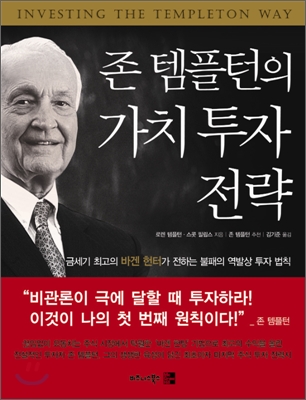
John Templeton's value investing strategy
 |
Description
Book Introduction
The Secret to Successful Investment from John Templeton, the 20th Century's Greatest Stock Investor
This is a guide to the investment strategies of John Templeton, who was selected as the best stock investor and value investor of the 20th century by Money Magazine in 1999.
This book is written by Lauren Templeton, John Templeton's great-granddaughter and successful hedge fund manager, who revealed his exceptional investment principles and strategies through in-depth interviews with John Templeton. In addition to the interviews with John Templeton, it also includes interviews with his family and a wealth of other materials only available to those in his family, revealing for the first time the investment secrets of John Templeton that made his legendary returns possible.
Each of the ten chapters in this book contains a core investment principle that John Templeton has adhered to throughout his life.
This book introduces how John Templeton applied his principles in his lifelong investment activities and how he achieved success in the process, presenting specific examples.
This book also provides readers with practical, detailed guidance on how to apply John Templeton's principles of successful investing to their own investment portfolios.
This book dramatically illustrates how John Templeton's most famous investment principle, "Invest when pessimism is at its peak," was developed, and how he identified such pessimistic moments and capitalized on the crisis to create enormous wealth through contrarian investments.
Through this book, you will encounter John Templeton's vivid voice, revealing his unique value investing strategy, characterized by "bargain hunting," and his investment principles and secrets, such as his global diversification strategy.
This is a guide to the investment strategies of John Templeton, who was selected as the best stock investor and value investor of the 20th century by Money Magazine in 1999.
This book is written by Lauren Templeton, John Templeton's great-granddaughter and successful hedge fund manager, who revealed his exceptional investment principles and strategies through in-depth interviews with John Templeton. In addition to the interviews with John Templeton, it also includes interviews with his family and a wealth of other materials only available to those in his family, revealing for the first time the investment secrets of John Templeton that made his legendary returns possible.
Each of the ten chapters in this book contains a core investment principle that John Templeton has adhered to throughout his life.
This book introduces how John Templeton applied his principles in his lifelong investment activities and how he achieved success in the process, presenting specific examples.
This book also provides readers with practical, detailed guidance on how to apply John Templeton's principles of successful investing to their own investment portfolios.
This book dramatically illustrates how John Templeton's most famous investment principle, "Invest when pessimism is at its peak," was developed, and how he identified such pessimistic moments and capitalized on the crisis to create enormous wealth through contrarian investments.
Through this book, you will encounter John Templeton's vivid voice, revealing his unique value investing strategy, characterized by "bargain hunting," and his investment principles and secrets, such as his global diversification strategy.
- You can preview some of the book's contents.
Preview
index
For Korean readers - The last investment advice from the great investor, John Templeton.
Recommended Reading: When pessimism reaches its peak, that's when to buy.
Chapter 1: The Birth of a Great Bargain Hunter
The childhood of the great investor, John Templeton
What Smart Investors Have in Common: Bargain Hunting
The beginning of a legendary investment
Be successful by doing beneficial work
There is no problem without a solution.
The gift of travel: a broad perspective that allows you to see the world.
Invest in stocks with the worst outlook
Poker and stock investing are games of chance.
When making important decisions, follow your intuition.
*John Templeton's value investing strategy
Chapter 2: Invest When You're Most Pessimistic
A company's stock price and its value are different.
The most unattractive stocks are the most attractive prey.
Make the most of the opportunities presented by 'emotional sellers'.
A look at the history of the stock market reveals the path to wise investment.
Buy when it rains, sell when the sun rises
Don't put all your eggs in one basket.
Seize the best opportunity to earn high returns
Stocks: When to Buy and When to Sell*
*John Templeton's value investing strategy
Chapter 3: The Global Era: Exploring Overseas Markets
To maximize diversification opportunities, look to overseas markets.
A fantastic combination of low-price buying and diversification strategies.
Take advantage of investment opportunities created by a lack of information.
Check if the current stock price is reasonable with the price-to-earnings ratio.
How to minimize investment risk
*John Templeton's value investing strategy
Chapter 4: Be the first to spot the rising sun
Look for investment opportunities when everyone else is negative.
For minimal investment, focus on undervalued stocks.
Find the hidden value of your company
Calculate the expected future earnings growth rate
Actively utilize comparative purchasing methods.
*John Templeton's value investing strategy
Chapter 5: Is the Stock Market Crashing or the Emergence of a Bull Market?*
'The Death of Stocks': A Dangerous Joke
Check stock performance rather than rumors.
Several Value Measures for Buying Cheap Stocks
Gain a reputation as a true value investor
*John Templeton's value investing strategy
Chapter 6: The Stock Market: A History of Madness
The history of the stock market repeats itself.
The dot-com bubble
Don't be quick to join the risky party of stock offerings.
Analysis of the appropriate timing for buying
*John Templeton's value investing strategy
Chapter 7: When to Buy Stocks*
When a sell-off occurs in the stock market, it's a buying opportunity.
Pay attention to the magic of compound interest
Maximize long-term returns
Take a gamble in a bear market
Effective Business Analysis Methods
Contrarian investing: Buy stocks that investors completely ignore.
*John Templeton's value investing strategy
Chapter 8: Learn the Rhythm of History
Asia's Miracle Faces Financial Crisis
Korea is the land of opportunity, seize the opportunity.
The Basics of Mutual Fund Investing
Pioneering the global market with low-price stock comparison buying.
*John Templeton's value investing strategy
Chapter 9: The Secret to Earning Profits with Bonds
Bonds, another investment product
Continuously seek out valuable products in the financial markets.
Buy bonds when stocks fall
How to maximize investment returns and minimize risks
*John Templeton's value investing strategy
Chapter 10: Conquering the New World: The Chinese Market
The sleeping dragon awakens
Indicators you must know before investing
Investing in China: Sticking to Your Principles as a Bargain Hunter
Stock selection criteria that work 100% in overseas markets
Forecast earnings per share for the next 10 years.
How to invest in stocks*
*John Templeton's value investing strategy
In closing this book
Search
Recommended Reading: When pessimism reaches its peak, that's when to buy.
Chapter 1: The Birth of a Great Bargain Hunter
The childhood of the great investor, John Templeton
What Smart Investors Have in Common: Bargain Hunting
The beginning of a legendary investment
Be successful by doing beneficial work
There is no problem without a solution.
The gift of travel: a broad perspective that allows you to see the world.
Invest in stocks with the worst outlook
Poker and stock investing are games of chance.
When making important decisions, follow your intuition.
*John Templeton's value investing strategy
Chapter 2: Invest When You're Most Pessimistic
A company's stock price and its value are different.
The most unattractive stocks are the most attractive prey.
Make the most of the opportunities presented by 'emotional sellers'.
A look at the history of the stock market reveals the path to wise investment.
Buy when it rains, sell when the sun rises
Don't put all your eggs in one basket.
Seize the best opportunity to earn high returns
Stocks: When to Buy and When to Sell*
*John Templeton's value investing strategy
Chapter 3: The Global Era: Exploring Overseas Markets
To maximize diversification opportunities, look to overseas markets.
A fantastic combination of low-price buying and diversification strategies.
Take advantage of investment opportunities created by a lack of information.
Check if the current stock price is reasonable with the price-to-earnings ratio.
How to minimize investment risk
*John Templeton's value investing strategy
Chapter 4: Be the first to spot the rising sun
Look for investment opportunities when everyone else is negative.
For minimal investment, focus on undervalued stocks.
Find the hidden value of your company
Calculate the expected future earnings growth rate
Actively utilize comparative purchasing methods.
*John Templeton's value investing strategy
Chapter 5: Is the Stock Market Crashing or the Emergence of a Bull Market?*
'The Death of Stocks': A Dangerous Joke
Check stock performance rather than rumors.
Several Value Measures for Buying Cheap Stocks
Gain a reputation as a true value investor
*John Templeton's value investing strategy
Chapter 6: The Stock Market: A History of Madness
The history of the stock market repeats itself.
The dot-com bubble
Don't be quick to join the risky party of stock offerings.
Analysis of the appropriate timing for buying
*John Templeton's value investing strategy
Chapter 7: When to Buy Stocks*
When a sell-off occurs in the stock market, it's a buying opportunity.
Pay attention to the magic of compound interest
Maximize long-term returns
Take a gamble in a bear market
Effective Business Analysis Methods
Contrarian investing: Buy stocks that investors completely ignore.
*John Templeton's value investing strategy
Chapter 8: Learn the Rhythm of History
Asia's Miracle Faces Financial Crisis
Korea is the land of opportunity, seize the opportunity.
The Basics of Mutual Fund Investing
Pioneering the global market with low-price stock comparison buying.
*John Templeton's value investing strategy
Chapter 9: The Secret to Earning Profits with Bonds
Bonds, another investment product
Continuously seek out valuable products in the financial markets.
Buy bonds when stocks fall
How to maximize investment returns and minimize risks
*John Templeton's value investing strategy
Chapter 10: Conquering the New World: The Chinese Market
The sleeping dragon awakens
Indicators you must know before investing
Investing in China: Sticking to Your Principles as a Bargain Hunter
Stock selection criteria that work 100% in overseas markets
Forecast earnings per share for the next 10 years.
How to invest in stocks*
*John Templeton's value investing strategy
In closing this book
Search
Into the book
'Invest when pessimism prevails' is my first investment rule.
In other words, the best investment opportunities are when pessimism reaches its peak.
This book outlines the various methods I use to identify when pessimistic moments are occurring in stocks, industries, and the national economy.
---p.10 (Recommendation)
Bull markets are born in pessimism, grow in skepticism, mature in optimism, and die in happiness.
The best time to buy is when you are most pessimistic, and the best time to sell is when you are most optimistic.
---p.11 (Recommendation)
John Templeton established the principle of paying everything in cash so as to be 'an interest-receiver, not an interest-payer', and he strictly adhered to it.
This was one of the important principles he tried to keep throughout his life.
---p.25 (Chapter 1: The Birth of a Great Bargain Hunter)
Do something that truly serves people.
That's success.
I enjoy giving investment advice.
And I enjoy helping others.
It gives you a pleasure that you can never get for thousands of dollars.
---p.29 (Chapter 1: The Birth of a Great Bargain Hunter)
John Templeton was able to achieve great results for decades thanks to the biases of other investors.
He never backed down when he felt he had an opportunity to exploit human ignorance and misunderstanding in the stock market.
---p.35 (Chapter 1: The Birth of a Great Bargain Hunter)
Investors always ask me, "What stocks have a good outlook?"
But this is the wrong question.
A better question would be, "What stock has the worst outlook?"
---p.38 (Chapter 1: The Birth of a Great Bargain Hunter)
The role of a bargain hunter is to actively seek the convenience of investors by buying stocks that investors are desperately trying to sell and selling stocks that investors are desperately trying to buy.
---p.60 (Chapter 2: Invest When You're Most Pessimistic)
The four most expensive words in the English language are 'this time it's different.'
---p.174 (Chapter 6: The Stock Market: A History of Madness)
During the Asian financial crisis, stock investors saw a "completely empty glass," while John Templeton saw a "glass waiting to be filled."
---p.246 (Chapter 8: Learn the Rhythm of History)
In an interview, when asked, "What country would you consider investing in after Japan?" John Templeton answered without hesitation, "Korea."
In other words, the best investment opportunities are when pessimism reaches its peak.
This book outlines the various methods I use to identify when pessimistic moments are occurring in stocks, industries, and the national economy.
---p.10 (Recommendation)
Bull markets are born in pessimism, grow in skepticism, mature in optimism, and die in happiness.
The best time to buy is when you are most pessimistic, and the best time to sell is when you are most optimistic.
---p.11 (Recommendation)
John Templeton established the principle of paying everything in cash so as to be 'an interest-receiver, not an interest-payer', and he strictly adhered to it.
This was one of the important principles he tried to keep throughout his life.
---p.25 (Chapter 1: The Birth of a Great Bargain Hunter)
Do something that truly serves people.
That's success.
I enjoy giving investment advice.
And I enjoy helping others.
It gives you a pleasure that you can never get for thousands of dollars.
---p.29 (Chapter 1: The Birth of a Great Bargain Hunter)
John Templeton was able to achieve great results for decades thanks to the biases of other investors.
He never backed down when he felt he had an opportunity to exploit human ignorance and misunderstanding in the stock market.
---p.35 (Chapter 1: The Birth of a Great Bargain Hunter)
Investors always ask me, "What stocks have a good outlook?"
But this is the wrong question.
A better question would be, "What stock has the worst outlook?"
---p.38 (Chapter 1: The Birth of a Great Bargain Hunter)
The role of a bargain hunter is to actively seek the convenience of investors by buying stocks that investors are desperately trying to sell and selling stocks that investors are desperately trying to buy.
---p.60 (Chapter 2: Invest When You're Most Pessimistic)
The four most expensive words in the English language are 'this time it's different.'
---p.174 (Chapter 6: The Stock Market: A History of Madness)
During the Asian financial crisis, stock investors saw a "completely empty glass," while John Templeton saw a "glass waiting to be filled."
---p.246 (Chapter 8: Learn the Rhythm of History)
In an interview, when asked, "What country would you consider investing in after Japan?" John Templeton answered without hesitation, "Korea."
---p.249 (Chapter 8: Learn the Rhythm of History)
Publisher's Review
The Unbeatable Contrarian Investment Rules of This Century's Greatest Bargain Hunter
Seize the best opportunities in a stock market rife with confusion and fear!
A stock investment textbook containing the investment secrets of John Templeton, the greatest stock investor of the 20th century.
The global financial crisis that began in the fall of 2008 froze the investment sentiment of investors around the world, including the United States and Korea.
Although financial crisis solutions are being announced one after another around the world, stock prices are only falling towards the bottom and show no signs of rebounding.
As the year began in early 2009, investment experts' investment outlooks were mixed, but most predicted that the bear rally would continue at least until the first half of 2009.
Some people said, “Seize the opportunity in a bear market!” and ended up getting hurt by the media and angry public sentiment.
The investment market is now in chaos and fear.
I'm caught in a situation where I can't see even an inch ahead.
In times like these, investors' concerns are especially great.
I am wavering and unsure whether I should turn the crisis into an opportunity or wait and see when the time comes and move along with others.
That's why they say, "Even if it's been torn in half, there's a 'hard work' trend in real estate, stocks, and bookstores."
Looking back, now is the perfect time for investors to learn and master the right investment philosophy and principles.
The new book, "John Templeton's Value Investing Strategy - The Unbeatable Contrarian Investment Laws from the Greatest Bargain Hunter of the Century," is a welcome read for these readers.
Sir John Templeton was named the greatest stock investor of the 20th century by Money Magazine in 1999.
John Templeton, who is called the best value investor along with Benjamin Graham, Peter Lynch, and Warren Buffett, who are called the pioneers of value investing, is better known to us as the 'investor of the soul.'
Most of his books published in Korea also focus on John Templeton as a successful role model with a great personality, rather than as an investor.
For that reason, it is true that his appearance as a top investor and his investment secrets are not well known to the general public.
However, the new book, "John Templeton's Value Investing Strategy," contains a detailed account of investor John Templeton's investment history, investment principles, and investment methodology.
This is because it contains the secret recipe he revealed through an interview with his granddaughter.
Also, the new book, "John Templeton's Value Investing Strategy," offers a fascinating look into how John Templeton's investment principles, which most investors are familiar with, such as "Invest when pessimism is at its peak" and "Bull markets are born in pessimism, grow in skepticism, mature in optimism, and die in happiness," were created and applied to actual investments.
The new book, "John Templeton's Value Investing Strategy," is a textbook on investment that serves as a model for all investors seeking opportunities in the frozen investment market, as it teaches, above all, that stocks are investments, not speculation, and that successful investments are based on continuous research.
Successful Investment Strategies You Must Know When Pessimism Rises
“I think the Korean stock market has almost reached the bottom.
“I have always tried to buy stocks at the most pessimistic point, and I believe the Korean stock market has reached that point now.” (p. 258, from ‘Chapter 8: Master the Rhythm of History’)
This is what John Templeton said in an article published in the Wall Street Journal in January 1998.
When the Korean stock market plummeted due to the foreign exchange crisis and many investors were fleeing the market like fleeing a burning house, John Templeton began preparing to buy Korean stocks whose prices had fallen drastically.
John Templeton invested in the Korean stock market through a mutual fund called 'Matthews Korea Fund' and succeeded in increasing the fund's investment by 267% in just two years.
Korea is only a small part of John Templeton's successful investment story of investing during the most pessimistic times and achieving the highest returns.
His remarkable returns during the Great Depression, World War II, and the 1997 Asian financial crisis made him "the greatest investor of the century" and a "Wall Street legend."
The first and last stock investment strategy book, featuring the vivid voice of legendary bargain hunter John Templeton.
“Sir John Templeton, the ‘Legend of Wall Street,’ passed away recently on July 8, 2008.
“One of the goals of writing this book is to preserve the value investing strategies and teachings he has demonstrated over the past 50 years and to share them with all investors.” (p. 6 from ‘To Korean Readers’)
John Templeton, who passed away on July 8, 2008, at the age of 95, was respected by investors for his honest and frugal life.
He has been diligent since his youth, saving half of his income and working 80 hours a week.
He is also famous for donating over $1 billion of his fortune to society, yet leaving nothing to his children.
He created the Templeton Prize, often called the Nobel Prize for religion and service, in 1972, and in 1987, he founded the John Templeton Foundation, donating all of his wealth to society by supporting research in various fields such as physics, space science, biology, and social science.
On Wall Street, he is revered as a 'spiritual investor'.
John Templeton published several books during his lifetime, but he never wrote a book that fully discussed his investment strategies and secrets.
This book is written by Lauren Templeton, John Templeton's great-granddaughter and successful hedge fund manager, who reveals his exceptional investment principles and strategies through in-depth interviews with John Templeton.
In this book, the author reveals for the first time the investment secrets of John Templeton, which made his legendary returns possible, based on interviews with his family and a wealth of information only available to those in his family.
Therefore, this book is the first and last work to summarize John Templeton's investment principles and secrets, such as his unique value investment strategy, which can be characterized as "bargain hunting," and his global diversification investment strategy, through the vivid voice of John Templeton.
Make the most of your investment in the volatile Korean stock market in 2009 with Templeton-style investing!
Each of the ten chapters in this book contains a core investment principle he has adhered to throughout his life.
This book presents specific examples of how John Templeton applied his principles in his lifelong investment activities and achieved success in the process.
This book also provides readers with practical, detailed guidance on how to apply John Templeton's successful investing principles to their own investment portfolios.
This book dramatically illustrates how John Templeton's most famous investment principle, "Invest when pessimism is at its peak," was developed, and how he identified such pessimistic moments and capitalized on the crisis to create enormous wealth through contrarian investments.
"Invest when pessimism is at its peak" - A buy-the-low strategy for maximum returns.
"It takes mental fortitude to buy when other investors are discouraged and sell when they are greedy.
Only when you can do that can you make huge profits."
(p.11 from 'Recommendation')
One of John Templeton's core investment strategies is 'bargain hunting', or buying low.
It is the best strategy to maximize returns.
John Templeton's use of low-price trading is a little different from the usual one.
The low price he was talking about was selling at a discount of about 80 percent of the actual value.
This means that it will soon be sold at 20 percent of its actual value.
Throughout his life, John Templeton diligently navigated stock markets around the world, buying stocks at prices drastically undervalued relative to their corporate value.
“There is only one reason why stocks are sold at low prices.
That's because investors are selling their stocks.
There is no other reason.
Therefore, only when investors become pessimistic can they buy stocks at low prices.” (p.10, from ‘Recommended Articles’)
John Templeton believed that the opportunity to "bargain hunt"—to buy quality stocks at significantly lower prices—occurs only when pessimism reaches its peak.
The imminent stock market crash presents a significant opportunity for bargain hunters, one that comes only two or three times a decade.
He was able to make a lot of money by taking advantage of the mistakes investors made due to greed and fear in the rhythm of stock market bubbles and crashes that have been repeated throughout history.
"Diversify your investments to minimize risk" - A diversified investment strategy to minimize investment risk.
"John Templeton diversified his risk by buying stocks in many different categories.
John Templeton knew a lot about probability.
And he talked about his ideas about investing almost entirely based on probability." (p.74 from 'Chapter 2: Invest When You're Most Pessimistic')
This book contains an interesting episode about John Templeton and poker.
John Templeton, who first learned poker at the age of eight, showed a natural talent for poker and is said to have paid 25 percent of his tuition at Yale University by playing poker.
John Templeton believed that stock investing, like poker, was a matter of probability and made investments based on probability.
Therefore, a diversified investment strategy was essential to reduce investment risk and increase the probability of success.
This book presents various examples of how John Templeton made huge profits by bargain hunting for low-priced stocks based on probability.
One example is the investment case in the U.S. stock market at the outbreak of World War II.
In 1939, when World War II broke out, the U.S. stock market was very unstable.
The economy appeared to be reverting to the Great Depression, and stock prices plummeted 49 percent in just 12 months.
At that time, John Templeton was convinced that the United States would enter the war and that stock prices would rebound due to the revitalization of the military industry, so he started buying cheap American stocks.
He borrowed $10,000 and bought stock in 104 companies that were trading for less than $1.
Among them, 37 companies were in bankruptcy.
But three years later, he surprised Wall Street again by generating massive investment returns from 100 companies, excluding four stocks.
"Turn your eyes to overseas markets" - Investing in overseas stocks for true bargain hunting.
"If you find a place to invest in the global stock market, your chances of long-term success are much higher.
“The wider the range of choices, the easier it is to find stocks with high returns.”
(p.88 from Chapter 3, "The Global Era: Exploring Overseas Markets")
John Templeton, who had gained extensive experience through overseas travel since childhood, considered the fact that stock investment was limited to domestic investment at the time to be a short-sighted way of thinking and was the first to look overseas.
To increase the probability of finding low-priced stocks, we need to target global stock markets, and to minimize the investment list, we believe that diversifying investments into overseas stocks is necessary.
One example of a country that made a lot of money through overseas stock investment is Japan.
Until two decades after the end of World War II, most Americans had no idea that Japan would emerge as a major global economic power.
But John Templeton anticipated this and began investing in the Japanese stock market in the 1950s, just after the end of World War II.
There were two reasons why investors avoided investing in Japanese stocks at the time.
The concerns were that stock price fluctuations were too extreme and that there was a lack of information about the Japanese stock market.
But these two factors were the basic conditions that John Templeton sought to find cheap stocks in the global market.
He invested in Japanese stocks, which were completely neglected, and in the 30 years since he invested in Japanese stocks, the Japanese stock market index has risen 36-fold.
He played the role of bargain hunter faithfully, making huge profits in the Japanese stock market and then withdrawing most of his investment before the market peaked in the late 1980s and moving into other low-priced stocks.
Seize the best opportunities in a stock market rife with confusion and fear!
A stock investment textbook containing the investment secrets of John Templeton, the greatest stock investor of the 20th century.
The global financial crisis that began in the fall of 2008 froze the investment sentiment of investors around the world, including the United States and Korea.
Although financial crisis solutions are being announced one after another around the world, stock prices are only falling towards the bottom and show no signs of rebounding.
As the year began in early 2009, investment experts' investment outlooks were mixed, but most predicted that the bear rally would continue at least until the first half of 2009.
Some people said, “Seize the opportunity in a bear market!” and ended up getting hurt by the media and angry public sentiment.
The investment market is now in chaos and fear.
I'm caught in a situation where I can't see even an inch ahead.
In times like these, investors' concerns are especially great.
I am wavering and unsure whether I should turn the crisis into an opportunity or wait and see when the time comes and move along with others.
That's why they say, "Even if it's been torn in half, there's a 'hard work' trend in real estate, stocks, and bookstores."
Looking back, now is the perfect time for investors to learn and master the right investment philosophy and principles.
The new book, "John Templeton's Value Investing Strategy - The Unbeatable Contrarian Investment Laws from the Greatest Bargain Hunter of the Century," is a welcome read for these readers.
Sir John Templeton was named the greatest stock investor of the 20th century by Money Magazine in 1999.
John Templeton, who is called the best value investor along with Benjamin Graham, Peter Lynch, and Warren Buffett, who are called the pioneers of value investing, is better known to us as the 'investor of the soul.'
Most of his books published in Korea also focus on John Templeton as a successful role model with a great personality, rather than as an investor.
For that reason, it is true that his appearance as a top investor and his investment secrets are not well known to the general public.
However, the new book, "John Templeton's Value Investing Strategy," contains a detailed account of investor John Templeton's investment history, investment principles, and investment methodology.
This is because it contains the secret recipe he revealed through an interview with his granddaughter.
Also, the new book, "John Templeton's Value Investing Strategy," offers a fascinating look into how John Templeton's investment principles, which most investors are familiar with, such as "Invest when pessimism is at its peak" and "Bull markets are born in pessimism, grow in skepticism, mature in optimism, and die in happiness," were created and applied to actual investments.
The new book, "John Templeton's Value Investing Strategy," is a textbook on investment that serves as a model for all investors seeking opportunities in the frozen investment market, as it teaches, above all, that stocks are investments, not speculation, and that successful investments are based on continuous research.
Successful Investment Strategies You Must Know When Pessimism Rises
“I think the Korean stock market has almost reached the bottom.
“I have always tried to buy stocks at the most pessimistic point, and I believe the Korean stock market has reached that point now.” (p. 258, from ‘Chapter 8: Master the Rhythm of History’)
This is what John Templeton said in an article published in the Wall Street Journal in January 1998.
When the Korean stock market plummeted due to the foreign exchange crisis and many investors were fleeing the market like fleeing a burning house, John Templeton began preparing to buy Korean stocks whose prices had fallen drastically.
John Templeton invested in the Korean stock market through a mutual fund called 'Matthews Korea Fund' and succeeded in increasing the fund's investment by 267% in just two years.
Korea is only a small part of John Templeton's successful investment story of investing during the most pessimistic times and achieving the highest returns.
His remarkable returns during the Great Depression, World War II, and the 1997 Asian financial crisis made him "the greatest investor of the century" and a "Wall Street legend."
The first and last stock investment strategy book, featuring the vivid voice of legendary bargain hunter John Templeton.
“Sir John Templeton, the ‘Legend of Wall Street,’ passed away recently on July 8, 2008.
“One of the goals of writing this book is to preserve the value investing strategies and teachings he has demonstrated over the past 50 years and to share them with all investors.” (p. 6 from ‘To Korean Readers’)
John Templeton, who passed away on July 8, 2008, at the age of 95, was respected by investors for his honest and frugal life.
He has been diligent since his youth, saving half of his income and working 80 hours a week.
He is also famous for donating over $1 billion of his fortune to society, yet leaving nothing to his children.
He created the Templeton Prize, often called the Nobel Prize for religion and service, in 1972, and in 1987, he founded the John Templeton Foundation, donating all of his wealth to society by supporting research in various fields such as physics, space science, biology, and social science.
On Wall Street, he is revered as a 'spiritual investor'.
John Templeton published several books during his lifetime, but he never wrote a book that fully discussed his investment strategies and secrets.
This book is written by Lauren Templeton, John Templeton's great-granddaughter and successful hedge fund manager, who reveals his exceptional investment principles and strategies through in-depth interviews with John Templeton.
In this book, the author reveals for the first time the investment secrets of John Templeton, which made his legendary returns possible, based on interviews with his family and a wealth of information only available to those in his family.
Therefore, this book is the first and last work to summarize John Templeton's investment principles and secrets, such as his unique value investment strategy, which can be characterized as "bargain hunting," and his global diversification investment strategy, through the vivid voice of John Templeton.
Make the most of your investment in the volatile Korean stock market in 2009 with Templeton-style investing!
Each of the ten chapters in this book contains a core investment principle he has adhered to throughout his life.
This book presents specific examples of how John Templeton applied his principles in his lifelong investment activities and achieved success in the process.
This book also provides readers with practical, detailed guidance on how to apply John Templeton's successful investing principles to their own investment portfolios.
This book dramatically illustrates how John Templeton's most famous investment principle, "Invest when pessimism is at its peak," was developed, and how he identified such pessimistic moments and capitalized on the crisis to create enormous wealth through contrarian investments.
"Invest when pessimism is at its peak" - A buy-the-low strategy for maximum returns.
"It takes mental fortitude to buy when other investors are discouraged and sell when they are greedy.
Only when you can do that can you make huge profits."
(p.11 from 'Recommendation')
One of John Templeton's core investment strategies is 'bargain hunting', or buying low.
It is the best strategy to maximize returns.
John Templeton's use of low-price trading is a little different from the usual one.
The low price he was talking about was selling at a discount of about 80 percent of the actual value.
This means that it will soon be sold at 20 percent of its actual value.
Throughout his life, John Templeton diligently navigated stock markets around the world, buying stocks at prices drastically undervalued relative to their corporate value.
“There is only one reason why stocks are sold at low prices.
That's because investors are selling their stocks.
There is no other reason.
Therefore, only when investors become pessimistic can they buy stocks at low prices.” (p.10, from ‘Recommended Articles’)
John Templeton believed that the opportunity to "bargain hunt"—to buy quality stocks at significantly lower prices—occurs only when pessimism reaches its peak.
The imminent stock market crash presents a significant opportunity for bargain hunters, one that comes only two or three times a decade.
He was able to make a lot of money by taking advantage of the mistakes investors made due to greed and fear in the rhythm of stock market bubbles and crashes that have been repeated throughout history.
"Diversify your investments to minimize risk" - A diversified investment strategy to minimize investment risk.
"John Templeton diversified his risk by buying stocks in many different categories.
John Templeton knew a lot about probability.
And he talked about his ideas about investing almost entirely based on probability." (p.74 from 'Chapter 2: Invest When You're Most Pessimistic')
This book contains an interesting episode about John Templeton and poker.
John Templeton, who first learned poker at the age of eight, showed a natural talent for poker and is said to have paid 25 percent of his tuition at Yale University by playing poker.
John Templeton believed that stock investing, like poker, was a matter of probability and made investments based on probability.
Therefore, a diversified investment strategy was essential to reduce investment risk and increase the probability of success.
This book presents various examples of how John Templeton made huge profits by bargain hunting for low-priced stocks based on probability.
One example is the investment case in the U.S. stock market at the outbreak of World War II.
In 1939, when World War II broke out, the U.S. stock market was very unstable.
The economy appeared to be reverting to the Great Depression, and stock prices plummeted 49 percent in just 12 months.
At that time, John Templeton was convinced that the United States would enter the war and that stock prices would rebound due to the revitalization of the military industry, so he started buying cheap American stocks.
He borrowed $10,000 and bought stock in 104 companies that were trading for less than $1.
Among them, 37 companies were in bankruptcy.
But three years later, he surprised Wall Street again by generating massive investment returns from 100 companies, excluding four stocks.
"Turn your eyes to overseas markets" - Investing in overseas stocks for true bargain hunting.
"If you find a place to invest in the global stock market, your chances of long-term success are much higher.
“The wider the range of choices, the easier it is to find stocks with high returns.”
(p.88 from Chapter 3, "The Global Era: Exploring Overseas Markets")
John Templeton, who had gained extensive experience through overseas travel since childhood, considered the fact that stock investment was limited to domestic investment at the time to be a short-sighted way of thinking and was the first to look overseas.
To increase the probability of finding low-priced stocks, we need to target global stock markets, and to minimize the investment list, we believe that diversifying investments into overseas stocks is necessary.
One example of a country that made a lot of money through overseas stock investment is Japan.
Until two decades after the end of World War II, most Americans had no idea that Japan would emerge as a major global economic power.
But John Templeton anticipated this and began investing in the Japanese stock market in the 1950s, just after the end of World War II.
There were two reasons why investors avoided investing in Japanese stocks at the time.
The concerns were that stock price fluctuations were too extreme and that there was a lack of information about the Japanese stock market.
But these two factors were the basic conditions that John Templeton sought to find cheap stocks in the global market.
He invested in Japanese stocks, which were completely neglected, and in the 30 years since he invested in Japanese stocks, the Japanese stock market index has risen 36-fold.
He played the role of bargain hunter faithfully, making huge profits in the Japanese stock market and then withdrawing most of his investment before the market peaked in the late 1980s and moving into other low-priced stocks.
GOODS SPECIFICS
- Date of issue: January 15, 2009
- Page count, weight, size: 332 pages | 566g | 172*224*30mm
- ISBN13: 9788991204478
- ISBN10: 8991204473
You may also like
카테고리
korean


korean

![ELLE 엘르 스페셜 에디션 A형 : 12월 [2025]](http://librairie.coreenne.fr/cdn/shop/files/b8e27a3de6c9538896439686c6b0e8fb.jpg?v=1766436872&width=3840)


