

Blink
 |
Description
Book Introduction
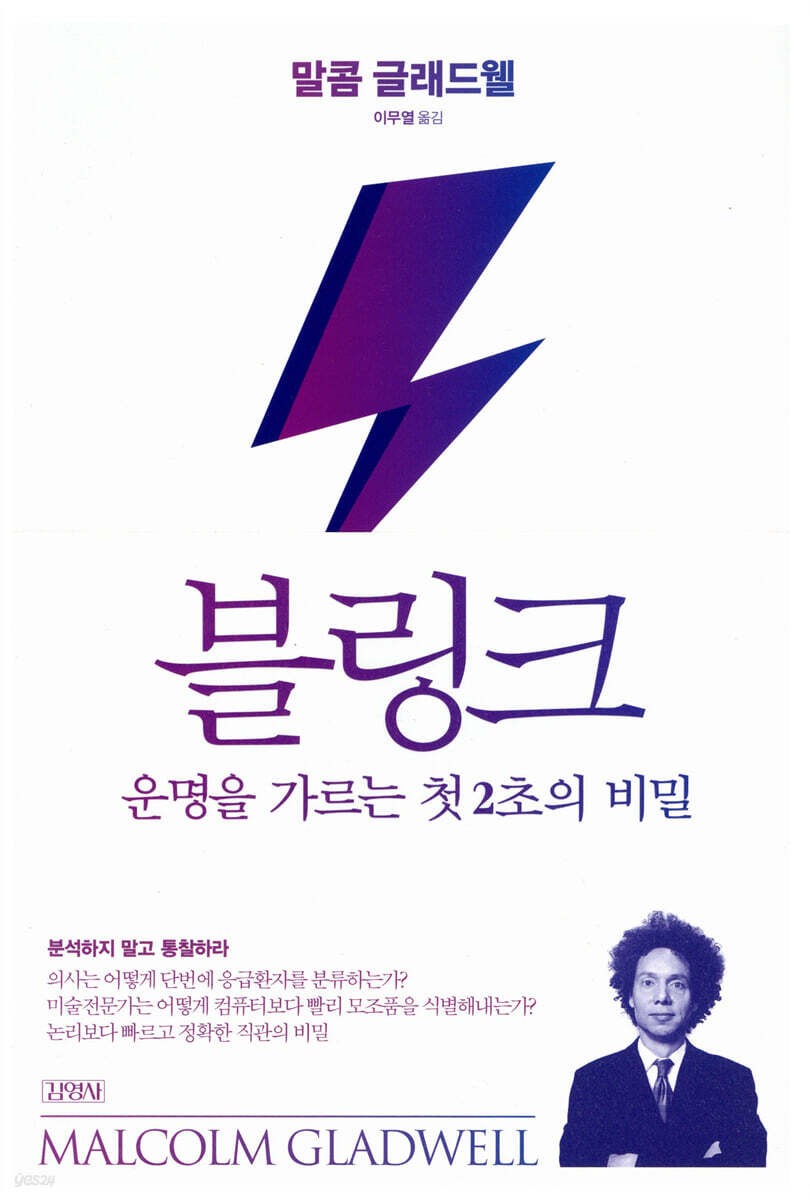
Malcolm Gladwell's book, Blink, which launched him into the ranks of world-renowned authors, has been republished.
Fifteen years after its initial publication, the amount of information available has increased beyond comparison, and data analysis is now considered essential for decision-making.
In the age of big data, does the value of insight still hold true? "Blink" revisits this question.
A judgment made in the first two seconds can be more accurate than months of meticulous scientific analysis.
The art of judgment learned from people like firefighters, doctors, and salesmen who changed their fates with a split-second choice.
How to develop insight that allows you to see through a handful of information.
The miracle of the first two seconds that changes your destiny.
Fifteen years after its initial publication, the amount of information available has increased beyond comparison, and data analysis is now considered essential for decision-making.
In the age of big data, does the value of insight still hold true? "Blink" revisits this question.
A judgment made in the first two seconds can be more accurate than months of meticulous scientific analysis.
The art of judgment learned from people like firefighters, doctors, and salesmen who changed their fates with a split-second choice.
How to develop insight that allows you to see through a handful of information.
The miracle of the first two seconds that changes your destiny.
- You can preview some of the book's contents.
Preview
index
Preface: A Suspicious-Looking Statue
Chapter 1.
Observing in Thin Pieces: How to See a Thousand Miles with a Single Piece of Knowledge
Chapter 2.
The Locked Door: The Subconscious Secret of Snap-Shot Decisions
Chapter 3.
Warren Harding's Fallacy: Why We Fall for Tall, Handsome Men
Chapter 4.
Paul Van Riefer's Triumph: How to Create Structures for the Emergence of Improvisation
Chapter 5.
Kenner's Dilemma: The Right and Wrong Ways to Ask What People Want
Chapter 6.
Seven Seconds in the Bronx: The Subtle Art of Mindreading
Chapter 7.
Listening with Your Eyes: Lessons from "Capturing the Moment"
Review: Understanding, not knowledge, is what's needed.
Discussion Topics
Acknowledgements
main
Search
Recommendation
Chapter 1.
Observing in Thin Pieces: How to See a Thousand Miles with a Single Piece of Knowledge
Chapter 2.
The Locked Door: The Subconscious Secret of Snap-Shot Decisions
Chapter 3.
Warren Harding's Fallacy: Why We Fall for Tall, Handsome Men
Chapter 4.
Paul Van Riefer's Triumph: How to Create Structures for the Emergence of Improvisation
Chapter 5.
Kenner's Dilemma: The Right and Wrong Ways to Ask What People Want
Chapter 6.
Seven Seconds in the Bronx: The Subtle Art of Mindreading
Chapter 7.
Listening with Your Eyes: Lessons from "Capturing the Moment"
Review: Understanding, not knowledge, is what's needed.
Discussion Topics
Acknowledgements
main
Search
Recommendation
Detailed image

Into the book
How long did you initially hold this book in your hands? Two seconds? Yet, in that brief moment, the cover design, the associations you might have had with my name, and the first few sentences of the statue's story all combined to create a single impression—a wave of thoughts, images, and expectations—that formed the foundation for your current attitude as you read this preface.
Aren't you curious what happened in those two seconds?
--- p.20
'Slicing thin' is not a special talent.
It is one of the essential abilities we must possess to be human.
Whenever we meet new people, need to quickly grasp something, or encounter a new situation, we observe it in thin slices.
It is cut into thin slices as needed.
We rely on that ability because there are so many hidden 'handwritings' out there, and there are many situations where we can gain enormously by paying careful attention to even the smallest detail of a very thin slice for just a second or two.
--- p.58
Thin-slicing and taking first impressions seriously means accepting that we sometimes learn more about someone or something in the blink of an eye than we could in months of study.
But at the same time, we must acknowledge and understand that there are situations where rapid perception can lead us astray.
--- p.101
Extra information is more than just useless.
It is rather harmful.
It just makes things more confusing.
Doctors who try to predict heart attacks often fail because they take too much information into account.
--- p.173
Gottman broke down complex problems into very simple elements.
He showed that even the most complex relationships and problems have identifiable underlying patterns.
Goldman's research demonstrated that less is more when extracting these types of patterns.
It shows that giving decision makers too much information makes it harder, not easier, to discern signals.
To become a decision maker who produces good results, you need to do some editing.
--- p.177
Too often we tolerate things that happen in the blink of an eye.
It seems we have little ability to control what rises to the surface from our unconscious.
But we have the ability to do so, and if we can control the environment in which rapid perception occurs, we can control rapid perception.
It can prevent people fighting wars, staffing emergency rooms, or maintaining order on the streets from making mistakes.
--- p.313
I've found countless instances where, when making a decision that isn't particularly important, it's better to consider all the arguments for and against.
But it's clear that decisions as important as choosing a partner or a career come from somewhere within us, from the subconscious.
I believe that when it comes to making important decisions in life, we are undoubtedly governed by our own nature or deep inner desires.
--- p.331
Sometimes, less information can lead to better decisions.
I don't think there's any reason why a defendant in a criminal trial should necessarily be present in court.
The defendant should be able to answer questions via email or through an intermediary from another room.
And any trial evidence or testimony that could bias the jury based on the defendant's age, race, or gender should be edited out and removed.
Aren't you curious what happened in those two seconds?
--- p.20
'Slicing thin' is not a special talent.
It is one of the essential abilities we must possess to be human.
Whenever we meet new people, need to quickly grasp something, or encounter a new situation, we observe it in thin slices.
It is cut into thin slices as needed.
We rely on that ability because there are so many hidden 'handwritings' out there, and there are many situations where we can gain enormously by paying careful attention to even the smallest detail of a very thin slice for just a second or two.
--- p.58
Thin-slicing and taking first impressions seriously means accepting that we sometimes learn more about someone or something in the blink of an eye than we could in months of study.
But at the same time, we must acknowledge and understand that there are situations where rapid perception can lead us astray.
--- p.101
Extra information is more than just useless.
It is rather harmful.
It just makes things more confusing.
Doctors who try to predict heart attacks often fail because they take too much information into account.
--- p.173
Gottman broke down complex problems into very simple elements.
He showed that even the most complex relationships and problems have identifiable underlying patterns.
Goldman's research demonstrated that less is more when extracting these types of patterns.
It shows that giving decision makers too much information makes it harder, not easier, to discern signals.
To become a decision maker who produces good results, you need to do some editing.
--- p.177
Too often we tolerate things that happen in the blink of an eye.
It seems we have little ability to control what rises to the surface from our unconscious.
But we have the ability to do so, and if we can control the environment in which rapid perception occurs, we can control rapid perception.
It can prevent people fighting wars, staffing emergency rooms, or maintaining order on the streets from making mistakes.
--- p.313
I've found countless instances where, when making a decision that isn't particularly important, it's better to consider all the arguments for and against.
But it's clear that decisions as important as choosing a partner or a career come from somewhere within us, from the subconscious.
I believe that when it comes to making important decisions in life, we are undoubtedly governed by our own nature or deep inner desires.
--- p.331
Sometimes, less information can lead to better decisions.
I don't think there's any reason why a defendant in a criminal trial should necessarily be present in court.
The defendant should be able to answer questions via email or through an intermediary from another room.
And any trial evidence or testimony that could bias the jury based on the defendant's age, race, or gender should be edited out and removed.
--- p.340
Publisher's Review
A world-renowned business writer whose every published book has been a New York Times bestseller.
Malcolm Gladwell's "Blink" 2020 Edition Released
The first two seconds of your choice determine your fate.
Don't analyze, be insightful
The secret to first-second judgment and intuition, which is faster and more accurate than logic, is even more crucial in the era of big data.
Malcolm Gladwell's book, Blink, which launched him into the ranks of world-renowned authors, has been republished.
In an age that emphasizes more information and more meticulous analysis, this book emphasizes the importance of intuition and insight, becoming a worldwide bestseller and considered a business classic.
The amount of information has grown beyond compare, and data analysis is now considered essential in every area, from strategic planning to marketing.
The status of information is higher than ever, to the point where securing data can determine the survival of a company.
However, more information does not necessarily lead to wiser decisions, whether for individuals or groups.
Those who accurately predicted the 2008 financial crisis were those who trusted their intuition more than the reports of credit rating agencies.
Malcolm Gladwell's words, "When things start to get complicated, unconscious thinking can be better," are therefore even more timely today.
Sometimes, when you meet new people or make important decisions, a certain feeling suddenly comes to mind.
We call it 'feeling'.
In this ultra-fast era where a split second or two of judgment can determine one's fate, accurate and quick decision-making skills are essential.
Especially for leaders who make a lot of decisions, there is less time to reflect and more responsibility for those decisions.
How can we improve the quality of our decision-making? How can we see the essence at a glance?
"Blink" shows the process of split-second judgment that occurs in the unconscious, and reveals that the first two seconds of judgment can be more accurate than months of careful analysis.
According to him, intuition is a signal sent by the brain based on accumulated experience and knowledge.
The more serious and complex the problem, the more experts follow their instincts rather than theoretical analysis.
This book tells the stories of people like firefighters, doctors, and salespeople who solved problems with spur-of-the-moment decisions, and explains how to develop intuition and when to trust or be wary of it.
Cut into thin slices and observe
How to see the whole picture with one piece of information
We tend to believe that considering more factors will lead to better decisions.
However, detailed analysis does not necessarily lead to good decisions.
The Getty Museum used cutting-edge technology to analyze the art statue for 14 months before concluding it was authentic, but experts were able to tell it was a fake in just two seconds.
John Gottman also observed a couple's conversation for just 15 minutes and could predict with 90% accuracy whether they would divorce 15 years later.
How is this possible?
This book introduces the secret of 'observing by cutting it into thin slices'.
'Thin slice observation' is a technique for identifying only the core information that is useful for judgment among a large amount of information.
It's about filtering out unnecessary information and focusing on one or two factors that have a decisive impact on the outcome.
In John Gottman's case, he observes only one thing in a couple's conversation: whether there is an attitude of contempt in either of them.
‘Observing by cutting into thin slices’ is a task that is done unconsciously.
When we repeat an experience, our unconscious mind identifies a series of patterns and then identifies key pieces of information.
This area of the brain, called the "adaptive unconscious," is like a giant computer that processes large amounts of data quickly and quietly.
This ability is not something that only a lucky few are born with, but something that everyone possesses.
We use this area whenever we first meet someone, when we're interviewing someone, when we're reacting to a new idea, or when we're making quick decisions in an emergency situation.
Beware of irrelevant information and bias.
Why Errors in Momentary Judgment Occur
But we know that intuition isn't always accurate.
You may have had the experience of following your gut and then suffering a setback.
So when should we follow our intuition and when should we be cautious? The author points out two causes of errors in momentary judgment that we must be wary of.
The first is prejudice.
Everyone has unconscious biases.
We often make assumptions about what kind of person someone is based on their clothing, speech, appearance, or where they are from.
This book refers to this human characteristic as the 'Warren Harding Fallacy'.
Warren Harding, the 29th President of the United States, was elected simply because he looked like a president.
However, he died suddenly two years later and is remembered as the worst president in American history.
In classical music, the introduction of blind auditions led to a rapid increase in the number of women and people of color in orchestras.
Unconscious biases about the gender or race of instrumentalists have clouded conductors' judgment.
Second, it is unnecessary information.
The perception that more information leads to better insights has become even stronger in today's big data era.
However, the book argues that in an emergency, more information can be harmful.
Cook County Hospital has struggled to identify whether patients complaining of chest pain are having a heart attack.
However, after reducing the checklist to just three items, the accuracy of identifying heart attack patients increased to more than 95%.
In situations where quick decisions are crucial, more information can actually be detrimental.
To be a good decision maker, you need to edit and simplify information.
Gain experience and knowledge that will help you make decisions.
How to develop snap judgment skills
Even if you have a lot of information, it is useless if you cannot distinguish meaningful signals from it.
“The key to good decision-making is not knowledge, but understanding.
We are swimming in knowledge.
“Understanding is hopelessly lacking.” The tennis coach who can tell if a player will double fault before he even hits the ball, the manager of the rock band U2 who recognizes the potential of an unknown singer the moment he hears him sing, the police officer who doesn’t shoot a gang member are all products of repeated experience and accumulated knowledge in similar situations.
To be able to act instinctively and intelligently at any given moment requires a long and rigorous training process.
The important thing is that we can consciously train and develop our intuition.
“In this book you will meet doctors, generals, coaches, furniture designers, musicians, actors, car salesmen, and many others.
“They are highly competent at what they do, and they all attribute much of their success to the fact that they have meticulously refined, managed, and educated their own unconscious responses, step by step.”
"What would happen if we took our instincts seriously? It would change how we fight wars, what we see on shelves, the kinds of movies we make, how police officers are trained, how couples counseling works, how job interviews work—everything.
And I think if we all weave these little changes together, we'll eventually create a different, better world."
Malcolm Gladwell's "Blink" 2020 Edition Released
The first two seconds of your choice determine your fate.
Don't analyze, be insightful
The secret to first-second judgment and intuition, which is faster and more accurate than logic, is even more crucial in the era of big data.
Malcolm Gladwell's book, Blink, which launched him into the ranks of world-renowned authors, has been republished.
In an age that emphasizes more information and more meticulous analysis, this book emphasizes the importance of intuition and insight, becoming a worldwide bestseller and considered a business classic.
The amount of information has grown beyond compare, and data analysis is now considered essential in every area, from strategic planning to marketing.
The status of information is higher than ever, to the point where securing data can determine the survival of a company.
However, more information does not necessarily lead to wiser decisions, whether for individuals or groups.
Those who accurately predicted the 2008 financial crisis were those who trusted their intuition more than the reports of credit rating agencies.
Malcolm Gladwell's words, "When things start to get complicated, unconscious thinking can be better," are therefore even more timely today.
Sometimes, when you meet new people or make important decisions, a certain feeling suddenly comes to mind.
We call it 'feeling'.
In this ultra-fast era where a split second or two of judgment can determine one's fate, accurate and quick decision-making skills are essential.
Especially for leaders who make a lot of decisions, there is less time to reflect and more responsibility for those decisions.
How can we improve the quality of our decision-making? How can we see the essence at a glance?
"Blink" shows the process of split-second judgment that occurs in the unconscious, and reveals that the first two seconds of judgment can be more accurate than months of careful analysis.
According to him, intuition is a signal sent by the brain based on accumulated experience and knowledge.
The more serious and complex the problem, the more experts follow their instincts rather than theoretical analysis.
This book tells the stories of people like firefighters, doctors, and salespeople who solved problems with spur-of-the-moment decisions, and explains how to develop intuition and when to trust or be wary of it.
Cut into thin slices and observe
How to see the whole picture with one piece of information
We tend to believe that considering more factors will lead to better decisions.
However, detailed analysis does not necessarily lead to good decisions.
The Getty Museum used cutting-edge technology to analyze the art statue for 14 months before concluding it was authentic, but experts were able to tell it was a fake in just two seconds.
John Gottman also observed a couple's conversation for just 15 minutes and could predict with 90% accuracy whether they would divorce 15 years later.
How is this possible?
This book introduces the secret of 'observing by cutting it into thin slices'.
'Thin slice observation' is a technique for identifying only the core information that is useful for judgment among a large amount of information.
It's about filtering out unnecessary information and focusing on one or two factors that have a decisive impact on the outcome.
In John Gottman's case, he observes only one thing in a couple's conversation: whether there is an attitude of contempt in either of them.
‘Observing by cutting into thin slices’ is a task that is done unconsciously.
When we repeat an experience, our unconscious mind identifies a series of patterns and then identifies key pieces of information.
This area of the brain, called the "adaptive unconscious," is like a giant computer that processes large amounts of data quickly and quietly.
This ability is not something that only a lucky few are born with, but something that everyone possesses.
We use this area whenever we first meet someone, when we're interviewing someone, when we're reacting to a new idea, or when we're making quick decisions in an emergency situation.
Beware of irrelevant information and bias.
Why Errors in Momentary Judgment Occur
But we know that intuition isn't always accurate.
You may have had the experience of following your gut and then suffering a setback.
So when should we follow our intuition and when should we be cautious? The author points out two causes of errors in momentary judgment that we must be wary of.
The first is prejudice.
Everyone has unconscious biases.
We often make assumptions about what kind of person someone is based on their clothing, speech, appearance, or where they are from.
This book refers to this human characteristic as the 'Warren Harding Fallacy'.
Warren Harding, the 29th President of the United States, was elected simply because he looked like a president.
However, he died suddenly two years later and is remembered as the worst president in American history.
In classical music, the introduction of blind auditions led to a rapid increase in the number of women and people of color in orchestras.
Unconscious biases about the gender or race of instrumentalists have clouded conductors' judgment.
Second, it is unnecessary information.
The perception that more information leads to better insights has become even stronger in today's big data era.
However, the book argues that in an emergency, more information can be harmful.
Cook County Hospital has struggled to identify whether patients complaining of chest pain are having a heart attack.
However, after reducing the checklist to just three items, the accuracy of identifying heart attack patients increased to more than 95%.
In situations where quick decisions are crucial, more information can actually be detrimental.
To be a good decision maker, you need to edit and simplify information.
Gain experience and knowledge that will help you make decisions.
How to develop snap judgment skills
Even if you have a lot of information, it is useless if you cannot distinguish meaningful signals from it.
“The key to good decision-making is not knowledge, but understanding.
We are swimming in knowledge.
“Understanding is hopelessly lacking.” The tennis coach who can tell if a player will double fault before he even hits the ball, the manager of the rock band U2 who recognizes the potential of an unknown singer the moment he hears him sing, the police officer who doesn’t shoot a gang member are all products of repeated experience and accumulated knowledge in similar situations.
To be able to act instinctively and intelligently at any given moment requires a long and rigorous training process.
The important thing is that we can consciously train and develop our intuition.
“In this book you will meet doctors, generals, coaches, furniture designers, musicians, actors, car salesmen, and many others.
“They are highly competent at what they do, and they all attribute much of their success to the fact that they have meticulously refined, managed, and educated their own unconscious responses, step by step.”
"What would happen if we took our instincts seriously? It would change how we fight wars, what we see on shelves, the kinds of movies we make, how police officers are trained, how couples counseling works, how job interviews work—everything.
And I think if we all weave these little changes together, we'll eventually create a different, better world."
GOODS SPECIFICS
- Date of issue: September 1, 2020
- Page count, weight, size: 372 pages | 654g | 152*225*30mm
- ISBN13: 9788934990802
- ISBN10: 8934990805
You may also like
카테고리
korean


korean

![GQ KOREA Mark (Monthly): December [2025]](http://librairie.coreenne.fr/cdn/shop/files/8ef265dbbfbf186523ed75ba7319009d.jpg?v=1765340328&width=3840)


