

periodic table
 |
Description
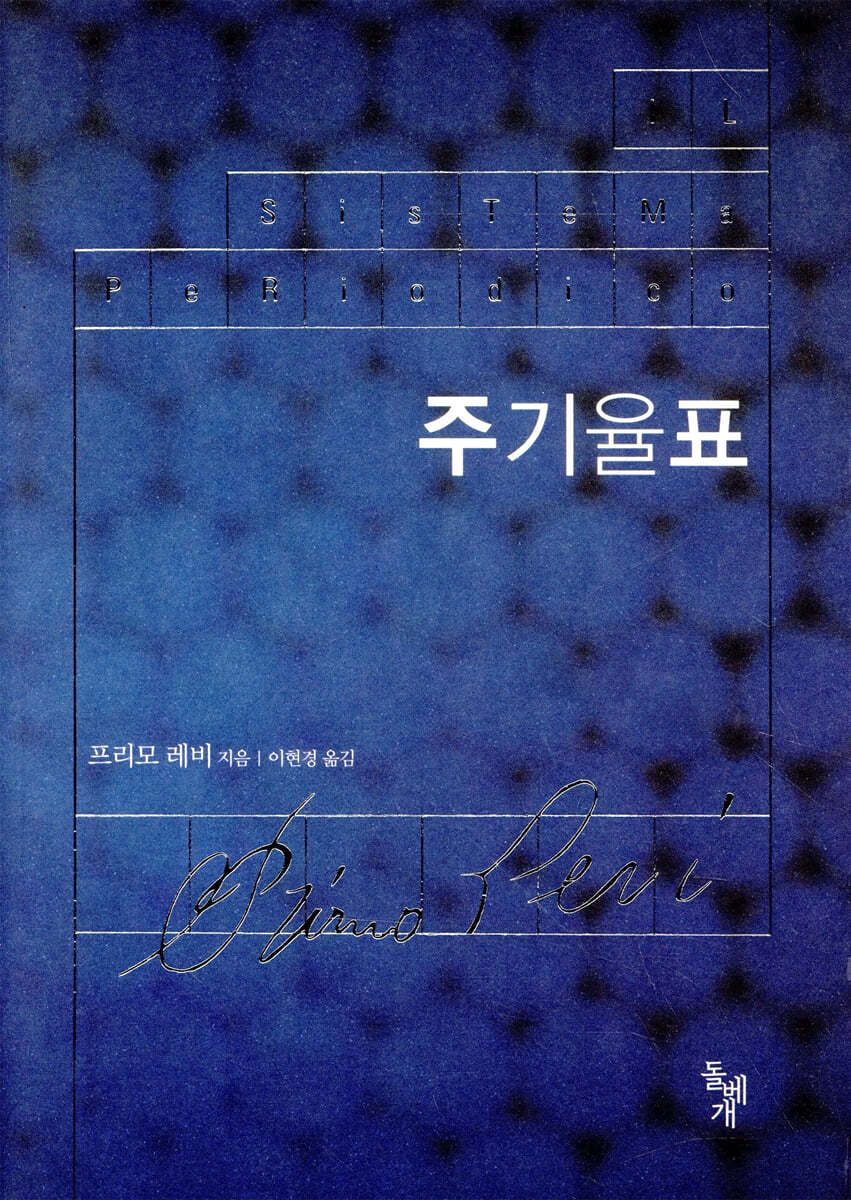
Book Introduction
A classic of modern literature that reflects on the limits of humanity through Auschwitz.
Primo Levi's masterpieces, "If This Is a Man" and "The Periodic Table," are introduced for the first time in Korea!
Hydrogen, zinc, iron, potassium...
How many people recall childhood memories and stories of loved ones from the elements on the periodic table they learned in chemistry class? The author, a leading Italian author and chemist who graduated summa cum laude from the University of Turin's Department of Chemistry, fills his memoir with a series of stories that connect him to a single element on the periodic table.
Each episode is self-contained and complete, yet the overall picture that the pieces come together to create is surprisingly splendid.
This ingenious and uniquely structured book, which has the character of both a meditation and a memoir, is one of Levy's most ingenious works and therefore one of his most popular.
Primo Levi's masterpieces, "If This Is a Man" and "The Periodic Table," are introduced for the first time in Korea!
Hydrogen, zinc, iron, potassium...
How many people recall childhood memories and stories of loved ones from the elements on the periodic table they learned in chemistry class? The author, a leading Italian author and chemist who graduated summa cum laude from the University of Turin's Department of Chemistry, fills his memoir with a series of stories that connect him to a single element on the periodic table.
Each episode is self-contained and complete, yet the overall picture that the pieces come together to create is surprisingly splendid.
This ingenious and uniquely structured book, which has the character of both a meditation and a memoir, is one of Levy's most ingenious works and therefore one of his most popular.
Into the book
The air we breathe contains so-called inert gases.
These have curious names, cleverly derived from Greek, meaning 'new' (neon), 'hidden' (krypton), 'motionless' (argon), and 'strange' (xenon).
They are truly inactive, meaning they are content with their situation and do not participate in any chemical reactions or combine with other elements.
It is for this very reason that noble gases have been able to remain unnoticed by humans for centuries.
However, in 1962, after a long and ingenious effort by a diligent chemist, he succeeded in causing the 'alien' (xenon) to briefly combine with the extremely voracious and active fluorine.
But this achievement was so unexpected that the chemist was awarded the Nobel Prize.
These inert gases are also called noble gases.
Of course, there is some debate as to whether all noble gases are truly inert, or whether all inert gases are noble.
And finally, inert gases are also called rare gases.
Among them is argon, which is a very large amount, making up 1 percent of the air, and is therefore 'still'.
In other words, that amount is twenty or thirty times more than the carbon dioxide that is essential for sustaining any trace of life on this planet.
I don't know much, but our ancestors had a lot in common with those machines.
Not all of them were materially inactive.
That was not allowed for them.
On the contrary, it should have been or should have been very active.
Because we had to eat to live, and there was a prevailing moral code that said, “If you don’t work, you don’t eat.”
But there is no doubt that their inner spirits, rather than being actively engaged, were immersed in worldly thoughts, witty conversations, and noble, refined, and unpaid discussions.
It is no coincidence that the deeds they left behind, each with a different character, all share a common element of stillness, an attitude of dignified restraint, and an attitude of voluntarily (or acceptingly) withdrawing to the margins of life, which flows like a great river.
These have curious names, cleverly derived from Greek, meaning 'new' (neon), 'hidden' (krypton), 'motionless' (argon), and 'strange' (xenon).
They are truly inactive, meaning they are content with their situation and do not participate in any chemical reactions or combine with other elements.
It is for this very reason that noble gases have been able to remain unnoticed by humans for centuries.
However, in 1962, after a long and ingenious effort by a diligent chemist, he succeeded in causing the 'alien' (xenon) to briefly combine with the extremely voracious and active fluorine.
But this achievement was so unexpected that the chemist was awarded the Nobel Prize.
These inert gases are also called noble gases.
Of course, there is some debate as to whether all noble gases are truly inert, or whether all inert gases are noble.
And finally, inert gases are also called rare gases.
Among them is argon, which is a very large amount, making up 1 percent of the air, and is therefore 'still'.
In other words, that amount is twenty or thirty times more than the carbon dioxide that is essential for sustaining any trace of life on this planet.
I don't know much, but our ancestors had a lot in common with those machines.
Not all of them were materially inactive.
That was not allowed for them.
On the contrary, it should have been or should have been very active.
Because we had to eat to live, and there was a prevailing moral code that said, “If you don’t work, you don’t eat.”
But there is no doubt that their inner spirits, rather than being actively engaged, were immersed in worldly thoughts, witty conversations, and noble, refined, and unpaid discussions.
It is no coincidence that the deeds they left behind, each with a different character, all share a common element of stillness, an attitude of dignified restraint, and an attitude of voluntarily (or acceptingly) withdrawing to the margins of life, which flows like a great river.
--- p.7
Publisher's Review
A classic of modern literature that reflects on the limits of humanity through Auschwitz.
Primo Levi's masterpieces, "If This Is a Man" and "The Periodic Table," are introduced for the first time in Korea!
Primo Levi, the most important writer representing 20th-century literature
Primo Levi, whose work is being introduced in Korea for the first time, is a representative writer of modern Italy along with Italo Calvino and Umberto Eco.
His representative works have been translated and introduced into over 20 languages around the world, and in Italy, his works are included in middle and high school textbooks as the most important works of modern literature.
At the end of the last century, Waterstones, the largest bookstore chain in the UK, conducted a survey of 25,000 readers to compile a list of the "100 Most Important Works of the Century," and only two Italian authors, Levi and Eco, were included on the list.
Levy's work tied for 28th place with D.
It came in at number 30, following H. H. Lawrence's "Lady Chatterley's Lover" and Virginia Woolf's "Mrs. Dalloway," followed by Vladimir Nabokov's "Lolita."
Eco's The Name of the Rose ranked 42nd, making him the most famous Italian author.
His works, along with Anne Frank's The Diary, Viktor Frankl's Night and Fog, and Elie Wiesel's Night, are most widely known for denouncing the brutality of Nazism.
In particular, he is considered one of the most important writers in the category of 'testimonial literature', which is one of the major trends in Italian literature and a new literary trend that emerged against the backdrop of World War II.
An Italian critic summarized the reason why Levi's work stands out among the numerous works that claim to be testimonial literature:
A work of profound beauty has emerged.
It is a true, moving and inspiring work.
It is full of vivid and vibrant consciousness, yet has a cautious scale, and is incomparable to other similar works that often display excessive passion, emotion, partisanship, or bitter sentimentality.
〔… … 〕 With his book about his vivid experiences in the Lager (concentration camps), Levi has created one of the most classic examples of the kind of retrospective, testimonial, critical and creative literature that our twentieth century aspires to achieve. (Criticism by Giuseppe Grassano.
(Reprinted from Lee So-young, “A Study on Human Value Consciousness in a Limiting Situation in Primo Levi’s “Se questo e un uomo,” Master’s thesis, Hankuk University of Foreign Studies, 1997, p. 4)
As is always the case with classics, Levi's works occupy an important position in various fields.
Besides putting the memoir form, and Auschwitz literature in particular, on a full-fledged path, there are other aspects that interest us today.
Levi always tried to keep a reflective distance from his position as an Auschwitz survivor.
He was a rare Jew who had experienced Auschwitz (and even fewer than all Jews who had not) in maintaining a critical view of Israel's invasion of Lebanon and the exclusive nationalism of Zionism.
If we recall that even Emmanuel Levinas, a philosopher who, as a Jew who indirectly experienced Auschwitz, is considered to have most seriously addressed the problem of the “other,” glossed over this issue with the rhetoric of “the painful inevitability of occupation,” we can vaguely gauge the value of his reflections.
As a chemist, his passion, hopes and disappointments, and his love for (scientific and technical) labor and adventure are also fascinating stories.
Another unique attraction of his work is the possibility of diverse philosophical interpretations that has captivated countless people, from anthropologist Claude Levi-Strauss and structuralist critic Tzvetan Todorov to philosophers Alain Badiou and Giorgio Agamben.
But most importantly, he draws profound insights from these extreme personal experiences and translates them into universal, and sometimes beautiful, language that anyone can read.
Primo Levi's masterpieces, "If This Is a Man" and "The Periodic Table," are introduced for the first time in Korea!
Primo Levi, the most important writer representing 20th-century literature
Primo Levi, whose work is being introduced in Korea for the first time, is a representative writer of modern Italy along with Italo Calvino and Umberto Eco.
His representative works have been translated and introduced into over 20 languages around the world, and in Italy, his works are included in middle and high school textbooks as the most important works of modern literature.
At the end of the last century, Waterstones, the largest bookstore chain in the UK, conducted a survey of 25,000 readers to compile a list of the "100 Most Important Works of the Century," and only two Italian authors, Levi and Eco, were included on the list.
Levy's work tied for 28th place with D.
It came in at number 30, following H. H. Lawrence's "Lady Chatterley's Lover" and Virginia Woolf's "Mrs. Dalloway," followed by Vladimir Nabokov's "Lolita."
Eco's The Name of the Rose ranked 42nd, making him the most famous Italian author.
His works, along with Anne Frank's The Diary, Viktor Frankl's Night and Fog, and Elie Wiesel's Night, are most widely known for denouncing the brutality of Nazism.
In particular, he is considered one of the most important writers in the category of 'testimonial literature', which is one of the major trends in Italian literature and a new literary trend that emerged against the backdrop of World War II.
An Italian critic summarized the reason why Levi's work stands out among the numerous works that claim to be testimonial literature:
A work of profound beauty has emerged.
It is a true, moving and inspiring work.
It is full of vivid and vibrant consciousness, yet has a cautious scale, and is incomparable to other similar works that often display excessive passion, emotion, partisanship, or bitter sentimentality.
〔… … 〕 With his book about his vivid experiences in the Lager (concentration camps), Levi has created one of the most classic examples of the kind of retrospective, testimonial, critical and creative literature that our twentieth century aspires to achieve. (Criticism by Giuseppe Grassano.
(Reprinted from Lee So-young, “A Study on Human Value Consciousness in a Limiting Situation in Primo Levi’s “Se questo e un uomo,” Master’s thesis, Hankuk University of Foreign Studies, 1997, p. 4)
As is always the case with classics, Levi's works occupy an important position in various fields.
Besides putting the memoir form, and Auschwitz literature in particular, on a full-fledged path, there are other aspects that interest us today.
Levi always tried to keep a reflective distance from his position as an Auschwitz survivor.
He was a rare Jew who had experienced Auschwitz (and even fewer than all Jews who had not) in maintaining a critical view of Israel's invasion of Lebanon and the exclusive nationalism of Zionism.
If we recall that even Emmanuel Levinas, a philosopher who, as a Jew who indirectly experienced Auschwitz, is considered to have most seriously addressed the problem of the “other,” glossed over this issue with the rhetoric of “the painful inevitability of occupation,” we can vaguely gauge the value of his reflections.
As a chemist, his passion, hopes and disappointments, and his love for (scientific and technical) labor and adventure are also fascinating stories.
Another unique attraction of his work is the possibility of diverse philosophical interpretations that has captivated countless people, from anthropologist Claude Levi-Strauss and structuralist critic Tzvetan Todorov to philosophers Alain Badiou and Giorgio Agamben.
But most importantly, he draws profound insights from these extreme personal experiences and translates them into universal, and sometimes beautiful, language that anyone can read.
GOODS SPECIFICS
- Date of issue: January 12, 2007
- Page count, weight, size: 383 pages | 505g | 146*205*30mm
- ISBN13: 9788971992654
- ISBN10: 8971992654
You may also like
카테고리
korean


korean

![GQ KOREA Mark (Monthly): December [2025]](http://librairie.coreenne.fr/cdn/shop/files/8ef265dbbfbf186523ed75ba7319009d.jpg?v=1765340328&width=3840)


