

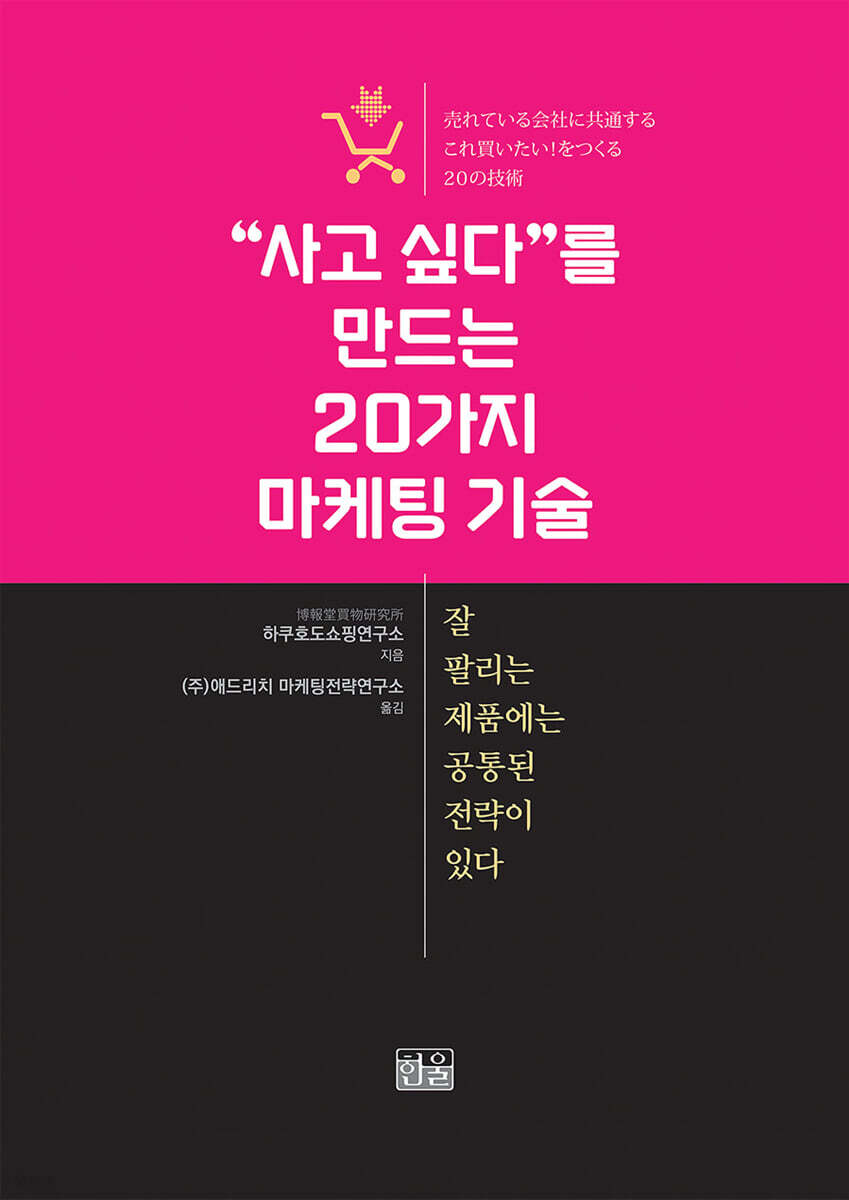
20 Marketing Techniques That Create "I Want to Buy"
 |
Description
Book Introduction
In the age of information saturation, in search of the lost 'desire to buy'
20 Triggers That Turn Likes Into Purchases
“I like it, but I don’t buy it.” This sentence most accurately describes today’s consumer landscape.
The market is saturated, and consumers are overwhelmed by information.
Hakuhodo Shopping Research Institute explains this gap with the equation of 'desire to own + desire to buy.'
The key is the 'desire to buy', which is the enjoyment of shopping itself, rather than the desire to own things.
When fans buy merchandise, it's a form of support, and waiting for limited editions isn't a desire, but a 'defense of the heart that doesn't want to miss out.'
This book dissects the unconscious mind of consumption and presents 20 triggers that stimulate the desire to buy—elements that simultaneously appeal to both emotion and reason, such as “favoritism,” “scarcity,” and “frictionlessness.”
These triggers are organized into four directions: BOOST, KEEP, LOVE, and REASON, and they stimulate and maintain desire, stimulate emotions, and lead to decisions.
Even in an era dominated by data and artificial intelligence, the center is ultimately ‘people.’
This book talks about a 'moving heart' rather than a 'selling technique'.
I recommend this book to those who want to understand the human beings within the wave of consumption, rather than those who want to read it.
20 Triggers That Turn Likes Into Purchases
“I like it, but I don’t buy it.” This sentence most accurately describes today’s consumer landscape.
The market is saturated, and consumers are overwhelmed by information.
Hakuhodo Shopping Research Institute explains this gap with the equation of 'desire to own + desire to buy.'
The key is the 'desire to buy', which is the enjoyment of shopping itself, rather than the desire to own things.
When fans buy merchandise, it's a form of support, and waiting for limited editions isn't a desire, but a 'defense of the heart that doesn't want to miss out.'
This book dissects the unconscious mind of consumption and presents 20 triggers that stimulate the desire to buy—elements that simultaneously appeal to both emotion and reason, such as “favoritism,” “scarcity,” and “frictionlessness.”
These triggers are organized into four directions: BOOST, KEEP, LOVE, and REASON, and they stimulate and maintain desire, stimulate emotions, and lead to decisions.
Even in an era dominated by data and artificial intelligence, the center is ultimately ‘people.’
This book talks about a 'moving heart' rather than a 'selling technique'.
I recommend this book to those who want to understand the human beings within the wave of consumption, rather than those who want to read it.
index
Part 1: 7 Triggers That Increase Your Desire to Buy: LOVE & BOOST
01 Favoritism: I buy things if I can express my feelings.
02 Story: Everyone will love it when they hear the backstory.
03 Self-Development: I want to invest in my future self.
04 Motivation to Learn: I want to satisfy my intellectual curiosity.
05 Process Satisfaction: Even the hardships leading up to the achievement are enjoyable.
06 Social Consciousness: If you are going to live anyway, do something that is helpful to society.
07 Freshness and Experience: "Now is the time to buy!" Producing the freshness of the season.
Part 2: 7 Triggers That Will Make You Want to Buy: REASON & BOOST
08 Rarity: A limited edition you won't regret missing!
09 Customization: I want something that fits me perfectly.
10 Shocking Surprises: The Unexpected Surprise That Will Make You Open Your Wallet
11. Fellowship: Buying Creates a Sense of Belonging
12. Consideration Ahead: I bought it here because I liked the thoughtfulness!
13 Serendipity: When you feel like it's a "fated encounter," you feel the urge to buy.
14. Riding the Wave: It's a Must, Everyone Likes It
Part 3: 3 Triggers That Keep You Wanting to Buy: LOVE & KEEP
15 My Pace: It's nice to be able to live easily without any burden.
16 Frictionless: Shopping becomes more enjoyable by eliminating minor inconveniences.
17 Loss Aversion: If you have nothing to lose, you can buy aggressively.
Part 4: 3 Triggers to Maintain Your "I Can Be an Apostle" Mindset: REASON & KEEP
18. Trustworthiness: Reliable track record, you can be sure of buying this.
19. Reasons and grounds: I want to shop after being convinced and convinced by the grounds.
20 Choices: This is good, I'll be happy if I choose it.
Six advanced techniques that combine two triggers to create new synergies.
01 Favoritism: I buy things if I can express my feelings.
02 Story: Everyone will love it when they hear the backstory.
03 Self-Development: I want to invest in my future self.
04 Motivation to Learn: I want to satisfy my intellectual curiosity.
05 Process Satisfaction: Even the hardships leading up to the achievement are enjoyable.
06 Social Consciousness: If you are going to live anyway, do something that is helpful to society.
07 Freshness and Experience: "Now is the time to buy!" Producing the freshness of the season.
Part 2: 7 Triggers That Will Make You Want to Buy: REASON & BOOST
08 Rarity: A limited edition you won't regret missing!
09 Customization: I want something that fits me perfectly.
10 Shocking Surprises: The Unexpected Surprise That Will Make You Open Your Wallet
11. Fellowship: Buying Creates a Sense of Belonging
12. Consideration Ahead: I bought it here because I liked the thoughtfulness!
13 Serendipity: When you feel like it's a "fated encounter," you feel the urge to buy.
14. Riding the Wave: It's a Must, Everyone Likes It
Part 3: 3 Triggers That Keep You Wanting to Buy: LOVE & KEEP
15 My Pace: It's nice to be able to live easily without any burden.
16 Frictionless: Shopping becomes more enjoyable by eliminating minor inconveniences.
17 Loss Aversion: If you have nothing to lose, you can buy aggressively.
Part 4: 3 Triggers to Maintain Your "I Can Be an Apostle" Mindset: REASON & KEEP
18. Trustworthiness: Reliable track record, you can be sure of buying this.
19. Reasons and grounds: I want to shop after being convinced and convinced by the grounds.
20 Choices: This is good, I'll be happy if I choose it.
Six advanced techniques that combine two triggers to create new synergies.
Into the book
One thing to be careful about is not to increase the amount of information too much.
This situation should be avoided because unilateral release of information can lead to information overload and leave no room for individuals to investigate.
The enthusiasts search and research on their own and learn a lot.
The more I get to know you, the deeper my affection for you becomes.
--- p.36, from “Chapter 1 Favoritism”
When attempting to design a process satisfaction trigger, it is essential to ensure that the design does not harm participants.
If people invest time and effort into a campaign but don't receive a reward, their satisfaction will likely decrease, and ultimately, their brand favorability will likely decline.
--- p.73, from “Chapter 5 Process Satisfaction”
When we looked at when people were most likely to leave a review, we found that most of the time it was either because the product was better than expected or because it didn't meet expectations and they were disappointed.
Therefore, reviews can be said to be a collection of 'shock experiences', big and small.
--- p.111, from “Chapter 10: Shock from Deviation”
Products with long purchase cycles, such as seasonings and detergents, are items that can easily be used up if you're not careful.
When there are mechanisms in place to prevent these "missed purchases," it feels like they're "taking care of what's really needed," as if they're scratching an itch.
For example, mosquito repellents have an expiration date that can be easily checked with the naked eye, depending on whether the repellent is chemical or not.
Products that have a device that lets you know when they're "almost used up" are more likely to be repurchased.
--- p.129-130, from “Chapter 12: Consideration Ahead”
When does a consumer feel "there's no quality issue"? One example is when "negative factors are explained in advance."
Consumers can reduce their risk of failure if information is made public about why something is cheap, where costs were cut, and conversely, why it is expensive.
The perception that "quality did not meet expectations" arises from the gap between expectations and reality, so if you know this from the beginning, you can decide whether to accept it or not.
So, there are quite a few consumers who deliberately look for harsh or negative reviews before making a purchase decision.
--- p.178-179, from “Chapter 17 Loss Avoidance”
When choosing a product in a category that you don't normally purchase, you often find yourself at a loss as to what the differences are between the products and what criteria should be used to make your choice.
Consumers can feel a sense of “choice” when choosing a product by determining the points they consider important according to the “Product Selection Guide.”
This situation should be avoided because unilateral release of information can lead to information overload and leave no room for individuals to investigate.
The enthusiasts search and research on their own and learn a lot.
The more I get to know you, the deeper my affection for you becomes.
--- p.36, from “Chapter 1 Favoritism”
When attempting to design a process satisfaction trigger, it is essential to ensure that the design does not harm participants.
If people invest time and effort into a campaign but don't receive a reward, their satisfaction will likely decrease, and ultimately, their brand favorability will likely decline.
--- p.73, from “Chapter 5 Process Satisfaction”
When we looked at when people were most likely to leave a review, we found that most of the time it was either because the product was better than expected or because it didn't meet expectations and they were disappointed.
Therefore, reviews can be said to be a collection of 'shock experiences', big and small.
--- p.111, from “Chapter 10: Shock from Deviation”
Products with long purchase cycles, such as seasonings and detergents, are items that can easily be used up if you're not careful.
When there are mechanisms in place to prevent these "missed purchases," it feels like they're "taking care of what's really needed," as if they're scratching an itch.
For example, mosquito repellents have an expiration date that can be easily checked with the naked eye, depending on whether the repellent is chemical or not.
Products that have a device that lets you know when they're "almost used up" are more likely to be repurchased.
--- p.129-130, from “Chapter 12: Consideration Ahead”
When does a consumer feel "there's no quality issue"? One example is when "negative factors are explained in advance."
Consumers can reduce their risk of failure if information is made public about why something is cheap, where costs were cut, and conversely, why it is expensive.
The perception that "quality did not meet expectations" arises from the gap between expectations and reality, so if you know this from the beginning, you can decide whether to accept it or not.
So, there are quite a few consumers who deliberately look for harsh or negative reviews before making a purchase decision.
--- p.178-179, from “Chapter 17 Loss Avoidance”
When choosing a product in a category that you don't normally purchase, you often find yourself at a loss as to what the differences are between the products and what criteria should be used to make your choice.
Consumers can feel a sense of “choice” when choosing a product by determining the points they consider important according to the “Product Selection Guide.”
--- p.203, from “Chapter 20 Choices”
Publisher's Review
“I like it, but I don’t buy it.”
: Consumers who want experiences, not possessions
This sentence most succinctly describes today's consumer landscape.
The market is saturated with good products, and consumers are feeling overwhelmed by the information overload.
While brand loyalty and preference are high, the "decisive moment" when consumers actually press the purchase button is disappearing.
This book, published by Hakuhodo Shopping Research Institute, which has been at the forefront of advertising, delves into this mysterious gap.
The core of this book is simple.
The purchasing behavior cannot be explained solely by the traditional 'desire to possess'.
In 2007, the Hakuhodo Shopping Research Institute established a unique equation: 'Shopping = Desire to Own + Desire to Buy.' This book states that the minds of modern consumers have shifted from 'the act of acquiring things' to 'enjoying the act itself,' or 'desire to buy.'
The insight that fans' purchase of merchandise is not simply a matter of ownership but a "language of support," and that staying up all night in front of limited editions is not a matter of desire but a "defense of the heart against wanting to miss out," makes it clear that advertising is ultimately a "translation of the language of the heart."
Buying is always emotional and intuitive.
Advertising and marketing cannot help but be humbled when faced with the question, “Why do we open our wallets?”
20 Triggers: An Antidote to the Era of "Lost Desire"
The phenomenon of consumers losing their desires due to being unable to decide what to choose amidst the flood of information, called "desire loss" by the Hakuhodo Shopping Research Institute, explains the reason for the existence of this book.
Making people like the product (ownership) is fundamental.
The challenge is pulling the 'trigger' to turn that desire into an actual purchase.
The book's "20 triggers that stimulate the desire to buy" are the result of scientifically analyzing this series of intuitive actions, that is, the moment of "the descent of the god of buying."
These triggers are categorized into four strategic directions: 'BOOST', which creates pleasure and stimulates desire, 'KEEP', which maintains the will to purchase, 'LOVE', which stimulates emotions, and 'REASON', which provides a decisive reason.
For example, the LOVE & BOOST group includes emotional drive elements such as 'favoritism', which expresses liking through purchases, and 'self-development', which invests in the future I want.
On the other hand, the REASON & BOOST group analyzes devices that trigger rational decisions, such as 'scarcity value', which is a reason to buy now, or 'customization' that is optimized for me.
Furthermore, triggers in the KEEP direction ('frictionless', 'loss aversion', etc.) delve into the realistic psychology of reducing the mental and physical burden to prevent the decision to purchase from fading away.
Through these 20 triggers, this book seeks to answer the questions consumers ask: "Why were I curious about that information? Why was I drawn to word-of-mouth? Why did I buy from that store?"
These triggers are not simply short-term techniques like ‘discount’ or ‘limited time’.
They are emotional devices designed to make consumers feel pleasure in the 'purchase journey' itself.
It contains the insight that the entire process of looking at customer reviews, visiting a store, viewing a product, listening to explanations from staff, and watching related videos is part of the experience of satisfying the 'desire to buy.'
In particular, for each of these 20 triggers, it provides a detailed explanation of three key pieces of information: ① when do consumers feel like buying, ② successful business cases, and ③ marketing utilization tips.
Through this, readers not only experience the feeling of 'fun' but also obtain a practical antidote that leads to 'realistic achievements'.
This book provides clear hints to the question, “How can we best utilize the 20 triggers in our company?”
Even in an era dominated by artificial intelligence, data, and trend analysis, the center is ultimately 'people.'
This book explores the rise of artificial intelligence in a "commerce anywhere" environment, while returning to the most human of questions.
A must-read for anyone concerned about advertising that sells.
Refusing to stop at simply saying "it's fun" or "it was helpful," this book aims for real results.
The twin strategy of 'desire to possess' and 'desire to buy' is the only way to break through the current saturated consumer market.
For those who believe that advertising is not a sales technique but a language of persuasion, and that the translation of that language ultimately begins with an experiment in deeply understanding the human mind, this book will become more than a mere reference book; it will become a practical textbook.
By the time readers finish this book, they will discover new perspectives and possibilities that will make the act of 'selling' more enjoyable.
: Consumers who want experiences, not possessions
This sentence most succinctly describes today's consumer landscape.
The market is saturated with good products, and consumers are feeling overwhelmed by the information overload.
While brand loyalty and preference are high, the "decisive moment" when consumers actually press the purchase button is disappearing.
This book, published by Hakuhodo Shopping Research Institute, which has been at the forefront of advertising, delves into this mysterious gap.
The core of this book is simple.
The purchasing behavior cannot be explained solely by the traditional 'desire to possess'.
In 2007, the Hakuhodo Shopping Research Institute established a unique equation: 'Shopping = Desire to Own + Desire to Buy.' This book states that the minds of modern consumers have shifted from 'the act of acquiring things' to 'enjoying the act itself,' or 'desire to buy.'
The insight that fans' purchase of merchandise is not simply a matter of ownership but a "language of support," and that staying up all night in front of limited editions is not a matter of desire but a "defense of the heart against wanting to miss out," makes it clear that advertising is ultimately a "translation of the language of the heart."
Buying is always emotional and intuitive.
Advertising and marketing cannot help but be humbled when faced with the question, “Why do we open our wallets?”
20 Triggers: An Antidote to the Era of "Lost Desire"
The phenomenon of consumers losing their desires due to being unable to decide what to choose amidst the flood of information, called "desire loss" by the Hakuhodo Shopping Research Institute, explains the reason for the existence of this book.
Making people like the product (ownership) is fundamental.
The challenge is pulling the 'trigger' to turn that desire into an actual purchase.
The book's "20 triggers that stimulate the desire to buy" are the result of scientifically analyzing this series of intuitive actions, that is, the moment of "the descent of the god of buying."
These triggers are categorized into four strategic directions: 'BOOST', which creates pleasure and stimulates desire, 'KEEP', which maintains the will to purchase, 'LOVE', which stimulates emotions, and 'REASON', which provides a decisive reason.
For example, the LOVE & BOOST group includes emotional drive elements such as 'favoritism', which expresses liking through purchases, and 'self-development', which invests in the future I want.
On the other hand, the REASON & BOOST group analyzes devices that trigger rational decisions, such as 'scarcity value', which is a reason to buy now, or 'customization' that is optimized for me.
Furthermore, triggers in the KEEP direction ('frictionless', 'loss aversion', etc.) delve into the realistic psychology of reducing the mental and physical burden to prevent the decision to purchase from fading away.
Through these 20 triggers, this book seeks to answer the questions consumers ask: "Why were I curious about that information? Why was I drawn to word-of-mouth? Why did I buy from that store?"
These triggers are not simply short-term techniques like ‘discount’ or ‘limited time’.
They are emotional devices designed to make consumers feel pleasure in the 'purchase journey' itself.
It contains the insight that the entire process of looking at customer reviews, visiting a store, viewing a product, listening to explanations from staff, and watching related videos is part of the experience of satisfying the 'desire to buy.'
In particular, for each of these 20 triggers, it provides a detailed explanation of three key pieces of information: ① when do consumers feel like buying, ② successful business cases, and ③ marketing utilization tips.
Through this, readers not only experience the feeling of 'fun' but also obtain a practical antidote that leads to 'realistic achievements'.
This book provides clear hints to the question, “How can we best utilize the 20 triggers in our company?”
Even in an era dominated by artificial intelligence, data, and trend analysis, the center is ultimately 'people.'
This book explores the rise of artificial intelligence in a "commerce anywhere" environment, while returning to the most human of questions.
A must-read for anyone concerned about advertising that sells.
Refusing to stop at simply saying "it's fun" or "it was helpful," this book aims for real results.
The twin strategy of 'desire to possess' and 'desire to buy' is the only way to break through the current saturated consumer market.
For those who believe that advertising is not a sales technique but a language of persuasion, and that the translation of that language ultimately begins with an experiment in deeply understanding the human mind, this book will become more than a mere reference book; it will become a practical textbook.
By the time readers finish this book, they will discover new perspectives and possibilities that will make the act of 'selling' more enjoyable.
GOODS SPECIFICS
- Date of issue: October 30, 2025
- Page count, weight, size: 240 pages | 148*209*20mm
- ISBN13: 9788946084049
You may also like
카테고리
korean


korean

![GQ KOREA Mark (Monthly): December [2025]](http://librairie.coreenne.fr/cdn/shop/files/8ef265dbbfbf186523ed75ba7319009d.jpg?v=1765340328&width=3840)


