

The man's bag
 |
Description
Book Introduction
This book is a collection of writings regularly published by the author, known as a philosophical artist and sculptor.
His prose, which begins with thoughts about objects and then reflects on the body, life, and even everyday life with a uniquely sensitive perspective, serves as a good example of how artistic vision and literary imagination can communicate.
'Why can't we see the back of things?
Why do things always show only their front side?
Is there no way to show the back?
Where the back of the thing that has disappeared from us goes,
Where do those invisible backs reside?'
The author gives meaning to all of these things, adding long observations, reflections, and rich commentary.
It also contains a wealth of background information that makes up the world of his works, the starting point of his creations, as well as his thoughts and reflections on art and life, and 53 photos of his works and drawings.
Let's delve into the author's unique exploration of the origins of art, a new approach with fresh ideas.
His prose, which begins with thoughts about objects and then reflects on the body, life, and even everyday life with a uniquely sensitive perspective, serves as a good example of how artistic vision and literary imagination can communicate.
'Why can't we see the back of things?
Why do things always show only their front side?
Is there no way to show the back?
Where the back of the thing that has disappeared from us goes,
Where do those invisible backs reside?'
The author gives meaning to all of these things, adding long observations, reflections, and rich commentary.
It also contains a wealth of background information that makes up the world of his works, the starting point of his creations, as well as his thoughts and reflections on art and life, and 53 photos of his works and drawings.
Let's delve into the author's unique exploration of the origins of art, a new approach with fresh ideas.
index
1.
At the beginning of the book - The Square Eye
2.
Head, the house of the soul
Fights and Greetings / Portraits and Beheadings / Black Holes / What Hair Says
3.
Hands, the human condition
Between Hand and Mouth / The World in Your Hand / Dialectics / Evolution / Violence / Greetings and Arrests / Fingerprints / Gloves
4.
A heart like a hand
Promise / The hawk and the prayer / The right and the left hand / The writing hand / The oar and the shovel
5.
Thinking feet
Detective Columbo and the Monk / The First Slave / The Table / The Bridge and the Road
6.
House on the Road
The Beginning and End of the Road / Hansel and Gretel / The Fixed Man / The Secret / The House as Other
7.
chair
Moving chair / Standing and sitting / Stationary chair / Rocking chair
8.
Boxes and bags
Fish's Coffin / Desk and Drawer / Pandora's Box / School Bag / The Man's Bag
9.
What is seen and what is not seen
The Back Side of Things / Strange Continents / Truth and Things
10.
shell and flesh
Signboard / Doctor and Sculptor / Overcoming Death
11.
Lose, don't lose
Throwing Away and Losing / Collectors / Tattoos
12.
minor incident
Coca-Cola / Roman Opalka / A Small Incident
13.
Pictures and words
Interview / On the Borderline / The Silence of Painting
14.
Work and Play
A Boring Life / A Vegetable Man / The Explosion Inside Me
15.
News, comedy, sadism
News / Comedy / Sadism
16.
The Hunter and the Hare
17.
Postscript - A New Dictionary of Iconography in the Age of Secularization - Jae-ryong Lee (Professor, Soongsil University, Literary Critic)
At the beginning of the book - The Square Eye
2.
Head, the house of the soul
Fights and Greetings / Portraits and Beheadings / Black Holes / What Hair Says
3.
Hands, the human condition
Between Hand and Mouth / The World in Your Hand / Dialectics / Evolution / Violence / Greetings and Arrests / Fingerprints / Gloves
4.
A heart like a hand
Promise / The hawk and the prayer / The right and the left hand / The writing hand / The oar and the shovel
5.
Thinking feet
Detective Columbo and the Monk / The First Slave / The Table / The Bridge and the Road
6.
House on the Road
The Beginning and End of the Road / Hansel and Gretel / The Fixed Man / The Secret / The House as Other
7.
chair
Moving chair / Standing and sitting / Stationary chair / Rocking chair
8.
Boxes and bags
Fish's Coffin / Desk and Drawer / Pandora's Box / School Bag / The Man's Bag
9.
What is seen and what is not seen
The Back Side of Things / Strange Continents / Truth and Things
10.
shell and flesh
Signboard / Doctor and Sculptor / Overcoming Death
11.
Lose, don't lose
Throwing Away and Losing / Collectors / Tattoos
12.
minor incident
Coca-Cola / Roman Opalka / A Small Incident
13.
Pictures and words
Interview / On the Borderline / The Silence of Painting
14.
Work and Play
A Boring Life / A Vegetable Man / The Explosion Inside Me
15.
News, comedy, sadism
News / Comedy / Sadism
16.
The Hunter and the Hare
17.
Postscript - A New Dictionary of Iconography in the Age of Secularization - Jae-ryong Lee (Professor, Soongsil University, Literary Critic)
Publisher's Review
An artist's interest and obsession with objects, everyday life, and the hidden side of things
"The Man's Bag," a revised version of the series of articles that were serialized in the monthly magazine "Modern Literature" under the title "Things, What Are They?" after two years, is an attempt to shift the gaze outside of the "square" frame, that is, all objects and daily life that are trapped within stereotypes, systems, and norms.
Although he himself modestly describes his work as "blunt and loose prose, like a sculptor's nail chisel on a stone," he received favorable reviews at the time of serialization, saying that "the process of developing visual observation and imagination about objects is structured through detailed linguistic work."
This book can be broadly divided into three parts.
First, the exploration of the body begins with the head, which is located close to the sky and symbolizes human identity; the hands, which contain human destiny and limitations; and the feet, which function as tools of thought and labor at the very bottom.
His eyes, which had scanned the house from head to toe, now walked down the street and into the house, reaching the chairs, desks, boxes and bags inside.
This work of meticulously examining trivial and insignificant things is an invitation to turn our linear and fixed perspective in a different direction and look behind it.
In this way, the sculptor's interest in the body and objects extends beyond the external appearance and leads to a serious exploration of their inner self, and this expansion (or transformation) into philosophical and literary thought inevitably leads to the process of concretizing his identity as an artist.
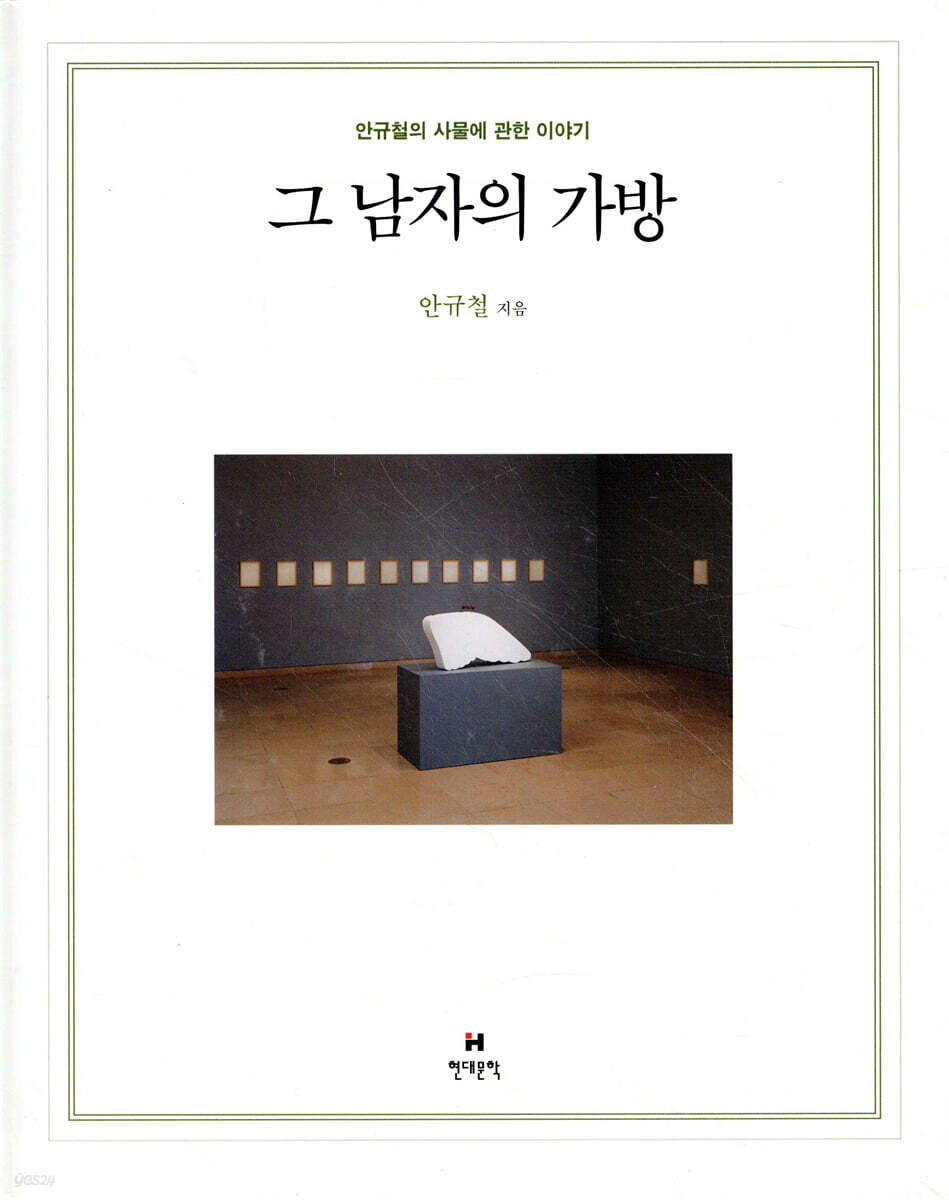
The title of this book is taken from one of his representative works, "The Man's Bag."
His intention to show the difference between truth and what is visible through a bag containing 'a pair of wings entrusted by an angel' is also well expressed in the questions "Why can't we see the back of things?" and "Can't we choose a gaze that looks at the text with one eye and the image with the other?" This also represents his world of works that have contemplated the boundaries between the visible and the invisible, and between pictures and words.
In particular, the confession that "all these psychological circumstances that led me to the path of art, such as tolerance for loneliness, longing for a romantic life, and self-awareness as a stranger with no hometown in either the city or the countryside, were his legacy," which he confesses while reminiscing about his father, a poor salaried surgeon, provides a glimpse into the artist's inner self and artistic perspective.
Although he himself modestly describes his work as "blunt and loose prose, like a sculptor's nail chisel on a stone," he received favorable reviews at the time of serialization, saying that "the process of developing visual observation and imagination about objects is structured through detailed linguistic work."
This book can be broadly divided into three parts.
First, the exploration of the body begins with the head, which is located close to the sky and symbolizes human identity; the hands, which contain human destiny and limitations; and the feet, which function as tools of thought and labor at the very bottom.
His eyes, which had scanned the house from head to toe, now walked down the street and into the house, reaching the chairs, desks, boxes and bags inside.
This work of meticulously examining trivial and insignificant things is an invitation to turn our linear and fixed perspective in a different direction and look behind it.
In this way, the sculptor's interest in the body and objects extends beyond the external appearance and leads to a serious exploration of their inner self, and this expansion (or transformation) into philosophical and literary thought inevitably leads to the process of concretizing his identity as an artist.
The title of this book is taken from one of his representative works, "The Man's Bag."
His intention to show the difference between truth and what is visible through a bag containing 'a pair of wings entrusted by an angel' is also well expressed in the questions "Why can't we see the back of things?" and "Can't we choose a gaze that looks at the text with one eye and the image with the other?" This also represents his world of works that have contemplated the boundaries between the visible and the invisible, and between pictures and words.
In particular, the confession that "all these psychological circumstances that led me to the path of art, such as tolerance for loneliness, longing for a romantic life, and self-awareness as a stranger with no hometown in either the city or the countryside, were his legacy," which he confesses while reminiscing about his father, a poor salaried surgeon, provides a glimpse into the artist's inner self and artistic perspective.
GOODS SPECIFICS
- Date of issue: March 2, 2004
- Format: Hardcover book binding method guide
- Pages, weight, size: 212 pages | 654g | 188*254*20mm
- ISBN13: 9788972752776
- ISBN10: 8972752770
You may also like
카테고리
korean


korean

![GQ KOREA Mark (Monthly): December [2025]](http://librairie.coreenne.fr/cdn/shop/files/8ef265dbbfbf186523ed75ba7319009d.jpg?v=1765340328&width=3840)


