

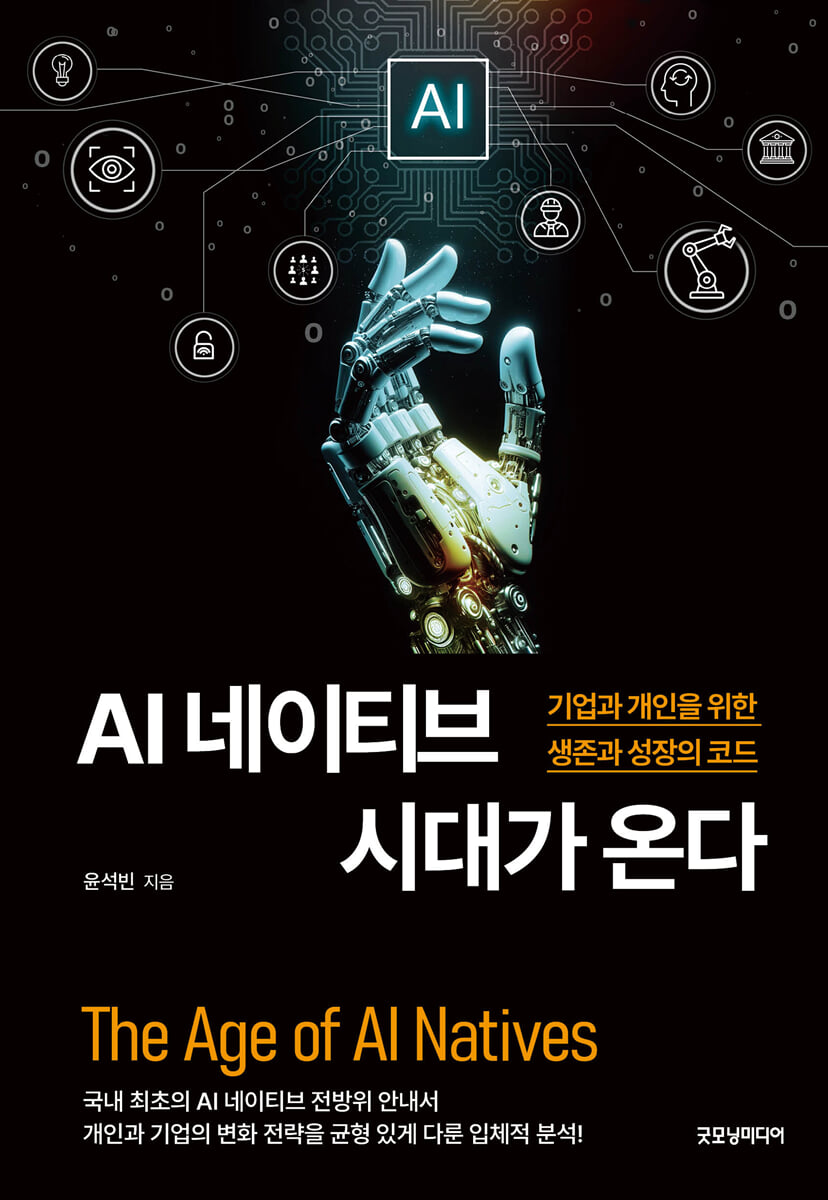
The era of AI natives is coming.
 |
Description
Book Introduction
In the AI-native era, are you and your organization ready to survive?
The author, who has captured the essence of the AI transition, asserts that only "AI natives" who go beyond simply "utilizing AI" and transform the very way they think and work can take the lead in the future.
This book provides a multi-faceted perspective on how artificial intelligence is fundamentally reshaping the way humans and organizations think and operate, and even the entire social structure.
This is Korea's first comprehensive guide to AI natives. It provides a balanced approach to the survival strategies needed for individuals and businesses in the AI native era.
The author redefines AI from a mere "tool" to a "way of being" that defines the essence of business and life, and proposes a new concept of "AI native." Viewing AI as a companion and platform, the author suggests ways for organizations and individuals to integrate AI into their identity and value creation structures.
From AI technology trends to the emergence and growth strategies of AI-native companies, AI-centric organizational design strategies, AI-native leadership and talent strategies, and even social value and future prospects, we reveal the core codes for survival and growth in the AI era. We analyze the impact of AI-native transition and the potential for market restructuring by industry from various angles and present an executable step-by-step strategic roadmap.
This book provides a practical roadmap for managers considering AI adoption, leaders spearheading organizational transformation and new business initiatives, professionals seeking long-term growth with AI, and general readers seeking to anticipate future changes and develop response strategies.
The author, who has captured the essence of the AI transition, asserts that only "AI natives" who go beyond simply "utilizing AI" and transform the very way they think and work can take the lead in the future.
This book provides a multi-faceted perspective on how artificial intelligence is fundamentally reshaping the way humans and organizations think and operate, and even the entire social structure.
This is Korea's first comprehensive guide to AI natives. It provides a balanced approach to the survival strategies needed for individuals and businesses in the AI native era.
The author redefines AI from a mere "tool" to a "way of being" that defines the essence of business and life, and proposes a new concept of "AI native." Viewing AI as a companion and platform, the author suggests ways for organizations and individuals to integrate AI into their identity and value creation structures.
From AI technology trends to the emergence and growth strategies of AI-native companies, AI-centric organizational design strategies, AI-native leadership and talent strategies, and even social value and future prospects, we reveal the core codes for survival and growth in the AI era. We analyze the impact of AI-native transition and the potential for market restructuring by industry from various angles and present an executable step-by-step strategic roadmap.
This book provides a practical roadmap for managers considering AI adoption, leaders spearheading organizational transformation and new business initiatives, professionals seeking long-term growth with AI, and general readers seeking to anticipate future changes and develop response strategies.
- You can preview some of the book's contents.
Preview
index
Preface: A New Dawn in the AI Native Era
Part 1. AI Natives: The Beginning of Revolutionary Change
Chapter 1: The Emergence of AI Natives
1.1 What is AI Native: Beyond Using AI
1.2 Cognitive Shift: From Tool User to Partner
1.3 The Generative AI Revolution and a Turning Point
1.4 Digital Natives vs. AI Natives
1.5 AI Natives Opening the Future: Opportunities and Challenges
Chapter 2: Connecting Software 3.0 and AI Natives
2.1 Evolution of the Programming Paradigm: From Commands to Learning, and from Learning to Dialogue
2.2 LLM: A New Era of General-Purpose Operating Systems (OS)
2.3 Mountains to Climb: The Limits and Future of Software 3.0
2.4 A Future Collaborating with AI: Choose Augmentation, Not Replacement
Part 2. The Birth and Growth of AI-Native Companies
Chapter 3: Conditions and Characteristics of AI-Native Companies
3.1. Definition of AI-Native Companies and Business Model Transformation
3.2.
Data Moat Building Strategy
3.3.
The essential difference between traditional and AI-native companies
3.4. AI Native Company Case Study 1
3.5. AI Native Company Case Study 2
Chapter 4: Strategies for Building an AI-Driven Organization
4.1 Limitations of Legacy Organizations and New Organizational Design
4.2 A Framework for Agile Organizations: The Spotify Model
4.3 Cultural Foundations: Google's Aristotle Project
4.4 Performance Measurement in the AI Era: Finding New KPIs
4.5 A Practical Roadmap for AI Native Transition
Chapter 5: AI-Native Leadership and Talent Strategy
5.1 New Leadership: From ‘Know-It-All’ to ‘Learn-It-All’
5.2 The Birth of Question-Based Leaders
5.3 Transforming the Education System: How to Cultivate AI Natives
5.4 New talent profile: Beyond I-shaped and T-shaped talents to M-shaped talents
5.5 Corporate Talent Strategy: Reskilling is Key
Part 3. Social Changes and Future Prospects in the AI Native Era
Chapter 6: The New Face of AI-Native Society
6.1 Coexistence of Humans and AI: Deepening the Centaur Model
6.2 Changes in job structure and response strategies
6.3 AI Gap and Social Challenges
6.4 Personalized AI Agents and Life Changes
Chapter 7: The Convergence of Web 3.0 and AI Natives
7.1 Why AI Needs Web 3.0: The Limitations of a Centralized Model
7.2 Core Principles of Convergence: DeAI, Data Sovereignty, and Token Economy
7.3 Convergence in Reality: A Case Study
7.4 The Prelude to an Agent Economy: The Interaction of Autonomous Agents
7.5 Challenges and the Way Forward
Chapter 8: Future Scenarios and Response Strategies
8.1 The Law of Accelerating Returns and Technological Singularity
8.2 Geopolitical Variables and a Multipolar AI World
8.3 The Light and Shadow of the AI Native Era 2030-2050
8.4 Designing a Sustainable Future Using AI
8.5 Long-term survival strategies for individuals and organizations
8.6 Quantum AI and Quantum Machine Learning: The Next Technological Revolution
Chapter 9: Norms and Values for Human-Centered AI
9.1 Ethical Responsibilities: Building Trustworthy AI
9.2 Challenges of Bias: Lessons from "Gender Shade"
9.3 The Rise of a New Role: AI Ethics Officer
9.4 Practice Guide: Building an AI Ethics Committee within Your Company
9.5 Recommendations for Implementing Human-Centered AI: The Vision of Stanford HAI
Part 1. AI Natives: The Beginning of Revolutionary Change
Chapter 1: The Emergence of AI Natives
1.1 What is AI Native: Beyond Using AI
1.2 Cognitive Shift: From Tool User to Partner
1.3 The Generative AI Revolution and a Turning Point
1.4 Digital Natives vs. AI Natives
1.5 AI Natives Opening the Future: Opportunities and Challenges
Chapter 2: Connecting Software 3.0 and AI Natives
2.1 Evolution of the Programming Paradigm: From Commands to Learning, and from Learning to Dialogue
2.2 LLM: A New Era of General-Purpose Operating Systems (OS)
2.3 Mountains to Climb: The Limits and Future of Software 3.0
2.4 A Future Collaborating with AI: Choose Augmentation, Not Replacement
Part 2. The Birth and Growth of AI-Native Companies
Chapter 3: Conditions and Characteristics of AI-Native Companies
3.1. Definition of AI-Native Companies and Business Model Transformation
3.2.
Data Moat Building Strategy
3.3.
The essential difference between traditional and AI-native companies
3.4. AI Native Company Case Study 1
3.5. AI Native Company Case Study 2
Chapter 4: Strategies for Building an AI-Driven Organization
4.1 Limitations of Legacy Organizations and New Organizational Design
4.2 A Framework for Agile Organizations: The Spotify Model
4.3 Cultural Foundations: Google's Aristotle Project
4.4 Performance Measurement in the AI Era: Finding New KPIs
4.5 A Practical Roadmap for AI Native Transition
Chapter 5: AI-Native Leadership and Talent Strategy
5.1 New Leadership: From ‘Know-It-All’ to ‘Learn-It-All’
5.2 The Birth of Question-Based Leaders
5.3 Transforming the Education System: How to Cultivate AI Natives
5.4 New talent profile: Beyond I-shaped and T-shaped talents to M-shaped talents
5.5 Corporate Talent Strategy: Reskilling is Key
Part 3. Social Changes and Future Prospects in the AI Native Era
Chapter 6: The New Face of AI-Native Society
6.1 Coexistence of Humans and AI: Deepening the Centaur Model
6.2 Changes in job structure and response strategies
6.3 AI Gap and Social Challenges
6.4 Personalized AI Agents and Life Changes
Chapter 7: The Convergence of Web 3.0 and AI Natives
7.1 Why AI Needs Web 3.0: The Limitations of a Centralized Model
7.2 Core Principles of Convergence: DeAI, Data Sovereignty, and Token Economy
7.3 Convergence in Reality: A Case Study
7.4 The Prelude to an Agent Economy: The Interaction of Autonomous Agents
7.5 Challenges and the Way Forward
Chapter 8: Future Scenarios and Response Strategies
8.1 The Law of Accelerating Returns and Technological Singularity
8.2 Geopolitical Variables and a Multipolar AI World
8.3 The Light and Shadow of the AI Native Era 2030-2050
8.4 Designing a Sustainable Future Using AI
8.5 Long-term survival strategies for individuals and organizations
8.6 Quantum AI and Quantum Machine Learning: The Next Technological Revolution
Chapter 9: Norms and Values for Human-Centered AI
9.1 Ethical Responsibilities: Building Trustworthy AI
9.2 Challenges of Bias: Lessons from "Gender Shade"
9.3 The Rise of a New Role: AI Ethics Officer
9.4 Practice Guide: Building an AI Ethics Committee within Your Company
9.5 Recommendations for Implementing Human-Centered AI: The Vision of Stanford HAI
Publisher's Review
"The AI Native Era is Coming" is a definitive, in-depth insight that explores on a massive scale how AI will fundamentally reshape the way humans and organizations think and operate, as well as the entire social structure.
Drawing on over 30 years of practical experience at the forefront of technological change and the case studies and lessons gleaned from firsthand observations of numerous industrial sites, the author redefines AI not simply as a "tool" but as a "way of being" that defines the essence of business and life.
He clearly distinguishes between the essential differences between "AI-enabled" and "AI-native," emphasizing that only organizations that integrate AI into their core values and structures from the early stages of design can truly drive disruptive innovation.
This approach persuasively demonstrates that it is not simply a matter of supplementing functionality, but rather a process of restructuring a company's value chain and ecosystem, fundamentally transforming its operating principles and decision-making structures.
This book also details a new technological environment in which AI operates like a general-purpose operating system (OS), based on the "Software 3.0" paradigm and the rapid advancement of LLM (Large Language Model).
Through real-world examples from leading global companies like Palantir and Tesla, this book demonstrates how AI-native companies build data moats, foster agile and flexible organizational cultures, and innovatively redefine leadership and talent strategies.
We also analyze the impact of AI native transition and the potential for market restructuring across industries from various angles and present an actionable, step-by-step strategic roadmap.
Furthermore, it broadly forecasts how the establishment of data sovereignty through convergence with Web3, the creation of new value based on a token economy, and the ultra-high-speed computation and complex modeling capabilities provided by quantum AI will accelerate paradigm shifts across industries.
Through this, readers will gain a three-dimensional understanding of the future technological and economic landscape brought about by the convergence of AI, blockchain, and quantum computing.
The author delicately weaves together four axes—technology, management, society, and ethics—to provide a balanced view of AI's potential and risks.
It analyzes and avoids threats such as hallucinations, algorithmic bias, and privacy violations, and specifically presents advanced prompting techniques, Retrieval-Augmented Generation (RAG) strategies, and methods for AI agents to utilize autonomous tools to overcome them.
In particular, it delves into the potential of a new information ecosystem, a global data trading structure, and an economic model based on autonomous agents that will be created by the combination of Web3 and quantum AI, and sharply analyzes the nature of change and its ramifications.
It also comprehensively addresses regulatory and standardization challenges, the need for international cooperation, and institutionalizing ethical responsibility, and presents a governance model for ensuring the sustainable operation of technological innovation.
Through this, readers can go beyond simple technical understanding and develop strategic thinking and practical preparation to drive change.
"The AI Native Era is Coming" provides a practical roadmap for managers considering AI adoption, leaders spearheading organizational transformation and new business planning, professionals seeking long-term growth with AI, and general readers seeking to anticipate future changes and develop response strategies.
The author makes it clear that “AI is not a choice, but a condition of survival,” and emphasizes that a cultural and philosophical shift is essential beyond technological adoption.
This book goes beyond the superficial achievements of AI innovation, delving deeply into its underlying structure and operating principles. It systematically presents the mindset and strategies necessary to grow into a leader in a global competitive environment, establishing itself as a must-read for the times.
The book also provides a wealth of practical examples of how AI native strategies are being applied in various industries, including education, healthcare, finance, and manufacturing.
For example, in the healthcare field, we explore how AI-based diagnosis and personalized treatment can improve patient survival rates, while in finance, we analyze how AI is being used for real-time risk management and hyper-personalized financial services.
In manufacturing, specific examples of how AI-native approaches are driving innovation are vividly presented, from predictive maintenance and supply chain optimization to eco-friendly production design.
This allows readers to move beyond simple conceptual understanding and clearly understand how AI-native transformation leads to business outcomes in each industry.
Finally, the author proposes scenarios for AI technology development over the next 10 to 20 years, the resulting social changes, and long-term survival strategies that individuals and organizations should prepare.
The commercialization of quantum AI, the spread of the autonomous agent economy, and the evolution of AI-human collaboration models will emerge as key axes of future competitiveness, and only those who lead these efforts will secure an advantage on the global stage, he emphasizes.
"The AI Native Era is Coming" is a profound and practical guidebook that guides readers to design the future by organically connecting the three axes of technology, strategy, and culture.
Drawing on over 30 years of practical experience at the forefront of technological change and the case studies and lessons gleaned from firsthand observations of numerous industrial sites, the author redefines AI not simply as a "tool" but as a "way of being" that defines the essence of business and life.
He clearly distinguishes between the essential differences between "AI-enabled" and "AI-native," emphasizing that only organizations that integrate AI into their core values and structures from the early stages of design can truly drive disruptive innovation.
This approach persuasively demonstrates that it is not simply a matter of supplementing functionality, but rather a process of restructuring a company's value chain and ecosystem, fundamentally transforming its operating principles and decision-making structures.
This book also details a new technological environment in which AI operates like a general-purpose operating system (OS), based on the "Software 3.0" paradigm and the rapid advancement of LLM (Large Language Model).
Through real-world examples from leading global companies like Palantir and Tesla, this book demonstrates how AI-native companies build data moats, foster agile and flexible organizational cultures, and innovatively redefine leadership and talent strategies.
We also analyze the impact of AI native transition and the potential for market restructuring across industries from various angles and present an actionable, step-by-step strategic roadmap.
Furthermore, it broadly forecasts how the establishment of data sovereignty through convergence with Web3, the creation of new value based on a token economy, and the ultra-high-speed computation and complex modeling capabilities provided by quantum AI will accelerate paradigm shifts across industries.
Through this, readers will gain a three-dimensional understanding of the future technological and economic landscape brought about by the convergence of AI, blockchain, and quantum computing.
The author delicately weaves together four axes—technology, management, society, and ethics—to provide a balanced view of AI's potential and risks.
It analyzes and avoids threats such as hallucinations, algorithmic bias, and privacy violations, and specifically presents advanced prompting techniques, Retrieval-Augmented Generation (RAG) strategies, and methods for AI agents to utilize autonomous tools to overcome them.
In particular, it delves into the potential of a new information ecosystem, a global data trading structure, and an economic model based on autonomous agents that will be created by the combination of Web3 and quantum AI, and sharply analyzes the nature of change and its ramifications.
It also comprehensively addresses regulatory and standardization challenges, the need for international cooperation, and institutionalizing ethical responsibility, and presents a governance model for ensuring the sustainable operation of technological innovation.
Through this, readers can go beyond simple technical understanding and develop strategic thinking and practical preparation to drive change.
"The AI Native Era is Coming" provides a practical roadmap for managers considering AI adoption, leaders spearheading organizational transformation and new business planning, professionals seeking long-term growth with AI, and general readers seeking to anticipate future changes and develop response strategies.
The author makes it clear that “AI is not a choice, but a condition of survival,” and emphasizes that a cultural and philosophical shift is essential beyond technological adoption.
This book goes beyond the superficial achievements of AI innovation, delving deeply into its underlying structure and operating principles. It systematically presents the mindset and strategies necessary to grow into a leader in a global competitive environment, establishing itself as a must-read for the times.
The book also provides a wealth of practical examples of how AI native strategies are being applied in various industries, including education, healthcare, finance, and manufacturing.
For example, in the healthcare field, we explore how AI-based diagnosis and personalized treatment can improve patient survival rates, while in finance, we analyze how AI is being used for real-time risk management and hyper-personalized financial services.
In manufacturing, specific examples of how AI-native approaches are driving innovation are vividly presented, from predictive maintenance and supply chain optimization to eco-friendly production design.
This allows readers to move beyond simple conceptual understanding and clearly understand how AI-native transformation leads to business outcomes in each industry.
Finally, the author proposes scenarios for AI technology development over the next 10 to 20 years, the resulting social changes, and long-term survival strategies that individuals and organizations should prepare.
The commercialization of quantum AI, the spread of the autonomous agent economy, and the evolution of AI-human collaboration models will emerge as key axes of future competitiveness, and only those who lead these efforts will secure an advantage on the global stage, he emphasizes.
"The AI Native Era is Coming" is a profound and practical guidebook that guides readers to design the future by organically connecting the three axes of technology, strategy, and culture.
GOODS SPECIFICS
- Date of issue: August 25, 2025
- Page count, weight, size: 320 pages | 142*210*19mm
- ISBN13: 9788989874577
- ISBN10: 8989874572
You may also like
카테고리
korean


korean

![GQ KOREA Mark (Monthly): December [2025]](http://librairie.coreenne.fr/cdn/shop/files/8ef265dbbfbf186523ed75ba7319009d.jpg?v=1765340328&width=3840)


