

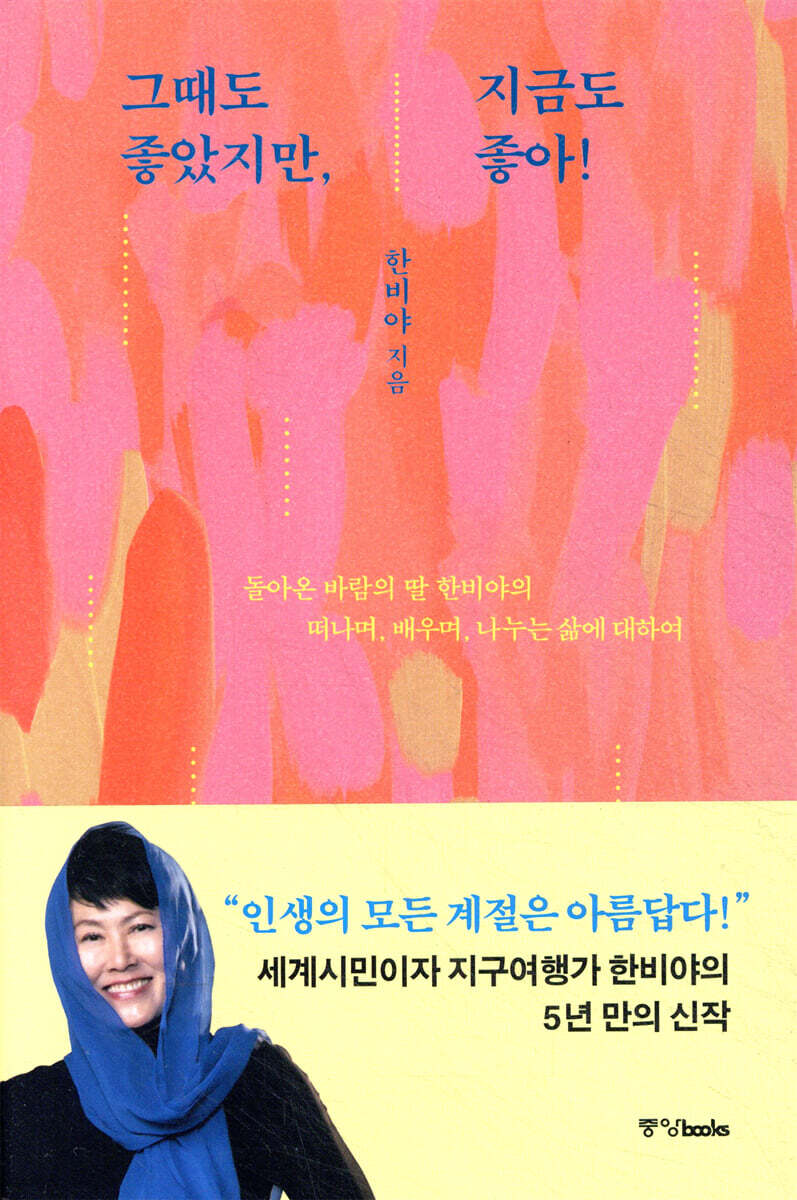
It was good then, and it's good now!
 |
Description
Book Introduction
Han Bi-ya, a representative Korean traveler and international relief activist, widely known by the nickname “Daughter of the Wind,” has published her new book, “It Was Good Then, It’s Good Now!” (Jungang Books), after five years.
In this book, Hanbiya conveys the lessons she learned in the latter half of her life, such as 'how to walk slowly,' 'the joy of sharing,' and 'the joy of learning,' in her characteristically cheerful and warm voice.
In this book, Hanbiya conveys the lessons she learned in the latter half of her life, such as 'how to walk slowly,' 'the joy of sharing,' and 'the joy of learning,' in her characteristically cheerful and warm voice.
index
Prologue: The Return of the Wind's Daughter
Chapter 1 To you who only runs like a racehorse
I'm learning how to walk slowly.
'Ssaksseuil' and 'I'll Pay' while Going Around and Helping
My Happiness Routine: Making One Person Happy a Day
Discover Your Inner Person Project I
Discover Your Inner Person Project II
Chapter 2: Global Citizen, Hanbiya
Worn-out left knee, once a servant, now a master
The Joy of Turning a Rats into Eagles: Undergraduate Courses
Teaching and Learning, Teaching and Learning: Graduate School Classes
I live in a global home, not a global village.
20 Years of My Soul: World Citizen School
This is a Rohingya refugee camp in Bangladesh.
Rohingya refugees: Is there really no tomorrow?
Chapter 3: There are difficult journeys, but there are no bad journeys.
A world trip that started with running away from home
Daughter of the Wind Season 2: A Trip with a Buddy
Analog Travelers in the Digital Age
Studying a foreign language while traveling is like sweeping the yard and collecting coins.
Now is the time to travel 'selfishly'
Wise Travel: Apart and Together
Chapter 4 It was good then, and it's good now!
Hanbiya's Retirement School
The "Fate Train Theory": Not being obsessed with passing relationships
Four Mantras for Living Peacefully
There is a time for everything: now is the best time in life.
It was good then, and it's good now
Epilogue To the readers who have stayed by my side
Chapter 1 To you who only runs like a racehorse
I'm learning how to walk slowly.
'Ssaksseuil' and 'I'll Pay' while Going Around and Helping
My Happiness Routine: Making One Person Happy a Day
Discover Your Inner Person Project I
Discover Your Inner Person Project II
Chapter 2: Global Citizen, Hanbiya
Worn-out left knee, once a servant, now a master
The Joy of Turning a Rats into Eagles: Undergraduate Courses
Teaching and Learning, Teaching and Learning: Graduate School Classes
I live in a global home, not a global village.
20 Years of My Soul: World Citizen School
This is a Rohingya refugee camp in Bangladesh.
Rohingya refugees: Is there really no tomorrow?
Chapter 3: There are difficult journeys, but there are no bad journeys.
A world trip that started with running away from home
Daughter of the Wind Season 2: A Trip with a Buddy
Analog Travelers in the Digital Age
Studying a foreign language while traveling is like sweeping the yard and collecting coins.
Now is the time to travel 'selfishly'
Wise Travel: Apart and Together
Chapter 4 It was good then, and it's good now!
Hanbiya's Retirement School
The "Fate Train Theory": Not being obsessed with passing relationships
Four Mantras for Living Peacefully
There is a time for everything: now is the best time in life.
It was good then, and it's good now
Epilogue To the readers who have stayed by my side
Detailed image

Into the book
I never really learned how to walk slowly.
There are many plausible sayings like “live at your own pace” and “it’s okay to take it slow,” but it’s hard to find people who actually live that way.
I was always anxious that I would fall behind if I lived slowly, and anxious that I would be pushed aside if I lived at my own pace.
So I ran and ran, even blindfolded.
--- p.20
When I worked at World Vision, I helped and rescued hundreds of thousands of people with funds worth hundreds of billions of won.
That's also why I'm called 'big hand' even though I have small hands.
But systematized, large-scale support inevitably leaves out blind spots where the most desperate people are left out.
There are also structural limitations that prevent us from providing immediate assistance in urgent situations.
On the other hand, 'I'll pay for it' is 120 out of 100 in effectiveness, efficiency, and satisfaction because I can directly help the person in front of me with my own money according to my own judgment.
--- p.25
If you look around carefully, you will see that there are people in need of help everywhere, both domestically and internationally.
No need for grand scale or special methods.
All it takes is one thought, sent to one person, one day.
The great help we receive throughout our lives remains in our hearts, but isn't it the small, heartfelt touches and glances that keep us warm for a long time?
--- p.41
Little feet that decided to walk, little hands that decided to give! Finding a way to live well, a way to live true to myself, isn't a grand task.
I think it all starts with, 'How do I walk today and how do I use my hands?'
Because those small, repeated actions every day accumulate to create my life, and that life will surely gradually lead me to become the person I want to be.
--- p.71
Anyone over 60 is bound to have a few creaks or two in one or two places.
It may be because humans are organisms with a set 'shelf life', but this is especially true for body parts that have been overused since childhood, like mine.
So, rather than a breakdown or malfunction, this is a sign that a long-standing component has done its job, and a bill for completing the task assigned to me.
--- p.81
The biggest feature of my class is that it is field-oriented.
This is a method of directly applying learned theories to real-world cases.
Half of the three-hour class is devoted to theory, while the other half consists of country-specific case studies, student presentations, and discussions.
To do this, I have to study as hard as a student for 16 weeks.
So, for two days before class, I read related papers and reports, analyze the latest field situations and issues, and create teaching materials.
New experiences and information from relief efforts brought in each year—from South Sudan in 2022, Rwanda in 2023, and the Rohingya refugee camps in Bangladesh in 2024—make these lively classes possible.
--- p.94
The Rohingya are called "Bengali Kala" (black people from the Bay of Bengal) and are subject to strict controls on movement, occupation, marriage, number of children, and education.
Even when going to a neighboring town, you need a separate pass, and there is a curfew after 6 PM.
There are also reports that couples are given permission to marry on the condition that they have only one child, and those who have more than one face huge fines or up to 10 years in prison.
--- p.118
Whether you travel alone, in pairs, or in groups, the essence of travel is the same.
It's about breaking away from my familiar routine and entering an unfamiliar world to have fun and interesting times, finding out what I want in that time and meeting my true self, encouraging and recharging myself as I encounter myself, and thus, liking myself more.
I think it doesn't matter if you're alone or with someone, as long as you can take care of this.
But what if you set out with that expectation in mind, only to find it difficult to actually pack it? In that case, I recommend closing your eyes and boldly going "separately, yet together."
--- p.214
In January 2023, Hanbiya's retirement school opened its doors.
And the only freshman was admitted.
(That's me!) As a principal, teacher, and student, I personally designed a curriculum optimized for my own goals and standards to coincide with the opening of the school.
The retirement school is a four-year system, with each grade being five years long, so it was a perfect fit.
It is divided into 1st grade (65-69 years old), 2nd grade (70-74 years old), 3rd grade (75-79 years old), and 4th grade (80+), and each grade will be flexibly adjusted according to the physical, financial, social, and emotional state of that period.
--- p.224
“Honestly, the good times are all gone.
Some people might ask, “What else is there left at this hour when the sun is setting and darkness is falling?”
I think differently.
While morning or midday may be appropriate for growth and achievement, evening or night is much more appropriate for maturity and leisure.
There is no one time that fits everything.
What matters is where you focus and how you view life as a whole.
There are many plausible sayings like “live at your own pace” and “it’s okay to take it slow,” but it’s hard to find people who actually live that way.
I was always anxious that I would fall behind if I lived slowly, and anxious that I would be pushed aside if I lived at my own pace.
So I ran and ran, even blindfolded.
--- p.20
When I worked at World Vision, I helped and rescued hundreds of thousands of people with funds worth hundreds of billions of won.
That's also why I'm called 'big hand' even though I have small hands.
But systematized, large-scale support inevitably leaves out blind spots where the most desperate people are left out.
There are also structural limitations that prevent us from providing immediate assistance in urgent situations.
On the other hand, 'I'll pay for it' is 120 out of 100 in effectiveness, efficiency, and satisfaction because I can directly help the person in front of me with my own money according to my own judgment.
--- p.25
If you look around carefully, you will see that there are people in need of help everywhere, both domestically and internationally.
No need for grand scale or special methods.
All it takes is one thought, sent to one person, one day.
The great help we receive throughout our lives remains in our hearts, but isn't it the small, heartfelt touches and glances that keep us warm for a long time?
--- p.41
Little feet that decided to walk, little hands that decided to give! Finding a way to live well, a way to live true to myself, isn't a grand task.
I think it all starts with, 'How do I walk today and how do I use my hands?'
Because those small, repeated actions every day accumulate to create my life, and that life will surely gradually lead me to become the person I want to be.
--- p.71
Anyone over 60 is bound to have a few creaks or two in one or two places.
It may be because humans are organisms with a set 'shelf life', but this is especially true for body parts that have been overused since childhood, like mine.
So, rather than a breakdown or malfunction, this is a sign that a long-standing component has done its job, and a bill for completing the task assigned to me.
--- p.81
The biggest feature of my class is that it is field-oriented.
This is a method of directly applying learned theories to real-world cases.
Half of the three-hour class is devoted to theory, while the other half consists of country-specific case studies, student presentations, and discussions.
To do this, I have to study as hard as a student for 16 weeks.
So, for two days before class, I read related papers and reports, analyze the latest field situations and issues, and create teaching materials.
New experiences and information from relief efforts brought in each year—from South Sudan in 2022, Rwanda in 2023, and the Rohingya refugee camps in Bangladesh in 2024—make these lively classes possible.
--- p.94
The Rohingya are called "Bengali Kala" (black people from the Bay of Bengal) and are subject to strict controls on movement, occupation, marriage, number of children, and education.
Even when going to a neighboring town, you need a separate pass, and there is a curfew after 6 PM.
There are also reports that couples are given permission to marry on the condition that they have only one child, and those who have more than one face huge fines or up to 10 years in prison.
--- p.118
Whether you travel alone, in pairs, or in groups, the essence of travel is the same.
It's about breaking away from my familiar routine and entering an unfamiliar world to have fun and interesting times, finding out what I want in that time and meeting my true self, encouraging and recharging myself as I encounter myself, and thus, liking myself more.
I think it doesn't matter if you're alone or with someone, as long as you can take care of this.
But what if you set out with that expectation in mind, only to find it difficult to actually pack it? In that case, I recommend closing your eyes and boldly going "separately, yet together."
--- p.214
In January 2023, Hanbiya's retirement school opened its doors.
And the only freshman was admitted.
(That's me!) As a principal, teacher, and student, I personally designed a curriculum optimized for my own goals and standards to coincide with the opening of the school.
The retirement school is a four-year system, with each grade being five years long, so it was a perfect fit.
It is divided into 1st grade (65-69 years old), 2nd grade (70-74 years old), 3rd grade (75-79 years old), and 4th grade (80+), and each grade will be flexibly adjusted according to the physical, financial, social, and emotional state of that period.
--- p.224
“Honestly, the good times are all gone.
Some people might ask, “What else is there left at this hour when the sun is setting and darkness is falling?”
I think differently.
While morning or midday may be appropriate for growth and achievement, evening or night is much more appropriate for maturity and leisure.
There is no one time that fits everything.
What matters is where you focus and how you view life as a whole.
--- p.263
Publisher's Review
Now is the time to learn how to walk well, not how to run well!
Why Han Bi-ya, from "The Return of the Wind," Talks About the "Pace of Life"
Hanbiya's life was always 'forward, further'.
In my 20s, I quit my job and walked the world, in my 40s, I saved lives at disaster sites, and in my 50s, I taught students about global citizenship.
He always ran without rest, without stopping.
But at some point, I realized that 'running' was not the answer to life.
In his new book, “It Was Good Then, It’s Good Now!”, he tells the story of his life as a “retired racehorse” and confesses:
“You don’t have to run like a racehorse anymore.
If you've run well enough, it's time to learn to walk for yourself."
In this book, the author describes the process of learning to let go of the rushed life and walk slowly, and delivers a warm message to modern people who are tired of competition and speed: “Now is the time to learn how to walk well, not how to run well.”
A life that makes at least one person happy every day.
How to faithfully love this moment, the present!
"It Was Good Then, It's Good Now!" contains Hanbiya's signature small, practical humor, such as "making just one person happy a day" through a single glance, a single word, or a single concern.
Additionally, the author shares the life wisdom he has learned while traveling the world through vivid experiences, and asks again about the meaning of 'help' and the essence of 'happiness'.
Through the stories of people we meet at relief sites and on remote trips, we are reminded of the power of gratitude and solidarity.
The author, who still places gratitude and love at the center of his life, is grateful that he can still learn and laugh even in the harsh reality through the heart of an African girl who said, "This is enough," the memory of a warm day shared over a bowl of noodles, and the small but deep helping hands extended along his travels.
This book is a greeting from the author to both the world and himself, and a warm encouragement to adults who are tired of vague worries and anxieties about the future, saying, "It's okay as it is now."
Why Han Bi-ya, from "The Return of the Wind," Talks About the "Pace of Life"
Hanbiya's life was always 'forward, further'.
In my 20s, I quit my job and walked the world, in my 40s, I saved lives at disaster sites, and in my 50s, I taught students about global citizenship.
He always ran without rest, without stopping.
But at some point, I realized that 'running' was not the answer to life.
In his new book, “It Was Good Then, It’s Good Now!”, he tells the story of his life as a “retired racehorse” and confesses:
“You don’t have to run like a racehorse anymore.
If you've run well enough, it's time to learn to walk for yourself."
In this book, the author describes the process of learning to let go of the rushed life and walk slowly, and delivers a warm message to modern people who are tired of competition and speed: “Now is the time to learn how to walk well, not how to run well.”
A life that makes at least one person happy every day.
How to faithfully love this moment, the present!
"It Was Good Then, It's Good Now!" contains Hanbiya's signature small, practical humor, such as "making just one person happy a day" through a single glance, a single word, or a single concern.
Additionally, the author shares the life wisdom he has learned while traveling the world through vivid experiences, and asks again about the meaning of 'help' and the essence of 'happiness'.
Through the stories of people we meet at relief sites and on remote trips, we are reminded of the power of gratitude and solidarity.
The author, who still places gratitude and love at the center of his life, is grateful that he can still learn and laugh even in the harsh reality through the heart of an African girl who said, "This is enough," the memory of a warm day shared over a bowl of noodles, and the small but deep helping hands extended along his travels.
This book is a greeting from the author to both the world and himself, and a warm encouragement to adults who are tired of vague worries and anxieties about the future, saying, "It's okay as it is now."
GOODS SPECIFICS
- Date of issue: November 24, 2025
- Page count, weight, size: 280 pages | 414g | 133*200*20mm
- ISBN13: 9788927881285
- ISBN10: 8927881281
You may also like
카테고리
korean


korean

![GQ KOREA Mark (Monthly): December [2025]](http://librairie.coreenne.fr/cdn/shop/files/8ef265dbbfbf186523ed75ba7319009d.jpg?v=1765340328&width=3840)


