

bare tree
 |
Description
Book Introduction
The vast literary forest of Park Wan-seo, which began with a single tree
A new edition to preserve meaningful footsteps for a long time!
The debut work of the ever-active Park Wan-seo, "Namok"
The 'Park Wan-seo Archive Edition' has been published to preserve the meaningful footsteps of Park Wan-seo, a giant of Korean literature.
『Namok』, newly presented in the Park Wan-seo Archive Edition, is the debut work that forms the foundation of author Park Wan-seo's 40-year career.
This work, which contains the author's autobiographical experiences during the Korean War, is the author's most beloved work, written 'at the age of forty, but with the young, kind, and pure heart of a man barely under twenty,' and is a full-length novel recognized for its popularity and artistic value, making it a representative work that must be introduced when looking back on his footsteps.
World History is continuing its project of introducing the precious legacy of author Park Wan-seo with a new cover to share it with readers.
This Park Wan-seo Archive Edition is the new name for a long-term project on world history, based on the belief that Park Wan-seo's literature, imbued with a profound understanding of the times and people, is a Korean classic and a meaningful work that transcends time, securing contemporaneity and universality.
As part of this project, the publication of the definitive edition of Park Wan-seo's essays, "Even if it's a grain of sand-sized truth" and "Not feeling the weight of love," confirmed readers' interest and affection by introducing Park Wan-seo's side as an essayist and the inherent charm of her prose.
In this newly released edition, we have meticulously considered the editing, binding, and overall design to convey the significance of 『Namok』 and enhance its collection value.
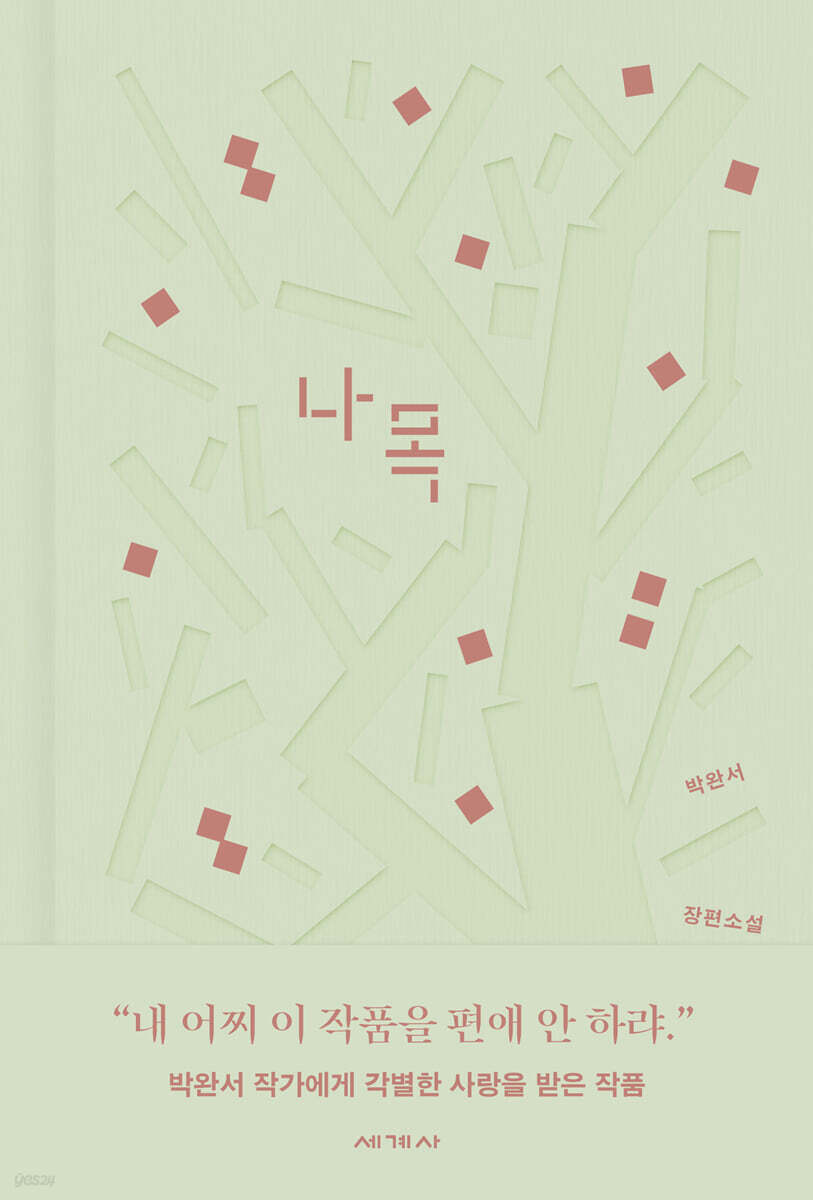
I tried to effectively reveal the meaning and characteristics of the title, ‘Naked Tree,’ so that the work itself can be felt just by looking at the cover.
With low-saturation warm colors and wood grain texture as the central motif, the image of 'wood' was expressed three-dimensionally throughout the cover by expressing the wood through post-processing (engraving) and using special paper to create the wood texture.
In addition, the cover, belt, and ribbon were unified in a dark green color to add aesthetic elements and meaning.
The color of olive is olive, and it symbolizes the long history of the olive tree, its sustainable survival, the power of perseverance, peace, and hope. It adds meaning to the 'bare tree' that has taken firm root despite the scars of war and bravely survives the winter while maintaining "faith in the distant spring."
A new edition to preserve meaningful footsteps for a long time!
The debut work of the ever-active Park Wan-seo, "Namok"
The 'Park Wan-seo Archive Edition' has been published to preserve the meaningful footsteps of Park Wan-seo, a giant of Korean literature.
『Namok』, newly presented in the Park Wan-seo Archive Edition, is the debut work that forms the foundation of author Park Wan-seo's 40-year career.
This work, which contains the author's autobiographical experiences during the Korean War, is the author's most beloved work, written 'at the age of forty, but with the young, kind, and pure heart of a man barely under twenty,' and is a full-length novel recognized for its popularity and artistic value, making it a representative work that must be introduced when looking back on his footsteps.
World History is continuing its project of introducing the precious legacy of author Park Wan-seo with a new cover to share it with readers.
This Park Wan-seo Archive Edition is the new name for a long-term project on world history, based on the belief that Park Wan-seo's literature, imbued with a profound understanding of the times and people, is a Korean classic and a meaningful work that transcends time, securing contemporaneity and universality.
As part of this project, the publication of the definitive edition of Park Wan-seo's essays, "Even if it's a grain of sand-sized truth" and "Not feeling the weight of love," confirmed readers' interest and affection by introducing Park Wan-seo's side as an essayist and the inherent charm of her prose.
In this newly released edition, we have meticulously considered the editing, binding, and overall design to convey the significance of 『Namok』 and enhance its collection value.
I tried to effectively reveal the meaning and characteristics of the title, ‘Naked Tree,’ so that the work itself can be felt just by looking at the cover.
With low-saturation warm colors and wood grain texture as the central motif, the image of 'wood' was expressed three-dimensionally throughout the cover by expressing the wood through post-processing (engraving) and using special paper to create the wood texture.
In addition, the cover, belt, and ribbon were unified in a dark green color to add aesthetic elements and meaning.
The color of olive is olive, and it symbolizes the long history of the olive tree, its sustainable survival, the power of perseverance, peace, and hope. It adds meaning to the 'bare tree' that has taken firm root despite the scars of war and bravely survives the winter while maintaining "faith in the distant spring."
- You can preview some of the book's contents.
Preview
index
· Author's Note
·· bare tree
··· Commentary on the work
The Birth of a Body in a State of War, or a Report on the Occupied Soul _ Kwon Myung-ah (Literary Critic, Professor, Dong-A University)
···· Tribute
That Great Light, Whispers, and Screams _Kim Geum-hee (novelist)
From a Far and Deep Place _Choi Eun-young (novelist)
·· bare tree
··· Commentary on the work
The Birth of a Body in a State of War, or a Report on the Occupied Soul _ Kwon Myung-ah (Literary Critic, Professor, Dong-A University)
···· Tribute
That Great Light, Whispers, and Screams _Kim Geum-hee (novelist)
From a Far and Deep Place _Choi Eun-young (novelist)
Detailed image
.jpg)
Into the book
But what was most unbearable was its gray stubbornness.
That terrifyingly stubborn stubbornness that refuses to back down even a little from the attitude of living reluctantly, unable to die.
The colorful desires that were stirring inside me, the desire to have fun in life, were growing weary in the face of this stubborn stubbornness.
--- p.18
Suddenly I find myself trying to recall a line from a poem I used to love.
The feeling of imitating others and borrowing something lost its interest and became dull when I realized it.
And only my unpretentious self remains.
All I could think was that it was scary and that it was cold.
It was all mine, and the feelings were intense and strong.
I started running down the dark road.
I kept thinking 'it's scary' and ran as if I was being pushed by 'it's scary' and 'it's cold'.
--- pp.33~34
He muttered to himself, his voice thick with fatigue and heartache.
I was about to say something in response, but then I shut my mouth.
This is because his fatigue and heartache were considered to be his own, unavoidable, something that could not be helped by the clumsy calculations or care of others - like his own body odor.
The sound of cannons echoed faintly in the northern sky.
My heart was pounding with fear and anticipation.
I didn't believe in peace, whether it was a victory or an armistice.
However, I knew that the war would just keep coming and going like a tidal wave, and that this would happen countless times in the future.
--- p.46
Before I knew it, she had moved to sit next to me, wrapped her arms around my back, and whispered something warm in my ear.
Her unique scent wafted through the air, like a combination of wildflowers and newborn wild animals.
It's so frustrating that she doesn't know she smells this good even in the gutter.
If the ground she stands on is a swamp, then the ground I stand on is a terrible, one-footed ground.
But how do I explain the meaning of that one step to her? It would probably be easier to explain the poem in English.
I really didn't want to be bothered and embarrassed by other people's business.
I decided to take the plunge.
--- p.164
I muttered quietly.
“Your wife is very beautiful, isn’t she?” “What color are her eyes?” “What color is her hair?” Fortunately, the words were left as a small murmur.
No matter how small it may be, it was the first Korean word I uttered today, but it was only Korean and was never my own.
I felt like I couldn't bear to leave without expressing my feelings and my thoughts.
I really wanted to express myself, even if it wasn't through words, even if it was through shouts or gestures.
--- p.166
I wiped the tears from my eyes, people dispersed, new people came, and I just stood there in a daze.
My head was blank and no thoughts came to mind.
I suddenly realized that the reason I was able to stand without falling or sliding to the ground was because someone was supporting me.
His support was skillful and comfortable.
A premonition came to me like a bright light.
I didn't look back and just enjoyed that feeling for a long time.
--- pp.168~169
I felt a fierce hostility towards her.
Hatred made everything in my heart tremble fiercely, and finally hatred filled my whole body.
I was content with my hatred for her.
Because now my feelings for her have become clear.
And I realized for the first time that hating others can be so satisfying and pleasurable.
--- p.329
I wanted to share my faults with other excuses, and furthermore, I wanted to believe that I had suffered enough for the faults I had committed.
I used to be very foolish and intimidated in front of idols, but I was more relaxed and cunning in front of the truth.
I decided to make up some other excuse for my brothers' deaths.
And be a little more generous to me.
How great a virtue it is to be generous.
--- p.331
But the trees stand proudly, without complaining, in perfect harmony with each other, and the women passing by during the kimchi-making season in the bitter cold.
Winter is before the eyes of the women, and the trees have faith in spring, though it is still far away.
Faith in spring.
The fact that the tree stands so proudly is precisely the faith in spring.
That terrifyingly stubborn stubbornness that refuses to back down even a little from the attitude of living reluctantly, unable to die.
The colorful desires that were stirring inside me, the desire to have fun in life, were growing weary in the face of this stubborn stubbornness.
--- p.18
Suddenly I find myself trying to recall a line from a poem I used to love.
The feeling of imitating others and borrowing something lost its interest and became dull when I realized it.
And only my unpretentious self remains.
All I could think was that it was scary and that it was cold.
It was all mine, and the feelings were intense and strong.
I started running down the dark road.
I kept thinking 'it's scary' and ran as if I was being pushed by 'it's scary' and 'it's cold'.
--- pp.33~34
He muttered to himself, his voice thick with fatigue and heartache.
I was about to say something in response, but then I shut my mouth.
This is because his fatigue and heartache were considered to be his own, unavoidable, something that could not be helped by the clumsy calculations or care of others - like his own body odor.
The sound of cannons echoed faintly in the northern sky.
My heart was pounding with fear and anticipation.
I didn't believe in peace, whether it was a victory or an armistice.
However, I knew that the war would just keep coming and going like a tidal wave, and that this would happen countless times in the future.
--- p.46
Before I knew it, she had moved to sit next to me, wrapped her arms around my back, and whispered something warm in my ear.
Her unique scent wafted through the air, like a combination of wildflowers and newborn wild animals.
It's so frustrating that she doesn't know she smells this good even in the gutter.
If the ground she stands on is a swamp, then the ground I stand on is a terrible, one-footed ground.
But how do I explain the meaning of that one step to her? It would probably be easier to explain the poem in English.
I really didn't want to be bothered and embarrassed by other people's business.
I decided to take the plunge.
--- p.164
I muttered quietly.
“Your wife is very beautiful, isn’t she?” “What color are her eyes?” “What color is her hair?” Fortunately, the words were left as a small murmur.
No matter how small it may be, it was the first Korean word I uttered today, but it was only Korean and was never my own.
I felt like I couldn't bear to leave without expressing my feelings and my thoughts.
I really wanted to express myself, even if it wasn't through words, even if it was through shouts or gestures.
--- p.166
I wiped the tears from my eyes, people dispersed, new people came, and I just stood there in a daze.
My head was blank and no thoughts came to mind.
I suddenly realized that the reason I was able to stand without falling or sliding to the ground was because someone was supporting me.
His support was skillful and comfortable.
A premonition came to me like a bright light.
I didn't look back and just enjoyed that feeling for a long time.
--- pp.168~169
I felt a fierce hostility towards her.
Hatred made everything in my heart tremble fiercely, and finally hatred filled my whole body.
I was content with my hatred for her.
Because now my feelings for her have become clear.
And I realized for the first time that hating others can be so satisfying and pleasurable.
--- p.329
I wanted to share my faults with other excuses, and furthermore, I wanted to believe that I had suffered enough for the faults I had committed.
I used to be very foolish and intimidated in front of idols, but I was more relaxed and cunning in front of the truth.
I decided to make up some other excuse for my brothers' deaths.
And be a little more generous to me.
How great a virtue it is to be generous.
--- p.331
But the trees stand proudly, without complaining, in perfect harmony with each other, and the women passing by during the kimchi-making season in the bitter cold.
Winter is before the eyes of the women, and the trees have faith in spring, though it is still far away.
Faith in spring.
The fact that the tree stands so proudly is precisely the faith in spring.
--- p.391
Publisher's Review
Twenty years old, a desolate memory of pure youth
The anxiety and sadness of an era deeply imbued with the afterglow of war
"Namok" is a meaningful work in that it is the first story to enter the vast world of "Park Wan-seo," which still holds a deep place in our hearts.
Author Park Wan-seo has produced numerous works that touch the heart through her 40-year career, starting with “Namok” in 1970.
From prose steeped in the colorful landscapes of everyday life and the simple, beautiful life of the author, to novels heavily imbued with the immense cultural impact that transcended him, including the Sino-Japanese War, World War II, and the Korean War.
The turbulent times were clearly and completely captured in the language of life.
In particular, 『Namok』 is the debut and representative work of author Park Wan-seo, and is also known as the author's most beloved work.
This is also the work that best reveals the important background of Park Wan-seo's literature, namely the scars of war and hardship.
1.4 After the retreat, in a dark and anxious period, this work vividly tells the story of the scars of war, love, and sincerity for art of the people left behind in the empty Seoul from the perspective of a twenty-year-old woman working in the portrait department of a PX (a store within a military base). It is a novel written by the real-life author Park Wan-seo, recalling the artist Park Su-geun, whom she met while working in the portrait department of the PX when she was twenty.
The reverence for life shown by the characters in the novel is amplified through the symbolism of the 'bare tree' that sheds its leaves and silently endures winter, creating a profound message of hope and healing that leaves a lasting impression on the reader.
“It is still a long way for me, but I have faith in spring.
“The tree’s stillness must be the very faith in spring.” - From “Namok”
War and its scars are common themes in Korean literature, but in Park Wan-seo's works, the era and its characters feel even more vivid.
Stories set in the distant past yet feel relatable. The reason why Park Wan-seo's works transcend time yet remain infinitely contemporary is because her deep understanding of humanity and broad insight into life are fully imbued into her stories.
Park Wan-seo's literature truly reaches us again today with its universality that transcends time.
Reading "Namok" while thinking about the author's heart and perspective, what message he was trying to convey through this story, full of autobiographical elements, the wounds of a dark time and life in the shadows, the characters' psychology and attitude toward life, will be a great reading experience that will allow you to feel its depth.
The anxiety and sadness of an era deeply imbued with the afterglow of war
"Namok" is a meaningful work in that it is the first story to enter the vast world of "Park Wan-seo," which still holds a deep place in our hearts.
Author Park Wan-seo has produced numerous works that touch the heart through her 40-year career, starting with “Namok” in 1970.
From prose steeped in the colorful landscapes of everyday life and the simple, beautiful life of the author, to novels heavily imbued with the immense cultural impact that transcended him, including the Sino-Japanese War, World War II, and the Korean War.
The turbulent times were clearly and completely captured in the language of life.
In particular, 『Namok』 is the debut and representative work of author Park Wan-seo, and is also known as the author's most beloved work.
This is also the work that best reveals the important background of Park Wan-seo's literature, namely the scars of war and hardship.
1.4 After the retreat, in a dark and anxious period, this work vividly tells the story of the scars of war, love, and sincerity for art of the people left behind in the empty Seoul from the perspective of a twenty-year-old woman working in the portrait department of a PX (a store within a military base). It is a novel written by the real-life author Park Wan-seo, recalling the artist Park Su-geun, whom she met while working in the portrait department of the PX when she was twenty.
The reverence for life shown by the characters in the novel is amplified through the symbolism of the 'bare tree' that sheds its leaves and silently endures winter, creating a profound message of hope and healing that leaves a lasting impression on the reader.
“It is still a long way for me, but I have faith in spring.
“The tree’s stillness must be the very faith in spring.” - From “Namok”
War and its scars are common themes in Korean literature, but in Park Wan-seo's works, the era and its characters feel even more vivid.
Stories set in the distant past yet feel relatable. The reason why Park Wan-seo's works transcend time yet remain infinitely contemporary is because her deep understanding of humanity and broad insight into life are fully imbued into her stories.
Park Wan-seo's literature truly reaches us again today with its universality that transcends time.
Reading "Namok" while thinking about the author's heart and perspective, what message he was trying to convey through this story, full of autobiographical elements, the wounds of a dark time and life in the shadows, the characters' psychology and attitude toward life, will be a great reading experience that will allow you to feel its depth.
GOODS SPECIFICS
- Date of issue: May 21, 2024
- Page count, weight, size: 420 pages | 685g | 135*205*30mm
- ISBN13: 9788933872390
- ISBN10: 8933872396
You may also like
카테고리
korean


korean

![ELLE 엘르 스페셜 에디션 A형 : 12월 [2025]](http://librairie.coreenne.fr/cdn/shop/files/b8e27a3de6c9538896439686c6b0e8fb.jpg?v=1766436872&width=3840)


