

Time to collect sand grains
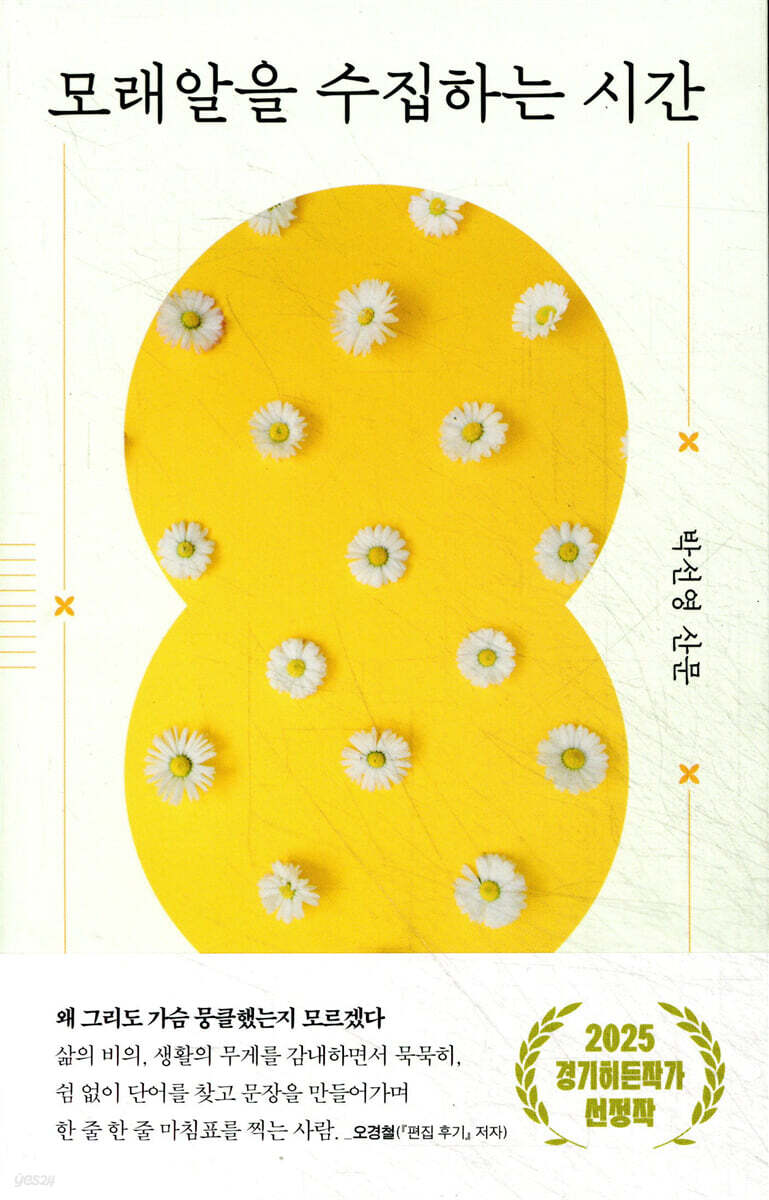 |
Description
Book Introduction
“Maybe everything in life is ‘suddenly’.”
Days like sand that fill the gaps in life
Silently bearing the burden of life, the rain of life,
A person who constantly searches for words, creates sentences, and puts periods at the end of each line.
_Oh Gyeong-cheol (author of "Editorial Postscript")
A piece that unravels the thread that will help us unravel our weary and painful lives.
_Yoon Dong-hee (CEO of Book Nomad)
Like the crescent moon at midday, I felt a faint, faint glimmer of hope, though it was not readily visible.
_Kim Ji-hye (novelist)
Meet Gyeonggi Province's Hidden Treasures: "Hidden Writers"
The Gyeonggi Hidden Writer Project, which supports writers with limitless potential to grow into the future of Korean literature, has published the essay "Time to Collect Grains of Sand" by Park Seon-yeong, the winner of the prose category.
This book carefully revives the most subtle knots that pass us by in our daily lives.
The four parts follow the cycle of the seasons, each season corresponding to the emotional line of life.
In autumn, there is a sense of beginning, a wavering and hesitant heart; in winter, there is the origin of memories that explain life; in spring, there is a sense of recovery that reaches out and revives; and in summer, there is the warmth that finally accepts the meaning of life.
The flow of seasons felt in the book resembles the rhythm experienced by the inner self of a human being.
The author has been working as a mathematics instructor for a long time and has dealt with numbers and formulas.
But at some point, I began to lean towards the world of literature, where each person finds their own unique answer, rather than a world where there is only one right answer.
Realizing that emotions last longer than calculations and words last longer than formulas, he decided to do what was close to his heart.
"Time to Collect Grains of Sand" is the first record of my second life that began that way.
Days like sand that fill the gaps in life
Silently bearing the burden of life, the rain of life,
A person who constantly searches for words, creates sentences, and puts periods at the end of each line.
_Oh Gyeong-cheol (author of "Editorial Postscript")
A piece that unravels the thread that will help us unravel our weary and painful lives.
_Yoon Dong-hee (CEO of Book Nomad)
Like the crescent moon at midday, I felt a faint, faint glimmer of hope, though it was not readily visible.
_Kim Ji-hye (novelist)
Meet Gyeonggi Province's Hidden Treasures: "Hidden Writers"
The Gyeonggi Hidden Writer Project, which supports writers with limitless potential to grow into the future of Korean literature, has published the essay "Time to Collect Grains of Sand" by Park Seon-yeong, the winner of the prose category.
This book carefully revives the most subtle knots that pass us by in our daily lives.
The four parts follow the cycle of the seasons, each season corresponding to the emotional line of life.
In autumn, there is a sense of beginning, a wavering and hesitant heart; in winter, there is the origin of memories that explain life; in spring, there is a sense of recovery that reaches out and revives; and in summer, there is the warmth that finally accepts the meaning of life.
The flow of seasons felt in the book resembles the rhythm experienced by the inner self of a human being.
The author has been working as a mathematics instructor for a long time and has dealt with numbers and formulas.
But at some point, I began to lean towards the world of literature, where each person finds their own unique answer, rather than a world where there is only one right answer.
Realizing that emotions last longer than calculations and words last longer than formulas, he decided to do what was close to his heart.
"Time to Collect Grains of Sand" is the first record of my second life that began that way.
index
Part 1: Autumn, Hesitation
Hongok | Fandom | Pure Love | Viewing | Writing | Immersion | Hesitation
Part 2 Winter, Reason
Apartment | Briquettes | Dream | See-off | Camellia | Largo | Driveway
Part 3 Spring, continued
Bracken | Pond | Daffodils | Hydrangeas | Gluttony | Thief | Encouragement
Part 4 Summer, Meaning
Tip of the tongue | Chatter | Longing | Sand | Cold noodles | Rearrangement | Summer
Author's Note
Hongok | Fandom | Pure Love | Viewing | Writing | Immersion | Hesitation
Part 2 Winter, Reason
Apartment | Briquettes | Dream | See-off | Camellia | Largo | Driveway
Part 3 Spring, continued
Bracken | Pond | Daffodils | Hydrangeas | Gluttony | Thief | Encouragement
Part 4 Summer, Meaning
Tip of the tongue | Chatter | Longing | Sand | Cold noodles | Rearrangement | Summer
Author's Note
Detailed image

Into the book
As summer fades and the weather becomes neither too hot nor too cold, rubies begin to appear.
Because the shipping period is short, it comes to the market at the end of September and disappears quickly, so you have to pick it to taste it.
After taking a bite of the red jade, I finally feel that autumn has come.
--- p.9
It's already been 10 years, a long time since he left.
I am older than the age he stopped at.
As I was writing this, I kept listening to the countless famous songs he left behind.
It was the 10th anniversary memorial service for Shin Hae-chul, which was held alone.
Listening to the music of that time brought back memories of that time filled with fiery passion.
--- p.20
Rather than saying ‘reading a book slowly,’ it would be more appropriate to say ‘slowly engraving a book.’
I was slightly impressed by H's reading, which was like breaking down each sentence into pieces.
The sentences I wrote down quickly sparkled until the ink dried.
“This is my first time reading a book like this,” said H.
“This must be your first time reading a book,” I muttered.
Ignoring my babbling, H described his first reading experience like this:
“It feels like I’m engraving each and every sentence into my body.”
--- p.38
That winter, I sometimes remember the short writings that passed through me.
Why do people want to write about their wounds? Is it because they harbor deep wounds, yearning for comfort and empathy, that they can't help but write? I wonder if writing has become a healing process for them.
I enrolled in the class to learn how to write, but it was a half-assed winter class where I just kept wondering why I wanted to write.
It took a while for it to get warm again.
--- pp.98-99
The bracken in my freezer will turn into plump bracken if I soak it in water and boil it.
How wonderful it would be if we could go back to the time when our family used to pick bracken.
And, I hope Dad is resting comfortably in a peaceful place like Merchewat.
As the bracken rainy season ends in Jeju Island, cherry blossoms begin to bloom in profusion on the mainland where I live.
--- p.111
Now, books in the waiting room are not put in bags.
Because I want to believe that there will definitely be people like me who will look for books in the waiting room.
I would be really happy if I found someone reading a book in the waiting room.
A person who knows the pleasure of reading a book that is there while waiting for his turn.
But it won't be as fun as sneaking a book from the waiting room.
I felt like I had found the book.
And that book was read better than any other book.
--- p.148
We tried to bury our complicated feelings again.
As we begin to realize that joy, sorrow, and sorrow can all come at the same time, we find the resolve to make death a part of our daily lives.
--- pp.190-191
There's a great bookstore in the neighborhood where I live.
At the reading group held there, you must use a nickname instead of your real name.
It was a device to forget the status and social responsibility attached to one's name and exist solely as a 'me' who reads books.
My nickname is 'Summer'.
I love summer, so I built it without hesitation.
If you called me 'Summer' at a gathering, I wouldn't have to say I like summer every time.
Because the shipping period is short, it comes to the market at the end of September and disappears quickly, so you have to pick it to taste it.
After taking a bite of the red jade, I finally feel that autumn has come.
--- p.9
It's already been 10 years, a long time since he left.
I am older than the age he stopped at.
As I was writing this, I kept listening to the countless famous songs he left behind.
It was the 10th anniversary memorial service for Shin Hae-chul, which was held alone.
Listening to the music of that time brought back memories of that time filled with fiery passion.
--- p.20
Rather than saying ‘reading a book slowly,’ it would be more appropriate to say ‘slowly engraving a book.’
I was slightly impressed by H's reading, which was like breaking down each sentence into pieces.
The sentences I wrote down quickly sparkled until the ink dried.
“This is my first time reading a book like this,” said H.
“This must be your first time reading a book,” I muttered.
Ignoring my babbling, H described his first reading experience like this:
“It feels like I’m engraving each and every sentence into my body.”
--- p.38
That winter, I sometimes remember the short writings that passed through me.
Why do people want to write about their wounds? Is it because they harbor deep wounds, yearning for comfort and empathy, that they can't help but write? I wonder if writing has become a healing process for them.
I enrolled in the class to learn how to write, but it was a half-assed winter class where I just kept wondering why I wanted to write.
It took a while for it to get warm again.
--- pp.98-99
The bracken in my freezer will turn into plump bracken if I soak it in water and boil it.
How wonderful it would be if we could go back to the time when our family used to pick bracken.
And, I hope Dad is resting comfortably in a peaceful place like Merchewat.
As the bracken rainy season ends in Jeju Island, cherry blossoms begin to bloom in profusion on the mainland where I live.
--- p.111
Now, books in the waiting room are not put in bags.
Because I want to believe that there will definitely be people like me who will look for books in the waiting room.
I would be really happy if I found someone reading a book in the waiting room.
A person who knows the pleasure of reading a book that is there while waiting for his turn.
But it won't be as fun as sneaking a book from the waiting room.
I felt like I had found the book.
And that book was read better than any other book.
--- p.148
We tried to bury our complicated feelings again.
As we begin to realize that joy, sorrow, and sorrow can all come at the same time, we find the resolve to make death a part of our daily lives.
--- pp.190-191
There's a great bookstore in the neighborhood where I live.
At the reading group held there, you must use a nickname instead of your real name.
It was a device to forget the status and social responsibility attached to one's name and exist solely as a 'me' who reads books.
My nickname is 'Summer'.
I love summer, so I built it without hesitation.
If you called me 'Summer' at a gathering, I wouldn't have to say I like summer every time.
--- p.201
Publisher's Review
A heart that holds onto small moments
A place where memories come back to life
Words like 'hong jade', 'yoga mat', 'pillar', 'briquette', and 'pond' appear not simply as materials, but as fragments of time, as traces left on the surface of emotions.
The author conjures up forgotten memories through objects and examines the rhythm and weight of a human life.
At the heart of this book is the author's meticulous observations that nonchalantly reveal layers of emotion.
In the first essay, “Red Jade,” the author talks about the process by which memories related to apples are recalled every time autumn begins.
Just one bite of sourness melts into the fears, excitement, and anxiety of childhood before exams.
Apples in those days were not just simple fruits, but seasonal comforts that made us forget our fears for a moment.
The following "Fan Heart" shows the reckless and pure passion of a teenager in the 1980s.
The adventure of heading to Gwangju to see Shin Hae-chul and Muhan Orbit perform shows how passion can soothe the anxieties of youth.
In "Pure Love," the yoga mat "Manduka" is used as a medium to depict memories and self-confidence contained in trivial objects.
The reason I can't throw away the sweat-stained mat is because the time I once "immersed myself to the point of feeling unfamiliar" remains intact on it.
Also, in the "Transcription" section, the essence of the act of living by reading and engraving slowly is shown through the husband's figure copying sentences by hand.
The author says that only by copying letters does he “feel like he is engraving each and every sentence into his body.”
In this book, personal memories expand into layers of social landscape and emotions.
In works like “Apartment” and “Coal Briquettes,” the formation of the middle class and the family’s survival in the 1980s are intertwined.
The old wallpaper of Mugunghwa Apartments, the smell of coal briquettes, and the milky smell of Gomguk go beyond the daily life of a single family and spread to the history of modern Korean housing culture and generational experiences.
Furthermore, "Immersion" captures people who still read books and knit even in the attention-deficit era of the smartphone, and asks again about the ethics of concentration and the aesthetics of slowness.
All these scenes remind us of the lost sense of immersion and concentration.
Rediscovering myself in the sediments of time
This book begins with an attitude of looking at the residue of everyday life.
The moments we thought were passing by are not actually gone, but are gradually deposited into our lives in invisible layers.
This book quietly shows how the texture of the time we have lived through shapes our present emotions and thoughts, tracing each layer one by one.
What's important here is how we look back on the past.
In the author's writing, rather than the narrative of a specific event or character, very small details, nuances, and emotional fluctuations slowly emerge from the sentences.
The purpose of reminiscence is not to embellish memories or neatly organize a period of time.
It's more like quietly observing how life has unfolded over time.
These narratives distance themselves from any attempt to explain or organize life.
Instead, I respect the speed at which memories emerge on their own and try to avoid damaging the subtle traces left behind by my mind at that time.
So in this book, the past is not a complete story, but exists as a sense that is still loosely connected to the present.
The phrase "collecting grains of sand" means giving space to moments that seem like they will soon disappear, and waiting for those moments to create meaning in life again.
"Time to Collect Grains of Sand" contains a quiet desire to re-evaluate the time that has already passed, and shows that life is not made up of grand stories, but of small moments.
A place where memories come back to life
Words like 'hong jade', 'yoga mat', 'pillar', 'briquette', and 'pond' appear not simply as materials, but as fragments of time, as traces left on the surface of emotions.
The author conjures up forgotten memories through objects and examines the rhythm and weight of a human life.
At the heart of this book is the author's meticulous observations that nonchalantly reveal layers of emotion.
In the first essay, “Red Jade,” the author talks about the process by which memories related to apples are recalled every time autumn begins.
Just one bite of sourness melts into the fears, excitement, and anxiety of childhood before exams.
Apples in those days were not just simple fruits, but seasonal comforts that made us forget our fears for a moment.
The following "Fan Heart" shows the reckless and pure passion of a teenager in the 1980s.
The adventure of heading to Gwangju to see Shin Hae-chul and Muhan Orbit perform shows how passion can soothe the anxieties of youth.
In "Pure Love," the yoga mat "Manduka" is used as a medium to depict memories and self-confidence contained in trivial objects.
The reason I can't throw away the sweat-stained mat is because the time I once "immersed myself to the point of feeling unfamiliar" remains intact on it.
Also, in the "Transcription" section, the essence of the act of living by reading and engraving slowly is shown through the husband's figure copying sentences by hand.
The author says that only by copying letters does he “feel like he is engraving each and every sentence into his body.”
In this book, personal memories expand into layers of social landscape and emotions.
In works like “Apartment” and “Coal Briquettes,” the formation of the middle class and the family’s survival in the 1980s are intertwined.
The old wallpaper of Mugunghwa Apartments, the smell of coal briquettes, and the milky smell of Gomguk go beyond the daily life of a single family and spread to the history of modern Korean housing culture and generational experiences.
Furthermore, "Immersion" captures people who still read books and knit even in the attention-deficit era of the smartphone, and asks again about the ethics of concentration and the aesthetics of slowness.
All these scenes remind us of the lost sense of immersion and concentration.
Rediscovering myself in the sediments of time
This book begins with an attitude of looking at the residue of everyday life.
The moments we thought were passing by are not actually gone, but are gradually deposited into our lives in invisible layers.
This book quietly shows how the texture of the time we have lived through shapes our present emotions and thoughts, tracing each layer one by one.
What's important here is how we look back on the past.
In the author's writing, rather than the narrative of a specific event or character, very small details, nuances, and emotional fluctuations slowly emerge from the sentences.
The purpose of reminiscence is not to embellish memories or neatly organize a period of time.
It's more like quietly observing how life has unfolded over time.
These narratives distance themselves from any attempt to explain or organize life.
Instead, I respect the speed at which memories emerge on their own and try to avoid damaging the subtle traces left behind by my mind at that time.
So in this book, the past is not a complete story, but exists as a sense that is still loosely connected to the present.
The phrase "collecting grains of sand" means giving space to moments that seem like they will soon disappear, and waiting for those moments to create meaning in life again.
"Time to Collect Grains of Sand" contains a quiet desire to re-evaluate the time that has already passed, and shows that life is not made up of grand stories, but of small moments.
GOODS SPECIFICS
- Date of issue: November 13, 2025
- Page count, weight, size: 212 pages | 256g | 120*188*14mm
- ISBN13: 9791124128015
- ISBN10: 1124128018
You may also like
카테고리
korean


korean

![GQ KOREA Mark (Monthly): December [2025]](http://librairie.coreenne.fr/cdn/shop/files/8ef265dbbfbf186523ed75ba7319009d.jpg?v=1765340328&width=3840)


