

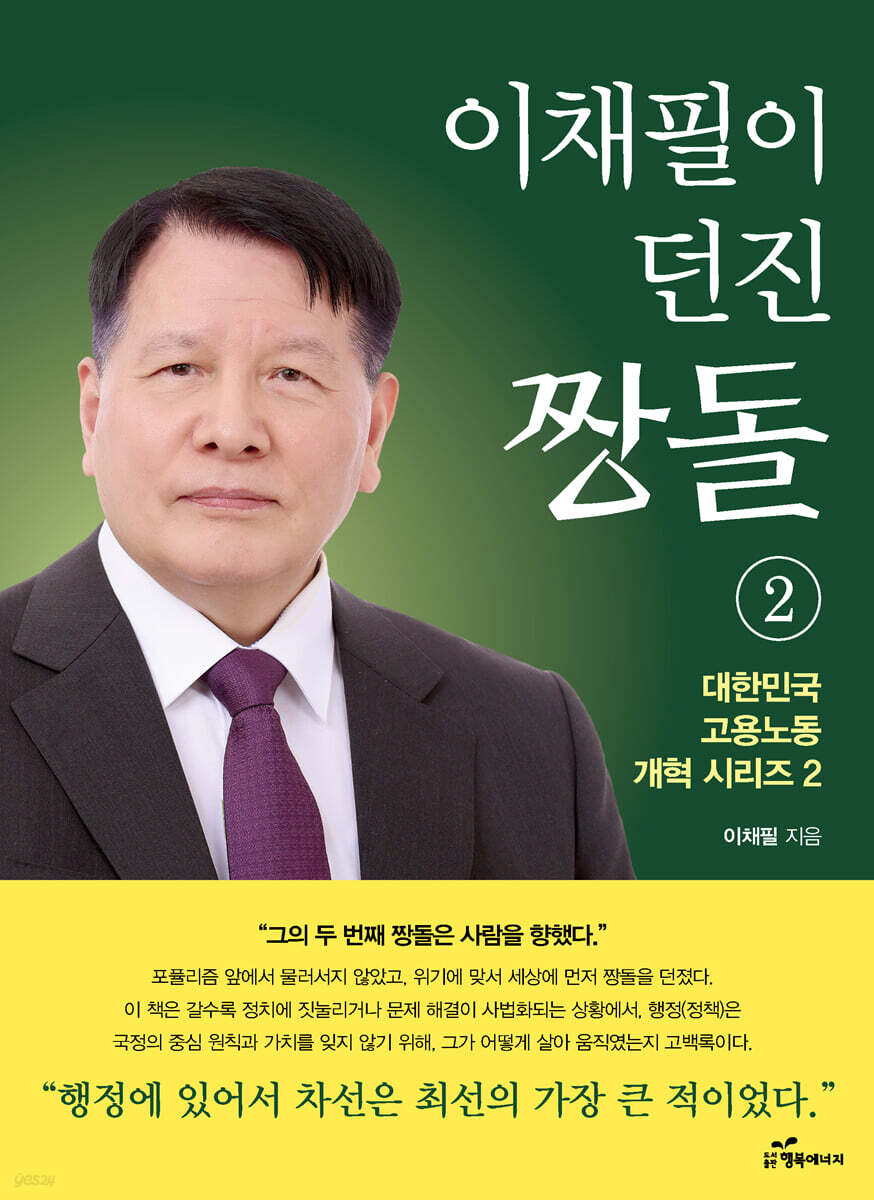
Lee Chae-pil's second stone
 |
Description
Book Introduction
This book covers the life of former Minister of Employment and Labor Lee Chae-pil, filled with adversity and challenges, as well as the beliefs he established and maintained in labor-related administration and the actions he took in accordance with them while working in labor-related fields, from his position as a civil servant at the Ministry of Employment and Labor to his position as Minister.
The author, who had to endure the world's contempt and discrimination while living with a disability in both legs due to polio, says that he wanted to throw a stone of resentment at various irrationalities and inefficiencies in South Korea, starting with the stone he threw as a child to protect himself from those who bullied him by making fun of his disability.
This book is a collection of writings that pour out the author's life and beliefs as a labor administrator in over 900 pages. "The Rock Thrown by Lee Chae-pil (1)" corresponds to the first four chapters of this extensive work.
Chapter 1 contains the story of the author, who had to overcome discrimination and contempt for being labeled as a "polio-disabled person" in a rural area where electricity was only available in his hometown when he was a senior in college. He overcame many adversities and challenges to enter college through the GED exam, and then took the civil service exam to become a civil servant at the Ministry of Employment and Labor.
The author recounts that as a child, living in a remote village, the only means of contact with the world was the radio. One day, by chance, he heard the words, “Administration is what actively solves the world’s problems, and a modern state is an administrative state,” and this sent shivers down his spine, solidifying his resolve to become a civil servant.
Chapter 2 discusses labor policies that author Lee Chae-pil led and participated in while serving as an employment and labor expert and administrative official, including the enactment of the Act on Promotion of Employment of Persons with Disabilities, the integration of the utilization of foreign workers and the employment permit system, the implementation of the employment insurance system, and the introduction of the vocational skills development account system.
The author, who has spent over 30 years as a labor administrator, has noted that administrators must always focus on the "field," and has declared "jobs" and "people" as his administrative goals.
Chapters 3 and 4 are chapters that provide a glimpse into author Lee Chae-pil's beliefs and principles regarding the proper position of 'law' in labor-management relations, based on his experience in regulating labor-management relations, which is a major axis of labor-related issues in Korea.
It contains public misunderstandings about the role and mission of the Ministry of Employment and Labor, secrets for resolving difficulties and problems encountered while enacting laws or promoting administration, the story of how maternity protection benefits came to be borne by the Employment Insurance Fund, suggestions for creative challenges for young people, the honest response of labor, management, and government to the long-term strike at Hyundai Heavy Industries, and the process by which the principle of no work, no pay and the principle of post-facto legal action regardless of labor and management were established, as well as evaluations of the labor disputes at Ssangyong Motors and Hanjin Heavy Industries. In particular, in 'Labor Reform after 13 Years - Implementation of Multiple Unions and Abolition of Full-time Union Officials', vivid testimony about the 'labor administration' that the author was involved in or promoted is recorded.
You can read the author's philosophy of labor administration, titled 'CD on LP: Labor-management autonomous solution within the framework of law and principles.'
In order to resolve the conflictual labor-management relations in Korea, the book specifically describes the implementation process of various labor-management relations reforms, such as labor reform through a tripartite agreement between labor, management, and the government based on a broad national consensus including labor, management, and the public interest, the introduction of a work hour exemption system, reform of full-time union officials, and the permission of multiple unions and the unification of negotiation channels. It also fully captures the leadership of labor, management, and the wisdom of administrators who wisely displayed themselves in the face of crises.
Chapter 5, "Safety and Justice - Behind the Industrial Accident and Serious Accident Prevention Act," is filled with content related to the revision of laws related to industrial safety and health to create a country safe from industrial accidents, and, above all, the spread of safety culture and awareness and the establishment of a center for the prevention of serious industrial accidents.
In his keynote speech at the 30th World Congress on Occupational Health, titled "Korea's Strategy for Preventing Industrial Accidents and Improving the Working Environment," he focused on introducing key issues in Korea's industrial health and strategies for preventing industrial accidents.
Through the contents of this keynote speech, we can find the future and direction of industrial safety and health administration.
And it clearly clarified the social, economic, and historical background of the Serious Disaster Punishment Act, which is currently a social issue, and the limitations of the law that prioritizes criminal punishment in the process of creating a safe country.
In Chapter 6, "The National Assembly and the Executive Branch in a Strange Country - Administration, Politics, and the Accountability of Bureaucracy," we can sense the author's lament over the "excessive politicization of administration and policy" resulting from political acumen and judgment that go beyond administrative procedures and legal requirements.
In various administrative and policy cases, such as the 'Establishment of Job World', 'Non-regular Workers Protection Act', 'Extension of retirement age for favoritism like roasting beans in a flash', 'Income-led growth and rapid increase in minimum wage', and 'Reduction of working hours', it systematically records the social and economic chaos and side effects caused by 'populism for favoritism' and 'administration for favoritism' that go beyond the law and common sense.
What kind of National Assembly is this? The book specifically addresses issues such as Yeouido politics, populism, and political budgeting, empirical exploration of a healthy relationship between the National Assembly and the executive branch, and the problems of excessive attempts at politically motivated legislation. The author's view of public service, stating, "Politics can be implemented with 51% approval, but a policy will ultimately fail if even 1% of the votes are wrong," will serve as a model for all public servants.
As a public official, he confesses the failures and frustrations he experienced directly and indirectly in the employment and labor administration (policy) and emphasizes that such failures should not be repeated.
Chapter 7, 'The Shadow of Reform - After the Jjangdol, Reflection and Responsibility', conveys to readers the turbulent life of a civil servant who promoted reform after leaving office (the true nature of eradicating deep-rooted evils), focusing on his experiences and records during the investigation and trial process.
In Chapter 8, 'Answering Foolish Questions - With a Ground-Up Spirit', he reflects on his 30 years of public service and introduces various episodes and cases of promoting personnel innovation and revitalizing organizations based on his direct and indirect experience of 'work and practicality are separate' personnel management.
In particular, in the section “Pro-labor, pro-management, pro-job minister,” one can feel the author’s deep convictions and philosophy regarding employment and labor policy, as well as his love for the people and the country.
This book is much more of a historical record of the complex production process of labor-related policies than an autobiographical account of the author.
As a civil servant in the Republic of Korea, I share my concerns, struggles, twists and turns, pain, and vision and direction for the future of administration, while delivering a message of dreams and hope to everyone.
The author passed the civil service examination with excellent grades and chose the Ministry of Labor. He then covered the entire spectrum of employment and labor administration, including industrial safety, employment, job skills, and labor-management relations. He improved and developed policies with a practical approach, while simultaneously recording his multifaceted efforts to legislate them, thereby adding historical value.
Behind this background, one can read a sharp sense of problem and the courage to throw a fastball at each time, and this can be seen to be supported by the author's skill and perseverance that he subtly displays.
The author, who had to endure the world's contempt and discrimination while living with a disability in both legs due to polio, says that he wanted to throw a stone of resentment at various irrationalities and inefficiencies in South Korea, starting with the stone he threw as a child to protect himself from those who bullied him by making fun of his disability.
This book is a collection of writings that pour out the author's life and beliefs as a labor administrator in over 900 pages. "The Rock Thrown by Lee Chae-pil (1)" corresponds to the first four chapters of this extensive work.
Chapter 1 contains the story of the author, who had to overcome discrimination and contempt for being labeled as a "polio-disabled person" in a rural area where electricity was only available in his hometown when he was a senior in college. He overcame many adversities and challenges to enter college through the GED exam, and then took the civil service exam to become a civil servant at the Ministry of Employment and Labor.
The author recounts that as a child, living in a remote village, the only means of contact with the world was the radio. One day, by chance, he heard the words, “Administration is what actively solves the world’s problems, and a modern state is an administrative state,” and this sent shivers down his spine, solidifying his resolve to become a civil servant.
Chapter 2 discusses labor policies that author Lee Chae-pil led and participated in while serving as an employment and labor expert and administrative official, including the enactment of the Act on Promotion of Employment of Persons with Disabilities, the integration of the utilization of foreign workers and the employment permit system, the implementation of the employment insurance system, and the introduction of the vocational skills development account system.
The author, who has spent over 30 years as a labor administrator, has noted that administrators must always focus on the "field," and has declared "jobs" and "people" as his administrative goals.
Chapters 3 and 4 are chapters that provide a glimpse into author Lee Chae-pil's beliefs and principles regarding the proper position of 'law' in labor-management relations, based on his experience in regulating labor-management relations, which is a major axis of labor-related issues in Korea.
It contains public misunderstandings about the role and mission of the Ministry of Employment and Labor, secrets for resolving difficulties and problems encountered while enacting laws or promoting administration, the story of how maternity protection benefits came to be borne by the Employment Insurance Fund, suggestions for creative challenges for young people, the honest response of labor, management, and government to the long-term strike at Hyundai Heavy Industries, and the process by which the principle of no work, no pay and the principle of post-facto legal action regardless of labor and management were established, as well as evaluations of the labor disputes at Ssangyong Motors and Hanjin Heavy Industries. In particular, in 'Labor Reform after 13 Years - Implementation of Multiple Unions and Abolition of Full-time Union Officials', vivid testimony about the 'labor administration' that the author was involved in or promoted is recorded.
You can read the author's philosophy of labor administration, titled 'CD on LP: Labor-management autonomous solution within the framework of law and principles.'
In order to resolve the conflictual labor-management relations in Korea, the book specifically describes the implementation process of various labor-management relations reforms, such as labor reform through a tripartite agreement between labor, management, and the government based on a broad national consensus including labor, management, and the public interest, the introduction of a work hour exemption system, reform of full-time union officials, and the permission of multiple unions and the unification of negotiation channels. It also fully captures the leadership of labor, management, and the wisdom of administrators who wisely displayed themselves in the face of crises.
Chapter 5, "Safety and Justice - Behind the Industrial Accident and Serious Accident Prevention Act," is filled with content related to the revision of laws related to industrial safety and health to create a country safe from industrial accidents, and, above all, the spread of safety culture and awareness and the establishment of a center for the prevention of serious industrial accidents.
In his keynote speech at the 30th World Congress on Occupational Health, titled "Korea's Strategy for Preventing Industrial Accidents and Improving the Working Environment," he focused on introducing key issues in Korea's industrial health and strategies for preventing industrial accidents.
Through the contents of this keynote speech, we can find the future and direction of industrial safety and health administration.
And it clearly clarified the social, economic, and historical background of the Serious Disaster Punishment Act, which is currently a social issue, and the limitations of the law that prioritizes criminal punishment in the process of creating a safe country.
In Chapter 6, "The National Assembly and the Executive Branch in a Strange Country - Administration, Politics, and the Accountability of Bureaucracy," we can sense the author's lament over the "excessive politicization of administration and policy" resulting from political acumen and judgment that go beyond administrative procedures and legal requirements.
In various administrative and policy cases, such as the 'Establishment of Job World', 'Non-regular Workers Protection Act', 'Extension of retirement age for favoritism like roasting beans in a flash', 'Income-led growth and rapid increase in minimum wage', and 'Reduction of working hours', it systematically records the social and economic chaos and side effects caused by 'populism for favoritism' and 'administration for favoritism' that go beyond the law and common sense.
What kind of National Assembly is this? The book specifically addresses issues such as Yeouido politics, populism, and political budgeting, empirical exploration of a healthy relationship between the National Assembly and the executive branch, and the problems of excessive attempts at politically motivated legislation. The author's view of public service, stating, "Politics can be implemented with 51% approval, but a policy will ultimately fail if even 1% of the votes are wrong," will serve as a model for all public servants.
As a public official, he confesses the failures and frustrations he experienced directly and indirectly in the employment and labor administration (policy) and emphasizes that such failures should not be repeated.
Chapter 7, 'The Shadow of Reform - After the Jjangdol, Reflection and Responsibility', conveys to readers the turbulent life of a civil servant who promoted reform after leaving office (the true nature of eradicating deep-rooted evils), focusing on his experiences and records during the investigation and trial process.
In Chapter 8, 'Answering Foolish Questions - With a Ground-Up Spirit', he reflects on his 30 years of public service and introduces various episodes and cases of promoting personnel innovation and revitalizing organizations based on his direct and indirect experience of 'work and practicality are separate' personnel management.
In particular, in the section “Pro-labor, pro-management, pro-job minister,” one can feel the author’s deep convictions and philosophy regarding employment and labor policy, as well as his love for the people and the country.
This book is much more of a historical record of the complex production process of labor-related policies than an autobiographical account of the author.
As a civil servant in the Republic of Korea, I share my concerns, struggles, twists and turns, pain, and vision and direction for the future of administration, while delivering a message of dreams and hope to everyone.
The author passed the civil service examination with excellent grades and chose the Ministry of Labor. He then covered the entire spectrum of employment and labor administration, including industrial safety, employment, job skills, and labor-management relations. He improved and developed policies with a practical approach, while simultaneously recording his multifaceted efforts to legislate them, thereby adding historical value.
Behind this background, one can read a sharp sense of problem and the courage to throw a fastball at each time, and this can be seen to be supported by the author's skill and perseverance that he subtly displays.
index
Chapter 5 Safety and Justice - Behind the Industrial Accident and Serious Accident Act
01 Identification of occupational accidents and reproductive toxic substances at an electronics component company
02 An unprecedented event in the history of the press: 8 companies indicted en masse
03 Appointment of the Head of the Industrial Health Department and the Temptation of Contamination
04 'Occupational Medicine Specialist' Placement and Utilization and Letter of Appreciation
05 Concept: A vessel containing meaning: Abolition of the 'agent' institution system
06 Department store renovation and repair accident
07 Spreading Safety Culture: Kim Woo-soo Delivers Safety Helmets and Proclaims Safety Rules
08 Monitoring the Samsung Semiconductor Leukemia Incident and Health Management Improvements
09 The first revision of the "Occupational Disease Recognition Standards" in 49 years since the implementation of the Industrial Accident Compensation Insurance System.
10 Pilot Installation of Major Industrial Accident Prevention Centers
11 Keynote Address at the 30th World Congress on Occupational Health (ICOH): "Korea's Strategy for Preventing Industrial Accidents and Improving Working Conditions"
12. "Punishment is too low to prevent industrial accidents.": "Half right, half wrong."
13 Direction of Revision of the Serious Disaster Punishment Act: Heavy Criminal Punishment vs. Economic Sanctions
14 How far has corporate safety awareness come?
15 Is a 'safe country' possible?
Chapter 6: The National Assembly and the Executive Branch of a Wonderland - Administration, Politics, and the Accountability of Bureaucracy
01 Request for a 'political budget' and the 'aftermath'
02 Attempt by a member of the National Assembly to amend the enforcement regulations into law
03 The establishment of Job World, which almost ended his public service career
04 What the heck is this National Assembly? Yeouido Politics and Voting Populism
05 Has the Non-Regular Workers Protection Act achieved its legislative purpose?
06 Extending the retirement age with kindness, like roasting beans in a flash
07 The National Assembly and the Executive Branch in a Strange Country: Overuse of "Dear Representative"
08 Chaos in Yeouido, a monster on the run
09 Minimum Wage Increase and Another Policy Failure
10 Minimum Wage Determination and Deliberation Criteria
11 The first-ever random labor inspection due to long working hours
12 Hyundai Motors and other automakers implement a two-shift system throughout the week.
13 The Long and Difficult History of Reducing Working Hours
14. Promotion and Restriction of the Labor Standards Act Revision to Reduce Actual Working Hours
15 Accountability in Administration, Politics, and Bureaucracy: There is no second best in my dictionary.
Chapter 7: The Shadow of Reform - After Jjangdol, Reflection and Responsibility
01 Reform of the 'Notification of Non-Union' and Union Establishment Reporting Systems
02 The Aftermath of Labor Reform
03 The prosecution rejected both the request for face-to-face investigation and video recording investigation.
04 Why did I end up in a wheelchair when I appeared at the prosecution?
05 The true nature of the corruption trial
06 The Chief Justice's Order for a "Good Trial" and the Trial of Public Opinion
07 'Presumption of Innocence'?: In practice, there is only 'presumption of guilt'.
08 Preliminary Presumption of Guilt Trial (1)
09 Preliminary Presumption of Guilt Trial (2)
10 A 'presumed guilty' trial that deliberately ignored contrary evidence.
11. A botched investigation and arbitrary verdict that ruined a life.
12 Secret Burial Investigation and Ingenious Trial
13. The warden's message: "Minister Lee was scammed."
14.
How to Reform a Tilt-Less Judiciary: Full Disclosure of Judgments (Including Evidence Records)
Law School Diary 207 (February 7, 2020 - August 31, 2020)
Chapter 8: Answering Foolish Questions - With a Grounded Spirit
01 It was wrong then and it's wrong now
02 Real-life Samgochoryeo
03 Promoting organizational vitality through personnel selection and special promotions for frontline employees.
04 “I feel more like I’ve been demoted than promoted.”
05 Reorganization of the Ministry of Labor into the Ministry of Employment and Labor (Ⅰ): Focus on Comprehensive Employment Policy
06 Reorganization of the Ministry of Labor into the Ministry of Employment and Labor (II): Employment and Labor Administration that Communicates with Customers
07 Bottom-up spirit: Gratitude as a lifelong secretary
08 How to Make Your Employees Do Their Job Well
09 How to deal with the political world so that civil servants can focus on their work: Responsibility belongs to the minister, and merit belongs to the practitioners.
10. First meeting with the President: “Minister Lee, do you plan to become President?”
11. Foolish questions and wise answers: The questions of (our) life have (the) answers in (the) present.
12. The Problem of Frequent Civil Service Rotation: The Training System for Director-Level Civil Servants Needs to Be Revised
13 Appointment of Public Institution Executives and Hypocritical Public Offering System: For Whom the Bell Tolls?
14 Pro-Labor, Pro-Management, Pro-Jobs Ministers
15 “Are you still running a business in Korea?”: I hope it’s a worry
Epilogue The Road Not Taken
Publication review
01 Identification of occupational accidents and reproductive toxic substances at an electronics component company
02 An unprecedented event in the history of the press: 8 companies indicted en masse
03 Appointment of the Head of the Industrial Health Department and the Temptation of Contamination
04 'Occupational Medicine Specialist' Placement and Utilization and Letter of Appreciation
05 Concept: A vessel containing meaning: Abolition of the 'agent' institution system
06 Department store renovation and repair accident
07 Spreading Safety Culture: Kim Woo-soo Delivers Safety Helmets and Proclaims Safety Rules
08 Monitoring the Samsung Semiconductor Leukemia Incident and Health Management Improvements
09 The first revision of the "Occupational Disease Recognition Standards" in 49 years since the implementation of the Industrial Accident Compensation Insurance System.
10 Pilot Installation of Major Industrial Accident Prevention Centers
11 Keynote Address at the 30th World Congress on Occupational Health (ICOH): "Korea's Strategy for Preventing Industrial Accidents and Improving Working Conditions"
12. "Punishment is too low to prevent industrial accidents.": "Half right, half wrong."
13 Direction of Revision of the Serious Disaster Punishment Act: Heavy Criminal Punishment vs. Economic Sanctions
14 How far has corporate safety awareness come?
15 Is a 'safe country' possible?
Chapter 6: The National Assembly and the Executive Branch of a Wonderland - Administration, Politics, and the Accountability of Bureaucracy
01 Request for a 'political budget' and the 'aftermath'
02 Attempt by a member of the National Assembly to amend the enforcement regulations into law
03 The establishment of Job World, which almost ended his public service career
04 What the heck is this National Assembly? Yeouido Politics and Voting Populism
05 Has the Non-Regular Workers Protection Act achieved its legislative purpose?
06 Extending the retirement age with kindness, like roasting beans in a flash
07 The National Assembly and the Executive Branch in a Strange Country: Overuse of "Dear Representative"
08 Chaos in Yeouido, a monster on the run
09 Minimum Wage Increase and Another Policy Failure
10 Minimum Wage Determination and Deliberation Criteria
11 The first-ever random labor inspection due to long working hours
12 Hyundai Motors and other automakers implement a two-shift system throughout the week.
13 The Long and Difficult History of Reducing Working Hours
14. Promotion and Restriction of the Labor Standards Act Revision to Reduce Actual Working Hours
15 Accountability in Administration, Politics, and Bureaucracy: There is no second best in my dictionary.
Chapter 7: The Shadow of Reform - After Jjangdol, Reflection and Responsibility
01 Reform of the 'Notification of Non-Union' and Union Establishment Reporting Systems
02 The Aftermath of Labor Reform
03 The prosecution rejected both the request for face-to-face investigation and video recording investigation.
04 Why did I end up in a wheelchair when I appeared at the prosecution?
05 The true nature of the corruption trial
06 The Chief Justice's Order for a "Good Trial" and the Trial of Public Opinion
07 'Presumption of Innocence'?: In practice, there is only 'presumption of guilt'.
08 Preliminary Presumption of Guilt Trial (1)
09 Preliminary Presumption of Guilt Trial (2)
10 A 'presumed guilty' trial that deliberately ignored contrary evidence.
11. A botched investigation and arbitrary verdict that ruined a life.
12 Secret Burial Investigation and Ingenious Trial
13. The warden's message: "Minister Lee was scammed."
14.
How to Reform a Tilt-Less Judiciary: Full Disclosure of Judgments (Including Evidence Records)
Law School Diary 207 (February 7, 2020 - August 31, 2020)
Chapter 8: Answering Foolish Questions - With a Grounded Spirit
01 It was wrong then and it's wrong now
02 Real-life Samgochoryeo
03 Promoting organizational vitality through personnel selection and special promotions for frontline employees.
04 “I feel more like I’ve been demoted than promoted.”
05 Reorganization of the Ministry of Labor into the Ministry of Employment and Labor (Ⅰ): Focus on Comprehensive Employment Policy
06 Reorganization of the Ministry of Labor into the Ministry of Employment and Labor (II): Employment and Labor Administration that Communicates with Customers
07 Bottom-up spirit: Gratitude as a lifelong secretary
08 How to Make Your Employees Do Their Job Well
09 How to deal with the political world so that civil servants can focus on their work: Responsibility belongs to the minister, and merit belongs to the practitioners.
10. First meeting with the President: “Minister Lee, do you plan to become President?”
11. Foolish questions and wise answers: The questions of (our) life have (the) answers in (the) present.
12. The Problem of Frequent Civil Service Rotation: The Training System for Director-Level Civil Servants Needs to Be Revised
13 Appointment of Public Institution Executives and Hypocritical Public Offering System: For Whom the Bell Tolls?
14 Pro-Labor, Pro-Management, Pro-Jobs Ministers
15 “Are you still running a business in Korea?”: I hope it’s a worry
Epilogue The Road Not Taken
Publication review
Detailed image

Into the book
When we use the word "if", we are assuming that it has not happened yet.
If I had lived a life without disabilities and held public office in a different ministry, how different would my situation be now?
Perhaps, given my personality, if my life had been a triumphant one, free from the setbacks and frustrations caused by my disability, I would have experienced even more mistakes and setbacks. I would have been a self-righteous, self-righteous person, driven by a conviction that I was right, and unwilling to listen to others.
As the proverb says, "Without discussion, management falls apart, but with many strategies, management succeeds," I think that my disability served as a brake that made me more serious.
Also, if I had spent most of my life in another ministry or a private company instead of working as a civil servant in the government, especially at the Ministry of Employment and Labor, the environment might have been different from what it is now.
Looking back, public service was a career that aligned with my ideals because it allowed me to directly influence more people with my abilities.
I consider it a very appropriate path for me to choose the Ministry of Employment and Labor and dedicate my youth to it, as it was a blue ocean area where I could fully develop my talents in a ministry that was just starting out.
Of course, along the way, I occasionally encountered difficulties that others would not experience.
However, I hope that my future evaluation will not be so harsh, as it is not because I did something shameful, and the truth will come out someday.
Finally, I express my feelings with a poem by Robert Frost (1874-1963).
“Two roads diverged in a wood, and I took the one less traveled by.
And that changed everything for me.”
If I had lived a life without disabilities and held public office in a different ministry, how different would my situation be now?
Perhaps, given my personality, if my life had been a triumphant one, free from the setbacks and frustrations caused by my disability, I would have experienced even more mistakes and setbacks. I would have been a self-righteous, self-righteous person, driven by a conviction that I was right, and unwilling to listen to others.
As the proverb says, "Without discussion, management falls apart, but with many strategies, management succeeds," I think that my disability served as a brake that made me more serious.
Also, if I had spent most of my life in another ministry or a private company instead of working as a civil servant in the government, especially at the Ministry of Employment and Labor, the environment might have been different from what it is now.
Looking back, public service was a career that aligned with my ideals because it allowed me to directly influence more people with my abilities.
I consider it a very appropriate path for me to choose the Ministry of Employment and Labor and dedicate my youth to it, as it was a blue ocean area where I could fully develop my talents in a ministry that was just starting out.
Of course, along the way, I occasionally encountered difficulties that others would not experience.
However, I hope that my future evaluation will not be so harsh, as it is not because I did something shameful, and the truth will come out someday.
Finally, I express my feelings with a poem by Robert Frost (1874-1963).
“Two roads diverged in a wood, and I took the one less traveled by.
And that changed everything for me.”
--- From "Epilogue - The Road Not Taken"
GOODS SPECIFICS
- Date of issue: November 11, 2025
- Page count, weight, size: 476 pages | 178*251*30mm
- ISBN13: 9791124134009
- ISBN10: 112413400X
You may also like
카테고리
korean


korean

![GQ KOREA Mark (Monthly): December [2025]](http://librairie.coreenne.fr/cdn/shop/files/8ef265dbbfbf186523ed75ba7319009d.jpg?v=1765340328&width=3840)


