

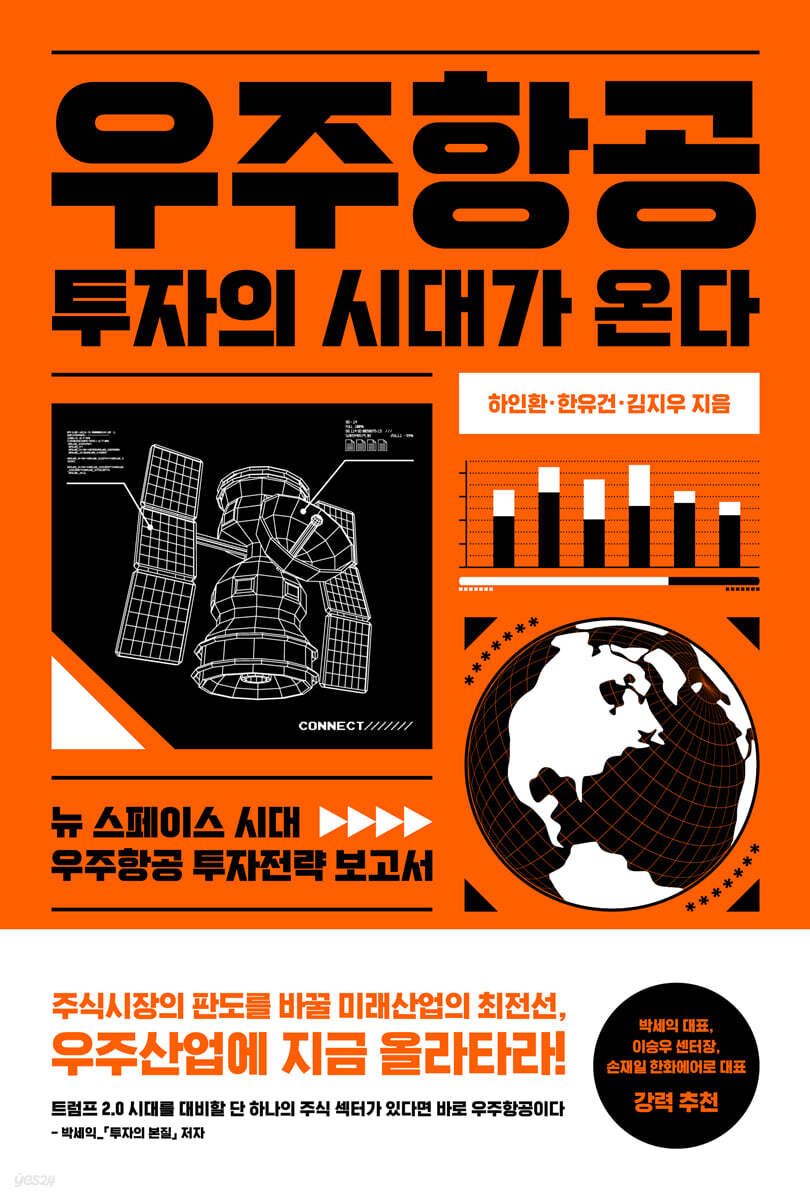
The era of aerospace investment is coming.
 |
Description
Book Introduction
The Only Investment Guide to Prepare for the New Space Era
The latest trends in the aerospace industry, presented through three in-depth analyses by three current analysts.
An investment book analyzing the space industry, which is constantly breaking new records, has been published by Winner's Book.
As we enter the Trump 2.0 era, it's time for investors to consider which industries they should focus on over the next four years.
The era of private space industry is dawning, led by Elon Musk's SpaceX.
This book systematically analyzes the space industry's development over the past, its current state, and its future direction, taking into account the current global situation.
Three current analysts, each of whom has been selected as the best analysts in various fields, explain the latest industry trends with various charts, graphs, and photos.
You can learn about the current state of the promising domestic space industry, along with the overseas industry where the industry is already actively developing, which companies are conducting developments, and the investment outlook.
This is the only book in Korea that contains in detail the beginning, present, future, and reality of the industry.
Completed through in-depth analysis by experts, this book will provide investors with insights into companies and industries not readily accessible to the average investor.
The latest trends in the aerospace industry, presented through three in-depth analyses by three current analysts.
An investment book analyzing the space industry, which is constantly breaking new records, has been published by Winner's Book.
As we enter the Trump 2.0 era, it's time for investors to consider which industries they should focus on over the next four years.
The era of private space industry is dawning, led by Elon Musk's SpaceX.
This book systematically analyzes the space industry's development over the past, its current state, and its future direction, taking into account the current global situation.
Three current analysts, each of whom has been selected as the best analysts in various fields, explain the latest industry trends with various charts, graphs, and photos.
You can learn about the current state of the promising domestic space industry, along with the overseas industry where the industry is already actively developing, which companies are conducting developments, and the investment outlook.
This is the only book in Korea that contains in detail the beginning, present, future, and reality of the industry.
Completed through in-depth analysis by experts, this book will provide investors with insights into companies and industries not readily accessible to the average investor.
- You can preview some of the book's contents.
Preview
index
Introduction: Why should we pay attention to the space industry now?
Chapter 1 - History of the Space Industry
1.
The Battle for Hegemony and the Birth of the Space Industry
2. The DARPA Story: Space Industry and Technological Innovation
3.
The full-scale investment in the space industry and the U.S. government
Chapter 2 - The Current State of the Space Industry
1.
Space Industry Value Chain
2.
8 overseas companies
1) Rocket Lab
2) Redwire
3) Intuitive Machines
4) MDA Space
5) Planet Labs
6) AST SpaceMobile
7) Globalstar
8) Heico
Chapter 3 - The Current State of the Korean Space Industry
1.
Status of Korean government support for the space industry
2.
The explosive growth of low-orbit satellites
3.
Top 5 Korean Companies
1) Setrek Eye
2) Innospace
3) Context
4) Kencoa Aerospace
5) Intellian Tech
Chapter 4 - The Future of the Space Industry
1.
Elon Musk's Blueprint: The Space Industry Led by SpaceX
2.
Prospects for Space Industry Investment
Chapter 5 - Space Industry Q&A
1.
Is a potential Department of Defense budget cut negative for the space industry?
2.
Why is the space industry being reorganized around low-orbit satellites?
3.
So what is the future direction of restructuring the space industry?
4.
Is it okay to invest in companies other than SpaceX?
Chapter 6 - Appendix
1.
Explanation of Key Terms
2.
The Korean government's plan to build a space economy foundation
3.
List of Korean satellites
Chapter 1 - History of the Space Industry
1.
The Battle for Hegemony and the Birth of the Space Industry
2. The DARPA Story: Space Industry and Technological Innovation
3.
The full-scale investment in the space industry and the U.S. government
Chapter 2 - The Current State of the Space Industry
1.
Space Industry Value Chain
2.
8 overseas companies
1) Rocket Lab
2) Redwire
3) Intuitive Machines
4) MDA Space
5) Planet Labs
6) AST SpaceMobile
7) Globalstar
8) Heico
Chapter 3 - The Current State of the Korean Space Industry
1.
Status of Korean government support for the space industry
2.
The explosive growth of low-orbit satellites
3.
Top 5 Korean Companies
1) Setrek Eye
2) Innospace
3) Context
4) Kencoa Aerospace
5) Intellian Tech
Chapter 4 - The Future of the Space Industry
1.
Elon Musk's Blueprint: The Space Industry Led by SpaceX
2.
Prospects for Space Industry Investment
Chapter 5 - Space Industry Q&A
1.
Is a potential Department of Defense budget cut negative for the space industry?
2.
Why is the space industry being reorganized around low-orbit satellites?
3.
So what is the future direction of restructuring the space industry?
4.
Is it okay to invest in companies other than SpaceX?
Chapter 6 - Appendix
1.
Explanation of Key Terms
2.
The Korean government's plan to build a space economy foundation
3.
List of Korean satellites
Detailed image

Into the book
President Trump expanded support for the space industry by promoting the Artemis project, a space exploration project, during his first term, and even visited a SpaceX rocket launch site in person immediately after winning the 2024 US presidential election.
The space industry, a shared interest of Donald Trump and Elon Musk, two of the most central figures in the Trump 2.0 era, will be the most important industry we need to know about in the next four years.
--- p.5
We explored the reasons for the space industry's popularity from both political and industrial capital perspectives, distinguished between areas with real growth potential and those filled with mere dreams, and assessed the future direction of growth through the space industry's value chain.
With growing interest in the space industry, information on space companies is steadily increasing. However, information on foreign companies remains limited. This book also provides detailed coverage of noteworthy foreign companies.
--- p.9
In fact, if we look at the flow of research and development (R&D) investment in the United States, we can see that federal government R&D has been increasing rapidly, especially since the mid-to-late 1950s.
In particular, given the fact that there was a sharp increase from the mid-1950s to the mid-1960s and that no such increase was observed thereafter, it can be said that the trend from the late 1950s to the early-to-mid 1960s was clearly unique.
This was clearly due to the ‘war for hegemony with the Soviet Union’, and the event that directly triggered this was the ‘successful launch of the Soviet Union’s artificial satellite’.
--- p.19
The history of the space industry, or the first era of the space industry, begins with Nazi Germany and World War II.
During World War II, Nazi Germany developed the V2 rocket for the purpose of attacking the Allies from a distance (Nazi Germany attacked Britain with the V2). The V2 rocket became the beginning of ballistic missiles and satellite launch rockets.
However, after Nazi Germany was defeated in World War II, the United States and the Soviet Union tried to secure V2 rockets.
And the Soviet Union was able to secure the V2 rocket first.
On the other hand, an opportunity came to the United States, which had not been able to secure the V2 rocket, thanks to the defection of Dr. Wernher von Braun, the developer of the V2 rocket.
Afterwards, Dr. von Braun made great contributions to the development of the American space industry, and despite being a collaborator of Nazi Germany, he came to be called the 'father of rocketry.'
--- p.36
The third era of the space industry, which began in the mid-to-late 2000s, is called the 'New Space' era.
The current space industry has several major differences from the 'Old Space' era.
Before that, the most important point is that in the new space era, the private sector has become the main investor in the space industry.
From here all the differences from the Old Space era are derived.
A symbol of change was the Obama administration's cancellation of the Constellation Program in 2010 (a lunar exploration program launched by the Bush administration in 2004 and led by NASA).
--- p.41
President Trump and the Republican Party are signaling continued investment in the space industry during their second term.
The Republican Party adopted "America First: A Return to Common Sense," a party platform outlining the policy direction of the next administration, ahead of the 2024 U.S. presidential election. The platform includes a plan for the space industry that will "build a robust manufacturing industry in near-Earth orbit, send astronauts to the Moon and Mars, and strengthen collaboration with the private space sector to advance our ability to access, live in, and develop space assets."
And in 2025, with these policies in place, President Trump returned to the White House as head of the US administration.
--- p.47
However, around the year 2000, a major change began to appear in the space industry.
This is SpaceX's 'rocket reuse'.
Elon Musk pointed out cost issues as one of the reasons for the stagnation in the space industry.
Before SpaceX, space companies received contracts from NASA to carry out space-related missions. These contracts were based on a "cost-plus" model: NASA dictated detailed instructions to the companies in charge of the project, and the companies carried out those instructions to the letter. NASA shouldered all the costs incurred in the process.
This type of contracting arrangement left companies with little incentive to innovate on their own, leading to stagnant growth and cost problems in the U.S. space industry that persisted into the 2000s.
But SpaceX has revolutionized the space industry by challenging these practices and improving cost efficiency.
The key to change was rocket reuse.
SpaceX began researching rocket reuse in the early 2010s.
In 2013, it began testing "rocket supersonic retro-thrust technology," which could be used for landings for future rocket reuse.
And in 2015, the first stage of the Falcon 9 rocket was successfully launched and landed on land, and in April 2016, it was successfully landed on the sea.
As a result, the space industry succeeded in reusing a rocket for the first time in March 2017.
--- p.58
What investors need to consider is 'interest rates'.
In times of extremely low interest rates like 2020, the attractiveness of valuations that can presently value distant future profits tends to be highlighted, so companies with extremely high valuations also attract attention.
The problem is that even among highly valued companies, there may be those that have visible growth potential and those that do not.
The space industry value chain, including satellite communications and observation, has a high valuation due to government investment and private commercialization, but its business growth rate is very fast, so high valuations can be justified even when interest rates rise. However, in areas like space travel that are difficult to realize immediately and thus have slow corporate growth rates, it is difficult to justify high valuations when interest rates rise.
Virgin Galactic was a notable space company in 2020 (during the era of ultra-low interest rates), but its stock price has been declining for a long time since 2021, likely due to rising interest rates.
Therefore, it will be important to select companies that can continue to show growth potential despite high interest rates.
--- p.65
Unlike the U.S. space industry, Korea's space industry is still in the government-led stage.
In particular, policy support for the space industry has been expanding since 2019-2020, as evidenced by the government budget expansion.
The process by which government support spreads to private companies is as follows: 'budget expansion → support expansion for specific key areas → project implementation by national research institutes and the Korea Aerospace Research Institute → technology development and sales generation through project contracts from private companies.'
Currently, in particular, the budget for satellite manufacturing and satellite navigation systems is expanding, and with the establishment of the National Aeronautics and Space Administration (NASA) starting in 2024, it is expected to lead policy support for the space industry in the future.
It is also worthwhile to refer to the 'Space Development Promotion Implementation Plan', which is periodically announced. Here, the budget for projects such as the Korean Satellite Navigation System, the next-generation launch vehicle development project, and the ultra-small satellite system development project see the largest increases.
The Korean companies in the space industry that will be discussed later are also mainly companies in this field.
--- p.134
While the scale of investment in the domestic space industry is gradually expanding, it is indeed somewhat disappointing for a country that possesses the world's best technological prowess in cutting-edge industries such as IT.
However, with the strengthening of organic cooperation between the private sector and the government through new mid- to long-term space development policy support, there is a high possibility that it will become Korea's main industry within the next 10 years.
The future direction of the domestic space industry is clear.
In the new space era, cluster construction is underway to establish a self-sustaining industrial base.
--- p.154
With Trump re-elected as US president, two concerns are emerging about the potential for budget cuts to the Department of Defense.
The first is the concern that the Russia-Ukraine war and the Israel-Palestine conflict could enter a ceasefire phase.
This could lead to an easing of military tensions and a reduction in defense spending.
The second is the possibility of a reduction in the Ministry of National Defense budget due to the establishment of the Ministry of Government Efficiency.
The Ministry of Government Efficiency aims to restructure government spending more efficiently, and the defense budget could be included in the cuts.
As the space industry itself is still in its infancy, many companies rely on defense or government projects.
Therefore, a reduction in the defense budget could create uncertainty in the short-term funding flow and project progress in the space industry.
--- p.223
However, the impact of such concerns on the mid- to long-term development of the space industry is expected to be limited.
Given the growth of the private space industry, the ongoing development of commercial projects and technological innovations, and the strategic importance of the industry to U.S. national security, it is unlikely that space will be deprioritized even if the defense budget shrinks.
Moreover, the space industry is gradually shifting towards a private sector-led approach, driven by private investment and international cooperation, which is alleviating these concerns.
The space industry, a shared interest of Donald Trump and Elon Musk, two of the most central figures in the Trump 2.0 era, will be the most important industry we need to know about in the next four years.
--- p.5
We explored the reasons for the space industry's popularity from both political and industrial capital perspectives, distinguished between areas with real growth potential and those filled with mere dreams, and assessed the future direction of growth through the space industry's value chain.
With growing interest in the space industry, information on space companies is steadily increasing. However, information on foreign companies remains limited. This book also provides detailed coverage of noteworthy foreign companies.
--- p.9
In fact, if we look at the flow of research and development (R&D) investment in the United States, we can see that federal government R&D has been increasing rapidly, especially since the mid-to-late 1950s.
In particular, given the fact that there was a sharp increase from the mid-1950s to the mid-1960s and that no such increase was observed thereafter, it can be said that the trend from the late 1950s to the early-to-mid 1960s was clearly unique.
This was clearly due to the ‘war for hegemony with the Soviet Union’, and the event that directly triggered this was the ‘successful launch of the Soviet Union’s artificial satellite’.
--- p.19
The history of the space industry, or the first era of the space industry, begins with Nazi Germany and World War II.
During World War II, Nazi Germany developed the V2 rocket for the purpose of attacking the Allies from a distance (Nazi Germany attacked Britain with the V2). The V2 rocket became the beginning of ballistic missiles and satellite launch rockets.
However, after Nazi Germany was defeated in World War II, the United States and the Soviet Union tried to secure V2 rockets.
And the Soviet Union was able to secure the V2 rocket first.
On the other hand, an opportunity came to the United States, which had not been able to secure the V2 rocket, thanks to the defection of Dr. Wernher von Braun, the developer of the V2 rocket.
Afterwards, Dr. von Braun made great contributions to the development of the American space industry, and despite being a collaborator of Nazi Germany, he came to be called the 'father of rocketry.'
--- p.36
The third era of the space industry, which began in the mid-to-late 2000s, is called the 'New Space' era.
The current space industry has several major differences from the 'Old Space' era.
Before that, the most important point is that in the new space era, the private sector has become the main investor in the space industry.
From here all the differences from the Old Space era are derived.
A symbol of change was the Obama administration's cancellation of the Constellation Program in 2010 (a lunar exploration program launched by the Bush administration in 2004 and led by NASA).
--- p.41
President Trump and the Republican Party are signaling continued investment in the space industry during their second term.
The Republican Party adopted "America First: A Return to Common Sense," a party platform outlining the policy direction of the next administration, ahead of the 2024 U.S. presidential election. The platform includes a plan for the space industry that will "build a robust manufacturing industry in near-Earth orbit, send astronauts to the Moon and Mars, and strengthen collaboration with the private space sector to advance our ability to access, live in, and develop space assets."
And in 2025, with these policies in place, President Trump returned to the White House as head of the US administration.
--- p.47
However, around the year 2000, a major change began to appear in the space industry.
This is SpaceX's 'rocket reuse'.
Elon Musk pointed out cost issues as one of the reasons for the stagnation in the space industry.
Before SpaceX, space companies received contracts from NASA to carry out space-related missions. These contracts were based on a "cost-plus" model: NASA dictated detailed instructions to the companies in charge of the project, and the companies carried out those instructions to the letter. NASA shouldered all the costs incurred in the process.
This type of contracting arrangement left companies with little incentive to innovate on their own, leading to stagnant growth and cost problems in the U.S. space industry that persisted into the 2000s.
But SpaceX has revolutionized the space industry by challenging these practices and improving cost efficiency.
The key to change was rocket reuse.
SpaceX began researching rocket reuse in the early 2010s.
In 2013, it began testing "rocket supersonic retro-thrust technology," which could be used for landings for future rocket reuse.
And in 2015, the first stage of the Falcon 9 rocket was successfully launched and landed on land, and in April 2016, it was successfully landed on the sea.
As a result, the space industry succeeded in reusing a rocket for the first time in March 2017.
--- p.58
What investors need to consider is 'interest rates'.
In times of extremely low interest rates like 2020, the attractiveness of valuations that can presently value distant future profits tends to be highlighted, so companies with extremely high valuations also attract attention.
The problem is that even among highly valued companies, there may be those that have visible growth potential and those that do not.
The space industry value chain, including satellite communications and observation, has a high valuation due to government investment and private commercialization, but its business growth rate is very fast, so high valuations can be justified even when interest rates rise. However, in areas like space travel that are difficult to realize immediately and thus have slow corporate growth rates, it is difficult to justify high valuations when interest rates rise.
Virgin Galactic was a notable space company in 2020 (during the era of ultra-low interest rates), but its stock price has been declining for a long time since 2021, likely due to rising interest rates.
Therefore, it will be important to select companies that can continue to show growth potential despite high interest rates.
--- p.65
Unlike the U.S. space industry, Korea's space industry is still in the government-led stage.
In particular, policy support for the space industry has been expanding since 2019-2020, as evidenced by the government budget expansion.
The process by which government support spreads to private companies is as follows: 'budget expansion → support expansion for specific key areas → project implementation by national research institutes and the Korea Aerospace Research Institute → technology development and sales generation through project contracts from private companies.'
Currently, in particular, the budget for satellite manufacturing and satellite navigation systems is expanding, and with the establishment of the National Aeronautics and Space Administration (NASA) starting in 2024, it is expected to lead policy support for the space industry in the future.
It is also worthwhile to refer to the 'Space Development Promotion Implementation Plan', which is periodically announced. Here, the budget for projects such as the Korean Satellite Navigation System, the next-generation launch vehicle development project, and the ultra-small satellite system development project see the largest increases.
The Korean companies in the space industry that will be discussed later are also mainly companies in this field.
--- p.134
While the scale of investment in the domestic space industry is gradually expanding, it is indeed somewhat disappointing for a country that possesses the world's best technological prowess in cutting-edge industries such as IT.
However, with the strengthening of organic cooperation between the private sector and the government through new mid- to long-term space development policy support, there is a high possibility that it will become Korea's main industry within the next 10 years.
The future direction of the domestic space industry is clear.
In the new space era, cluster construction is underway to establish a self-sustaining industrial base.
--- p.154
With Trump re-elected as US president, two concerns are emerging about the potential for budget cuts to the Department of Defense.
The first is the concern that the Russia-Ukraine war and the Israel-Palestine conflict could enter a ceasefire phase.
This could lead to an easing of military tensions and a reduction in defense spending.
The second is the possibility of a reduction in the Ministry of National Defense budget due to the establishment of the Ministry of Government Efficiency.
The Ministry of Government Efficiency aims to restructure government spending more efficiently, and the defense budget could be included in the cuts.
As the space industry itself is still in its infancy, many companies rely on defense or government projects.
Therefore, a reduction in the defense budget could create uncertainty in the short-term funding flow and project progress in the space industry.
--- p.223
However, the impact of such concerns on the mid- to long-term development of the space industry is expected to be limited.
Given the growth of the private space industry, the ongoing development of commercial projects and technological innovations, and the strategic importance of the industry to U.S. national security, it is unlikely that space will be deprioritized even if the defense budget shrinks.
Moreover, the space industry is gradually shifting towards a private sector-led approach, driven by private investment and international cooperation, which is alleviating these concerns.
--- p.224
Publisher's Review
Future investments will be determined by your knowledge of aerospace!
A Quick Investor's Choice for a Second Trump Term and Beyond
With the stock market also being affected by the turbulent international situation, there are certain areas that must be studied for future investment.
Aerospace is an industry that has the potential to expand infinitely as human technology advances.
The space industry has grown gradually since its inception as a state-led project for national defense competitiveness, but the successful decline in rocket launch costs since the late 2010s, led by SpaceX, has ushered in an era of private space industry, the New Space era.
Currently, it is a promising industry directly related to national defense and communications, and has already become a blue ocean market attracting global attention.
Accordingly, investors should assess the future prospects of the space industry, obtain information on promising companies, and prepare for future value stocks.
With Trump's re-election, the space industry is also an area that the U.S. government is focusing its attention on.
Private industries, led by Elon Musk's SpaceX, are also showing steady growth.
This book examines the current situation and introduces companies entering this vast market, examining the industry's value chain, derived services, and expected financial impact.
In particular, through an analysis of the financial status of promising companies, in addition to a detailed explanation of their business direction, investors will be able to obtain direct assistance in making investment decisions and forecasting future prospects.
Korea's first investment book analyzing the space industry's origins, current status, and investment prospects.
Contains information that was not easily accessible to ordinary investors.
It traces the development of the industry from the first Soviet satellite launched into space during the Cold War, when the space industry was in its infancy, to the US moon landing, and the beginning of the new space era.
We also examine surrounding industries impacted by the space industry and identify which companies are operating in each value chain.
We analyzed the specific developments in each sector of the rocket launch vehicle manufacturing and satellite manufacturing, operation, and service industries, as well as the long-term investment merits.
All of this content can be understood in a more three-dimensional way through abundant photographs, graphs, and diagrams.
Currently, the space industry is a field that has not yet received much attention from the domestic public, so there is a lot of information that is difficult to access.
The friendly and clear explanations from three current analysts, who have written numerous space industry reports, are enough to quench the thirst of these investors.
Everything you need to know about global space industry trends through expert analysis.
Business strengths and financial status of promising domestic and foreign companies
Chapter 1 examines the background to humanity's expansion into space from the perspective of the war for hegemony.
Examining how the U.S. Department of Defense, during the Cold War, seized the "Sputnik moment" and launched a full-scale government-led space project serves as a starting point for the global space industry that followed.
Chapter 2 takes a close look at the space industry's value chain.
You can find out where each stage is and what its importance is based on the general industrial stage classification and the fields distinguished within the space industry itself.
Afterwards, we introduce companies located in each value chain, starting with overseas companies.
Through the list of eight overseas companies, you can understand the current status of companies listed on the stock market.
Chapter 3 focuses on the domestic space industry.
We will examine the current size of the Korean space industry market and its relationship with the state-led defense industry as a divided nation.
Additionally, communication services linked to low-orbit satellites are worth pursuing for growth alongside the technology of South Korea, a leading smartphone manufacturing powerhouse.
And you can check the investment prospects of five Korean companies that are expanding their activities on the international stage and achieving results.
Chapter 4 examines Elon Musk's blueprint.
Understanding the New Space Era begins with understanding Elon Musk's business direction and SpaceX.
From the 2010s, when rocket reuse was successful and dramatically reduced the cost of launching rockets, to the 2020s, when expansion into the telecommunications and automotive industries is expected to bring explosive growth in business, and even the future, which is still early from an investment perspective but is expected to see space tourism and the utilization of space mineral resources, this is all a blueprint that SpaceX is drawing.
Therefore, we have organized the chapters to help you understand all of this and understand the investment prospects for the space industry.
Chapter 5 contains a Q&A to answer investors' questions.
Here are analysts' responses to questions such as whether the potential reduction in the U.S. Department of Defense budget is negative for the space industry, how the space industry is being reorganized, and whether it is really a good idea to invest in space companies.
Through [The Era of Space Investment is Coming], acquire all the knowledge about the space industry and become a successful investor in the new space era that has already arrived.
A Quick Investor's Choice for a Second Trump Term and Beyond
With the stock market also being affected by the turbulent international situation, there are certain areas that must be studied for future investment.
Aerospace is an industry that has the potential to expand infinitely as human technology advances.
The space industry has grown gradually since its inception as a state-led project for national defense competitiveness, but the successful decline in rocket launch costs since the late 2010s, led by SpaceX, has ushered in an era of private space industry, the New Space era.
Currently, it is a promising industry directly related to national defense and communications, and has already become a blue ocean market attracting global attention.
Accordingly, investors should assess the future prospects of the space industry, obtain information on promising companies, and prepare for future value stocks.
With Trump's re-election, the space industry is also an area that the U.S. government is focusing its attention on.
Private industries, led by Elon Musk's SpaceX, are also showing steady growth.
This book examines the current situation and introduces companies entering this vast market, examining the industry's value chain, derived services, and expected financial impact.
In particular, through an analysis of the financial status of promising companies, in addition to a detailed explanation of their business direction, investors will be able to obtain direct assistance in making investment decisions and forecasting future prospects.
Korea's first investment book analyzing the space industry's origins, current status, and investment prospects.
Contains information that was not easily accessible to ordinary investors.
It traces the development of the industry from the first Soviet satellite launched into space during the Cold War, when the space industry was in its infancy, to the US moon landing, and the beginning of the new space era.
We also examine surrounding industries impacted by the space industry and identify which companies are operating in each value chain.
We analyzed the specific developments in each sector of the rocket launch vehicle manufacturing and satellite manufacturing, operation, and service industries, as well as the long-term investment merits.
All of this content can be understood in a more three-dimensional way through abundant photographs, graphs, and diagrams.
Currently, the space industry is a field that has not yet received much attention from the domestic public, so there is a lot of information that is difficult to access.
The friendly and clear explanations from three current analysts, who have written numerous space industry reports, are enough to quench the thirst of these investors.
Everything you need to know about global space industry trends through expert analysis.
Business strengths and financial status of promising domestic and foreign companies
Chapter 1 examines the background to humanity's expansion into space from the perspective of the war for hegemony.
Examining how the U.S. Department of Defense, during the Cold War, seized the "Sputnik moment" and launched a full-scale government-led space project serves as a starting point for the global space industry that followed.
Chapter 2 takes a close look at the space industry's value chain.
You can find out where each stage is and what its importance is based on the general industrial stage classification and the fields distinguished within the space industry itself.
Afterwards, we introduce companies located in each value chain, starting with overseas companies.
Through the list of eight overseas companies, you can understand the current status of companies listed on the stock market.
Chapter 3 focuses on the domestic space industry.
We will examine the current size of the Korean space industry market and its relationship with the state-led defense industry as a divided nation.
Additionally, communication services linked to low-orbit satellites are worth pursuing for growth alongside the technology of South Korea, a leading smartphone manufacturing powerhouse.
And you can check the investment prospects of five Korean companies that are expanding their activities on the international stage and achieving results.
Chapter 4 examines Elon Musk's blueprint.
Understanding the New Space Era begins with understanding Elon Musk's business direction and SpaceX.
From the 2010s, when rocket reuse was successful and dramatically reduced the cost of launching rockets, to the 2020s, when expansion into the telecommunications and automotive industries is expected to bring explosive growth in business, and even the future, which is still early from an investment perspective but is expected to see space tourism and the utilization of space mineral resources, this is all a blueprint that SpaceX is drawing.
Therefore, we have organized the chapters to help you understand all of this and understand the investment prospects for the space industry.
Chapter 5 contains a Q&A to answer investors' questions.
Here are analysts' responses to questions such as whether the potential reduction in the U.S. Department of Defense budget is negative for the space industry, how the space industry is being reorganized, and whether it is really a good idea to invest in space companies.
Through [The Era of Space Investment is Coming], acquire all the knowledge about the space industry and become a successful investor in the new space era that has already arrived.
GOODS SPECIFICS
- Date of issue: May 20, 2025
- Page count, weight, size: 264 pages | 152*225*20mm
- ISBN13: 9791189352905
- ISBN10: 1189352907
You may also like
카테고리
korean


korean

![GQ KOREA Mark (Monthly): December [2025]](http://librairie.coreenne.fr/cdn/shop/files/8ef265dbbfbf186523ed75ba7319009d.jpg?v=1765340328&width=3840)


