

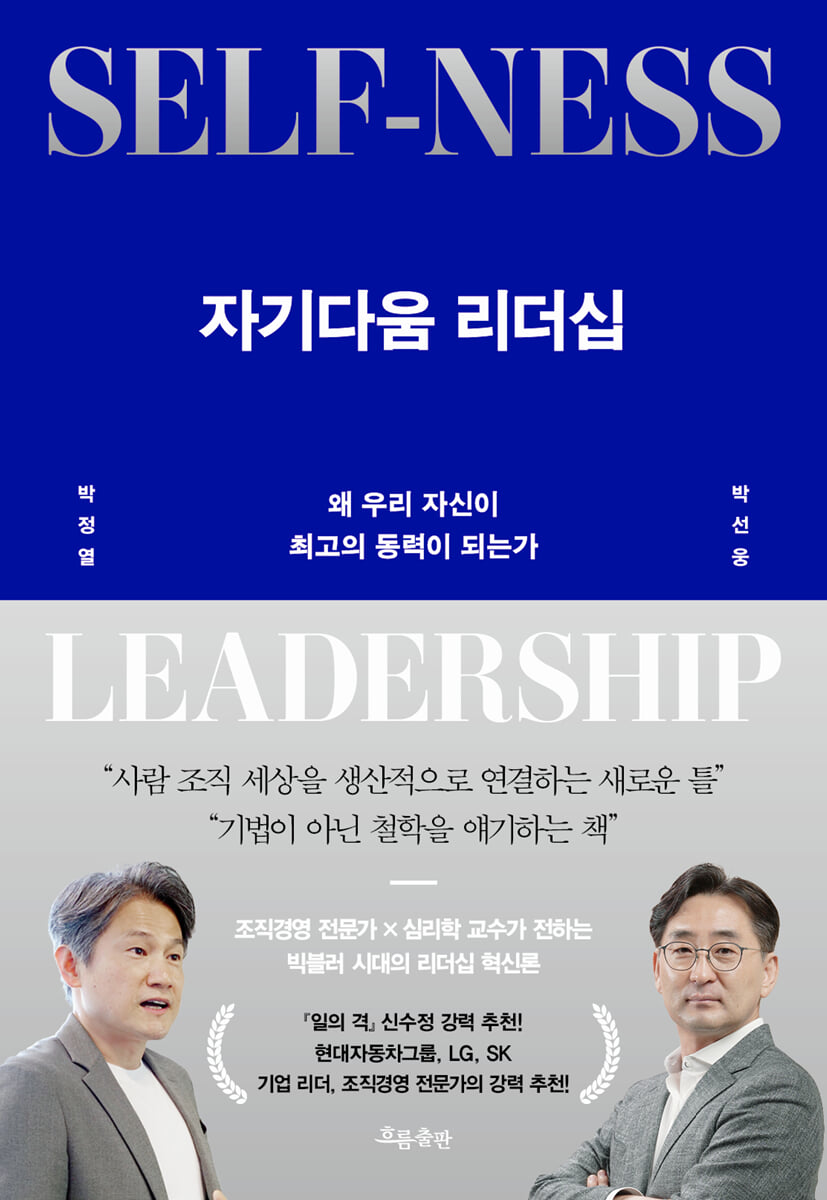
Self-centered leadership
 |
Description
Book Introduction
Each with their own excellence, not just one standard
Leadership Advice for a New Era: Making Employees the Main Entrepreneurs
The landscape of organizational management is changing.
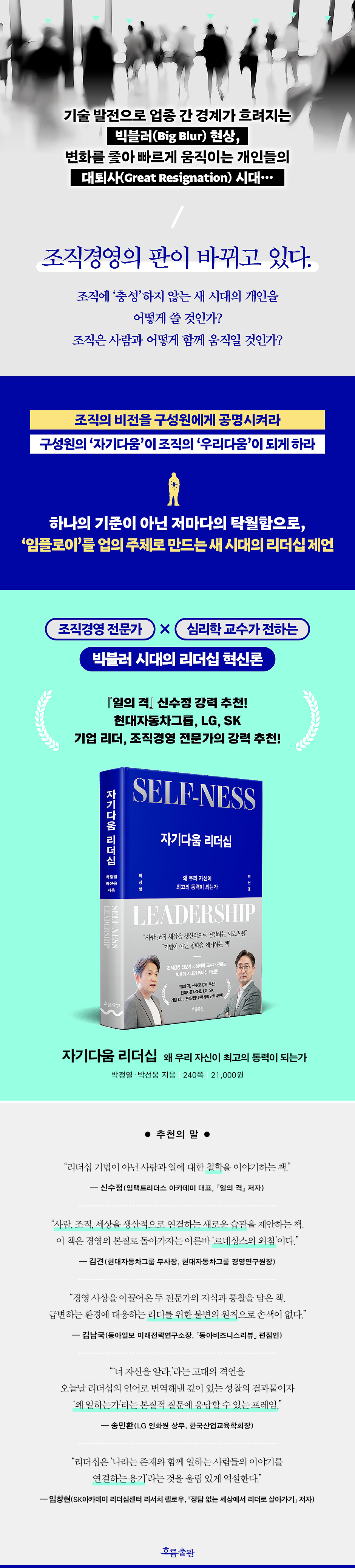
As technological advancements accelerate and complexity grows, the boundaries between industries collapse, ushering in an era of the Big Blur. Working individuals are moving quickly to keep pace with change, and the era of the Great Resignation has also arrived.
Many organizations are trying to embrace their members by re-establishing their organizational vision and culture, but individuals in the new era, with their strong individualism and desire for individualization, are no longer loyal to the organization.
We explore how we can thrive within an organization, achieve results in our own unique way, and tell our own story at work.
How do organizations utilize their members in the face of those who refuse to be "employees" anymore? What kind of leadership is needed to transform change into opportunity in today's organizational management?
In this book, Professor Jeong-yeol Park, an expert in organizational management and talent development, and Professor Seon-woong Park, an expert in identity psychology, propose 'authentic leadership' as the answer.
The most powerful driving force that can be drawn from a person is when their 'self' is realized.
In a time where efficiency-driven mediocrity and Taylorism have passed, leaders must now look at their members through a high-resolution lens, discerning their unique strengths and desires and connecting these to the organization's vision to drive engagement.
In an organization where individuality is realized, the narratives of its members and the narratives of the organization intersect, their visions align, and a tremendous driving force gathers.
In this way, both members and the organization experience explosive growth together.
"Leadership: The Self" draws on comprehensive knowledge encompassing psychology, philosophy, and management, along with accumulated innovation experience in various organizations, to propose new management, leadership, and organizational changes, as well as practical strategies for implementation.
We received recommendations from many corporate leaders and organizational management experts, including Shin Su-jeong, the author of "The Class of Work," and CEO of Impact Leaders Academy; Kim Kyeon, Vice President of Hyundai Motor Group; and LG and SKT.
Leadership Advice for a New Era: Making Employees the Main Entrepreneurs
The landscape of organizational management is changing.
As technological advancements accelerate and complexity grows, the boundaries between industries collapse, ushering in an era of the Big Blur. Working individuals are moving quickly to keep pace with change, and the era of the Great Resignation has also arrived.
Many organizations are trying to embrace their members by re-establishing their organizational vision and culture, but individuals in the new era, with their strong individualism and desire for individualization, are no longer loyal to the organization.
We explore how we can thrive within an organization, achieve results in our own unique way, and tell our own story at work.
How do organizations utilize their members in the face of those who refuse to be "employees" anymore? What kind of leadership is needed to transform change into opportunity in today's organizational management?
In this book, Professor Jeong-yeol Park, an expert in organizational management and talent development, and Professor Seon-woong Park, an expert in identity psychology, propose 'authentic leadership' as the answer.
The most powerful driving force that can be drawn from a person is when their 'self' is realized.
In a time where efficiency-driven mediocrity and Taylorism have passed, leaders must now look at their members through a high-resolution lens, discerning their unique strengths and desires and connecting these to the organization's vision to drive engagement.
In an organization where individuality is realized, the narratives of its members and the narratives of the organization intersect, their visions align, and a tremendous driving force gathers.
In this way, both members and the organization experience explosive growth together.
"Leadership: The Self" draws on comprehensive knowledge encompassing psychology, philosophy, and management, along with accumulated innovation experience in various organizations, to propose new management, leadership, and organizational changes, as well as practical strategies for implementation.
We received recommendations from many corporate leaders and organizational management experts, including Shin Su-jeong, the author of "The Class of Work," and CEO of Impact Leaders Academy; Kim Kyeon, Vice President of Hyundai Motor Group; and LG and SKT.
- You can preview some of the book's contents.
Preview
index
Recommendation
Introduction _ What Moves Us
Prologue: When One Person's World Meets Work
The answer to direction lies within us.
Don't get stuck in MBTI
Three things that make up self-understanding
Hire people, not resumes
The narratives of the organization and its members must be aligned.
Part 1: The Era of Big Blur: Forecasting Organizational Structure
Chapter 1: Organizational Growth Is Determined by a Leader's Interpersonal Relationship
We have entered an era where building a wall means death.
Innovation in people perspective comes first.
Management in the 20th Century: Taylorism, Fordism, and Sloanism
Read the needs of working humans
Chapter 2 - Each with their own excellence, not just one standard
The 'age of average' is over.
Authority and hierarchy silence members.
A "culture of respect," not a "culture of politeness."
Part 2 - Look at your members through a high-resolution lens.
Chapter 3: Identity, the Powerful Force That Moves People
Identity has direction
When our identity is embedded in the identity of work
Two Ways to Create Immersion in Your Work
Resonate with 'Why' rather than 'What'
Create an intersection between organizational and member identities.
Chapter 4 - Identity in Full Bloom, Being Yourself
When an organization respects its uniqueness
The irreversible wave of individualization
When you feel a sense of influence, your productivity skyrockets.
Three things that make you unique: interests, strengths, and aspirations.
Chapter 5: Attractive Organizations Don't Have Employees
The 'self-actor' who becomes the subject of karma
'One-way alignment' rather than uniformity
The formula for creating value that makes you unique
Leadership as Self: Exploration and Experimentation, Not Control and Management
Part 3: An Organization That Moves Forward Without Hesitation
Chapter 6: An organization that can write 'stories'
Beyond achievement to growth
Growth, development of the ability to deal with complexity
The future of work
Two Reasons Why Creative Innovation Organizations Fail
A Place Without Hierarchy: Morningstar's Creative Experiment
Chapter 7: Organizations Must Be Safe Laboratories
Embrace failure as a part of the process
Give failure a 'next chance'
Three Conditions for Turning Failure into Success
Be a leader who gives direction to your own identity.
Chapter 8: Eight Leadership Principles for Overcoming the Big Blur Era
Principle 1: Resonate with a 'Deep Sense of Purpose'
Principle 2: Create a culture that embraces diversity
Rule 3: Avoid the Key Talent Syndrome
Principle 4: Activate the 'human side' of your organization.
Principle 5: Throw away authoritarianism
Rule 6: Turn your failures into assets.
Principle 7: Hire Yourself Beyond Skills
Principle 8: Focus on Outcomes, Not Outputs
Conclusion _ The most explosively growing organization because it is the most personal
References
Introduction _ What Moves Us
Prologue: When One Person's World Meets Work
The answer to direction lies within us.
Don't get stuck in MBTI
Three things that make up self-understanding
Hire people, not resumes
The narratives of the organization and its members must be aligned.
Part 1: The Era of Big Blur: Forecasting Organizational Structure
Chapter 1: Organizational Growth Is Determined by a Leader's Interpersonal Relationship
We have entered an era where building a wall means death.
Innovation in people perspective comes first.
Management in the 20th Century: Taylorism, Fordism, and Sloanism
Read the needs of working humans
Chapter 2 - Each with their own excellence, not just one standard
The 'age of average' is over.
Authority and hierarchy silence members.
A "culture of respect," not a "culture of politeness."
Part 2 - Look at your members through a high-resolution lens.
Chapter 3: Identity, the Powerful Force That Moves People
Identity has direction
When our identity is embedded in the identity of work
Two Ways to Create Immersion in Your Work
Resonate with 'Why' rather than 'What'
Create an intersection between organizational and member identities.
Chapter 4 - Identity in Full Bloom, Being Yourself
When an organization respects its uniqueness
The irreversible wave of individualization
When you feel a sense of influence, your productivity skyrockets.
Three things that make you unique: interests, strengths, and aspirations.
Chapter 5: Attractive Organizations Don't Have Employees
The 'self-actor' who becomes the subject of karma
'One-way alignment' rather than uniformity
The formula for creating value that makes you unique
Leadership as Self: Exploration and Experimentation, Not Control and Management
Part 3: An Organization That Moves Forward Without Hesitation
Chapter 6: An organization that can write 'stories'
Beyond achievement to growth
Growth, development of the ability to deal with complexity
The future of work
Two Reasons Why Creative Innovation Organizations Fail
A Place Without Hierarchy: Morningstar's Creative Experiment
Chapter 7: Organizations Must Be Safe Laboratories
Embrace failure as a part of the process
Give failure a 'next chance'
Three Conditions for Turning Failure into Success
Be a leader who gives direction to your own identity.
Chapter 8: Eight Leadership Principles for Overcoming the Big Blur Era
Principle 1: Resonate with a 'Deep Sense of Purpose'
Principle 2: Create a culture that embraces diversity
Rule 3: Avoid the Key Talent Syndrome
Principle 4: Activate the 'human side' of your organization.
Principle 5: Throw away authoritarianism
Rule 6: Turn your failures into assets.
Principle 7: Hire Yourself Beyond Skills
Principle 8: Focus on Outcomes, Not Outputs
Conclusion _ The most explosively growing organization because it is the most personal
References
Detailed image
Into the book
“Know thyself.” Leaders who seek to build great organizations by mobilizing the passion of their members must always remember this saying.
The most powerful force that moves people is the force that comes out when something inside them stirs.
When something within oneself stirs, whether it be an interest or aptitude for the work, a desire to help those in need, a rage against injustice, or a yearning for excellence, people pour their soul into their work.
A leader's crucial role is to gather the energy of his or her members and channel it toward achieving the organization's ultimate goals.
At the starting point is understanding yourself.
--- p.24
Jennifer Deal summarized what employees want from the workplace these days into three things: "I want to be respected," "I want to do meaningful work and be compensated accordingly," and "I want to grow through my work."
So, they want to be recognized by their organizations and leaders for their unique strengths, not as mistakes, but as objects of respect. They want to see through various channels that their work is contributing to changing the world. They want to feel confident that they are making progress, rather than feeling exhausted, even when they are doing the same work day after day.
--- p.66
Ultimately, everything about leadership begins with a perspective on human nature, that is, a view of humanity.
A leader who believes that human nature is selfish and lazy, like the 〈X〉 perspective, may think that carrots and sticks should be used appropriately.
On the other hand, if a leader believes, as in the Y perspective, that humans are beings who dedicate themselves to tasks that they find meaningful and valuable and take active actions to properly complete those tasks, he or she will provide the environment and opportunities for each member to effectively exercise such initiative.
Which of these two perspectives on humanity is correct? According to Self-Determination Theory, which has sought the answer over the past several decades, the latter is the answer.
--- p.67
Even in the stories of ordinary people's achievements, their interests, strengths, and aspirations were operating beneath the surface, and at least one of these aligned with the needs of the world.
Moreover, the stronger the connection, the more likely it was that one would achieve success by maximizing one's interests, strengths, and aspirations rather than compromising, yielding, or putting them down, and by drawing support and assistance from those around them.
The authors refer to the organically intertwined combination of these three elements as 'self-identity.'
These three elements that make up self-identity are a powerful driving force that enables people to actively create pleasant changes in their lives.
When our curiosity fuels our work, when we excel at what we do, and when the values and beliefs we cherish have a positive impact on the world, we experience passion and engagement.
In this way, you can enjoy your presence at work.
Self-confidence is the full bloom of identity.
--- p.125
Now, members are no longer simply employees who serve as the hands and feet of their employers and handle their work, but they are now realizing that they are individuals who can exert a meaningful influence on the world through their work.
Work is still a means of making a living, but it is also a pathway to achieving great things that would be impossible on your own.
…In the process of achieving goals, each member experiences a sense of presence and growth, a meaningful connection to the world, and the company can reap the fruits of its labor in the form of profit while exerting a positive influence on the world.
--- p.128
Will the organization continue to be effective in the future? Perhaps, if the synergy among its members is maximized and the organization's excellence is maintained.
To do this, the organization must now become a safe laboratory.
We must maximize the benefits of collective intelligence brought about by diversity and embrace complexity productively.
Each member must connect their individuality to their work, making experimentation and exploration a daily routine, maintaining psychological safety, finding lessons and messages from failure, and then working to challenge themselves again.
Leaders need a paradigm shift from thinking of their members as resources needed to achieve organizational success to thinking of them as beings who deserve respect.
As long as we perceive our members as resources, they are merely objects to be managed.
But when we recognize the members as beings, the uniqueness of each member begins to show, and the door to collective creativity opens.
The most powerful force that moves people is the force that comes out when something inside them stirs.
When something within oneself stirs, whether it be an interest or aptitude for the work, a desire to help those in need, a rage against injustice, or a yearning for excellence, people pour their soul into their work.
A leader's crucial role is to gather the energy of his or her members and channel it toward achieving the organization's ultimate goals.
At the starting point is understanding yourself.
--- p.24
Jennifer Deal summarized what employees want from the workplace these days into three things: "I want to be respected," "I want to do meaningful work and be compensated accordingly," and "I want to grow through my work."
So, they want to be recognized by their organizations and leaders for their unique strengths, not as mistakes, but as objects of respect. They want to see through various channels that their work is contributing to changing the world. They want to feel confident that they are making progress, rather than feeling exhausted, even when they are doing the same work day after day.
--- p.66
Ultimately, everything about leadership begins with a perspective on human nature, that is, a view of humanity.
A leader who believes that human nature is selfish and lazy, like the 〈X〉 perspective, may think that carrots and sticks should be used appropriately.
On the other hand, if a leader believes, as in the Y perspective, that humans are beings who dedicate themselves to tasks that they find meaningful and valuable and take active actions to properly complete those tasks, he or she will provide the environment and opportunities for each member to effectively exercise such initiative.
Which of these two perspectives on humanity is correct? According to Self-Determination Theory, which has sought the answer over the past several decades, the latter is the answer.
--- p.67
Even in the stories of ordinary people's achievements, their interests, strengths, and aspirations were operating beneath the surface, and at least one of these aligned with the needs of the world.
Moreover, the stronger the connection, the more likely it was that one would achieve success by maximizing one's interests, strengths, and aspirations rather than compromising, yielding, or putting them down, and by drawing support and assistance from those around them.
The authors refer to the organically intertwined combination of these three elements as 'self-identity.'
These three elements that make up self-identity are a powerful driving force that enables people to actively create pleasant changes in their lives.
When our curiosity fuels our work, when we excel at what we do, and when the values and beliefs we cherish have a positive impact on the world, we experience passion and engagement.
In this way, you can enjoy your presence at work.
Self-confidence is the full bloom of identity.
--- p.125
Now, members are no longer simply employees who serve as the hands and feet of their employers and handle their work, but they are now realizing that they are individuals who can exert a meaningful influence on the world through their work.
Work is still a means of making a living, but it is also a pathway to achieving great things that would be impossible on your own.
…In the process of achieving goals, each member experiences a sense of presence and growth, a meaningful connection to the world, and the company can reap the fruits of its labor in the form of profit while exerting a positive influence on the world.
--- p.128
Will the organization continue to be effective in the future? Perhaps, if the synergy among its members is maximized and the organization's excellence is maintained.
To do this, the organization must now become a safe laboratory.
We must maximize the benefits of collective intelligence brought about by diversity and embrace complexity productively.
Each member must connect their individuality to their work, making experimentation and exploration a daily routine, maintaining psychological safety, finding lessons and messages from failure, and then working to challenge themselves again.
Leaders need a paradigm shift from thinking of their members as resources needed to achieve organizational success to thinking of them as beings who deserve respect.
As long as we perceive our members as resources, they are merely objects to be managed.
But when we recognize the members as beings, the uniqueness of each member begins to show, and the door to collective creativity opens.
--- pp.225-226
Publisher's Review
Make the organization's vision resonate with its members.
Let each member's "self" become the organization's "us."
In the era of the Big Blur, the workplace has become a stage for self-promotion.
A new leadership philosophy that allows people and organizations to grow explosively together.
Blind, a social platform for office workers, releases its annual "Blind Index," which measures the level of happiness enjoyed at work.
According to Blind's 2022 report, workplace happiness was very low, at 41 out of 100, with younger employees, such as associates and managers, reporting particularly low levels of happiness.
What has made Korean office workers unhappy at work? The biggest reason is the lack of meaningful work, or the degree to which their work aligns with their life direction.
The impact of work meaning on workplace happiness was more than twice that of work-life balance and three times that of in-house welfare.
This result clearly shows that people, at least young people of this era, do not work simply to make a living.
Organizational management expert × Psychology professor
Leadership Innovation in the Age of Big Blur
“The most essential ‘reset’ of our time is to redefine humanity.” (Klaus Schwab, Executive Chairman of the World Economic Forum)
Organizational growth is determined by the leader's interpersonal relationships.
When leaders understand the essence of what motivates people, they can maximize their potential.
We are most spontaneous and deeply engaged in our work when we can express our identity, individuality, and who we are at work.
And creativity and innovation naturally arise from this immersion.
Here is the leader's job.
This is leadership that examines each member's unique "self" through a high-resolution lens, connects their driving force to the organization's "unity," reads the desires of each individual worker, and turns the workplace into a "stage of activity" where they can express their will.
If an organization can embrace the individuality and life narrative of each member and create a shared narrative, individuals will experience growth and the company will achieve success.
This is the self-centered leadership that the authors talk about.
Make sure your members' stories connect with the organization's story.
Beyond MBTI, "Narrative Identity": Understanding a Person's World
The two authors point out the shortcomings of MBTI, which has been used as a tool for understanding people, and propose the psychological concept of 'narrative identity.'
The story of how you became who you are today is a unique individuality that cannot be compared to anyone else's.
When people can continue to write their own life stories in the organization, they connect their lives to the organization and become immersed in their work.
The book explores various domestic and international management cases, including Hyundai Motor Group, Shopify, Wipro, and Costco, that recruited members and operated organizations based on narrative identity.
In doing so, it persuasively conveys the effectiveness of hospitality leadership that considers and actively utilizes each person's individuality.
Making employees the subject of karma
Eight Principles of Personal Leadership
The phenomenon of thigh-crossing in the era of the Big Blur is an expression of the thirst for self-identity, work, the workplace, and connection with the world.
Many people ask fundamental questions about life, work, organizations, and themselves.
"Do I truly like this organization's culture? Am I truly recognized? Does the organization provide opportunities for growth and fulfillment? Can I find meaning in my work?" The authors examined organizations that practically considered and implemented ways to embrace their members' identities, dramatically increasing employee satisfaction with the organization and their jobs.
And they summarized their leadership principles into eight points.
■ Principle 1.
Resonate with a 'deep sense of purpose'
There must be a process through which all members can realize the impact of their work and grasp its meaning.
And this needs to be shared within the organization.
As we deeply empathize with the reason for working together and come to see each other's work as a positive-sum game, the members feel united as one and develop abilities that exceed the sum of their individual capabilities.
■ Principle 2.
Create a culture that embraces diversity
Diverse organizations are better at solving problems than organizations where each member possesses exceptional individual skills because they can utilize a variety of thinking tools to solve problems.
Diversity is expressed as creativity, especially when ‘cognitive diversity’ rather than ‘demographic diversity’ is established.
■ Principle 3.
Ditch the Key Talent Syndrome
'Apollo Syndrome' refers to the phenomenon where a group of talented people performs poorly.
They waste time trying to convince their colleagues of their own ideas, only focusing on the weaknesses in each other's arguments and failing to reach a consensus.
The more difficult and complex a job is, the more essential it is to have exceptional talent. However, if these individuals neglect behaviors that hinder the level of diversity within the organization, it will be difficult for the organization to achieve the desired results.
■ Principle 4.
Activate the 'human side' of your organization.
If an organization fails to become a hub that "buffers" conflict and "connects" people, it will not be able to productively resolve the conflicts that arise as internal diversity grows, leaving scars on the organization.
Connections between members are possible when they are mutually beneficial and when shared values are discovered, refined, and formed into a common language.
■ Principle 5.
Throw away authoritarianism
There is no 'Generation MZ', you were also 'Generation X'.
According to our research, negative stereotypes about the MZ generation are based on the older generation's 'authoritarianism'.
The older generation of bosses, who are authoritarian, tend to have low favorability toward the younger generation and avoid collaboration.
Authoritarianism is the most dangerous 'enemy of innovation' of all.
■ Principle 6.
Turn your failures into assets
Convert the experience of failure into ‘profit from failure.’
If we analyze the lessons learned from failed projects by dividing them into "assets" and "liabilities" like a balance sheet, failures can be reinterpreted as tangible and intangible investments rather than complete failures.
When organizations don't condemn failure, their members have the courage to be creative.
When an organization becomes a 'safe laboratory', 'self-actualization' is born.
■ Principle 7.
Hire for your uniqueness, not just your skills.
Success comes when our true self becomes our true self.
When hiring new employees, it's important to go beyond simply assessing their fluency in job skills to consider how their unique personalities can organically connect with the organization's vision.
■ Principle 8.
Focus on the outcome, not the output.
Output refers to the product that comes from input, and outcome is a concept that includes the value created in addition to the product.
Output-based performance evaluation follows the dichotomy of whether the intended output was produced or not.
However, outcome-based evaluation is based on whether value was provided to customers or users.
When organizations evaluate their members based on outcomes, they will be more flexible and quicker in their attempts to produce results that meet the ultimate meaning and goals of their work, even in difficult situations.
This is ‘agility’, which can be said to be the dream of every organization.
Leaders also change with the times.
Nowadays, a great leader is not someone who reigns with outstanding charisma, but someone who understands his or her own uniqueness, respects and encourages the individual selves of each member of the organization, and helps them use the resulting passion and energy to achieve the organization's goals.
"Leadership: The Self" demonstrates, through a variety of management examples and concrete methodologies, that leadership must evolve from control and direction to exploration, experimentation, empathy, and shared narratives.
This book, which contains the knowledge and insights of two leading management experts, will serve as a timeless guide for leaders who must adapt to a rapidly changing environment.
Let each member's "self" become the organization's "us."
In the era of the Big Blur, the workplace has become a stage for self-promotion.
A new leadership philosophy that allows people and organizations to grow explosively together.
Blind, a social platform for office workers, releases its annual "Blind Index," which measures the level of happiness enjoyed at work.
According to Blind's 2022 report, workplace happiness was very low, at 41 out of 100, with younger employees, such as associates and managers, reporting particularly low levels of happiness.
What has made Korean office workers unhappy at work? The biggest reason is the lack of meaningful work, or the degree to which their work aligns with their life direction.
The impact of work meaning on workplace happiness was more than twice that of work-life balance and three times that of in-house welfare.
This result clearly shows that people, at least young people of this era, do not work simply to make a living.
Organizational management expert × Psychology professor
Leadership Innovation in the Age of Big Blur
“The most essential ‘reset’ of our time is to redefine humanity.” (Klaus Schwab, Executive Chairman of the World Economic Forum)
Organizational growth is determined by the leader's interpersonal relationships.
When leaders understand the essence of what motivates people, they can maximize their potential.
We are most spontaneous and deeply engaged in our work when we can express our identity, individuality, and who we are at work.
And creativity and innovation naturally arise from this immersion.
Here is the leader's job.
This is leadership that examines each member's unique "self" through a high-resolution lens, connects their driving force to the organization's "unity," reads the desires of each individual worker, and turns the workplace into a "stage of activity" where they can express their will.
If an organization can embrace the individuality and life narrative of each member and create a shared narrative, individuals will experience growth and the company will achieve success.
This is the self-centered leadership that the authors talk about.
Make sure your members' stories connect with the organization's story.
Beyond MBTI, "Narrative Identity": Understanding a Person's World
The two authors point out the shortcomings of MBTI, which has been used as a tool for understanding people, and propose the psychological concept of 'narrative identity.'
The story of how you became who you are today is a unique individuality that cannot be compared to anyone else's.
When people can continue to write their own life stories in the organization, they connect their lives to the organization and become immersed in their work.
The book explores various domestic and international management cases, including Hyundai Motor Group, Shopify, Wipro, and Costco, that recruited members and operated organizations based on narrative identity.
In doing so, it persuasively conveys the effectiveness of hospitality leadership that considers and actively utilizes each person's individuality.
Making employees the subject of karma
Eight Principles of Personal Leadership
The phenomenon of thigh-crossing in the era of the Big Blur is an expression of the thirst for self-identity, work, the workplace, and connection with the world.
Many people ask fundamental questions about life, work, organizations, and themselves.
"Do I truly like this organization's culture? Am I truly recognized? Does the organization provide opportunities for growth and fulfillment? Can I find meaning in my work?" The authors examined organizations that practically considered and implemented ways to embrace their members' identities, dramatically increasing employee satisfaction with the organization and their jobs.
And they summarized their leadership principles into eight points.
■ Principle 1.
Resonate with a 'deep sense of purpose'
There must be a process through which all members can realize the impact of their work and grasp its meaning.
And this needs to be shared within the organization.
As we deeply empathize with the reason for working together and come to see each other's work as a positive-sum game, the members feel united as one and develop abilities that exceed the sum of their individual capabilities.
■ Principle 2.
Create a culture that embraces diversity
Diverse organizations are better at solving problems than organizations where each member possesses exceptional individual skills because they can utilize a variety of thinking tools to solve problems.
Diversity is expressed as creativity, especially when ‘cognitive diversity’ rather than ‘demographic diversity’ is established.
■ Principle 3.
Ditch the Key Talent Syndrome
'Apollo Syndrome' refers to the phenomenon where a group of talented people performs poorly.
They waste time trying to convince their colleagues of their own ideas, only focusing on the weaknesses in each other's arguments and failing to reach a consensus.
The more difficult and complex a job is, the more essential it is to have exceptional talent. However, if these individuals neglect behaviors that hinder the level of diversity within the organization, it will be difficult for the organization to achieve the desired results.
■ Principle 4.
Activate the 'human side' of your organization.
If an organization fails to become a hub that "buffers" conflict and "connects" people, it will not be able to productively resolve the conflicts that arise as internal diversity grows, leaving scars on the organization.
Connections between members are possible when they are mutually beneficial and when shared values are discovered, refined, and formed into a common language.
■ Principle 5.
Throw away authoritarianism
There is no 'Generation MZ', you were also 'Generation X'.
According to our research, negative stereotypes about the MZ generation are based on the older generation's 'authoritarianism'.
The older generation of bosses, who are authoritarian, tend to have low favorability toward the younger generation and avoid collaboration.
Authoritarianism is the most dangerous 'enemy of innovation' of all.
■ Principle 6.
Turn your failures into assets
Convert the experience of failure into ‘profit from failure.’
If we analyze the lessons learned from failed projects by dividing them into "assets" and "liabilities" like a balance sheet, failures can be reinterpreted as tangible and intangible investments rather than complete failures.
When organizations don't condemn failure, their members have the courage to be creative.
When an organization becomes a 'safe laboratory', 'self-actualization' is born.
■ Principle 7.
Hire for your uniqueness, not just your skills.
Success comes when our true self becomes our true self.
When hiring new employees, it's important to go beyond simply assessing their fluency in job skills to consider how their unique personalities can organically connect with the organization's vision.
■ Principle 8.
Focus on the outcome, not the output.
Output refers to the product that comes from input, and outcome is a concept that includes the value created in addition to the product.
Output-based performance evaluation follows the dichotomy of whether the intended output was produced or not.
However, outcome-based evaluation is based on whether value was provided to customers or users.
When organizations evaluate their members based on outcomes, they will be more flexible and quicker in their attempts to produce results that meet the ultimate meaning and goals of their work, even in difficult situations.
This is ‘agility’, which can be said to be the dream of every organization.
Leaders also change with the times.
Nowadays, a great leader is not someone who reigns with outstanding charisma, but someone who understands his or her own uniqueness, respects and encourages the individual selves of each member of the organization, and helps them use the resulting passion and energy to achieve the organization's goals.
"Leadership: The Self" demonstrates, through a variety of management examples and concrete methodologies, that leadership must evolve from control and direction to exploration, experimentation, empathy, and shared narratives.
This book, which contains the knowledge and insights of two leading management experts, will serve as a timeless guide for leaders who must adapt to a rapidly changing environment.
GOODS SPECIFICS
- Date of issue: May 1, 2025
- Format: Paperback book binding method guide
- Page count, weight, size: 240 pages | 392g | 135*200*20mm
- ISBN13: 9788965967132
- ISBN10: 8965967139
You may also like
카테고리
korean


korean

![GQ KOREA Mark (Monthly): December [2025]](http://librairie.coreenne.fr/cdn/shop/files/8ef265dbbfbf186523ed75ba7319009d.jpg?v=1765340328&width=3840)


