

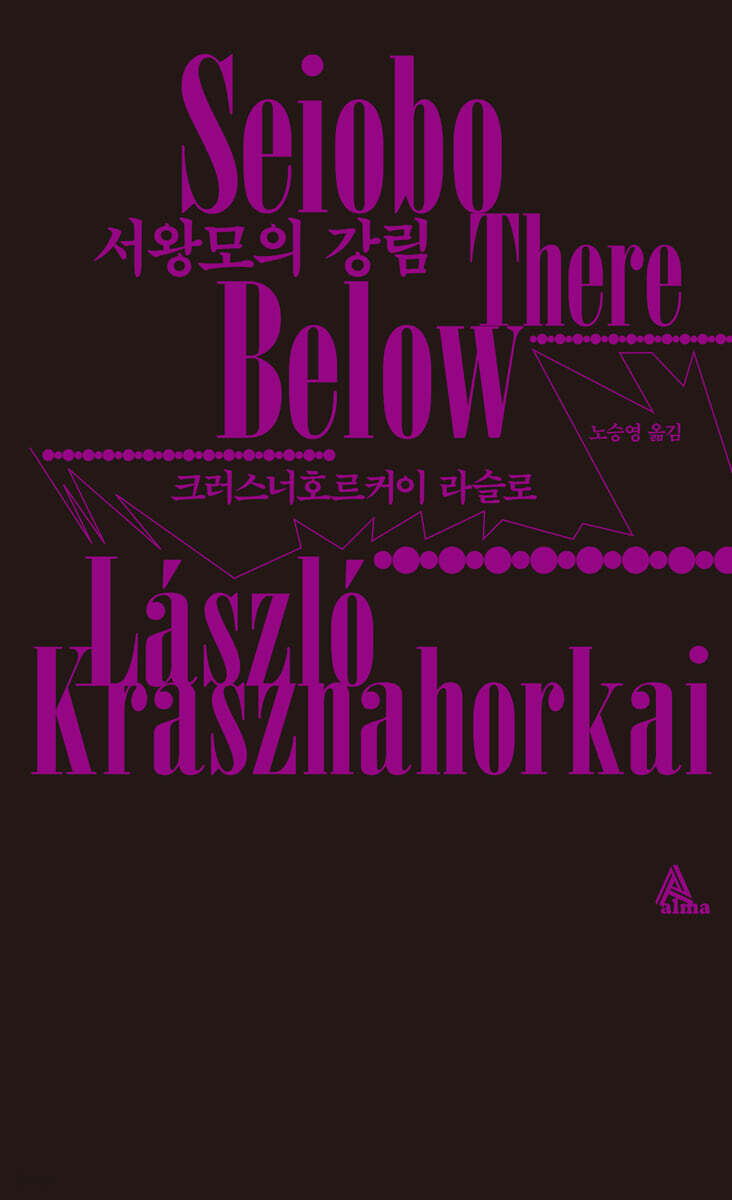
The Descent of the Queen Mother of the West
 |
Description
Book Introduction
Built with ten thousand commas and one hundred periods
A huge temple dedicated to art
Infinitely expanding beyond time and space
A story about art, humanity, and God
"An artist who reawakened the power of art even amidst the fear of destruction."
Continuing our connection with Korean readers with the new work "Hersheyt 07769."
László Krásznáhorkaj, a master of modern Hungarian literature, has won the 2025 Nobel Prize in Literature.
The Nobel Committee stated that the award was given for “a powerful and visionary work that reawakens the power of art even in the face of the horrors of destruction,” and that he had shown again the possibility of a “prophetic language” that modern literature had lost.
A literary prophet walking the boundaries of language, between destruction and salvation.
Since his literary debut in 1985 with "Satantango," László Krzysztof Krzysztof has been a writer who has depicted the anxieties of human existence and the collapse of the world in his compelling prose. His prose, with its endlessly long sentences and intense narrative tension, immerses readers in a unique style that can be called a "reading exercise."
Alma Publishing has introduced the author's six representative works, "Satan Tango," "Melancholy of Resistance," "The Last Wolf," "The World Goes On," "The Descent of the Queen Mother of the West," and "The Return of Baron Wenkheim," to Korea, and plans to publish a new work, "Herscht 07769," in January 2026.
"Hersht 07769" depicts the journey of "Hersht," a man called by a number instead of a name, as he seeks to rediscover his identity and the meaning of language in a world after the collapse of civilization. In a society where communication is based solely on numbers and symbols, he encounters a world of humans whose names can no longer be called. This work is considered to be the author's later work that most densely embodies the "anxiety of existence" and "human possibilities after the end of language," which the author has consistently explored.
His literary works, which have expanded globally, have long cultivated a deep readership, even amidst a quiet resonance. This Nobel Prize in Literature marks the moment when his endless exploration of the origins of humanity and art is once again resurrected in the languages of the world, and will undoubtedly resonate deeply with readers.
Promotion of screenings of "Reading László Krzysztof ...
To commemorate this award, Alma Publishing will present a booklet titled "Reading László Krasnahorkai" (tentative title), which aims to bring readers closer to the world of literature, which is by no means easy but essential to read. The contributors include Professor Han Kyung-min, poet Jo Won-gyu, film critic Jeong Seong-il, literary critic Jang Eun-soo, critic Geum Jeong-yeon, and poet Kim Yu-tae, who will each interpret the author's world from their own perspectives.
Additionally, in order to expand and illuminate the author's literary world through film, we are promoting the screening of "Werckmeister Harmonies," based on the films "Satantango" and "Resistance Melancholy" by another world-renowned director, Tar Bella.
A huge temple dedicated to art
Infinitely expanding beyond time and space
A story about art, humanity, and God
"An artist who reawakened the power of art even amidst the fear of destruction."
Continuing our connection with Korean readers with the new work "Hersheyt 07769."
László Krásznáhorkaj, a master of modern Hungarian literature, has won the 2025 Nobel Prize in Literature.
The Nobel Committee stated that the award was given for “a powerful and visionary work that reawakens the power of art even in the face of the horrors of destruction,” and that he had shown again the possibility of a “prophetic language” that modern literature had lost.
A literary prophet walking the boundaries of language, between destruction and salvation.
Since his literary debut in 1985 with "Satantango," László Krzysztof Krzysztof has been a writer who has depicted the anxieties of human existence and the collapse of the world in his compelling prose. His prose, with its endlessly long sentences and intense narrative tension, immerses readers in a unique style that can be called a "reading exercise."
Alma Publishing has introduced the author's six representative works, "Satan Tango," "Melancholy of Resistance," "The Last Wolf," "The World Goes On," "The Descent of the Queen Mother of the West," and "The Return of Baron Wenkheim," to Korea, and plans to publish a new work, "Herscht 07769," in January 2026.
"Hersht 07769" depicts the journey of "Hersht," a man called by a number instead of a name, as he seeks to rediscover his identity and the meaning of language in a world after the collapse of civilization. In a society where communication is based solely on numbers and symbols, he encounters a world of humans whose names can no longer be called. This work is considered to be the author's later work that most densely embodies the "anxiety of existence" and "human possibilities after the end of language," which the author has consistently explored.
His literary works, which have expanded globally, have long cultivated a deep readership, even amidst a quiet resonance. This Nobel Prize in Literature marks the moment when his endless exploration of the origins of humanity and art is once again resurrected in the languages of the world, and will undoubtedly resonate deeply with readers.
Promotion of screenings of "Reading László Krzysztof ...
To commemorate this award, Alma Publishing will present a booklet titled "Reading László Krasnahorkai" (tentative title), which aims to bring readers closer to the world of literature, which is by no means easy but essential to read. The contributors include Professor Han Kyung-min, poet Jo Won-gyu, film critic Jeong Seong-il, literary critic Jang Eun-soo, critic Geum Jeong-yeon, and poet Kim Yu-tae, who will each interpret the author's world from their own perspectives.
Additionally, in order to expand and illuminate the author's literary world through film, we are promoting the screening of "Werckmeister Harmonies," based on the films "Satantango" and "Resistance Melancholy" by another world-renowned director, Tar Bella.
- You can preview some of the book's contents.
Preview
index
1 / The Hunters of Kamogawa...9
2 / The Exiled Queen...29
3 / Preservation of Buddha statues..71
5 / Cristo Morto..129
8 / Climb up the Acropolis...181
13 / He wakes up at dawn..211
21 / The Birth of a Murderer...237
34 / The Life and Work of Master Inoue Kazuyuki...303
55 / Il Ritorno in Perugia..355
89 / A distant command...419
144 / Something is burning outside..455
233 / Where you're looking...469
377 / Private Passion...497
610 / A single, dry strip amidst the greenery...527
987 / Ise Shrine, Year of the Ten Palace...547
1597 / Zeami leaves...617
2584 / Screams from Underground...651
Translator's Note...661
2 / The Exiled Queen...29
3 / Preservation of Buddha statues..71
5 / Cristo Morto..129
8 / Climb up the Acropolis...181
13 / He wakes up at dawn..211
21 / The Birth of a Murderer...237
34 / The Life and Work of Master Inoue Kazuyuki...303
55 / Il Ritorno in Perugia..355
89 / A distant command...419
144 / Something is burning outside..455
233 / Where you're looking...469
377 / Private Passion...497
610 / A single, dry strip amidst the greenery...527
987 / Ise Shrine, Year of the Ten Palace...547
1597 / Zeami leaves...617
2584 / Screams from Underground...651
Translator's Note...661
Into the book
Even with all this speculation running wild, it is impossible to doubt their existence, to deny that they exist.
--- p.56 From “The Exiled Queen”
Then, finally, the thrilling day arrived when the restored pieces were reassembled in the afternoon, and before the promised delivery date, the statue, radiating its original brilliance, was placed on the hydraulic table once more, whole. When the Zengenji Amitabha Buddha and its gaze of indescribable power swept over everyone in the Academy as if whipping everything, they felt as if they were in a storm, and even Fujimori Seiichi felt it, so that for the first time, he could not bear the silence—the immense, heavy, terrifying, enigmatic silence—and for a long time he bowed his head and lowered his eyes before the statue, something even he, the Academy's foreman who had seen so much, had never seen before.
--- p.101 From “Preservation of Buddha Statues”
He looked into the eyes of Christ, and saw nothing else, but this pure sadness, a sadness that seemed to have no cause, and he was frozen in one thought: that sadness is only sadness for everything, for creation, for existence, for being, for time, for pain and suffering, for birth and destruction - and suddenly a noise struck his ears, and for a moment his head cleared, and after a moment he realized that it was seeping in from outside, … …
--- p.178 From "Christo Morto"
The world must see these replicas and then figure out which one is real.
--- p.274 From "The Birth of a Murderer"
He said, That is because I think only of today, Because I have no tomorrow, Because I have no future, Because every day is the last day, Because every day is complete and full, Because I could die on any day, I am ready to accept death, And then everything will be over, What he means is - he looked at the guest sitting opposite him at the end of the room - That one whole will end, And somewhere far away another whole will begin, I am waiting for death, He said with a constant smile, I am waiting, He said, Death is always with me, And I have nothing to lose in dying, Because for me the present means everything, This day, This hour, This moment - This moment when I am dying.
--- p.322 From “The Life and Work of Master Inoue Kazuyuki”
It is as if he already suspects that the Alhambra does not provide him with the knowledge that he knows nothing about the Alhambra and that the Alhambra itself knows nothing about this ignorance, for ignorance does not even exist.
It is a complex process not to know something, and the story unfolds under the shadow of the truth.
Because there is truth in it.
Because the Alhambra is there.
That's the truth.
--- p.453 From "The Distant Command"
If I look at her, the least painful part for me is not knowing the name of the sculptor, who may have been from Antioch, or indeed the son of Menides, as is forever engraved on the plinth—so what? The least disturbing part for me is not knowing what the right arm was doing at any given moment, or what the left arm was doing, but what matters here, I feel, is the thread that leads the Venus de Milo to the original, to the one and only Aphrodite, made by Praxiteles at Cnidos, and that is what matters to me. If I look at her—and here Chébaigne, knowing he can waste no more of the audience's time, steps back, lowers his voice, as if he were about to tell me the conclusion—you know, if I look at her, he says softly, all I can think about—and this would be a form of suffering indeed—is that this Aphrodite is so captivating, so ecstatic, so indescribably beautiful.
--- p.489 From "Where You Are Looking"
In general, I don't believe in dates, because everything flows into and out of one another, and everything extends out like tentacles, so there's no such thing as a definite era or anything ridiculous, and you only have to think about it to see that the world is too complex for that. Just think about where an event begins and ends, it's obvious. It's no use looking into dates or eras, so let's leave all that to the experts, the idiots and the bull-headed Andanis.
--- p.504 From “Private Passion”
The star has died out and the geniuses have perished,
--- p.509 From "Private Passion"
Akio-san, you really love Kyoto, don't you? Then, in an instant, Kawamoto completely breaks down, and goes down the road into the thick darkness, only to return this far, and in a hoarse voice, barely manages to say, No, not at all, I hate this city.
--- pp.615-616 From "Ise Shrine Shiknyeoncheongu"
Since poetry flows out of its own accord, just sing, sing to me, so that you will not be alone in your sorrow, I too will be sorrowful, an old man, old and abandoned, alone and isolated from the world, longing for his lost hometown, longing for life, longing for what he has lost forever.
--- p.56 From “The Exiled Queen”
Then, finally, the thrilling day arrived when the restored pieces were reassembled in the afternoon, and before the promised delivery date, the statue, radiating its original brilliance, was placed on the hydraulic table once more, whole. When the Zengenji Amitabha Buddha and its gaze of indescribable power swept over everyone in the Academy as if whipping everything, they felt as if they were in a storm, and even Fujimori Seiichi felt it, so that for the first time, he could not bear the silence—the immense, heavy, terrifying, enigmatic silence—and for a long time he bowed his head and lowered his eyes before the statue, something even he, the Academy's foreman who had seen so much, had never seen before.
--- p.101 From “Preservation of Buddha Statues”
He looked into the eyes of Christ, and saw nothing else, but this pure sadness, a sadness that seemed to have no cause, and he was frozen in one thought: that sadness is only sadness for everything, for creation, for existence, for being, for time, for pain and suffering, for birth and destruction - and suddenly a noise struck his ears, and for a moment his head cleared, and after a moment he realized that it was seeping in from outside, … …
--- p.178 From "Christo Morto"
The world must see these replicas and then figure out which one is real.
--- p.274 From "The Birth of a Murderer"
He said, That is because I think only of today, Because I have no tomorrow, Because I have no future, Because every day is the last day, Because every day is complete and full, Because I could die on any day, I am ready to accept death, And then everything will be over, What he means is - he looked at the guest sitting opposite him at the end of the room - That one whole will end, And somewhere far away another whole will begin, I am waiting for death, He said with a constant smile, I am waiting, He said, Death is always with me, And I have nothing to lose in dying, Because for me the present means everything, This day, This hour, This moment - This moment when I am dying.
--- p.322 From “The Life and Work of Master Inoue Kazuyuki”
It is as if he already suspects that the Alhambra does not provide him with the knowledge that he knows nothing about the Alhambra and that the Alhambra itself knows nothing about this ignorance, for ignorance does not even exist.
It is a complex process not to know something, and the story unfolds under the shadow of the truth.
Because there is truth in it.
Because the Alhambra is there.
That's the truth.
--- p.453 From "The Distant Command"
If I look at her, the least painful part for me is not knowing the name of the sculptor, who may have been from Antioch, or indeed the son of Menides, as is forever engraved on the plinth—so what? The least disturbing part for me is not knowing what the right arm was doing at any given moment, or what the left arm was doing, but what matters here, I feel, is the thread that leads the Venus de Milo to the original, to the one and only Aphrodite, made by Praxiteles at Cnidos, and that is what matters to me. If I look at her—and here Chébaigne, knowing he can waste no more of the audience's time, steps back, lowers his voice, as if he were about to tell me the conclusion—you know, if I look at her, he says softly, all I can think about—and this would be a form of suffering indeed—is that this Aphrodite is so captivating, so ecstatic, so indescribably beautiful.
--- p.489 From "Where You Are Looking"
In general, I don't believe in dates, because everything flows into and out of one another, and everything extends out like tentacles, so there's no such thing as a definite era or anything ridiculous, and you only have to think about it to see that the world is too complex for that. Just think about where an event begins and ends, it's obvious. It's no use looking into dates or eras, so let's leave all that to the experts, the idiots and the bull-headed Andanis.
--- p.504 From “Private Passion”
The star has died out and the geniuses have perished,
--- p.509 From "Private Passion"
Akio-san, you really love Kyoto, don't you? Then, in an instant, Kawamoto completely breaks down, and goes down the road into the thick darkness, only to return this far, and in a hoarse voice, barely manages to say, No, not at all, I hate this city.
--- pp.615-616 From "Ise Shrine Shiknyeoncheongu"
Since poetry flows out of its own accord, just sing, sing to me, so that you will not be alone in your sorrow, I too will be sorrowful, an old man, old and abandoned, alone and isolated from the world, longing for his lost hometown, longing for life, longing for what he has lost forever.
--- p.644 From "Zeami is Leaving"
Publisher's Review
Winner of the 2019 National Book Award for Translated Literature and the 2015 Man Booker International Prize
A collection of short stories by László Krzysztof ...
“László Krusnahorkay presents us with works that shine under the prism of hidden meaning.
Our task is to connect the dots, to feel the mystery of the sentence, to embrace the confusion that comes with patience and acceptance, and to prepare for an encounter with a moment of profound significance.”
_《Millions》
“László Krzysztof Krzysztof Krzysztof Krzysztof F ...
But sometimes these sentences excite us and even make us feel happy.”
_《The Guardian》
A new work by László Krásznáhorkaj, a master of modern Hungarian literature, has been published exclusively through Alma Publishing.
Krusnahorkai, winner of the 2015 Man Booker International Prize and the 2019 National Book Award for Translated Literature, is a writer who is consistently mentioned as a candidate for the Nobel Prize in Literature.
Since becoming known in Korea as the original novelist for Bela Tarr's film "Satan Tango," he has built a solid fan base with his unrivaled writing style and writing skills.
《The Descent of the Queen Mother of the West》 is an important work that will allow readers who have consistently followed Krusnahorkai's work to experience another side of his charm.
Or, it could be a good opportunity for readers who wanted to get closer to Krusnahorkai but were unable to do so.
Consisting of 17 short stories, "The Descent of the Queen Mother of the West" contains many stories set in places that are relatively familiar to us.
Examples include modern-day Kyoto in Japan, the Acropolis in Greece, and the Louvre Museum in France.
Unlike long-form novels, where it's difficult to refocus once the storyline is interrupted, the fact that each episode has an ending is a major factor in lowering the barrier to entry.
At the same time, “The Descent of the Queen Mother of the West” is a work that fully embodies the literary essence of Krasnahorkai.
As Krasnahorka once said, “Periods do not belong to humans, but to God.” Anyone reading his work for the first time may be perplexed by the sentences that never end, no matter how many pages are turned, and the commas that appear constantly.
《The Descent of the Queen Mother of the West》 also vividly displays the style of Krasnahorkai.
However, if you read along calmly, you will encounter a work that unfolds vividly before your eyes, as if you were watching a movie filmed in one long take.
If you surrender to the flow of the sentences, you will encounter literary moments you have never experienced before.
The 17 works included in “The Descent of the Queen Mother of the West” each present a different theme, but one thing they have in common is that they all deal with “art” in a broad sense.
Each piece features at least one work of art.
It could be an actual painting, a Buddhist statue, the Acropolis of Athens, a traditional Japanese mask dance, or even a ritual ceremony itself.
《The Descent of the Queen Mother of the West》 is a collection of works in which art itself, not humans, is the protagonist, and for this reason it holds a special place among Krusnahorkai's works.
* Introducing the included works *
The Hunters of the Kamo River
A white heron sits on the Kamo River in Kyoto and hunts for fish.
The white heron is a noble being, but only the speaker recognizes its sublime beauty.
No one passing by the riverbank pays attention to a single bird hunting in the Kamogawa River.
The Exiled Queen
This short anecdote about Queen Vashti of Persia being banished for disobeying the orders of King Ahasuerus is combined with the work of Renaissance painter Filippino Lippi to explore the tragic beauty.
Preservation of Buddha Statues
This is the story of the entire process of restoring the seated statue of Amitabha Buddha at Zengenji Temple in Inazawa City, Aichi Prefecture, Japan.
It depicts the Buddha statue being moved to the restoration office, restoration being completed, and the opening ceremony (a ceremony to receive the restored Buddha statue back and draw its eyes).
Christo Morto
The protagonist, who visited Venice, Italy, goes to the San Rocco Gallery to see a painting he mysteriously encountered 11 years ago when he visited the city with a group of tourists.
"Go up to the Acropolis"
The protagonist, a tourist who came to Athens to see the Acropolis, a place he had dreamed of his entire life, suffers from airport congestion and taxi drivers' rudeness, then chats with friendly young men over coffee at a restaurant. Despite their dissuasion, he sets off for the Acropolis.
"He wakes up at dawn"
A craftsman who makes Noh masks (traditional Japanese Noh theater masks) meticulously describes the process of completing one mask.
When the artisan, who lived an ascetic life and devoted himself solely to making ghost masks, added the final touch, a ghost was born from the mask.
The Birth of a Murderer
A man who had left his home country penniless and disillusioned with ordinary life stumbles upon a building called Casa Mila and sees an exhibition of Russian icons.
He hears a one-sided story about the Holy Fire from the guard guarding the place.
The Life and Work of Master Inoue Kazuyuki
It depicts the strange history and unique spiritual world of master Inoue Kazuyuki, who plays the main character in the traditional Japanese Noh play "Shiwangmo."
"Il Litorno in Perugia"
Pietro Perugino (hereinafter referred to as 'Maestro') was a painter from Perugia who traveled throughout Italy with his studio students and settled in Florence, but for some reason he packed up and returned to Perugia.
The four disciples load their carts and set off separately, experiencing all sorts of twists and turns, including falling asleep from being drunk on wine.
"A Distant Command"
Nothing is clear about the Alhambra Palace, including its real name, when it was built, who commissioned its construction, and what it was built for.
"Something is burning outside."
Twelve artists gather at a campsite on Lake Spunta Ana in Romania.
While they each engage in artistic pursuits, meditating and experiencing nature, the man from Bucharest simply sits there, watching the others.
He disappears for a period of time, and several people wake up at dawn to follow him.
"Where you are looking"
Sebagne, who has been working as a security guard at the Louvre for 32 years, finds his only pleasure in looking at the Venus de Milo in the exhibition room he is in charge of.
Private Passion
Architects from the city gather at a library lecture hall and passionately speculate about Baroque music.
Baroque is the art of suffering, the art of death, and everything should have ended with Baroque.
This architect is not only anachronistic but also misunderstood, so the elderly people who attend his lectures do not understand a word he says.
"Just a dry strip in the green"
Landscape painter Kinzl stands in line to buy a train ticket from Geneva to Lausanne after the death of his lover, Augustine.
He feels angry at people who spy on him and at the station staff who are slow to issue tickets.
He had recently completed a landscape painting depicting Lake Geneva, but had not yet given it a title, and it was only when he reached the ticket booth that the correct title came to him.
Ise Shrine Shiknyeoncheongu
Ise Jingu is a shrine dedicated to the sun goddess Amaterasu Omikami and the god of food, clothing, and shelter Toyouke no Omikami, located in Ise City, Mie Prefecture, Japan.
This story is based on the Shiknyeoncheon Palace ritual, where the shrine building here is rebuilt every 20 years.
A Western tourist and his Japanese friend go through many twists and turns to attend the 62nd Ise Shrine Shrine Shrine Ceremony.
"Zeami is leaving"
Jeami is the person who established Noh as an art genre.
The story covers the period between Zeami's fall from grace and his exile on Sado Island, where he wrote his final work, Kintosho.
"Screams from Underground"
The Shang Dynasty wanted to build an inviolable tomb, but the era we live in now far surpasses the timescale they imagined, so now everything has disappeared, leaving only the screams of the beasts that guarded the tomb.
Series Introduction
Alma Incognita series
Embark on a special adventure into an unknown world through literature.
Toshiki Okada
The End of the Special Time Granted to Us (by Toshiki Okada, translated by Sanghong Lee, August 2016)
A Relatively Optimistic Case (by Toshiki Okada, translated by Hongi Lee, July 2017)
Hervé Guibert
Ghost Images (by Hervé Guibert, translated by An Bo-ok, March 2017)
The Man in the Red Hat (by Hervé Guibert, translated by An Bo-ok, June 2018)
To the Friend Who Couldn't Save My Life (Hervé Gibet, November 2018)
The Record of Compassion (by Hervé Guibert, translated by Shin Yu-jin, March 2022)
Mathieu Langdon
Erberino (by Mathieu Lindon, translated by Shin Yu-jin, December 2022)
Uming
Elephant on the Sunlit Road (Written by Wuming, translated by Heo Yu-yeong, March 2018)
Laszlo Krusnahorkay
Satan Tango (by László Krzysztof ...
The Melancholy of Resistance (by László Krzysztof ...
The Last Wolf (by László Krzysztof ...
The Descent of the Queen Mother of the West (by László Krzysztof ...
The World Goes On (by László Krzysztof ...
The Return of Baron Wenckheim (by László Krzysztof ...
David Foster Wallace
Oblivion (by David Foster Wallace, translated by Shin Ji-young, October 2019)
String Theory (by David Foster Wallace, translated by Noh Seung-young, November 2019)
A Univus Pluram: Television and the American Novel (by David Foster Wallace, translated by Noh Seung-young, February 2022)
Olivia Rosenthal
Survival Mechanisms in Hostile Situations (by Olivia Rosenthal, translated by Hankookhwa, January 2020)
Kim Sa-gwa
Outside is a Burning Swamp/Trapped in a Mental Hospital (by Kim Sa-gwa, November 2020)
Laurie Frankel
Claude and Poppy (by Laurie Frankl, translated by Kim Hee-jung, May 2023)
John Jeremiah Sullivan
Pulphead (by John Jeremiah Sullivan, translated by Go Young-beom, August 2023)
Norman Erickson Passaribu
Mostly Happy Stories (by Norman Erickson Passaribu, translated by Go Young-beom, November 2023)
Guillaume Laurent
My Body Disappeared (by Guillaume Laurent, translated by Kim Do-yeon, March 2024)
Ludovic Escand
Dreamers of the Night (by Ludovic Escand, translated by Kim Nam-joo, January 2025)
* Will continue to be published.
A collection of short stories by László Krzysztof ...
“László Krusnahorkay presents us with works that shine under the prism of hidden meaning.
Our task is to connect the dots, to feel the mystery of the sentence, to embrace the confusion that comes with patience and acceptance, and to prepare for an encounter with a moment of profound significance.”
_《Millions》
“László Krzysztof Krzysztof Krzysztof Krzysztof F ...
But sometimes these sentences excite us and even make us feel happy.”
_《The Guardian》
A new work by László Krásznáhorkaj, a master of modern Hungarian literature, has been published exclusively through Alma Publishing.
Krusnahorkai, winner of the 2015 Man Booker International Prize and the 2019 National Book Award for Translated Literature, is a writer who is consistently mentioned as a candidate for the Nobel Prize in Literature.
Since becoming known in Korea as the original novelist for Bela Tarr's film "Satan Tango," he has built a solid fan base with his unrivaled writing style and writing skills.
《The Descent of the Queen Mother of the West》 is an important work that will allow readers who have consistently followed Krusnahorkai's work to experience another side of his charm.
Or, it could be a good opportunity for readers who wanted to get closer to Krusnahorkai but were unable to do so.
Consisting of 17 short stories, "The Descent of the Queen Mother of the West" contains many stories set in places that are relatively familiar to us.
Examples include modern-day Kyoto in Japan, the Acropolis in Greece, and the Louvre Museum in France.
Unlike long-form novels, where it's difficult to refocus once the storyline is interrupted, the fact that each episode has an ending is a major factor in lowering the barrier to entry.
At the same time, “The Descent of the Queen Mother of the West” is a work that fully embodies the literary essence of Krasnahorkai.
As Krasnahorka once said, “Periods do not belong to humans, but to God.” Anyone reading his work for the first time may be perplexed by the sentences that never end, no matter how many pages are turned, and the commas that appear constantly.
《The Descent of the Queen Mother of the West》 also vividly displays the style of Krasnahorkai.
However, if you read along calmly, you will encounter a work that unfolds vividly before your eyes, as if you were watching a movie filmed in one long take.
If you surrender to the flow of the sentences, you will encounter literary moments you have never experienced before.
The 17 works included in “The Descent of the Queen Mother of the West” each present a different theme, but one thing they have in common is that they all deal with “art” in a broad sense.
Each piece features at least one work of art.
It could be an actual painting, a Buddhist statue, the Acropolis of Athens, a traditional Japanese mask dance, or even a ritual ceremony itself.
《The Descent of the Queen Mother of the West》 is a collection of works in which art itself, not humans, is the protagonist, and for this reason it holds a special place among Krusnahorkai's works.
* Introducing the included works *
The Hunters of the Kamo River
A white heron sits on the Kamo River in Kyoto and hunts for fish.
The white heron is a noble being, but only the speaker recognizes its sublime beauty.
No one passing by the riverbank pays attention to a single bird hunting in the Kamogawa River.
The Exiled Queen
This short anecdote about Queen Vashti of Persia being banished for disobeying the orders of King Ahasuerus is combined with the work of Renaissance painter Filippino Lippi to explore the tragic beauty.
Preservation of Buddha Statues
This is the story of the entire process of restoring the seated statue of Amitabha Buddha at Zengenji Temple in Inazawa City, Aichi Prefecture, Japan.
It depicts the Buddha statue being moved to the restoration office, restoration being completed, and the opening ceremony (a ceremony to receive the restored Buddha statue back and draw its eyes).
Christo Morto
The protagonist, who visited Venice, Italy, goes to the San Rocco Gallery to see a painting he mysteriously encountered 11 years ago when he visited the city with a group of tourists.
"Go up to the Acropolis"
The protagonist, a tourist who came to Athens to see the Acropolis, a place he had dreamed of his entire life, suffers from airport congestion and taxi drivers' rudeness, then chats with friendly young men over coffee at a restaurant. Despite their dissuasion, he sets off for the Acropolis.
"He wakes up at dawn"
A craftsman who makes Noh masks (traditional Japanese Noh theater masks) meticulously describes the process of completing one mask.
When the artisan, who lived an ascetic life and devoted himself solely to making ghost masks, added the final touch, a ghost was born from the mask.
The Birth of a Murderer
A man who had left his home country penniless and disillusioned with ordinary life stumbles upon a building called Casa Mila and sees an exhibition of Russian icons.
He hears a one-sided story about the Holy Fire from the guard guarding the place.
The Life and Work of Master Inoue Kazuyuki
It depicts the strange history and unique spiritual world of master Inoue Kazuyuki, who plays the main character in the traditional Japanese Noh play "Shiwangmo."
"Il Litorno in Perugia"
Pietro Perugino (hereinafter referred to as 'Maestro') was a painter from Perugia who traveled throughout Italy with his studio students and settled in Florence, but for some reason he packed up and returned to Perugia.
The four disciples load their carts and set off separately, experiencing all sorts of twists and turns, including falling asleep from being drunk on wine.
"A Distant Command"
Nothing is clear about the Alhambra Palace, including its real name, when it was built, who commissioned its construction, and what it was built for.
"Something is burning outside."
Twelve artists gather at a campsite on Lake Spunta Ana in Romania.
While they each engage in artistic pursuits, meditating and experiencing nature, the man from Bucharest simply sits there, watching the others.
He disappears for a period of time, and several people wake up at dawn to follow him.
"Where you are looking"
Sebagne, who has been working as a security guard at the Louvre for 32 years, finds his only pleasure in looking at the Venus de Milo in the exhibition room he is in charge of.
Private Passion
Architects from the city gather at a library lecture hall and passionately speculate about Baroque music.
Baroque is the art of suffering, the art of death, and everything should have ended with Baroque.
This architect is not only anachronistic but also misunderstood, so the elderly people who attend his lectures do not understand a word he says.
"Just a dry strip in the green"
Landscape painter Kinzl stands in line to buy a train ticket from Geneva to Lausanne after the death of his lover, Augustine.
He feels angry at people who spy on him and at the station staff who are slow to issue tickets.
He had recently completed a landscape painting depicting Lake Geneva, but had not yet given it a title, and it was only when he reached the ticket booth that the correct title came to him.
Ise Shrine Shiknyeoncheongu
Ise Jingu is a shrine dedicated to the sun goddess Amaterasu Omikami and the god of food, clothing, and shelter Toyouke no Omikami, located in Ise City, Mie Prefecture, Japan.
This story is based on the Shiknyeoncheon Palace ritual, where the shrine building here is rebuilt every 20 years.
A Western tourist and his Japanese friend go through many twists and turns to attend the 62nd Ise Shrine Shrine Shrine Ceremony.
"Zeami is leaving"
Jeami is the person who established Noh as an art genre.
The story covers the period between Zeami's fall from grace and his exile on Sado Island, where he wrote his final work, Kintosho.
"Screams from Underground"
The Shang Dynasty wanted to build an inviolable tomb, but the era we live in now far surpasses the timescale they imagined, so now everything has disappeared, leaving only the screams of the beasts that guarded the tomb.
Series Introduction
Alma Incognita series
Embark on a special adventure into an unknown world through literature.
Toshiki Okada
The End of the Special Time Granted to Us (by Toshiki Okada, translated by Sanghong Lee, August 2016)
A Relatively Optimistic Case (by Toshiki Okada, translated by Hongi Lee, July 2017)
Hervé Guibert
Ghost Images (by Hervé Guibert, translated by An Bo-ok, March 2017)
The Man in the Red Hat (by Hervé Guibert, translated by An Bo-ok, June 2018)
To the Friend Who Couldn't Save My Life (Hervé Gibet, November 2018)
The Record of Compassion (by Hervé Guibert, translated by Shin Yu-jin, March 2022)
Mathieu Langdon
Erberino (by Mathieu Lindon, translated by Shin Yu-jin, December 2022)
Uming
Elephant on the Sunlit Road (Written by Wuming, translated by Heo Yu-yeong, March 2018)
Laszlo Krusnahorkay
Satan Tango (by László Krzysztof ...
The Melancholy of Resistance (by László Krzysztof ...
The Last Wolf (by László Krzysztof ...
The Descent of the Queen Mother of the West (by László Krzysztof ...
The World Goes On (by László Krzysztof ...
The Return of Baron Wenckheim (by László Krzysztof ...
David Foster Wallace
Oblivion (by David Foster Wallace, translated by Shin Ji-young, October 2019)
String Theory (by David Foster Wallace, translated by Noh Seung-young, November 2019)
A Univus Pluram: Television and the American Novel (by David Foster Wallace, translated by Noh Seung-young, February 2022)
Olivia Rosenthal
Survival Mechanisms in Hostile Situations (by Olivia Rosenthal, translated by Hankookhwa, January 2020)
Kim Sa-gwa
Outside is a Burning Swamp/Trapped in a Mental Hospital (by Kim Sa-gwa, November 2020)
Laurie Frankel
Claude and Poppy (by Laurie Frankl, translated by Kim Hee-jung, May 2023)
John Jeremiah Sullivan
Pulphead (by John Jeremiah Sullivan, translated by Go Young-beom, August 2023)
Norman Erickson Passaribu
Mostly Happy Stories (by Norman Erickson Passaribu, translated by Go Young-beom, November 2023)
Guillaume Laurent
My Body Disappeared (by Guillaume Laurent, translated by Kim Do-yeon, March 2024)
Ludovic Escand
Dreamers of the Night (by Ludovic Escand, translated by Kim Nam-joo, January 2025)
* Will continue to be published.
GOODS SPECIFICS
- Publication date: July 25, 2022
- Page count, weight, size: 688 pages | 796g | 130*213*35mm
- ISBN13: 9791159923630
- ISBN10: 1159923639
You may also like
카테고리
korean


korean

![ELLE 엘르 스페셜 에디션 A형 : 12월 [2025]](http://librairie.coreenne.fr/cdn/shop/files/b8e27a3de6c9538896439686c6b0e8fb.jpg?v=1766436872&width=3840)


