

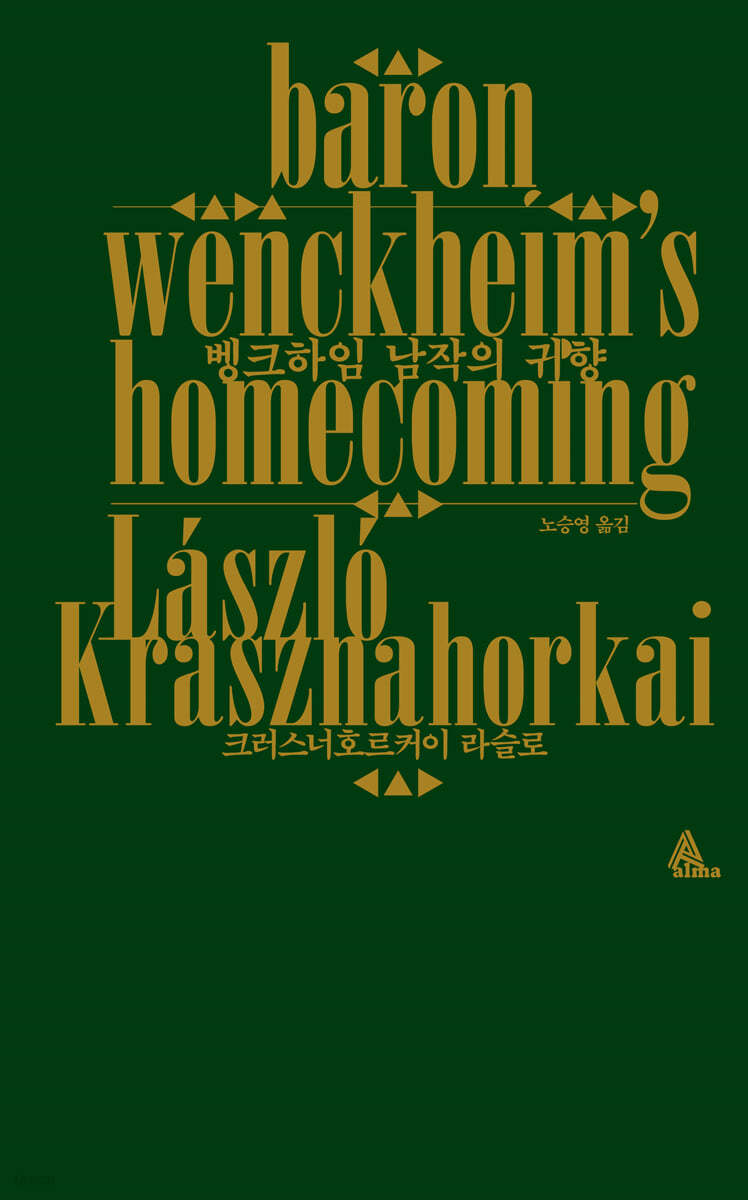
The Return of Baron Wenkheim
 |
Description
Book Introduction
Following “Satan Tango,” “Melancholy of Resistance,” and “War and War”
The final installment of the Laszlo tetralogy
The only novel in a writer's life that has been acknowledged!
Baron Benkheim, who harbored the one and only love of his life, returns to the place where his love began and dies.
"An artist who reawakened the power of art even amidst the fear of destruction."
Continuing our connection with Korean readers with the new work "Hersheyt 07769."
László Krásznáhorkaj, a master of modern Hungarian literature, has won the 2025 Nobel Prize in Literature.
The Nobel Committee stated that the award was given for “a powerful and visionary work that reawakens the power of art even in the face of the horrors of destruction,” and that he had shown again the possibility of a “prophetic language” that modern literature had lost.
A literary prophet walking the boundaries of language, between destruction and salvation.
Since his literary debut in 1985 with "Satantango," László Krzysztof Krzysztof Krzysztof has been a writer who has depicted the anxieties of human existence and the collapse of the world in his compelling prose. His prose, with its endlessly long sentences and intense narrative tension, immerses readers in a unique style that can be called a "reading exercise."
Alma Publishing has introduced the author's six representative works, "Satan Tango," "Melancholy of Resistance," "The Last Wolf," "The World Goes On," "The Descent of the Queen Mother of the West," and "The Return of Baron Wenkheim," to Korea, and plans to publish a new work, "Herscht 07769," in January 2026.
"Hersht 07769" depicts the journey of "Hersht," a man called by a number instead of a name, as he seeks to rediscover his identity and the meaning of language in a world after the collapse of civilization. In a society where communication is based solely on numbers and symbols, he encounters a world of humans whose names can no longer be called. This work is considered to be the author's later work that most densely embodies the "anxiety of existence" and "human possibilities after the end of language," which the author has consistently explored.
His literary works, which have expanded globally, have long cultivated a deep readership, even amidst a quiet resonance. This Nobel Prize in Literature marks the moment when his endless exploration of the origins of humanity and art is once again resurrected in the languages of the world, and will undoubtedly resonate deeply with readers.
Promotion of screenings of "Reading László Krzysztof ...
To commemorate this award, Alma Publishing will present a booklet titled "Reading László Krasnahorkai" (tentative title), which aims to bring readers closer to the world of literature, which is by no means easy but essential to read. The contributors include Professor Han Kyung-min, poet Jo Won-gyu, film critic Jeong Seong-il, literary critic Jang Eun-soo, critic Geum Jeong-yeon, and poet Kim Yu-tae, who will each interpret the author's world from their own perspectives.
Additionally, in order to expand and illuminate the author's literary world through film, we are promoting the screening of "Werckmeister Harmonies," based on the films "Satantango" and "Resistance Melancholy" by another world-renowned director, Tar Bella.
The final installment of the Laszlo tetralogy
The only novel in a writer's life that has been acknowledged!
Baron Benkheim, who harbored the one and only love of his life, returns to the place where his love began and dies.
"An artist who reawakened the power of art even amidst the fear of destruction."
Continuing our connection with Korean readers with the new work "Hersheyt 07769."
László Krásznáhorkaj, a master of modern Hungarian literature, has won the 2025 Nobel Prize in Literature.
The Nobel Committee stated that the award was given for “a powerful and visionary work that reawakens the power of art even in the face of the horrors of destruction,” and that he had shown again the possibility of a “prophetic language” that modern literature had lost.
A literary prophet walking the boundaries of language, between destruction and salvation.
Since his literary debut in 1985 with "Satantango," László Krzysztof Krzysztof Krzysztof has been a writer who has depicted the anxieties of human existence and the collapse of the world in his compelling prose. His prose, with its endlessly long sentences and intense narrative tension, immerses readers in a unique style that can be called a "reading exercise."
Alma Publishing has introduced the author's six representative works, "Satan Tango," "Melancholy of Resistance," "The Last Wolf," "The World Goes On," "The Descent of the Queen Mother of the West," and "The Return of Baron Wenkheim," to Korea, and plans to publish a new work, "Herscht 07769," in January 2026.
"Hersht 07769" depicts the journey of "Hersht," a man called by a number instead of a name, as he seeks to rediscover his identity and the meaning of language in a world after the collapse of civilization. In a society where communication is based solely on numbers and symbols, he encounters a world of humans whose names can no longer be called. This work is considered to be the author's later work that most densely embodies the "anxiety of existence" and "human possibilities after the end of language," which the author has consistently explored.
His literary works, which have expanded globally, have long cultivated a deep readership, even amidst a quiet resonance. This Nobel Prize in Literature marks the moment when his endless exploration of the origins of humanity and art is once again resurrected in the languages of the world, and will undoubtedly resonate deeply with readers.
Promotion of screenings of "Reading László Krzysztof ...
To commemorate this award, Alma Publishing will present a booklet titled "Reading László Krasnahorkai" (tentative title), which aims to bring readers closer to the world of literature, which is by no means easy but essential to read. The contributors include Professor Han Kyung-min, poet Jo Won-gyu, film critic Jeong Seong-il, literary critic Jang Eun-soo, critic Geum Jeong-yeon, and poet Kim Yu-tae, who will each interpret the author's world from their own perspectives.
Additionally, in order to expand and illuminate the author's literary world through film, we are promoting the screening of "Werckmeister Harmonies," based on the films "Satantango" and "Resistance Melancholy" by another world-renowned director, Tar Bella.
- You can preview some of the book's contents.
Preview
index
Trrrrrr… …
I'll knock you down, you smart guy
rum
Pale, so pale
Perm
He wrote me a letter.
Perm
He will arrive.
Because he said so
Perm
Infinite difficulties
Hmmmm
Be careful
Lari Lari
Loser (Arepentida)
lee
Shout out to the Hungarians
Rome
All the hidden ones
Reference materials for performance
Next
Rum, pump, pump, pump, hummeum, larira, lee, rom
Rum, pump, pump, pump, hummeum, larira, lee, rom
Rum - Lari La, Lira Rom
Trrrrrr
Da Capo Al Fine
I'll knock you down, you smart guy
rum
Pale, so pale
Perm
He wrote me a letter.
Perm
He will arrive.
Because he said so
Perm
Infinite difficulties
Hmmmm
Be careful
Lari Lari
Loser (Arepentida)
lee
Shout out to the Hungarians
Rome
All the hidden ones
Reference materials for performance
Next
Rum, pump, pump, pump, hummeum, larira, lee, rom
Rum, pump, pump, pump, hummeum, larira, lee, rom
Rum - Lari La, Lira Rom
Trrrrrr
Da Capo Al Fine
Into the book
I neither love you nor hate you, and as I see it, you are all going to hell, and when one falls, another will take his place, and I see and hear in advance what will happen, and there will be neither joy nor consolation in it, so that nothing like this will ever happen again, and when I go on stage with you, the musicians, even if this mission, this mission based on possibility, comes to fruition, I will not be in the least satisfied, and I want to tell you something in farewell: I do not like music, or, in other words, I confess that I do not like at all what we are trying to create here together, because I am the overseer of everything here, I create nothing, I am merely present before every sound, and I simply wait for the end of it all according to the truth of God.
--- pp.16-17
He was alone in the first-class compartment for the first time, clutching his suitcase in one hand and the small table in the other, and he just watched them, the woman and the child moving about, for it was obvious that the woman wanted to take a picture of the child, and to do this he had to stand where the sun was shining, but the sun was constantly playing with them, and when the sun appeared, by the time the camera was ready, the child was in the shade, and when they went to another sun that had just appeared, the sun disappeared before they could finish their work, so the Baron could not take his eyes off them, and he saw the child obediently follow the woman from point to point, and occasionally be guided between the tracks, and he stopped at the sun, but the sunlight constantly disappeared above him, and suddenly the train jolts but does not move, it stands there as if there was some kind of technical fault, but there was no technical fault, and a minute later - with a tremendous rattling, rattling, creaking, creaking - the train is unable to move. He began to show himself very slowly, and the reason he put down his suitcase and took his hands off the little table was because he had to keep turning if he wanted to see them, and he really wanted to see them, and he wanted to see the child and the woman until the very last moment, but it was useless to take his hands off the table, it was useless to turn around, because they quickly disappeared from his sight, and anyway there was little he could see because his eyes were full of tears, but when the train passed in front of the dark dispatch room, he wiped the tears from his eyes and clutched his suitcase and the little table once more, though not as hard as before, and did not look out the window because he was staring inside, and he was looking at the dirty, shiny floor, at the crocodile shoes that were trying to stick to the floor.
--- pp.179-180
For perhaps a week now the Baron had been writing and rewriting a letter to be delivered by a messenger, but he changed his mind and wrote a second letter, in which he tried to correct everything he felt he had not been able to express accurately in the first letter, describing the unfortunate situation of his memory failing him, which meant that something had likely happened to his memory over time, or, in other words, that it was rusting away. There were many things he could not remember, many things he could no longer recall, names seemed to have vanished from his mind forever, and he tried to recall the names of streets in vain, the name of the artesian well near the old Greater Romania district, and the name of the bridge on the way to the hospital, but neither the well nor the bridge could be remembered anymore, they were clearly gone. As he wrote in his letter to Hungary, he had little left, not only because his memory was failing, but also because his legs had weakened as a result of the natural process of aging; he always walked with a slight stumble, and suffered from poor eyesight, a sensitive stomach, creaky joints, and a sore back. He didn't want to continue, not to mention his lungs, because it would all end in misery, and what he feared was that she, Marietta, would get a more unpleasant impression of him than he really was. "But please, let me down," he said, crumpling up the first letter and throwing it into the trash can next to the piano desk because he had misspelled "believe" as "down," and continuing to write, "There is only one thing in my power that will never be broken, and that is, strictly speaking, that I feel such pain when I think of this city, and of you, Marietta, in this city. I am now over sixty-five. Perhaps I am confessing two facts, the two things that have sustained my life: that I knew a city and that I knew you in that city, and that this has only one meaning for me, and that is, 'What I love most in this life is this city, and you in it.' You must know clearly that I am not revealing some great secret here, but that I still remember, however cowardly I may be, that in the end I will remember you." You said you loved me, so I know it's over now, and I know I'm not the same person I used to be, and I know I'm a wreck, but you know, Marietta, when I was at my lowest, thinking about this city and you in it always lifted my spirits, and in fact, I wanted to go see you one last time and talk to you in person, because you exist, my dear Marietta - he wrote, but now the paper was sliding down the piano desk and into the trash can - your face, your smile, and the two little dimples on your pretty, pretty cheeks when you smiled were more precious to me than anything, more precious than anything else.
--- pp.222-224
She kept the two letters just above her heart, in her coat pocket when she went out, and in her side pocket when she was at home in her dressing gown, so of course it was next to her heart, not above it, but that didn't matter, she thought, what mattered was the feeling, and the two letters were above her heart, and would always be, and she had been with them for days, weeks in fact, and she was determined never to part with them, and she wanted to share this boundless happiness she felt with someone, with a relative or an acquaintance, but she could not, because she had found no one to share it with, and she had tried twice with Dora, but in vain, and even Irene was not worthy of this, the only secret of her soul, and to this Irene—her true best friend, her share of joys and sorrows—she could not even talk about the most important things in her life, because Irene was so practical, and to everything, to every feeling, every joy—but all this was always in her heart—and now, with the two letters so close to her heart, she found herself mocking them and She would have teased her, calling her a sweet, young, romantic fool, and she had always thought so, but this time her heart would have been shattered, and she felt that this heart beneath the two letters, her own heart, was so fragile that it would crumble not only at the slightest word of regret but also at the sharpest remonstrance of someone like Irene, so she always carried the two letters with her, and she carried her fragile heart with the utmost caution around the city, and there was no one to whom she could show either of them, absolutely no one, because there was no one to whom she could confide what she felt, and she thought happily that she was happy once again, and that her happiness could be expressed in such simple words, and not by making plans or anything, but by the mere possession of the two letters, so terribly delicate a feeling flowed into her, a feeling she could never hope for again, because she had never again desired such infinitely refined words, and because she could never believe that this could ever happen again in her life, when her life was so, so disappointing, that she could never hope for it again. She could not believe in the slightest that a miracle, the miracle she had always waited for but which always ended in disappointment, would happen again.
--- pp.278-279
The two sat in silence, until the sound of coffee boiling in the kitchen came, and Murker kindly excused himself and came out of the living room, pouring espresso into a porcelain cup, and he was not yet trembling, but he knew he would be soon, and for a moment he was still assimilating and rejecting what had just happened, and the fragrant aroma of coffee filled the air, and they sipped it back and forth. The Baron remained silent, coughing sharply, and began to ponder what kind of relationship this woman might have with Marietta. No matter from which angle he approached the question, he always came to the same conclusion: she must be her mother, or at least her great-aunt. In any case, here he sat—the Baron groaning in his shell chair—and before him was Marietta's mother, or at least her great-aunt. He had never seen either, but this lovely face, so gentle, so shy, was just as he had always imagined, and even though he had never seen their faces, he could freely imagine their similarities and their behavior, and so, he I thought there was a resemblance, though Marietta didn't seem to have inherited this woman's features entirely, but there were still a few minor peculiarities in her face and manner that connected them, and while she was doing this, Muricer was sipping her coffee, her mouth moving as little as possible, because she was trying to escape with this sipping, because this sipping seemed to be what would save her, and, oh, God, now for the first time, her hand, the hand holding the coffee cup, began to tremble and tremble, and here, opposite her, sat Bella, that world-famous person who had been featured in every newspaper, who had traveled all over the world to meet her, and now he was sitting right here in front of her, and now the light fixture above them was different, and the armchair she was sitting in was different, and the whole living room, in fact the whole apartment, was no longer the same, because it was Bella, the one with the youthful features she could discern in that old face, Bella, the one who had written her those endlessly sweet phrases from across the ocean, that Bella. Now that he was sitting opposite her and pouring out his feelings to her, the Baron, after a while seeing no way out of this confusion—since this woman seemed unwilling to talk at the moment—had no other way than to tell her in the most sincere way his most sacred feelings, could only say at first that it was quite surprising that he, the Baron, could talk about so delicate and so personal a matter as the love of man, but here, somehow—he cast his eyes around the living room—he felt a certain comfort, and he 'ought' to apologize to her for such an expression, for it had only been a few minutes since his arrival, but this kind woman was so generous, yet so willing, to let such a stranger into her house, that he never—I mean it, my dear lady—never, not for a moment could I forget that day, when I was nineteen, when I had to leave this city, this country, and there was only one thing left in my life I could cling to, and that was Marietta, my My family traveled all over the world and finally settled in Argentina, but I never forgot her face, and the outline of that lovely face was always before my eyes, and I could call it up at any time, and not a day went by that I did not call it up, and in the meantime, one by one, my family died or were scattered far away, and I was left alone in Buenos Aires, he said. But not a day went by that I did not see her smile at me, and that was the only thing – you must laugh at me now, my dear lady – really, that was the only thing that kept me alive, that smile, because apart from my love for Marietta, I had nothing, and besides, I wanted nothing, no business, no learning, and still less art, because it always reminded me of her.
--- pp.366-368
Everything is burning, as they patrol the area in the commander's jeep, the radio comes on and for some reason the entire thornbush is engulfed in flames, smoke is rising and the stench is overwhelming as if struck by lightning, the flames are enormous, we need four vehicles right now, request support from Bekeschover, four vehicles are not enough, make sure you have plenty of water, the flames are so big, stop, he yells at the driver to turn the car around! The driver immediately put the car into reverse, stepped on the accelerator, and backed away about twenty meters because the flames were engulfing them, reaching the jeep and its occupants. Listen carefully, the police chief shouted to the driver, "If you want to grill meat, you need to bring a grill." "Yes, chief," the driver replied, but the other passengers didn't even hear what the two were saying because they were dumbfounded by the sight of the fire. First, the fire had clearly started only a few days ago, when it was drizzling. Second, why was the weeds burning like this? Everyone knew there was no one here, and the person who had been there, he wasn't a suspect. So even if someone had tried to come back, it couldn't have been him, because they would have caught him, so he wouldn't have set the whole place on fire, so why would he have done that? Thirdly, it was the police chief who had just raised this issue, and he was talking to himself, but he was saying it out loud so everyone could hear it. He said that he smelled some kind of petroleum, but it couldn't have been petroleum, it was the city. There was no oil anywhere he knew of, so what was burning so blazingly, what material could cause such a huge flame? "Well, Chief," the driver, a special forces officer, cautiously said, "Go ahead." The police chief nodded. "Well, I think the fire is different from the fire in the German-owned house four years ago. It burned very regularly back then, but this fire is different." "So, what do you think?" the police chief asked. "Well, the police officer said the flames were raging." "Yes," the police chief shouted. "You're right, that's the problem." He tried to remember where he'd seen those flames, and yes, he remembered a Discovery Channel documentary about the Dresden firebombing or the Vietnam carpet bombing. "Yes, I saw something similar back then. It looked like the flames were rising up here." "This isn't fire," the chief declared. A silence fell over the jeep because they understood what he was trying to say, but they asked themselves, "If this isn't fire, then what is it?" The fire here in the thornbush, so to speak. It's a 'huge fire',
--- pp.455-456
I start with this, he says to someone in the small waiting room of the train station in Bicere, that he should think for two hours a day so that he doesn't have to think all day, because thinking all day exhausts your stamina. And the same goes for passion, which never gets anywhere. Passion never gets anywhere, as it necessarily follows from the nature of things. So I'm not going to stop practicing. This is good, because what my brain needs to function happens to coincide with what I'm quite good at, so I can't let this exceptional circumstance stop me from practicing my thought immunity. Compressing this practice to two hours a day has turned out to be useful, so to speak, great, because for several months now, the thought of engaging in any activity of thought other than between three and five in the afternoon hasn't crossed my mind. In ten seconds it'll be three in the afternoon, and I can't deny that I'm going to be extremely exhausted, but that's no excuse. I have to finish today's practice, so I can talk about Georg Cantor. I have to talk about him because he's the one who did it. Because he is the central figure in all matters, how should I put it, he said to someone in the empty waiting room of the train station, he is still the central figure, as he was in the past, once forgotten but now alive again, what emerged with Cantor, the problem to which Cantor gave his answer is that everything goes round and round, Cantor, with this ill-fated comet from St. Petersburg-Halle, we return to the point from which we have started ten thousand times, to the point from which we have returned ten thousand times. But he was not the first to give this answer, for he was so deeply imbued with that well-known messianism, that there can be no doubt for a moment, that he fervently believed in that monotheistic being which can only arise from a deep communal passion for the Tanakh, the Jewish scripture, and that this being really arose because of where Georg Cantor – he savored the name – went astray. Yes, of course he went astray with his roots in the Tanakh, but of course the problem always arises from the roots, or at least from them. It is most likely to spread haphazardly, you see. Cantor did not even formulate the hypothesis that there is no infinity. He knew ab ovo that there is infinity from the beginning. He felt that this was his calling, that he was called, perhaps, to create in his own way, on the basis of his own particularly deep-seated beliefs, a so-called scientific foundation. In that respect, he was not satisfied with his progress up to that point. Poor Cantor, this strange genius, his pure talent and his trickery can both be traced back to the same point. He was, so to speak, sick of faith. It has always been like this, we always arrive at this point: it is not true to say, 'In the beginning was this and that', in fact, it should have been written like this. In the beginning was faith, General!
--- pp.472-474
Here, as he looked at the two tracks in front of him, the end was drawing near, and if everyone, so to speak, possessed something, then what did he possess in this vast existence? Why had he been born and lived this life to the end? Why, so to speak, had all this to happen? He stopped, as he had done several times, as if he heard a train approaching from the opposite direction. But it was not, it was only his imagination, so he continued walking, and not only did he not feel fear, he did not feel a single drop of fear, but on the contrary, he knew that he was utterly free, for it did not seem as if he were walking towards death, but as if he were simply moving along the quiet track through a forest that was now completely dark, lost in thought. He just walked and walked, and not a single train came either from the direction of the Josef Sanatorium or from the direction of Sherkard. He was really going to pray to the good Lord, but this had become a completely new thing for him in the past few decades, and it seemed as if the good Lord were above everything on earth. He had sometimes tried to call upon the Lord, but had felt awkward and helpless and had given up - this was decades ago - but now the thought did not seem entirely out of the blue, for it was to call upon the Lord again, to implore Him once more, that if it had been necessary for him to exist, that the Lord would enlighten his heart in these last few minutes - he begged - to explain to him what use He had been in bringing him into this life and keeping him alive, because his life had been so terribly, yet so terribly useless. So, what kind of life was it? - he asked inwardly, but he spoke clearly so that the good Lord could hear clearly from above. - Then what kind of life is it in which nothing has happened, and has not happened to such an extent, beyond the fact that the world exists? In it there is love, in the world, and the fact that this love is an illusion was revealed only in later years because it was really an illusion and did not exist, and perhaps because it never existed at all because it was not real, because its object could never have been real. Because what it was then, and what it now occupied, was miserable, desolate, empty, and deceptive. What was the point of all this? The Baron asked the good Lord as he walked towards death, which, he thought as he marched between the sleepers, could 'still' come at any moment, but would not come. He took off his hat, knelt down on either side of the track, and listened to the ground to see if he could hear the train from the Josef Sanatorium or the local train from Scherkerd, but there was none. So he walked on, and how many kilometers had he already walked? He looked back, and of course, the road twisted so many times that he could not tell how far he had come, for he had no thoughts. It was of no use having worn a watch when he started from the bridge; he was not particularly interested in time anyway, and it might have been minutes or even an hour since he had started his walk. The point is—he shook his head again—that the train had already passed. The king had said that the train would not come, but he had asked the hotel doorman (after making him swear on his soul not to tell anyone), who had secretly given him the information when no one was looking, and the Sherkard-Bekesszaba timetable was in his possession, from which he read the times of the trains that could affect him: 5:32, 6:32, 7:32, 8:26 - the last train on the far right - and since the trains were like this and the intervals between them were not more than an hour, then either the timetable was incorrect or there was a delay, a delay - the Baron raised his head again - and he stood still for a moment to gather his strength, then he put his hands on his knees, took a deep breath of the chilly forest air, and then he set off again, hoping to receive the good grace of the good Lord in heaven from another angle, so to speak, when he had decided to wait patiently for the Lord's answer, some obstacle arose and the train was delayed, which gave him a little more time, but he was not here to be patient. Waiting did not mean he did not trust that there would be an answer to his question, for, relying on that answer, he could calmly throw himself into the arms of death, and he had no particular notion of death, so he simply walked along the tracks toward the delayed local train, which was coming from the Josef Sanatorium station, but which he had intended to walk until it appeared at one of these corners, and there was nothing for him to do but to stay between the two tracks. Assuming that such a train would not stop before turning the corner, he supposed—and of course the train would not—the Baron said to himself that if at one of these corners a person suddenly appeared too close for the train to stop, it was possible, so to speak, for the train to hit him and crush him to pieces, but why should that interest him now, he thought, the important thing was to hurry and catch up with what he had come here to wait for, but still. Until then, he was really waiting for an answer, to know what all this was for.
--- pp.515-519
But, he raised his voice, and said, "The question remains as to what his 'will' was, and it does exist, so I'm not right. On the one hand, no one can doubt that there was a 'will' - according to you, there was none - but on the other hand, there was a 'will', and it certainly existed and exists now, because it is real, and according to this 'will', of course, his property will be donated to the city - the police chief was not interested in this at all, but he usually did not like the mayor's tone, and today for some reason he really was, so he interrupted and retorted - he did not care what the mayor called it, a will or a will, the point is that neither existed. Well, the mayor asked for the chief's understanding, and interrupted, but he himself had never heard that there was no will, and he wondered where exactly the chief got this information. Everyone knows that there was a will, and he knows what this will is, so to speak, his property - the mayor is small and plump, and he has big hands. Drawing a circle - it belongs to the poem and this is not a controversial issue, no, it is a controversial issue, and now the chief says, somewhat agitated, no, it is not, it seems useless to tell you, but I feel I must say it again, so let me repeat, we found nothing, do you understand, mayor? Nothing, not a single filé, not a single forint, not a single peso, not a single currency, nothing, nothing. I have a friend who has learned Latin, and he is the best I can use in such matters. As soon as the matter arose - he emphasized the first syllable of the word 'problem' - he began to investigate the relatives (he knows where this property you mentioned is), he knows the account numbers, he knows which bank it is, and he knows how to get all this information. But his investigations have led to a sad result, and it is a personal disappointment to me, so don't argue about it any more, which means 'there is no property'. Listen to me, this baron - he fiddled with his reading glasses - left nothing behind, not a single filé, let me tell you this - the police chief paused for a moment, and the two guests, their faces filled with skepticism and suspicion, yet with interest, leaned in to hear what he had to say - Let me tell you this, he had 'no' assets whatsoever, this whole thing was a huge financial fraud, this baron, our baron, come on, the mayor, was nothing more than a swindler who came here literally without a single pilare, not even the small amount of euros his family in Vienna had given him for his travel expenses could be found, you see, not even his wallet, he said, not at the crime scene, not at his hotel, we searched the whole place, really, it's not because we're indifferent... ... that we haven't gotten to the truth... ...
--- pp.544-546
Because these places were not engulfed in flames one by one, but all at the exact same moment, and because the choice of words is at issue here, if there had been someone to describe this—and there wasn't—he would have undoubtedly used expressions like "engulfed in flames," "set ablaze," "became a sacrifice to the flames," and so on, but in this case the predicates of the sentences cannot imply any order to these events, whether they want it or not, so what happened here was an unimaginably enormous, enormous fire attack, a fire attack "much bigger than the city itself," which struck the city, so there could be something to talk about, but there was no one left to tell what happened, and there were only words that followed a mechanical sequence, lined up neatly in space, but since there was no one to say them, if we were to just line them up one by one, the fire would have swept in from the direction of the Csaba, Chocosi, and Nagyvarady roads, from the direction of the Romanian border, from the direction of the Elek road, and in an instant it engulfed the city, and this The speed of the fire was so tremendous, so distant, that these words, these words that no one can pronounce anymore, do not even exist, for there is no time for them to appear. As for the destruction, everything happened like a terrifying fairy tale, so this place was finished, it was gone, so there was no more city hall, no more peace, no more Greater Romania, no less Romania, no Greater Hungary, no crinoline, no more city center, nothing, no more inhabitants, so that the city ceased to exist after this attack, but, strangely enough, on the outskirts of the city, on the road leading to Doboz, a huge cement water tower, though badly burned, still stood, teetering and swaying like the other buildings, but still standing, and on top of it, from one of the empty, gaping windows of the once legendary observatory—the glass had shattered in an instant in the heat wave—a retard dangling his leg out of the window, that retard from the orphanage, who had come here last night, suddenly, drawn by his own troubled mind, dangling his leg. There was, but he didn't reach for the iron frame because it was too hot, so he spread his hands wider and balanced them on the cement window sill, pretending to kick first with his left leg, then with his right, until he got tired and shook his legs a little, and sang softly to himself while looking at the burning embers that had been his city until just a moment ago.
The city is burning, the city is burning,
Call the fire truck, call the fire truck,
Fire, fire, fire, fire,
Sprinkle water, sprinkle water.
He started again,
The city is burning, the city is burning,
Call the fire truck, call the fire truck,
Fire, fire, fire, fire,
Sprinkle water, sprinkle water.
The song did not stop, and now he did not rest his hands on the windowsill, but simply sat and rocked back and forth from the empty window, looking at the charred ruins, where the city once stood, and then he began to sing again, always from the beginning, because the melody and the words wanted him to do so.
The city is burning, the city is burning,
Call the fire truck, call the fire truck,
Fire, fire, fire, fire,
Sprinkle water, sprinkle water.
Finally, he looked up at the sky, the darkening sky, raised both hands, and gestured to the invisible audience, as if he had clearly seen someone, perhaps the conductor, do it before, and he turned to the audience with a lively,
Okay, now everyone together
--- pp.16-17
He was alone in the first-class compartment for the first time, clutching his suitcase in one hand and the small table in the other, and he just watched them, the woman and the child moving about, for it was obvious that the woman wanted to take a picture of the child, and to do this he had to stand where the sun was shining, but the sun was constantly playing with them, and when the sun appeared, by the time the camera was ready, the child was in the shade, and when they went to another sun that had just appeared, the sun disappeared before they could finish their work, so the Baron could not take his eyes off them, and he saw the child obediently follow the woman from point to point, and occasionally be guided between the tracks, and he stopped at the sun, but the sunlight constantly disappeared above him, and suddenly the train jolts but does not move, it stands there as if there was some kind of technical fault, but there was no technical fault, and a minute later - with a tremendous rattling, rattling, creaking, creaking - the train is unable to move. He began to show himself very slowly, and the reason he put down his suitcase and took his hands off the little table was because he had to keep turning if he wanted to see them, and he really wanted to see them, and he wanted to see the child and the woman until the very last moment, but it was useless to take his hands off the table, it was useless to turn around, because they quickly disappeared from his sight, and anyway there was little he could see because his eyes were full of tears, but when the train passed in front of the dark dispatch room, he wiped the tears from his eyes and clutched his suitcase and the little table once more, though not as hard as before, and did not look out the window because he was staring inside, and he was looking at the dirty, shiny floor, at the crocodile shoes that were trying to stick to the floor.
--- pp.179-180
For perhaps a week now the Baron had been writing and rewriting a letter to be delivered by a messenger, but he changed his mind and wrote a second letter, in which he tried to correct everything he felt he had not been able to express accurately in the first letter, describing the unfortunate situation of his memory failing him, which meant that something had likely happened to his memory over time, or, in other words, that it was rusting away. There were many things he could not remember, many things he could no longer recall, names seemed to have vanished from his mind forever, and he tried to recall the names of streets in vain, the name of the artesian well near the old Greater Romania district, and the name of the bridge on the way to the hospital, but neither the well nor the bridge could be remembered anymore, they were clearly gone. As he wrote in his letter to Hungary, he had little left, not only because his memory was failing, but also because his legs had weakened as a result of the natural process of aging; he always walked with a slight stumble, and suffered from poor eyesight, a sensitive stomach, creaky joints, and a sore back. He didn't want to continue, not to mention his lungs, because it would all end in misery, and what he feared was that she, Marietta, would get a more unpleasant impression of him than he really was. "But please, let me down," he said, crumpling up the first letter and throwing it into the trash can next to the piano desk because he had misspelled "believe" as "down," and continuing to write, "There is only one thing in my power that will never be broken, and that is, strictly speaking, that I feel such pain when I think of this city, and of you, Marietta, in this city. I am now over sixty-five. Perhaps I am confessing two facts, the two things that have sustained my life: that I knew a city and that I knew you in that city, and that this has only one meaning for me, and that is, 'What I love most in this life is this city, and you in it.' You must know clearly that I am not revealing some great secret here, but that I still remember, however cowardly I may be, that in the end I will remember you." You said you loved me, so I know it's over now, and I know I'm not the same person I used to be, and I know I'm a wreck, but you know, Marietta, when I was at my lowest, thinking about this city and you in it always lifted my spirits, and in fact, I wanted to go see you one last time and talk to you in person, because you exist, my dear Marietta - he wrote, but now the paper was sliding down the piano desk and into the trash can - your face, your smile, and the two little dimples on your pretty, pretty cheeks when you smiled were more precious to me than anything, more precious than anything else.
--- pp.222-224
She kept the two letters just above her heart, in her coat pocket when she went out, and in her side pocket when she was at home in her dressing gown, so of course it was next to her heart, not above it, but that didn't matter, she thought, what mattered was the feeling, and the two letters were above her heart, and would always be, and she had been with them for days, weeks in fact, and she was determined never to part with them, and she wanted to share this boundless happiness she felt with someone, with a relative or an acquaintance, but she could not, because she had found no one to share it with, and she had tried twice with Dora, but in vain, and even Irene was not worthy of this, the only secret of her soul, and to this Irene—her true best friend, her share of joys and sorrows—she could not even talk about the most important things in her life, because Irene was so practical, and to everything, to every feeling, every joy—but all this was always in her heart—and now, with the two letters so close to her heart, she found herself mocking them and She would have teased her, calling her a sweet, young, romantic fool, and she had always thought so, but this time her heart would have been shattered, and she felt that this heart beneath the two letters, her own heart, was so fragile that it would crumble not only at the slightest word of regret but also at the sharpest remonstrance of someone like Irene, so she always carried the two letters with her, and she carried her fragile heart with the utmost caution around the city, and there was no one to whom she could show either of them, absolutely no one, because there was no one to whom she could confide what she felt, and she thought happily that she was happy once again, and that her happiness could be expressed in such simple words, and not by making plans or anything, but by the mere possession of the two letters, so terribly delicate a feeling flowed into her, a feeling she could never hope for again, because she had never again desired such infinitely refined words, and because she could never believe that this could ever happen again in her life, when her life was so, so disappointing, that she could never hope for it again. She could not believe in the slightest that a miracle, the miracle she had always waited for but which always ended in disappointment, would happen again.
--- pp.278-279
The two sat in silence, until the sound of coffee boiling in the kitchen came, and Murker kindly excused himself and came out of the living room, pouring espresso into a porcelain cup, and he was not yet trembling, but he knew he would be soon, and for a moment he was still assimilating and rejecting what had just happened, and the fragrant aroma of coffee filled the air, and they sipped it back and forth. The Baron remained silent, coughing sharply, and began to ponder what kind of relationship this woman might have with Marietta. No matter from which angle he approached the question, he always came to the same conclusion: she must be her mother, or at least her great-aunt. In any case, here he sat—the Baron groaning in his shell chair—and before him was Marietta's mother, or at least her great-aunt. He had never seen either, but this lovely face, so gentle, so shy, was just as he had always imagined, and even though he had never seen their faces, he could freely imagine their similarities and their behavior, and so, he I thought there was a resemblance, though Marietta didn't seem to have inherited this woman's features entirely, but there were still a few minor peculiarities in her face and manner that connected them, and while she was doing this, Muricer was sipping her coffee, her mouth moving as little as possible, because she was trying to escape with this sipping, because this sipping seemed to be what would save her, and, oh, God, now for the first time, her hand, the hand holding the coffee cup, began to tremble and tremble, and here, opposite her, sat Bella, that world-famous person who had been featured in every newspaper, who had traveled all over the world to meet her, and now he was sitting right here in front of her, and now the light fixture above them was different, and the armchair she was sitting in was different, and the whole living room, in fact the whole apartment, was no longer the same, because it was Bella, the one with the youthful features she could discern in that old face, Bella, the one who had written her those endlessly sweet phrases from across the ocean, that Bella. Now that he was sitting opposite her and pouring out his feelings to her, the Baron, after a while seeing no way out of this confusion—since this woman seemed unwilling to talk at the moment—had no other way than to tell her in the most sincere way his most sacred feelings, could only say at first that it was quite surprising that he, the Baron, could talk about so delicate and so personal a matter as the love of man, but here, somehow—he cast his eyes around the living room—he felt a certain comfort, and he 'ought' to apologize to her for such an expression, for it had only been a few minutes since his arrival, but this kind woman was so generous, yet so willing, to let such a stranger into her house, that he never—I mean it, my dear lady—never, not for a moment could I forget that day, when I was nineteen, when I had to leave this city, this country, and there was only one thing left in my life I could cling to, and that was Marietta, my My family traveled all over the world and finally settled in Argentina, but I never forgot her face, and the outline of that lovely face was always before my eyes, and I could call it up at any time, and not a day went by that I did not call it up, and in the meantime, one by one, my family died or were scattered far away, and I was left alone in Buenos Aires, he said. But not a day went by that I did not see her smile at me, and that was the only thing – you must laugh at me now, my dear lady – really, that was the only thing that kept me alive, that smile, because apart from my love for Marietta, I had nothing, and besides, I wanted nothing, no business, no learning, and still less art, because it always reminded me of her.
--- pp.366-368
Everything is burning, as they patrol the area in the commander's jeep, the radio comes on and for some reason the entire thornbush is engulfed in flames, smoke is rising and the stench is overwhelming as if struck by lightning, the flames are enormous, we need four vehicles right now, request support from Bekeschover, four vehicles are not enough, make sure you have plenty of water, the flames are so big, stop, he yells at the driver to turn the car around! The driver immediately put the car into reverse, stepped on the accelerator, and backed away about twenty meters because the flames were engulfing them, reaching the jeep and its occupants. Listen carefully, the police chief shouted to the driver, "If you want to grill meat, you need to bring a grill." "Yes, chief," the driver replied, but the other passengers didn't even hear what the two were saying because they were dumbfounded by the sight of the fire. First, the fire had clearly started only a few days ago, when it was drizzling. Second, why was the weeds burning like this? Everyone knew there was no one here, and the person who had been there, he wasn't a suspect. So even if someone had tried to come back, it couldn't have been him, because they would have caught him, so he wouldn't have set the whole place on fire, so why would he have done that? Thirdly, it was the police chief who had just raised this issue, and he was talking to himself, but he was saying it out loud so everyone could hear it. He said that he smelled some kind of petroleum, but it couldn't have been petroleum, it was the city. There was no oil anywhere he knew of, so what was burning so blazingly, what material could cause such a huge flame? "Well, Chief," the driver, a special forces officer, cautiously said, "Go ahead." The police chief nodded. "Well, I think the fire is different from the fire in the German-owned house four years ago. It burned very regularly back then, but this fire is different." "So, what do you think?" the police chief asked. "Well, the police officer said the flames were raging." "Yes," the police chief shouted. "You're right, that's the problem." He tried to remember where he'd seen those flames, and yes, he remembered a Discovery Channel documentary about the Dresden firebombing or the Vietnam carpet bombing. "Yes, I saw something similar back then. It looked like the flames were rising up here." "This isn't fire," the chief declared. A silence fell over the jeep because they understood what he was trying to say, but they asked themselves, "If this isn't fire, then what is it?" The fire here in the thornbush, so to speak. It's a 'huge fire',
--- pp.455-456
I start with this, he says to someone in the small waiting room of the train station in Bicere, that he should think for two hours a day so that he doesn't have to think all day, because thinking all day exhausts your stamina. And the same goes for passion, which never gets anywhere. Passion never gets anywhere, as it necessarily follows from the nature of things. So I'm not going to stop practicing. This is good, because what my brain needs to function happens to coincide with what I'm quite good at, so I can't let this exceptional circumstance stop me from practicing my thought immunity. Compressing this practice to two hours a day has turned out to be useful, so to speak, great, because for several months now, the thought of engaging in any activity of thought other than between three and five in the afternoon hasn't crossed my mind. In ten seconds it'll be three in the afternoon, and I can't deny that I'm going to be extremely exhausted, but that's no excuse. I have to finish today's practice, so I can talk about Georg Cantor. I have to talk about him because he's the one who did it. Because he is the central figure in all matters, how should I put it, he said to someone in the empty waiting room of the train station, he is still the central figure, as he was in the past, once forgotten but now alive again, what emerged with Cantor, the problem to which Cantor gave his answer is that everything goes round and round, Cantor, with this ill-fated comet from St. Petersburg-Halle, we return to the point from which we have started ten thousand times, to the point from which we have returned ten thousand times. But he was not the first to give this answer, for he was so deeply imbued with that well-known messianism, that there can be no doubt for a moment, that he fervently believed in that monotheistic being which can only arise from a deep communal passion for the Tanakh, the Jewish scripture, and that this being really arose because of where Georg Cantor – he savored the name – went astray. Yes, of course he went astray with his roots in the Tanakh, but of course the problem always arises from the roots, or at least from them. It is most likely to spread haphazardly, you see. Cantor did not even formulate the hypothesis that there is no infinity. He knew ab ovo that there is infinity from the beginning. He felt that this was his calling, that he was called, perhaps, to create in his own way, on the basis of his own particularly deep-seated beliefs, a so-called scientific foundation. In that respect, he was not satisfied with his progress up to that point. Poor Cantor, this strange genius, his pure talent and his trickery can both be traced back to the same point. He was, so to speak, sick of faith. It has always been like this, we always arrive at this point: it is not true to say, 'In the beginning was this and that', in fact, it should have been written like this. In the beginning was faith, General!
--- pp.472-474
Here, as he looked at the two tracks in front of him, the end was drawing near, and if everyone, so to speak, possessed something, then what did he possess in this vast existence? Why had he been born and lived this life to the end? Why, so to speak, had all this to happen? He stopped, as he had done several times, as if he heard a train approaching from the opposite direction. But it was not, it was only his imagination, so he continued walking, and not only did he not feel fear, he did not feel a single drop of fear, but on the contrary, he knew that he was utterly free, for it did not seem as if he were walking towards death, but as if he were simply moving along the quiet track through a forest that was now completely dark, lost in thought. He just walked and walked, and not a single train came either from the direction of the Josef Sanatorium or from the direction of Sherkard. He was really going to pray to the good Lord, but this had become a completely new thing for him in the past few decades, and it seemed as if the good Lord were above everything on earth. He had sometimes tried to call upon the Lord, but had felt awkward and helpless and had given up - this was decades ago - but now the thought did not seem entirely out of the blue, for it was to call upon the Lord again, to implore Him once more, that if it had been necessary for him to exist, that the Lord would enlighten his heart in these last few minutes - he begged - to explain to him what use He had been in bringing him into this life and keeping him alive, because his life had been so terribly, yet so terribly useless. So, what kind of life was it? - he asked inwardly, but he spoke clearly so that the good Lord could hear clearly from above. - Then what kind of life is it in which nothing has happened, and has not happened to such an extent, beyond the fact that the world exists? In it there is love, in the world, and the fact that this love is an illusion was revealed only in later years because it was really an illusion and did not exist, and perhaps because it never existed at all because it was not real, because its object could never have been real. Because what it was then, and what it now occupied, was miserable, desolate, empty, and deceptive. What was the point of all this? The Baron asked the good Lord as he walked towards death, which, he thought as he marched between the sleepers, could 'still' come at any moment, but would not come. He took off his hat, knelt down on either side of the track, and listened to the ground to see if he could hear the train from the Josef Sanatorium or the local train from Scherkerd, but there was none. So he walked on, and how many kilometers had he already walked? He looked back, and of course, the road twisted so many times that he could not tell how far he had come, for he had no thoughts. It was of no use having worn a watch when he started from the bridge; he was not particularly interested in time anyway, and it might have been minutes or even an hour since he had started his walk. The point is—he shook his head again—that the train had already passed. The king had said that the train would not come, but he had asked the hotel doorman (after making him swear on his soul not to tell anyone), who had secretly given him the information when no one was looking, and the Sherkard-Bekesszaba timetable was in his possession, from which he read the times of the trains that could affect him: 5:32, 6:32, 7:32, 8:26 - the last train on the far right - and since the trains were like this and the intervals between them were not more than an hour, then either the timetable was incorrect or there was a delay, a delay - the Baron raised his head again - and he stood still for a moment to gather his strength, then he put his hands on his knees, took a deep breath of the chilly forest air, and then he set off again, hoping to receive the good grace of the good Lord in heaven from another angle, so to speak, when he had decided to wait patiently for the Lord's answer, some obstacle arose and the train was delayed, which gave him a little more time, but he was not here to be patient. Waiting did not mean he did not trust that there would be an answer to his question, for, relying on that answer, he could calmly throw himself into the arms of death, and he had no particular notion of death, so he simply walked along the tracks toward the delayed local train, which was coming from the Josef Sanatorium station, but which he had intended to walk until it appeared at one of these corners, and there was nothing for him to do but to stay between the two tracks. Assuming that such a train would not stop before turning the corner, he supposed—and of course the train would not—the Baron said to himself that if at one of these corners a person suddenly appeared too close for the train to stop, it was possible, so to speak, for the train to hit him and crush him to pieces, but why should that interest him now, he thought, the important thing was to hurry and catch up with what he had come here to wait for, but still. Until then, he was really waiting for an answer, to know what all this was for.
--- pp.515-519
But, he raised his voice, and said, "The question remains as to what his 'will' was, and it does exist, so I'm not right. On the one hand, no one can doubt that there was a 'will' - according to you, there was none - but on the other hand, there was a 'will', and it certainly existed and exists now, because it is real, and according to this 'will', of course, his property will be donated to the city - the police chief was not interested in this at all, but he usually did not like the mayor's tone, and today for some reason he really was, so he interrupted and retorted - he did not care what the mayor called it, a will or a will, the point is that neither existed. Well, the mayor asked for the chief's understanding, and interrupted, but he himself had never heard that there was no will, and he wondered where exactly the chief got this information. Everyone knows that there was a will, and he knows what this will is, so to speak, his property - the mayor is small and plump, and he has big hands. Drawing a circle - it belongs to the poem and this is not a controversial issue, no, it is a controversial issue, and now the chief says, somewhat agitated, no, it is not, it seems useless to tell you, but I feel I must say it again, so let me repeat, we found nothing, do you understand, mayor? Nothing, not a single filé, not a single forint, not a single peso, not a single currency, nothing, nothing. I have a friend who has learned Latin, and he is the best I can use in such matters. As soon as the matter arose - he emphasized the first syllable of the word 'problem' - he began to investigate the relatives (he knows where this property you mentioned is), he knows the account numbers, he knows which bank it is, and he knows how to get all this information. But his investigations have led to a sad result, and it is a personal disappointment to me, so don't argue about it any more, which means 'there is no property'. Listen to me, this baron - he fiddled with his reading glasses - left nothing behind, not a single filé, let me tell you this - the police chief paused for a moment, and the two guests, their faces filled with skepticism and suspicion, yet with interest, leaned in to hear what he had to say - Let me tell you this, he had 'no' assets whatsoever, this whole thing was a huge financial fraud, this baron, our baron, come on, the mayor, was nothing more than a swindler who came here literally without a single pilare, not even the small amount of euros his family in Vienna had given him for his travel expenses could be found, you see, not even his wallet, he said, not at the crime scene, not at his hotel, we searched the whole place, really, it's not because we're indifferent... ... that we haven't gotten to the truth... ...
--- pp.544-546
Because these places were not engulfed in flames one by one, but all at the exact same moment, and because the choice of words is at issue here, if there had been someone to describe this—and there wasn't—he would have undoubtedly used expressions like "engulfed in flames," "set ablaze," "became a sacrifice to the flames," and so on, but in this case the predicates of the sentences cannot imply any order to these events, whether they want it or not, so what happened here was an unimaginably enormous, enormous fire attack, a fire attack "much bigger than the city itself," which struck the city, so there could be something to talk about, but there was no one left to tell what happened, and there were only words that followed a mechanical sequence, lined up neatly in space, but since there was no one to say them, if we were to just line them up one by one, the fire would have swept in from the direction of the Csaba, Chocosi, and Nagyvarady roads, from the direction of the Romanian border, from the direction of the Elek road, and in an instant it engulfed the city, and this The speed of the fire was so tremendous, so distant, that these words, these words that no one can pronounce anymore, do not even exist, for there is no time for them to appear. As for the destruction, everything happened like a terrifying fairy tale, so this place was finished, it was gone, so there was no more city hall, no more peace, no more Greater Romania, no less Romania, no Greater Hungary, no crinoline, no more city center, nothing, no more inhabitants, so that the city ceased to exist after this attack, but, strangely enough, on the outskirts of the city, on the road leading to Doboz, a huge cement water tower, though badly burned, still stood, teetering and swaying like the other buildings, but still standing, and on top of it, from one of the empty, gaping windows of the once legendary observatory—the glass had shattered in an instant in the heat wave—a retard dangling his leg out of the window, that retard from the orphanage, who had come here last night, suddenly, drawn by his own troubled mind, dangling his leg. There was, but he didn't reach for the iron frame because it was too hot, so he spread his hands wider and balanced them on the cement window sill, pretending to kick first with his left leg, then with his right, until he got tired and shook his legs a little, and sang softly to himself while looking at the burning embers that had been his city until just a moment ago.
The city is burning, the city is burning,
Call the fire truck, call the fire truck,
Fire, fire, fire, fire,
Sprinkle water, sprinkle water.
He started again,
The city is burning, the city is burning,
Call the fire truck, call the fire truck,
Fire, fire, fire, fire,
Sprinkle water, sprinkle water.
The song did not stop, and now he did not rest his hands on the windowsill, but simply sat and rocked back and forth from the empty window, looking at the charred ruins, where the city once stood, and then he began to sing again, always from the beginning, because the melody and the words wanted him to do so.
The city is burning, the city is burning,
Call the fire truck, call the fire truck,
Fire, fire, fire, fire,
Sprinkle water, sprinkle water.
Finally, he looked up at the sky, the darkening sky, raised both hands, and gestured to the invisible audience, as if he had clearly seen someone, perhaps the conductor, do it before, and he turned to the audience with a lively,
Okay, now everyone together
--- pp.751-754
Publisher's Review
At the pinnacle of Laszlo's work
The Return of Baron Wenckheim
The works of László Krzysztof ...
From “Satantango” and “Melancholy of Resistance” that have been translated and introduced in Korea to “War and War” that has not yet been translated, perhaps Laszlo’s sentences are suitable for depicting a gloomy world that seems about to be destroyed, as Susan Sontag, who called him “a master of modern apocalyptic literature,” said.
In that vein, "The Return of Baron Wenckheim" is the final work in the László tetralogy, and with its massive length, continuous sentences, and unique worldview, it marks the pinnacle of László's work.
Laszlo's characteristically expressive style, which is long, connected by commas instead of periods, and clearly reveals complex and ambiguous states of consciousness, is clearly revealed.
How important and meaningful this work is to Laszlo is revealed in his words.
He said in an interview with The Paris Review:
“I have said a thousand times that I only want to write one book.
I wasn't satisfied with my first book, so I wrote a second one.
I wasn't satisfied with the second book, so I wrote a third.
Now, I conclude this story with “The Return of Baron Wenckheim.” Therefore, this novel is a confession of failure, and a single novel that contains all the attempts and stories the author has wanted to tell over the decades of his life.
This novel is the culmination of Laszlo's work spanning decades.
-Publisher's Weekly
"Cadenzas of the Previous Novel", The Return of Baron Wenckheim
Write music with the rhythm of words
The author calls this novel “a cadenza to the previous novel.”
Cadenza is a musical term referring to a splendid and free unaccompanied section designed to allow the performer to demonstrate his or her virtuosity to the fullest just before the end of a piece or movement.
Originally, the performer improvised, but it became customary for the composer to mark the piece directly on the score because it was easy to deviate from convention or the essence of the piece.
He explained that "The Return of Baron Wenckheim" is a novel that contains scribbles he wrote during his life as a novelist.
So, it is a work that is improvisational and shows off Laszlo's skills to the fullest.
Perhaps that is why the order of this novel is like a musical score.
It's a bit unfamiliar, the titles on each corner sound like lyrics, and it seems like an arrangement of the sounds of instruments and the voices of a choir.
Laszlo says he doesn't use a computer, but only uses it for storage.
He said in an interview:
"Is this the result of ten thousand years of living? Is it all about microphones, laptops, and technological society? It's truly sad and disappointing.
“From Leonardo da Vinci to Einstein, from Buddha to André Seremedi, there have been so many geniuses in human history.”
Laszlo only mentally refines long sentences, winding sentences that are connected only by commas and punctuation marks and do not have periods.
László is truly a genius who knows how to capture the rhythm of words and tell a story according to their breath.
Homecoming, the eternal longing of humanity
Laszlo says he has never felt at home anywhere since he was a child.
Home is an unstable space, and the feeling of home is a kind of illusion.
This feeling is primitive and old.
So, to maintain this feeling throughout one's life is a kind of blessing, luck, and ability.
To feel at home, you have to be blind to many things, unacknowledge many things, and fail to recognize that your home is unstable.
Meanwhile, love is a matter of safety.
A home without family, relatives, or friends to protect me is not safe.
And yet, Baron Benkheim heads home, to his 'hometown'.
To a place where there is no longer any familiarity or safety, but only a longing for affection.
In pursuit of his old and forgotten first love and his only memory, he also returns home following primitive and old emotions.
Homecoming is a very old theme that has been repeated over and over in literature.
This novel, in the most 'Hungarian' style, depicts the disappearance of the most familiar and ancient values.
Laszlo doesn't try to break away from the classic clichés of pioneering works dealing with homecoming.
Baron Benkheim lived his entire life with only one love, and he returned to the place where that love began and died.
Like an old ballad, like a song of chivalry.
So Baron Benkheim shows the unchanging value and its end through homecoming and death.
Pay homage to the old.
Series Introduction
Alma Incognita series
Embark on a special adventure into an unknown world through literature.
Toshiki Okada
The End of the Special Time Granted to Us (by Toshiki Okada, translated by Sanghong Lee, August 2016)
A Relatively Optimistic Case (by Toshiki Okada, translated by Hongi Lee, July 2017)
Hervé Guibert
Ghost Images (by Hervé Guibert, translated by An Bo-ok, March 2017)
The Man in the Red Hat (by Hervé Guibert, translated by An Bo-ok, June 2018)
To the Friend Who Couldn't Save My Life (Hervé Gibet, November 2018)
The Record of Compassion (by Hervé Guibert, translated by Shin Yu-jin, March 2022)
Mathieu Langdon
Erberino (by Mathieu Lindon, translated by Shin Yu-jin, December 2022)
Uming
Elephant on the Sunlit Road (Written by Wuming, translated by Heo Yu-yeong, March 2018)
Laszlo Krusnahorkay
Satan Tango (by László Krzysztof ...
The Melancholy of Resistance (by László Krzysztof ...
The Last Wolf (by László Krzysztof ...
The Descent of the Queen Mother of the West (by László Krzysztof ...
The World Goes On (by László Krzysztof ...
The Return of Baron Wenckheim (by László Krzysztof ...
David Foster Wallace
Oblivion (by David Foster Wallace, translated by Shin Ji-young, October 2019)
String Theory (by David Foster Wallace, translated by Noh Seung-young, November 2019)
A Univus Pluram: Television and the American Novel (by David Foster Wallace, translated by Noh Seung-young, February 2022)
Olivia Rosenthal
Survival Mechanisms in Hostile Situations (by Olivia Rosenthal, translated by Hankookhwa, January 2020)
Kim Sa-gwa
Outside is a Burning Swamp/Trapped in a Mental Hospital (by Kim Sa-gwa, November 2020)
Laurie Frankel
Claude and Poppy (by Laurie Frankl, translated by Kim Hee-jung, May 2023)
John Jeremiah Sullivan
Pulphead (by John Jeremiah Sullivan, translated by Go Young-beom, August 2023)
Norman Erickson Passaribu
Mostly Happy Stories (by Norman Erickson Passaribu, translated by Go Young-beom, November 2023)
Guillaume Laurent
My Body Disappeared (by Guillaume Laurent, translated by Kim Do-yeon, March 2024)
Ludovic Escand
Dreamers of the Night (by Ludovic Escand, translated by Kim Nam-joo, January 2025)
* Will continue to be published.
The Return of Baron Wenckheim
The works of László Krzysztof ...
From “Satantango” and “Melancholy of Resistance” that have been translated and introduced in Korea to “War and War” that has not yet been translated, perhaps Laszlo’s sentences are suitable for depicting a gloomy world that seems about to be destroyed, as Susan Sontag, who called him “a master of modern apocalyptic literature,” said.
In that vein, "The Return of Baron Wenckheim" is the final work in the László tetralogy, and with its massive length, continuous sentences, and unique worldview, it marks the pinnacle of László's work.
Laszlo's characteristically expressive style, which is long, connected by commas instead of periods, and clearly reveals complex and ambiguous states of consciousness, is clearly revealed.
How important and meaningful this work is to Laszlo is revealed in his words.
He said in an interview with The Paris Review:
“I have said a thousand times that I only want to write one book.
I wasn't satisfied with my first book, so I wrote a second one.
I wasn't satisfied with the second book, so I wrote a third.
Now, I conclude this story with “The Return of Baron Wenckheim.” Therefore, this novel is a confession of failure, and a single novel that contains all the attempts and stories the author has wanted to tell over the decades of his life.
This novel is the culmination of Laszlo's work spanning decades.
-Publisher's Weekly
"Cadenzas of the Previous Novel", The Return of Baron Wenckheim
Write music with the rhythm of words
The author calls this novel “a cadenza to the previous novel.”
Cadenza is a musical term referring to a splendid and free unaccompanied section designed to allow the performer to demonstrate his or her virtuosity to the fullest just before the end of a piece or movement.
Originally, the performer improvised, but it became customary for the composer to mark the piece directly on the score because it was easy to deviate from convention or the essence of the piece.
He explained that "The Return of Baron Wenckheim" is a novel that contains scribbles he wrote during his life as a novelist.
So, it is a work that is improvisational and shows off Laszlo's skills to the fullest.
Perhaps that is why the order of this novel is like a musical score.
It's a bit unfamiliar, the titles on each corner sound like lyrics, and it seems like an arrangement of the sounds of instruments and the voices of a choir.
Laszlo says he doesn't use a computer, but only uses it for storage.
He said in an interview:
"Is this the result of ten thousand years of living? Is it all about microphones, laptops, and technological society? It's truly sad and disappointing.
“From Leonardo da Vinci to Einstein, from Buddha to André Seremedi, there have been so many geniuses in human history.”
Laszlo only mentally refines long sentences, winding sentences that are connected only by commas and punctuation marks and do not have periods.
László is truly a genius who knows how to capture the rhythm of words and tell a story according to their breath.
Homecoming, the eternal longing of humanity
Laszlo says he has never felt at home anywhere since he was a child.
Home is an unstable space, and the feeling of home is a kind of illusion.
This feeling is primitive and old.
So, to maintain this feeling throughout one's life is a kind of blessing, luck, and ability.
To feel at home, you have to be blind to many things, unacknowledge many things, and fail to recognize that your home is unstable.
Meanwhile, love is a matter of safety.
A home without family, relatives, or friends to protect me is not safe.
And yet, Baron Benkheim heads home, to his 'hometown'.
To a place where there is no longer any familiarity or safety, but only a longing for affection.
In pursuit of his old and forgotten first love and his only memory, he also returns home following primitive and old emotions.
Homecoming is a very old theme that has been repeated over and over in literature.
This novel, in the most 'Hungarian' style, depicts the disappearance of the most familiar and ancient values.
Laszlo doesn't try to break away from the classic clichés of pioneering works dealing with homecoming.
Baron Benkheim lived his entire life with only one love, and he returned to the place where that love began and died.
Like an old ballad, like a song of chivalry.
So Baron Benkheim shows the unchanging value and its end through homecoming and death.
Pay homage to the old.
Series Introduction
Alma Incognita series
Embark on a special adventure into an unknown world through literature.
Toshiki Okada
The End of the Special Time Granted to Us (by Toshiki Okada, translated by Sanghong Lee, August 2016)
A Relatively Optimistic Case (by Toshiki Okada, translated by Hongi Lee, July 2017)
Hervé Guibert
Ghost Images (by Hervé Guibert, translated by An Bo-ok, March 2017)
The Man in the Red Hat (by Hervé Guibert, translated by An Bo-ok, June 2018)
To the Friend Who Couldn't Save My Life (Hervé Gibet, November 2018)
The Record of Compassion (by Hervé Guibert, translated by Shin Yu-jin, March 2022)
Mathieu Langdon
Erberino (by Mathieu Lindon, translated by Shin Yu-jin, December 2022)
Uming
Elephant on the Sunlit Road (Written by Wuming, translated by Heo Yu-yeong, March 2018)
Laszlo Krusnahorkay
Satan Tango (by László Krzysztof ...
The Melancholy of Resistance (by László Krzysztof ...
The Last Wolf (by László Krzysztof ...
The Descent of the Queen Mother of the West (by László Krzysztof ...
The World Goes On (by László Krzysztof ...
The Return of Baron Wenckheim (by László Krzysztof ...
David Foster Wallace
Oblivion (by David Foster Wallace, translated by Shin Ji-young, October 2019)
String Theory (by David Foster Wallace, translated by Noh Seung-young, November 2019)
A Univus Pluram: Television and the American Novel (by David Foster Wallace, translated by Noh Seung-young, February 2022)
Olivia Rosenthal
Survival Mechanisms in Hostile Situations (by Olivia Rosenthal, translated by Hankookhwa, January 2020)
Kim Sa-gwa
Outside is a Burning Swamp/Trapped in a Mental Hospital (by Kim Sa-gwa, November 2020)
Laurie Frankel
Claude and Poppy (by Laurie Frankl, translated by Kim Hee-jung, May 2023)
John Jeremiah Sullivan
Pulphead (by John Jeremiah Sullivan, translated by Go Young-beom, August 2023)
Norman Erickson Passaribu
Mostly Happy Stories (by Norman Erickson Passaribu, translated by Go Young-beom, November 2023)
Guillaume Laurent
My Body Disappeared (by Guillaume Laurent, translated by Kim Do-yeon, March 2024)
Ludovic Escand
Dreamers of the Night (by Ludovic Escand, translated by Kim Nam-joo, January 2025)
* Will continue to be published.
GOODS SPECIFICS
- Date of issue: December 27, 2024
- Page count, weight, size: 768 pages | 878g | 130*213*45mm
- ISBN13: 9791159924248
- ISBN10: 1159924244
You may also like
카테고리
korean


korean

![GQ KOREA Mark (Monthly): December [2025]](http://librairie.coreenne.fr/cdn/shop/files/8ef265dbbfbf186523ed75ba7319009d.jpg?v=1765340328&width=3840)


