

Schopenhauer for the Stressed
 |
Description
Book Introduction
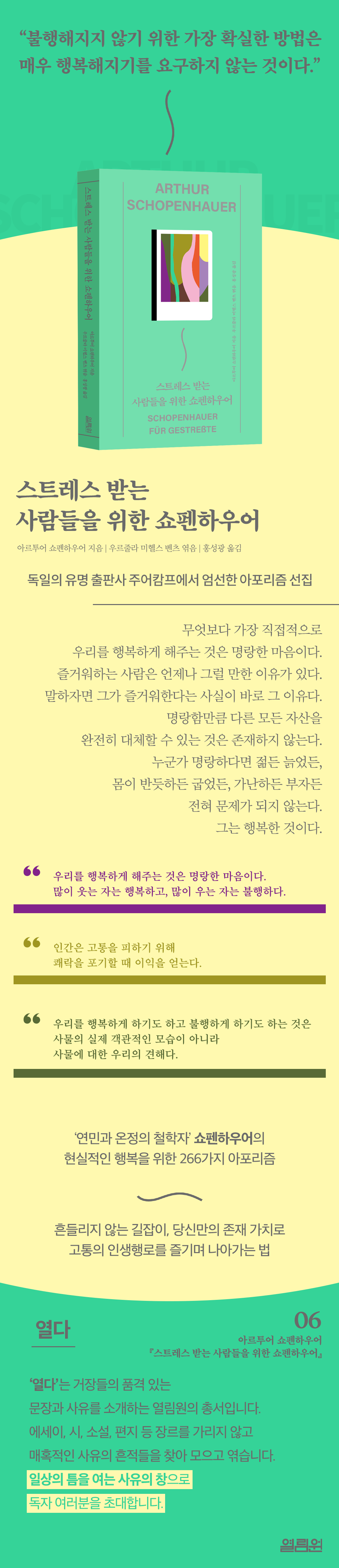
“To avoid being very unhappy
The most sure way is
“It doesn’t ask you to be very happy.”
Unlike other Schopenhauer textbooks compiled domestically, 『Schopenhauer for the Stressed』 is a collection of aphorisms planned and compiled directly for the public in Germany, the birthplace of Schopenhauer.
The editor, Ursula Michels-Benz, is a former editor at the renowned German publishing house Surkamp, which has introduced books by world-renowned intellectuals such as Brecht, Adorno, and Benjamin. She has carefully selected 266 sentences that capture the essence of Schopenhauer.
The aphorisms in this book are composed of concise yet sharp sentences, so you can read and ponder them quickly even in your busy daily life.
In just a few lines, we are forced to confront the source of our anxiety and at the same time discover the inner strength to cope with it.
The translation was done by Hong Seong-gwang, who has translated many German philosophy books, including Schopenhauer's original works of philosophy, 『The World as Will and Representation』 and 『Schopenhauer's Theory of Happiness and Philosophy of Life』.
He calls Schopenhauer a 'philosopher of compassion and kindness' and conveys the hidden essence of Schopenhauer that we must learn.
This book is composed of seven parts. Parts 1, 2, and 3 suggest the direction of happiness and value that a person should pursue solely for himself. Parts 4, 5, and 6 contain guidelines for the attitudes we should adopt in order to deal wisely in relationships with others, including natural objects.
The final chapter, Part 7, concludes with Schopenhauer's own beautiful and calm insight into human mortality and the death we will ultimately face.
The most sure way is
“It doesn’t ask you to be very happy.”
Unlike other Schopenhauer textbooks compiled domestically, 『Schopenhauer for the Stressed』 is a collection of aphorisms planned and compiled directly for the public in Germany, the birthplace of Schopenhauer.
The editor, Ursula Michels-Benz, is a former editor at the renowned German publishing house Surkamp, which has introduced books by world-renowned intellectuals such as Brecht, Adorno, and Benjamin. She has carefully selected 266 sentences that capture the essence of Schopenhauer.
The aphorisms in this book are composed of concise yet sharp sentences, so you can read and ponder them quickly even in your busy daily life.
In just a few lines, we are forced to confront the source of our anxiety and at the same time discover the inner strength to cope with it.
The translation was done by Hong Seong-gwang, who has translated many German philosophy books, including Schopenhauer's original works of philosophy, 『The World as Will and Representation』 and 『Schopenhauer's Theory of Happiness and Philosophy of Life』.
He calls Schopenhauer a 'philosopher of compassion and kindness' and conveys the hidden essence of Schopenhauer that we must learn.
This book is composed of seven parts. Parts 1, 2, and 3 suggest the direction of happiness and value that a person should pursue solely for himself. Parts 4, 5, and 6 contain guidelines for the attitudes we should adopt in order to deal wisely in relationships with others, including natural objects.
The final chapter, Part 7, concludes with Schopenhauer's own beautiful and calm insight into human mortality and the death we will ultimately face.
- You can preview some of the book's contents.
Preview
index
Entering
Part 1 Our happiness depends on what makes us who we are.
- The right relationship between our needs and insights
90 percent of our happiness depends on our health.
What makes us happiest is a cheerful mind.
True happiness is impossible without rest.
Part 2: You must comfort yourself with your own beliefs.
- We ourselves are the performers of our actions.
The beginning of all comfort is the teaching that humans did not come from nothing.
The truth has nothing to do with likes or dislikes.
It is not fame that is valuable, but what makes one worthy of it.
Part 3: You Must Think for Yourself
- Archetype, consciousness, higher art
Only what you think for yourself has real value.
You must digest the knowledge you acquire into your own thoughts.
We need a heart that can appreciate beautiful works of art.
Part 4: Recovery is a natural product
- The center of the world in the voice of nature
Nature draws human will toward light
The will to live is the innermost core of all living things.
The body is a self-healing machine.
Part 5: Only those who pursue objective goals are great.
- About your relationship with yourself and others
I need to focus on what I have now.
Courtesy is wisdom, rudeness is foolishness.
Moral excellence is superior to all theoretical wisdom.
Part 6: We Have Something Smarter Than Our Brains
- Inner impulse and actual time achieved
Human life is like a work of art touched for the first time.
It is as important to see and experience firsthand as it is to read and learn.
A person's character is not in his head, but in his heart.
Part 7: Death is a great reservoir that holds life.
- The immortality of our true being
The goodness of the heart is a mysterious and transcendent thing.
Just as anywhere on Earth is present, so too is every form of life.
We survive in nature through death.
Commentary by Schopenhauer, the Philosopher of Compassion and Kindness_Hong Seong-gwang
annual report
Part 1 Our happiness depends on what makes us who we are.
- The right relationship between our needs and insights
90 percent of our happiness depends on our health.
What makes us happiest is a cheerful mind.
True happiness is impossible without rest.
Part 2: You must comfort yourself with your own beliefs.
- We ourselves are the performers of our actions.
The beginning of all comfort is the teaching that humans did not come from nothing.
The truth has nothing to do with likes or dislikes.
It is not fame that is valuable, but what makes one worthy of it.
Part 3: You Must Think for Yourself
- Archetype, consciousness, higher art
Only what you think for yourself has real value.
You must digest the knowledge you acquire into your own thoughts.
We need a heart that can appreciate beautiful works of art.
Part 4: Recovery is a natural product
- The center of the world in the voice of nature
Nature draws human will toward light
The will to live is the innermost core of all living things.
The body is a self-healing machine.
Part 5: Only those who pursue objective goals are great.
- About your relationship with yourself and others
I need to focus on what I have now.
Courtesy is wisdom, rudeness is foolishness.
Moral excellence is superior to all theoretical wisdom.
Part 6: We Have Something Smarter Than Our Brains
- Inner impulse and actual time achieved
Human life is like a work of art touched for the first time.
It is as important to see and experience firsthand as it is to read and learn.
A person's character is not in his head, but in his heart.
Part 7: Death is a great reservoir that holds life.
- The immortality of our true being
The goodness of the heart is a mysterious and transcendent thing.
Just as anywhere on Earth is present, so too is every form of life.
We survive in nature through death.
Commentary by Schopenhauer, the Philosopher of Compassion and Kindness_Hong Seong-gwang
annual report
Detailed image
Into the book
Our happiness is greatly influenced by our cheerful mood, and this cheerful mood is greatly influenced by our health.
Even in the same situation or event, you can easily see the difference when you are healthy and strong and when you are irritated and anxious due to illness.
It is not the actual objective appearance of things, but our views of them that make us happy or unhappy.
--- p.21
Every day can be said to be a small life.
Every day is a small life that begins with birth, which is awakening, and ends with sleep, which is death.
Therefore, falling asleep is a daily death, and waking up each day is a new birth.
So, if you want to fully accomplish the task of waking up, it might be possible to do so by considering the discomfort and difficulty of waking up as the pain of birth.
--- p.63
We can see nature and music as two different expressions of the same language.
When it comes to expressing the world, music is the highest level of common language.
--- p.90
How can such a loyal friend and such a clever dog be kept chained up? Every time I see such a dog, I feel a pang of pity and a strong anger towards its owner.
I feel a sense of satisfaction when I think about an article that appeared in the Times a few years ago.
It was about a nobleman who had a large dog tied to a chain. One day, while he was walking in a large courtyard, he suddenly felt like petting the dog and reached out his hand. However, the dog bit his arm.
Isn't that a natural thing to say? The dog must have wanted to say something like this.
“You are not my master, but the devil who made my short life a living hell.” Anyone who chains a dog deserves this misfortune!
--- pp.101-102
I found a wildflower and cried out in amazement at its beauty and the perfection of every part.
“But everything in this flower, so many things like this, go unnoticed, sometimes blooming and then withering without anyone noticing.” Then the flower answered:
“You fool! Do you think I bloom for others to see? Flowers bloom for me, not for others.
Flowers bloom because I like them.
“My joy and my delight are in the fact that flowers bloom, in the fact that I exist.”
--- p.109
In order to readily and without hesitation acknowledge and approve the values of others, you must have your own values.
--- p.133
It is better not to refute other people's opinions.
If you try to change people's thinking by explaining each and every absurdity they believe, you will not achieve your goal even if you live as long as Methuselah (a character in Genesis who lived to be 969 years old).
Also, when talking, you should never point out other people's mistakes, even if you mean well.
It is easy to hurt people's feelings, but difficult to correct them.
If you start to get angry because you're hearing nonsense, just think of it as one of those comedy scenes where two clowns are having a conversation.
--- p.134
Goodness of heart consists in deep and universal compassion for all living things, especially for human beings.
As intelligence increases, so does one's sensitivity to pain.
--- p.143
Look at the moral drive I've built.
Regardless of era and nation, even amid the horrors of revolution and war, on a large and small scale, among all peoples, in all situations of life, even in lawlessness, every day, every hour, at any time.
Who would dare deny for a moment that it prevents countless injustices every day? Even when good deeds are performed, often quite unintentionally, without any hope of reciprocation, and where they prove effective, we all acknowledge their true moral worth with awe and admiration.
--- p.143
Never let your mind be consumed by plans and worries for the future, nor by longing for the past; never forget that the present is the only reality and the only certainty.
(…) only the present is true and genuine.
Reality is a time full of reality, and our lives exist only in reality.
That is why we must always accept the present with a cheerful mood.
Therefore, it is better to deliberately enjoy free time that is bearable and does not cause direct discomfort or pain.
In other words, we should not spend the present feeling depressed, with an irritated face because of past hopes that turned out to be failures or because of worries about the future.
--- pp.161-162
Just as a composer can incorporate a multitude of sounds into a symphony, so too can everyone's journey through life be one of harmony and harmony.
The great dream we dream of in life is, in a sense, only one thing: the will to live.
It is a big dream that only one being has, but at the same time, everyone shares in that dream.
So everything is intertwined and fits together.
--- p.170
“My true inner being is present in all living beings as directly as it appears to me alone, in my own consciousness.” The Sanskrit formula 'tat tvam asi', 'that is you', is this realization, which bursts forth as compassion.
It is also the basis of all true, unselfish virtue and the true expression of good deeds.
It is this realization that all appeals to tolerance, charity, and humanity ultimately aim at.
This appeal reminds us that we are all one and the same.
In our dreams and in our waking state, we are present not only to ourselves but also to all those who appear before us.
“It is you,” even though it may not be easy to recognize.
--- p.176
We know very well what we lose through death.
But we do not know what we gain through death.
Even in the same situation or event, you can easily see the difference when you are healthy and strong and when you are irritated and anxious due to illness.
It is not the actual objective appearance of things, but our views of them that make us happy or unhappy.
--- p.21
Every day can be said to be a small life.
Every day is a small life that begins with birth, which is awakening, and ends with sleep, which is death.
Therefore, falling asleep is a daily death, and waking up each day is a new birth.
So, if you want to fully accomplish the task of waking up, it might be possible to do so by considering the discomfort and difficulty of waking up as the pain of birth.
--- p.63
We can see nature and music as two different expressions of the same language.
When it comes to expressing the world, music is the highest level of common language.
--- p.90
How can such a loyal friend and such a clever dog be kept chained up? Every time I see such a dog, I feel a pang of pity and a strong anger towards its owner.
I feel a sense of satisfaction when I think about an article that appeared in the Times a few years ago.
It was about a nobleman who had a large dog tied to a chain. One day, while he was walking in a large courtyard, he suddenly felt like petting the dog and reached out his hand. However, the dog bit his arm.
Isn't that a natural thing to say? The dog must have wanted to say something like this.
“You are not my master, but the devil who made my short life a living hell.” Anyone who chains a dog deserves this misfortune!
--- pp.101-102
I found a wildflower and cried out in amazement at its beauty and the perfection of every part.
“But everything in this flower, so many things like this, go unnoticed, sometimes blooming and then withering without anyone noticing.” Then the flower answered:
“You fool! Do you think I bloom for others to see? Flowers bloom for me, not for others.
Flowers bloom because I like them.
“My joy and my delight are in the fact that flowers bloom, in the fact that I exist.”
--- p.109
In order to readily and without hesitation acknowledge and approve the values of others, you must have your own values.
--- p.133
It is better not to refute other people's opinions.
If you try to change people's thinking by explaining each and every absurdity they believe, you will not achieve your goal even if you live as long as Methuselah (a character in Genesis who lived to be 969 years old).
Also, when talking, you should never point out other people's mistakes, even if you mean well.
It is easy to hurt people's feelings, but difficult to correct them.
If you start to get angry because you're hearing nonsense, just think of it as one of those comedy scenes where two clowns are having a conversation.
--- p.134
Goodness of heart consists in deep and universal compassion for all living things, especially for human beings.
As intelligence increases, so does one's sensitivity to pain.
--- p.143
Look at the moral drive I've built.
Regardless of era and nation, even amid the horrors of revolution and war, on a large and small scale, among all peoples, in all situations of life, even in lawlessness, every day, every hour, at any time.
Who would dare deny for a moment that it prevents countless injustices every day? Even when good deeds are performed, often quite unintentionally, without any hope of reciprocation, and where they prove effective, we all acknowledge their true moral worth with awe and admiration.
--- p.143
Never let your mind be consumed by plans and worries for the future, nor by longing for the past; never forget that the present is the only reality and the only certainty.
(…) only the present is true and genuine.
Reality is a time full of reality, and our lives exist only in reality.
That is why we must always accept the present with a cheerful mood.
Therefore, it is better to deliberately enjoy free time that is bearable and does not cause direct discomfort or pain.
In other words, we should not spend the present feeling depressed, with an irritated face because of past hopes that turned out to be failures or because of worries about the future.
--- pp.161-162
Just as a composer can incorporate a multitude of sounds into a symphony, so too can everyone's journey through life be one of harmony and harmony.
The great dream we dream of in life is, in a sense, only one thing: the will to live.
It is a big dream that only one being has, but at the same time, everyone shares in that dream.
So everything is intertwined and fits together.
--- p.170
“My true inner being is present in all living beings as directly as it appears to me alone, in my own consciousness.” The Sanskrit formula 'tat tvam asi', 'that is you', is this realization, which bursts forth as compassion.
It is also the basis of all true, unselfish virtue and the true expression of good deeds.
It is this realization that all appeals to tolerance, charity, and humanity ultimately aim at.
This appeal reminds us that we are all one and the same.
In our dreams and in our waking state, we are present not only to ourselves but also to all those who appear before us.
“It is you,” even though it may not be easy to recognize.
--- p.176
We know very well what we lose through death.
But we do not know what we gain through death.
--- p.191
Publisher's Review
“To avoid being very unhappy
The most sure way is
“It doesn’t ask you to be very happy.”
Unlike other Schopenhauer textbooks compiled domestically, 『Schopenhauer for the Stressed』 is a collection of aphorisms planned and compiled directly for the public in Germany, the birthplace of Schopenhauer.
The editor, Ursula Michels-Benz, is a former editor at the renowned German publishing house Surkamp, which has introduced books by world-renowned intellectuals such as Brecht, Adorno, and Benjamin. She has carefully selected 266 sentences that capture the essence of Schopenhauer.
The aphorisms in this book are composed of concise yet sharp sentences, so you can read and ponder them quickly even in your busy daily life.
In just a few lines, we are forced to confront the source of our anxiety and at the same time discover the inner strength to cope with it.
The translation was done by Hong Seong-gwang, who has translated many German philosophy books, including Schopenhauer's original works of philosophy, 『The World as Will and Representation』 and 『Schopenhauer's Theory of Happiness and Philosophy of Life』.
He calls Schopenhauer a 'philosopher of compassion and kindness' and conveys the hidden essence of Schopenhauer that we must learn.
This book is composed of seven parts. Parts 1, 2, and 3 suggest the direction of happiness and value that a person should pursue solely for himself. Parts 4, 5, and 6 contain guidelines for the attitudes we should adopt in order to deal wisely in relationships with others, including natural objects.
The final chapter, Part 7, concludes with Schopenhauer's own beautiful and calm insight into human mortality and the death we will ultimately face.
“Above all, most directly
“What makes us happy is a cheerful mind.”
Schopenhauer was not a pessimist, but a free-spirited realist.
Happiness and unhappiness depend on how you move your mind.
“Life itself is suffering, but our attitude toward it can make it more or less suffering,” and “our imagination of happiness or unhappiness is like a sandcastle,” so “we must be careful not to build a sandcastle with our imagination.” “It is very uncertain what serious reflection and serious concern can improve.
On the other hand, cheerfulness has direct benefits.
Cheerfulness alone is the true coin of happiness, and is not a bill of exchange like all others.
“The only thing that directly makes you happy in the present is cheerfulness.” Therefore, “whenever cheerfulness comes, you must open the door wide.
“Because cheerfulness never comes at the wrong time.” The cheerfulness that Schopenhauer emphasized in this way comes to us as practical wisdom to manage the tension and anxiety of daily life, and becomes a source of inner strength that protects us even in the midst of pain and anxiety.
“Stress, despair, unhappiness,
Even the cure for the fear of death is
“It is not somewhere else, but within the person himself.”
Since the source of suffering lies within oneself, healing also comes from one's own attitude.
“Artur Schopenhauer delved deeper into the issues of the relationship between external circumstances and one’s own will in forming the path of life that we consider fateful, and corrected not only the apparent helplessness of human beings but also the mistaken notion that our condition can be changed only by external circumstances.” In modern society where stress and anxiety are part of daily life, the path to healing that Schopenhauer speaks of is not a special technique or a grand philosophical system, but a concrete insight into how to control one’s mind in daily life.
He reminds us that the first thing we must do to lighten the burden of life is not to make helpless attempts to change the world, but to adjust our own attitudes.
“The present cannot escape from the will, and the will cannot escape from the present.
“Those who are content with life as it is, those who affirm life in some way (…) can overcome foolish fears.” Ultimately, Schopenhauer for the Stressed Out offers a philosophy of hope that we can live our lives again by regaining our inner initiative, even when we cannot control our external circumstances.
The most sure way is
“It doesn’t ask you to be very happy.”
Unlike other Schopenhauer textbooks compiled domestically, 『Schopenhauer for the Stressed』 is a collection of aphorisms planned and compiled directly for the public in Germany, the birthplace of Schopenhauer.
The editor, Ursula Michels-Benz, is a former editor at the renowned German publishing house Surkamp, which has introduced books by world-renowned intellectuals such as Brecht, Adorno, and Benjamin. She has carefully selected 266 sentences that capture the essence of Schopenhauer.
The aphorisms in this book are composed of concise yet sharp sentences, so you can read and ponder them quickly even in your busy daily life.
In just a few lines, we are forced to confront the source of our anxiety and at the same time discover the inner strength to cope with it.
The translation was done by Hong Seong-gwang, who has translated many German philosophy books, including Schopenhauer's original works of philosophy, 『The World as Will and Representation』 and 『Schopenhauer's Theory of Happiness and Philosophy of Life』.
He calls Schopenhauer a 'philosopher of compassion and kindness' and conveys the hidden essence of Schopenhauer that we must learn.
This book is composed of seven parts. Parts 1, 2, and 3 suggest the direction of happiness and value that a person should pursue solely for himself. Parts 4, 5, and 6 contain guidelines for the attitudes we should adopt in order to deal wisely in relationships with others, including natural objects.
The final chapter, Part 7, concludes with Schopenhauer's own beautiful and calm insight into human mortality and the death we will ultimately face.
“Above all, most directly
“What makes us happy is a cheerful mind.”
Schopenhauer was not a pessimist, but a free-spirited realist.
Happiness and unhappiness depend on how you move your mind.
“Life itself is suffering, but our attitude toward it can make it more or less suffering,” and “our imagination of happiness or unhappiness is like a sandcastle,” so “we must be careful not to build a sandcastle with our imagination.” “It is very uncertain what serious reflection and serious concern can improve.
On the other hand, cheerfulness has direct benefits.
Cheerfulness alone is the true coin of happiness, and is not a bill of exchange like all others.
“The only thing that directly makes you happy in the present is cheerfulness.” Therefore, “whenever cheerfulness comes, you must open the door wide.
“Because cheerfulness never comes at the wrong time.” The cheerfulness that Schopenhauer emphasized in this way comes to us as practical wisdom to manage the tension and anxiety of daily life, and becomes a source of inner strength that protects us even in the midst of pain and anxiety.
“Stress, despair, unhappiness,
Even the cure for the fear of death is
“It is not somewhere else, but within the person himself.”
Since the source of suffering lies within oneself, healing also comes from one's own attitude.
“Artur Schopenhauer delved deeper into the issues of the relationship between external circumstances and one’s own will in forming the path of life that we consider fateful, and corrected not only the apparent helplessness of human beings but also the mistaken notion that our condition can be changed only by external circumstances.” In modern society where stress and anxiety are part of daily life, the path to healing that Schopenhauer speaks of is not a special technique or a grand philosophical system, but a concrete insight into how to control one’s mind in daily life.
He reminds us that the first thing we must do to lighten the burden of life is not to make helpless attempts to change the world, but to adjust our own attitudes.
“The present cannot escape from the will, and the will cannot escape from the present.
“Those who are content with life as it is, those who affirm life in some way (…) can overcome foolish fears.” Ultimately, Schopenhauer for the Stressed Out offers a philosophy of hope that we can live our lives again by regaining our inner initiative, even when we cannot control our external circumstances.
GOODS SPECIFICS
- Date of issue: September 15, 2025
- Page count, weight, size: 232 pages | 232g | 115*185*15mm
- ISBN13: 9791170403562
- ISBN10: 1170403565
You may also like
카테고리
korean


korean

![GQ KOREA Mark (Monthly): December [2025]](http://librairie.coreenne.fr/cdn/shop/files/8ef265dbbfbf186523ed75ba7319009d.jpg?v=1765340328&width=3840)


