

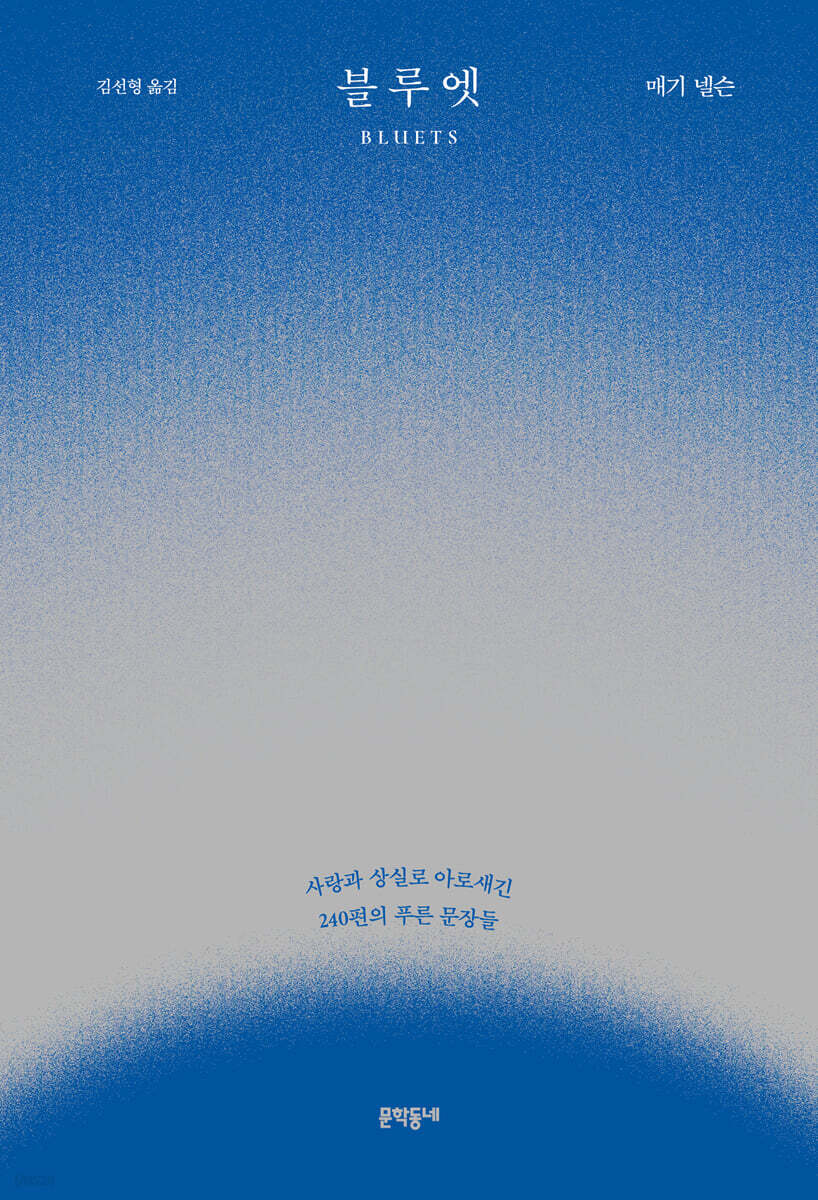
Bluet
 |
Description
Book Introduction
The most influential writer in contemporary America
Maggie Nelson's beautiful essay
Maggie Nelson, a bestselling author representing modern American literature, has recently published a new book, Bluet, by Munhakdongne.
This unique essay, a close combination of poetic sensibility and philosophical thought, begins with a persistent attachment to a single color, "blue," and meticulously explores love and loss, desire and depression, gender and art, earning it the love of countless readers around the world.
This book, which was published in Korea in 2019 but later went out of print, leaving many readers disappointed, has been republished in a delicate and beautiful hardcover edition, with translator Kim Seon-hyeong meticulously refining the elegant translation and adding a "Translator's Note."
Bluet, which instantly catapulted Maggie Nelson to the ranks of world-renowned essayists and became a cult classic, was praised for its remarkable expression of the emotional depth that makes us most human through lyrical and philosophical texts viewed through a blue lens, and was selected as one of the “10 Best Books Published in the Past 20 Years” by Bookforum in 2015.
In 2024, it was adapted into a play by renowned British director Katie Mitchell and performed at the Royal Court Theatre.
Nelson's work is renowned for blurring genre boundaries, crossing poetry, essays, and criticism.
His bold writing style, which does not hesitate to make deep confessions, can easily be misunderstood as containing only lyrical sentiments, but the deep insights and sharp critical perspectives that suddenly appear between sentences have made him one of the most influential writers of his time.
His writing evokes the tradition from Montaigne and the aphoristic writing of Barthes, and also touches on the poststructuralist characteristic of creating meaning through discontinuity and rupture.
"Bluet" is not just a simple essay; it is a mosaic of aesthetic thought and a philosophical variation of personal confession.
Maggie Nelson's beautiful essay
Maggie Nelson, a bestselling author representing modern American literature, has recently published a new book, Bluet, by Munhakdongne.
This unique essay, a close combination of poetic sensibility and philosophical thought, begins with a persistent attachment to a single color, "blue," and meticulously explores love and loss, desire and depression, gender and art, earning it the love of countless readers around the world.
This book, which was published in Korea in 2019 but later went out of print, leaving many readers disappointed, has been republished in a delicate and beautiful hardcover edition, with translator Kim Seon-hyeong meticulously refining the elegant translation and adding a "Translator's Note."
Bluet, which instantly catapulted Maggie Nelson to the ranks of world-renowned essayists and became a cult classic, was praised for its remarkable expression of the emotional depth that makes us most human through lyrical and philosophical texts viewed through a blue lens, and was selected as one of the “10 Best Books Published in the Past 20 Years” by Bookforum in 2015.
In 2024, it was adapted into a play by renowned British director Katie Mitchell and performed at the Royal Court Theatre.
Nelson's work is renowned for blurring genre boundaries, crossing poetry, essays, and criticism.
His bold writing style, which does not hesitate to make deep confessions, can easily be misunderstood as containing only lyrical sentiments, but the deep insights and sharp critical perspectives that suddenly appear between sentences have made him one of the most influential writers of his time.
His writing evokes the tradition from Montaigne and the aphoristic writing of Barthes, and also touches on the poststructuralist characteristic of creating meaning through discontinuity and rupture.
"Bluet" is not just a simple essay; it is a mosaic of aesthetic thought and a philosophical variation of personal confession.
- You can preview some of the book's contents.
Preview
index
Bluet
Translator's Note
Translator's Note
Detailed image
.jpg)
Into the book
How about starting by saying that I am in love with color?
How about confessing your feelings while tearing the napkin into small pieces?
It's a love that started slowly.
Oh, that's okay, we do have some similarities.
Then one day, my feelings became more serious.
--- p.9
A man asks, "Why blue?" I get asked this question often.
I always don't know how to answer.
I want to ask ourselves, we can't choose what or who we love.
We have no choice.
--- p.16
Sex doesn't touch anything.
Sex does not interfere with the use of language.
Because it cannot give any basis to language.
Sex just leaves everything as it is.
--- p.20
Honestly, I'm not excited about all the blue in the world.
I'm not really interested in matte turquoise, and I'm not at all attracted to lukewarm, faded indigo.
Sometimes I worry that if I don't get my heart set on something blue, I'll completely despair or die.
So, they sometimes pretend to be passionately affectionate.
Sometimes I'm afraid that I won't be able to fully convey my deep, profound affection.
--- p.28
Gass, who argues that the blue we crave in life can be found virtually only in fiction, advises writers:
“Give up the blue things of this world and pursue the words that speak of them.”
--- p.44
Finally, decisively rejected, young Werther puts on a blue coat and shoots himself in the head.
It was a replica of the coat I wore the night I first danced with my love.
It takes a full night for Werther to bleed to death.
And after this death, young men wearing the same blue coats and committing suicide followed in a line all over Germany and Europe.
--- p.80
I don't really care if half of all Western adults, besides me, love blue, and if someone comes along every ten years who can't help but write a book about blue.
I'm convinced that Blue and I have a special and strong bond that deserves to be written down and shared.
If we were to name one characteristic of blue on Earth, we would have to admit that it is its richness.
--- p.102
In a 1994 interview, twenty years after writing "Famous Blue Raincoat," Cohen admitted that he no longer clearly remembered the circumstances of the love triangle depicted in the song.
“I always felt like there was an invisible man seducing the women I dated.
“I can’t remember if this person is real or just a fictional character.” I find this forgetfulness very empowering, and then the next moment it feels like a terrible tragedy.
How about confessing your feelings while tearing the napkin into small pieces?
It's a love that started slowly.
Oh, that's okay, we do have some similarities.
Then one day, my feelings became more serious.
--- p.9
A man asks, "Why blue?" I get asked this question often.
I always don't know how to answer.
I want to ask ourselves, we can't choose what or who we love.
We have no choice.
--- p.16
Sex doesn't touch anything.
Sex does not interfere with the use of language.
Because it cannot give any basis to language.
Sex just leaves everything as it is.
--- p.20
Honestly, I'm not excited about all the blue in the world.
I'm not really interested in matte turquoise, and I'm not at all attracted to lukewarm, faded indigo.
Sometimes I worry that if I don't get my heart set on something blue, I'll completely despair or die.
So, they sometimes pretend to be passionately affectionate.
Sometimes I'm afraid that I won't be able to fully convey my deep, profound affection.
--- p.28
Gass, who argues that the blue we crave in life can be found virtually only in fiction, advises writers:
“Give up the blue things of this world and pursue the words that speak of them.”
--- p.44
Finally, decisively rejected, young Werther puts on a blue coat and shoots himself in the head.
It was a replica of the coat I wore the night I first danced with my love.
It takes a full night for Werther to bleed to death.
And after this death, young men wearing the same blue coats and committing suicide followed in a line all over Germany and Europe.
--- p.80
I don't really care if half of all Western adults, besides me, love blue, and if someone comes along every ten years who can't help but write a book about blue.
I'm convinced that Blue and I have a special and strong bond that deserves to be written down and shared.
If we were to name one characteristic of blue on Earth, we would have to admit that it is its richness.
--- p.102
In a 1994 interview, twenty years after writing "Famous Blue Raincoat," Cohen admitted that he no longer clearly remembered the circumstances of the love triangle depicted in the song.
“I always felt like there was an invisible man seducing the women I dated.
“I can’t remember if this person is real or just a fictional character.” I find this forgetfulness very empowering, and then the next moment it feels like a terrible tragedy.
--- p.128
Publisher's Review
A record of infinite life and love, opened up in one color
"Bluet" received great attention as a new form of essay never seen before.
Major media outlets, including The New York Times, The Guardian, The Boston Review, and The New Yorker, also covered this work prominently.
Through Bluet, Nelson rejected a single narrative and established his literary stance of recording fragments of thought and knots of emotion as they were, providing a refreshing experience to both young readers and critics.
He doesn't hide the pain of heartbreak and loss.
While attempting to compile his lifelong love and obsession with the color blue into what he calls a "pillow book," he experiences a painful separation from a loved one and is confronted with the serious accident of a close friend.
To overcome grief, he navigates a world of depression, divinity, alcohol, and desire, passing through famous "blue lovers" like Wittgenstein, Goethe, Joan Mitchell, Leonard Cohen, and Billie Holiday.
This collection of short stories is at once the most intellectual and visceral response to existential questions about the inseparable relationship between joy and pain, and what role aesthetic beauty can play in times of great heartbreak or grief.
The 240 short essays are sometimes confessional, sometimes critical, and at times expand the spectrum of thought by borrowing the voices of philosophers, poets, painters, and singers.
These stages are all loosely connected along the central axis called 'blue' and form a huge sea.
The crisp sentences, resembling blue waves, shine like dispersing foam, leaving a deep aftertaste.
As the reader follows the pages, he or she naturally experiences how a single color can evoke various psychological and cultural layers.
Blue-tinged prose, solidly woven with desire and reason
Blue is a common color that everyone can perceive, but at the same time, it is a color that no one can completely define.
It is precisely in this ambiguity that Maggie Nelson helps readers to evoke their own confessions and reflections.
Blue has also traditionally been associated with masculinity, melancholy, and art, but Nelson expands it to encompass love, desire, and queer sensibilities.
This provides an important interpretive point that connects with the discourse of gender and sexuality, and also serves as a basis for expanding the critical scope.
"Bluet" is personal and lyrical, but at the same time political and philosophical.
So, 『Blueet』 is not simply a book that praises the color blue.
This is a beautiful book that simultaneously examines the fragility of human existence and the abyss of the world through a single color.
Nelson's prose is concise but never cold, and he weaves personal suffering into intellectual thought and artistic reflection, yielding new meaning.
Today we live in an age where loss and anxiety are unavoidable.
In a society rife with disconnection and isolation, texts that sublimate dull sadness into brilliant art are all the more precious.
So, the blue stories that fill 『Blueet』 are always current.
Perhaps what we need to do now is to find a single piece of blue mirror that reflects ourselves among the fragments of our shattered emotions.
"Bluet" is a book that hands over that mirror.
A book about 'Heartbreak'.
The blue story resonates strongly like a pop song.
The New Yorker
A unique work focusing on fragmentary forms.
A candy bar of retrospection and criticism that approaches with a new feeling.
Los Angeles Times
240 poems of wisdom and meditation, enough to be classified as "poetry" in a bookstore.
Guardian
Is blue a light, a color, an idea, a metaphor, a sense, or a state of mind?
In this book, blue is everything.
Optical illusion.
Gift and loss, pain and sorrow and death.
The metaphysics of agnosticism.
A deep depression that only women feel.
Our lives shake like a blue tarp soaked in rain.
A sad, sick, and lonely god of the outskirts.
Fragments of the blue god stain the reader's skin and dig into his heart.
It's so wet and seeping.
Thus, Nelson's Blue resonates with a synesthesia of pain rather than intellectual insight, and like 240 shards of ice, it flies and pierces the reader's eyes and heart. _From the Translator's Note
"Bluet" received great attention as a new form of essay never seen before.
Major media outlets, including The New York Times, The Guardian, The Boston Review, and The New Yorker, also covered this work prominently.
Through Bluet, Nelson rejected a single narrative and established his literary stance of recording fragments of thought and knots of emotion as they were, providing a refreshing experience to both young readers and critics.
He doesn't hide the pain of heartbreak and loss.
While attempting to compile his lifelong love and obsession with the color blue into what he calls a "pillow book," he experiences a painful separation from a loved one and is confronted with the serious accident of a close friend.
To overcome grief, he navigates a world of depression, divinity, alcohol, and desire, passing through famous "blue lovers" like Wittgenstein, Goethe, Joan Mitchell, Leonard Cohen, and Billie Holiday.
This collection of short stories is at once the most intellectual and visceral response to existential questions about the inseparable relationship between joy and pain, and what role aesthetic beauty can play in times of great heartbreak or grief.
The 240 short essays are sometimes confessional, sometimes critical, and at times expand the spectrum of thought by borrowing the voices of philosophers, poets, painters, and singers.
These stages are all loosely connected along the central axis called 'blue' and form a huge sea.
The crisp sentences, resembling blue waves, shine like dispersing foam, leaving a deep aftertaste.
As the reader follows the pages, he or she naturally experiences how a single color can evoke various psychological and cultural layers.
Blue-tinged prose, solidly woven with desire and reason
Blue is a common color that everyone can perceive, but at the same time, it is a color that no one can completely define.
It is precisely in this ambiguity that Maggie Nelson helps readers to evoke their own confessions and reflections.
Blue has also traditionally been associated with masculinity, melancholy, and art, but Nelson expands it to encompass love, desire, and queer sensibilities.
This provides an important interpretive point that connects with the discourse of gender and sexuality, and also serves as a basis for expanding the critical scope.
"Bluet" is personal and lyrical, but at the same time political and philosophical.
So, 『Blueet』 is not simply a book that praises the color blue.
This is a beautiful book that simultaneously examines the fragility of human existence and the abyss of the world through a single color.
Nelson's prose is concise but never cold, and he weaves personal suffering into intellectual thought and artistic reflection, yielding new meaning.
Today we live in an age where loss and anxiety are unavoidable.
In a society rife with disconnection and isolation, texts that sublimate dull sadness into brilliant art are all the more precious.
So, the blue stories that fill 『Blueet』 are always current.
Perhaps what we need to do now is to find a single piece of blue mirror that reflects ourselves among the fragments of our shattered emotions.
"Bluet" is a book that hands over that mirror.
A book about 'Heartbreak'.
The blue story resonates strongly like a pop song.
The New Yorker
A unique work focusing on fragmentary forms.
A candy bar of retrospection and criticism that approaches with a new feeling.
Los Angeles Times
240 poems of wisdom and meditation, enough to be classified as "poetry" in a bookstore.
Guardian
Is blue a light, a color, an idea, a metaphor, a sense, or a state of mind?
In this book, blue is everything.
Optical illusion.
Gift and loss, pain and sorrow and death.
The metaphysics of agnosticism.
A deep depression that only women feel.
Our lives shake like a blue tarp soaked in rain.
A sad, sick, and lonely god of the outskirts.
Fragments of the blue god stain the reader's skin and dig into his heart.
It's so wet and seeping.
Thus, Nelson's Blue resonates with a synesthesia of pain rather than intellectual insight, and like 240 shards of ice, it flies and pierces the reader's eyes and heart. _From the Translator's Note
GOODS SPECIFICS
- Date of issue: September 15, 2025
- Format: Hardcover book binding method guide
- Page count, weight, size: 164 pages | 376g | 140*210*14mm
- ISBN13: 9791141612702
- ISBN10: 1141612704
You may also like
카테고리
korean


korean

![GQ KOREA Mark (Monthly): December [2025]](http://librairie.coreenne.fr/cdn/shop/files/8ef265dbbfbf186523ed75ba7319009d.jpg?v=1765340328&width=3840)


