

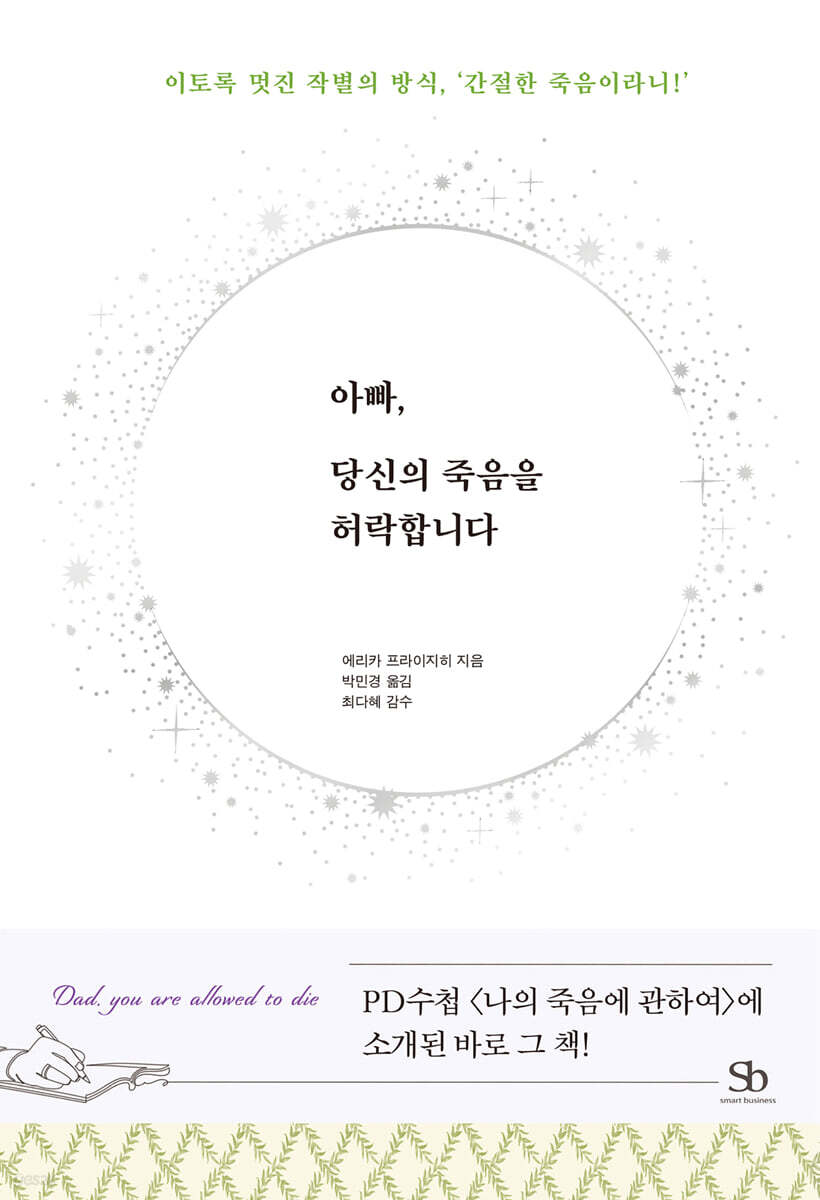
Dad, I allow you to die.
 |
Description
Book Introduction
Britain: The Best Place to Die VS Korea: The Worst Place to Die
3 million people pledge to refuse life-sustaining treatment!
82% in favor of 'assisted euthanasia'!
PD Notebook [About My Death]
The hotly-talked-about book introduced!
Are you ready for a dignified death?
“What we need in the euthanasia debate is
“It’s not pity, it’s compassion and respect.”
The author of this book, Dr. Erika Freisig, hopes that just as abortion due to unwanted pregnancy is no longer punishable, the standards for voluntary assisted dying will also be relaxed and socially acceptable.
And I hope this book will be a small contribution to that change.
She poses the following question to all of us:
"In most countries, killing human embryos due to unwanted pregnancies is permitted, but why are those suffering from severe, incurable diseases denied the right to end their excruciating suffering, even if they desperately desire it? Attitudes toward death must change, not just in Europe but around the world.
Even if the change is slow and takes a long time.”
What a wonderful way to say goodbye, 'a desperate death!'
“Preparing to leave well to live well,
“Knowing death makes the rest of your life precious!”
3 million people pledge to refuse life-sustaining treatment!
82% in favor of 'assisted euthanasia'!
PD Notebook [About My Death]
The hotly-talked-about book introduced!
Are you ready for a dignified death?
“What we need in the euthanasia debate is
“It’s not pity, it’s compassion and respect.”
The author of this book, Dr. Erika Freisig, hopes that just as abortion due to unwanted pregnancy is no longer punishable, the standards for voluntary assisted dying will also be relaxed and socially acceptable.
And I hope this book will be a small contribution to that change.
She poses the following question to all of us:
"In most countries, killing human embryos due to unwanted pregnancies is permitted, but why are those suffering from severe, incurable diseases denied the right to end their excruciating suffering, even if they desperately desire it? Attitudes toward death must change, not just in Europe but around the world.
Even if the change is slow and takes a long time.”
What a wonderful way to say goodbye, 'a desperate death!'
“Preparing to leave well to live well,
“Knowing death makes the rest of your life precious!”
- You can preview some of the book's contents.
Preview
index
Introduction l Without a good death, life becomes distorted!
A Word from the Editor l On the Boundary Between Life and Death, Speaking of the Last Right!
To our Korean readers, l When you think about the end of life, life now shines!
my father
A question of faith
quality of life
Unusual emergency duty
Fear as a Counseling Physician
Death and Afterlife
Who am I?
Life Circle and Eternal Spirit
A Word from the Editor l On the Boundary Between Life and Death, Speaking of the Last Right!
To our Korean readers, l When you think about the end of life, life now shines!
my father
A question of faith
quality of life
Unusual emergency duty
Fear as a Counseling Physician
Death and Afterlife
Who am I?
Life Circle and Eternal Spirit
Detailed image

Into the book
“It was only at the age of eighty-two, a difficult age for me, with disabilities and old age, that I decided to fulfill my father’s long-held wish.
I decided to help my father with his voluntary assisted death.
So, on May 3, 2005, my father, Albrecht Gottlieb Habeger-Wigget-Pughi, carried out his longed-for will to die by self-determination.
And now, nine years later, I am grateful to my father for showing me such a wonderful way to say goodbye.”
“For me, being human means having the right to self-determination.
That's what makes me different from beasts.
If I can no longer make my own decisions, others will control me, and I will no longer feel human.
So I'm grateful that I can now decide to die here in Switzerland.
Of course, that's not possible in our country, it's a shame.
“For that to happen, a lot of things would have to change.”
“I shuddered at the coldness with which my grandfather described his suicide method in front of his beloved wife.
'Now, imagine the moment when your grandmother hears the gunshot and comes into the room.
"What will unfold before your eyes? Can you do such a thing to your wife?" I asked coldly.
Tears welled up in his eyes as he looked at his wife for a long time.
“Teacher, what else can I do? I just want to die!”
"Which is a better option? Assisted dying, where family and friends truly empathize with your loved one's wish to die, allowing everyone to say their final goodbyes? Or suicide, a covert and gruesome act of gunfire, leaving them with a lifetime of unanswered questions?"
“The smell of death,” my husband used that expression.
But she couldn't die.
The husband pleaded with his wife to either overdose her with morphine or take her to Exit immediately for assisted death.
But it was already too late.
This should have been done when the wife was able to make her own decisions and allow assisted dying.
“In the end, the patient had no choice but to spend his last hours in a terrible way.”
“Teacher, let’s be honest.
I'm blind and can't tell day from night, and I can't hear my grandchildren laughing or playing even though they're right next to me.
I just wait all day.
The terrible day passes and night comes again.
When I sit down, my back hurts, and when I stand up, my arms and legs hurt.
Only death can free me from the darkness I am trapped in.
What's the point of a life like that? What would I do if I were the teacher?
“If you had the chance, wouldn’t you want to end it now?”
I decided to help my father with his voluntary assisted death.
So, on May 3, 2005, my father, Albrecht Gottlieb Habeger-Wigget-Pughi, carried out his longed-for will to die by self-determination.
And now, nine years later, I am grateful to my father for showing me such a wonderful way to say goodbye.”
“For me, being human means having the right to self-determination.
That's what makes me different from beasts.
If I can no longer make my own decisions, others will control me, and I will no longer feel human.
So I'm grateful that I can now decide to die here in Switzerland.
Of course, that's not possible in our country, it's a shame.
“For that to happen, a lot of things would have to change.”
“I shuddered at the coldness with which my grandfather described his suicide method in front of his beloved wife.
'Now, imagine the moment when your grandmother hears the gunshot and comes into the room.
"What will unfold before your eyes? Can you do such a thing to your wife?" I asked coldly.
Tears welled up in his eyes as he looked at his wife for a long time.
“Teacher, what else can I do? I just want to die!”
"Which is a better option? Assisted dying, where family and friends truly empathize with your loved one's wish to die, allowing everyone to say their final goodbyes? Or suicide, a covert and gruesome act of gunfire, leaving them with a lifetime of unanswered questions?"
“The smell of death,” my husband used that expression.
But she couldn't die.
The husband pleaded with his wife to either overdose her with morphine or take her to Exit immediately for assisted death.
But it was already too late.
This should have been done when the wife was able to make her own decisions and allow assisted dying.
“In the end, the patient had no choice but to spend his last hours in a terrible way.”
“Teacher, let’s be honest.
I'm blind and can't tell day from night, and I can't hear my grandchildren laughing or playing even though they're right next to me.
I just wait all day.
The terrible day passes and night comes again.
When I sit down, my back hurts, and when I stand up, my arms and legs hurt.
Only death can free me from the darkness I am trapped in.
What's the point of a life like that? What would I do if I were the teacher?
“If you had the chance, wouldn’t you want to end it now?”
--- From the text
Publisher's Review
At the border of life and death, speak your last right!
The book begins with the personal confession of a Swiss doctor, but soon leads the reader into the desperate reality faced by terminally ill patients.
The right to choose the end of life while maintaining human dignity, the possibility of ending one's life in the name of "self-determination" even in extreme pain, and the legal and ethical gaps we face as we observe the perspectives of medical professionals who oversee the entire process are all clearly revealed.
This is not just a story about death, but a record that makes us reflect again on human dignity and social responsibility.
Assisted dying may still be an unfamiliar and uncomfortable concept for some.
But for patients living in terminal pain, it is a concrete and desperate reality, and sometimes it may be the last remaining human choice.
We must never ignore the fact that for some, that choice may be their only hope of ending their suffering.
Without a good death, life becomes distorted!
Life does not simply mean 'being alive'.
For terminally ill patients and those suffering from incurable diseases, life becomes a pressing question: 'How will I spend my remaining time? How will I finish it in my own way?'
Yet, our society is forced to reflect on whether it is still turning a blind eye to the voices of those suffering at the end of life, as if unconditionally extending life is the only absolute value.
Decisions about how to live include decisions about how to end one's life.
This is the core of the right to self-determination guaranteed by the Constitution, and is a matter directly related to the essence of human dignity.
In the meantime, I have spoken about the 'final human rights of terminally ill patients' at debates, and at 'Right to Die Day' events, I have emphasized that death, which can be decided by one's own will, is the realization of human dignity.
In addition, they pointed out the legislative vacuum surrounding assisted death and the problem of assisted suicide in criminal law, and filed a constitutional petition.
These activities aim to establish the right to live with dignity as a human being until the last moment of life and to establish an institutional foundation for realizing that right.
When I think about the end of life, life now shines!
But the reality is not easy.
Patients in our country have to travel to distant countries like Switzerland to find the option of assisted dying.
But for seriously ill patients who can't even handle a flight of more than ten hours, such an option is virtually impossible.
This structure blocks patients' right to choose, and this is not simply a legal or institutional deficiency, but a blind spot in human rights that is being neglected.
Patients should no longer be forced to cross borders to receive end-of-life care.
Our society also has a responsibility to institutionalize more options for terminally ill patients and ensure that those choices are respected.
This book does not stop at simply introducing a few cases.
It moves the discussion on assisted dying beyond the simple framework of pros and cons, and reexamines it from the perspective of realizing human dignity and expanding the right to self-determination.
In Korean society, too, a serious social discussion must now begin to make a 'dignified death' possible.
While we still have a long way to go, I hope this book will serve as a landmark in the discourse on ensuring the rights and choices of patients at the end of life.
As a reader and a citizen who longs for a dignified death, I deeply support the meaning of this book and will accompany you on that journey.
- Choi Da-hye (President of the Korean Association for the Dignified Death)
The book begins with the personal confession of a Swiss doctor, but soon leads the reader into the desperate reality faced by terminally ill patients.
The right to choose the end of life while maintaining human dignity, the possibility of ending one's life in the name of "self-determination" even in extreme pain, and the legal and ethical gaps we face as we observe the perspectives of medical professionals who oversee the entire process are all clearly revealed.
This is not just a story about death, but a record that makes us reflect again on human dignity and social responsibility.
Assisted dying may still be an unfamiliar and uncomfortable concept for some.
But for patients living in terminal pain, it is a concrete and desperate reality, and sometimes it may be the last remaining human choice.
We must never ignore the fact that for some, that choice may be their only hope of ending their suffering.
Without a good death, life becomes distorted!
Life does not simply mean 'being alive'.
For terminally ill patients and those suffering from incurable diseases, life becomes a pressing question: 'How will I spend my remaining time? How will I finish it in my own way?'
Yet, our society is forced to reflect on whether it is still turning a blind eye to the voices of those suffering at the end of life, as if unconditionally extending life is the only absolute value.
Decisions about how to live include decisions about how to end one's life.
This is the core of the right to self-determination guaranteed by the Constitution, and is a matter directly related to the essence of human dignity.
In the meantime, I have spoken about the 'final human rights of terminally ill patients' at debates, and at 'Right to Die Day' events, I have emphasized that death, which can be decided by one's own will, is the realization of human dignity.
In addition, they pointed out the legislative vacuum surrounding assisted death and the problem of assisted suicide in criminal law, and filed a constitutional petition.
These activities aim to establish the right to live with dignity as a human being until the last moment of life and to establish an institutional foundation for realizing that right.
When I think about the end of life, life now shines!
But the reality is not easy.
Patients in our country have to travel to distant countries like Switzerland to find the option of assisted dying.
But for seriously ill patients who can't even handle a flight of more than ten hours, such an option is virtually impossible.
This structure blocks patients' right to choose, and this is not simply a legal or institutional deficiency, but a blind spot in human rights that is being neglected.
Patients should no longer be forced to cross borders to receive end-of-life care.
Our society also has a responsibility to institutionalize more options for terminally ill patients and ensure that those choices are respected.
This book does not stop at simply introducing a few cases.
It moves the discussion on assisted dying beyond the simple framework of pros and cons, and reexamines it from the perspective of realizing human dignity and expanding the right to self-determination.
In Korean society, too, a serious social discussion must now begin to make a 'dignified death' possible.
While we still have a long way to go, I hope this book will serve as a landmark in the discourse on ensuring the rights and choices of patients at the end of life.
As a reader and a citizen who longs for a dignified death, I deeply support the meaning of this book and will accompany you on that journey.
- Choi Da-hye (President of the Korean Association for the Dignified Death)
GOODS SPECIFICS
- Date of issue: October 1, 2025
- Page count, weight, size: 232 pages | 254g | 125*185*15mm
- ISBN13: 9791163430766
- ISBN10: 1163430765
You may also like
카테고리
korean


korean

![GQ KOREA Mark (Monthly): December [2025]](http://librairie.coreenne.fr/cdn/shop/files/8ef265dbbfbf186523ed75ba7319009d.jpg?v=1765340328&width=3840)


