

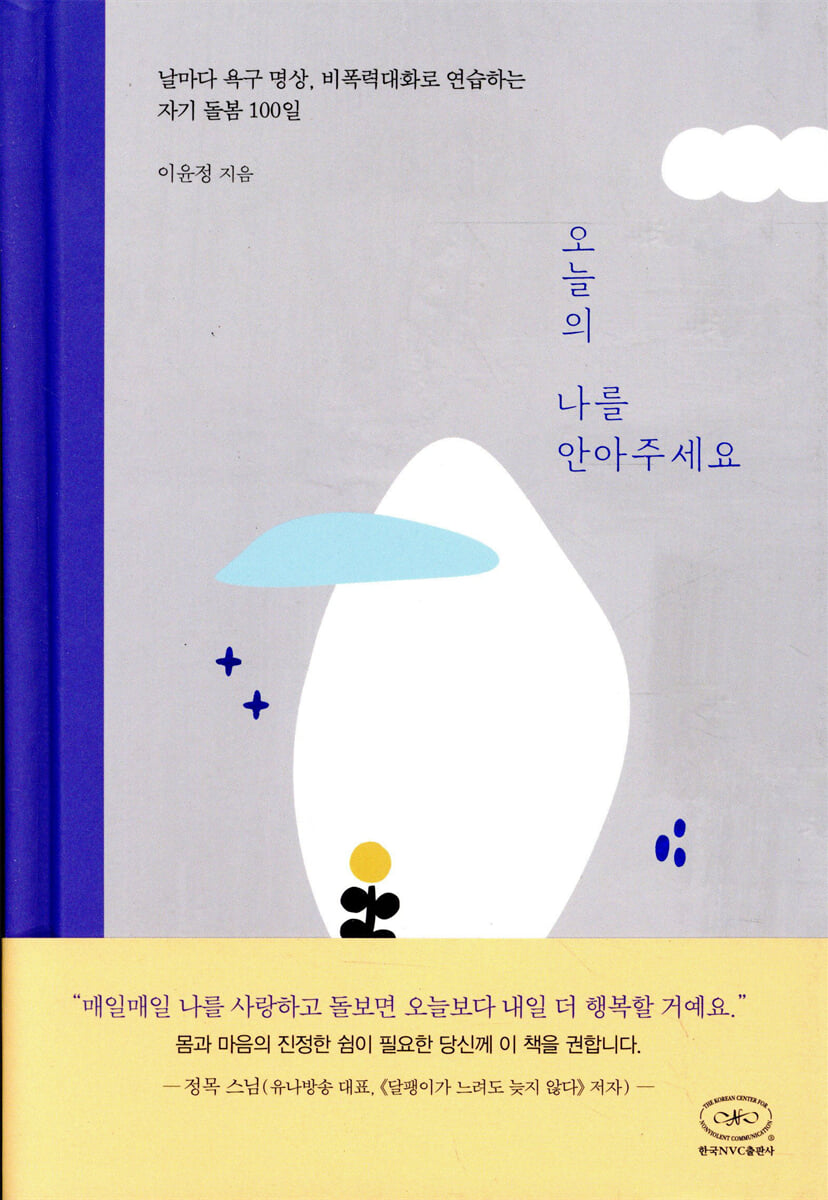
Please hug me today
 |
Description
Book Introduction
The second book by author Lee Yun-jeong, a certified trainer at the Center for Nonviolent Communication (CNVC), an international peace organization, and former vice president of the Korea Center for Nonviolent Communication and president of the Korea Nonviolent Communication Education Center, has been published after 10 years.
While the first book, "Children are in Puberty, Mothers are in Growth" (Hankyoreh Edu, 2010), contained methods for communicating with adolescent children through non-violent communication, the second book, "Please Embrace Today's Me," talks about self-care time through a 100-day desire meditation.
In other words, it guides you on how to communicate peacefully with yourself and those around you by becoming aware of your own 'needs' and finding ways to satisfy them.
While the first book, "Children are in Puberty, Mothers are in Growth" (Hankyoreh Edu, 2010), contained methods for communicating with adolescent children through non-violent communication, the second book, "Please Embrace Today's Me," talks about self-care time through a 100-day desire meditation.
In other words, it guides you on how to communicate peacefully with yourself and those around you by becoming aware of your own 'needs' and finding ways to satisfy them.
index
Part 1.
Taking care of my body
Day 001 Air
Day 002 Water
Day 003 Sleep
Day 004 Food
Day 005 Housing
Day 006 Safety
Day 007 Taking care of
Day 008 Rest
Day 009 Health
Day 010 Skinship
Day 011 Softness
Day 012 Protected
Day 013 Warmth
Day 014 Comfort
Day 015 Free Movement
Day 016 Attachment
Day 017 Exercise
Part 2.
To be a little happier within us
Day 018 Willing to Give
Day 019 Communication
Day 020 Interest
Day 021 Support
Day 022 Judea
Day 023 Help and Support
Day 024 Sharing
Day 025 Intimacy
Day 026 Acceptance
Day 027 Respect
Day 028 Community
Day 029 Sense of Belonging
Day 030 Consideration
Day 031 Magnetic Connection
Day 032 Connection
Day 033 Friendship
Day 034 Liking
Day 035 Cooperation
Day 036 Understanding
Day 037 Reciprocity
Day 038 Empathy
Day 039 Gratitude
Day 040 Recognition
Day 041 Yuan
Day 042 Stability
Day 043 Trust
Day 044 Confidence
Day 045 Predictability
Day 046 Consistency
Day 047 Honesty
Part 3.
When our lives are connected
Day 048 Hope
Day 049 Fun and Enjoyment
Day 050 Discovery
Day 051 Contribution
Day 052 Congratulations
Day 053 Mourning
Day 054 Reward
Day 055 Abilities
Day 056 Challenge
Day 057 The Meaning of Life
Celebrating Day 058
Day 059 Enlightenment
Day 060 Stimulation
Day 061 Participation
Day 062 Recovery
Day 063 Considered Important
Day 064 Subjectivity
Day 065 Efficacy
Day 066 Humor
Day 067 Excitement
Part 4.
On Perfect Beauty
Day 068 Authenticity
Day 069 Integrity
Day 070 Presence
Day 071 Match
Day 072 Flatness
Day 073 Leisure
Day 074 Harmony
Day 075 Clarity
Day 076 Equality
Day 077 Order
Day 078 Feeling free
Day 079 Peace
Day 080 Childhood Dream
Day 081 Today's dream
Day 082 Beauty
Day 083 My Beauty
Day 084 Gaeseong
Day 085 Vision
Day 086 Spiritual Communion
Day 087 Spirituality
Part 5.
To become more free
Day 088 Autonomy
Day 089 Awakening
Day 090 Healing
Day 091 Self-Respect
Day 092 Learning
Day 093 Self-Expression
Day 094 Growth
Day 095 Self-Trust
Day 096 Goal
Day 097 Achievement
Day 098 Expertise
Day 099 Creativity
Day 100 Play
Taking care of my body
Day 001 Air
Day 002 Water
Day 003 Sleep
Day 004 Food
Day 005 Housing
Day 006 Safety
Day 007 Taking care of
Day 008 Rest
Day 009 Health
Day 010 Skinship
Day 011 Softness
Day 012 Protected
Day 013 Warmth
Day 014 Comfort
Day 015 Free Movement
Day 016 Attachment
Day 017 Exercise
Part 2.
To be a little happier within us
Day 018 Willing to Give
Day 019 Communication
Day 020 Interest
Day 021 Support
Day 022 Judea
Day 023 Help and Support
Day 024 Sharing
Day 025 Intimacy
Day 026 Acceptance
Day 027 Respect
Day 028 Community
Day 029 Sense of Belonging
Day 030 Consideration
Day 031 Magnetic Connection
Day 032 Connection
Day 033 Friendship
Day 034 Liking
Day 035 Cooperation
Day 036 Understanding
Day 037 Reciprocity
Day 038 Empathy
Day 039 Gratitude
Day 040 Recognition
Day 041 Yuan
Day 042 Stability
Day 043 Trust
Day 044 Confidence
Day 045 Predictability
Day 046 Consistency
Day 047 Honesty
Part 3.
When our lives are connected
Day 048 Hope
Day 049 Fun and Enjoyment
Day 050 Discovery
Day 051 Contribution
Day 052 Congratulations
Day 053 Mourning
Day 054 Reward
Day 055 Abilities
Day 056 Challenge
Day 057 The Meaning of Life
Celebrating Day 058
Day 059 Enlightenment
Day 060 Stimulation
Day 061 Participation
Day 062 Recovery
Day 063 Considered Important
Day 064 Subjectivity
Day 065 Efficacy
Day 066 Humor
Day 067 Excitement
Part 4.
On Perfect Beauty
Day 068 Authenticity
Day 069 Integrity
Day 070 Presence
Day 071 Match
Day 072 Flatness
Day 073 Leisure
Day 074 Harmony
Day 075 Clarity
Day 076 Equality
Day 077 Order
Day 078 Feeling free
Day 079 Peace
Day 080 Childhood Dream
Day 081 Today's dream
Day 082 Beauty
Day 083 My Beauty
Day 084 Gaeseong
Day 085 Vision
Day 086 Spiritual Communion
Day 087 Spirituality
Part 5.
To become more free
Day 088 Autonomy
Day 089 Awakening
Day 090 Healing
Day 091 Self-Respect
Day 092 Learning
Day 093 Self-Expression
Day 094 Growth
Day 095 Self-Trust
Day 096 Goal
Day 097 Achievement
Day 098 Expertise
Day 099 Creativity
Day 100 Play
Into the book
To better meet the desire for 'food', I recommend two things.
‘Reflect on the cause of hunger’ and ‘Treat food with reverence.’
Today, take a picture or write down everything that goes into your mouth.
Every time I eat something, I connect with my heart.
Savor the process of food entering your body through your mouth, and feel the color and texture of the food.
Rather than eating a meal in a hurry, prepare the food you eat with care and enjoy it so that it becomes a form of ‘care for yourself.’
--- p.32, from “Food”
I write down what I eat from the time I wake up until I go to sleep.
If you write down everything that goes into your mouth, you will realize that you are eating more than you need.
“Even if you drink just a sip of water, you gain weight.” This saying really resonates with me.
If I take pictures of everything I eat every day, I can become aware of my attitude toward food.
If you think about your food cravings, you can practice food meditation every time you eat.
Appreciate each bite and chew slowly, savoring the texture and taste.
The cucumber scent I didn't like becomes enjoyable, and the peach scent I couldn't get past becomes enjoyable.
Sometimes I cry because I'm sad while eating a banana.
Next, connect with your mind when you feel like eating.
--- p.33, from “Meditation on Food Cravings”
Marshall B. Rosenberg, the founder of nonviolent communication
Rosenburg) says that the 'joy of giving willingly' is human nature.
Think of an experience in your life when you gave something from your heart or received something from someone.
Today, I hope you feel the joy of giving to someone willingly.
Let's see how the world changes when I give, and what is given to me.
--- p.90, from "Giving Willingly"
How much have I willingly given in my life?
The first thing that comes to mind is an experience where I felt ashamed or wronged because I was not willing to give.
Let's stay in that memory without any judgment.
"You gave it to me because you wanted something." "I still feel resentful that I gave it to you out of a sense of responsibility." I realize that I wanted to give it from the bottom of my heart and I empathize with myself.
I also recall memories of giving willingly without any expectations.
Thinking back, I feel happy and think I did well.
'Yes, that's how you give when you give.
'With all my heart.' I think again about the nobility of giving.
--- p.91, from “Meditation on the Desire to Willingly Give”
What experiences do you have when you connect with objects or nature? The first goal of nonviolent communication is to foster deep connection with one another.
If you start a conversation with accusations or judgments and try to prove you're right or convince the other person, the connection is lost.
Connections are formed when we understand what each other values and wants and find ways to fulfill those needs with equal respect.
What matters is whether you truly want to connect in that moment.
To see that heart, you must first connect with yourself before connecting with the other person.
--- p.146, from "Connection"
If you do a 'need for connection meditation' before meeting someone, you can better let go of any stimulation that arises during the meeting.
As you go to meet someone, think of that person and imagine a scene where you meet them sincerely, a situation where a deep and satisfying connection is made.
I feel the speed of my breathing.
Think of the most comfortable smile you can give when you meet that person and imagine that person connecting with you as well.
If you meet suddenly or communicate with an uncomfortable feeling, you won't be able to connect.
If we recall Jeong Hyeon-jong's poem, "The arrival of a person is a tremendous event because it represents the arrival of a person's entire life," we can easily understand why connection meditation, which prepares us for an encounter, is necessary.
--- p.147 From “The Need for Connection Meditation”
'Mourning' means letting go of a loss.
Although the word 'mourning' may not be familiar, there are countless things in life to mourn.
The expression 'mourning' is often used when someone dies.
But mourning is necessary not only for bereavement, but also when we are separated for any reason, when we have to give up on our dreams or plans, when we are pushed to a corner and unexpected events occur in life.
When we lose a body part to an accident or illness, or when we lose a physical ability due to aging, when we have to leave our beloved home, or when we see our beloved natural scenery being destroyed, we must grieve as much as we want and let it flow freely in moments when our desires are not fulfilled.
--- p.232, from “Mourning”
When did you first understand grief? We grieve when we lose something we longed for.
Repeat the word 'mourning' with your breathing.
I think back to a time in my life when I needed to mourn.
There are moments when I've grieved enough, and there are still moments when the pain in my throat gets stuck and lingers.
When you feel pain, stop and acknowledge your feelings by saying, "It hurt then. Even now, when I think about it, I feel sad and drained. Do I need more time?"
Today is a day of mourning, and I embrace it as it comes, without any discomfort.
--- p.233, from “Meditation on the Need for Mourning”
In nonviolent communication, sincerity is not a measure of consistency or diligence.
When integrity becomes important, we want to plan, participate, and even endure boredom to achieve results.
The energy of immersion is created.
When I hear someone say, “My child is not diligent, which is a big problem,” I ask, “Is that true?”
The only difference is that each person has different levels of sincerity.
If you expect the other person to be sincere in the way you want, it is not connected to desire, but rather an obsession with means and methods.
--- p.298, from “Sincerity”
Integrity was a pleasant word when I was a child.
It meant a positive evaluation.
When raising a creative and free-spirited child, it was always a regrettable word.
Because I looked at the child thinking that he was not sincere.
Sincerity met with the desire for nonviolent communication does not mean that.
It doesn't matter whether you are honest or not.
The question is, 'Do I want to be honest?'
Keep sincerity in your heart and focus on your breathing.
Breathe in sincerely, breathe out sincerely.
We can practice integrity through actions as simple as breathing.
We are honest.
When you breathe, when you eat, when you have a hobby, when you love someone… .
--- p.299, from “Meditation on the Desire for Integrity”
The two aspects of nonviolent communication are expressing oneself honestly and listening to the other person with empathy.
Expressing yourself honestly is as difficult as empathizing with someone.
It's sometimes disconcerting to meet people who misinterpret the desire for "self-expression" as "making all the criticisms I want" or "saying whatever I want."
Self-expression is not just about expression.
The intention is to connect with others.
To express yourself, you must first organize your mind.
Remember, your goal is to communicate with the other person by conveying your feelings clearly, not by proving their faults or making them aware of your pain.
--- p.396, from “Self-Expression”
Self-expression seems easy, but it is difficult.
I want to express my feelings that I've been holding back, but I've been thinking for several days about whether it's better to keep quiet or express them.
· How do you feel when you think about that? It's uncomfortable.
There is no apparent conflict, but thinking about it makes me feel uncomfortable and makes me feel uncomfortable looking at him.
I'm also worried that there might be a misunderstanding between us.
· Why do I want to say this? Since we'll be meeting each other again in the future, I want to communicate well and get along comfortably.
· Do you have a favor to ask that person? Let's ask them to have lunch on Friday.
· What if this conversation goes well? I think I'll become close with this person, and it'll be fun to do things together in the future.
Now that you've made up your mind, you need the courage to put it into action.
I texted her asking if she had time to talk tomorrow.
I'm looking forward to tomorrow.
‘Reflect on the cause of hunger’ and ‘Treat food with reverence.’
Today, take a picture or write down everything that goes into your mouth.
Every time I eat something, I connect with my heart.
Savor the process of food entering your body through your mouth, and feel the color and texture of the food.
Rather than eating a meal in a hurry, prepare the food you eat with care and enjoy it so that it becomes a form of ‘care for yourself.’
--- p.32, from “Food”
I write down what I eat from the time I wake up until I go to sleep.
If you write down everything that goes into your mouth, you will realize that you are eating more than you need.
“Even if you drink just a sip of water, you gain weight.” This saying really resonates with me.
If I take pictures of everything I eat every day, I can become aware of my attitude toward food.
If you think about your food cravings, you can practice food meditation every time you eat.
Appreciate each bite and chew slowly, savoring the texture and taste.
The cucumber scent I didn't like becomes enjoyable, and the peach scent I couldn't get past becomes enjoyable.
Sometimes I cry because I'm sad while eating a banana.
Next, connect with your mind when you feel like eating.
--- p.33, from “Meditation on Food Cravings”
Marshall B. Rosenberg, the founder of nonviolent communication
Rosenburg) says that the 'joy of giving willingly' is human nature.
Think of an experience in your life when you gave something from your heart or received something from someone.
Today, I hope you feel the joy of giving to someone willingly.
Let's see how the world changes when I give, and what is given to me.
--- p.90, from "Giving Willingly"
How much have I willingly given in my life?
The first thing that comes to mind is an experience where I felt ashamed or wronged because I was not willing to give.
Let's stay in that memory without any judgment.
"You gave it to me because you wanted something." "I still feel resentful that I gave it to you out of a sense of responsibility." I realize that I wanted to give it from the bottom of my heart and I empathize with myself.
I also recall memories of giving willingly without any expectations.
Thinking back, I feel happy and think I did well.
'Yes, that's how you give when you give.
'With all my heart.' I think again about the nobility of giving.
--- p.91, from “Meditation on the Desire to Willingly Give”
What experiences do you have when you connect with objects or nature? The first goal of nonviolent communication is to foster deep connection with one another.
If you start a conversation with accusations or judgments and try to prove you're right or convince the other person, the connection is lost.
Connections are formed when we understand what each other values and wants and find ways to fulfill those needs with equal respect.
What matters is whether you truly want to connect in that moment.
To see that heart, you must first connect with yourself before connecting with the other person.
--- p.146, from "Connection"
If you do a 'need for connection meditation' before meeting someone, you can better let go of any stimulation that arises during the meeting.
As you go to meet someone, think of that person and imagine a scene where you meet them sincerely, a situation where a deep and satisfying connection is made.
I feel the speed of my breathing.
Think of the most comfortable smile you can give when you meet that person and imagine that person connecting with you as well.
If you meet suddenly or communicate with an uncomfortable feeling, you won't be able to connect.
If we recall Jeong Hyeon-jong's poem, "The arrival of a person is a tremendous event because it represents the arrival of a person's entire life," we can easily understand why connection meditation, which prepares us for an encounter, is necessary.
--- p.147 From “The Need for Connection Meditation”
'Mourning' means letting go of a loss.
Although the word 'mourning' may not be familiar, there are countless things in life to mourn.
The expression 'mourning' is often used when someone dies.
But mourning is necessary not only for bereavement, but also when we are separated for any reason, when we have to give up on our dreams or plans, when we are pushed to a corner and unexpected events occur in life.
When we lose a body part to an accident or illness, or when we lose a physical ability due to aging, when we have to leave our beloved home, or when we see our beloved natural scenery being destroyed, we must grieve as much as we want and let it flow freely in moments when our desires are not fulfilled.
--- p.232, from “Mourning”
When did you first understand grief? We grieve when we lose something we longed for.
Repeat the word 'mourning' with your breathing.
I think back to a time in my life when I needed to mourn.
There are moments when I've grieved enough, and there are still moments when the pain in my throat gets stuck and lingers.
When you feel pain, stop and acknowledge your feelings by saying, "It hurt then. Even now, when I think about it, I feel sad and drained. Do I need more time?"
Today is a day of mourning, and I embrace it as it comes, without any discomfort.
--- p.233, from “Meditation on the Need for Mourning”
In nonviolent communication, sincerity is not a measure of consistency or diligence.
When integrity becomes important, we want to plan, participate, and even endure boredom to achieve results.
The energy of immersion is created.
When I hear someone say, “My child is not diligent, which is a big problem,” I ask, “Is that true?”
The only difference is that each person has different levels of sincerity.
If you expect the other person to be sincere in the way you want, it is not connected to desire, but rather an obsession with means and methods.
--- p.298, from “Sincerity”
Integrity was a pleasant word when I was a child.
It meant a positive evaluation.
When raising a creative and free-spirited child, it was always a regrettable word.
Because I looked at the child thinking that he was not sincere.
Sincerity met with the desire for nonviolent communication does not mean that.
It doesn't matter whether you are honest or not.
The question is, 'Do I want to be honest?'
Keep sincerity in your heart and focus on your breathing.
Breathe in sincerely, breathe out sincerely.
We can practice integrity through actions as simple as breathing.
We are honest.
When you breathe, when you eat, when you have a hobby, when you love someone… .
--- p.299, from “Meditation on the Desire for Integrity”
The two aspects of nonviolent communication are expressing oneself honestly and listening to the other person with empathy.
Expressing yourself honestly is as difficult as empathizing with someone.
It's sometimes disconcerting to meet people who misinterpret the desire for "self-expression" as "making all the criticisms I want" or "saying whatever I want."
Self-expression is not just about expression.
The intention is to connect with others.
To express yourself, you must first organize your mind.
Remember, your goal is to communicate with the other person by conveying your feelings clearly, not by proving their faults or making them aware of your pain.
--- p.396, from “Self-Expression”
Self-expression seems easy, but it is difficult.
I want to express my feelings that I've been holding back, but I've been thinking for several days about whether it's better to keep quiet or express them.
· How do you feel when you think about that? It's uncomfortable.
There is no apparent conflict, but thinking about it makes me feel uncomfortable and makes me feel uncomfortable looking at him.
I'm also worried that there might be a misunderstanding between us.
· Why do I want to say this? Since we'll be meeting each other again in the future, I want to communicate well and get along comfortably.
· Do you have a favor to ask that person? Let's ask them to have lunch on Friday.
· What if this conversation goes well? I think I'll become close with this person, and it'll be fun to do things together in the future.
Now that you've made up your mind, you need the courage to put it into action.
I texted her asking if she had time to talk tomorrow.
I'm looking forward to tomorrow.
--- p.397, from “Meditation on the Desire for Self-Expression”
Publisher's Review
In my own way, completely, deeply and warmly
100 days of self-care to meet your inner desires
― One Desire a Day to Take Care of My Life through Nonviolent Communication ―
“To have desires is to broaden one’s bosom.
It's also a way to love yourself and care about people.
If you want to live fully, as yourself, I recommend that you discover your desires moment by moment and connect with the energy of your desires.”
This book is a valuable result of 'Kakao Project 100', in which the author participated as a talent donation.
In early 2020, I started this project to provide some small help to society, seeing the spread of anxiety and depression due to COVID-19.
It was with the conviction that if we were aware of our own needs and took sufficient care of them, we would overcome the pain of the pandemic.
About 360 people participated in this project over the past year, and the 200 days are recorded in this book.
These are valuable records that will help you see how noticing and clarifying your desires can impact your life.
-It was a meaningful time in my life where I became aware of NVC and developed the habit of connecting with my desires.
_sexual love
-This project has awakened a sense of purpose and direction in life that I had forgotten.
_Kesiah Jung Morris
-The 100 days of taking care of my needs were brighter and more vivid than any other day in my life.
_Lee Jin-hee
The new book, "Hold Me Today," introduces 100 needs we need to live with human dignity.
What exactly is the need in nonviolent communication that the author discusses in this book? In nonviolent communication, need is viewed as a universal human value, distinct from desire, means, or methods.
It is the source of feelings and positive life energy.
Desire has the power to take care of life and move us one step closer to happiness.
The 100 desires presented in this book are based on the author's 15 years of experience practicing nonviolent communication, which he has identified as important. These desires are divided into five major themes, with those closely related to our lives being prioritized.
Part 1, 'Taking Care of My Body', presents 17 basic needs for survival, including air, water, sleep, food, housing, and safety.
Just as we don't feel gratitude towards those close to us, we take things for granted because we are so used to them that we don't even realize they are needs.
Part 2, 'To Be a Little Happier Within Us', presents 30 social and emotional requirements for living together, including communication, support, community, consideration, cooperation, and trust.
These are the desires to realize that our 24 hours are made up of the constant help of others.
Part 3, 'When Our Lives Connect', presents 20 ways to find meaning in life, including hope, fun and joy, celebration, mourning, enlightenment, and humor.
Because if you extend a helping hand to those around you to help them survive the hardships of life, your heart will feel warm and you will be filled with passion.
Part 4, 'On Complete Beauty', presents 20 energies that integrate body and mind, including authenticity, sincerity, presence, harmony, order, spiritual communication, and spirituality.
When our body and mind are in harmony, we feel light, free and at ease.
It guides me to breathe fully, walk true to myself, and maintain my own pace.
Part 5, 'To Become Freer' presents 13 freedoms to fulfill and choose one's own values, including healing, self-respect, growth, self-trust, goals, and expertise.
These are desires that help me love myself by protecting my values, supporting my choices, and taking good care of myself.
The author suggests thinking of one desire per day for 100 days.
We are urged to understand one need that we can easily and familiarly solve as a daily problem in our lives, to fully experience self-care through meditation, and then to reflect on the day's needs through celebration, mourning, and awareness.
That is the practice of taking care of my life and a shortcut to happiness.
It's like the 100-day prayer that is offered when trying a new change in Buddhism.
After 100 days of thinking about one desire per day, you will become more aware of your own desires, become accustomed to self-care, and understand the needs of others, and communicate to find ways to meet each other's needs.
As Venerable Jeongmok said, “The author’s wide perspective is evident in the cases he has solved by experiencing the pain of people in the field for many years and directly encountering them,” and the author’s writing, written with a warm personality, purifies our hearts, worn out by anxiety and depression.
In these pandemic times, this book will serve as an excellent guide for those interested in personal transformation and needing true rest for body and mind, those vaguely dreaming of "happiness," those who want to practice self-care in their lives, and those who want to practice "need fulfillment" in nonviolent communication.
100 days of self-care to meet your inner desires
― One Desire a Day to Take Care of My Life through Nonviolent Communication ―
“To have desires is to broaden one’s bosom.
It's also a way to love yourself and care about people.
If you want to live fully, as yourself, I recommend that you discover your desires moment by moment and connect with the energy of your desires.”
This book is a valuable result of 'Kakao Project 100', in which the author participated as a talent donation.
In early 2020, I started this project to provide some small help to society, seeing the spread of anxiety and depression due to COVID-19.
It was with the conviction that if we were aware of our own needs and took sufficient care of them, we would overcome the pain of the pandemic.
About 360 people participated in this project over the past year, and the 200 days are recorded in this book.
These are valuable records that will help you see how noticing and clarifying your desires can impact your life.
-It was a meaningful time in my life where I became aware of NVC and developed the habit of connecting with my desires.
_sexual love
-This project has awakened a sense of purpose and direction in life that I had forgotten.
_Kesiah Jung Morris
-The 100 days of taking care of my needs were brighter and more vivid than any other day in my life.
_Lee Jin-hee
The new book, "Hold Me Today," introduces 100 needs we need to live with human dignity.
What exactly is the need in nonviolent communication that the author discusses in this book? In nonviolent communication, need is viewed as a universal human value, distinct from desire, means, or methods.
It is the source of feelings and positive life energy.
Desire has the power to take care of life and move us one step closer to happiness.
The 100 desires presented in this book are based on the author's 15 years of experience practicing nonviolent communication, which he has identified as important. These desires are divided into five major themes, with those closely related to our lives being prioritized.
Part 1, 'Taking Care of My Body', presents 17 basic needs for survival, including air, water, sleep, food, housing, and safety.
Just as we don't feel gratitude towards those close to us, we take things for granted because we are so used to them that we don't even realize they are needs.
Part 2, 'To Be a Little Happier Within Us', presents 30 social and emotional requirements for living together, including communication, support, community, consideration, cooperation, and trust.
These are the desires to realize that our 24 hours are made up of the constant help of others.
Part 3, 'When Our Lives Connect', presents 20 ways to find meaning in life, including hope, fun and joy, celebration, mourning, enlightenment, and humor.
Because if you extend a helping hand to those around you to help them survive the hardships of life, your heart will feel warm and you will be filled with passion.
Part 4, 'On Complete Beauty', presents 20 energies that integrate body and mind, including authenticity, sincerity, presence, harmony, order, spiritual communication, and spirituality.
When our body and mind are in harmony, we feel light, free and at ease.
It guides me to breathe fully, walk true to myself, and maintain my own pace.
Part 5, 'To Become Freer' presents 13 freedoms to fulfill and choose one's own values, including healing, self-respect, growth, self-trust, goals, and expertise.
These are desires that help me love myself by protecting my values, supporting my choices, and taking good care of myself.
The author suggests thinking of one desire per day for 100 days.
We are urged to understand one need that we can easily and familiarly solve as a daily problem in our lives, to fully experience self-care through meditation, and then to reflect on the day's needs through celebration, mourning, and awareness.
That is the practice of taking care of my life and a shortcut to happiness.
It's like the 100-day prayer that is offered when trying a new change in Buddhism.
After 100 days of thinking about one desire per day, you will become more aware of your own desires, become accustomed to self-care, and understand the needs of others, and communicate to find ways to meet each other's needs.
As Venerable Jeongmok said, “The author’s wide perspective is evident in the cases he has solved by experiencing the pain of people in the field for many years and directly encountering them,” and the author’s writing, written with a warm personality, purifies our hearts, worn out by anxiety and depression.
In these pandemic times, this book will serve as an excellent guide for those interested in personal transformation and needing true rest for body and mind, those vaguely dreaming of "happiness," those who want to practice self-care in their lives, and those who want to practice "need fulfillment" in nonviolent communication.
GOODS SPECIFICS
- Publication date: July 20, 2021
- Format: Hardcover book binding method guide
- Page count, weight, size: 428 pages | 128*188*30mm
- ISBN13: 9791185121338
- ISBN10: 1185121331
You may also like
카테고리
korean


korean

![GQ KOREA Mark (Monthly): December [2025]](http://librairie.coreenne.fr/cdn/shop/files/8ef265dbbfbf186523ed75ba7319009d.jpg?v=1765340328&width=3840)


