

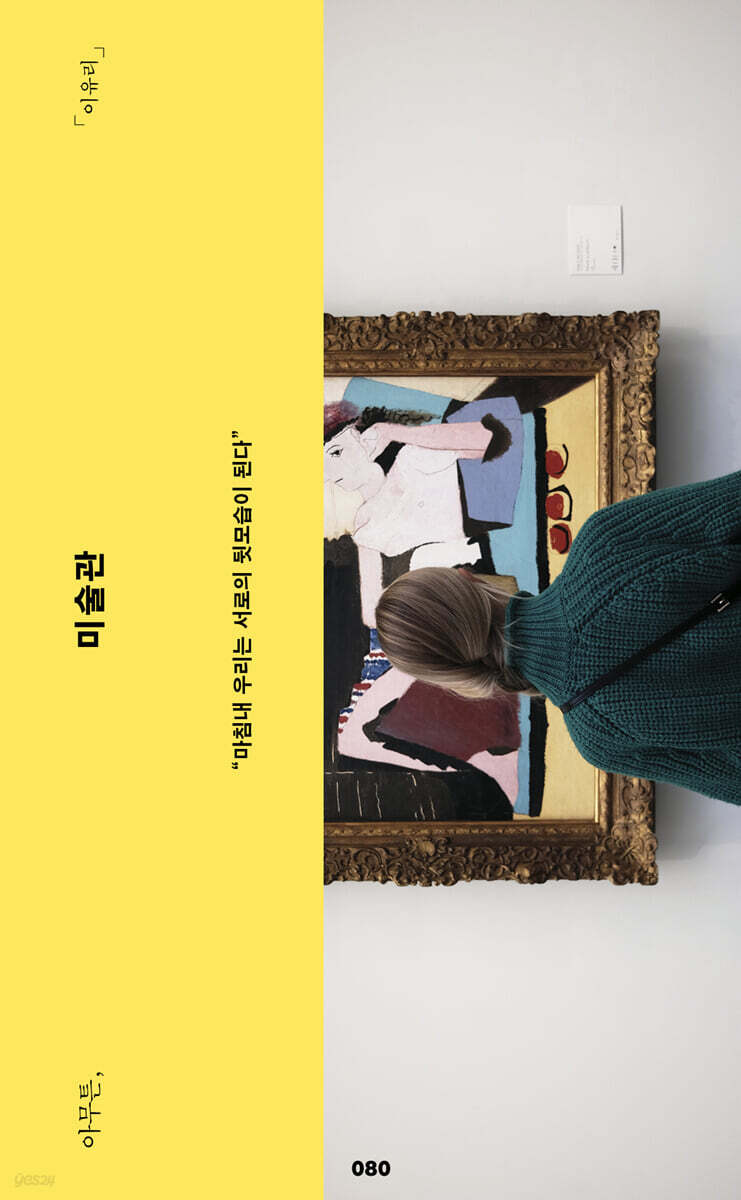
Anyway, the art museum
 |
Description
Book Introduction
The eightieth book in the 'Anyway' series.
This is a new essay by Lee Yu-ri, who has been at the forefront of popularizing art by communicating with readers through works such as “Women Who Torn the Canvas” and “The Tilted Museum.” She honestly expresses her feelings and experiences while visiting museums for a long time.
While his previous works primarily focused on raising concerns about the power structure and inequality surrounding artists and their works, "Anyway, Art Museum" contains more personal and everyday stories.
The author recalls the unforgettable moments in his life brought about by the art museum, and tells in a calm yet intimate voice how he found comfort and growth within it.
Starting from childhood memories of creating my own art gallery by cutting out famous paintings from newspapers and magazines, to my time studying abroad in London when I frequented galleries so often that the thresholds wore out, and to the moment when I stood in front of Cheon Kyung-ja's paintings and decided to start a new life, the book is filled with stories about art galleries that I have encountered at every turn in life.
Also, as someone who loves art museums more than anyone else, he doesn't miss out on interesting information about the little things we might have casually passed by in art museums, such as picture frames, goods, and the backstories behind works titled "Untitled."
As the author said, “I wrote this book as if I were walking through an art gallery with an unknown reader,” after reading the book, you will feel as if you have wandered through a quiet art gallery with him.
This is a new essay by Lee Yu-ri, who has been at the forefront of popularizing art by communicating with readers through works such as “Women Who Torn the Canvas” and “The Tilted Museum.” She honestly expresses her feelings and experiences while visiting museums for a long time.
While his previous works primarily focused on raising concerns about the power structure and inequality surrounding artists and their works, "Anyway, Art Museum" contains more personal and everyday stories.
The author recalls the unforgettable moments in his life brought about by the art museum, and tells in a calm yet intimate voice how he found comfort and growth within it.
Starting from childhood memories of creating my own art gallery by cutting out famous paintings from newspapers and magazines, to my time studying abroad in London when I frequented galleries so often that the thresholds wore out, and to the moment when I stood in front of Cheon Kyung-ja's paintings and decided to start a new life, the book is filled with stories about art galleries that I have encountered at every turn in life.
Also, as someone who loves art museums more than anyone else, he doesn't miss out on interesting information about the little things we might have casually passed by in art museums, such as picture frames, goods, and the backstories behind works titled "Untitled."
As the author said, “I wrote this book as if I were walking through an art gallery with an unknown reader,” after reading the book, you will feel as if you have wandered through a quiet art gallery with him.
- You can preview some of the book's contents.
Preview
index
First meeting
First, rush to the art gallery
Waiting posture
Inconvenient Art
The Power of Space, Roscoe
Back view
Stendhal syndrome
Women who go to art galleries are in danger.
Opening the wardrobe
Why do my legs hurt when I go to an art museum?
White Cube
Untitled
frame
Goods
Art museums that are harmful to the planet?
Art museums as an alternative
Spaces transformed into art galleries
A slightly more affectionate art gallery
Practice finding beauty in everyday life
The last page of life
First, rush to the art gallery
Waiting posture
Inconvenient Art
The Power of Space, Roscoe
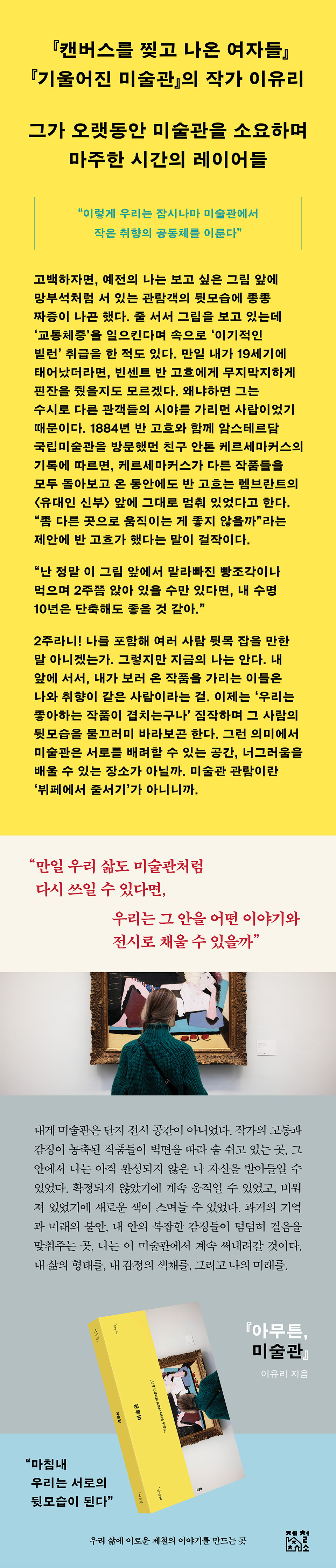
Back view
Stendhal syndrome
Women who go to art galleries are in danger.
Opening the wardrobe
Why do my legs hurt when I go to an art museum?
White Cube
Untitled
frame
Goods
Art museums that are harmful to the planet?
Art museums as an alternative
Spaces transformed into art galleries
A slightly more affectionate art gallery
Practice finding beauty in everyday life
The last page of life
Detailed image
Into the book
If you look at paintings that often, at some point your vision will open up.
Most art museums collect and exhibit works from similar eras.
Even though the artists are different, the themes and materials are similar, so at some point, a common pattern catches your eye and you naturally sense the message the painting is trying to convey.
For example, I didn't even know that the word 'still life' meant 'still life painting'.
But when you go to the 16th-17th century Dutch and Flemish exhibition, you see a constant stream of works featuring skulls, flowers, and candlesticks.
The candles in the painting were going out, the flowers were withering, and the fruit was rotting.
Although no one explained it to me, after seeing similar works for a long time, I could naturally sense the emptiness that the paintings radiated.
It was only later that I learned that they were still lifes called 'Vanitas', which means emptiness or worthlessness in Latin.
The truth is that no matter how beautiful we are, no matter how much wealth or fame we have, we are all beings who must die someday.
The genre of painting that taught the lesson of Memento Mori, or 'remember that you will die', was still life.
--- pp.19-20
That's what uncomfortable and true art is.
That very being that runs towards me, a coward, grabs the hair of the prejudice that has taken root deep in my heart and mercilessly tears it out, right down to the roots.
That's why art museums sometimes become places for reflection.
I went in to see a work of art, but ended up coming out facing myself.
--- pp.38-39
Come to think of it, spaces like art galleries and museums are quite peculiar.
Upon entering this place, the audience experiences a new experience of becoming a work of art themselves through the ‘power’ of the space.
Not just people.
The same goes for objects that enter this space.
For example, the chair placed in the corner of the art gallery is actually just a chair for the exhibition guard to rest.
But, hasn't there been a time when you stood far away and watched it because it somehow felt like a work of art?
--- pp.51-52
Looking at a picture is no different from having a conversation with yourself or someone else.
The women who viewed the exhibition alone pondered the works in front of them, asking questions and thinking.
That question raised questions about the existing order, and that question fostered an independent and subjective worldview.
The worldview that sprouted in women's minds at this time was completely different from the 'traditional image' imposed by patriarchy.
The museum gave wings to their imagination, and imagination helped women break free from the patriarchal mold and fly “over the threshold” (in the words of poet Adrienne Rich).
What lies beyond the threshold?
No one knew.
Even women themselves.
--- p.72
Why do I feel exhausted and my feet are on fire, as if I just walked around the country for three hours?
My head starts to spin and I start to wonder, 'Is that yellow and is that red?'
As it turns out, this symptom has a name.
It is called 'Museum Leg'.
It wasn't just my unique problem, it was a phenomenon that many people experienced.
But even after visiting not only large museums like the Louvre but also smaller ones, we often suffer from 'museum leg.'
Why on earth is that?
--- p.84
When you walk through an art gallery, you will come across frames as often as paintings.
Although it is a supporting role that makes the painting stand out, sometimes the frame itself catches the eye.
One day, I suddenly looked at the picture frame that was attached to the painting as if it were one body, and this thought occurred to me.
'The picture frame is an 'anchor', a 'sail', and a 'trap' to me.'
--- p.107
According to Alain de Botton, the true essence of museum visits is seeing the world through the eyes of artists and examining closely what they loved.
That's why the important thing is to get your hands on things that the artist would have liked, things (goods!) that connect with his world of art.
If you think about it carefully, it's true.
The lessons we learn from museums—the meaning of beauty, the expansion of the mind—usually vanish into thin air the moment we leave.
However, souvenirs keep the impressions we felt at the museum in our hearts for a long time and serve as a bridge that gently connects us to our daily lives.
So, souvenir shops can be said to be the vanguard for popularizing and understanding art in modern society.
--- pp.118-119
Yes, that's right.
This is the inherent limitation of art museums.
Even the 'spirit of resistance that has just burst forth' is likely to lose its original sharpness the moment it crosses the threshold of an art museum.
Because art museums are institutional frameworks that protect and manage works of art, art recognized there comfortably meets viewers.
But there is also a great risk that the provocative message will be neutralized.
Sometimes it seems like artists joining hands with art galleries is a 'Faustian bargain'.
Because within the authority of the art museum, there is a risk that the artist's subversive voice will be weakened or interpreted in a neutral way.
Even the once sharp Olympia was completely disarmed upon entering the Orsay Museum, and Banksy's sharp mockery was absorbed into the authority bestowed by the system the moment it entered the 'clean zone' of the art museum.
No wonder the joke came to be that “the way an art museum loves an artist is like the way a taxidermist loves a deer.”
--- pp.135-136
Perhaps everyone lives with their own art gallery in their heart.
An inner space where all the fragments of life are displayed, from childhood dreams and memories of first failures to traces of love and loss.
Sometimes we don't even look into the room that has been closed for a long time and just covered in dust.
But if some opportunity arises, the room can be opened again.
--- pp.145-146
Every time I go to an art gallery or museum, I unintentionally confirm my own ignorance.
The moment I see the title of the exhibited work, I am overcome with a sense of self-destruction.
For example, let’s look at National Treasure No. 170, a white porcelain jar with a blue-and-white plum and bamboo design, housed in the National Museum of Korea.
I clearly read it in Korean, but I have no idea what it means.
I'm even confused about where to stop reading.
This is because Chinese characters were mechanically converted into Korean characters.
My confusion was only resolved when I saw the English title written on it.
White Porcelain Lidded Jar with Plum, Bird and Bamboo Design in Underglaze Cobalt Blue.
'Ah, a lidded white porcelain jar with a cobalt blue plum blossom, bird, and bamboo painting!' The English title is simpler and clearer, so I wonder what's going on.
This is not the United States, this is South Korea.
--- p.149
The museum displays the works of artists who have already turned the last page of their lives and closed the back cover.
But what we encounter are not just a few works painted towards the end of their lives.
The exhibition also includes numerous traces left by the author while he was adrift in the vast ocean of life, unable to find the answer.
I used to imagine them standing before it, their innocent eyes holding a brush, not knowing what the future would hold.
Most art museums collect and exhibit works from similar eras.
Even though the artists are different, the themes and materials are similar, so at some point, a common pattern catches your eye and you naturally sense the message the painting is trying to convey.
For example, I didn't even know that the word 'still life' meant 'still life painting'.
But when you go to the 16th-17th century Dutch and Flemish exhibition, you see a constant stream of works featuring skulls, flowers, and candlesticks.
The candles in the painting were going out, the flowers were withering, and the fruit was rotting.
Although no one explained it to me, after seeing similar works for a long time, I could naturally sense the emptiness that the paintings radiated.
It was only later that I learned that they were still lifes called 'Vanitas', which means emptiness or worthlessness in Latin.
The truth is that no matter how beautiful we are, no matter how much wealth or fame we have, we are all beings who must die someday.
The genre of painting that taught the lesson of Memento Mori, or 'remember that you will die', was still life.
--- pp.19-20
That's what uncomfortable and true art is.
That very being that runs towards me, a coward, grabs the hair of the prejudice that has taken root deep in my heart and mercilessly tears it out, right down to the roots.
That's why art museums sometimes become places for reflection.
I went in to see a work of art, but ended up coming out facing myself.
--- pp.38-39
Come to think of it, spaces like art galleries and museums are quite peculiar.
Upon entering this place, the audience experiences a new experience of becoming a work of art themselves through the ‘power’ of the space.
Not just people.
The same goes for objects that enter this space.
For example, the chair placed in the corner of the art gallery is actually just a chair for the exhibition guard to rest.
But, hasn't there been a time when you stood far away and watched it because it somehow felt like a work of art?
--- pp.51-52
Looking at a picture is no different from having a conversation with yourself or someone else.
The women who viewed the exhibition alone pondered the works in front of them, asking questions and thinking.
That question raised questions about the existing order, and that question fostered an independent and subjective worldview.
The worldview that sprouted in women's minds at this time was completely different from the 'traditional image' imposed by patriarchy.
The museum gave wings to their imagination, and imagination helped women break free from the patriarchal mold and fly “over the threshold” (in the words of poet Adrienne Rich).
What lies beyond the threshold?
No one knew.
Even women themselves.
--- p.72
Why do I feel exhausted and my feet are on fire, as if I just walked around the country for three hours?
My head starts to spin and I start to wonder, 'Is that yellow and is that red?'
As it turns out, this symptom has a name.
It is called 'Museum Leg'.
It wasn't just my unique problem, it was a phenomenon that many people experienced.
But even after visiting not only large museums like the Louvre but also smaller ones, we often suffer from 'museum leg.'
Why on earth is that?
--- p.84
When you walk through an art gallery, you will come across frames as often as paintings.
Although it is a supporting role that makes the painting stand out, sometimes the frame itself catches the eye.
One day, I suddenly looked at the picture frame that was attached to the painting as if it were one body, and this thought occurred to me.
'The picture frame is an 'anchor', a 'sail', and a 'trap' to me.'
--- p.107
According to Alain de Botton, the true essence of museum visits is seeing the world through the eyes of artists and examining closely what they loved.
That's why the important thing is to get your hands on things that the artist would have liked, things (goods!) that connect with his world of art.
If you think about it carefully, it's true.
The lessons we learn from museums—the meaning of beauty, the expansion of the mind—usually vanish into thin air the moment we leave.
However, souvenirs keep the impressions we felt at the museum in our hearts for a long time and serve as a bridge that gently connects us to our daily lives.
So, souvenir shops can be said to be the vanguard for popularizing and understanding art in modern society.
--- pp.118-119
Yes, that's right.
This is the inherent limitation of art museums.
Even the 'spirit of resistance that has just burst forth' is likely to lose its original sharpness the moment it crosses the threshold of an art museum.
Because art museums are institutional frameworks that protect and manage works of art, art recognized there comfortably meets viewers.
But there is also a great risk that the provocative message will be neutralized.
Sometimes it seems like artists joining hands with art galleries is a 'Faustian bargain'.
Because within the authority of the art museum, there is a risk that the artist's subversive voice will be weakened or interpreted in a neutral way.
Even the once sharp Olympia was completely disarmed upon entering the Orsay Museum, and Banksy's sharp mockery was absorbed into the authority bestowed by the system the moment it entered the 'clean zone' of the art museum.
No wonder the joke came to be that “the way an art museum loves an artist is like the way a taxidermist loves a deer.”
--- pp.135-136
Perhaps everyone lives with their own art gallery in their heart.
An inner space where all the fragments of life are displayed, from childhood dreams and memories of first failures to traces of love and loss.
Sometimes we don't even look into the room that has been closed for a long time and just covered in dust.
But if some opportunity arises, the room can be opened again.
--- pp.145-146
Every time I go to an art gallery or museum, I unintentionally confirm my own ignorance.
The moment I see the title of the exhibited work, I am overcome with a sense of self-destruction.
For example, let’s look at National Treasure No. 170, a white porcelain jar with a blue-and-white plum and bamboo design, housed in the National Museum of Korea.
I clearly read it in Korean, but I have no idea what it means.
I'm even confused about where to stop reading.
This is because Chinese characters were mechanically converted into Korean characters.
My confusion was only resolved when I saw the English title written on it.
White Porcelain Lidded Jar with Plum, Bird and Bamboo Design in Underglaze Cobalt Blue.
'Ah, a lidded white porcelain jar with a cobalt blue plum blossom, bird, and bamboo painting!' The English title is simpler and clearer, so I wonder what's going on.
This is not the United States, this is South Korea.
--- p.149
The museum displays the works of artists who have already turned the last page of their lives and closed the back cover.
But what we encounter are not just a few works painted towards the end of their lives.
The exhibition also includes numerous traces left by the author while he was adrift in the vast ocean of life, unable to find the answer.
I used to imagine them standing before it, their innocent eyes holding a brush, not knowing what the future would hold.
--- p.167
GOODS SPECIFICS
- Date of issue: November 10, 2025
- Page count, weight, size: 176 pages | 198g | 110*178*15mm
- ISBN13: 9791188343898
- ISBN10: 1188343890
You may also like
카테고리
korean


korean

![GQ KOREA Mark (Monthly): December [2025]](http://librairie.coreenne.fr/cdn/shop/files/8ef265dbbfbf186523ed75ba7319009d.jpg?v=1765340328&width=3840)


