

Work and Tools
 |
Description
Book Introduction
A story about the working people in our neighborhood by author Kwon Yun-deok, who received much love from readers for her delicate portrayal of a large family living together in the space called 'home' in her first picture book, 'Manhee's House'.
You can meet people who work and live together in our neighborhood.
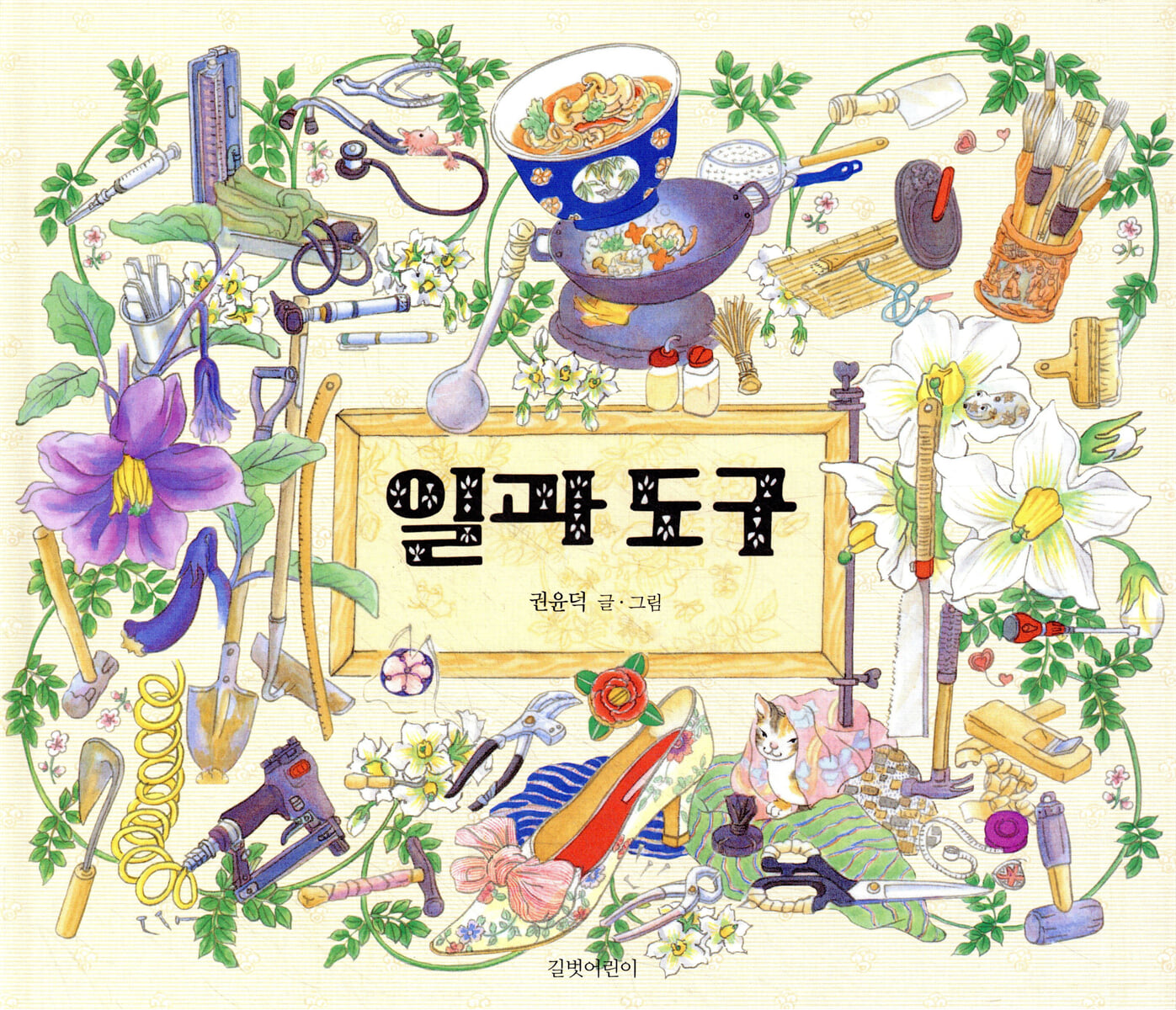
It depicts the work and tools of farmers (farms), doctors (hospitals), shoemakers (shoe factories), carpenters (woodworking shops), cooks (Chinese restaurants), tailors (clothing shops), and painters (studios).
By placing the dynamic life at the center of the story, "Work and Tools" transcends discrimination against occupations and demonstrates that all work is valuable.
The tools that are densely drawn in the workplace convey the author's own sense of wonder to readers, naturally stimulating children's interest in work.
Although we cannot explain the uses of every tool in detail, we can help you understand the relationship between work and tools by showing you how to use the tools in your work.
Finally, I have included an appendix with descriptions of the tools essential for each task.
The paintings on silk beautifully capture the beauty of the workplace and the people working there.
By using both light and strong colors, the painting was done in a simple manner, with bright colors popping out where necessary, to make the working people look beautiful.
"Work and Tools" is a story about a small town, but at the same time, it is a story about people living in the big world.
You can meet people who work and live together in our neighborhood.
It depicts the work and tools of farmers (farms), doctors (hospitals), shoemakers (shoe factories), carpenters (woodworking shops), cooks (Chinese restaurants), tailors (clothing shops), and painters (studios).
By placing the dynamic life at the center of the story, "Work and Tools" transcends discrimination against occupations and demonstrates that all work is valuable.
The tools that are densely drawn in the workplace convey the author's own sense of wonder to readers, naturally stimulating children's interest in work.
Although we cannot explain the uses of every tool in detail, we can help you understand the relationship between work and tools by showing you how to use the tools in your work.
Finally, I have included an appendix with descriptions of the tools essential for each task.
The paintings on silk beautifully capture the beauty of the workplace and the people working there.
By using both light and strong colors, the painting was done in a simple manner, with bright colors popping out where necessary, to make the working people look beautiful.
"Work and Tools" is a story about a small town, but at the same time, it is a story about people living in the big world.
- You can preview some of the book's contents.
Preview
Detailed image

Publisher's Review
Stories of working people drawn by Kwon Yun-deok, author of "Manhee's House."
In her first picture book, Manhee's House, author Kwon Yun-deok delicately depicted a large family living together in the space called 'house', receiving much love from readers.
Thirteen years after publishing his first work, he moved that space to 'Our Neighborhood' and captured the people who work and live together there in the picture book 'Work and Tools'.
The author, who decided to depict the friendly places in the neighborhood, such as a mill, hospital, and clothing store, and the people who live there sharing affection, was able to cover each workplace one by one, and became very curious about the various tools that were scattered everywhere he went.
As I researched and drew the shapes, names, and uses of each tool, I felt that the shapes of the tools were beautiful, and I also thought that the skillful hands of the people who used them were truly amazing.
The author's idea to draw our neighborhood developed through research and sketching, and then to show how people work and the tools they use.
Above all, I wanted to express the beauty I felt there through painting.
So, rather than limiting myself to just one neighborhood, I looked for things that have existed since ancient times, are still necessary, and will never disappear.
They chose jobs such as farmer (farm), doctor (hospital), shoemaker (shoe factory), carpenter (woodwork shop), cook (Chinese restaurant), tailor (clothing shop), and painter (art studio).
Also, the fact that I work with a lot of tools is another reason why I chose the above profession.
The importance of showing things through pictures
Since long ago, people have lived together in one village.
They farmed, made clothes, built houses, cured the sick, danced, sang, and painted.
And each time, I made the necessary tools one by one.
The clothes we wear, the food we eat, and the houses we live in
Someone made it using a lot of tools and machines.
"Work and Tools" begins with the above sentence.
To show readers that all work is valuable, transcending discrimination against occupations, the author places communal life at the center of the story.
The story begins with a girl going out for a drink with her cat.
The places where the child and cat will visit in the future are marked on the neighborhood map.
The child and cat walk around the neighborhood together, entering and exiting the work space.
The workspace consists of two floor-to-floor spreads of paintings.
The first scene shows a workplace filled with tools.
The cat appears alone, as if guiding the space.
The most frequently used tools are arranged in large columns at the front, and the less frequently used tools are drawn smaller around them so that the important ones are clearly visible.
The second scene shows people working with tools.
It depicts the work process so that you can understand the nature and characteristics of the work, and naturally shows how tools are used in the process.
The child and the cat also experience working with tools in their respective workplaces.
In the final part of the picture book, people met at each workplace wave warmly to the child and the cat.
The picture book ends with the child and the cat returning home with smiles on their faces, holding the things they have made (products of each profession).
The tools that are densely drawn in the workplace will convey the novelty that the author himself felt to the readers, and will make them interested in the work.
Although I can't explain the uses of every tool in detail, I tried to show how to use the tools in work so that you can understand the relationship between work and tools.
Finally, I've included an appendix with descriptions of the tools essential for each task.
Workplaces and workers wrapped in silk
The picture was painted on silk.
Silk absorbs pigments well and can be painted on the back, allowing for both subtle and vivid colors.
It is the most suitable material to convey the artist's intention to express the beauty of the workplace and the people working there.
If you look at the picture, a pumpkin is floating in the sky, a sewing machine is lying as if it might fall over, and a cutting board is drawn as if it might tip over.
The author's intention is to show in detail how people work and the tools they use.
That is, it is difficult to show everything by drawing it as a visible space, so the composition was distorted to create a lot of space.
I also painted without being bound by a set composition, so as to capture the readers' attention and make them curious about the work and tools.
By using both light and strong colors, the painting was done in a simple manner, but with bright colors popping out where necessary, to make the working people look beautiful.
As you follow the colorful colors on the screen, you will notice the beauty of the people working, and furthermore, you will be able to feel the hands of the workers as you look at the meticulously drawn tools.
In her first picture book, Manhee's House, author Kwon Yun-deok delicately depicted a large family living together in the space called 'house', receiving much love from readers.
Thirteen years after publishing his first work, he moved that space to 'Our Neighborhood' and captured the people who work and live together there in the picture book 'Work and Tools'.
The author, who decided to depict the friendly places in the neighborhood, such as a mill, hospital, and clothing store, and the people who live there sharing affection, was able to cover each workplace one by one, and became very curious about the various tools that were scattered everywhere he went.
As I researched and drew the shapes, names, and uses of each tool, I felt that the shapes of the tools were beautiful, and I also thought that the skillful hands of the people who used them were truly amazing.
The author's idea to draw our neighborhood developed through research and sketching, and then to show how people work and the tools they use.
Above all, I wanted to express the beauty I felt there through painting.
So, rather than limiting myself to just one neighborhood, I looked for things that have existed since ancient times, are still necessary, and will never disappear.
They chose jobs such as farmer (farm), doctor (hospital), shoemaker (shoe factory), carpenter (woodwork shop), cook (Chinese restaurant), tailor (clothing shop), and painter (art studio).
Also, the fact that I work with a lot of tools is another reason why I chose the above profession.
The importance of showing things through pictures
Since long ago, people have lived together in one village.
They farmed, made clothes, built houses, cured the sick, danced, sang, and painted.
And each time, I made the necessary tools one by one.
The clothes we wear, the food we eat, and the houses we live in
Someone made it using a lot of tools and machines.
"Work and Tools" begins with the above sentence.
To show readers that all work is valuable, transcending discrimination against occupations, the author places communal life at the center of the story.
The story begins with a girl going out for a drink with her cat.
The places where the child and cat will visit in the future are marked on the neighborhood map.
The child and cat walk around the neighborhood together, entering and exiting the work space.
The workspace consists of two floor-to-floor spreads of paintings.
The first scene shows a workplace filled with tools.
The cat appears alone, as if guiding the space.
The most frequently used tools are arranged in large columns at the front, and the less frequently used tools are drawn smaller around them so that the important ones are clearly visible.
The second scene shows people working with tools.
It depicts the work process so that you can understand the nature and characteristics of the work, and naturally shows how tools are used in the process.
The child and the cat also experience working with tools in their respective workplaces.
In the final part of the picture book, people met at each workplace wave warmly to the child and the cat.
The picture book ends with the child and the cat returning home with smiles on their faces, holding the things they have made (products of each profession).
The tools that are densely drawn in the workplace will convey the novelty that the author himself felt to the readers, and will make them interested in the work.
Although I can't explain the uses of every tool in detail, I tried to show how to use the tools in work so that you can understand the relationship between work and tools.
Finally, I've included an appendix with descriptions of the tools essential for each task.
Workplaces and workers wrapped in silk
The picture was painted on silk.
Silk absorbs pigments well and can be painted on the back, allowing for both subtle and vivid colors.
It is the most suitable material to convey the artist's intention to express the beauty of the workplace and the people working there.
If you look at the picture, a pumpkin is floating in the sky, a sewing machine is lying as if it might fall over, and a cutting board is drawn as if it might tip over.
The author's intention is to show in detail how people work and the tools they use.
That is, it is difficult to show everything by drawing it as a visible space, so the composition was distorted to create a lot of space.
I also painted without being bound by a set composition, so as to capture the readers' attention and make them curious about the work and tools.
By using both light and strong colors, the painting was done in a simple manner, but with bright colors popping out where necessary, to make the working people look beautiful.
As you follow the colorful colors on the screen, you will notice the beauty of the people working, and furthermore, you will be able to feel the hands of the workers as you look at the meticulously drawn tools.
GOODS SPECIFICS
- Date of issue: July 31, 2008
- Format: Hardcover book binding method guide
- Page count, weight, size: 40 pages | 500g | 265*226*15mm
- ISBN13: 9788955820836
- ISBN10: 8955820836
You may also like
카테고리
korean


korean

![GQ KOREA Mark (Monthly): December [2025]](http://librairie.coreenne.fr/cdn/shop/files/8ef265dbbfbf186523ed75ba7319009d.jpg?v=1765340328&width=3840)


