

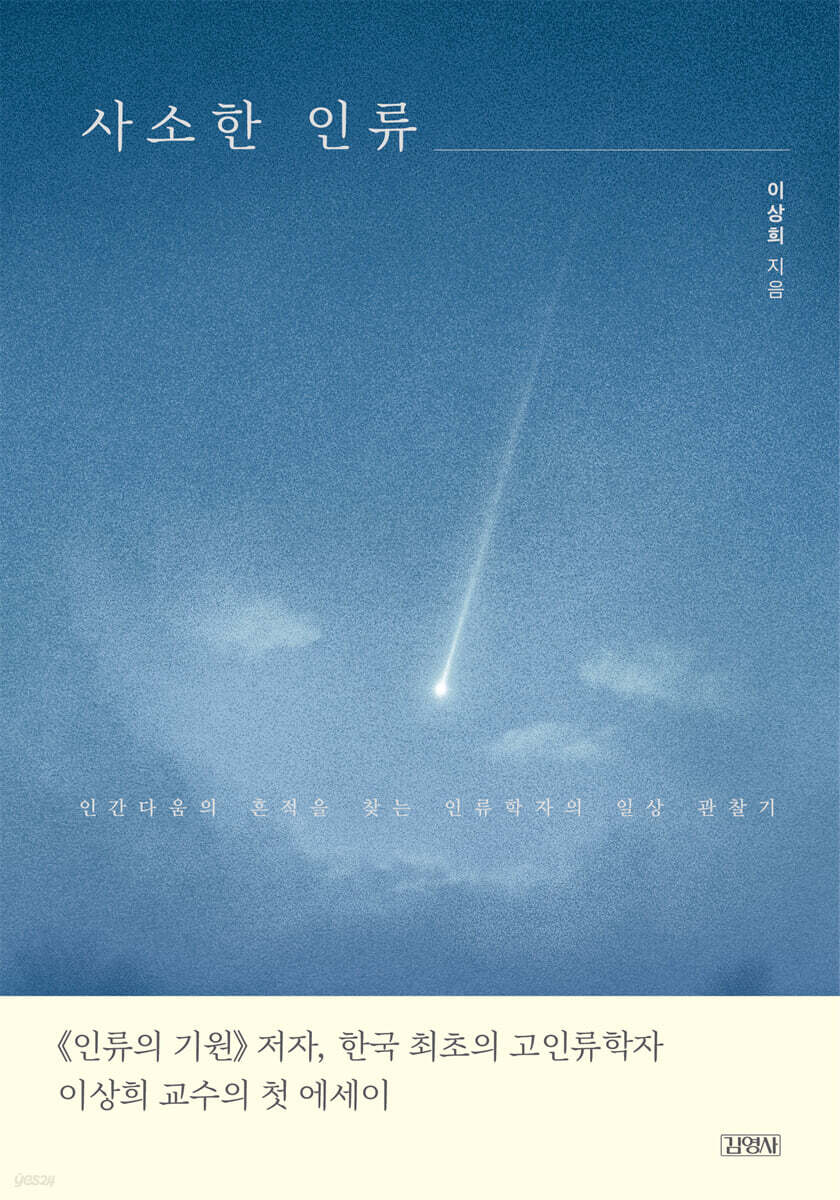
petty humanity
 |
Description
Book Introduction
★★Highly recommended by reporter Da-hye Lee and astronomer Chae-kyung Shim★★
“Humans are ultimately evolving beings.”
An anthropologist's daily observations in search of traces of humanity.
Paleoanthropologists trace the lives of our ancestors by searching for traces of ancient humans through fossilized bone fragments and artifacts from millions of years ago.
Where in the long history of primate evolution does humanity begin? Professor Lee Sang-hee, South Korea's first paleoanthropologist, presents his first essay, "Trivial Humans," which explores the "humanity" of the first humans and the daily lives of today as seen through the eyes of a professional who constantly ponders what it means to be a "human being."
Professor Lee Sang-hee is the first Korean paleoanthropologist to study paleoanthropology in the United States before the field was even introduced to Korean academic circles.
The author humorously and sharply unfolds the everyday thoughts and feelings she experiences while walking on the ground with both feet, reading books, seeing the colorful naked bodies of women in the bathhouse, raising children and giving birth, and raising a dog.
“Humans are ultimately evolving beings.”
An anthropologist's daily observations in search of traces of humanity.
Paleoanthropologists trace the lives of our ancestors by searching for traces of ancient humans through fossilized bone fragments and artifacts from millions of years ago.
Where in the long history of primate evolution does humanity begin? Professor Lee Sang-hee, South Korea's first paleoanthropologist, presents his first essay, "Trivial Humans," which explores the "humanity" of the first humans and the daily lives of today as seen through the eyes of a professional who constantly ponders what it means to be a "human being."
Professor Lee Sang-hee is the first Korean paleoanthropologist to study paleoanthropology in the United States before the field was even introduced to Korean academic circles.
The author humorously and sharply unfolds the everyday thoughts and feelings she experiences while walking on the ground with both feet, reading books, seeing the colorful naked bodies of women in the bathhouse, raising children and giving birth, and raising a dog.
- You can preview some of the book's contents.
Preview
index
Prologue: I invite you to the world of a small human being.
1.
Learning humanity
How I Became a Paleoanthropologist│A Story Not on My Business Card│Celebrating Lucy's 50th Birthday│Mongolian Points and Genghis Khan│The Origin of Falling│The Beijing Man is Alive│Prehistoric Men│The Call of Instinct│At the Graduation Ceremony│Are You a Liberal Arts Student?│A Liberal Arts Student's Argument│The Face of a Scholar
2.
living humanity
The Gloomy Valley of Death│Memories of a Fire│Kyunjung's Diary│Throwing Away Food Waste│Precious Childhood│Fighting Against Time│Ji Cheon-myeong's Cello│Jjong-jjong and Koda│Friendship Moves the World│Memories of Persepolis│The Uninvited Guest of Reactivity│The Path to Becoming an Elder
3.
The human race called women
The Word "Feminine"│Jeans and Mr. Lee│Housework Wars│A Good Time to Have a Baby│A Salaried Professor│Becoming a Second-Ranking Professor│A Motherly Professor│Rude Goodwill│Meeting Sarah Nelson│Wan-kyung and the Grandmother Hypothesis│Venus in the Bathhouse│Ramen Solidarity
Epilogue: The Solidarity of Rice and Porridge
1.
Learning humanity
How I Became a Paleoanthropologist│A Story Not on My Business Card│Celebrating Lucy's 50th Birthday│Mongolian Points and Genghis Khan│The Origin of Falling│The Beijing Man is Alive│Prehistoric Men│The Call of Instinct│At the Graduation Ceremony│Are You a Liberal Arts Student?│A Liberal Arts Student's Argument│The Face of a Scholar
2.
living humanity
The Gloomy Valley of Death│Memories of a Fire│Kyunjung's Diary│Throwing Away Food Waste│Precious Childhood│Fighting Against Time│Ji Cheon-myeong's Cello│Jjong-jjong and Koda│Friendship Moves the World│Memories of Persepolis│The Uninvited Guest of Reactivity│The Path to Becoming an Elder
3.
The human race called women
The Word "Feminine"│Jeans and Mr. Lee│Housework Wars│A Good Time to Have a Baby│A Salaried Professor│Becoming a Second-Ranking Professor│A Motherly Professor│Rude Goodwill│Meeting Sarah Nelson│Wan-kyung and the Grandmother Hypothesis│Venus in the Bathhouse│Ramen Solidarity
Epilogue: The Solidarity of Rice and Porridge
Detailed image

Into the book
To be honest, at the time, the joy of being able to leave home was greater than the desire to study further.
I was not equipped to face the suffocating atmosphere at home head-on.
In those days, the only reason for a grown woman to leave home was marriage.
But I didn't want to get married without being financially independent and rely solely on my husband's income to get out of my parents' house.
What I wanted was independence, not separation.
--- p.16 From "Somehow I Became a Paleoanthropologist"
I no longer need business cards, but whenever I see the moment when I become the first Asian woman elected as the president of the faculty council in the history of the school, or whenever I encounter the title "Korea's first paleoanthropologist" that the Korean media naturally adds to my name when introducing me, a new business card piles up in my mind.
--- p.26 From “The Story Not on the Business Card”
To think that I have to entrust my life to such a poor move.
Human bipedal walking is of no help whatsoever to life in the harsh realm of nature.
And it's not that fast either.
It's not fast, there's a risk of falling, and there's no way to move on your own other than walking on two feet.
In fact, bipedal walking monopolizes human locomotion.
--- p.42 From “The Origin of Falling”
Humans give meaning to the dead by burying them in the ground.
It is estimated that humans began burying their dead during the Neanderthal era and the European Paleolithic period.
But soon after, they started burying dead dogs in the ground too.
The oldest dog grave is a 14,000-year-old site found in Oberkassel, Bonn, Germany.
It is a grave where two dogs and two people are buried. One of the dogs was said to have been terminally ill but survived for another month through care.
It means that dogs were valued as much as people today.
--- p.111 From "Kyeonjung Diary"
You get used to the smell of goat manure and food waste.
Humans would have survived to the end thanks to their powerful adaptability to adapt to any environment.
But this great adaptability can sometimes be a double-edged sword.
Just as people become insensitive to incredibly foul smells over time, they also quickly become accustomed to outrageous corruption, arrogance, and coercion.
--- p.119 From “Throwing Away Food Waste”
The brain continues to grow without rest from the fetal period until immediately after birth, reaching almost its full size around the age of six.
And for the next six years, the child puts everything else aside and practices using the most important organ in the human body: the brain.
Absorb, digest, and apply the information necessary to survive.
We create various relationships in society and try countless variations of cooperation, conflict, mediation, reconciliation, and negotiation.
So, childhood, which seems like a time when nothing happens, is actually a time entirely for learning.
--- p.125 From “Precious Childhood”
During the time I was fighting against time, I tried my best to take as much time as possible away from myself.
Now I know that time can never be mine, so I don't fight for it or take it away.
I am finally walking with time.
--- p.134 From "Fighting Time"
The conclusion is clear.
As a woman, if you're thinking about your career, there's no better time to have a baby.
No matter when you give birth, it's so hard that you'll die.
But this conclusion is based on a faulty premise.
The premise is that giving birth and raising a child is entirely the responsibility of a woman, a mother.
--- p.199 From “A Good Time to Have a Baby”
Indeed, one of the students who had been praising me at length finally spoke up as if he had made up his mind.
“But… the lectures are too intense.
“We have a professor who…” I waited calmly for him to continue.
“We just wish you were more… motherly.” At that moment, I couldn’t believe my ears.
I was so embarrassed that even now, 20 years later, I can still clearly remember the sentence the student blurted out.
My heart was pounding and my face was flushing, and I was at a loss as to what to do. My mind was blank, but I tried to answer coolly, as if it were a joke.
“I’m doing my best as a mother to my daughter, so I’ll just be a professor here.”
--- p.219 From “A Professor Like a Mother”
The "grandmother hypothesis," which suggests that women live long after menopause because they can contribute to the survival and prosperity of their descendants by helping to raise their grandchildren without having to give birth themselves, leaves room for evolutionary success even after reproductive function ends.
Women who have experienced menopause tend to live much healthier lives than men of the same age, and their physical functions other than reproductive function age later than men.
This was the orthodoxy taught by anthropology and biology, and I taught it as well.
I was not equipped to face the suffocating atmosphere at home head-on.
In those days, the only reason for a grown woman to leave home was marriage.
But I didn't want to get married without being financially independent and rely solely on my husband's income to get out of my parents' house.
What I wanted was independence, not separation.
--- p.16 From "Somehow I Became a Paleoanthropologist"
I no longer need business cards, but whenever I see the moment when I become the first Asian woman elected as the president of the faculty council in the history of the school, or whenever I encounter the title "Korea's first paleoanthropologist" that the Korean media naturally adds to my name when introducing me, a new business card piles up in my mind.
--- p.26 From “The Story Not on the Business Card”
To think that I have to entrust my life to such a poor move.
Human bipedal walking is of no help whatsoever to life in the harsh realm of nature.
And it's not that fast either.
It's not fast, there's a risk of falling, and there's no way to move on your own other than walking on two feet.
In fact, bipedal walking monopolizes human locomotion.
--- p.42 From “The Origin of Falling”
Humans give meaning to the dead by burying them in the ground.
It is estimated that humans began burying their dead during the Neanderthal era and the European Paleolithic period.
But soon after, they started burying dead dogs in the ground too.
The oldest dog grave is a 14,000-year-old site found in Oberkassel, Bonn, Germany.
It is a grave where two dogs and two people are buried. One of the dogs was said to have been terminally ill but survived for another month through care.
It means that dogs were valued as much as people today.
--- p.111 From "Kyeonjung Diary"
You get used to the smell of goat manure and food waste.
Humans would have survived to the end thanks to their powerful adaptability to adapt to any environment.
But this great adaptability can sometimes be a double-edged sword.
Just as people become insensitive to incredibly foul smells over time, they also quickly become accustomed to outrageous corruption, arrogance, and coercion.
--- p.119 From “Throwing Away Food Waste”
The brain continues to grow without rest from the fetal period until immediately after birth, reaching almost its full size around the age of six.
And for the next six years, the child puts everything else aside and practices using the most important organ in the human body: the brain.
Absorb, digest, and apply the information necessary to survive.
We create various relationships in society and try countless variations of cooperation, conflict, mediation, reconciliation, and negotiation.
So, childhood, which seems like a time when nothing happens, is actually a time entirely for learning.
--- p.125 From “Precious Childhood”
During the time I was fighting against time, I tried my best to take as much time as possible away from myself.
Now I know that time can never be mine, so I don't fight for it or take it away.
I am finally walking with time.
--- p.134 From "Fighting Time"
The conclusion is clear.
As a woman, if you're thinking about your career, there's no better time to have a baby.
No matter when you give birth, it's so hard that you'll die.
But this conclusion is based on a faulty premise.
The premise is that giving birth and raising a child is entirely the responsibility of a woman, a mother.
--- p.199 From “A Good Time to Have a Baby”
Indeed, one of the students who had been praising me at length finally spoke up as if he had made up his mind.
“But… the lectures are too intense.
“We have a professor who…” I waited calmly for him to continue.
“We just wish you were more… motherly.” At that moment, I couldn’t believe my ears.
I was so embarrassed that even now, 20 years later, I can still clearly remember the sentence the student blurted out.
My heart was pounding and my face was flushing, and I was at a loss as to what to do. My mind was blank, but I tried to answer coolly, as if it were a joke.
“I’m doing my best as a mother to my daughter, so I’ll just be a professor here.”
--- p.219 From “A Professor Like a Mother”
The "grandmother hypothesis," which suggests that women live long after menopause because they can contribute to the survival and prosperity of their descendants by helping to raise their grandchildren without having to give birth themselves, leaves room for evolutionary success even after reproductive function ends.
Women who have experienced menopause tend to live much healthier lives than men of the same age, and their physical functions other than reproductive function age later than men.
This was the orthodoxy taught by anthropology and biology, and I taught it as well.
--- p.241 From “The Wan-gyeong and Grandmother Hypothesis”
Publisher's Review
The human species called 'I' discovered by anthropologist Lee Sang-hee
Evolution from a vast human race to a small individual
Lee Sang-hee, a girl who dreamed of becoming a pianist during her school days, but her dream was dashed by a slump just before the college entrance exam, becomes an undergraduate majoring in archaeology and art history.
While taking college classes, he became fascinated by the science of archaeology, neo-archaeology, which was just beginning to emerge in the United States at the time. He was reborn from a humanities student to a graduate student studying paleoanthropology, a sub-field of biological anthropology, and thus from a liberal arts student to a science student.
Growing up as the eldest daughter in an extremely conservative family in the 1970s and 1980s, she left for the vast ocean of the United States as soon as she graduated from college and became a researcher on Asian women and a tenured professor at an American university.
It is impossible for the path of life to have been smooth, having to live with countless different identities, including humanity, human, scholar, woman, Asian, professor, daughter, wife, mother, and even dog owner (!).
It is truly astonishing how a scholar who has traced the history of mankind for millions of years looks back on his own life, which seems like a fleeting moment compared to the history of mankind, and realizes that even within it lies the history of human evolution, and that humans are beings who somehow move forward.
Let's walk together along the winding path of an anthropologist who, despite living a life of intense struggle, never lost sight of learning, reflection, leisure, and humor.
Something that cannot be felt in fossils from tens of thousands of years ago
The small yet vivid sense of being alive
Professor Lee Sang-hee is a tenured professor of anthropology at the University of Riverside in California, USA.
He received his Ph.D. in paleoanthropology from the University of Michigan in the United States, and attracted academic attention with his theses on topics such as ‘Evolution of Old Age’ and ‘Sexual Differences in Human Evolution.’
In 2018, he was appointed a fellow of the American Association for the Advancement of Science (AAAS, an organization representing the American science and technology community that annually selects scientists who have led the development and revival of science and have made outstanding social and scientific progress as fellows), and in the same year, he was awarded the Howells Award for the publication of the English version of “Close Encounters with Humankind” and in 2025, he was awarded the American Society for Biological Anthropology’s Distinguished Service Award, making him a true global leader in paleoanthropology.
However, he did not dream of becoming a paleoanthropologist from the beginning.
The dream of this tomboyish college student, who grew up being scolded for being unladylike throughout her childhood, was simply independence.
I wanted to escape from the stuffy house that was like the Joseon Dynasty.
But in the 1980s, marriage was the only reason for a grown woman to leave home.
I didn't want to just sit still and wait for my in-laws to get married and move out.
I wanted to become an independent person with full economic power.
Luckily, I got the opportunity to receive a scholarship from the Education Foundation and went to study abroad in the United States.
As I was an undergraduate majoring in archaeology at university, I didn't really know what paleoanthropology was until then.
Of course, the graduate school life in the United States that I faced was not easy.
Having lived as a liberal arts student for over 20 years, the world of paleoanthropology, which requires knowledge of physiology, physics, statistics, and medicine, was painfully deep and wide.
He gradually transforms into a paleoanthropologist, dissecting cadavers in anatomy classes with medical students and staying up late at night in a lab filled with thousands of skeletons, battling his instinctive fear of death.
There was a time when it was common knowledge that human evolution followed a stepwise model.
The linear evolution from monkey-like ancestors to modern humans, with the chimpanzee walking hunched over on the far left, gradually straightening his back and walking forward, following the arrow pointing to the right, is a textbook illustration that has been strongly imprinted in people's minds.
However, soon, a theory emerged in the academic world that it followed a phylogenetic evolutionary model in which multiple branches branched out from a single root and a large tree trunk, and then a theory that it was a model in which the branches meandered like a river and continued to meet and part ways to advance into the great ocean became more prevalent.
Professor Lee Sang-hee, reflecting on his life so far, realized that human life does not develop in a linear fashion, but rather moves forward while bumping into things, wandering, and falling down many times. In other words, the trajectory of human evolution and human life are not very different.
In search of the first traces left by ancient humans
Take the first step on a new path
The author has not only lived as a scholar, but also as a foreigner in the vast and unfamiliar country of America.
In Korea, where I was born and raised, I had to repeatedly reexamine my race, gender, and class, which I had not been particularly aware of or had deliberately tried to ignore.
It was definitely not easy to protect myself while facing people who couldn't pronounce or write my own name properly, neighbors who looked at me with innocent expressions and gave me the "slit-eye" gesture (a gesture that is used to slit the eyes, a derogatory term for Asians), fellow faculty members who took white male professors in jeans for granted but mistook me for a campus janitor if I wore slightly more comfortable clothes, and students who confidently demanded that I be treated "like a mother".
Yet he never gave up.
Sometimes he embraced his life and people with understanding and tolerance, sometimes with sharp criticism and sincere encouragement.
When he first started his career as a professor, it was difficult to find even female professors around him, let alone professors who were raising children.
However, despite the unfamiliar gazes of those around her and the excruciating pain of childbirth and childcare, she never gave up on her research and lectures, and overcame the crisis by following the faint light left behind by the few female colleagues who had paved the way before her.
Professor Lee Sang-hee, through her strong solidarity with her female colleagues living in the same era, simultaneously dispels the prejudices and misunderstandings attached to "older women," thereby opening a new path for minority women in academia.
His steps, tracing the first traces left by our ancestors millions of years ago and forging a new path in paleoanthropology, cannot be accidental.
With his characteristic boldness, he constantly discovered new eras of humanity, scholarship, and femininity.
Let's follow the path pioneered by Professor Lee Sang-hee through "A Trivial Humanity," which contains that fascinating journey.
Evolution from a vast human race to a small individual
Lee Sang-hee, a girl who dreamed of becoming a pianist during her school days, but her dream was dashed by a slump just before the college entrance exam, becomes an undergraduate majoring in archaeology and art history.
While taking college classes, he became fascinated by the science of archaeology, neo-archaeology, which was just beginning to emerge in the United States at the time. He was reborn from a humanities student to a graduate student studying paleoanthropology, a sub-field of biological anthropology, and thus from a liberal arts student to a science student.
Growing up as the eldest daughter in an extremely conservative family in the 1970s and 1980s, she left for the vast ocean of the United States as soon as she graduated from college and became a researcher on Asian women and a tenured professor at an American university.
It is impossible for the path of life to have been smooth, having to live with countless different identities, including humanity, human, scholar, woman, Asian, professor, daughter, wife, mother, and even dog owner (!).
It is truly astonishing how a scholar who has traced the history of mankind for millions of years looks back on his own life, which seems like a fleeting moment compared to the history of mankind, and realizes that even within it lies the history of human evolution, and that humans are beings who somehow move forward.
Let's walk together along the winding path of an anthropologist who, despite living a life of intense struggle, never lost sight of learning, reflection, leisure, and humor.
Something that cannot be felt in fossils from tens of thousands of years ago
The small yet vivid sense of being alive
Professor Lee Sang-hee is a tenured professor of anthropology at the University of Riverside in California, USA.
He received his Ph.D. in paleoanthropology from the University of Michigan in the United States, and attracted academic attention with his theses on topics such as ‘Evolution of Old Age’ and ‘Sexual Differences in Human Evolution.’
In 2018, he was appointed a fellow of the American Association for the Advancement of Science (AAAS, an organization representing the American science and technology community that annually selects scientists who have led the development and revival of science and have made outstanding social and scientific progress as fellows), and in the same year, he was awarded the Howells Award for the publication of the English version of “Close Encounters with Humankind” and in 2025, he was awarded the American Society for Biological Anthropology’s Distinguished Service Award, making him a true global leader in paleoanthropology.
However, he did not dream of becoming a paleoanthropologist from the beginning.
The dream of this tomboyish college student, who grew up being scolded for being unladylike throughout her childhood, was simply independence.
I wanted to escape from the stuffy house that was like the Joseon Dynasty.
But in the 1980s, marriage was the only reason for a grown woman to leave home.
I didn't want to just sit still and wait for my in-laws to get married and move out.
I wanted to become an independent person with full economic power.
Luckily, I got the opportunity to receive a scholarship from the Education Foundation and went to study abroad in the United States.
As I was an undergraduate majoring in archaeology at university, I didn't really know what paleoanthropology was until then.
Of course, the graduate school life in the United States that I faced was not easy.
Having lived as a liberal arts student for over 20 years, the world of paleoanthropology, which requires knowledge of physiology, physics, statistics, and medicine, was painfully deep and wide.
He gradually transforms into a paleoanthropologist, dissecting cadavers in anatomy classes with medical students and staying up late at night in a lab filled with thousands of skeletons, battling his instinctive fear of death.
There was a time when it was common knowledge that human evolution followed a stepwise model.
The linear evolution from monkey-like ancestors to modern humans, with the chimpanzee walking hunched over on the far left, gradually straightening his back and walking forward, following the arrow pointing to the right, is a textbook illustration that has been strongly imprinted in people's minds.
However, soon, a theory emerged in the academic world that it followed a phylogenetic evolutionary model in which multiple branches branched out from a single root and a large tree trunk, and then a theory that it was a model in which the branches meandered like a river and continued to meet and part ways to advance into the great ocean became more prevalent.
Professor Lee Sang-hee, reflecting on his life so far, realized that human life does not develop in a linear fashion, but rather moves forward while bumping into things, wandering, and falling down many times. In other words, the trajectory of human evolution and human life are not very different.
In search of the first traces left by ancient humans
Take the first step on a new path
The author has not only lived as a scholar, but also as a foreigner in the vast and unfamiliar country of America.
In Korea, where I was born and raised, I had to repeatedly reexamine my race, gender, and class, which I had not been particularly aware of or had deliberately tried to ignore.
It was definitely not easy to protect myself while facing people who couldn't pronounce or write my own name properly, neighbors who looked at me with innocent expressions and gave me the "slit-eye" gesture (a gesture that is used to slit the eyes, a derogatory term for Asians), fellow faculty members who took white male professors in jeans for granted but mistook me for a campus janitor if I wore slightly more comfortable clothes, and students who confidently demanded that I be treated "like a mother".
Yet he never gave up.
Sometimes he embraced his life and people with understanding and tolerance, sometimes with sharp criticism and sincere encouragement.
When he first started his career as a professor, it was difficult to find even female professors around him, let alone professors who were raising children.
However, despite the unfamiliar gazes of those around her and the excruciating pain of childbirth and childcare, she never gave up on her research and lectures, and overcame the crisis by following the faint light left behind by the few female colleagues who had paved the way before her.
Professor Lee Sang-hee, through her strong solidarity with her female colleagues living in the same era, simultaneously dispels the prejudices and misunderstandings attached to "older women," thereby opening a new path for minority women in academia.
His steps, tracing the first traces left by our ancestors millions of years ago and forging a new path in paleoanthropology, cannot be accidental.
With his characteristic boldness, he constantly discovered new eras of humanity, scholarship, and femininity.
Let's follow the path pioneered by Professor Lee Sang-hee through "A Trivial Humanity," which contains that fascinating journey.
GOODS SPECIFICS
- Date of issue: September 29, 2025
- Page count, weight, size: 260 pages | 362g | 140*200*15mm
- ISBN13: 9791173323690
You may also like
카테고리
korean


korean

![GQ KOREA Mark (Monthly): December [2025]](http://librairie.coreenne.fr/cdn/shop/files/8ef265dbbfbf186523ed75ba7319009d.jpg?v=1765340328&width=3840)


