

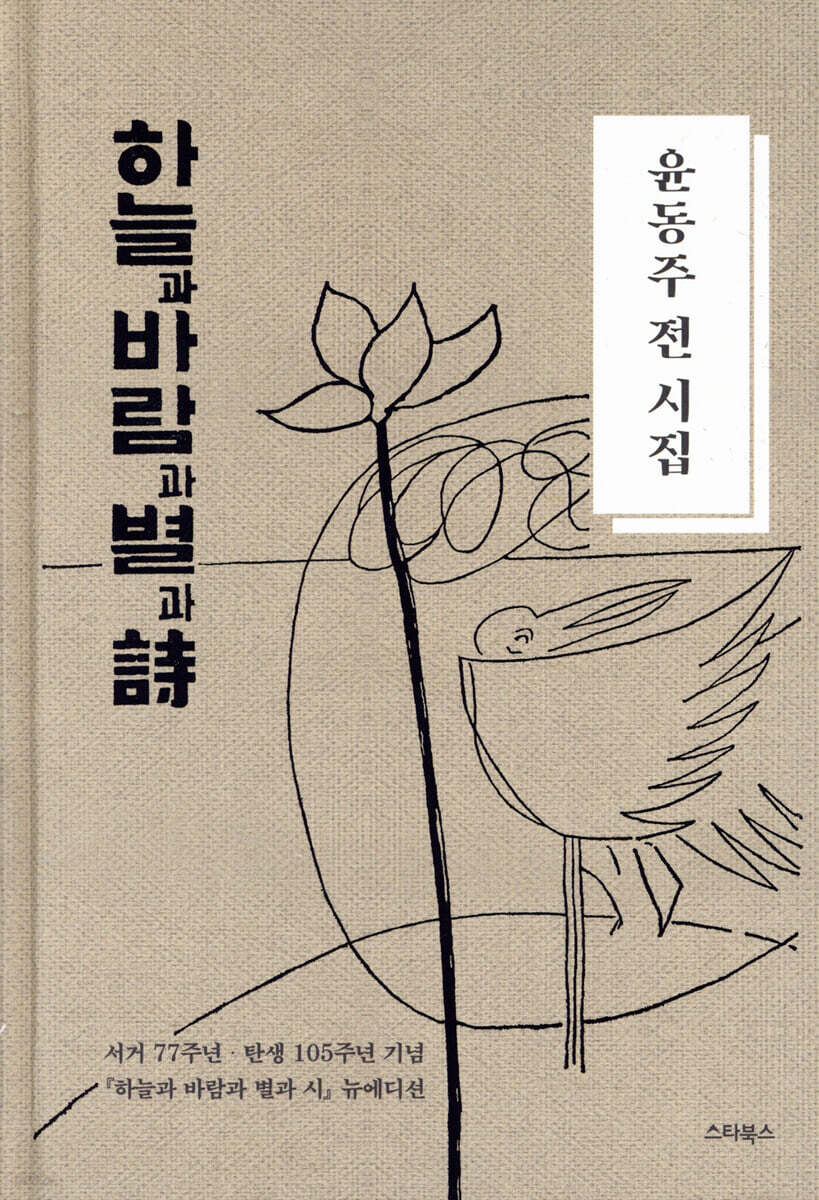
Yun Dong-ju's complete poetry collection, Sky, Wind, Stars, and Poetry
 |
Description
Book Introduction
"Sky, Wind, Stars, and Poetry" commemorating the 77th anniversary of his death and the 105th anniversary of his birth
A new edition of the best-selling 『Yun Dong-ju Complete Poetry Collection』 in high-quality hardcover.
“An eternal young poet whose popularity grows day by day, encompassing three countries!”
In commemoration of the 77th anniversary of Yun Dong-ju's death and the 105th anniversary of his birth in 2022, the newly edited 『Yun Dong-ju Complete Poetry Collection: Sky, Wind, Stars, and Poetry』 is the only poetry collection that contains all of poet Yun Dong-ju's works, including the preface and postscript, in one volume.
This poetry collection was published in 2017 to commemorate the 100th anniversary of Yun Dong-ju's birth, collecting all of Yun Dong-ju's poems and essays that were not lost, as well as the prefaces, reviews, and postfaces written for Yun Dong-ju. The best-selling 『Yun Dong-ju Complete Poetry Collection』 was neatly edited and redesigned to make it easier for anyone to read and enjoy, in commemoration of the 77th anniversary of Yun Dong-ju's death.
This poetry collection, produced in high-quality hardcover to commemorate the 77th anniversary of Yun Dong-ju's death, reorganizes the original four-part 『Yun Dong-ju Complete Poetry Collection』 into eight chapters.
Additionally, the memorial essays that were added each time a poem was published were compiled into the last eight chapters and carefully edited so that any reader can read and understand them easily and comfortably.
A new edition of the best-selling 『Yun Dong-ju Complete Poetry Collection』 in high-quality hardcover.
“An eternal young poet whose popularity grows day by day, encompassing three countries!”
In commemoration of the 77th anniversary of Yun Dong-ju's death and the 105th anniversary of his birth in 2022, the newly edited 『Yun Dong-ju Complete Poetry Collection: Sky, Wind, Stars, and Poetry』 is the only poetry collection that contains all of poet Yun Dong-ju's works, including the preface and postscript, in one volume.
This poetry collection was published in 2017 to commemorate the 100th anniversary of Yun Dong-ju's birth, collecting all of Yun Dong-ju's poems and essays that were not lost, as well as the prefaces, reviews, and postfaces written for Yun Dong-ju. The best-selling 『Yun Dong-ju Complete Poetry Collection』 was neatly edited and redesigned to make it easier for anyone to read and enjoy, in commemoration of the 77th anniversary of Yun Dong-ju's death.
This poetry collection, produced in high-quality hardcover to commemorate the 77th anniversary of Yun Dong-ju's death, reorganizes the original four-part 『Yun Dong-ju Complete Poetry Collection』 into eight chapters.
Additionally, the memorial essays that were added each time a poem was published were compiled into the last eight chapters and carefully edited so that any reader can read and understand them easily and comfortably.
- You can preview some of the book's contents.
Preview
index
prolog
Prologue: “Sky, Wind, Stars, and Poetry”
1.
Sky, wind, stars, and poetry
Self-portrait | Boy | Snowy map | Night of return | Hospital | New road | Street without signs | The first morning | Another first morning | Until dawn | A scary time | The cross | The wind blows | Sad tribe | Going with eyes closed | Another hometown | Road | Star-counting night
2.
white shadow
White Shadow | Loving Memories | Flowing Streets | Easily Written Poems | Spring
3.
night
Night | Testament | Portrait of a younger brother | Consolation | Liver | Mountain stream | Confession
4.
Eight Beatitudes
Eight Blessings | A Sleepless Night | Like the Moon | Pepper Field | Temple of Love | Miracle | Rainy Night | Window | Sea | Birobong | Afternoon in the Gorge | Meditation | Shower | Cold and Warm | Scenery | Moonlit Night | Chapter | Twilight Becomes the Sea | Morning | Laundry | Dreams Are Broken | Forest | A Day Like This | On the Mountain | Sunny Side | Chicken | Heart 1 | Heart 3 | Pigeon | Twilight | Southern Sky | Blue Sky | On the Street | Life and Death | One Candle
5.
Sanulrim
Echoes of the Mountain | Sunflower Face | The Gwitturami and I | Baby's Dawn | Sunlight and Wind | Firefly | Both | Lie Beak | Snow | Sparrow | Sole Pattern | Letter | Spring | What Do We Eat? | Chimney | Sun Rain | Broom | Roof Tiles | Manneken Pis Map | Chick | Seashell | Winter
6.
meal ticket
Meal ticket | Lark | Parting | On Moranbong | Afternoon Stadium | Granary | That Woman | Sorrow | Cosmos | Rose | Sick | Daydreaming | No Tomorrow | Pocket | Dog | Hometown | Autumn Night | Airplane | Tree | Apple | Snow | Chicken | Grandfather | Mandoli
7.
prose
Turgenev's Hill | Shooting the Moon | Where a Shooting Star Falls | Flowers Bloom in the Garden | End and Beginning
8.
A poem excavated later
Chest 2 | Window Hole | Dog 2 | Depression | Night Walk | Behind the Rain | Mother | Street Tree
9.
Preface, Postscript, and Foreword
Preface - Jeong Ji-yong
If it's outside the window, it's two legs - Yoo Young
Postscript - Kang Cheo-jung
Postscript - Jeong Byeong-uk
The Life of the Former Count - Yun Il-ju
Star of the Dark Ages Sky - Baekcheol
Yun Dong-ju's poetry - Park Du-jin
Memories of Dong-ju's Brother - Moon Ik-hwan
Human Yun Dong-ju - Jang Deok-sun
Postscript - Yun Il-ju
Publishing the 3rd edition - Jeong Byeong-uk
Yun Dong-ju's chronology
Prologue: “Sky, Wind, Stars, and Poetry”
1.
Sky, wind, stars, and poetry
Self-portrait | Boy | Snowy map | Night of return | Hospital | New road | Street without signs | The first morning | Another first morning | Until dawn | A scary time | The cross | The wind blows | Sad tribe | Going with eyes closed | Another hometown | Road | Star-counting night
2.
white shadow
White Shadow | Loving Memories | Flowing Streets | Easily Written Poems | Spring
3.
night
Night | Testament | Portrait of a younger brother | Consolation | Liver | Mountain stream | Confession
4.
Eight Beatitudes
Eight Blessings | A Sleepless Night | Like the Moon | Pepper Field | Temple of Love | Miracle | Rainy Night | Window | Sea | Birobong | Afternoon in the Gorge | Meditation | Shower | Cold and Warm | Scenery | Moonlit Night | Chapter | Twilight Becomes the Sea | Morning | Laundry | Dreams Are Broken | Forest | A Day Like This | On the Mountain | Sunny Side | Chicken | Heart 1 | Heart 3 | Pigeon | Twilight | Southern Sky | Blue Sky | On the Street | Life and Death | One Candle
5.
Sanulrim
Echoes of the Mountain | Sunflower Face | The Gwitturami and I | Baby's Dawn | Sunlight and Wind | Firefly | Both | Lie Beak | Snow | Sparrow | Sole Pattern | Letter | Spring | What Do We Eat? | Chimney | Sun Rain | Broom | Roof Tiles | Manneken Pis Map | Chick | Seashell | Winter
6.
meal ticket
Meal ticket | Lark | Parting | On Moranbong | Afternoon Stadium | Granary | That Woman | Sorrow | Cosmos | Rose | Sick | Daydreaming | No Tomorrow | Pocket | Dog | Hometown | Autumn Night | Airplane | Tree | Apple | Snow | Chicken | Grandfather | Mandoli
7.
prose
Turgenev's Hill | Shooting the Moon | Where a Shooting Star Falls | Flowers Bloom in the Garden | End and Beginning
8.
A poem excavated later
Chest 2 | Window Hole | Dog 2 | Depression | Night Walk | Behind the Rain | Mother | Street Tree
9.
Preface, Postscript, and Foreword
Preface - Jeong Ji-yong
If it's outside the window, it's two legs - Yoo Young
Postscript - Kang Cheo-jung
Postscript - Jeong Byeong-uk
The Life of the Former Count - Yun Il-ju
Star of the Dark Ages Sky - Baekcheol
Yun Dong-ju's poetry - Park Du-jin
Memories of Dong-ju's Brother - Moon Ik-hwan
Human Yun Dong-ju - Jang Deok-sun
Postscript - Yun Il-ju
Publishing the 3rd edition - Jeong Byeong-uk
Yun Dong-ju's chronology
Detailed image

Into the book
I don't need to bother my brain with silly thoughts like, "I found myself in the garden, I climbed out the window, I opened the door, I came out."
However, all I have to do is stand in front of Kotsumotsu, who is shy even when Guitram cries, and become sad like the shadow of the statue of Doctor Piringsu.
I have no symbol to pass on this feeling to anyone.
The collar is sensitive, so it gets chilly even in the moonlight, and the autumn dew is so cold that it is like a man's tears.
When the footsteps move the body and place it on the edge of the pond, there is also autumn, the three watch of the night, trees, and the moon in the pond.
--- p.156~157 from “Shooting the Moon”
Forsythia, azalea, rhododendron, lilac, daylily, rose, forsythia, peony, lily, iris, chrysanthemum, kaneshun, balsam, zinnia, dahlia, sunflower, kotsumotsu――The day when kotsumotsu falls alone is not the end of the universe.
Here, the blue sky rises high, and red and yellow maple leaves dye every branch as colorfully as the flowers, and then, as the croaking of the owls ceases, the world of maple leaves collapses, and overnight, white snow falls and piles up, and red charcoal fires burn in the brazier, and many stories and many things happen in this brazier.
--- p.161 From “Flowers Bloom in the Garden”
I change the endpoint to the starting point.
Where I get off is my final destination.
Because where I ride becomes my point of view.
In this short moment, I am buried among so many people, and I become so superficial to them.
I don't have the talent to demonstrate my humanity to these people.
It is impossible for me to measure their joys, sorrows, and pains.
It's too vague.
People seem to become superficial too easily when things are frequent and the quantity is large.
The more that happens, the more busy you become in taking care of yourself.
Step on the signal and the train takes off.
Even though it's not a car heading home, my heart is pounding for no reason.
Our train moves slowly and stops at makeshift stops when it gets out of breath.
--- p.170 From “The End and the Beginning”
His next younger brother, Ilju, and my conversation―
“How old would you be if you were alive?”
“I’m thirty-one years old.”
“I’m twenty-nine when I die―.”
“When did you go to Gando?”
“In my grandfather’s time.”
“How was your stay?”
“My grandfather pioneered the land and was a small landowner.”
“What does your father do?”
“You did business and also went to work.”
“Ah, if poetry and sorrow were to begin to flourish in Gando, it would have to be from the same generation as Yun Dong-ju!” I exclaimed.
--- p.186~187 From "Jeong Ji-yong - Preface"
“I don’t know what it means, but he shouted his last words and died.
I guess the sound felt like they were shouting “Long Live Korean Independence.”
These words were relayed by the Japanese guard who was watching Dongju's death to his bereaved family who went to retrieve his body.
That single, heartbreaking cry! The Japanese guard must have felt the same way, even if he knew what it meant.
He left Dongju Prison with only one word, at the age of twenty-nine, the year he was liberated.
Mong-gyu also died a few days later, so he too was a talented man.
Their remains now rest in peace in Gando, and now, through the hands of their friends, Dongju's poetry will be made into a book and passed down to the world for eternity.
--- p.197 From “Gangcheojung - Postscript”
『Take away the body of Dongju, who died on February 16th』
By sending a telegram like this, the Japanese took away Yun Dong-ju, the brother-in-law who had endured loneliness for 29 years, longing only for poetry and his homeland. This was just six months before the fall of Japan in 1945.
Myeongdong (明東) in Bukgando in the 1910s—it was a place where the smell of newly-built soil lingered, a place where patriotic men who had lost their country gathered in anger, a place where new schools and churches were built, a place where adults and children alike were filled with passion and enthusiasm.
--- p.204 From “Yoon Il-ju - The Life of the Former Count”
He was a very quiet and introspective person.
So he was known as a quiet person among his friends.
But no one thought he was arrogant.
Everyone wanted to date that silent Dongju.
His eyes always searched the sky for purity, but his body temperature felt warm to everyone.
I can confess without any exaggeration.
I have never felt the human warmth that emanated from deep within him from anyone else.
So the corner of my heart that he occupied will never be filled with anything else.
Even in Manchuria, a foreign land, I was wandering the streets of Xinjing at noon when I heard the bell of liberation ringing, and what made my heart ache unbearably was the fantasy of Dongju.
“Dongju, if you had lived… … ”
Brother Dong-ju was a truly wonderful man.
--- p.225 From "Moon Ik-hwan - Memories of Brother Dong-ju"
The 10th anniversary of Dong-ju's death has passed, and another 10 years have passed.
The 20th anniversary of his death, when he was planning to reprint his poetry collection that had been out of print and erect a monument in the garden of his alma mater, passed without bearing fruit.
Now, as a national poet, his brilliant vision is forcing readers to seek out his poetry collection.
It is only natural that his poetry collection will excite the hearts of young people in this land as it is published, but as someone who has been involved in compiling his poetry collection from the beginning, I feel a sense of accomplishment.
I am delighted to have taken the time to publish this third edition, sparing no effort in any way I can to help those who admire Dongju's sensibility, integrity, and humanity and seek out his poetry.
However, all I have to do is stand in front of Kotsumotsu, who is shy even when Guitram cries, and become sad like the shadow of the statue of Doctor Piringsu.
I have no symbol to pass on this feeling to anyone.
The collar is sensitive, so it gets chilly even in the moonlight, and the autumn dew is so cold that it is like a man's tears.
When the footsteps move the body and place it on the edge of the pond, there is also autumn, the three watch of the night, trees, and the moon in the pond.
--- p.156~157 from “Shooting the Moon”
Forsythia, azalea, rhododendron, lilac, daylily, rose, forsythia, peony, lily, iris, chrysanthemum, kaneshun, balsam, zinnia, dahlia, sunflower, kotsumotsu――The day when kotsumotsu falls alone is not the end of the universe.
Here, the blue sky rises high, and red and yellow maple leaves dye every branch as colorfully as the flowers, and then, as the croaking of the owls ceases, the world of maple leaves collapses, and overnight, white snow falls and piles up, and red charcoal fires burn in the brazier, and many stories and many things happen in this brazier.
--- p.161 From “Flowers Bloom in the Garden”
I change the endpoint to the starting point.
Where I get off is my final destination.
Because where I ride becomes my point of view.
In this short moment, I am buried among so many people, and I become so superficial to them.
I don't have the talent to demonstrate my humanity to these people.
It is impossible for me to measure their joys, sorrows, and pains.
It's too vague.
People seem to become superficial too easily when things are frequent and the quantity is large.
The more that happens, the more busy you become in taking care of yourself.
Step on the signal and the train takes off.
Even though it's not a car heading home, my heart is pounding for no reason.
Our train moves slowly and stops at makeshift stops when it gets out of breath.
--- p.170 From “The End and the Beginning”
His next younger brother, Ilju, and my conversation―
“How old would you be if you were alive?”
“I’m thirty-one years old.”
“I’m twenty-nine when I die―.”
“When did you go to Gando?”
“In my grandfather’s time.”
“How was your stay?”
“My grandfather pioneered the land and was a small landowner.”
“What does your father do?”
“You did business and also went to work.”
“Ah, if poetry and sorrow were to begin to flourish in Gando, it would have to be from the same generation as Yun Dong-ju!” I exclaimed.
--- p.186~187 From "Jeong Ji-yong - Preface"
“I don’t know what it means, but he shouted his last words and died.
I guess the sound felt like they were shouting “Long Live Korean Independence.”
These words were relayed by the Japanese guard who was watching Dongju's death to his bereaved family who went to retrieve his body.
That single, heartbreaking cry! The Japanese guard must have felt the same way, even if he knew what it meant.
He left Dongju Prison with only one word, at the age of twenty-nine, the year he was liberated.
Mong-gyu also died a few days later, so he too was a talented man.
Their remains now rest in peace in Gando, and now, through the hands of their friends, Dongju's poetry will be made into a book and passed down to the world for eternity.
--- p.197 From “Gangcheojung - Postscript”
『Take away the body of Dongju, who died on February 16th』
By sending a telegram like this, the Japanese took away Yun Dong-ju, the brother-in-law who had endured loneliness for 29 years, longing only for poetry and his homeland. This was just six months before the fall of Japan in 1945.
Myeongdong (明東) in Bukgando in the 1910s—it was a place where the smell of newly-built soil lingered, a place where patriotic men who had lost their country gathered in anger, a place where new schools and churches were built, a place where adults and children alike were filled with passion and enthusiasm.
--- p.204 From “Yoon Il-ju - The Life of the Former Count”
He was a very quiet and introspective person.
So he was known as a quiet person among his friends.
But no one thought he was arrogant.
Everyone wanted to date that silent Dongju.
His eyes always searched the sky for purity, but his body temperature felt warm to everyone.
I can confess without any exaggeration.
I have never felt the human warmth that emanated from deep within him from anyone else.
So the corner of my heart that he occupied will never be filled with anything else.
Even in Manchuria, a foreign land, I was wandering the streets of Xinjing at noon when I heard the bell of liberation ringing, and what made my heart ache unbearably was the fantasy of Dongju.
“Dongju, if you had lived… … ”
Brother Dong-ju was a truly wonderful man.
--- p.225 From "Moon Ik-hwan - Memories of Brother Dong-ju"
The 10th anniversary of Dong-ju's death has passed, and another 10 years have passed.
The 20th anniversary of his death, when he was planning to reprint his poetry collection that had been out of print and erect a monument in the garden of his alma mater, passed without bearing fruit.
Now, as a national poet, his brilliant vision is forcing readers to seek out his poetry collection.
It is only natural that his poetry collection will excite the hearts of young people in this land as it is published, but as someone who has been involved in compiling his poetry collection from the beginning, I feel a sense of accomplishment.
I am delighted to have taken the time to publish this third edition, sparing no effort in any way I can to help those who admire Dongju's sensibility, integrity, and humanity and seek out his poetry.
--- p.236 From "Jeong Byeong-uk - On the 3rd Edition"
Publisher's Review
Countless people from Korea, Japan, China and many other countries around the world
Everything about the young poet Yun Dong-ju, whose anniversary is celebrated and honored every year!
This poetry collection, 『Yoon Dong-ju's Complete Poetry Collection 'Sky, Wind, Stars and Poetry'』, which was published in 1948 with 31 poems by poet Yoon Dong-ju, included a preface by Jeong Ji-yong, a memorial poem by Yu Yeong, and an afterword by Kang Cheo-jung.
However, the preface and postface of the first edition are missing from the printed versions from 1955 onwards for the following reasons.
Poet Jeong Ji-yong was abducted to North Korea during the Korean War (later, the Pyongyang-based Tongil Sinbo reported in its April 24, May 1, and May 7, 1993, articles that Jeong Ji-yong had been killed by a US bombing near Dongducheon, Gyeonggi Province, around September 1950), and Kang Cheo-jung, a reporter for the Kyunghyang Shinmun, left home on September 4, 1950, telling his family that he would go to the Soviet Union to study, after which his whereabouts became unknown.
At that time, Kang Cheo-jung was sentenced to death on charges of being an underground member of the South Korean Labor Party and was awaiting execution when the Korean War broke out. When the People's Army entered Seoul and opened the prison, he returned home and recuperated for about two months before leaving South Korea.
After the Korean War, during the period of sharp ideological conflict between North and South Korea, the writings of Jeong Ji-yong and Kang Cheo-jung disappeared.
Additionally, in 1955, to commemorate the 10th anniversary of Yun Dong-ju's death, 62 poems and prose pieces were added to the collection "Sky, Wind, Stars and Poetry 1955," which was published for a total of 93 poems.
The 62 additional episodes are about when Yun Hye-won, the younger sister, moved south to Seoul in December 1948 and brought all of her brother's manuscripts and favorite books from their hometown, but due to strict surveillance, she was unable to bring the photo album.
I was afraid that if I did something wrong, the guards would find me and my precious manuscript would be stolen, so I kept the photo album at a relative's house, planning to retrieve it later, but something came up and I couldn't retrieve it.
It is said that Yoon Hye-won regretted this and felt heartbroken for a long time.
Among those manuscripts, 62 were selected, and 93 poems and essays were published with a cover featuring a painting by artist Kim Hwan-ki.
This collection of poems includes an afterword by Jeong Byeong-uk and ‘The Life of Seonbaek’ written by Yun Il-ju, and the third expanded collection of poems from 1979, ‘Sky, Wind, Stars and Poetry 1979’, includes afterwords by Baek Cheol, Park Du-jin, and Moon Ik-hwan.
Therefore, the memorial writings for Jeong Ji-yong, Yu Yeong, and Kang Cheo-jung, all of whom are preserved in Chapter 8, are in themselves excellent literary works.
The notation of this poetry collection follows modern notation as much as possible, but as long as it does not interfere with reading, I tried to preserve the feeling of the original text as much as possible. Some words that were included differently depending on the year of publication, such as '얼골/얼굴' and '코쓰모쓰/코모스', were written as they were published at the time so that the changes can be conveyed.
In addition, the titles of the works written in “Yoon Dong-ju Chronology” follow modern language.
Everything about the young poet Yun Dong-ju, whose anniversary is celebrated and honored every year!
This poetry collection, 『Yoon Dong-ju's Complete Poetry Collection 'Sky, Wind, Stars and Poetry'』, which was published in 1948 with 31 poems by poet Yoon Dong-ju, included a preface by Jeong Ji-yong, a memorial poem by Yu Yeong, and an afterword by Kang Cheo-jung.
However, the preface and postface of the first edition are missing from the printed versions from 1955 onwards for the following reasons.
Poet Jeong Ji-yong was abducted to North Korea during the Korean War (later, the Pyongyang-based Tongil Sinbo reported in its April 24, May 1, and May 7, 1993, articles that Jeong Ji-yong had been killed by a US bombing near Dongducheon, Gyeonggi Province, around September 1950), and Kang Cheo-jung, a reporter for the Kyunghyang Shinmun, left home on September 4, 1950, telling his family that he would go to the Soviet Union to study, after which his whereabouts became unknown.
At that time, Kang Cheo-jung was sentenced to death on charges of being an underground member of the South Korean Labor Party and was awaiting execution when the Korean War broke out. When the People's Army entered Seoul and opened the prison, he returned home and recuperated for about two months before leaving South Korea.
After the Korean War, during the period of sharp ideological conflict between North and South Korea, the writings of Jeong Ji-yong and Kang Cheo-jung disappeared.
Additionally, in 1955, to commemorate the 10th anniversary of Yun Dong-ju's death, 62 poems and prose pieces were added to the collection "Sky, Wind, Stars and Poetry 1955," which was published for a total of 93 poems.
The 62 additional episodes are about when Yun Hye-won, the younger sister, moved south to Seoul in December 1948 and brought all of her brother's manuscripts and favorite books from their hometown, but due to strict surveillance, she was unable to bring the photo album.
I was afraid that if I did something wrong, the guards would find me and my precious manuscript would be stolen, so I kept the photo album at a relative's house, planning to retrieve it later, but something came up and I couldn't retrieve it.
It is said that Yoon Hye-won regretted this and felt heartbroken for a long time.
Among those manuscripts, 62 were selected, and 93 poems and essays were published with a cover featuring a painting by artist Kim Hwan-ki.
This collection of poems includes an afterword by Jeong Byeong-uk and ‘The Life of Seonbaek’ written by Yun Il-ju, and the third expanded collection of poems from 1979, ‘Sky, Wind, Stars and Poetry 1979’, includes afterwords by Baek Cheol, Park Du-jin, and Moon Ik-hwan.
Therefore, the memorial writings for Jeong Ji-yong, Yu Yeong, and Kang Cheo-jung, all of whom are preserved in Chapter 8, are in themselves excellent literary works.
The notation of this poetry collection follows modern notation as much as possible, but as long as it does not interfere with reading, I tried to preserve the feeling of the original text as much as possible. Some words that were included differently depending on the year of publication, such as '얼골/얼굴' and '코쓰모쓰/코모스', were written as they were published at the time so that the changes can be conveyed.
In addition, the titles of the works written in “Yoon Dong-ju Chronology” follow modern language.
GOODS SPECIFICS
- Publication date: February 16, 2022
- Format: Hardcover book binding method guide
- Page count, weight, size: 256 pages | 368g | 142*204*16mm
- ISBN13: 9791157956357
- ISBN10: 1157956351
You may also like
카테고리
korean


korean

![ELLE 엘르 스페셜 에디션 A형 : 12월 [2025]](http://librairie.coreenne.fr/cdn/shop/files/b8e27a3de6c9538896439686c6b0e8fb.jpg?v=1766436872&width=3840)


