

I didn't ask, but
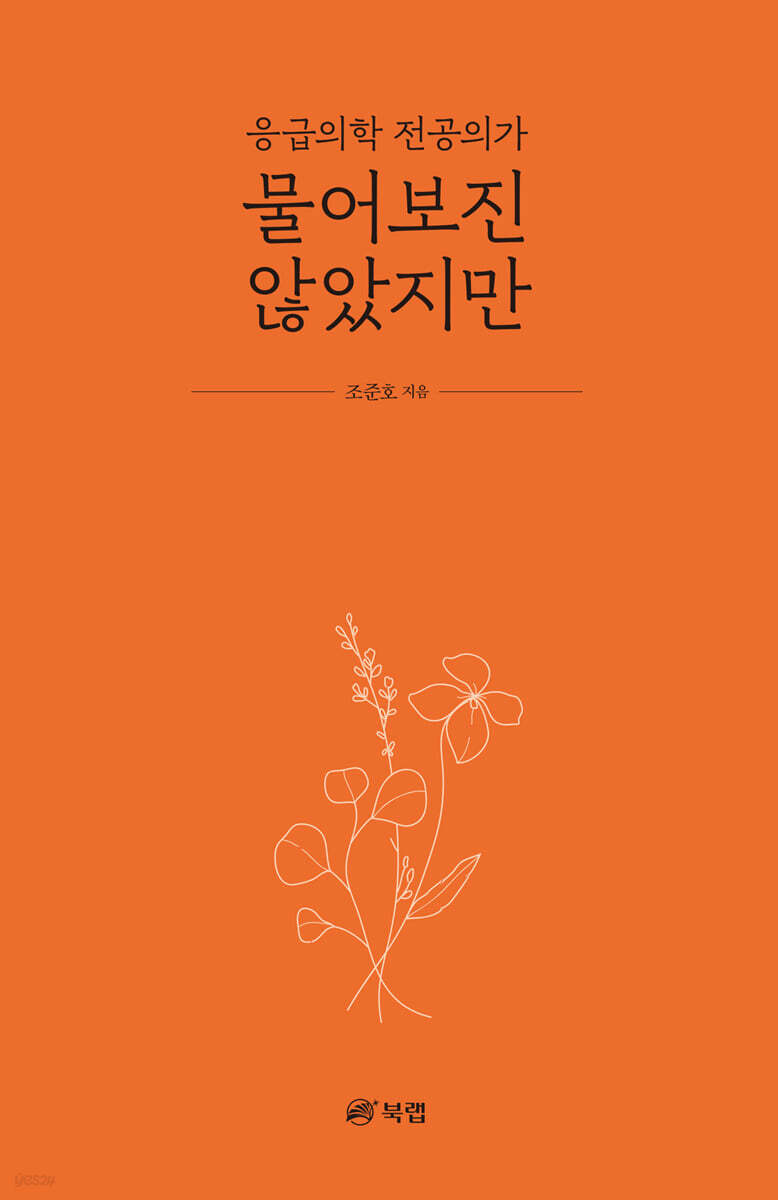 |
Description
Book Introduction
Repetition doesn't make perfection, but it reduces imperfection.
In the end, those small differences become life-saving forces!
An emergency medicine doctor who stands on the border between life and death, guarding the night
The doctor's attitude and reason for existence discovered through endless repetition and training
This is the record of a doctor who spent a long time reflecting on the border between life and death, during nights that were longer than days.
At the edge of an invisible order, emergency medicine physicians serve as the leaves, stems, and roots that allow cardiologists and neurosurgeons to blossom.
Flowers bloom because they are there.
He continues to practice today with the belief that 'repetition does not create perfection, but it reduces imperfection.'
In that repetition, both the doctor's expertise and the meaning of existence as a human being are contained.
He wanted to be a “night doctor,” but he never forgot that doctors are healers and experts.
He says that a systematic process of education and reflection is necessary to cultivate professionalism.
A story that emergency medicine residents haven't asked, and probably won't ask, but that I absolutely wanted to tell.
This book is the culmination of that sincerity.
In the end, those small differences become life-saving forces!
An emergency medicine doctor who stands on the border between life and death, guarding the night
The doctor's attitude and reason for existence discovered through endless repetition and training
This is the record of a doctor who spent a long time reflecting on the border between life and death, during nights that were longer than days.
At the edge of an invisible order, emergency medicine physicians serve as the leaves, stems, and roots that allow cardiologists and neurosurgeons to blossom.
Flowers bloom because they are there.
He continues to practice today with the belief that 'repetition does not create perfection, but it reduces imperfection.'
In that repetition, both the doctor's expertise and the meaning of existence as a human being are contained.
He wanted to be a “night doctor,” but he never forgot that doctors are healers and experts.
He says that a systematic process of education and reflection is necessary to cultivate professionalism.
A story that emergency medicine residents haven't asked, and probably won't ask, but that I absolutely wanted to tell.
This book is the culmination of that sincerity.
- You can preview some of the book's contents.
Preview
index
Entering
adaptation
A waterfall, each and every drop of water passing by gathers together to form a waterfall
Leaves, stems, and roots rather than flowers
Repetition, the Habit That Creates Excellence
white hat hacker
Doughnut of Truth
Death asks life
resilience
2-stage side kick
challenge
Act now!
Fail fast, learn fast
Blaze a trail
Deviation
research
P 〈0.05
Things that show hostility
lie
leader
Professionalism
isolation
Justice and Utilitarianism
The man on the spot
comparison
systems thinking
Emergency room spin
uncertainty
tragedy of the commons
My strength lies with my colleagues. When I'm having a hard time, my colleagues are at ease.
In conclusion
grateful people
adaptation
A waterfall, each and every drop of water passing by gathers together to form a waterfall
Leaves, stems, and roots rather than flowers
Repetition, the Habit That Creates Excellence
white hat hacker
Doughnut of Truth
Death asks life
resilience
2-stage side kick
challenge
Act now!
Fail fast, learn fast
Blaze a trail
Deviation
research
P 〈0.05
Things that show hostility
lie
leader
Professionalism
isolation
Justice and Utilitarianism
The man on the spot
comparison
systems thinking
Emergency room spin
uncertainty
tragedy of the commons
My strength lies with my colleagues. When I'm having a hard time, my colleagues are at ease.
In conclusion
grateful people
Into the book
The emergency room is open 24 hours a day, and no matter how well prepared you are, problems can easily arise because you never know when or what kind of patient will arrive.
Other specialists cannot staff the emergency room, leaving a larger void.
When emergency medicine doctors work very hard and very well, the emergency room is quiet that night.
If nothing happens overnight, people will wonder, “What do you do in emergency medicine?”
When something goes wrong, I hear, “What did you do in emergency medicine?”
Have you ever been praised? I don't remember.
If no problems arise, that would be the best.
--- p.40
During my second year of residency, a patient with hyperthyroidism came to the emergency room with symptoms including high fever, tachycardia, anxiety, excessive sweating, and tremors.
At that time, thyroid storm could not be diagnosed because the thyroid function blood test came out the next day.
This is a situation that should be suspected only based on clinical findings.
If not treated quickly, the patient becomes at risk.
Y, an emergency medicine fellow who had just joined the hospital after being discharged from the military, has a name of genius, and just like his name, there were times when he seemed like a 'genius'.
As I was passing through the emergency room, I saw this patient and told him to start taking medication right away, and he told me to prescribe antithyroid drugs and beta blockers.
I had never personally prescribed such medication before.
--- p.81
Research funds.
These days, the process of writing and submitting a paper costs money.
First of all, collecting research data itself costs a lot of money. For example, writing a paper using a specific machine or conducting animal experiments costs a lot of money.
They say that a single rat costs about 35,000 won, and this is separate from the cost of feed, raising fees, and space usage fees.
Getting statistical advice can cost money, and English translation and editing can also cost money.
When hiring a researcher, there are personnel costs, and finally, when submitting to an academic journal, there is a submission fee or review fee.
So how do you obtain this kind of research funding? In my case, I first applied for the on-campus research grant for new professors.
--- p.121
There is a word called systems thinking.
Systems thinking, or systems thinking, is a way of thinking that attempts to understand the phenomenon as a whole by understanding how each element interacts with each other and its complexity, rather than looking at individual elements separately.
Instead of dividing the world into parts, we look at how it relates to the whole and understand how the elements that make up the system are interconnected and interact, thereby finding effective solutions to complex problems or phenomena.
In the medical field, it is used to identify the root cause of disease by viewing individuals and social systems as an organically connected whole.
--- p.161
I returned to my alma mater again.
I have continued to meet new people, including students and residents, and have tried to have a positive influence on their journey to becoming doctors.
But it wasn't as easy as it seemed.
As students became residents, they became rude, arrogant, and weak.
Residents became specialists and became capitalists.
Of course, some grew up to be excellent doctors, but their numbers were too small.
The relationship between the students and the residents became so strained that it could no longer be restored due to the political situation, and I closed my heart to them, leaving me with nothing to do at the university hospital.
It's no longer human to human like it used to be.
It's just a business-related relationship.
I completely disagree with the resident's statement that he learned patient care and surgical techniques through YouTube and over-the-shoulder.
What I learned during my training was definitely more than that.
It wasn't just a simple surgery or ultrasound.
I learned how to make eye contact with patients, explain things, and work together to solve problems.
Other specialists cannot staff the emergency room, leaving a larger void.
When emergency medicine doctors work very hard and very well, the emergency room is quiet that night.
If nothing happens overnight, people will wonder, “What do you do in emergency medicine?”
When something goes wrong, I hear, “What did you do in emergency medicine?”
Have you ever been praised? I don't remember.
If no problems arise, that would be the best.
--- p.40
During my second year of residency, a patient with hyperthyroidism came to the emergency room with symptoms including high fever, tachycardia, anxiety, excessive sweating, and tremors.
At that time, thyroid storm could not be diagnosed because the thyroid function blood test came out the next day.
This is a situation that should be suspected only based on clinical findings.
If not treated quickly, the patient becomes at risk.
Y, an emergency medicine fellow who had just joined the hospital after being discharged from the military, has a name of genius, and just like his name, there were times when he seemed like a 'genius'.
As I was passing through the emergency room, I saw this patient and told him to start taking medication right away, and he told me to prescribe antithyroid drugs and beta blockers.
I had never personally prescribed such medication before.
--- p.81
Research funds.
These days, the process of writing and submitting a paper costs money.
First of all, collecting research data itself costs a lot of money. For example, writing a paper using a specific machine or conducting animal experiments costs a lot of money.
They say that a single rat costs about 35,000 won, and this is separate from the cost of feed, raising fees, and space usage fees.
Getting statistical advice can cost money, and English translation and editing can also cost money.
When hiring a researcher, there are personnel costs, and finally, when submitting to an academic journal, there is a submission fee or review fee.
So how do you obtain this kind of research funding? In my case, I first applied for the on-campus research grant for new professors.
--- p.121
There is a word called systems thinking.
Systems thinking, or systems thinking, is a way of thinking that attempts to understand the phenomenon as a whole by understanding how each element interacts with each other and its complexity, rather than looking at individual elements separately.
Instead of dividing the world into parts, we look at how it relates to the whole and understand how the elements that make up the system are interconnected and interact, thereby finding effective solutions to complex problems or phenomena.
In the medical field, it is used to identify the root cause of disease by viewing individuals and social systems as an organically connected whole.
--- p.161
I returned to my alma mater again.
I have continued to meet new people, including students and residents, and have tried to have a positive influence on their journey to becoming doctors.
But it wasn't as easy as it seemed.
As students became residents, they became rude, arrogant, and weak.
Residents became specialists and became capitalists.
Of course, some grew up to be excellent doctors, but their numbers were too small.
The relationship between the students and the residents became so strained that it could no longer be restored due to the political situation, and I closed my heart to them, leaving me with nothing to do at the university hospital.
It's no longer human to human like it used to be.
It's just a business-related relationship.
I completely disagree with the resident's statement that he learned patient care and surgical techniques through YouTube and over-the-shoulder.
What I learned during my training was definitely more than that.
It wasn't just a simple surgery or ultrasound.
I learned how to make eye contact with patients, explain things, and work together to solve problems.
--- p.191
GOODS SPECIFICS
- Date of issue: November 28, 2025
- Page count, weight, size: 194 pages | 215g | 120*185*11mm
- ISBN13: 9791172249625
- ISBN10: 1172249628
You may also like
카테고리
korean


korean

![GQ KOREA Mark (Monthly): December [2025]](http://librairie.coreenne.fr/cdn/shop/files/8ef265dbbfbf186523ed75ba7319009d.jpg?v=1765340328&width=3840)


