

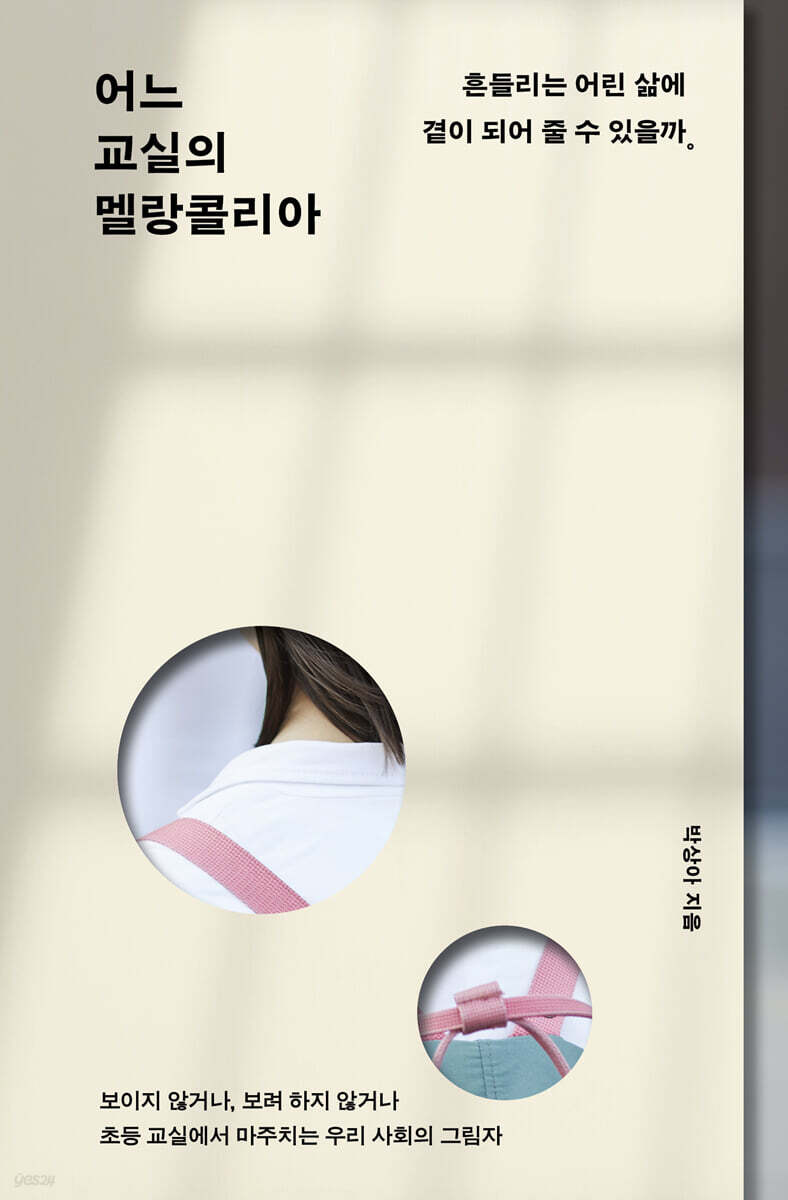
Melancholia in a Classroom
 |
Description
Book Introduction
Beyond the children's sparkling eyes
The shadow outside the classroom is clearly visible
"Melancholia in a Classroom" is an educational essay that illuminates inequality and blind spots in care in Korean society through the lives of children encountered by a 20-something elementary school teacher over five years.
The shadows seen in the faces of children who come to school without coats even in the middle of winter, children who cannot bear to eat the praised snacks but put them in their pockets, and children who wander the streets after school point out that these are problems shared by our entire society.
Author Park Sang-ah conveys that there are times when adult care is more urgent than a teacher's teachings.
We witness how the gap between rich and poor, gaps in care, prejudice, and violence block educational opportunities and erode children's lives. We also see how, even if we try to solve these problems, as mere teachers, we cannot reach the root of the problems that lie outside the school.
The lives he observed from the closest position to the children were each different, like wild flowers hidden in a field of lush grass.
This book is a small window that shows that it is the proper role of adults to pay attention to such lives, to look into each child's eyes and reach out to them.
The shadow outside the classroom is clearly visible
"Melancholia in a Classroom" is an educational essay that illuminates inequality and blind spots in care in Korean society through the lives of children encountered by a 20-something elementary school teacher over five years.
The shadows seen in the faces of children who come to school without coats even in the middle of winter, children who cannot bear to eat the praised snacks but put them in their pockets, and children who wander the streets after school point out that these are problems shared by our entire society.
Author Park Sang-ah conveys that there are times when adult care is more urgent than a teacher's teachings.
We witness how the gap between rich and poor, gaps in care, prejudice, and violence block educational opportunities and erode children's lives. We also see how, even if we try to solve these problems, as mere teachers, we cannot reach the root of the problems that lie outside the school.
The lives he observed from the closest position to the children were each different, like wild flowers hidden in a field of lush grass.
This book is a small window that shows that it is the proper role of adults to pay attention to such lives, to look into each child's eyes and reach out to them.
- You can preview some of the book's contents.
Preview
index
prolog.
Hoping for ten people to take one step
Chapter 1.
Children are innocent
Toyoko Kids in a Classroom
On the Violence That Survived Despite the Era of Corporal Punishment Ban
Even so, adults still have a role to play.
Why would you hospitalize a child who is not sick?
Children hear what is said during the day, and children also hear what is said at night.
Issues to consider when dealing with your child's problem behavior
Chapter 2.
The gap between rich and poor permeates even the classroom
The right to peek into someone's room during a Zoom class
There's a kid who carries Haribo gummies in his pocket.
Why I Can't Be Able to Ask What You Did Over the Weekend
Regarding the fact that the background of the photo is a sewer
Some kids talk about Tesla, Louis Vuitton, and iPhone.
Chapter 3.
A hundred lives, a hundred exceptions
The sadness of having to teach seasonal clothing
There are children on the edge in the classroom.
If you want to send a child to middle school, you need to know the child's family circumstances.
The strongest siblings I've ever met in my teaching career
Clumsy minds wandering the classroom
About the three faces of that child
Chapter 4.
Living with children
The story of how I came to visit the sharing market
If a child who cannot wash participates in survival swimming
Can a teacher be a 'real' friend?
The reason my old laptop is named Opportunity
Epilogue.
They are all flowers
Hoping for ten people to take one step
Chapter 1.
Children are innocent
Toyoko Kids in a Classroom
On the Violence That Survived Despite the Era of Corporal Punishment Ban
Even so, adults still have a role to play.
Why would you hospitalize a child who is not sick?
Children hear what is said during the day, and children also hear what is said at night.
Issues to consider when dealing with your child's problem behavior
Chapter 2.
The gap between rich and poor permeates even the classroom
The right to peek into someone's room during a Zoom class
There's a kid who carries Haribo gummies in his pocket.
Why I Can't Be Able to Ask What You Did Over the Weekend
Regarding the fact that the background of the photo is a sewer
Some kids talk about Tesla, Louis Vuitton, and iPhone.
Chapter 3.
A hundred lives, a hundred exceptions
The sadness of having to teach seasonal clothing
There are children on the edge in the classroom.
If you want to send a child to middle school, you need to know the child's family circumstances.
The strongest siblings I've ever met in my teaching career
Clumsy minds wandering the classroom
About the three faces of that child
Chapter 4.
Living with children
The story of how I came to visit the sharing market
If a child who cannot wash participates in survival swimming
Can a teacher be a 'real' friend?
The reason my old laptop is named Opportunity
Epilogue.
They are all flowers
Detailed image

Into the book
The countless emotions I felt in the classroom were difficult to define in a single word.
Some days I felt frustrated, some days I felt sad, and some days I felt listless.
There were many days when I fell into emptiness and moments when I had to swallow bitterness.
Every time I met the children, the complex emotions that came over me made my heart heavy, like a cloudy sky with rain.
The word 'melancholia' in the title of this book comes from that sense of despair and gloom.
Each day with the children was a clear reality rather than a romantic one.
--- p.7 「Prologue.
From "Hoping for Ten People to Take One Step"
I'm just now realizing this as I read the text messages, which are a mixture of persuasion, anger, and love and hate.
My efforts to somehow get Jinseo to return to the classroom had failed.
It was greed to try to turn back Jinseo's heart, which was not filled with essential love.
The fact that the interest and effort of a single teacher does not have as big an impact as you might think.
When I face that limitation, I feel sad.
Who could have sent this child home?
How could I have embraced you more warmly?
It's a night when I feel ashamed of the moments when I repeated the proposition, "All children deserve to be loved," without even realizing that it was out of touch with reality.
--- p.22 「Chapter 1.
From "Children are not guilty"
Some children live in an environment where their only world is the snacks handed out by their school teachers.
To some, it may be just 'a single jelly', but they put their heart and soul into obtaining that jelly, and they cherish each and every one of them as if they were treasures.
In the process, sometimes you put your family before your own.
When faced with such children, there is not much for the homeroom teacher to do.
It just fills up the snack basket and makes it more full.
I just cheer them on without showing any pity or sympathy towards them.
One more thing, it just subtly teaches you how to take care of your own share before others.
--- p.87 「Chapter 2.
From “The gap between rich and poor that permeates even the classroom”
If you want to send a child to middle school, you need to know the child's family circumstances.
I have to ask uncomfortable questions and sometimes hear an unpleasant voice in return.
But when it comes to forcing children through this process due to unavoidable circumstances, I really want to give up.
It would have been much better to just hear from my parents about my feelings of dissatisfaction, frustration, irritation, and anger.
Whenever I met the children's eyes, overflowing with trust and obedience, without a single trace of negative emotion, and witnessed them trying to somehow get the "documents" the teacher had mentioned, I would unconsciously lower my head.
--- p.142 「Chapter 3.
From “A Hundred Lives, A Hundred Exceptions”
How long will I be allowed to pursue the teaching profession?
Just thinking about how many 'backstabbing' moments I'll face in the future makes my eyes ache and my head hurt.
But I decide again to do it silently with a good heart.
Because I believe that when hearts that cannot ignore come together, they can reach children who really need it.
Because I believe that simple attention and helping hand will make some children's days a little more peaceful.
And now I know that that care and touch will soon return as a wood fire that warms my heart.
--- pp.196-197 「Chapter 4.
From “Living with Children”
I think I only found out when I reached the last chapter.
In conclusion, I want children to be welcomed into the world for who they are.
Even if your family background isn't stable, your finances are difficult, you have a disability, or you don't meet the standards of the average person, you want to be respected and loved by others.
Children have that right.
Some days I felt frustrated, some days I felt sad, and some days I felt listless.
There were many days when I fell into emptiness and moments when I had to swallow bitterness.
Every time I met the children, the complex emotions that came over me made my heart heavy, like a cloudy sky with rain.
The word 'melancholia' in the title of this book comes from that sense of despair and gloom.
Each day with the children was a clear reality rather than a romantic one.
--- p.7 「Prologue.
From "Hoping for Ten People to Take One Step"
I'm just now realizing this as I read the text messages, which are a mixture of persuasion, anger, and love and hate.
My efforts to somehow get Jinseo to return to the classroom had failed.
It was greed to try to turn back Jinseo's heart, which was not filled with essential love.
The fact that the interest and effort of a single teacher does not have as big an impact as you might think.
When I face that limitation, I feel sad.
Who could have sent this child home?
How could I have embraced you more warmly?
It's a night when I feel ashamed of the moments when I repeated the proposition, "All children deserve to be loved," without even realizing that it was out of touch with reality.
--- p.22 「Chapter 1.
From "Children are not guilty"
Some children live in an environment where their only world is the snacks handed out by their school teachers.
To some, it may be just 'a single jelly', but they put their heart and soul into obtaining that jelly, and they cherish each and every one of them as if they were treasures.
In the process, sometimes you put your family before your own.
When faced with such children, there is not much for the homeroom teacher to do.
It just fills up the snack basket and makes it more full.
I just cheer them on without showing any pity or sympathy towards them.
One more thing, it just subtly teaches you how to take care of your own share before others.
--- p.87 「Chapter 2.
From “The gap between rich and poor that permeates even the classroom”
If you want to send a child to middle school, you need to know the child's family circumstances.
I have to ask uncomfortable questions and sometimes hear an unpleasant voice in return.
But when it comes to forcing children through this process due to unavoidable circumstances, I really want to give up.
It would have been much better to just hear from my parents about my feelings of dissatisfaction, frustration, irritation, and anger.
Whenever I met the children's eyes, overflowing with trust and obedience, without a single trace of negative emotion, and witnessed them trying to somehow get the "documents" the teacher had mentioned, I would unconsciously lower my head.
--- p.142 「Chapter 3.
From “A Hundred Lives, A Hundred Exceptions”
How long will I be allowed to pursue the teaching profession?
Just thinking about how many 'backstabbing' moments I'll face in the future makes my eyes ache and my head hurt.
But I decide again to do it silently with a good heart.
Because I believe that when hearts that cannot ignore come together, they can reach children who really need it.
Because I believe that simple attention and helping hand will make some children's days a little more peaceful.
And now I know that that care and touch will soon return as a wood fire that warms my heart.
--- pp.196-197 「Chapter 4.
From “Living with Children”
I think I only found out when I reached the last chapter.
In conclusion, I want children to be welcomed into the world for who they are.
Even if your family background isn't stable, your finances are difficult, you have a disability, or you don't meet the standards of the average person, you want to be respected and loved by others.
Children have that right.
--- p.225 「Epilogue.
From "Everyone is a Flower"
From "Everyone is a Flower"
Publisher's Review
Times when care was needed rather than teaching
Beyond innocence and loveliness,
The Bare Face of the Classroom as Facing a 20-Year-Old Teacher
These days, warnings about low birth rates and population decline have become familiar.
But how are the children already born in this land, especially those who are excluded from the attention and institutional protection of adults, living?
"Melancholia in a Classroom" takes a look at the dark side of Korean society that we tend to ignore today through the scenes that a 20-something elementary school teacher encountered in the classroom over the course of five years.
The anecdotes that unfold in school life, the images of children each enduring different difficulties, and the honest feelings of a teacher who speaks softly and subtly before them become records that go beyond simple experiences and touch upon various issues both inside and outside the classroom.
When I first started teaching, I thought that all children grew up in warm homes and were loved.
Making mistakes, getting scolded, and still smiling innocently.
But the reality was different.
There were children who had to be taught how to dress for the season or how to wash their hair before being taught Korean or math, children for whom the only snack in their world was the jelly they received as a stamp of praise during class, and children who wandered around after school without a place to go.
I felt respect for children who grew up strong and bright in more difficult environments than others, but I also felt frustrated when I couldn't stop children who were thrown around by complicated family situations and ended up on the path of delinquency.
The teaching methods, classroom management ideas, and play activities I had prepared with the expectation of teaching children were all secondary to this reality.
As the author went through countless moments where immediate care was needed rather than teaching, a clouded light and a heavy sadness settled in a corner of his heart.
Even though I always tried my best to provide the best help and respect, there weren't many problems I could solve as a teacher.
The lives of children as seen from the perspective of an adult nearby
The meaning of school as a space and the profession of teacher
From the beginning, the author did not intend to live as an ‘adult next to children.’
Whenever the line between public and private life becomes blurred in front of children in need of care, I always wonder how far I should dedicate myself as a teacher.
They also complained about uncooperative parents, a social atmosphere that did not respect teachers' authority, and a flawed education and welfare system.
Even if teachers wanted to work for the children, the root of the problem often lay outside the school, so there seemed to be little they could do.
In the midst of these conflicts, he constantly questioned his own limitations and sometimes felt skeptical about the role of schools and teachers.
The author, who describes himself as someone who is far from having a strong sense of mission or service spirit, confesses that it was “force majeure” that made him have no choice but to roll up his sleeves every time it came to children’s affairs.
At an age where it's normal for children to not know how to take care of themselves, I couldn't turn away from the innocent faces of children who had to grow up alone without the care of those around them.
Even though I had thoughts like, 'Do I really have to do this?', I ended up becoming an adult who made home visits, browsed charity markets, and washed children's hair.
It was only after being so close to the children and being supported and nagged by them that he finally came to a realization.
What these children really need is a careful look into their lives, a willingness to understand their young peers in our society and to reach out as much as possible.
Inequality, care gaps, prejudice and violence
How to Block Educational Opportunities
The question the author poses is ultimately one.
"Why do some children never even reach the starting line?" The classroom, an everyday space, becomes a window that reflects the structural deficiencies of our society.
Set in a classroom, this book explores how the gap between rich and poor, gaps in care, prejudice, and violence intertwine to block educational opportunities, ultimately undermining a child's self-esteem and future.
It doesn't stop at just critically describing this, but it also captures the guilt and helplessness felt as an adult who stays closest to the children, as well as the desire to still stand by the children, as well as the agony and determination of a teacher, which holds the reader's heart for a long time.
The voices contained in this book are not limited to those within the educational community.
This is also a record that asks us what responsibilities we have as members of a society where children live together.
The author says:
If we gather together little by little, hearts that do not ignore children, we will eventually be able to reach the places where they are most needed.
"Melancholia in a Classroom" is a book for children, but at the same time, it is a book for society and adults who must welcome and care for children.
This book quietly but resonates with a profound sense of solidarity, conveying the message that the most practical form of solidarity needed by adults in this age is an attitude of closely observing children's lives, a willingness to share care appropriate to each individual's wounds, and that small, concrete respect.
Beyond innocence and loveliness,
The Bare Face of the Classroom as Facing a 20-Year-Old Teacher
These days, warnings about low birth rates and population decline have become familiar.
But how are the children already born in this land, especially those who are excluded from the attention and institutional protection of adults, living?
"Melancholia in a Classroom" takes a look at the dark side of Korean society that we tend to ignore today through the scenes that a 20-something elementary school teacher encountered in the classroom over the course of five years.
The anecdotes that unfold in school life, the images of children each enduring different difficulties, and the honest feelings of a teacher who speaks softly and subtly before them become records that go beyond simple experiences and touch upon various issues both inside and outside the classroom.
When I first started teaching, I thought that all children grew up in warm homes and were loved.
Making mistakes, getting scolded, and still smiling innocently.
But the reality was different.
There were children who had to be taught how to dress for the season or how to wash their hair before being taught Korean or math, children for whom the only snack in their world was the jelly they received as a stamp of praise during class, and children who wandered around after school without a place to go.
I felt respect for children who grew up strong and bright in more difficult environments than others, but I also felt frustrated when I couldn't stop children who were thrown around by complicated family situations and ended up on the path of delinquency.
The teaching methods, classroom management ideas, and play activities I had prepared with the expectation of teaching children were all secondary to this reality.
As the author went through countless moments where immediate care was needed rather than teaching, a clouded light and a heavy sadness settled in a corner of his heart.
Even though I always tried my best to provide the best help and respect, there weren't many problems I could solve as a teacher.
The lives of children as seen from the perspective of an adult nearby
The meaning of school as a space and the profession of teacher
From the beginning, the author did not intend to live as an ‘adult next to children.’
Whenever the line between public and private life becomes blurred in front of children in need of care, I always wonder how far I should dedicate myself as a teacher.
They also complained about uncooperative parents, a social atmosphere that did not respect teachers' authority, and a flawed education and welfare system.
Even if teachers wanted to work for the children, the root of the problem often lay outside the school, so there seemed to be little they could do.
In the midst of these conflicts, he constantly questioned his own limitations and sometimes felt skeptical about the role of schools and teachers.
The author, who describes himself as someone who is far from having a strong sense of mission or service spirit, confesses that it was “force majeure” that made him have no choice but to roll up his sleeves every time it came to children’s affairs.
At an age where it's normal for children to not know how to take care of themselves, I couldn't turn away from the innocent faces of children who had to grow up alone without the care of those around them.
Even though I had thoughts like, 'Do I really have to do this?', I ended up becoming an adult who made home visits, browsed charity markets, and washed children's hair.
It was only after being so close to the children and being supported and nagged by them that he finally came to a realization.
What these children really need is a careful look into their lives, a willingness to understand their young peers in our society and to reach out as much as possible.
Inequality, care gaps, prejudice and violence
How to Block Educational Opportunities
The question the author poses is ultimately one.
"Why do some children never even reach the starting line?" The classroom, an everyday space, becomes a window that reflects the structural deficiencies of our society.
Set in a classroom, this book explores how the gap between rich and poor, gaps in care, prejudice, and violence intertwine to block educational opportunities, ultimately undermining a child's self-esteem and future.
It doesn't stop at just critically describing this, but it also captures the guilt and helplessness felt as an adult who stays closest to the children, as well as the desire to still stand by the children, as well as the agony and determination of a teacher, which holds the reader's heart for a long time.
The voices contained in this book are not limited to those within the educational community.
This is also a record that asks us what responsibilities we have as members of a society where children live together.
The author says:
If we gather together little by little, hearts that do not ignore children, we will eventually be able to reach the places where they are most needed.
"Melancholia in a Classroom" is a book for children, but at the same time, it is a book for society and adults who must welcome and care for children.
This book quietly but resonates with a profound sense of solidarity, conveying the message that the most practical form of solidarity needed by adults in this age is an attitude of closely observing children's lives, a willingness to share care appropriate to each individual's wounds, and that small, concrete respect.
GOODS SPECIFICS
- Date of issue: August 14, 2025
- Page count, weight, size: 232 pages | 296g | 136*207*20mm
- ISBN13: 9791193378502
- ISBN10: 1193378508
You may also like
카테고리
korean


korean

![GQ KOREA Mark (Monthly): December [2025]](http://librairie.coreenne.fr/cdn/shop/files/8ef265dbbfbf186523ed75ba7319009d.jpg?v=1765340328&width=3840)


