

Simply, firmly, elegantly
 |
Description
Book Introduction
“Work, things, life, people
I have only three questions.
Is it simple, solid, or elegant?
Poet Park No-hae's new book will be a milestone in your life this New Year.
Simplicity, Solidity, and Elegance, as Captured Through the Poet's Eyes
Sometimes, a single book can become a milestone in life.
Poet Park No-hae, who delivered shocking emotions to an era and shook the souls of millions of readers with his 1984 poetry collection, “Labor’s Dawn,” his 1997 prison essay, “Only People Are Hope,” and his 2010 poetry collection, “So Don’t Disappear.”
In the new year of 2020, his new book was published.
[Park No-hae Photo Essay 02] ‘Simply, firmly, and elegantly.’
This is the second book following [Park No-hae Photo Essay 01] 『One Day』, which was published in October of last year and sold out its first printing of 3,000 copies in just three weeks.
The new book, "Simply, Strongly, and Elegantly," features 37 black-and-white photographs and stories of people from 12 countries around the world, including Sudan, Indonesia, Peru, and Pakistan, who live abundantly with simple living, hopeful lives with a strong inner self, and dazzling lives with elegant elegance, even in the midst of poverty and hardship.
The photographs recorded by poet Park No-hae with a gentle gaze capture the lives of the people of Earth Village, living a simple life brought about by poverty, a solid life forged by hardship, and a graceful life conceived by loneliness.
Through this, we are able to meditate on what kind of life is a rich life and the life we truly want to live.
I have only three questions.
Is it simple, solid, or elegant?
Poet Park No-hae's new book will be a milestone in your life this New Year.
Simplicity, Solidity, and Elegance, as Captured Through the Poet's Eyes
Sometimes, a single book can become a milestone in life.
Poet Park No-hae, who delivered shocking emotions to an era and shook the souls of millions of readers with his 1984 poetry collection, “Labor’s Dawn,” his 1997 prison essay, “Only People Are Hope,” and his 2010 poetry collection, “So Don’t Disappear.”
In the new year of 2020, his new book was published.
[Park No-hae Photo Essay 02] ‘Simply, firmly, and elegantly.’
This is the second book following [Park No-hae Photo Essay 01] 『One Day』, which was published in October of last year and sold out its first printing of 3,000 copies in just three weeks.
The new book, "Simply, Strongly, and Elegantly," features 37 black-and-white photographs and stories of people from 12 countries around the world, including Sudan, Indonesia, Peru, and Pakistan, who live abundantly with simple living, hopeful lives with a strong inner self, and dazzling lives with elegant elegance, even in the midst of poverty and hardship.
The photographs recorded by poet Park No-hae with a gentle gaze capture the lives of the people of Earth Village, living a simple life brought about by poverty, a solid life forged by hardship, and a graceful life conceived by loneliness.
Through this, we are able to meditate on what kind of life is a rich life and the life we truly want to live.
- You can preview some of the book's contents.
Preview
index
Prologue
The more you go, the more · 9
work
A Solid Home on the Mountain · 14
Morning Prayer in the Himalayas · 18
With a Heart Like a Lake · 22
Farmer of the Nubian Desert · 24
Blooming Labor · 26
A woman weaving cloth from lotus stems · 30
Extracting Peanut Oil with a Millstone · 32
Flower Garden on the Muddy Ground · 34
Spice Shop in the Old Bazaar · 38
The Dazzling Flag of Life · 40
Donkey, Be Careful · 44
The Pashtun Shepherd · 46
Under the Vine · 48
Napping under the shade of a tree · 50
The Boy Who Came on Flowers · 54
Drawing Water from the Perennial Snow · 56
Mom's Coffee · 58 Hospitality in the Wilderness · 62
The World's Highest School · 64
Children of the Wind · 66
Nomads of Tibet · 70
As the Seasons Pass · 72
The Andean Farmer · 76
The Girl in the Sugarcane Field · 78
When stirring the tanka · 80
At the Boundary Between Two Worlds · 82
With Faith Like a Rocky Mountain · 86
Just One Book · 88
Tiny Mosque · 90
Still, the children smile · 94
Schools Destroyed by Floods · 98
Evening in Kashmir · 100
Earnest Prayer · 102
Temple of the Olive Tree · 104
Simple, Solid, and Elegant · 108
A Room Deep in My Heart · 110
On the summit of Machu Picchu · 112
Biography · 117
Books · 122
The more you go, the more · 9
work
A Solid Home on the Mountain · 14
Morning Prayer in the Himalayas · 18
With a Heart Like a Lake · 22
Farmer of the Nubian Desert · 24
Blooming Labor · 26
A woman weaving cloth from lotus stems · 30
Extracting Peanut Oil with a Millstone · 32
Flower Garden on the Muddy Ground · 34
Spice Shop in the Old Bazaar · 38
The Dazzling Flag of Life · 40
Donkey, Be Careful · 44
The Pashtun Shepherd · 46
Under the Vine · 48
Napping under the shade of a tree · 50
The Boy Who Came on Flowers · 54
Drawing Water from the Perennial Snow · 56
Mom's Coffee · 58 Hospitality in the Wilderness · 62
The World's Highest School · 64
Children of the Wind · 66
Nomads of Tibet · 70
As the Seasons Pass · 72
The Andean Farmer · 76
The Girl in the Sugarcane Field · 78
When stirring the tanka · 80
At the Boundary Between Two Worlds · 82
With Faith Like a Rocky Mountain · 86
Just One Book · 88
Tiny Mosque · 90
Still, the children smile · 94
Schools Destroyed by Floods · 98
Evening in Kashmir · 100
Earnest Prayer · 102
Temple of the Olive Tree · 104
Simple, Solid, and Elegant · 108
A Room Deep in My Heart · 110
On the summit of Machu Picchu · 112
Biography · 117
Books · 122
Detailed image
.jpg)
Into the book
As the sun that scorched the desert begins to set, Sudanese farmers in white jalabis draw water from the Nile River to make furrows and sow seeds.
(…) When it dries up and dies, we plant again, and when it dries up and dies again, we plant again, and we do this without any complaints or resentment.
Thanks to the sacraments of the farmers repeated every day, green life grows in the burning desert today as well.
Am I a person who expands the wasteland with every step?
Are you a person who expands the green territory with every step?
--- p.24
In Pashtun, where the cold detonation of US drones rang out, I met a shepherd holding a lamb that could not yet walk well.
“I can’t do anything about the reality of war, but I will protect these little lambs.
“I think the best thing I can do in this life is to pass on the land I have lived on for generations to my children and to ensure that the bleating of lambs never ceases.” There is no power stronger than love that pushes one through life to the very end.
--- p.46
Life is about leaving behind your own story.
Life is about passing down stories as a legacy.
As long as the story of his life lives on in the hearts of future generations, he will live forever beside those he loved.
--- p.48
My child, the world is a dangerous place, but you have the land of the Andes, the benevolent Pachamama, and your companions, like stars in the darkness.
The noble seed has already been planted within you, so protect it, endure it, and join hands with each other.
Go your way well and be strong.
--- p.69
A confident, blue energy and style seem to flow from the farmer, who has a healthy body that has lived with his two strong feet on the ground and a soul that is not easily discouraged.
The confidence that others give you can be taken back, but those who have their own life that the world cannot take away become stronger as difficulties arise and time passes.
--- p.76
A girl harvesting sugarcane as if dancing a sword dance.
(…) There are two types of people who hold swords.
Those who destroy the world with the sword of unbridled power and those who protect the world with the sword of life.
Truly, she was the most beautiful swordsman.
--- p.78
A boy riding a tankwa, a traditional boat made of papyrus, on Lake Tana, which is as vast as the sea.
(…) That boy is not strong.
You have learned the power to harmonize yourself by going with the flow of nature's rhythm.
Doesn't the spirit of all things reside in the boy's gestures, which are as simple, solid, and elegant as possible, stripped of all unnecessary movements, decorations, and possessions?
--- p.80
An old monk reads from a 1,500-year-old Ge'ez Bible in a soft, deep voice.
“The truth is, just one thing is enough.
“I have read and meditated on just one book every day.” The only thing that has stood the test of time is something old that always comes back to life, going against the grain.
--- p.88
Even if the entire world tries to crush and kill a human being, if there is just one place, just one person by their side who shares their innermost feelings, understands them, believes in them, and embraces them, that love will keep them alive.
--- p.100
In the ruins, I hear the message of the olive tree, the only one with green vitality blowing in the wind.
What will crumble and what will survive in the face of the wind of time that sweeps everything away?
What will be forgotten and what will remain green?
In the light of historical perspective, what is truly more important?
--- p.107
As the giant sandstorm, the 'Haboob', passes and a blue dawn breaks over the Nubian Desert, the morning sun also rises over the Nile River.
But the real sun of the desert is the women.
They are the dazzling morning sun of the desert, with a simple life, a rich and solid inner self, a hopeful and elegant appearance, and a dazzling desert atmosphere all around them.
Every morning of my life is you.
--- p.108
The cloistered monastery of Santa Catalina, standing on a plateau.
The room of a monk who came here at the age of eighteen and spent his entire life in poverty, labor, and prayer in silence before passing away.
In an age of desperate self-possession and self-promotion, a single square meter room shines high and deep above the earth.
Even though my achievements on earth will scatter like dust, I will go this way, offering only one helpless heart of love.
(…) When it dries up and dies, we plant again, and when it dries up and dies again, we plant again, and we do this without any complaints or resentment.
Thanks to the sacraments of the farmers repeated every day, green life grows in the burning desert today as well.
Am I a person who expands the wasteland with every step?
Are you a person who expands the green territory with every step?
--- p.24
In Pashtun, where the cold detonation of US drones rang out, I met a shepherd holding a lamb that could not yet walk well.
“I can’t do anything about the reality of war, but I will protect these little lambs.
“I think the best thing I can do in this life is to pass on the land I have lived on for generations to my children and to ensure that the bleating of lambs never ceases.” There is no power stronger than love that pushes one through life to the very end.
--- p.46
Life is about leaving behind your own story.
Life is about passing down stories as a legacy.
As long as the story of his life lives on in the hearts of future generations, he will live forever beside those he loved.
--- p.48
My child, the world is a dangerous place, but you have the land of the Andes, the benevolent Pachamama, and your companions, like stars in the darkness.
The noble seed has already been planted within you, so protect it, endure it, and join hands with each other.
Go your way well and be strong.
--- p.69
A confident, blue energy and style seem to flow from the farmer, who has a healthy body that has lived with his two strong feet on the ground and a soul that is not easily discouraged.
The confidence that others give you can be taken back, but those who have their own life that the world cannot take away become stronger as difficulties arise and time passes.
--- p.76
A girl harvesting sugarcane as if dancing a sword dance.
(…) There are two types of people who hold swords.
Those who destroy the world with the sword of unbridled power and those who protect the world with the sword of life.
Truly, she was the most beautiful swordsman.
--- p.78
A boy riding a tankwa, a traditional boat made of papyrus, on Lake Tana, which is as vast as the sea.
(…) That boy is not strong.
You have learned the power to harmonize yourself by going with the flow of nature's rhythm.
Doesn't the spirit of all things reside in the boy's gestures, which are as simple, solid, and elegant as possible, stripped of all unnecessary movements, decorations, and possessions?
--- p.80
An old monk reads from a 1,500-year-old Ge'ez Bible in a soft, deep voice.
“The truth is, just one thing is enough.
“I have read and meditated on just one book every day.” The only thing that has stood the test of time is something old that always comes back to life, going against the grain.
--- p.88
Even if the entire world tries to crush and kill a human being, if there is just one place, just one person by their side who shares their innermost feelings, understands them, believes in them, and embraces them, that love will keep them alive.
--- p.100
In the ruins, I hear the message of the olive tree, the only one with green vitality blowing in the wind.
What will crumble and what will survive in the face of the wind of time that sweeps everything away?
What will be forgotten and what will remain green?
In the light of historical perspective, what is truly more important?
--- p.107
As the giant sandstorm, the 'Haboob', passes and a blue dawn breaks over the Nubian Desert, the morning sun also rises over the Nile River.
But the real sun of the desert is the women.
They are the dazzling morning sun of the desert, with a simple life, a rich and solid inner self, a hopeful and elegant appearance, and a dazzling desert atmosphere all around them.
Every morning of my life is you.
--- p.108
The cloistered monastery of Santa Catalina, standing on a plateau.
The room of a monk who came here at the age of eighteen and spent his entire life in poverty, labor, and prayer in silence before passing away.
In an age of desperate self-possession and self-promotion, a single square meter room shines high and deep above the earth.
Even though my achievements on earth will scatter like dust, I will go this way, offering only one helpless heart of love.
--- p.110
Publisher's Review
“I have a standard by which I can discern between good and bad, between foolish and wise, between ugly and beautiful.
Do you make bad out of good or do you make good out of bad?
Do you make simple things complicated or do you make complex things simple?
Do you blossom the heart of material things or sell your heart to accumulate material things?
The best life skills are always those that blossom into the richest life with the simplest things.
So my questions are just three:
Is it simple, solid, or elegant?
“Work, things, life, people.”
- Park No-hae, from “Simply, Firmly, and Elegantly”
Poet Park No-hae's new book will be a milestone in your life this New Year.
Sometimes, a single book can become a milestone in life.
Poet Park No-hae, who delivered shocking emotions to an era and shook the souls of millions of readers with his 1984 poetry collection, “Labor’s Dawn,” his 1997 prison essay, “Only People Are Hope,” and his 2010 poetry collection, “So Don’t Disappear.”
In the new year of 2020, his new book was published.
[Park No-hae Photo Essay 02] ‘Simply, firmly, and elegantly.’
This is the second book following [Park No-hae Photo Essay 01] 『One Day』, which was published in October of last year and sold out its first edition of 3,000 copies in just three weeks, and is currently in its fourth edition.
Poet Park No-hae's "Earth Age Wandering Notes," written over the past 20 years.
Revolutionary Park No-hae, who was arrested, tortured, and sentenced to life imprisonment in the 1991 South Korean Socialist Workers' Alliance (SANO) incident.
After being released from solitary confinement in 1998 and becoming a free man, he turned his back on the path to power, saying, “I will not sell the past to live in the present,” and walked the “pilgrimage of love” as a “wanderer of the Earth Age” for over 20 years.
I walked through the most remote, highest, and deepest villages on Earth, villages that are not even on maps, and captured the prototype of a good life that we have lost with a black and white camera and fountain pen.
The new book, "Simply, Strongly, and Elegantly," features 37 black-and-white photographs and stories of people from 12 countries around the world, including Sudan, Indonesia, Peru, and Pakistan, who live abundantly with simple living, hopeful lives with a strong inner self, and dazzling lives with elegant elegance, even in the midst of poverty and hardship.
Photos and text that make you reflect on "What kind of life is a rich life?"
What are the "simplicity, strength, and elegance" captured by poet Park No-hae? The "simple" daily life of a monk who entered a cloistered monastery at the age of eighteen and dedicated his life to poverty, labor, and silent prayer before passing away; the "firm" gestures of an Ethiopian boy balancing on a single pole as he navigates Lake Tana, the source of the Blue Nile; the flower-like smile and "graceful" demeanor of a Burmese woman who built a house and cultivated a lotus field with her own hands, even on a muddy ground.
In this way, the photographs recorded by poet Park No-hae with a gentle gaze capture the lives of the people of Earth Village, living a simple life brought about by poverty, a solid life forged by hardship, and an elegant life conceived by loneliness.
Through this, we are able to meditate on what kind of life is a rich life and the life we truly want to live.
Bringing the quality of Korean literature to the world with beautiful covers, art printing, and simultaneous Korean-English editions.
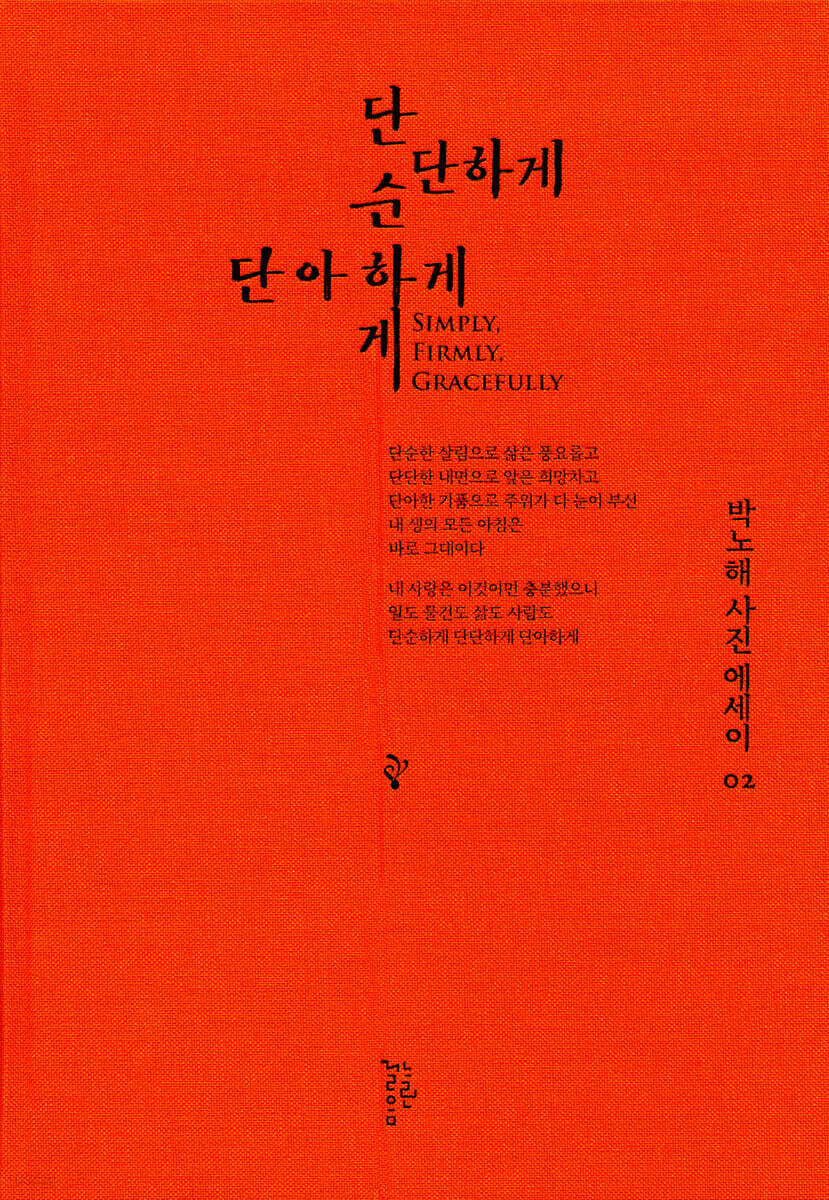
The construction of this book is also simple, solid, and elegant.
A cover with a font clearly engraved in poet Park No-hae's handwriting on a crimson cloth.
You can own an exhibition hall in your hand with black-and-white photo art prints recognized by leading European museums and publishers.
‘Photography’ transcends the borders of language.
This is why people around the world immediately connect with and are moved by poet Park No-hae's photographs.
Furthermore, in order to fully convey his ‘thoughts’, he included both English and Korean in the first volume of his photo essays, ‘One Day’.
Brother Anthony of Taize (Ahn Seon-jae), a peerless master of Korean literature translation, took charge of the English translation, meticulously capturing the rhythm and emotion of the Korean language.
At a time when Korean music, film, literature, and history are receiving worldwide attention, poet Park No-hae is conveying the dignity of Korean literature to the world through his beautiful and profound works.
[La Gallery] exhibition where you can directly view the 37 works included in the book
The accumulated number of visitors to the 'Park No-hae Photo Exhibition', which is celebrating its 10th anniversary this year, is approximately 270,000.
The 37 photographs included in this photo essay can be seen at the exhibition “Simply, Firmly, Elegantly” (January 15-June 28, 2020, [La Cafe Gallery], Tongui-dong, Jongno-gu), which opens on January 15, 2020.
As I appreciate the authentic analog black-and-white photography, each developed by a craftsman, and the poet Park No-hae's writings that amplify the emotion of the photographs, along with the melodies of world music carefully selected by the poet himself, I feel as if I am taking a step closer to the depths of my heart.
Maybe that's why.
Visitors call [La Gallery], where Park No-hae's photography exhibition is permanently held, "the pilgrimage of my soul."
In the new year, let's make work, things, life, and people 'simple, solid, and elegant.'
As we open this book by poet Park No-hae to welcome the new year, I hope we can ask ourselves the question, “Is my life simple, solid, or elegant?”
“Every morning of my life, dazzling with hope and elegance, rich and strong in a simple life, is you.
My love was enough for this.
“Work, things, life, and people, simply, firmly, and elegantly.” (Park No-hae, from “Simply, Firmly, and Elegantly”) If I keep this book by my side and read it throughout the year, it will be a book that will brighten my daily life and my heart like a light.
Do you make bad out of good or do you make good out of bad?
Do you make simple things complicated or do you make complex things simple?
Do you blossom the heart of material things or sell your heart to accumulate material things?
The best life skills are always those that blossom into the richest life with the simplest things.
So my questions are just three:
Is it simple, solid, or elegant?
“Work, things, life, people.”
- Park No-hae, from “Simply, Firmly, and Elegantly”
Poet Park No-hae's new book will be a milestone in your life this New Year.
Sometimes, a single book can become a milestone in life.
Poet Park No-hae, who delivered shocking emotions to an era and shook the souls of millions of readers with his 1984 poetry collection, “Labor’s Dawn,” his 1997 prison essay, “Only People Are Hope,” and his 2010 poetry collection, “So Don’t Disappear.”
In the new year of 2020, his new book was published.
[Park No-hae Photo Essay 02] ‘Simply, firmly, and elegantly.’
This is the second book following [Park No-hae Photo Essay 01] 『One Day』, which was published in October of last year and sold out its first edition of 3,000 copies in just three weeks, and is currently in its fourth edition.
Poet Park No-hae's "Earth Age Wandering Notes," written over the past 20 years.
Revolutionary Park No-hae, who was arrested, tortured, and sentenced to life imprisonment in the 1991 South Korean Socialist Workers' Alliance (SANO) incident.
After being released from solitary confinement in 1998 and becoming a free man, he turned his back on the path to power, saying, “I will not sell the past to live in the present,” and walked the “pilgrimage of love” as a “wanderer of the Earth Age” for over 20 years.
I walked through the most remote, highest, and deepest villages on Earth, villages that are not even on maps, and captured the prototype of a good life that we have lost with a black and white camera and fountain pen.
The new book, "Simply, Strongly, and Elegantly," features 37 black-and-white photographs and stories of people from 12 countries around the world, including Sudan, Indonesia, Peru, and Pakistan, who live abundantly with simple living, hopeful lives with a strong inner self, and dazzling lives with elegant elegance, even in the midst of poverty and hardship.
Photos and text that make you reflect on "What kind of life is a rich life?"
What are the "simplicity, strength, and elegance" captured by poet Park No-hae? The "simple" daily life of a monk who entered a cloistered monastery at the age of eighteen and dedicated his life to poverty, labor, and silent prayer before passing away; the "firm" gestures of an Ethiopian boy balancing on a single pole as he navigates Lake Tana, the source of the Blue Nile; the flower-like smile and "graceful" demeanor of a Burmese woman who built a house and cultivated a lotus field with her own hands, even on a muddy ground.
In this way, the photographs recorded by poet Park No-hae with a gentle gaze capture the lives of the people of Earth Village, living a simple life brought about by poverty, a solid life forged by hardship, and an elegant life conceived by loneliness.
Through this, we are able to meditate on what kind of life is a rich life and the life we truly want to live.
Bringing the quality of Korean literature to the world with beautiful covers, art printing, and simultaneous Korean-English editions.
The construction of this book is also simple, solid, and elegant.
A cover with a font clearly engraved in poet Park No-hae's handwriting on a crimson cloth.
You can own an exhibition hall in your hand with black-and-white photo art prints recognized by leading European museums and publishers.
‘Photography’ transcends the borders of language.
This is why people around the world immediately connect with and are moved by poet Park No-hae's photographs.
Furthermore, in order to fully convey his ‘thoughts’, he included both English and Korean in the first volume of his photo essays, ‘One Day’.
Brother Anthony of Taize (Ahn Seon-jae), a peerless master of Korean literature translation, took charge of the English translation, meticulously capturing the rhythm and emotion of the Korean language.
At a time when Korean music, film, literature, and history are receiving worldwide attention, poet Park No-hae is conveying the dignity of Korean literature to the world through his beautiful and profound works.
[La Gallery] exhibition where you can directly view the 37 works included in the book
The accumulated number of visitors to the 'Park No-hae Photo Exhibition', which is celebrating its 10th anniversary this year, is approximately 270,000.
The 37 photographs included in this photo essay can be seen at the exhibition “Simply, Firmly, Elegantly” (January 15-June 28, 2020, [La Cafe Gallery], Tongui-dong, Jongno-gu), which opens on January 15, 2020.
As I appreciate the authentic analog black-and-white photography, each developed by a craftsman, and the poet Park No-hae's writings that amplify the emotion of the photographs, along with the melodies of world music carefully selected by the poet himself, I feel as if I am taking a step closer to the depths of my heart.
Maybe that's why.
Visitors call [La Gallery], where Park No-hae's photography exhibition is permanently held, "the pilgrimage of my soul."
In the new year, let's make work, things, life, and people 'simple, solid, and elegant.'
As we open this book by poet Park No-hae to welcome the new year, I hope we can ask ourselves the question, “Is my life simple, solid, or elegant?”
“Every morning of my life, dazzling with hope and elegance, rich and strong in a simple life, is you.
My love was enough for this.
“Work, things, life, and people, simply, firmly, and elegantly.” (Park No-hae, from “Simply, Firmly, and Elegantly”) If I keep this book by my side and read it throughout the year, it will be a book that will brighten my daily life and my heart like a light.
GOODS SPECIFICS
- Date of issue: January 16, 2020
- Format: Hardcover book binding method guide
- Page count, weight, size: 128 pages | 380g | 150*215*15mm
- ISBN13: 9788991418271
- ISBN10: 8991418279
You may also like
카테고리
korean


korean

![GQ KOREA Mark (Monthly): December [2025]](http://librairie.coreenne.fr/cdn/shop/files/8ef265dbbfbf186523ed75ba7319009d.jpg?v=1765340328&width=3840)


