

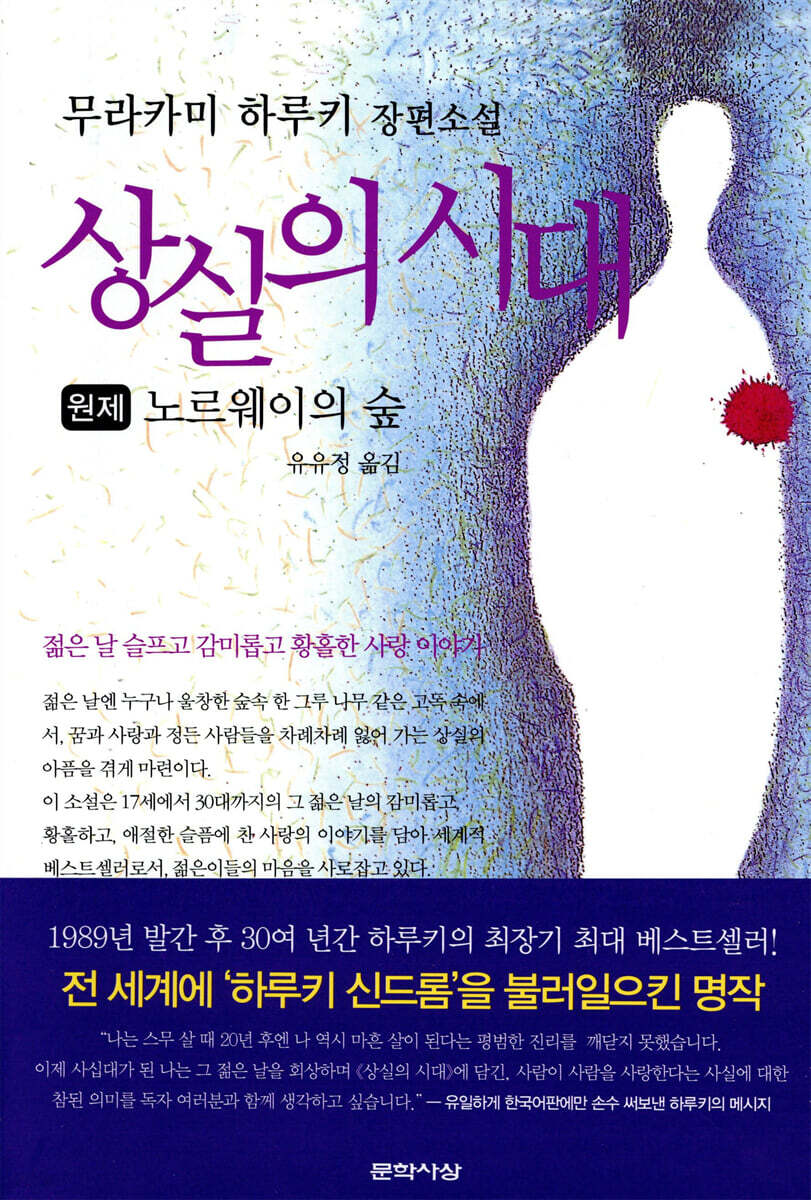
The Age of Loss
 |
Description
Book Introduction
Haruki Murakami's masterpiece, which movingly depicts the wanderings of today's young generation and the sense of loss they feel.
Haruki Murakami's novel, which opened a new chapter in literature, is a huge bestseller that sold 6 million copies in Japan and is widely read in Korea as a must-read for twenty-year-olds.
The death of a friend, a college dispute, and relationships with three women of different images.
By the time you reach the last page of the book, you will find yourself growing up along with the main character.
Haruki Murakami's novel, which opened a new chapter in literature, is a huge bestseller that sold 6 million copies in Japan and is widely read in Korea as a must-read for twenty-year-olds.
The death of a friend, a college dispute, and relationships with three women of different images.
By the time you reach the last page of the book, you will find yourself growing up along with the main character.
- You can preview some of the book's contents.
Preview
index
1.
Naoko in a hazy memory from 18 years ago
2.
The spring day when I was seventeen and faced death
3.
'Firefly' Flying Through Lost Time
4.
Midori, a vibrant woman with a vibrant spirit
5.
The disappearance of Naoko, who suffers from a mental illness
6.
Naoko and Reiko met at a nursing home
7.
Midori, so close yet so far
8.
Parallel lines drawn by Nagasawa and Hatsumi
9.
A night spent like Midori and the Puritans
10.
On the brink of conflict
11.
Where am I now
Naoko in a hazy memory from 18 years ago
2.
The spring day when I was seventeen and faced death
3.
'Firefly' Flying Through Lost Time
4.
Midori, a vibrant woman with a vibrant spirit
5.
The disappearance of Naoko, who suffers from a mental illness
6.
Naoko and Reiko met at a nursing home
7.
Midori, so close yet so far
8.
Parallel lines drawn by Nagasawa and Hatsumi
9.
A night spent like Midori and the Puritans
10.
On the brink of conflict
11.
Where am I now
Into the book
Certainly it was true.
As we live, we simultaneously cultivate death.
But that was only part of the truth we had to learn.
What Naoko's death taught me is that no truth can heal the grief of losing a loved one.
No truth, no sincerity, no strength, no gentleness can heal that sorrow.
All we can do is grieve that grief to the fullest and learn something from it, and what we learn will be of no help to the next unexpected grief.
As we live, we simultaneously cultivate death.
But that was only part of the truth we had to learn.
What Naoko's death taught me is that no truth can heal the grief of losing a loved one.
No truth, no sincerity, no strength, no gentleness can heal that sorrow.
All we can do is grieve that grief to the fullest and learn something from it, and what we learn will be of no help to the next unexpected grief.
--- p.413
But of course I had no idea what he really wanted to say.
Maybe he mistook me for someone else.
In any case, he died on a cold, rainy Friday morning, so there is now no way to know what the truth was.
I imagined that perhaps he would have shrunk even smaller when he took his last breath.
And it would have been reduced to a handful of ash in the incinerator.
But of course I had no idea what he really wanted to say.
Maybe he mistook me for someone else.
In any case, he died on a cold, rainy Friday morning, so there is now no way to know what the truth was.
I imagined that perhaps he would have shrunk even smaller when he took his last breath.
And it would have been reduced to a handful of ash in the incinerator.
Maybe he mistook me for someone else.
In any case, he died on a cold, rainy Friday morning, so there is now no way to know what the truth was.
I imagined that perhaps he would have shrunk even smaller when he took his last breath.
And it would have been reduced to a handful of ash in the incinerator.
But of course I had no idea what he really wanted to say.
Maybe he mistook me for someone else.
In any case, he died on a cold, rainy Friday morning, so there is now no way to know what the truth was.
I imagined that perhaps he would have shrunk even smaller when he took his last breath.
And it would have been reduced to a handful of ash in the incinerator.
--- p.332
Death is not the opposite extreme of life, but rather exists as a part of it.
Until then, I had understood death as an independent entity completely separate from life.
That is, 'death will surely seize us in its grasp someday.
But conversely, until the day death takes hold of us, we are not caught by death.'
It seemed to me a perfectly natural and logical proposition.
Life is here, death is there.
I am on this side, and not on that side.
But with the night Kizuki died as the boundary, I can no longer simply understand death (and life) in that way.
Death was not something that existed on the other side of life.
Death is something inherent in the very being of 'me', and no matter how hard I try, I cannot forget that fact.
The death that took Kizuki one night in May when I was seventeen was something that also caught me by surprise.
Death is not the opposite extreme of life, but rather exists as a part of it.
Until then, I had understood death as an independent entity completely separate from life.
That is, 'death will surely seize us in its grasp someday.
But conversely, until the day death takes hold of us, we are not caught by death.'
It seemed to me a perfectly natural and logical proposition.
Life is here, death is there.
I am on this side, and not on that side.
But with the night Kizuki died as the boundary, I can no longer simply understand death (and life) in that way.
Death was not something that existed on the other side of life.
Death is something inherent in the very being of 'me', and no matter how hard I try, I cannot forget that fact.
The death that took Kizuki one night in May when I was seventeen was something that also caught me by surprise.
Until then, I had understood death as an independent entity completely separate from life.
That is, 'death will surely seize us in its grasp someday.
But conversely, until the day death takes hold of us, we are not caught by death.'
It seemed to me a perfectly natural and logical proposition.
Life is here, death is there.
I am on this side, and not on that side.
But with the night Kizuki died as the boundary, I can no longer simply understand death (and life) in that way.
Death was not something that existed on the other side of life.
Death is something inherent in the very being of 'me', and no matter how hard I try, I cannot forget that fact.
The death that took Kizuki one night in May when I was seventeen was something that also caught me by surprise.
Death is not the opposite extreme of life, but rather exists as a part of it.
Until then, I had understood death as an independent entity completely separate from life.
That is, 'death will surely seize us in its grasp someday.
But conversely, until the day death takes hold of us, we are not caught by death.'
It seemed to me a perfectly natural and logical proposition.
Life is here, death is there.
I am on this side, and not on that side.
But with the night Kizuki died as the boundary, I can no longer simply understand death (and life) in that way.
Death was not something that existed on the other side of life.
Death is something inherent in the very being of 'me', and no matter how hard I try, I cannot forget that fact.
The death that took Kizuki one night in May when I was seventeen was something that also caught me by surprise.
--- p.49
'Honey, where are you now?'
She asked in a quiet voice.
Where am I now? I lifted my head, still holding the receiver, and looked around the public phone booth.
Where am I now?
But I had no idea where that place was.
I couldn't even guess.
Where on earth am I? All I could see was countless people hurrying along, nowhere to be found.
I kept calling Midori in the middle of nowhere.
'Honey, where are you now?'
She asked in a quiet voice.
Where am I now? I lifted my head, still holding the receiver, and looked around the public phone booth.
Where am I now?
But I had no idea where that place was.
I couldn't even guess.
Where on earth am I? All I could see was countless people hurrying along, nowhere to be found.
I kept calling Midori in the middle of nowhere.
She asked in a quiet voice.
Where am I now? I lifted my head, still holding the receiver, and looked around the public phone booth.
Where am I now?
But I had no idea where that place was.
I couldn't even guess.
Where on earth am I? All I could see was countless people hurrying along, nowhere to be found.
I kept calling Midori in the middle of nowhere.
'Honey, where are you now?'
She asked in a quiet voice.
Where am I now? I lifted my head, still holding the receiver, and looked around the public phone booth.
Where am I now?
But I had no idea where that place was.
I couldn't even guess.
Where on earth am I? All I could see was countless people hurrying along, nowhere to be found.
I kept calling Midori in the middle of nowhere.
--- p.441
Hey, can't you get up? I'm still here.
Wake up! Wake up and think! Why am I still here?
There is no pain.
There is no pain at all.
Every time I kick it, it just makes a hollow sound.
And even that sound will disappear someday.
As if everything else had eventually disappeared.
But on the Lufthansa plane at Hamburg Airport, it was kicking my head longer and harder than usual.
Get up and think about it.
Hey, can't you get up? I'm still here.
Wake up! Wake up and think! Why am I still here?
There is no pain.
There is no pain at all.
Every time I kick it, it just makes a hollow sound.
And even that sound will disappear someday.
As if everything else had eventually disappeared.
But on the Lufthansa plane at Hamburg Airport, it was kicking my head longer and harder than usual.
Get up and think about it.
Wake up! Wake up and think! Why am I still here?
There is no pain.
There is no pain at all.
Every time I kick it, it just makes a hollow sound.
And even that sound will disappear someday.
As if everything else had eventually disappeared.
But on the Lufthansa plane at Hamburg Airport, it was kicking my head longer and harder than usual.
Get up and think about it.
Hey, can't you get up? I'm still here.
Wake up! Wake up and think! Why am I still here?
There is no pain.
There is no pain at all.
Every time I kick it, it just makes a hollow sound.
And even that sound will disappear someday.
As if everything else had eventually disappeared.
But on the Lufthansa plane at Hamburg Airport, it was kicking my head longer and harder than usual.
Get up and think about it.
--- p.39
When I'm lonely, I cry.
Being able to cry is a good thing, says Reiko.
But loneliness is really painful.
When I'm lonely, all kinds of people come to me in the dark of the night and talk to me.
People come to me and talk to me like trees rustling in the wind at night.
At times like that, I talk a lot with Kizuki and my older sister.
They too are lonely and looking for someone to talk to.
When I'm lonely, I cry.
Being able to cry is a good thing, says Reiko.
But loneliness is really painful.
When I'm lonely, all kinds of people come to me in the dark of the night and talk to me.
People come to me and talk to me like trees rustling in the wind at night.
At times like that, I talk a lot with Kizuki and my older sister.
They too are lonely and looking for someone to talk to.
Being able to cry is a good thing, says Reiko.
But loneliness is really painful.
When I'm lonely, all kinds of people come to me in the dark of the night and talk to me.
People come to me and talk to me like trees rustling in the wind at night.
At times like that, I talk a lot with Kizuki and my older sister.
They too are lonely and looking for someone to talk to.
When I'm lonely, I cry.
Being able to cry is a good thing, says Reiko.
But loneliness is really painful.
When I'm lonely, all kinds of people come to me in the dark of the night and talk to me.
People come to me and talk to me like trees rustling in the wind at night.
At times like that, I talk a lot with Kizuki and my older sister.
They too are lonely and looking for someone to talk to.
--- p.358
Watanabe is a truly ordinary student.
He is neither a very handsome student nor a very bright student.
He's just an ordinary, and in some ways, dull, boring student.
But Watanabe is always surrounded by extraordinary people.
Naoko was like that, and so was Midori.
But those people who weren't so ordinary all loved Watanabe. (I also think the setting is a bit artificial, because Watanabe doesn't work or study very hard, but everyone likes him, and they all like him even though he's not good at interpersonal relationships and is almost indifferent.)
But Watanabe also has his charm.
The point is that when there is someone who is really talented, you don't act mean to them.
Watanabe's strength is that he is quick to acknowledge his own shortcomings and recognize the differences between himself and others.
But Watanabe's weakness is that he is too lenient.
Because he keeps hurting Midori by trying to play both sides of the fence between Naoko and Midori.
The most memorable part is the first sex scene with Naoko.
On Naoko's twentieth birthday, Naoko (Watanabe's close friend Kizuki's girlfriend)
However, Kizuki ended his life by suicide) and they spend the night together through an incomprehensible but magical attraction.
Naoko and Watanabe could not forget that night, and Naoko committed suicide while in a sanatorium, with that day buried deep in her heart.
It is truly impossible for me to put into words the feeling of a time of loss.
Every time I read that book again and again, I get a different feeling! That's something I can't explain.
Norwegian Wood does not appear in this book.
Norwegian Wood is just the title of a Beatles song.
This book is definitely a mysterious book that cannot be described until you read it.
Watanabe is a truly ordinary student.
He is neither a very handsome student nor a very bright student.
He's just an ordinary, and in some ways, dull, boring student.
But Watanabe is always surrounded by extraordinary people.
Naoko was like that, and so was Midori.
But those people who weren't so ordinary all loved Watanabe. (I also think the setting is a bit artificial, because Watanabe doesn't work or study very hard, but everyone likes him, and they all like him even though he's not good at interpersonal relationships and is almost indifferent.)
But Watanabe also has his charm.
The point is that when there is someone who is really talented, you don't act mean to them.
Watanabe's strength is that he is quick to acknowledge his own shortcomings and recognize the differences between himself and others.
But Watanabe's weakness is that he is too lenient.
Because he keeps hurting Midori by trying to play both sides of the fence between Naoko and Midori.
The most memorable part is the first sex scene with Naoko.
On Naoko's twentieth birthday, Naoko (Watanabe's close friend Kizuki's girlfriend)
However, Kizuki ended his life by suicide) and they spend the night together through an incomprehensible but magical attraction.
Naoko and Watanabe could not forget that night, and Naoko committed suicide while in a sanatorium, with that day buried deep in her heart.
It is truly impossible for me to put into words the feeling of a time of loss.
Every time I read that book again and again, I get a different feeling! That's something I can't explain.
Norwegian Wood does not appear in this book.
Norwegian Wood is just the title of a Beatles song.
This book is definitely a mysterious book that cannot be described until you read it.
He is neither a very handsome student nor a very bright student.
He's just an ordinary, and in some ways, dull, boring student.
But Watanabe is always surrounded by extraordinary people.
Naoko was like that, and so was Midori.
But those people who weren't so ordinary all loved Watanabe. (I also think the setting is a bit artificial, because Watanabe doesn't work or study very hard, but everyone likes him, and they all like him even though he's not good at interpersonal relationships and is almost indifferent.)
But Watanabe also has his charm.
The point is that when there is someone who is really talented, you don't act mean to them.
Watanabe's strength is that he is quick to acknowledge his own shortcomings and recognize the differences between himself and others.
But Watanabe's weakness is that he is too lenient.
Because he keeps hurting Midori by trying to play both sides of the fence between Naoko and Midori.
The most memorable part is the first sex scene with Naoko.
On Naoko's twentieth birthday, Naoko (Watanabe's close friend Kizuki's girlfriend)
However, Kizuki ended his life by suicide) and they spend the night together through an incomprehensible but magical attraction.
Naoko and Watanabe could not forget that night, and Naoko committed suicide while in a sanatorium, with that day buried deep in her heart.
It is truly impossible for me to put into words the feeling of a time of loss.
Every time I read that book again and again, I get a different feeling! That's something I can't explain.
Norwegian Wood does not appear in this book.
Norwegian Wood is just the title of a Beatles song.
This book is definitely a mysterious book that cannot be described until you read it.
Watanabe is a truly ordinary student.
He is neither a very handsome student nor a very bright student.
He's just an ordinary, and in some ways, dull, boring student.
But Watanabe is always surrounded by extraordinary people.
Naoko was like that, and so was Midori.
But those people who weren't so ordinary all loved Watanabe. (I also think the setting is a bit artificial, because Watanabe doesn't work or study very hard, but everyone likes him, and they all like him even though he's not good at interpersonal relationships and is almost indifferent.)
But Watanabe also has his charm.
The point is that when there is someone who is really talented, you don't act mean to them.
Watanabe's strength is that he is quick to acknowledge his own shortcomings and recognize the differences between himself and others.
But Watanabe's weakness is that he is too lenient.
Because he keeps hurting Midori by trying to play both sides of the fence between Naoko and Midori.
The most memorable part is the first sex scene with Naoko.
On Naoko's twentieth birthday, Naoko (Watanabe's close friend Kizuki's girlfriend)
However, Kizuki ended his life by suicide) and they spend the night together through an incomprehensible but magical attraction.
Naoko and Watanabe could not forget that night, and Naoko committed suicide while in a sanatorium, with that day buried deep in her heart.
It is truly impossible for me to put into words the feeling of a time of loss.
Every time I read that book again and again, I get a different feeling! That's something I can't explain.
Norwegian Wood does not appear in this book.
Norwegian Wood is just the title of a Beatles song.
This book is definitely a mysterious book that cannot be described until you read it.
--- p.
It's raining today.
Rainy Sundays make me a little confused.
When it rains, I can't do laundry or iron.
I can't go for a walk, and I can't roll around on the roof.
All I can do is sit at my desk, put it on auto-repeat, listen to it over and over again, and stare blankly at the rainy yard scenery.
As I've written before, I don't wind my watch on Sundays.
It's raining today.
Rainy Sundays make me a little confused.
When it rains, I can't do laundry or iron.
I can't go for a walk, and I can't roll around on the roof.
All I can do is sit at my desk, put it on auto-repeat, listen to it over and over again, and stare blankly at the rainy yard scenery.
As I've written before, I don't wind my watch on Sundays.
Rainy Sundays make me a little confused.
When it rains, I can't do laundry or iron.
I can't go for a walk, and I can't roll around on the roof.
All I can do is sit at my desk, put it on auto-repeat, listen to it over and over again, and stare blankly at the rainy yard scenery.
As I've written before, I don't wind my watch on Sundays.
It's raining today.
Rainy Sundays make me a little confused.
When it rains, I can't do laundry or iron.
I can't go for a walk, and I can't roll around on the roof.
All I can do is sit at my desk, put it on auto-repeat, listen to it over and over again, and stare blankly at the rainy yard scenery.
As I've written before, I don't wind my watch on Sundays.
--- p.337
He said that perhaps there is something like a hard shell inside my mind, and only a very limited number of people can break through it and get inside.
So, he said that he started to think that maybe he couldn't love people properly.
'Have you ever loved anyone?' she asked.
'doesn't exist.'
She didn't ask anything more.
As autumn ended and the cold wind blew through the streets, she would sometimes lean against my arm.
He said that perhaps there is something like a hard shell inside my mind, and only a very limited number of people can break through it and get inside.
So, he said that he started to think that maybe he couldn't love people properly.
'Have you ever loved anyone?' she asked.
'doesn't exist.'
She didn't ask anything more.
As autumn ended and the cold wind blew through the streets, she would sometimes lean against my arm.
So, he said that he started to think that maybe he couldn't love people properly.
'Have you ever loved anyone?' she asked.
'doesn't exist.'
She didn't ask anything more.
As autumn ended and the cold wind blew through the streets, she would sometimes lean against my arm.
He said that perhaps there is something like a hard shell inside my mind, and only a very limited number of people can break through it and get inside.
So, he said that he started to think that maybe he couldn't love people properly.
'Have you ever loved anyone?' she asked.
'doesn't exist.'
She didn't ask anything more.
As autumn ended and the cold wind blew through the streets, she would sometimes lean against my arm.
--- p.54-55
The bill is only now coming back to me because I didn't pay the price when I had to go through the pains of growing up.
So that's how it happened for Kizuki, and here I am.
We were like naked children growing up on a deserted island.
When we were hungry, we ate bananas, and when we were lonely, we fell asleep in each other's arms.
But how long can this continue? We have to keep growing and entering society.
So you were important to us.
You were the link that connected us to the outside world.
In the end, it didn't work out... (omitted) Of course, Kizuki is dead and no longer in this world, but you are still the beneficial link connecting me to the outside world, even now.
And just as Kizuki liked you, I like you too. And even though I had no intention of doing so, we may have ended up hurting you.
But I never imagined it would turn out that way. I didn't pay the price for things like the pain of growing up, and now the bill is finally coming back to me.
So that's how it happened for Kizuki, and here I am.
We were like naked children growing up on a deserted island.
When we were hungry, we ate bananas, and when we were lonely, we fell asleep in each other's arms.
But how long can this continue? We have to keep growing and entering society.
So you were important to us.
You were the link that connected us to the outside world.
In the end, it didn't work out... (omitted) Of course, Kizuki is dead and no longer in this world, but you are still the beneficial link connecting me to the outside world, even now.
And just as Kizuki liked you, I like you too. And even though I had no intention of doing so, we may have ended up hurting you.
But I never imagined it would turn out like that
So that's how it happened for Kizuki, and here I am.
We were like naked children growing up on a deserted island.
When we were hungry, we ate bananas, and when we were lonely, we fell asleep in each other's arms.
But how long can this continue? We have to keep growing and entering society.
So you were important to us.
You were the link that connected us to the outside world.
In the end, it didn't work out... (omitted) Of course, Kizuki is dead and no longer in this world, but you are still the beneficial link connecting me to the outside world, even now.
And just as Kizuki liked you, I like you too. And even though I had no intention of doing so, we may have ended up hurting you.
But I never imagined it would turn out that way. I didn't pay the price for things like the pain of growing up, and now the bill is finally coming back to me.
So that's how it happened for Kizuki, and here I am.
We were like naked children growing up on a deserted island.
When we were hungry, we ate bananas, and when we were lonely, we fell asleep in each other's arms.
But how long can this continue? We have to keep growing and entering society.
So you were important to us.
You were the link that connected us to the outside world.
In the end, it didn't work out... (omitted) Of course, Kizuki is dead and no longer in this world, but you are still the beneficial link connecting me to the outside world, even now.
And just as Kizuki liked you, I like you too. And even though I had no intention of doing so, we may have ended up hurting you.
But I never imagined it would turn out like that
--- p.229-230
The rain continued until morning.
Unlike last night, it was a light autumn rain that was barely visible.
I could barely tell that it was raining by the water patterns in the puddles and the sound of the drops dripping from the eaves.
When I opened my eyes, a milky fog hung outside the window, but as the sun rose, the fog was driven away by the wind, and the forest and mountain ridges gradually came into view.
Just like yesterday morning, the three of us had breakfast and then went to the birdhouse to look after the birds.
Naoko and Reiko wore plastic raincoats with hoods, and I wore a waterproof windbreaker over my sweater.
The air was damp and chilly.
The birds, too, seemed to be trying to avoid the rain, flocking deep into their nests and leaning against each other.
The rain continued until morning.
Unlike last night, it was a light autumn rain that was barely visible.
I could barely tell that it was raining by the water patterns in the puddles and the sound of the drops dripping from the eaves.
When I opened my eyes, a milky fog hung outside the window, but as the sun rose, the fog was driven away by the wind, and the forest and mountain ridges gradually came into view.
Just like yesterday morning, the three of us had breakfast and then went to the birdhouse to look after the birds.
Naoko and Reiko wore plastic raincoats with hoods, and I wore a waterproof windbreaker over my sweater.
The air was damp and chilly.
The birds, too, seemed to be trying to avoid the rain, flocking deep into their nests and leaning against each other.
Unlike last night, it was a light autumn rain that was barely visible.
I could barely tell that it was raining by the water patterns in the puddles and the sound of the drops dripping from the eaves.
When I opened my eyes, a milky fog hung outside the window, but as the sun rose, the fog was driven away by the wind, and the forest and mountain ridges gradually came into view.
Just like yesterday morning, the three of us had breakfast and then went to the birdhouse to look after the birds.
Naoko and Reiko wore plastic raincoats with hoods, and I wore a waterproof windbreaker over my sweater.
The air was damp and chilly.
The birds, too, seemed to be trying to avoid the rain, flocking deep into their nests and leaning against each other.
The rain continued until morning.
Unlike last night, it was a light autumn rain that was barely visible.
I could barely tell that it was raining by the water patterns in the puddles and the sound of the drops dripping from the eaves.
When I opened my eyes, a milky fog hung outside the window, but as the sun rose, the fog was driven away by the wind, and the forest and mountain ridges gradually came into view.
Just like yesterday morning, the three of us had breakfast and then went to the birdhouse to look after the birds.
Naoko and Reiko wore plastic raincoats with hoods, and I wore a waterproof windbreaker over my sweater.
The air was damp and chilly.
The birds, too, seemed to be trying to avoid the rain, flocking deep into their nests and leaning against each other.
--- p.257
Fresh air, a quiet world isolated from the outside world, a regular life, daily exercise—I think those were the things I needed.
It's a great thing to be able to write a letter to someone.
It's a wonderful thing to be able to sit down at a desk, pick up a pen, and write something like this to convey your thoughts to someone.
Of course, when I write it down, it seems like I only expressed a small part of what I wanted to say, but I think that's okay.
Just the feeling of wanting to write something to someone makes me happy right now.
So I am writing to you now like this.
Fresh air, a quiet world isolated from the outside world, a regular life, daily exercise—I think those were the things I needed.
It's a great thing to be able to write a letter to someone.
It's a wonderful thing to be able to sit down at a desk, pick up a pen, and write something like this to convey your thoughts to someone.
Of course, when I write it down, it seems like I only expressed a small part of what I wanted to say, but I think that's okay.
Just the feeling of wanting to write something to someone makes me happy right now.
So I am writing to you now like this.
It's a great thing to be able to write a letter to someone.
It's a wonderful thing to be able to sit down at a desk, pick up a pen, and write something like this to convey your thoughts to someone.
Of course, when I write it down, it seems like I only expressed a small part of what I wanted to say, but I think that's okay.
Just the feeling of wanting to write something to someone makes me happy right now.
So I am writing to you now like this.
Fresh air, a quiet world isolated from the outside world, a regular life, daily exercise—I think those were the things I needed.
It's a great thing to be able to write a letter to someone.
It's a wonderful thing to be able to sit down at a desk, pick up a pen, and write something like this to convey your thoughts to someone.
Of course, when I write it down, it seems like I only expressed a small part of what I wanted to say, but I think that's okay.
Just the feeling of wanting to write something to someone makes me happy right now.
So I am writing to you now like this.
--- p.166-167
What I wanted to draw was what it means for a person to love another person.
That is the concise theme of this novel.
However, I wanted to portray the atmosphere that surrounded an era.
Because to truly love someone means confronting the weight of the ego and also confronting the weight of external society head-on.
What I wanted to draw was what it means for a person to love another person.
That is the concise theme of this novel.
However, I wanted to portray the atmosphere that surrounded an era.
Because to truly love someone means confronting the weight of the ego and also confronting the weight of external society head-on.
That is the concise theme of this novel.
However, I wanted to portray the atmosphere that surrounded an era.
Because to truly love someone means confronting the weight of the ego and also confronting the weight of external society head-on.
What I wanted to draw was what it means for a person to love another person.
That is the concise theme of this novel.
However, I wanted to portray the atmosphere that surrounded an era.
Because to truly love someone means confronting the weight of the ego and also confronting the weight of external society head-on.
--- From Haruki Murakami
I had been resting my forehead against the window and keeping my eyes closed all this time.
Then, after a while, Midori opened her mouth.
'Where are you now?'
She asked in a quiet voice.
Where am I now? I lifted my head, holding the receiver, and looked around the payphone.
Where am I now?
But I had no idea where that place was. I couldn't even guess... I was still calling out to Midori in the middle of nowhere.
I had been resting my forehead against the window and keeping my eyes closed all this time.
Then, after a while, Midori opened her mouth.
'Where are you now?'
She asked in a quiet voice.
Where am I now? I lifted my head, holding the receiver, and looked around the payphone.
Where am I now?
But I had no idea where that place was. I couldn't even guess... I was still calling out to Midori in the middle of nowhere.
Then, after a while, Midori opened her mouth.
'Where are you now?'
She asked in a quiet voice.
Where am I now? I lifted my head, holding the receiver, and looked around the payphone.
Where am I now?
But I had no idea where that place was. I couldn't even guess... I was still calling out to Midori in the middle of nowhere.
I had been resting my forehead against the window and keeping my eyes closed all this time.
Then, after a while, Midori opened her mouth.
'Where are you now?'
She asked in a quiet voice.
Where am I now? I lifted my head, holding the receiver, and looked around the payphone.
Where am I now?
But I had no idea where that place was. I couldn't even guess... I was still calling out to Midori in the middle of nowhere.
--- p.468
I haven't heard a word from the other end of the phone in a while.
There was only silence, as if a light rain from all over the world was falling on the lawns of the entire planet.
All this time I had my forehead pressed against the glass window and my eyes closed.
Then, after a while, Midori opened her mouth.
“Where are you now?” she asked in a quiet voice.
Where am I now? I looked around the payphone, my face raised, the receiver still in my hand.
Where am I now?
--- p.468,---pp,14-20,---I have to think only about continuing to live. During that time, there was no word from the other end of the phone.
There was only silence, as if a light rain from all over the world was falling on the lawns of the entire planet.
All this time I had my forehead pressed against the glass window and my eyes closed.
Then, after a while, Midori opened her mouth.
“Where are you now?” she asked in a quiet voice.
Where am I now? I looked around the payphone, my face raised, the receiver still in my hand.
Where am I now?
--- p.468,---pp,14-20,---From "You must only think about continuing to live"
There was only silence, as if a light rain from all over the world was falling on the lawns of the entire planet.
All this time I had my forehead pressed against the glass window and my eyes closed.
Then, after a while, Midori opened her mouth.
“Where are you now?” she asked in a quiet voice.
Where am I now? I looked around the payphone, my face raised, the receiver still in my hand.
Where am I now?
--- p.468,---pp,14-20,---I have to think only about continuing to live. During that time, there was no word from the other end of the phone.
There was only silence, as if a light rain from all over the world was falling on the lawns of the entire planet.
All this time I had my forehead pressed against the glass window and my eyes closed.
Then, after a while, Midori opened her mouth.
“Where are you now?” she asked in a quiet voice.
Where am I now? I looked around the payphone, my face raised, the receiver still in my hand.
Where am I now?
--- p.468,---pp,14-20,---From "You must only think about continuing to live"
--- p.468, --- p.14-20
When Kizuki died, I learned one thing from his death.
And I learned it with resignation.
Or I thought I had learned it.
It was like this.
'Death is not the opposite of life, but rather it is latent within our lives.'
Certainly it was true.
By living, we are simultaneously fostering death.
But that was only part of the truth we had to learn.
This is what Naoko's death taught me.
No truth can heal the sorrow of losing a loved one.
No truth, no sincerity, no strength, no gentleness can heal that sorrow.
All we can do is grieve that grief to the fullest and learn something from it, and what we learn will be of no help to the unexpected grief that comes next.
When Kizuki died, I learned one thing from his death.
And I learned it with resignation.
Or I thought I had learned it.
It was like this.
'Death is not the opposite of life, but rather it is latent within our lives.'
Certainly it was true.
By living, we are simultaneously fostering death.
But that was only part of the truth we had to learn.
This is what Naoko's death taught me.
No truth can heal the sorrow of losing a loved one.
No truth, no sincerity, no strength, no gentleness can heal that sorrow.
All we can do is grieve that grief to the fullest and learn something from it, and what we learn will be of no help to the unexpected grief that comes next.
And I learned it with resignation.
Or I thought I had learned it.
It was like this.
'Death is not the opposite of life, but rather it is latent within our lives.'
Certainly it was true.
By living, we are simultaneously fostering death.
But that was only part of the truth we had to learn.
This is what Naoko's death taught me.
No truth can heal the sorrow of losing a loved one.
No truth, no sincerity, no strength, no gentleness can heal that sorrow.
All we can do is grieve that grief to the fullest and learn something from it, and what we learn will be of no help to the unexpected grief that comes next.
When Kizuki died, I learned one thing from his death.
And I learned it with resignation.
Or I thought I had learned it.
It was like this.
'Death is not the opposite of life, but rather it is latent within our lives.'
Certainly it was true.
By living, we are simultaneously fostering death.
But that was only part of the truth we had to learn.
This is what Naoko's death taught me.
No truth can heal the sorrow of losing a loved one.
No truth, no sincerity, no strength, no gentleness can heal that sorrow.
All we can do is grieve that grief to the fullest and learn something from it, and what we learn will be of no help to the unexpected grief that comes next.
--- p.440
Towards the end of that month, the 'Assault Team' gave me a firefly.
The firefly was in a bottle of instant coffee.
The bottle contained a few leaves and water, and the lid had a few small air holes in it.
Towards the end of that month, the 'Assault Team' gave me a firefly.
The firefly was in a bottle of instant coffee.
The bottle contained a few leaves and water, and the lid had a few small air holes in it.
The firefly was in a bottle of instant coffee.
The bottle contained a few leaves and water, and the lid had a few small air holes in it.
Towards the end of that month, the 'Assault Team' gave me a firefly.
The firefly was in a bottle of instant coffee.
The bottle contained a few leaves and water, and the lid had a few small air holes in it.
--- From the text
In mid-April, Naoko turned twenty.
Since I was born in November, that means I'm about 7 months older than him.
It felt strange that she was turning twenty.
I thought it would be better for her to be somewhere between eighteen and nineteen years old.
After eighteen comes nineteen, and after nineteen comes eighteen—that would be nice.
But anyway, she turned twenty.
And in the fall, I will be twenty years old.
Only Kizuki, who was already dead, remained seventeen years old.
In mid-April, Naoko turned twenty.
Since I was born in November, that means I'm about 7 months older than him.
It felt strange that she was turning twenty.
I thought it would be better for her to be somewhere between eighteen and nineteen years old.
After eighteen comes nineteen, and after nineteen comes eighteen—that would be nice.
But anyway, she turned twenty.
And in the fall, I will be twenty years old.
Only Kizuki, who was already dead, remained seventeen years old.
Since I was born in November, that means I'm about 7 months older than him.
It felt strange that she was turning twenty.
I thought it would be better for her to be somewhere between eighteen and nineteen years old.
After eighteen comes nineteen, and after nineteen comes eighteen—that would be nice.
But anyway, she turned twenty.
And in the fall, I will be twenty years old.
Only Kizuki, who was already dead, remained seventeen years old.
In mid-April, Naoko turned twenty.
Since I was born in November, that means I'm about 7 months older than him.
It felt strange that she was turning twenty.
I thought it would be better for her to be somewhere between eighteen and nineteen years old.
After eighteen comes nineteen, and after nineteen comes eighteen—that would be nice.
But anyway, she turned twenty.
And in the fall, I will be twenty years old.
Only Kizuki, who was already dead, remained seventeen years old.
--- p.
I want to make stew for you
I don't have a pot
I want to knit a muffler for you
I don't have any yarn
I want to write a poem for you
I don't have a pen
I want to make stew for you
I don't have a pot
I want to knit a muffler for you
I don't have any yarn
I want to write a poem for you
I don't have a pen
--- p.149
'...In Naoko's case, various problems are somewhat complicated and tangled like a tangled web, so it takes effort to unravel them one by one.
It might take a long time to solve it, and maybe it will finally be solved at some point...'
(syncopation)
She once again picked up the basketball and spun it around, then bounced it on the ground.
“The most important thing is not to rush,” Reiko told me.
'If this is another piece of advice I can give, then it's advice.
You shouldn't rush.
Even if things are so tangled that you don't know what to do, don't give in to despair or get impatient and try to force things.
You have to take your time and slowly unravel them one by one.
Can you do it?'
Let's try
'It may take time, and even if you take time, it may not be completely fixed.
Student, have you ever thought about that?'
I nodded.
"Waiting isn't easy," Reiko said, bouncing the ball.
'Especially for people of student age.
Because all I have to do is wait patiently for her to get better.
That doesn't mean there's a time limit or guarantee.
"Can a student do that? Do you love Naoko enough to do that?"
“I don’t know,” I said honestly.
'I really don't know what it means to love someone.
I mean, in a different sense from what Naoko said.
But I'll try my best.
If I don't do that, I don't know where I should go.
Anyway, as Reiko-san said earlier, Naoko and I need to help each other, and it seems like that's the only way to save each other. '...In Naoko's case, there are a lot of complicated problems, tangled like strings, so it's going to take a lot of effort to unravel them one by one.
It might take a long time to solve it, and maybe it will finally be solved at some point...'
(syncopation)
She once again picked up the basketball and spun it around, then bounced it on the ground.
“The most important thing is not to rush,” Reiko told me.
'If this is another piece of advice I can give, then it's advice.
You shouldn't rush.
Even if things are so tangled that you don't know what to do, don't give in to despair or get impatient and try to force things.
You have to take your time and slowly unravel them one by one.
Can you do it?'
Let's try
'It may take time, and even if you take time, it may not be completely fixed.
Student, have you ever thought about that?'
I nodded.
"Waiting isn't easy," Reiko said, bouncing the ball.
'Especially for people of student age.
Because all I have to do is wait patiently for her to get better.
That doesn't mean there's a time limit or guarantee.
"Can a student do that? Do you love Naoko enough to do that?"
“I don’t know,” I said honestly.
'I really don't know what it means to love someone.
I mean, in a different sense from what Naoko said.
But I'll try my best.
If I don't do that, I don't know where I should go.
Anyway, as Reiko-san said earlier, Naoko and I need to help each other, and it seems like that's the only way we can save each other.'
It might take a long time to solve it, and maybe it will finally be solved at some point...'
(syncopation)
She once again picked up the basketball and spun it around, then bounced it on the ground.
“The most important thing is not to rush,” Reiko told me.
'If this is another piece of advice I can give, then it's advice.
You shouldn't rush.
Even if things are so tangled that you don't know what to do, don't give in to despair or get impatient and try to force things.
You have to take your time and slowly unravel them one by one.
Can you do it?'
Let's try
'It may take time, and even if you take time, it may not be completely fixed.
Student, have you ever thought about that?'
I nodded.
"Waiting isn't easy," Reiko said, bouncing the ball.
'Especially for people of student age.
Because all I have to do is wait patiently for her to get better.
That doesn't mean there's a time limit or guarantee.
"Can a student do that? Do you love Naoko enough to do that?"
“I don’t know,” I said honestly.
'I really don't know what it means to love someone.
I mean, in a different sense from what Naoko said.
But I'll try my best.
If I don't do that, I don't know where I should go.
Anyway, as Reiko-san said earlier, Naoko and I need to help each other, and it seems like that's the only way to save each other. '...In Naoko's case, there are a lot of complicated problems, tangled like strings, so it's going to take a lot of effort to unravel them one by one.
It might take a long time to solve it, and maybe it will finally be solved at some point...'
(syncopation)
She once again picked up the basketball and spun it around, then bounced it on the ground.
“The most important thing is not to rush,” Reiko told me.
'If this is another piece of advice I can give, then it's advice.
You shouldn't rush.
Even if things are so tangled that you don't know what to do, don't give in to despair or get impatient and try to force things.
You have to take your time and slowly unravel them one by one.
Can you do it?'
Let's try
'It may take time, and even if you take time, it may not be completely fixed.
Student, have you ever thought about that?'
I nodded.
"Waiting isn't easy," Reiko said, bouncing the ball.
'Especially for people of student age.
Because all I have to do is wait patiently for her to get better.
That doesn't mean there's a time limit or guarantee.
"Can a student do that? Do you love Naoko enough to do that?"
“I don’t know,” I said honestly.
'I really don't know what it means to love someone.
I mean, in a different sense from what Naoko said.
But I'll try my best.
If I don't do that, I don't know where I should go.
Anyway, as Reiko-san said earlier, Naoko and I need to help each other, and it seems like that's the only way we can save each other.'
--- pp.187-188
I want to make stew for you
I don't have a pot
I want to knit a muffler for you
I don't have any yarn
I want to write a poem for you
I don't have a pen
I want to make stew for you
I don't have a pot
I want to knit a muffler for you
I don't have any yarn
I want to write a poem for you
I don't have a pen
--- p.149
Publisher's Review
Murakami's novel, which opened a new chapter in his literary career by calmly depicting the boundless loss and rebirth of the young generation living today with sadness and emotion, is a huge bestseller that sold 6 million copies in Japan. It features the protagonist, "I," who is not caught up in university disputes, studies, works part-time, and is good at sex, along with three women with different images, and the author's consciousness of constantly searching for something is well depicted through his relationships with Midori and Reiko.
This work has been translated and published in many countries around the world and has sold well, which has led to some saying that it is difficult to receive proper criticism.
Afterwards, discussions raged in the Japanese literary world, mainly regarding this novel as a typical genre painting of pure literature and trying to understand it as a popular phenomenon.
Sharply contrasting pros and cons arose surrounding this work.
In any era, such sharp and brilliant arguments are bound to clearly demarcate the perspectives on the contemporary era or society.
The power of Eros in a work of art fundamentally depends on the sensitivity and worldview of the human being who accepts it.
Therefore, when looking at this writer, it would be good to think of him as a touchstone for how we view the modern era.
In that case, the view that one absolutely supports this writer or does not acknowledge him at all is meaningless.
Therefore, anyone who mentions a writer like Haruki Murakami will be judged by the times only on how they defend or deny him.
This work has been translated and published in many countries around the world and has sold well, which has led to some saying that it is difficult to receive proper criticism.
Afterwards, discussions raged in the Japanese literary world, mainly regarding this novel as a typical genre painting of pure literature and trying to understand it as a popular phenomenon.
Sharply contrasting pros and cons arose surrounding this work.
In any era, such sharp and brilliant arguments are bound to clearly demarcate the perspectives on the contemporary era or society.
The power of Eros in a work of art fundamentally depends on the sensitivity and worldview of the human being who accepts it.
Therefore, when looking at this writer, it would be good to think of him as a touchstone for how we view the modern era.
In that case, the view that one absolutely supports this writer or does not acknowledge him at all is meaningless.
Therefore, anyone who mentions a writer like Haruki Murakami will be judged by the times only on how they defend or deny him.
GOODS SPECIFICS
- Date of issue: October 2, 2000
- Page count, weight, size: 514 pages | 752g | 154*225*35mm
- ISBN13: 9788970123691
- ISBN10: 8970123695
You may also like
카테고리
korean


korean

![GQ KOREA Mark (Monthly): December [2025]](http://librairie.coreenne.fr/cdn/shop/files/8ef265dbbfbf186523ed75ba7319009d.jpg?v=1765340328&width=3840)


