

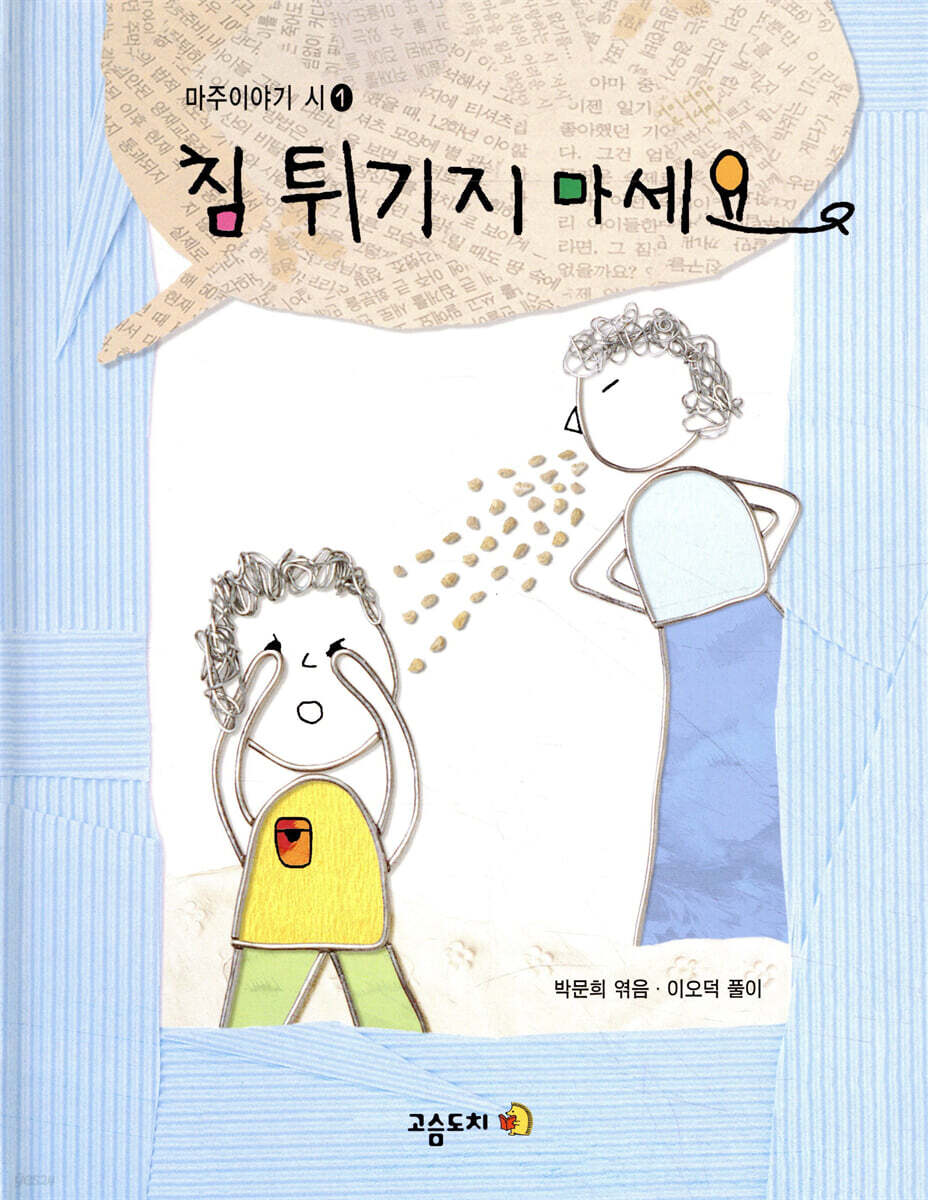
Don't spit
 |
Description
Book Introduction
The 'Facing Story Poem' included in this book is not a poem written for the purpose of writing poetry.
These are things that parents or teachers record in a notebook what children usually say every day, and the children copy and draw pictures on them.
Because these are words that come out of children's mouths naturally, it feels like they express the world of children more vividly than ordinary poems.
It is an education that fosters children's imagination and sensitivity.
These are things that parents or teachers record in a notebook what children usually say every day, and the children copy and draw pictures on them.
Because these are words that come out of children's mouths naturally, it feels like they express the world of children more vividly than ordinary poems.
It is an education that fosters children's imagination and sensitivity.
index
1.
shit road
2.
Because the tree is big
3.
Hehehe hehehe
4.
Living in a house on the ground
5.
Don't spit
shit road
2.
Because the tree is big
3.
Hehehe hehehe
4.
Living in a house on the ground
5.
Don't spit
Into the book
'I'm with my mom every day'
Even if mom is outside
My mother's heart is in Gyeongnam Apartment
Through room 609, building 1
Because I like Gwangjin
I'm with my mom
Because we're together every day
Even if mom is outside
My mother's heart is in Gyeongnam Apartment
Through room 609, building 1
Because I like Gwangjin
I'm with my mom
Because we're together every day
--- p.54
Even if mom is outside
My mother's heart is through Gyeongnam Apartment Building 1, Room 609
Because I like Gwangjin
I'm with my mom
Because we're together every day.
Even if mom is outside
My mother's heart is through Gyeongnam Apartment Building 1, Room 609
Because I like Gwangjin
I'm with my mom
Because we're together every day.
My mother's heart is through Gyeongnam Apartment Building 1, Room 609
Because I like Gwangjin
I'm with my mom
Because we're together every day.
Even if mom is outside
My mother's heart is through Gyeongnam Apartment Building 1, Room 609
Because I like Gwangjin
I'm with my mom
Because we're together every day.
--- p.54
Mom, Dad, let's play a word game.
huh?
Okay, try it.
Me first, the bike.
goose
consolation
Comforting a sick person? You're all grown up, you know that too.
No, I mean the rocket going up the mountain.
Mom, Dad, let's play a word game.
huh?
Okay, try it.
Me first, the bike.
goose
consolation
Comforting a sick person? You're all grown up, you know that too.
No, I mean the rocket going up the mountain.
huh?
Okay, try it.
Me first, the bike.
goose
consolation
Comforting a sick person? You're all grown up, you know that too.
No, I mean the rocket going up the mountain.
Mom, Dad, let's play a word game.
huh?
Okay, try it.
Me first, the bike.
goose
consolation
Comforting a sick person? You're all grown up, you know that too.
No, I mean the rocket going up the mountain.
--- p.31
(There are so many good articles that I don't know which ones to write...)
Don't spit
Kim Soo-jin
'Mom! You don't have to buy it for me.
Just take a look.'
'If you ask me to buy you a doll again, you're going to get beaten!
okay?'
'But Mom!
Don't spit in my face.'
soup
Jo Min-jeong
Why did you put rice in the soup?
I don't want to
From now on, ask me
Tell me about the country
It has to be that way.
(There are so many good articles that I don't know which ones to write...)
Don't spit
Kim Soo-jin
'Mom! You don't have to buy it for me.
Just take a look.'
'If you ask me to buy you a doll again, you're going to get beaten!
okay?'
'But Mom!
Don't spit in my face.'
soup
Jo Min-jeong
Why did you put rice in the soup?
I don't want to
From now on, ask me
Tell me about the country
It has to be that way.
Don't spit
Kim Soo-jin
'Mom! You don't have to buy it for me.
Just take a look.'
'If you ask me to buy you a doll again, you're going to get beaten!
okay?'
'But Mom!
Don't spit in my face.'
soup
Jo Min-jeong
Why did you put rice in the soup?
I don't want to
From now on, ask me
Tell me about the country
It has to be that way.
(There are so many good articles that I don't know which ones to write...)
Don't spit
Kim Soo-jin
'Mom! You don't have to buy it for me.
Just take a look.'
'If you ask me to buy you a doll again, you're going to get beaten!
okay?'
'But Mom!
Don't spit in my face.'
soup
Jo Min-jeong
Why did you put rice in the soup?
I don't want to
From now on, ask me
Tell me about the country
It has to be that way.
--- p.53-59
(There are so many good articles that I don't know which ones to write...)
Don't spit
Kim Soo-jin
'Mom! You don't have to buy it for me.
Just take a look.'
'If you ask me to buy you a doll again, you're going to get beaten!
okay?'
'But Mom!
Don't spit in my face.'
soup
Jo Min-jeong
Why did you put rice in the soup?
I don't want to
From now on, ask me
Tell me about the country
It has to be that way.
(There are so many good articles that I don't know which ones to write...)
Don't spit
Kim Soo-jin
'Mom! You don't have to buy it for me.
Just take a look.'
'If you ask me to buy you a doll again, you're going to get beaten!
okay?'
'But Mom!
Don't spit in my face.'
soup
Jo Min-jeong
Why did you put rice in the soup?
I don't want to
From now on, ask me
Tell me about the country
It has to be that way.
Don't spit
Kim Soo-jin
'Mom! You don't have to buy it for me.
Just take a look.'
'If you ask me to buy you a doll again, you're going to get beaten!
okay?'
'But Mom!
Don't spit in my face.'
soup
Jo Min-jeong
Why did you put rice in the soup?
I don't want to
From now on, ask me
Tell me about the country
It has to be that way.
(There are so many good articles that I don't know which ones to write...)
Don't spit
Kim Soo-jin
'Mom! You don't have to buy it for me.
Just take a look.'
'If you ask me to buy you a doll again, you're going to get beaten!
okay?'
'But Mom!
Don't spit in my face.'
soup
Jo Min-jeong
Why did you put rice in the soup?
I don't want to
From now on, ask me
Tell me about the country
It has to be that way.
--- p.53-59
Publisher's Review
All children are poets
Teacher Lee O-deok, who has been teaching writing to children for a long time, has easily discovered that children's natural words contain jewels that reflect the world in a unique and beautiful way.
So, he often told teachers and parents, "The short words that children utter as they live in the world become poetry," and "All children are poets."
Ultimately, I worry that the rigid education system that constantly drags children around, telling them to do this and memorize that, is robbing them of their poetic sensibility, which allows them to take care of themselves and become familiar with the world.
Above all, the educational principle of Maju Story, which allows children to tell their own stories in their own words, is based on these words of teacher Iodeok Lee.
It is not easy to establish such principles as a specific educational methodology and put them into practice.
Talk face to face.
In other words, the person who gave the education the name Majuiyagi, a pure Korean word for conversation, and was able to establish a direction for education where teachers and parents listen to children, understand them, and feel together rather than just teaching them, was teacher Park Moon-hee, who has been living with children in kindergarten for a long time.
As the poems in this book demonstrate, through the face-to-face education, children gain confidence in expressing their own world, rather than trying to imitate the words and thinking of adults.
Also, children grow up to be able to listen to others on their own, not through ethics as a given, but through the knowledge that there is someone who listens to their feelings of injustice or regret that made them feel they had to say those things.
Currently, many early childhood education institutions are paying great attention to the face-to-face storytelling education.
This book follows the children's "Facing Story Poems," with detailed commentary by Mr. Lee O-deok, who explores each poem from three perspectives: 1) How should we interpret children's words? 2) What if we could respond to their words? 3) How can we revive the Korean language through children's words?
As I read along with the writings of Mr. Lee O-deok, who listens to the children's words and explains them with such care, I find myself immersed in the pure world of children's lives and hearts.
Through children's words, adults learn about their clear minds and their amazing intuition about things. They can also see themselves and even the tainted and sick aspects of the adult world in that clear mirror, which can serve as valuable material for reflection.
So, he often told teachers and parents, "The short words that children utter as they live in the world become poetry," and "All children are poets."
Ultimately, I worry that the rigid education system that constantly drags children around, telling them to do this and memorize that, is robbing them of their poetic sensibility, which allows them to take care of themselves and become familiar with the world.
Above all, the educational principle of Maju Story, which allows children to tell their own stories in their own words, is based on these words of teacher Iodeok Lee.
It is not easy to establish such principles as a specific educational methodology and put them into practice.
Talk face to face.
In other words, the person who gave the education the name Majuiyagi, a pure Korean word for conversation, and was able to establish a direction for education where teachers and parents listen to children, understand them, and feel together rather than just teaching them, was teacher Park Moon-hee, who has been living with children in kindergarten for a long time.
As the poems in this book demonstrate, through the face-to-face education, children gain confidence in expressing their own world, rather than trying to imitate the words and thinking of adults.
Also, children grow up to be able to listen to others on their own, not through ethics as a given, but through the knowledge that there is someone who listens to their feelings of injustice or regret that made them feel they had to say those things.
Currently, many early childhood education institutions are paying great attention to the face-to-face storytelling education.
This book follows the children's "Facing Story Poems," with detailed commentary by Mr. Lee O-deok, who explores each poem from three perspectives: 1) How should we interpret children's words? 2) What if we could respond to their words? 3) How can we revive the Korean language through children's words?
As I read along with the writings of Mr. Lee O-deok, who listens to the children's words and explains them with such care, I find myself immersed in the pure world of children's lives and hearts.
Through children's words, adults learn about their clear minds and their amazing intuition about things. They can also see themselves and even the tainted and sick aspects of the adult world in that clear mirror, which can serve as valuable material for reflection.
GOODS SPECIFICS
- Date of issue: August 31, 2000
- Page count, weight, size: 72 pages | 188*257*15mm
- ISBN13: 9788995068786
- ISBN10: 8995068787
You may also like
카테고리
korean


korean

![GQ KOREA Mark (Monthly): December [2025]](http://librairie.coreenne.fr/cdn/shop/files/8ef265dbbfbf186523ed75ba7319009d.jpg?v=1765340328&width=3840)


