

Below average things
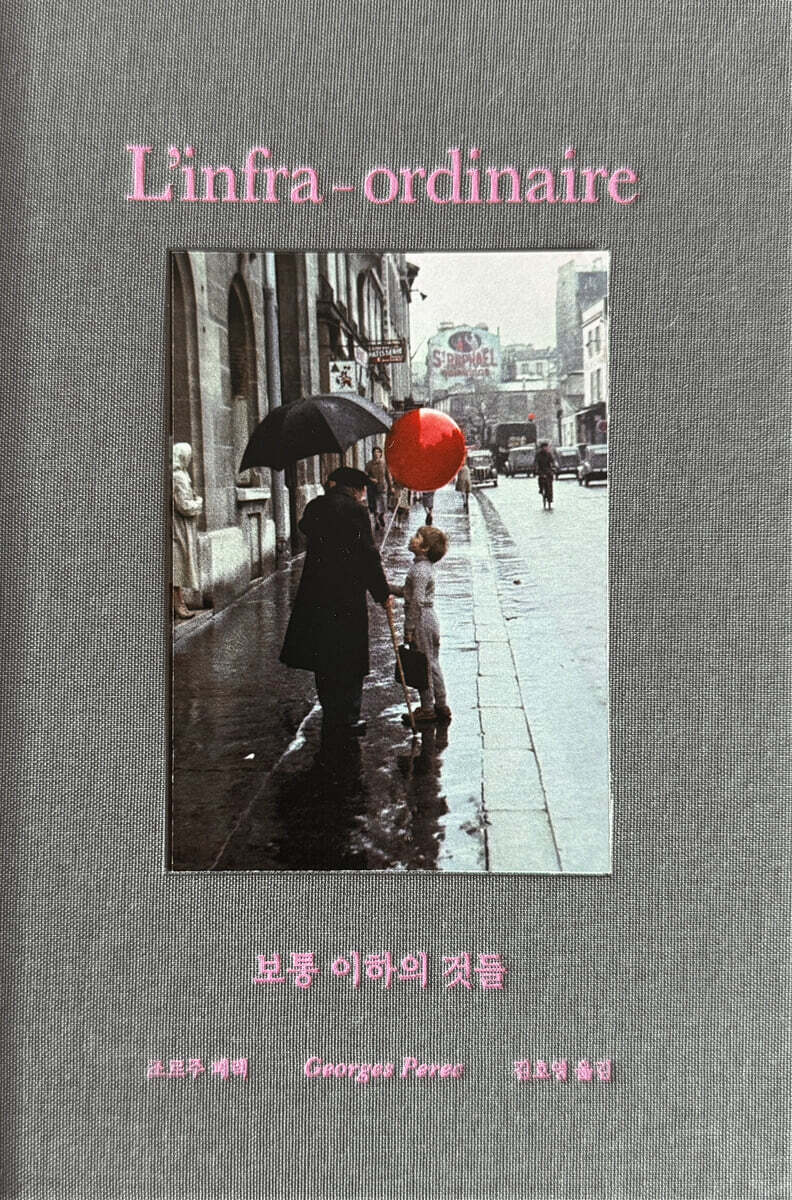 |
Description
Book Introduction
A life that is below average, trivial, and useless.
Things and places that are so familiar that they go unnoticed.
A man stands in front of 24 rue de Villain.
The man's name is Georges Perec.
Perec is considered a representative writer of late 20th-century French literature and one of the most important writers of 20th-century Europe, known for his unique experimental spirit, sensibility, and original linguistic sense.
He loiters in front of 24 Rue de Villain, where he spent his childhood, but turns away, unable to enter the building.
His father died in World War II when he was four, and his mother was taken to Auschwitz and died when he was six.
24 Rue de Villain was a place filled with memories of his childhood with his parents, but it was a great trauma for Perec that most of those memories had been forgotten.
Since Rue de Vilain was slated for demolition as part of the Paris urban development project, number 24, Perec's childhood home, was also destined to disappear completely within a few years.
But despite the fact that it was not an easy place to face mentally, he returned to Rue de Vilain to start a project he called 'Places' (Les Lieux).
Through the 'Places' project, Perec planned to select twelve places with a special connection to him and record them over a period of about twelve years, and regularly recording 'Rue des Vilains' was naturally at the core of this project.
He chose two of the twelve locations each month, described them, and then sealed an envelope with the manuscript and a subway ticket, movie ticket, pamphlet, etc. related to the location.
Perec believed that because it is time that ultimately destroys memories, the act of recording familiar places and objects was a resistance against the tyranny of time.
Georges Perec's "Below Ordinary Things," soon to be published by Green Ray, contains nine essays in different styles, including the text "Rue de Villain."
All nine texts deal with the theme of 'everyday writing', dealing with ordinary things, but in slightly different ways.
It is no exaggeration to say that this one book contains all of the writing styles that Perec attempted during his lifetime.
Things and places that are so familiar that they go unnoticed.
A man stands in front of 24 rue de Villain.
The man's name is Georges Perec.
Perec is considered a representative writer of late 20th-century French literature and one of the most important writers of 20th-century Europe, known for his unique experimental spirit, sensibility, and original linguistic sense.
He loiters in front of 24 Rue de Villain, where he spent his childhood, but turns away, unable to enter the building.
His father died in World War II when he was four, and his mother was taken to Auschwitz and died when he was six.
24 Rue de Villain was a place filled with memories of his childhood with his parents, but it was a great trauma for Perec that most of those memories had been forgotten.
Since Rue de Vilain was slated for demolition as part of the Paris urban development project, number 24, Perec's childhood home, was also destined to disappear completely within a few years.
But despite the fact that it was not an easy place to face mentally, he returned to Rue de Vilain to start a project he called 'Places' (Les Lieux).
Through the 'Places' project, Perec planned to select twelve places with a special connection to him and record them over a period of about twelve years, and regularly recording 'Rue des Vilains' was naturally at the core of this project.
He chose two of the twelve locations each month, described them, and then sealed an envelope with the manuscript and a subway ticket, movie ticket, pamphlet, etc. related to the location.
Perec believed that because it is time that ultimately destroys memories, the act of recording familiar places and objects was a resistance against the tyranny of time.
Georges Perec's "Below Ordinary Things," soon to be published by Green Ray, contains nine essays in different styles, including the text "Rue de Villain."
All nine texts deal with the theme of 'everyday writing', dealing with ordinary things, but in slightly different ways.
It is no exaggeration to say that this one book contains all of the writing styles that Perec attempted during his lifetime.
- You can preview some of the book's contents.
Preview
index
At the beginning of the book
Below average things
What will you approach?
Rue de Villain
Two hundred and forty-three vivid color postcards
Travel around Beaubourg
Walking in London
Holy of Holies
An experimental list of liquid and solid foods I ate during the year 1974.
Still life / Style leaf
I like it, I don't like it
commentary
Ordinary Life, Writing Beyond Ordinary
Georges Perec Chronology
Below average things
What will you approach?
Rue de Villain
Two hundred and forty-three vivid color postcards
Travel around Beaubourg
Walking in London
Holy of Holies
An experimental list of liquid and solid foods I ate during the year 1974.
Still life / Style leaf
I like it, I don't like it
commentary
Ordinary Life, Writing Beyond Ordinary
Georges Perec Chronology
Detailed image

Into the book
What happens every day and returns every day, the common, the everyday, the obvious, the ordinary, the mediocre, the below-average, the noise, the familiar.
How can we describe them, how can we ask questions about them, how can we describe them?
--- p.16
Let's ask questions about something familiar.
The problem is that we are already used to it.
We don't question the familiar, the familiar doesn't question us, and it doesn't seem to pose any particular problem.
We live with it without thinking about it, as if the familiar did not convey any questions or answers and did not carry any information.
It is no longer even a condition of life, it becomes a kind of numbness.
We sleep dreamlessly throughout our lives.
But where does our life lie? Where is our body? Where is our space?
--- p.17
Let's describe your street.
Let's describe another street.
And let's compare.
Let's make a list of your pockets and bags.
Let us ask ourselves about the history, purpose, and future of each of the objects we have taken out there. (Omitted) It doesn't really matter to me that these questions are so fragmentary that they hardly require any method, and are at best mere plans.
What's even more important to me is that these questions seem trivial and useless.
That is precisely what makes these questions as important, if not more important, than the countless others we have tried in vain to grasp the truth.
How can we describe them, how can we ask questions about them, how can we describe them?
--- p.16
Let's ask questions about something familiar.
The problem is that we are already used to it.
We don't question the familiar, the familiar doesn't question us, and it doesn't seem to pose any particular problem.
We live with it without thinking about it, as if the familiar did not convey any questions or answers and did not carry any information.
It is no longer even a condition of life, it becomes a kind of numbness.
We sleep dreamlessly throughout our lives.
But where does our life lie? Where is our body? Where is our space?
--- p.17
Let's describe your street.
Let's describe another street.
And let's compare.
Let's make a list of your pockets and bags.
Let us ask ourselves about the history, purpose, and future of each of the objects we have taken out there. (Omitted) It doesn't really matter to me that these questions are so fragmentary that they hardly require any method, and are at best mere plans.
What's even more important to me is that these questions seem trivial and useless.
That is precisely what makes these questions as important, if not more important, than the countless others we have tried in vain to grasp the truth.
--- p.18
Publisher's Review
Perec usually called himself a farmer who plowed four fields.
Sociological, novelistic, playful, and autobiographical writing can be said to be the fruits of these four fields, and 『Sub-ordinary Things』 contains all of Perec's writings on 'ordinary things' written according to these four styles.
This book is full of writings about everyday subjects, such as recording places that no one pays attention to, such as the area around Rue des Villains or the Beaubourg district, satirizing human material desires by describing the various types of offices we go to every day, making a thoroughly subjective list of 'likes/dislikes', traveling around London and discovering and spreading its unique charm, arranging imaginary travel destinations using mathematical formulas and writing postcards as if sending them to acquaintances as if they were travelers wandering the world in their imagination.
Yet, it never loses its originality.
Just as we go to work, eat, drink, take walks, travel, and chat about things we like and dislike, Perec's essays also permeate our daily lives.
In doing so, it makes us look again at the ‘sub-normal things’ surrounding us.
Professor Kim Ho-young, Korea's leading Georges Perec expert who has translated Perec's major works such as "The Usage of Life," "Types of Space," "An Art Lover's Room," and "Winter Journey/Yesterday's Journey," has taken on the translation, and "Things Below Ordinary," which contains the diverse writing styles of Perec, is now available to Korean readers for the first time.
The power of time can sometimes come as a fear.
As time passes, people, memories, and places all change and become weathered.
And in the end, you either die or disappear, leaving nothing behind.
No one can stop the flow of time, but the 'writing of everyday life' that Perec shows is like a small resistance against this flow of time.
Through 『Things Below Ordinary』, I hope that readers will also try writing about their daily lives to include in their own autobiographies.
Sociological, novelistic, playful, and autobiographical writing can be said to be the fruits of these four fields, and 『Sub-ordinary Things』 contains all of Perec's writings on 'ordinary things' written according to these four styles.
This book is full of writings about everyday subjects, such as recording places that no one pays attention to, such as the area around Rue des Villains or the Beaubourg district, satirizing human material desires by describing the various types of offices we go to every day, making a thoroughly subjective list of 'likes/dislikes', traveling around London and discovering and spreading its unique charm, arranging imaginary travel destinations using mathematical formulas and writing postcards as if sending them to acquaintances as if they were travelers wandering the world in their imagination.
Yet, it never loses its originality.
Just as we go to work, eat, drink, take walks, travel, and chat about things we like and dislike, Perec's essays also permeate our daily lives.
In doing so, it makes us look again at the ‘sub-normal things’ surrounding us.
Professor Kim Ho-young, Korea's leading Georges Perec expert who has translated Perec's major works such as "The Usage of Life," "Types of Space," "An Art Lover's Room," and "Winter Journey/Yesterday's Journey," has taken on the translation, and "Things Below Ordinary," which contains the diverse writing styles of Perec, is now available to Korean readers for the first time.
The power of time can sometimes come as a fear.
As time passes, people, memories, and places all change and become weathered.
And in the end, you either die or disappear, leaving nothing behind.
No one can stop the flow of time, but the 'writing of everyday life' that Perec shows is like a small resistance against this flow of time.
Through 『Things Below Ordinary』, I hope that readers will also try writing about their daily lives to include in their own autobiographies.
GOODS SPECIFICS
- Date of issue: December 31, 2023
- Format: Hardcover book binding method guide
- Page count, weight, size: 200 pages | 354g | 130*195*20mm
- ISBN13: 9791198375315
- ISBN10: 1198375310
You may also like
카테고리
korean


korean

![GQ KOREA Mark (Monthly): December [2025]](http://librairie.coreenne.fr/cdn/shop/files/8ef265dbbfbf186523ed75ba7319009d.jpg?v=1765340328&width=3840)


