

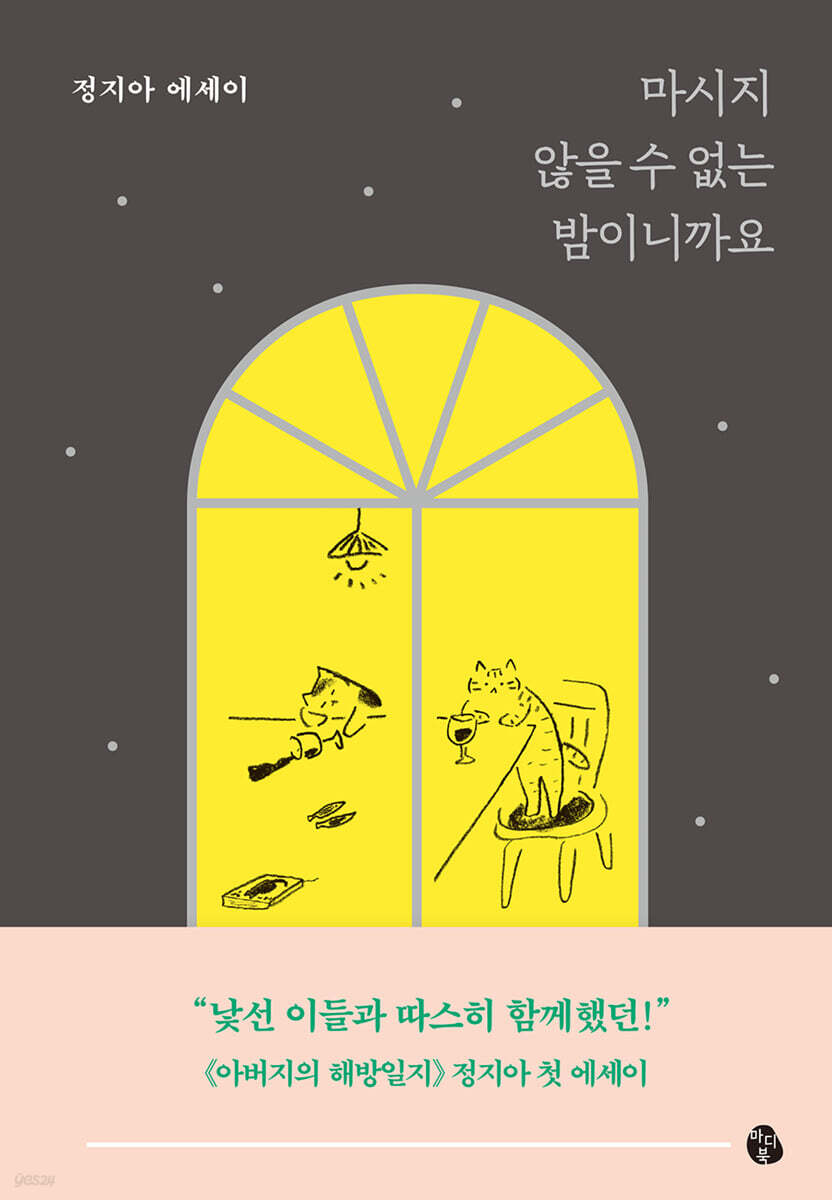
Because it's a night I can't help but drink
 |
Description
Book Introduction
- A word from MD
-
The warmth of a drunken person is comfortingAn essay praising drinking by author Jeong Ji-ah from "Father's Liberation Diary."
He, a heavy drinker, tells stories about the alcohol and people he has met.
From stories of trekking through Jirisan Mountain with whiskey in hand to the tragedy of history felt in a foreign country.
A book that deliciously conveys the warmth of people through walls broken down by alcohol.
September 15, 2023. Essay PD Lee Na-young
“If you drink it slowly and quietly for a long time, anyone will feel it.
“Compassion for all living things…”
It comforts our tired lives with deep emotions and lingering feelings.
An essay praising drinking by author Jeong Ji-ah of "Father's Liberation Diary"
Author Jeong Ji-ah, who moved countless readers with her best-selling book, “Father’s Liberation Diary,” has published her first essay, “Because It’s a Night I Can’t Help Drinking.”
As a writer known for his love of alcohol, he has written 34 stories about alcohol and people he has encountered, sometimes humorously and sometimes with sincerity.
From the sweet memories of first being introduced to the world of alcohol through her socialist father, to the dizzying memories of drinking whiskey secretly while hiding her wanted status and climbing Jirisan Mountain, to the power of makgeolli that brought together artists with loud voices and strong personalities, to the identity of the two-drinking benefactor who helped Jeong Ji-ah become a solid novelist, these high-alcohol stories unfold without pause, guaranteeing fun and emotion.
The story is not limited to the domestic context.
This turbulent journey, spanning Japan, Vietnam, Mongolia, and even as far as Ireland, makes us reflect on our lost history and feel compassion for all living things.
So, by the time they close the book, readers will have encountered a wondrous experience where the high barriers between people are effortlessly broken down through alcohol, and a night where they cannot help but drink.
“Compassion for all living things…”
It comforts our tired lives with deep emotions and lingering feelings.
An essay praising drinking by author Jeong Ji-ah of "Father's Liberation Diary"
Author Jeong Ji-ah, who moved countless readers with her best-selling book, “Father’s Liberation Diary,” has published her first essay, “Because It’s a Night I Can’t Help Drinking.”
As a writer known for his love of alcohol, he has written 34 stories about alcohol and people he has encountered, sometimes humorously and sometimes with sincerity.
From the sweet memories of first being introduced to the world of alcohol through her socialist father, to the dizzying memories of drinking whiskey secretly while hiding her wanted status and climbing Jirisan Mountain, to the power of makgeolli that brought together artists with loud voices and strong personalities, to the identity of the two-drinking benefactor who helped Jeong Ji-ah become a solid novelist, these high-alcohol stories unfold without pause, guaranteeing fun and emotion.
The story is not limited to the domestic context.
This turbulent journey, spanning Japan, Vietnam, Mongolia, and even as far as Ireland, makes us reflect on our lost history and feel compassion for all living things.
So, by the time they close the book, readers will have encountered a wondrous experience where the high barriers between people are effortlessly broken down through alcohol, and a night where they cannot help but drink.
- You can preview some of the book's contents.
Preview
index
Part 1
I know your identity
Dad's first drink
Shivas, the beginning of betrayal and corruption
Youth does not know youth
Our festive night
Cheers to your blue eyes!
A single day on the grassland, free from the food chain
For all the high school graduates in the world
The Miracle of the Five Loaves and Two Fish - Makgeolli at Namwon Station
Part 2
Slowly and quietly for a long time
Egg rice and a glass of soju!
Bloody Vlady
My currency is blue
Shark fin, Royal Salute, and cold rice
The Taste of Decadence, Macallan 1926
Him? Her? No, just you!
Accepting favors also requires latitude.
I'm a really fast snail writer.
Part 3
It was just so fucking scary…
There is no such thing as a free lunch in my life.
Dancing with the fluttering cherry blossoms
The perfection of affection
When the bonfire in the meadow fades away
Did we love each other back then?
Dance Wind Confession - JJ's Memories
I've been here for a long time
Alcohol is a digestive aid
Part 4
Closed relationships, aggressive whiskey!
Paradise on a Summer Day
The time when I seeped into you and you seeped into me
In early spring, when the ground is thawing, my heart is thawing
Vodka with a fox!
The shelf life of a relationship
My Blue Supply
Epilogue
I know your identity
Dad's first drink
Shivas, the beginning of betrayal and corruption
Youth does not know youth
Our festive night
Cheers to your blue eyes!
A single day on the grassland, free from the food chain
For all the high school graduates in the world
The Miracle of the Five Loaves and Two Fish - Makgeolli at Namwon Station
Part 2
Slowly and quietly for a long time
Egg rice and a glass of soju!
Bloody Vlady
My currency is blue
Shark fin, Royal Salute, and cold rice
The Taste of Decadence, Macallan 1926
Him? Her? No, just you!
Accepting favors also requires latitude.
I'm a really fast snail writer.
Part 3
It was just so fucking scary…
There is no such thing as a free lunch in my life.
Dancing with the fluttering cherry blossoms
The perfection of affection
When the bonfire in the meadow fades away
Did we love each other back then?
Dance Wind Confession - JJ's Memories
I've been here for a long time
Alcohol is a digestive aid
Part 4
Closed relationships, aggressive whiskey!
Paradise on a Summer Day
The time when I seeped into you and you seeped into me
In early spring, when the ground is thawing, my heart is thawing
Vodka with a fox!
The shelf life of a relationship
My Blue Supply
Epilogue
Detailed image

Into the book
The winter nights were long.
Even though our parents weren't around, we played more quietly than we did at other homes.
I didn't even play card games or Go-Stop as an excuse to grab someone's wrist.
Although we went to the lighthouse a few times, no one drank so much that they got drunk.
We just exchanged stories about this and that.
The sound of snow falling softly occasionally seeped into the silence.
Someone opened the door to go to the bathroom and let out a gasp.
“Wormmaya!”
Everyone walked towards the door in a sitting position.
I shivered in the cold air and craned my neck to look outside. The outside was a pure white snow field.
It was pure white with not a single footprint.
Without saying a word, everyone ran out into the yard.
There was a handful of snow on both the plum and persimmon trees.
The bamboo trees in the backyard were bent down to the ground, unable to bear the weight of the snow.
Everyone was speechless before the spectacle of nature.
Someone shined a light into the sky.
Inside the pillar of light, fist-sized snowflakes were falling vertically.
It was the first and last time I was overwhelmed by purity.
I think I had that thought that day.
I want to live so purely, so overwhelmingly.
Seeing as no one dared speak, I wondered if my friends felt the same way. At nineteen, I believed it.
We can live the pure time that awaits us in pure white.
---From "Part 1: Dad's First Drink"
My glass was also filled with Macallan 1926, known as the Rolls Royce of single malts.
The guy was hot, deep and rich.
It was a sticky, endless taste that dragged me into a swamp.
As I sipped the Macallan 1926, I thought of my father, a failed socialist.
My father, who traded the 18-year-old Chivas Regal I sent him to taste good liquor before he left this world for a box of soju.
In their youth, they both advocated for national unification and equality, but their endings were completely different.
I always felt sad and sorry for my father, a failed socialist.
I was sure that my father himself would find your life lonely.
But as I drank Macallan 1926, I realized:
That my father's ending suits my taste better.
I know my father feels the same way.
Isn't it truly fortunate that there was no chance of success, no chance of failure!
---From "The Taste of Corruption, Part 2, Macallan, 1926"
At such moments, the taste of the alcohol is not that important.
On nights when the stars shine, the sky and the meadow meet, and the bonfire burns brightly.
As the alcohol took effect, the words gradually disappeared.
Some people stared intently at the bonfire, some looked up at the sky, and some gazed at the endless grassland.
We were just quietly drinking, and the people who had gone to sleep came over to us one by one.
They also sat down next to us and drank in silence.
They were no different from us.
They too needed a little alcohol at moments like this.
They and we, I mean, just us, experienced the wonder that day, using the power of alcohol to sink into ourselves or become a part of the universe for a moment.
New stars rose, the moon raced across the meadow, the alcohol slowly warmed our veins, the campfire was burning, and so the night deepened in the meadow.
---From "When the Campfire in the Prairie Dies Out"
Even though it was summer, I felt a chill on the rocks in the valley and got goosebumps.
Will I make it out alive? Throughout my journey in North Korea, I was prohibited from acting independently except in designated areas.
South Korean officials had warned us several times that acting alone would lead to serious problems.
I'm acting alone right now, and I don't even know where I am... I can't help but get goosebumps.
I looked around.
Fortunately, I saw the lights of the hotel I had checked into yesterday not far away.
There was not a single light to be seen outside the hotel, let alone a single person.
The security agents were always guarding and monitoring the hotel. What could have been? Thinking back, I think it was probably because the area was so remote and remote that they had no chance of contact with North Koreans.
At that time, I didn't even think about it, and as soon as I realized the situation, I started running towards the hotel.
It wasn't far.
About 200~300 meters.
We arrived at the hotel, out of breath.
The hotel was plunged into deep darkness without a single guard.
Only a few dimly lit rooms where South Korean writers were probably staying were illuminated.
It seemed to be a nightlight.
My mind was blown.
Drinking, getting drunk, blacking out, staggering along a mountain path, drunk on alcohol and romance, falling asleep while looking at the Milky Way—what! People can do that! And they could.
Even in that forbidden land, North Korea.
---From "I've Been There for a Long Time"
“Teacher! Me too.”
A child with blue lips held out his hand.
Even though it was midsummer, the stream water was chillingly cold.
He filled the blue bottle and handed it to the child.
The child, who had just finished a glass, jumped around in the water, as if trying to ward off the cold.
I put a piece of cheese in the child's mouth.
Blue Lani, enjoying the cold water naked! I wish I could jump in, just like a child, just as I was born.
But unlike when I was born, I was covered in the dirt of the world and couldn't muster up the courage at all.
I was embarrassed so I drank the blue again.
The bright child jumped up and down and went to the end of the pool shaded by the banyan tree.
Then he jumped up and floated his body on the water.
In that state, the child began to swim.
It was a properly learned backstroke.
As the child threw his arms back, his body was pushed backwards.
At some point, the child's body slid beyond the border of the banyan tree's shade and into the hot sunlight shimmering on the surface of the water.
I watched the scene as if I was possessed.
Her small, round chest was floating in the sunlight.
As my child swam backstroke across the pool, only one thought crossed my mind.
It's splendidly beautiful.
I must have had a brilliant youth too.
At that time, I didn't even look back on my body.
The body was insignificant.
The mind is noble, the body is trivial.
So I abhorred all acts that yielded to the desires of the flesh.
What a disgusting thing.
Because there is a body, there is a mind.
I was so insignificant when I was young.
With that thought in mind, I generously offered blue, the precious blue, to my poor body, which I had treated so insignificantly.
In a summer paradise where beautiful bodies and radiant youth unfold.
Even though our parents weren't around, we played more quietly than we did at other homes.
I didn't even play card games or Go-Stop as an excuse to grab someone's wrist.
Although we went to the lighthouse a few times, no one drank so much that they got drunk.
We just exchanged stories about this and that.
The sound of snow falling softly occasionally seeped into the silence.
Someone opened the door to go to the bathroom and let out a gasp.
“Wormmaya!”
Everyone walked towards the door in a sitting position.
I shivered in the cold air and craned my neck to look outside. The outside was a pure white snow field.
It was pure white with not a single footprint.
Without saying a word, everyone ran out into the yard.
There was a handful of snow on both the plum and persimmon trees.
The bamboo trees in the backyard were bent down to the ground, unable to bear the weight of the snow.
Everyone was speechless before the spectacle of nature.
Someone shined a light into the sky.
Inside the pillar of light, fist-sized snowflakes were falling vertically.
It was the first and last time I was overwhelmed by purity.
I think I had that thought that day.
I want to live so purely, so overwhelmingly.
Seeing as no one dared speak, I wondered if my friends felt the same way. At nineteen, I believed it.
We can live the pure time that awaits us in pure white.
---From "Part 1: Dad's First Drink"
My glass was also filled with Macallan 1926, known as the Rolls Royce of single malts.
The guy was hot, deep and rich.
It was a sticky, endless taste that dragged me into a swamp.
As I sipped the Macallan 1926, I thought of my father, a failed socialist.
My father, who traded the 18-year-old Chivas Regal I sent him to taste good liquor before he left this world for a box of soju.
In their youth, they both advocated for national unification and equality, but their endings were completely different.
I always felt sad and sorry for my father, a failed socialist.
I was sure that my father himself would find your life lonely.
But as I drank Macallan 1926, I realized:
That my father's ending suits my taste better.
I know my father feels the same way.
Isn't it truly fortunate that there was no chance of success, no chance of failure!
---From "The Taste of Corruption, Part 2, Macallan, 1926"
At such moments, the taste of the alcohol is not that important.
On nights when the stars shine, the sky and the meadow meet, and the bonfire burns brightly.
As the alcohol took effect, the words gradually disappeared.
Some people stared intently at the bonfire, some looked up at the sky, and some gazed at the endless grassland.
We were just quietly drinking, and the people who had gone to sleep came over to us one by one.
They also sat down next to us and drank in silence.
They were no different from us.
They too needed a little alcohol at moments like this.
They and we, I mean, just us, experienced the wonder that day, using the power of alcohol to sink into ourselves or become a part of the universe for a moment.
New stars rose, the moon raced across the meadow, the alcohol slowly warmed our veins, the campfire was burning, and so the night deepened in the meadow.
---From "When the Campfire in the Prairie Dies Out"
Even though it was summer, I felt a chill on the rocks in the valley and got goosebumps.
Will I make it out alive? Throughout my journey in North Korea, I was prohibited from acting independently except in designated areas.
South Korean officials had warned us several times that acting alone would lead to serious problems.
I'm acting alone right now, and I don't even know where I am... I can't help but get goosebumps.
I looked around.
Fortunately, I saw the lights of the hotel I had checked into yesterday not far away.
There was not a single light to be seen outside the hotel, let alone a single person.
The security agents were always guarding and monitoring the hotel. What could have been? Thinking back, I think it was probably because the area was so remote and remote that they had no chance of contact with North Koreans.
At that time, I didn't even think about it, and as soon as I realized the situation, I started running towards the hotel.
It wasn't far.
About 200~300 meters.
We arrived at the hotel, out of breath.
The hotel was plunged into deep darkness without a single guard.
Only a few dimly lit rooms where South Korean writers were probably staying were illuminated.
It seemed to be a nightlight.
My mind was blown.
Drinking, getting drunk, blacking out, staggering along a mountain path, drunk on alcohol and romance, falling asleep while looking at the Milky Way—what! People can do that! And they could.
Even in that forbidden land, North Korea.
---From "I've Been There for a Long Time"
“Teacher! Me too.”
A child with blue lips held out his hand.
Even though it was midsummer, the stream water was chillingly cold.
He filled the blue bottle and handed it to the child.
The child, who had just finished a glass, jumped around in the water, as if trying to ward off the cold.
I put a piece of cheese in the child's mouth.
Blue Lani, enjoying the cold water naked! I wish I could jump in, just like a child, just as I was born.
But unlike when I was born, I was covered in the dirt of the world and couldn't muster up the courage at all.
I was embarrassed so I drank the blue again.
The bright child jumped up and down and went to the end of the pool shaded by the banyan tree.
Then he jumped up and floated his body on the water.
In that state, the child began to swim.
It was a properly learned backstroke.
As the child threw his arms back, his body was pushed backwards.
At some point, the child's body slid beyond the border of the banyan tree's shade and into the hot sunlight shimmering on the surface of the water.
I watched the scene as if I was possessed.
Her small, round chest was floating in the sunlight.
As my child swam backstroke across the pool, only one thought crossed my mind.
It's splendidly beautiful.
I must have had a brilliant youth too.
At that time, I didn't even look back on my body.
The body was insignificant.
The mind is noble, the body is trivial.
So I abhorred all acts that yielded to the desires of the flesh.
What a disgusting thing.
Because there is a body, there is a mind.
I was so insignificant when I was young.
With that thought in mind, I generously offered blue, the precious blue, to my poor body, which I had treated so insignificantly.
In a summer paradise where beautiful bodies and radiant youth unfold.
---From "Part 4: Paradise on a Summer Day"
Publisher's Review
“As time goes by, it gets deeper, it seems like it’s not true, but it gets better,
There are such relationships in the world.
“Just like whiskey.”
Alcohol that transcends time and space, allowing us to understand and embrace one another, and the warmth of people.
The days are short in Gurye.
Jirisan Mountain rises high in front and Baekunsan Mountain rises high behind, so the sun sets quickly.
The shadow of the mountain behind the house slowly swallows up the front yard of the house, and by the time it reaches the Seomjin River, only the sound of deer crying can be heard going back and forth between the mountains.
And then, soon, complete darkness.
On the road along the Seomjin River, where there are no streetlights, only the occasional car of a random tourist passes by silently.
But as the darkness deepens, there is a house that shines brightly.
This is the ‘House of Doctor of Literature Jeong Ji-ah.’
The lights in writer Jeong Ji-ah's house don't go out easily.
This is because of the writer's habit of writing at night rather than during the day.
In a small village where only four households, including the writer, reside, the writer's typing sound can be heard longer than the sound of the owl all night long.
It's been a really long night.
What keeps those long nights from being lonely is 'alcohol'.
Author Jeong Ji-ah is a famous drinker.
Rather than drinking a lot, I know how to drink when I need to.
“Because the wind is nice, because the rain calls for alcohol, because the bright sun calls for alcohol, because the snow is fluttering and it’s hard to stay sober…” And because there are people.
There is a constant stream of guests at writer Jeong Ji-ah's house.
That means the lights are on for a long time late at night.
People who broke down walls over a drink in their hometown as children, on the road, on the podium, and in distant foreign lands.
This book is a story about alcohol and people that author Jeong Ji-ah encountered over a long period of time.
“From that day on, my betrayal and corruption began.
“Isn’t this truly a day to be thankful for!”
Jeong Ji-ah, the daughter of a guerrilla who roams Jirisan Mountain with whiskey from a capitalist country
The youngest daughter born to a socialist father and mother, she first tasted alcohol on Christmas Eve, when she was nineteen, on a snowy winter day.
When their daughter decides to stay home and play with her friends all night, her parents give her some plum wine they made themselves and then leave the house under the pretense of playing cards.
Author Jeong Ji-ah, who spent the last winter of her teenage years listening to the sound of snow falling softly, thinks about this amidst the white purity that covers the world.
“I want to live so purely, so overwhelmingly.”
But the world was not easy for the daughter of a guerrilla.
The writer, who was always under surveillance by the dictatorship, was eventually wanted and went on the run.
The first time I tasted whiskey, the alcohol of the capitalist powerhouse, was on Jirisan Mountain, where I was trying to avoid being noticed by others while on a wanted list.
The only reason I brought whiskey was because it was light and got me drunk quickly.
But late one winter night, among the people gathered at Baemsagol Mountain Lodge, the writer secretly takes out his passport and drinks it, and his identity is discovered.
However, those who recognized author Jeong Ji-ah were also fighters who resisted the military dictatorship in their own ways, and they spent a brief night of freedom and solidarity, drunk on whiskey.
Years later, the author, who came out into the world, bids farewell to the past days “filled with poverty, sadness, and frustration” and seeps into the lives of people living today.
Rather than clinging to the past, he resolves to do something that will contribute to future history, as his father said, and to do his part through novels.
Still, the writer was not lonely or sad.
Because there was always good alcohol by his side, and better people than him.
“I like you.
Because he's a good person.
“Because you and I are both drinkers.”
A feast of captivating and moving stories that break down barriers between people.
In fact, author Jeong Ji-ah is “a person who needs a really long time to make friends.”
“I think we need to meet for about 10 years before we can become friends.”
So sometimes, before people even get close, they get scared and build a wall.
For such writers, alcohol is not simply a tool for getting drunk.
Like the apple tree in the African savanna shown in National Geographic, like the monkey that gets drunk after eating the fruit from that apple tree and steps on the lion's head to fly, alcohol is the wing that allows you to break your limits.
On days with good alcohol, writer Jeong Ji-ah fearlessly takes a step closer to people.
"Because It's a Night You Can't Not Drink" contains stories of people who broke down walls by clinking their glasses.
Hometown friends who shared memories of the most glorious times but now face their own tragedies; long-time seniors and juniors who built friendships through repeated misunderstandings and understandings like warp and weft; teachers who reached out with a warm hand with an indifferent expression and the desire as teachers to hold the hands of their students like them; even the relationship that walked together somewhere between love and longing.
As you turn the pages, you will surely find yourself thinking of someone you long to see deep in your heart.
Stories don't just stay between people.
It reminds us of the tragic aspects of history that we ignore and live with, flying far away to Japan, Vietnam, and Mongolia.
The scene where he hears the news of Mr. Kim, who appears in "Father's Liberation Diary" in North Korea, and engages in a drinking contest with a Ministry of State Security official is the highlight of this book.
The author shows that wherever there is alcohol and people, things are similar, and that this can be the case “even in that forbidden land, North Korea.”
To sum up, "Because It's a Night I Can't Not Drink" is a story about alcohol, but more than that, it's a story about the people surrounding alcohol.
That person is the author of this book, Ji-ah Jeong, the editor writing this review, and you, the reader of this article.
So, I guarantee you that by the time you close the last chapter of this book, you will find yourself as a drinker, fondling an empty glass.
Today is a 'night you can't help but drink' for you.
There are such relationships in the world.
“Just like whiskey.”
Alcohol that transcends time and space, allowing us to understand and embrace one another, and the warmth of people.
The days are short in Gurye.
Jirisan Mountain rises high in front and Baekunsan Mountain rises high behind, so the sun sets quickly.
The shadow of the mountain behind the house slowly swallows up the front yard of the house, and by the time it reaches the Seomjin River, only the sound of deer crying can be heard going back and forth between the mountains.
And then, soon, complete darkness.
On the road along the Seomjin River, where there are no streetlights, only the occasional car of a random tourist passes by silently.
But as the darkness deepens, there is a house that shines brightly.
This is the ‘House of Doctor of Literature Jeong Ji-ah.’
The lights in writer Jeong Ji-ah's house don't go out easily.
This is because of the writer's habit of writing at night rather than during the day.
In a small village where only four households, including the writer, reside, the writer's typing sound can be heard longer than the sound of the owl all night long.
It's been a really long night.
What keeps those long nights from being lonely is 'alcohol'.
Author Jeong Ji-ah is a famous drinker.
Rather than drinking a lot, I know how to drink when I need to.
“Because the wind is nice, because the rain calls for alcohol, because the bright sun calls for alcohol, because the snow is fluttering and it’s hard to stay sober…” And because there are people.
There is a constant stream of guests at writer Jeong Ji-ah's house.
That means the lights are on for a long time late at night.
People who broke down walls over a drink in their hometown as children, on the road, on the podium, and in distant foreign lands.
This book is a story about alcohol and people that author Jeong Ji-ah encountered over a long period of time.
“From that day on, my betrayal and corruption began.
“Isn’t this truly a day to be thankful for!”
Jeong Ji-ah, the daughter of a guerrilla who roams Jirisan Mountain with whiskey from a capitalist country
The youngest daughter born to a socialist father and mother, she first tasted alcohol on Christmas Eve, when she was nineteen, on a snowy winter day.
When their daughter decides to stay home and play with her friends all night, her parents give her some plum wine they made themselves and then leave the house under the pretense of playing cards.
Author Jeong Ji-ah, who spent the last winter of her teenage years listening to the sound of snow falling softly, thinks about this amidst the white purity that covers the world.
“I want to live so purely, so overwhelmingly.”
But the world was not easy for the daughter of a guerrilla.
The writer, who was always under surveillance by the dictatorship, was eventually wanted and went on the run.
The first time I tasted whiskey, the alcohol of the capitalist powerhouse, was on Jirisan Mountain, where I was trying to avoid being noticed by others while on a wanted list.
The only reason I brought whiskey was because it was light and got me drunk quickly.
But late one winter night, among the people gathered at Baemsagol Mountain Lodge, the writer secretly takes out his passport and drinks it, and his identity is discovered.
However, those who recognized author Jeong Ji-ah were also fighters who resisted the military dictatorship in their own ways, and they spent a brief night of freedom and solidarity, drunk on whiskey.
Years later, the author, who came out into the world, bids farewell to the past days “filled with poverty, sadness, and frustration” and seeps into the lives of people living today.
Rather than clinging to the past, he resolves to do something that will contribute to future history, as his father said, and to do his part through novels.
Still, the writer was not lonely or sad.
Because there was always good alcohol by his side, and better people than him.
“I like you.
Because he's a good person.
“Because you and I are both drinkers.”
A feast of captivating and moving stories that break down barriers between people.
In fact, author Jeong Ji-ah is “a person who needs a really long time to make friends.”
“I think we need to meet for about 10 years before we can become friends.”
So sometimes, before people even get close, they get scared and build a wall.
For such writers, alcohol is not simply a tool for getting drunk.
Like the apple tree in the African savanna shown in National Geographic, like the monkey that gets drunk after eating the fruit from that apple tree and steps on the lion's head to fly, alcohol is the wing that allows you to break your limits.
On days with good alcohol, writer Jeong Ji-ah fearlessly takes a step closer to people.
"Because It's a Night You Can't Not Drink" contains stories of people who broke down walls by clinking their glasses.
Hometown friends who shared memories of the most glorious times but now face their own tragedies; long-time seniors and juniors who built friendships through repeated misunderstandings and understandings like warp and weft; teachers who reached out with a warm hand with an indifferent expression and the desire as teachers to hold the hands of their students like them; even the relationship that walked together somewhere between love and longing.
As you turn the pages, you will surely find yourself thinking of someone you long to see deep in your heart.
Stories don't just stay between people.
It reminds us of the tragic aspects of history that we ignore and live with, flying far away to Japan, Vietnam, and Mongolia.
The scene where he hears the news of Mr. Kim, who appears in "Father's Liberation Diary" in North Korea, and engages in a drinking contest with a Ministry of State Security official is the highlight of this book.
The author shows that wherever there is alcohol and people, things are similar, and that this can be the case “even in that forbidden land, North Korea.”
To sum up, "Because It's a Night I Can't Not Drink" is a story about alcohol, but more than that, it's a story about the people surrounding alcohol.
That person is the author of this book, Ji-ah Jeong, the editor writing this review, and you, the reader of this article.
So, I guarantee you that by the time you close the last chapter of this book, you will find yourself as a drinker, fondling an empty glass.
Today is a 'night you can't help but drink' for you.
GOODS SPECIFICS
- Date of issue: September 7, 2023
- Page count, weight, size: 320 pages | 416g | 130*188*30mm
- ISBN13: 9791193289020
- ISBN10: 1193289025
You may also like
카테고리
korean


korean

![GQ KOREA Mark (Monthly): December [2025]](http://librairie.coreenne.fr/cdn/shop/files/8ef265dbbfbf186523ed75ba7319009d.jpg?v=1765340328&width=3840)


