

A pretty good happy ending
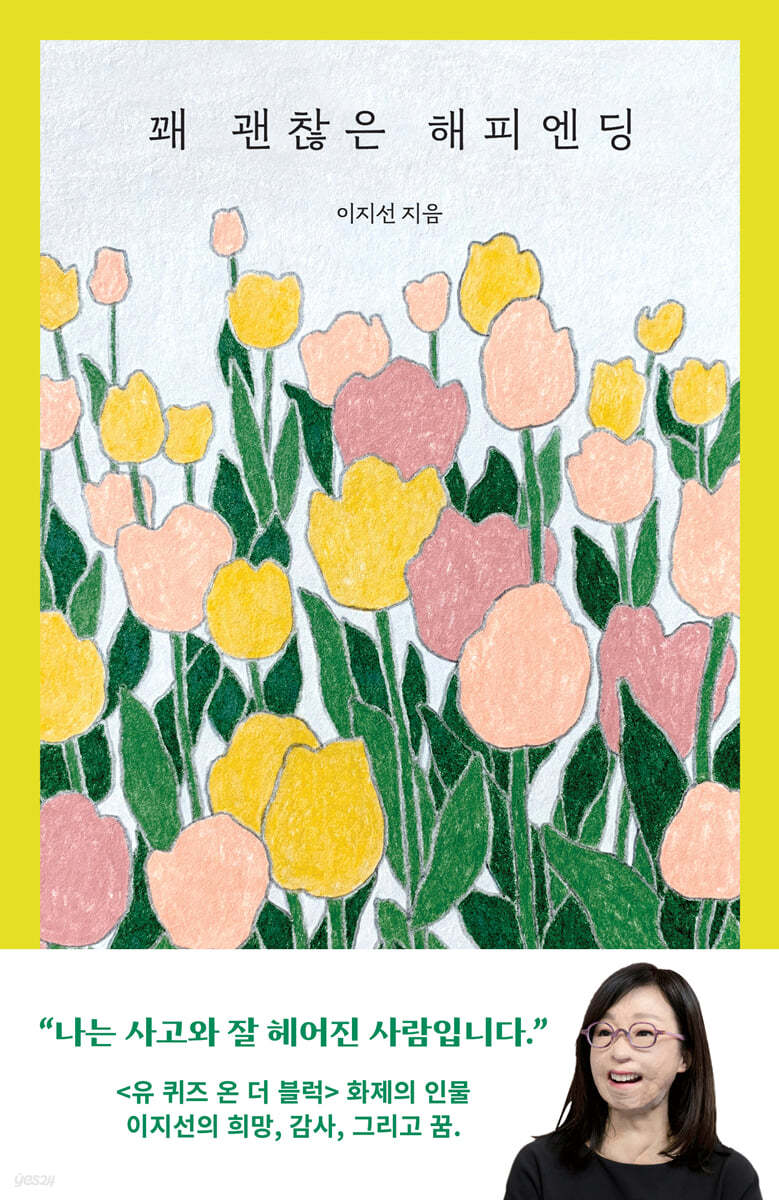 |
Description
Book Introduction
10 Years Later: "I Love You, Ji-seon" A ray of hope held in the ashes of life… Life is a gift Lee Ji-seon, who gave hope to 400,000 readers with “I Love You, Ji-seon,” has returned after about 10 years. Lee Ji-seon, who was in a car accident at the age of 23 and suffered third-degree burns on 55 percent of her body, overcame over 40 painful surgeries and is now living a 'second life.' If the first book, "I Love Ji-seon," conveyed the secrets of life he discovered until he reconciled with his incredible fate and regained hope, "A Pretty Good Happy Ending" contains his journey from a survivor to a person with ordinary life, from a foreign student who left with a dream to a professor who teaches students. After enduring countless hardships, Lee Ji-seon confesses that she has come to realize that life is not a cave, but a tunnel where a bright light awaits her someday. It conveys the small but enjoyable daily life of holding hands with precious people around you and heading towards a 'pretty good happy ending'. In "A Pretty Good Happy Ending," Lee Ji-seon calmly portrays the daily life of someone who has broken up with an accident. What sustained him through difficult times was writing. Thanks to this, I was able to move forward toward hope and dreams without being swept away by hatred and resentment. Even when everyone gives up and says it's the end, Lee Ji-seon doesn't give up hope, gets back up, and sets out to help those marginalized in society. Leaving behind those who worried, "Can I live alone with that body?", he went abroad to study and earned his master's and doctoral degrees in 11 and a half years. He continues to run towards his dream as a university professor, researcher, and lifelong running mate, sharing positive influence. It's been over 20 years since Lee Ji-seon had her 'second birthday'. The reason his life cannot but be 'hopeful' is not only because he endured hardship and survived. Because we live endlessly in the present progressive tense and dream of tomorrow. Because I dream of a better tomorrow and a better world by sharing with people the secrets of life learned through hardship. In his book, you can see him growing a little more, becoming brighter and stronger, and having the power to be more grateful and loving. |
- You can preview some of the book's contents.
Preview
index
Prologue: Towards a Pretty Good Happy Ending
Part 1.
Passing through the tunnel
A person who broke up with an accident
The power of writing
I'm too rich for them
Comparative Happiness
Don't let him know my heart
Wise Hospital Life
Merry Christmas to everyone
My nose is running
I saw the future diary
Cold of the mind
Hobby Nomad
Part 2.
A person who does small things
Boston Life
Still starting
Just be there
I thought life in New York would be glamorous
Dr. LA Juguri
Memories of warm help
A person who does small things
I'm Professor Lee Ji-seon, class of 2017.
Standing at the end of the earth
Part 3.
My life's running mate
There is no defense against hope.
A fight lasting 7 hours, 22 minutes, and 26 seconds
If you don't give up, miracles will happen.
If we are together
I have a hill to lean on
My brother said so
I found out why I was born with a mole
Let the wounds become flowers
Children who gave spring as a gift
Epilogue: To You Who Are Wounded
Part 1.
Passing through the tunnel
A person who broke up with an accident
The power of writing
I'm too rich for them
Comparative Happiness
Don't let him know my heart
Wise Hospital Life
Merry Christmas to everyone
My nose is running
I saw the future diary
Cold of the mind
Hobby Nomad
Part 2.
A person who does small things
Boston Life
Still starting
Just be there
I thought life in New York would be glamorous
Dr. LA Juguri
Memories of warm help
A person who does small things
I'm Professor Lee Ji-seon, class of 2017.
Standing at the end of the earth
Part 3.
My life's running mate
There is no defense against hope.
A fight lasting 7 hours, 22 minutes, and 26 seconds
If you don't give up, miracles will happen.
If we are together
I have a hill to lean on
My brother said so
I found out why I was born with a mole
Let the wounds become flowers
Children who gave spring as a gift
Epilogue: To You Who Are Wounded
Publisher's Review
Lee Ji-seon, who gave hope to 400,000 readers with “I Love You, Ji-seon,” has returned after about 10 years.
Lee Ji-seon, who was in a car accident at the age of 23 and suffered third-degree burns on 55 percent of her body, overcame over 40 painful surgeries and is now living a 'second life.'
If the first book, "I Love Ji-seon," conveyed the secrets of life he discovered until he reconciled with his incredible fate and regained hope, "A Pretty Good Happy Ending" contains his journey from a survivor to a person with ordinary life, from a foreign student who left with a dream to a professor who teaches students.
After enduring countless hardships, Lee Ji-seon confesses that she has come to realize that life is not a cave, but a tunnel where a bright light awaits her someday.
It conveys the small but enjoyable daily life of holding hands with precious people around you and heading towards a 'pretty good happy ending'.
In "A Pretty Good Happy Ending," Lee Ji-seon calmly portrays the daily life of someone who has broken up with an accident.
What sustained him through difficult times was writing.
Thanks to this, I was able to move forward toward hope and dreams without being swept away by hatred and resentment.
Even when everyone gives up and says it's the end, Lee Ji-seon doesn't give up hope, gets back up, and sets out to help those marginalized in society.
Leaving behind those who worried, "Can I live alone with that body?", he went abroad to study and earned his master's and doctoral degrees in 11 and a half years. He continues to run towards his dream as a university professor, researcher, and lifelong running mate, sharing positive influence.
It's been over 20 years since Lee Ji-seon had her 'second birthday'.
The reason his life cannot but be 'hopeful' is not only because he endured hardship and survived.
Because we live endlessly in the present progressive tense and dream of tomorrow.
Because I dream of a better tomorrow and a better world by sharing with people the secrets of life learned through hardship.
In his book, you can see him growing a little more, becoming brighter and stronger, and having the power to be more grateful and loving.
I had an accident.
That's right.
No one can question the use of the expression 'I was hit' as it accurately describes my situation at the time.
But at some point, I started to feel uncomfortable using the word 'got hit'.
I hated that every time I said I had an accident, it felt like I was saying I was a "victim" of a car accident caused by a drunk driver.
Who in this world wants to live as a victim?
No matter what other expressions I use to describe the accident, the fact remains that an unexpected accident occurred on an ordinary night and that I suffered tremendous damage as a result. However, I did not want to make myself, who had spent the time since that night trying to survive, live as a victim.
(Omitted) I lived the time after that day.
He endured pain to survive and underwent dozens of skin grafts to make his body a little more comfortable to write with.
Even though I couldn't see anything, I dreamed, worked hard to achieve that dream, loved the people who endured that time with me, and lived being loved.
I stopped looking back on yesterday and feeling sad, and lived the day that was given to me.
As time passed and I looked back, I realized that I was no longer in that place or that time where something bad happened.
Pages 16-17
The power of humor and gratitude discovered while reconciling with a cruel fate
“Lee Ji-seon is a cheerful person who knows how to taste a spoonful of humor that shines wherever she goes,” says Song Eun-i.
"A Pretty Good Happy Ending" is full of Lee Ji-seon's signature positive energy.
He is known as an icon of overcoming hardship, but in fact, he possesses a somewhat sloppy, unexpected charm.
Small things are precious.
Happiness lies in laughter, not in grand narratives.
Whenever he hears encouraging words like, "You will be greatly useful," from those who were moved by his lecture, he cries out to himself, "Oh, no, no! I will live by doing small things."
Through her lively and witty daily life, Lee Ji-seon conveys the power of laughter and gratitude.
When the Blue House contacts him to ask for his opinion or when his current situation is reported on the news, he is bewildered and thinks, "Was I really this great?" and when he waits for his destined partner, wondering, "Could it be this person?" but when he actually likes someone, he is so embarrassed that he tries hard not to show his feelings and even packs a transportation card as part of his marathon preparations. When I read the story, a smile comes to my face.
I'm reminded again that happiness isn't something only special people can discover.
Even now, 20 years after the accident, I am still going through a long tunnel, having to undergo skin grafting surgery, but I am slowly emerging from the darkness and seeing the positive changes that have occurred in me, and I am very happy about the small things in my daily life.
We rediscover the power of positivity and happiness through Lee Ji-seon, who finds small blessings in today's life, like a sip of cool water to quench her thirst, and enjoys a little more happiness.
I didn't find reasons to be grateful by comparing myself to those who seemed to have it harder than me, and I didn't become more unhappy by comparing myself to others.
I found something to be grateful for in the present, not through comparison.
By doing so, I was able to live much happier than what other people thought.
I believe that true happiness will come when I am grateful for what I have now rather than what I have lost, and when I cherish what I can enjoy now rather than lament what others have less.
I learned that gratitude and happiness should not be relative things obtained by comparing oneself to others, but rather should be obtained from a place that is not easily changed and is not easily shaken.
Page 41
Life is a loving running mate running the marathon together.
Dozens of painful surgeries and rehabilitation training after the accident were difficult, but there was something that made it even harder for him.
It was a look of pity and a violent gaze directed at oneself, and prejudice against the disabled.
He confesses that he was hurt by the reaction that conveyed the sense of superiority that "I'm better than that person" and the perception that "disabled people are pitiful people," but he was able to overcome numerous hardships and get back on his feet thanks to the help of his family, friends, school, and church.
Lee Ji-seon, who has risen so tall, dreams of sharing her positive influence to convey the voices of the marginalized.
Despite being a burn victim who struggles to sweat, Lee Ji-seon completed two full marathons to raise awareness for the establishment of a children's rehabilitation hospital.
I ran the New York Marathon alone, and the Seoul Marathon with several people.
Lee Ji-seon emphasized that she was able to shorten her record by 40 minutes when running 'together'.
Thanks to family, friends, and neighbors who encouraged each other not to give up in difficult times and were willing to take last place for the weak, I was able to go faster and with less difficulty.
Remembering that experience, Lee Ji-seon extends her hand affectionately, suggesting that they become each other's running mates toward a "pretty good happy ending" based on empathy and solidarity rather than pity.
Lee Ji-seon's race, where they overcome a cruel fate and rise again to support each other's lives and dreams in the marathon called life, is still ongoing.
The harsh reality hurts us, and we all live with indelible scars. But in the midst of all this, beautiful, fairytale-like events happen through the people we are grateful for.
I hope you focus your life on recovery and growth, not pain.
Even though we encounter unexpected things in life, they do not destroy us.
I hope you can be proud of yourself for enduring and persevering so far and encourage yourself.
I hope that you, who have decided to bring good things out of misfortune, will look back on the past and discover the small but truly good things you have gained in the midst of it all, and that you will find their meaning and treasure them in your life.
I hope that you, who are wounded, and I, together with you, will overcome this bad thing and live as people who have grown even in extreme pain, hoping for a pretty good happy ending.
I wholeheartedly hope that you can tell yourself, “It’s okay, it’s okay,” so that one day you can say, “Yeah, it’s good that you survived.”
_Pages 245~6
Lee Ji-seon, who was in a car accident at the age of 23 and suffered third-degree burns on 55 percent of her body, overcame over 40 painful surgeries and is now living a 'second life.'
If the first book, "I Love Ji-seon," conveyed the secrets of life he discovered until he reconciled with his incredible fate and regained hope, "A Pretty Good Happy Ending" contains his journey from a survivor to a person with ordinary life, from a foreign student who left with a dream to a professor who teaches students.
After enduring countless hardships, Lee Ji-seon confesses that she has come to realize that life is not a cave, but a tunnel where a bright light awaits her someday.
It conveys the small but enjoyable daily life of holding hands with precious people around you and heading towards a 'pretty good happy ending'.
In "A Pretty Good Happy Ending," Lee Ji-seon calmly portrays the daily life of someone who has broken up with an accident.
What sustained him through difficult times was writing.
Thanks to this, I was able to move forward toward hope and dreams without being swept away by hatred and resentment.
Even when everyone gives up and says it's the end, Lee Ji-seon doesn't give up hope, gets back up, and sets out to help those marginalized in society.
Leaving behind those who worried, "Can I live alone with that body?", he went abroad to study and earned his master's and doctoral degrees in 11 and a half years. He continues to run towards his dream as a university professor, researcher, and lifelong running mate, sharing positive influence.
It's been over 20 years since Lee Ji-seon had her 'second birthday'.
The reason his life cannot but be 'hopeful' is not only because he endured hardship and survived.
Because we live endlessly in the present progressive tense and dream of tomorrow.
Because I dream of a better tomorrow and a better world by sharing with people the secrets of life learned through hardship.
In his book, you can see him growing a little more, becoming brighter and stronger, and having the power to be more grateful and loving.
I had an accident.
That's right.
No one can question the use of the expression 'I was hit' as it accurately describes my situation at the time.
But at some point, I started to feel uncomfortable using the word 'got hit'.
I hated that every time I said I had an accident, it felt like I was saying I was a "victim" of a car accident caused by a drunk driver.
Who in this world wants to live as a victim?
No matter what other expressions I use to describe the accident, the fact remains that an unexpected accident occurred on an ordinary night and that I suffered tremendous damage as a result. However, I did not want to make myself, who had spent the time since that night trying to survive, live as a victim.
(Omitted) I lived the time after that day.
He endured pain to survive and underwent dozens of skin grafts to make his body a little more comfortable to write with.
Even though I couldn't see anything, I dreamed, worked hard to achieve that dream, loved the people who endured that time with me, and lived being loved.
I stopped looking back on yesterday and feeling sad, and lived the day that was given to me.
As time passed and I looked back, I realized that I was no longer in that place or that time where something bad happened.
Pages 16-17
The power of humor and gratitude discovered while reconciling with a cruel fate
“Lee Ji-seon is a cheerful person who knows how to taste a spoonful of humor that shines wherever she goes,” says Song Eun-i.
"A Pretty Good Happy Ending" is full of Lee Ji-seon's signature positive energy.
He is known as an icon of overcoming hardship, but in fact, he possesses a somewhat sloppy, unexpected charm.
Small things are precious.
Happiness lies in laughter, not in grand narratives.
Whenever he hears encouraging words like, "You will be greatly useful," from those who were moved by his lecture, he cries out to himself, "Oh, no, no! I will live by doing small things."
Through her lively and witty daily life, Lee Ji-seon conveys the power of laughter and gratitude.
When the Blue House contacts him to ask for his opinion or when his current situation is reported on the news, he is bewildered and thinks, "Was I really this great?" and when he waits for his destined partner, wondering, "Could it be this person?" but when he actually likes someone, he is so embarrassed that he tries hard not to show his feelings and even packs a transportation card as part of his marathon preparations. When I read the story, a smile comes to my face.
I'm reminded again that happiness isn't something only special people can discover.
Even now, 20 years after the accident, I am still going through a long tunnel, having to undergo skin grafting surgery, but I am slowly emerging from the darkness and seeing the positive changes that have occurred in me, and I am very happy about the small things in my daily life.
We rediscover the power of positivity and happiness through Lee Ji-seon, who finds small blessings in today's life, like a sip of cool water to quench her thirst, and enjoys a little more happiness.
I didn't find reasons to be grateful by comparing myself to those who seemed to have it harder than me, and I didn't become more unhappy by comparing myself to others.
I found something to be grateful for in the present, not through comparison.
By doing so, I was able to live much happier than what other people thought.
I believe that true happiness will come when I am grateful for what I have now rather than what I have lost, and when I cherish what I can enjoy now rather than lament what others have less.
I learned that gratitude and happiness should not be relative things obtained by comparing oneself to others, but rather should be obtained from a place that is not easily changed and is not easily shaken.
Page 41
Life is a loving running mate running the marathon together.
Dozens of painful surgeries and rehabilitation training after the accident were difficult, but there was something that made it even harder for him.
It was a look of pity and a violent gaze directed at oneself, and prejudice against the disabled.
He confesses that he was hurt by the reaction that conveyed the sense of superiority that "I'm better than that person" and the perception that "disabled people are pitiful people," but he was able to overcome numerous hardships and get back on his feet thanks to the help of his family, friends, school, and church.
Lee Ji-seon, who has risen so tall, dreams of sharing her positive influence to convey the voices of the marginalized.
Despite being a burn victim who struggles to sweat, Lee Ji-seon completed two full marathons to raise awareness for the establishment of a children's rehabilitation hospital.
I ran the New York Marathon alone, and the Seoul Marathon with several people.
Lee Ji-seon emphasized that she was able to shorten her record by 40 minutes when running 'together'.
Thanks to family, friends, and neighbors who encouraged each other not to give up in difficult times and were willing to take last place for the weak, I was able to go faster and with less difficulty.
Remembering that experience, Lee Ji-seon extends her hand affectionately, suggesting that they become each other's running mates toward a "pretty good happy ending" based on empathy and solidarity rather than pity.
Lee Ji-seon's race, where they overcome a cruel fate and rise again to support each other's lives and dreams in the marathon called life, is still ongoing.
The harsh reality hurts us, and we all live with indelible scars. But in the midst of all this, beautiful, fairytale-like events happen through the people we are grateful for.
I hope you focus your life on recovery and growth, not pain.
Even though we encounter unexpected things in life, they do not destroy us.
I hope you can be proud of yourself for enduring and persevering so far and encourage yourself.
I hope that you, who have decided to bring good things out of misfortune, will look back on the past and discover the small but truly good things you have gained in the midst of it all, and that you will find their meaning and treasure them in your life.
I hope that you, who are wounded, and I, together with you, will overcome this bad thing and live as people who have grown even in extreme pain, hoping for a pretty good happy ending.
I wholeheartedly hope that you can tell yourself, “It’s okay, it’s okay,” so that one day you can say, “Yeah, it’s good that you survived.”
_Pages 245~6
GOODS SPECIFICS
- Publication date: April 27, 2022
- Page count, weight, size: 248 pages | 294g | 130*200*15mm
- ISBN13: 9788954686266
- ISBN10: 8954686265
You may also like
카테고리
korean


korean

![GQ KOREA Mark (Monthly): December [2025]](http://librairie.coreenne.fr/cdn/shop/files/8ef265dbbfbf186523ed75ba7319009d.jpg?v=1765340328&width=3840)


