

A Thousand Names of Joy
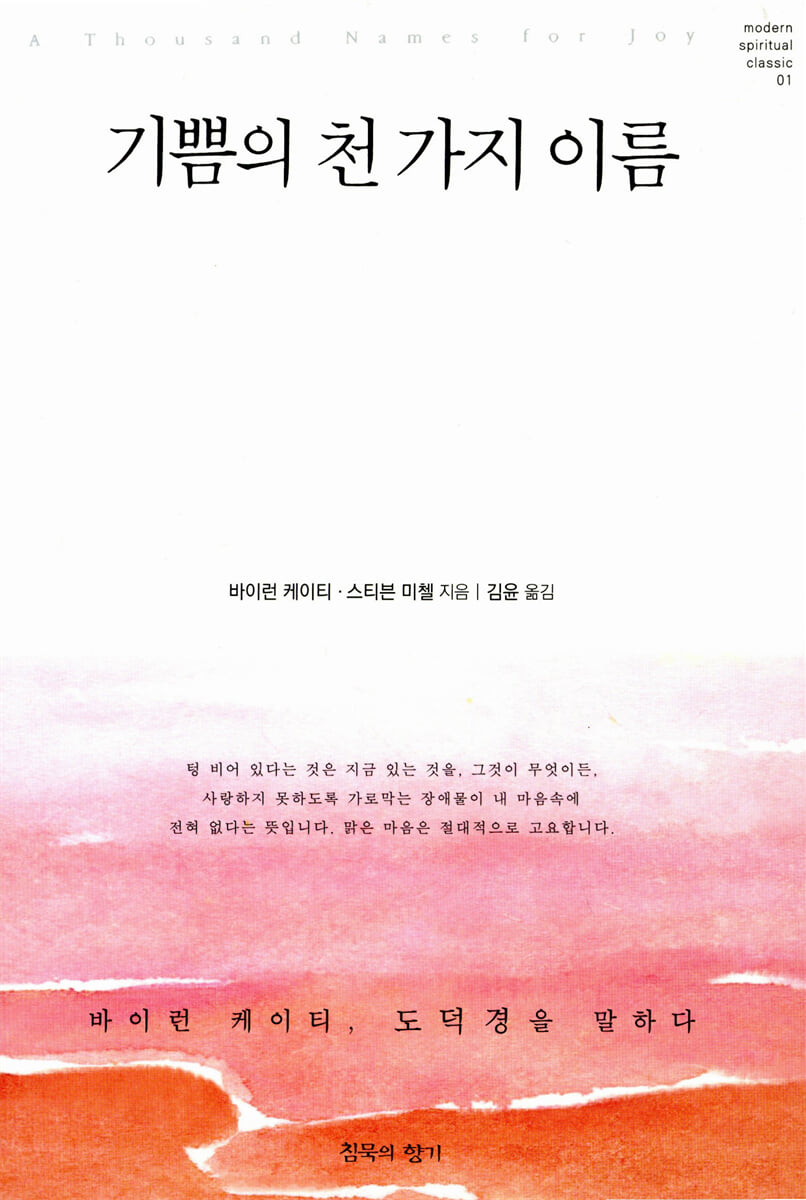 |
Description
Book Introduction
A peaceful mind free from stress,
A free life, unconstrained by any thoughts,
It's possible for anyone
Byron Katie, a world-renowned spiritual leader, uses the Tao Te Ching as a source of inspiration to teach us how to live a free and peaceful life.
What is the ultimate truth or reality, what we are in our original state, why thoughts are the cause of all suffering and stress, how to be completely liberated from the prison of thoughts and enjoy unshakable peace, what a life of complete freedom without any hindrances is like, and the truth that we are already that freedom, although we are not aware of it, are told with profound insight and moving language.
It also includes explanations and examples of 'work', a simple yet wonderful way to break free from the shackles of thought.
Byron Katie is one of the most influential spiritual leaders in the world today, and Time magazine has described her as a spiritual leader of the new age.
This book, first published in 2014, has been republished with a comprehensively revised translation.
A free life, unconstrained by any thoughts,
It's possible for anyone
Byron Katie, a world-renowned spiritual leader, uses the Tao Te Ching as a source of inspiration to teach us how to live a free and peaceful life.
What is the ultimate truth or reality, what we are in our original state, why thoughts are the cause of all suffering and stress, how to be completely liberated from the prison of thoughts and enjoy unshakable peace, what a life of complete freedom without any hindrances is like, and the truth that we are already that freedom, although we are not aware of it, are told with profound insight and moving language.
It also includes explanations and examples of 'work', a simple yet wonderful way to break free from the shackles of thought.
Byron Katie is one of the most influential spiritual leaders in the world today, and Time magazine has described her as a spiritual leader of the new age.
This book, first published in 2014, has been republished with a comprehensively revised translation.
- You can preview some of the book's contents.
Preview
index
introduction
preface
A Thousand Names of Joy
Appendix: How to do the job
Acknowledgements
Recommendation
preface
A Thousand Names of Joy
Appendix: How to do the job
Acknowledgements
Recommendation
Into the book
Peace is our natural state.
Only when we believe untrue thoughts can we leave peace and enter into emotions like sadness or anger.
When beliefs do not attract, the mind remains quiet and open to all that comes.
For example, if there were no need for attention from others, who would you be when you're around people? You'd be love itself.
When you believe the myth that people should care about you, you become so starved for affection that you can't care about people or yourself.
The experience of love cannot come from another person.
It can only come from within yourself.
--- p.122
The fundamental thought that causes stress is the idea of one 'me'.
Before that thought, there was peace.
Thoughts are born from 'nothingness' and immediately return to where they came from.
If you look before, between, and after thoughts, you will see that there is only boundless empty space.
It is a space of 'not knowing'.
That is our true self.
It is the source of everything, and in it everything is.
Life and death, beginning, middle and end… … .
--- p.88~88
After ten years of deep depression and despair, my real life began at the age of forty-three.
That's when I realized that the reason I was suffering wasn't because I couldn't control it.
Pain was the result of struggling with reality.
I realized that when I believe in my thoughts, I suffer, and when I don't believe in my thoughts, I don't suffer.
This is true for everyone.
Freedom is that simple.
I have come to realize that suffering is a choice.
I found joy within myself, and that joy has never gone away for a moment.
That joy is always within everyone.
When you ask questions of your heart with a love for truth, your life will always become happier and kinder.
--- p.142
When you don't believe in thoughts, you are free from the fundamental desire that reality should be different from what it is.
You realize what you cannot express in words, what you cannot think.
Understand that all 'secrets' are of your own making.
There are no secrets, actually.
Everything is bright and clear as day.
And it's simple.
Because in fact, there is nothing.
There is only the story that appears now.
Actually, there isn't even that.
--- p.27
When you don't believe your thoughts, what you are now is you.
There is no separation here.
You are everything.
Only the unquestioned mind believes that you are one 'I' living in one body.
What is the original oneness? It is chair-hand-cup-window-sky before 'chair', 'hand', 'cup', 'window', and 'sky.'
You don't have to go back to that one.
Because I never left.
How could you leave that place? Where else could you go? The center of the universe is wherever you are, and it exists everywhere.
It is where it begins and where it ends, the beauty of darkness and the joy of emptiness.
Only the center is real.
When you understand that, you realize that there is no need for even oneness.
Only when we believe untrue thoughts can we leave peace and enter into emotions like sadness or anger.
When beliefs do not attract, the mind remains quiet and open to all that comes.
For example, if there were no need for attention from others, who would you be when you're around people? You'd be love itself.
When you believe the myth that people should care about you, you become so starved for affection that you can't care about people or yourself.
The experience of love cannot come from another person.
It can only come from within yourself.
--- p.122
The fundamental thought that causes stress is the idea of one 'me'.
Before that thought, there was peace.
Thoughts are born from 'nothingness' and immediately return to where they came from.
If you look before, between, and after thoughts, you will see that there is only boundless empty space.
It is a space of 'not knowing'.
That is our true self.
It is the source of everything, and in it everything is.
Life and death, beginning, middle and end… … .
--- p.88~88
After ten years of deep depression and despair, my real life began at the age of forty-three.
That's when I realized that the reason I was suffering wasn't because I couldn't control it.
Pain was the result of struggling with reality.
I realized that when I believe in my thoughts, I suffer, and when I don't believe in my thoughts, I don't suffer.
This is true for everyone.
Freedom is that simple.
I have come to realize that suffering is a choice.
I found joy within myself, and that joy has never gone away for a moment.
That joy is always within everyone.
When you ask questions of your heart with a love for truth, your life will always become happier and kinder.
--- p.142
When you don't believe in thoughts, you are free from the fundamental desire that reality should be different from what it is.
You realize what you cannot express in words, what you cannot think.
Understand that all 'secrets' are of your own making.
There are no secrets, actually.
Everything is bright and clear as day.
And it's simple.
Because in fact, there is nothing.
There is only the story that appears now.
Actually, there isn't even that.
--- p.27
When you don't believe your thoughts, what you are now is you.
There is no separation here.
You are everything.
Only the unquestioned mind believes that you are one 'I' living in one body.
What is the original oneness? It is chair-hand-cup-window-sky before 'chair', 'hand', 'cup', 'window', and 'sky.'
You don't have to go back to that one.
Because I never left.
How could you leave that place? Where else could you go? The center of the universe is wherever you are, and it exists everywhere.
It is where it begins and where it ends, the beauty of darkness and the joy of emptiness.
Only the center is real.
When you understand that, you realize that there is no need for even oneness.
--- p.54
Publisher's Review
This is a book by world-renowned spiritual leader Byron Katie, which uses the Tao Te Ching as a material to discuss the path to a free and peaceful life.
Byron Katie is one of the most influential spiritual leaders in the world today, and Time magazine has described her as a spiritual leader of the new age.
This book, first published in 2014, has been republished with a comprehensively revised translation.
If you believe in thoughts, you will suffer.
If you don't believe in thoughts, you will be peaceful and happy.
Byron Katie, an ordinary housewife living in a small town in the southern California desert, suffered from depression and suicidal thoughts for over a decade after her divorce, and was admitted to a nursing home. One morning in February 1986, she suddenly woke up in a state of absolute joy (what people call enlightenment).
“All the anger and thoughts that had been tormenting me, my whole world, my whole world, had disappeared.
At the same time, laughter welled up from deep within and overflowed.
I couldn't make out anything.
It was as if something else had awakened.
'It' opened its eyes.
'It' was looking through Katie's eyes.
And I was filled with joy! I was drunk with joy.
There was nothing separate from it, nothing it could not accept.
Everything was just that.”
The truth Byron Katie discovered then was simple.
The cause of all stress and suffering is believing in ‘thoughts’.
If you believe in your thoughts, you will be stressed and in pain, and if you don't believe in your thoughts, you will be peaceful and happy.
“I have found that when I believe my thoughts I suffer, but when I don’t believe them I don’t suffer, and this is true for everyone.
Freedom is that simple.
I've come to realize that suffering is a choice we make.
The joy I discovered within me then has never disappeared for a moment.
That joy is always within everyone.”
She discovered 'The Work' upon waking up and has since spread this simple yet wondrous method of liberating the world from the shackles of thought.
What is the ultimate truth?
What would life be like for a being free from all thoughts?
Having awakened on her own without any spiritual master, she naturally did not belong to any spiritual tradition and had never been exposed to spiritual classics.
Her husband, Stephen Mitchell, a spiritual literature writer, read her a chapter of the Tao Te Ching that he had paraphrased, and recorded Byron Katie's comments on it, which he published in a book.
In this book, she responds to her husband's request and speaks of the unspeakable Tao.
Her words on the Tao, which run from chapter 1 to chapter 81 of the Tao Te Ching, are like a garland densely adorned with jewels, each shining with its own brilliance, and it is difficult to summarize their variety and depth in a few words.
But at least the ultimate truth she points to is not something that is separate from me, not some lofty thing, not some realm that can be reached through long and arduous practice or effort.
On the contrary, it is something pre-linguistic, without any separation, that is always present, that is me, but that we simply do not recognize.
Katie says about Chapter 1 of the Tao Te Ching:
“In this world before language, there is only what is real.
It is indivisible, incomprehensible, and already present here and now.
Nothing that appears separate can be real.
Because it is something that the mind creates by naming it.
When you understand this, even the unreal becomes beautiful.
Because there is nothing that can threaten reality.
I don't see any separate thing called 'tree' or 'you' or 'me'.
Believe it or not, these things are just imagination.”
Another major thread that weaves together the colorful language that points to the Tao is the figure of Byron Katie, who lives as the Tao itself.
Just because you realize what the Tao is, it doesn't mean you can immediately enjoy complete freedom.
This is because beliefs about ideas that have been solidified over a long period of time have deep roots, and because thoughts move faster than light, they can shake the mind in an instant.
How does a Taoist live, finally freed from the prison of all thoughts and all ideas?
The book is filled with vivid images and episodes that illustrate the life of such a free spirit, and her life testifies that her words are not just a theory, but are true.
Steven Mitchell cites several examples of such lives in his introduction.
“It is also a portrait of a woman who remains unwaveringly joyful, whether she is dancing with her baby granddaughter, or her house has been robbed and robbed of everything, or standing before a man who wants to kill her, or going on an adventure walking toward the kitchen, or hearing from a doctor that she will go blind, or . . . being diagnosed with cancer.”
A peaceful mind free from stress,
A free life, unconstrained by any thoughts,
It's possible for anyone
But if such a life were only for Byron Katie or a very small number of people, if it were only possible for a special few who are different from the ordinary majority of us, then such words and writing would be of little value and use.
But for Byron Katie, who sees no separation in the universe, she is soon one of us.
And, even though we may not know it, it is the freedom we are already seeking, and she has found the way, so we can find it too.
And, invariably, “How?” shows us the way.
“I know pain, I know joy, I know who I am.
I am soon yours.
Even if you don't realize it yet...
When there is no story, there is no past, no future, nothing to worry about, nothing to do, nowhere to go, no one to be, and everything is fine.”
Unlike previous works such as The Four Questions, which focused on helping people discover their own truths and become free through 'work', this book shows Byron Katie's own way of seeing the world and living her daily life.
And she expresses the ultimate truth and the freedom of life with a uniqueness, delicacy, and clarity rarely seen anywhere else.
Therefore, this is a precious and excellent work of spiritual literature that will be most welcomed by readers who want to know more about Byron Katie and those interested in the Tao.
Byron Katie is one of the most influential spiritual leaders in the world today, and Time magazine has described her as a spiritual leader of the new age.
This book, first published in 2014, has been republished with a comprehensively revised translation.
If you believe in thoughts, you will suffer.
If you don't believe in thoughts, you will be peaceful and happy.
Byron Katie, an ordinary housewife living in a small town in the southern California desert, suffered from depression and suicidal thoughts for over a decade after her divorce, and was admitted to a nursing home. One morning in February 1986, she suddenly woke up in a state of absolute joy (what people call enlightenment).
“All the anger and thoughts that had been tormenting me, my whole world, my whole world, had disappeared.
At the same time, laughter welled up from deep within and overflowed.
I couldn't make out anything.
It was as if something else had awakened.
'It' opened its eyes.
'It' was looking through Katie's eyes.
And I was filled with joy! I was drunk with joy.
There was nothing separate from it, nothing it could not accept.
Everything was just that.”
The truth Byron Katie discovered then was simple.
The cause of all stress and suffering is believing in ‘thoughts’.
If you believe in your thoughts, you will be stressed and in pain, and if you don't believe in your thoughts, you will be peaceful and happy.
“I have found that when I believe my thoughts I suffer, but when I don’t believe them I don’t suffer, and this is true for everyone.
Freedom is that simple.
I've come to realize that suffering is a choice we make.
The joy I discovered within me then has never disappeared for a moment.
That joy is always within everyone.”
She discovered 'The Work' upon waking up and has since spread this simple yet wondrous method of liberating the world from the shackles of thought.
What is the ultimate truth?
What would life be like for a being free from all thoughts?
Having awakened on her own without any spiritual master, she naturally did not belong to any spiritual tradition and had never been exposed to spiritual classics.
Her husband, Stephen Mitchell, a spiritual literature writer, read her a chapter of the Tao Te Ching that he had paraphrased, and recorded Byron Katie's comments on it, which he published in a book.
In this book, she responds to her husband's request and speaks of the unspeakable Tao.
Her words on the Tao, which run from chapter 1 to chapter 81 of the Tao Te Ching, are like a garland densely adorned with jewels, each shining with its own brilliance, and it is difficult to summarize their variety and depth in a few words.
But at least the ultimate truth she points to is not something that is separate from me, not some lofty thing, not some realm that can be reached through long and arduous practice or effort.
On the contrary, it is something pre-linguistic, without any separation, that is always present, that is me, but that we simply do not recognize.
Katie says about Chapter 1 of the Tao Te Ching:
“In this world before language, there is only what is real.
It is indivisible, incomprehensible, and already present here and now.
Nothing that appears separate can be real.
Because it is something that the mind creates by naming it.
When you understand this, even the unreal becomes beautiful.
Because there is nothing that can threaten reality.
I don't see any separate thing called 'tree' or 'you' or 'me'.
Believe it or not, these things are just imagination.”
Another major thread that weaves together the colorful language that points to the Tao is the figure of Byron Katie, who lives as the Tao itself.
Just because you realize what the Tao is, it doesn't mean you can immediately enjoy complete freedom.
This is because beliefs about ideas that have been solidified over a long period of time have deep roots, and because thoughts move faster than light, they can shake the mind in an instant.
How does a Taoist live, finally freed from the prison of all thoughts and all ideas?
The book is filled with vivid images and episodes that illustrate the life of such a free spirit, and her life testifies that her words are not just a theory, but are true.
Steven Mitchell cites several examples of such lives in his introduction.
“It is also a portrait of a woman who remains unwaveringly joyful, whether she is dancing with her baby granddaughter, or her house has been robbed and robbed of everything, or standing before a man who wants to kill her, or going on an adventure walking toward the kitchen, or hearing from a doctor that she will go blind, or . . . being diagnosed with cancer.”
A peaceful mind free from stress,
A free life, unconstrained by any thoughts,
It's possible for anyone
But if such a life were only for Byron Katie or a very small number of people, if it were only possible for a special few who are different from the ordinary majority of us, then such words and writing would be of little value and use.
But for Byron Katie, who sees no separation in the universe, she is soon one of us.
And, even though we may not know it, it is the freedom we are already seeking, and she has found the way, so we can find it too.
And, invariably, “How?” shows us the way.
“I know pain, I know joy, I know who I am.
I am soon yours.
Even if you don't realize it yet...
When there is no story, there is no past, no future, nothing to worry about, nothing to do, nowhere to go, no one to be, and everything is fine.”
Unlike previous works such as The Four Questions, which focused on helping people discover their own truths and become free through 'work', this book shows Byron Katie's own way of seeing the world and living her daily life.
And she expresses the ultimate truth and the freedom of life with a uniqueness, delicacy, and clarity rarely seen anywhere else.
Therefore, this is a precious and excellent work of spiritual literature that will be most welcomed by readers who want to know more about Byron Katie and those interested in the Tao.
GOODS SPECIFICS
- Publication date: November 18, 2020
- Page count, weight, size: 419 pages | 592g | 150*220*21mm
- ISBN13: 9788989590866
- ISBN10: 8989590868
You may also like
카테고리
korean


korean

![GQ KOREA Mark (Monthly): December [2025]](http://librairie.coreenne.fr/cdn/shop/files/8ef265dbbfbf186523ed75ba7319009d.jpg?v=1765340328&width=3840)


