

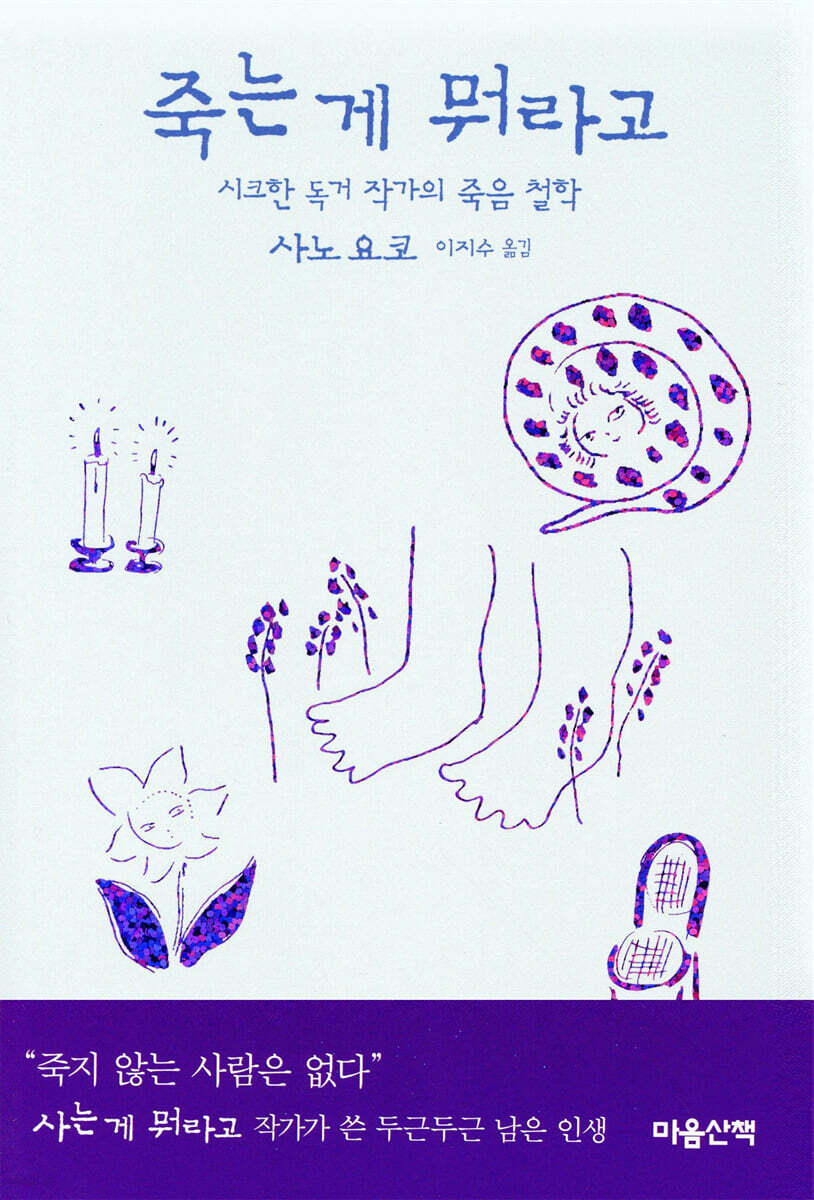
What is death?
 |
Description
Book Introduction
A new life after cancer recurrence
The author of "What is Life?" cries out, "I want to die gracefully."
Yoko Sano, author of “The Cat Who Lived a Million Times” and “What Is Life?”
She showed a chic attitude towards life and left a record of her life up until two years before she passed away after a relapse of cancer.
"What is Dying?" depicts Yoko Sano humbly accepting death as a natural part of life, while upholding the belief that "do not spare money or life."
This attitude is fully reflected in the prose and dialogues that make up this book, as well as in the memoirs of author Natsuo Sekikawa.
Yoko Sano consistently says in a detached voice, “I don’t care about dying.”
The author of "What is Life?" cries out, "I want to die gracefully."
Yoko Sano, author of “The Cat Who Lived a Million Times” and “What Is Life?”
She showed a chic attitude towards life and left a record of her life up until two years before she passed away after a relapse of cancer.
"What is Dying?" depicts Yoko Sano humbly accepting death as a natural part of life, while upholding the belief that "do not spare money or life."
This attitude is fully reflected in the prose and dialogues that make up this book, as well as in the memoirs of author Natsuo Sekikawa.
Yoko Sano consistently says in a detached voice, “I don’t care about dying.”
- You can preview some of the book's contents.
Preview
index
What is death?
11 Do not spare your money or your life.
28 Cowardice is the worst
40 Endless Fireworks
53 People with bad personalities don't know that they have bad personalities.
64 No one is immortal
77 Even if I die and my world dies, don't make a fuss
Things I didn't know
122 I'm dying of pain
131 Curiosity is shallow
144 No one's name was attached to it.
158 Cherry blossoms blooming next year
168 Everyone seems to be sliding in a certain direction
179 About Yoko Sano
197 Translator's Note
11 Do not spare your money or your life.
28 Cowardice is the worst
40 Endless Fireworks
53 People with bad personalities don't know that they have bad personalities.
64 No one is immortal
77 Even if I die and my world dies, don't make a fuss
Things I didn't know
122 I'm dying of pain
131 Curiosity is shallow
144 No one's name was attached to it.
158 Cherry blossoms blooming next year
168 Everyone seems to be sliding in a certain direction
179 About Yoko Sano
197 Translator's Note
Detailed image
.jpg)
Into the book
People become life, and cancer becomes knowledge.
After learning that the original Japanese title of this book was "Full of the Will to Die," a scene suddenly came to mind.
In the Monastery of Tripis, known as the "capital of silence," the only permitted phrase is "Brothers, let us remember death."
Why? In today's culture, death is always imminent, declared, or happens.
However, the death that Yoko Sano persistently talks about after being diagnosed with cancer inevitably testifies to life like two sides of a coin.
Just as extreme pain is proof of being alive, the will to die is also the most intense sight of life.
The irony of Steve Jobs, the most famous cancer patient of the 21st century, calling death “life’s greatest invention” should be understood this way.
Do you know that when you try to quickly type 'person' and make a typo, it often ends up being 'life'?
This book is like a thoughtful typo written by a strong grandmother who had cancer but did not quit smoking and wanted to die as a person, not as a patient, and who suddenly reached a point of 'knowledge' while writing about 'cancer'.
After learning that the original Japanese title of this book was "Full of the Will to Die," a scene suddenly came to mind.
In the Monastery of Tripis, known as the "capital of silence," the only permitted phrase is "Brothers, let us remember death."
Why? In today's culture, death is always imminent, declared, or happens.
However, the death that Yoko Sano persistently talks about after being diagnosed with cancer inevitably testifies to life like two sides of a coin.
Just as extreme pain is proof of being alive, the will to die is also the most intense sight of life.
The irony of Steve Jobs, the most famous cancer patient of the 21st century, calling death “life’s greatest invention” should be understood this way.
Do you know that when you try to quickly type 'person' and make a typo, it often ends up being 'life'?
This book is like a thoughtful typo written by a strong grandmother who had cancer but did not quit smoking and wanted to die as a person, not as a patient, and who suddenly reached a point of 'knowledge' while writing about 'cancer'.
Baek Young-ok (novelist)
I also believe that the most precious things cannot be bought with money.
--- p.40
All the things are something.
Money is all that matters.
--- p.48
A person with a bad mouth is worse than a gorilla or a cow.
--- p.50
It's okay to be poor.
I want to die with dignity and pride.
But I don't know what to do.
--- p.52p
If you live, you will just forget.
The fact that I am dying.
--- p.54p
If I were to be born again, I would want to be a 'stupid beauty'.
A while ago, I looked at my face in the mirror and said, “You’ve managed to live with this face.
When I said, “It’s both wonderful and admirable,” he felt so proud that he cried.
--- p.56~57
I can't do greetings.
If you try to be polite, your mouth will rot.
So, my compliments are sincere.
--- p.62
I learned everything from poverty.
--- p.63
I didn't mind dying, but I thought several times a day that death was the best way to be free from this pain, but it still felt unfair.
I felt wronged several times a day.
I groaned in frustration.
--- p.130
I pride myself on being able to spend money well even when I don't have any.
--- p.135
All the heavens and hells of this world are on the kotatsu.
I also believe that the most precious things cannot be bought with money.
--- p.40
All the things are something.
Money is all that matters.
--- p.48
A person with a bad mouth is worse than a gorilla or a cow.
--- p.50
It's okay to be poor.
I want to die with dignity and pride.
But I don't know what to do.
--- p.52p
If you live, you will just forget.
The fact that I am dying.
--- p.54p
If I were to be born again, I would want to be a 'stupid beauty'.
A while ago, I looked at my face in the mirror and said, “You’ve managed to live with this face.
When I said, “It’s both wonderful and admirable,” he felt so proud that he cried.
--- p.56~57
I can't do greetings.
If you try to be polite, your mouth will rot.
So, my compliments are sincere.
--- p.62
I learned everything from poverty.
--- p.63
I didn't mind dying, but I thought several times a day that death was the best way to be free from this pain, but it still felt unfair.
I felt wronged several times a day.
I groaned in frustration.
--- p.130
I pride myself on being able to spend money well even when I don't have any.
--- p.135
All the heavens and hells of this world are on the kotatsu.
--- p.40
All the things are something.
Money is all that matters.
--- p.48
A person with a bad mouth is worse than a gorilla or a cow.
--- p.50
It's okay to be poor.
I want to die with dignity and pride.
But I don't know what to do.
--- p.52p
If you live, you will just forget.
The fact that I am dying.
--- p.54p
If I were to be born again, I would want to be a 'stupid beauty'.
A while ago, I looked at my face in the mirror and said, “You’ve managed to live with this face.
When I said, “It’s both wonderful and admirable,” he felt so proud that he cried.
--- p.56~57
I can't do greetings.
If you try to be polite, your mouth will rot.
So, my compliments are sincere.
--- p.62
I learned everything from poverty.
--- p.63
I didn't mind dying, but I thought several times a day that death was the best way to be free from this pain, but it still felt unfair.
I felt wronged several times a day.
I groaned in frustration.
--- p.130
I pride myself on being able to spend money well even when I don't have any.
--- p.135
All the heavens and hells of this world are on the kotatsu.
I also believe that the most precious things cannot be bought with money.
--- p.40
All the things are something.
Money is all that matters.
--- p.48
A person with a bad mouth is worse than a gorilla or a cow.
--- p.50
It's okay to be poor.
I want to die with dignity and pride.
But I don't know what to do.
--- p.52p
If you live, you will just forget.
The fact that I am dying.
--- p.54p
If I were to be born again, I would want to be a 'stupid beauty'.
A while ago, I looked at my face in the mirror and said, “You’ve managed to live with this face.
When I said, “It’s both wonderful and admirable,” he felt so proud that he cried.
--- p.56~57
I can't do greetings.
If you try to be polite, your mouth will rot.
So, my compliments are sincere.
--- p.62
I learned everything from poverty.
--- p.63
I didn't mind dying, but I thought several times a day that death was the best way to be free from this pain, but it still felt unfair.
I felt wronged several times a day.
I groaned in frustration.
--- p.130
I pride myself on being able to spend money well even when I don't have any.
--- p.135
All the heavens and hells of this world are on the kotatsu.
--- p.176
Publisher's Review
A new life after cancer recurrence
The author of "What is Life?" cries out, "I want to die gracefully."
Yoko Sano, author of “The Cat Who Lived a Million Times” and “What Is Life?”
She showed a chic attitude towards life and left a record of her life up until two years before she passed away after a relapse of cancer.
"What is Dying?" depicts Yoko Sano humbly accepting death as a natural part of life, while upholding the belief that "do not spare money or life."
This attitude is fully reflected in the prose and dialogues that make up this book, as well as in the memoirs of author Natsuo Sekikawa.
Yoko Sano consistently says in a detached voice, “I don’t care about dying.”
The world won't be in trouble no matter who dies.
So there's no need to make such a fuss about dying.
If I die, my world will die too, but the universe will not disappear.
I wish you wouldn't make such a fuss.
-Page 119
Tatsuo Hirai, director of the Neurology Clinic, says this attitude is “due to my profession as a writer, and the fact that I have a good grasp of questions like ‘What is life? What am I? What is death?’”
However, even the meticulous Yoko Sano had one thing she couldn't do: pain.
I don't mind dying, but I don't like being sick.
Being sick is scary.
I don't mind drooling with a dazed head, but I just want to avoid pain.
-Page 72
Eventually, she ends up paying a lot of money and going into hospice.
There, he meets people who, like him, have fled the world and its suffering, people who are sliding towards death day by day, and their families.
In this book, unlike his previous work, "What is Life?", the author goes beyond the personal relationships between himself and his acquaintances to meet strangers and observe their demise up close.
It has disappeared.
In my little universe.
I couldn't express it in words,
That feeling is the realization that something precious is gone forever.
It was a loneliness that made me realize that I had to accept it.
A person I have never spoken to and who has no relationship with me,
Now, there will never be a time when it will pass before me in a transparent and silent manner.
-Pages 152-153
Yoko Sano, admitted to a hospice, observes death from a somewhat objective distance.
It is a perspective from a person (2.5 person) that is neither too far away nor too close to be heartbreaking.
At some point, she stopped whining and getting angry.
I just feel lonely.
In this moment, we see Sano Yoko's personal wish to "die well" expanded into a universal death preparation education.
Furthermore, as the author expresses his sorrow for the disappearance of others, not his own, we also gain the realization that people only regain their humanity through others.
A sharp and powerful voice
A grumbling that becomes sharper at the end of life
As in the previous work, you can easily find Yoko Sano's signature quotes in "What is Dying?"
I, too, believe that the most precious things cannot be bought with money. (Page 40)
Language is very important to humans.
It could be said that language alone proves humanity. (p. 50)
Each person is different.
Yes, each person is different. (Page 55)
I think people should die at home. (p. 70)
Nature never fails to become a picture that you want to tear apart. (p. 151)
You will know as time goes by without asking. (Page 174)
To a writer at the end of his life, even the monotony of daily life comes across as an unfamiliar image.
In this book, Yoko Sano displays keen insight into conversations and trivial phenomena that can easily be overlooked.
It is often a matter of frustration or irritation about one's situation, but it is also intertwined with questions about life that we have accepted indifferently.
So, Sano Yoko's grumbling also serves to bring to light contradictions that are buried in everyday life to the point where we are no longer even aware of them.
Animals have strong, still eyes that can withstand solitude.
But animals that use language have lost their solitary eyes.
Such eyes become tools for expressing all kinds of desires and twinkle greedily.
We humans have become so fatefully.
-Page 50
There is no one who does not die
But I'm alive until I die
Yoko Sano has been familiar with death since childhood.
When she was three, she witnessed her 33-day-old brother die from a nosebleed, and when she was eight, she watched indifferently as her four-year-old brother, whom she had cared for like a son, was buried in an unclaimed grave.
I didn't know what it was at the time.
It was only when her older brother, who had been like a part of her body to her, died the following year that Yoko Sano began to feel the reality of death for the first time and cried.
I felt “the greatest loss” of my life.
After that, she became “a person who only cries when things break up.” She also became a person who “doesn’t know how to live until I die.”
The deaths I witnessed in my childhood made me constantly question the rest of my life.
What kind of scenery did Sano Yoko discover anew when she faced her own inevitable death?
Even if I die, weeds will grow as if nothing happened.
Little flowers will bloom, rain will fall, and the sun will shine.
Every day a newborn baby is born and a ninety-four-year-old mummy dies in a nursing home.
Nevertheless, I want to die thinking that this world is beautiful.
I, who am as dirty and poisonous as mud mixed with shit, think that way.
-Page 157
A person lives until he dies.
-Page 175
In this book, Yoko Sano never says that she wants to live.
I don't even give you the advice to reflect on life self-sufficiently or to live without regrets.
Since I'm alive until I die, I just want to live (and die) properly for the rest of my life.
This polite detachment.
The generous embrace of one who has gained knowledge through the pain of cancer.
In this way, in “What is Dying,” Yoko Sano expresses her admiration for life without reservation.
The author of "What is Life?" cries out, "I want to die gracefully."
Yoko Sano, author of “The Cat Who Lived a Million Times” and “What Is Life?”
She showed a chic attitude towards life and left a record of her life up until two years before she passed away after a relapse of cancer.
"What is Dying?" depicts Yoko Sano humbly accepting death as a natural part of life, while upholding the belief that "do not spare money or life."
This attitude is fully reflected in the prose and dialogues that make up this book, as well as in the memoirs of author Natsuo Sekikawa.
Yoko Sano consistently says in a detached voice, “I don’t care about dying.”
The world won't be in trouble no matter who dies.
So there's no need to make such a fuss about dying.
If I die, my world will die too, but the universe will not disappear.
I wish you wouldn't make such a fuss.
-Page 119
Tatsuo Hirai, director of the Neurology Clinic, says this attitude is “due to my profession as a writer, and the fact that I have a good grasp of questions like ‘What is life? What am I? What is death?’”
However, even the meticulous Yoko Sano had one thing she couldn't do: pain.
I don't mind dying, but I don't like being sick.
Being sick is scary.
I don't mind drooling with a dazed head, but I just want to avoid pain.
-Page 72
Eventually, she ends up paying a lot of money and going into hospice.
There, he meets people who, like him, have fled the world and its suffering, people who are sliding towards death day by day, and their families.
In this book, unlike his previous work, "What is Life?", the author goes beyond the personal relationships between himself and his acquaintances to meet strangers and observe their demise up close.
It has disappeared.
In my little universe.
I couldn't express it in words,
That feeling is the realization that something precious is gone forever.
It was a loneliness that made me realize that I had to accept it.
A person I have never spoken to and who has no relationship with me,
Now, there will never be a time when it will pass before me in a transparent and silent manner.
-Pages 152-153
Yoko Sano, admitted to a hospice, observes death from a somewhat objective distance.
It is a perspective from a person (2.5 person) that is neither too far away nor too close to be heartbreaking.
At some point, she stopped whining and getting angry.
I just feel lonely.
In this moment, we see Sano Yoko's personal wish to "die well" expanded into a universal death preparation education.
Furthermore, as the author expresses his sorrow for the disappearance of others, not his own, we also gain the realization that people only regain their humanity through others.
A sharp and powerful voice
A grumbling that becomes sharper at the end of life
As in the previous work, you can easily find Yoko Sano's signature quotes in "What is Dying?"
I, too, believe that the most precious things cannot be bought with money. (Page 40)
Language is very important to humans.
It could be said that language alone proves humanity. (p. 50)
Each person is different.
Yes, each person is different. (Page 55)
I think people should die at home. (p. 70)
Nature never fails to become a picture that you want to tear apart. (p. 151)
You will know as time goes by without asking. (Page 174)
To a writer at the end of his life, even the monotony of daily life comes across as an unfamiliar image.
In this book, Yoko Sano displays keen insight into conversations and trivial phenomena that can easily be overlooked.
It is often a matter of frustration or irritation about one's situation, but it is also intertwined with questions about life that we have accepted indifferently.
So, Sano Yoko's grumbling also serves to bring to light contradictions that are buried in everyday life to the point where we are no longer even aware of them.
Animals have strong, still eyes that can withstand solitude.
But animals that use language have lost their solitary eyes.
Such eyes become tools for expressing all kinds of desires and twinkle greedily.
We humans have become so fatefully.
-Page 50
There is no one who does not die
But I'm alive until I die
Yoko Sano has been familiar with death since childhood.
When she was three, she witnessed her 33-day-old brother die from a nosebleed, and when she was eight, she watched indifferently as her four-year-old brother, whom she had cared for like a son, was buried in an unclaimed grave.
I didn't know what it was at the time.
It was only when her older brother, who had been like a part of her body to her, died the following year that Yoko Sano began to feel the reality of death for the first time and cried.
I felt “the greatest loss” of my life.
After that, she became “a person who only cries when things break up.” She also became a person who “doesn’t know how to live until I die.”
The deaths I witnessed in my childhood made me constantly question the rest of my life.
What kind of scenery did Sano Yoko discover anew when she faced her own inevitable death?
Even if I die, weeds will grow as if nothing happened.
Little flowers will bloom, rain will fall, and the sun will shine.
Every day a newborn baby is born and a ninety-four-year-old mummy dies in a nursing home.
Nevertheless, I want to die thinking that this world is beautiful.
I, who am as dirty and poisonous as mud mixed with shit, think that way.
-Page 157
A person lives until he dies.
-Page 175
In this book, Yoko Sano never says that she wants to live.
I don't even give you the advice to reflect on life self-sufficiently or to live without regrets.
Since I'm alive until I die, I just want to live (and die) properly for the rest of my life.
This polite detachment.
The generous embrace of one who has gained knowledge through the pain of cancer.
In this way, in “What is Dying,” Yoko Sano expresses her admiration for life without reservation.
GOODS SPECIFICS
- Date of issue: November 5, 2015
- Page count, weight, size: 200 pages | 228g | 128*190*12mm
- ISBN13: 9788960902435
- ISBN10: 8960902438
You may also like
카테고리
korean


korean

![GQ KOREA Mark (Monthly): December [2025]](http://librairie.coreenne.fr/cdn/shop/files/8ef265dbbfbf186523ed75ba7319009d.jpg?v=1765340328&width=3840)


