

A stone that doesn't leave the house
 |
Description
Book Introduction
A quiet invitation to hidden friends
With ‘easy support and unburdening courage’
A picture book that knocks on the door of your heart
Our school's picture book brand, Green Tangerine, presents a new book, "The Pebble That Never Leaves the House."
This book, through the story of the protagonist, Dolmeng, who stays in his room because he is afraid of the outside world, delivers warm comfort and encouragement to not only reclusive, lonely youth and children, but also all the "cowards with courage" in our society.
In "The Stone That Never Leaves the House," a stone appears who is so scared that he hides inside his house.
One day, a small stone comes to visit the stone that starts to cry and is startled by even the slightest noise from outside.
The little stone, who had been alone, musters up the courage to go out to find a friend, but when he hears that he is lost outside, his master stone tries to solidify his prejudice that he is still afraid of the world, but the little stone tells him that it was the protagonist's great courage to open the door.
Another threat approaches the two who quickly become friends… .
So what decision will these two stones make?
With ‘easy support and unburdening courage’
A picture book that knocks on the door of your heart
Our school's picture book brand, Green Tangerine, presents a new book, "The Pebble That Never Leaves the House."
This book, through the story of the protagonist, Dolmeng, who stays in his room because he is afraid of the outside world, delivers warm comfort and encouragement to not only reclusive, lonely youth and children, but also all the "cowards with courage" in our society.
In "The Stone That Never Leaves the House," a stone appears who is so scared that he hides inside his house.
One day, a small stone comes to visit the stone that starts to cry and is startled by even the slightest noise from outside.
The little stone, who had been alone, musters up the courage to go out to find a friend, but when he hears that he is lost outside, his master stone tries to solidify his prejudice that he is still afraid of the world, but the little stone tells him that it was the protagonist's great courage to open the door.
Another threat approaches the two who quickly become friends… .
So what decision will these two stones make?
- You can preview some of the book's contents.
Preview
Detailed image

Into the book
“I mustered up my courage and came out.
I haven't met any friends and I've even lost my way!
“I guess going out of the house is not a good idea?”
I asked with a sigh.
Then the little pebble shouted with round eyes.
“No! That’s not true!
“You opened the door for me!”
I haven't met any friends and I've even lost my way!
“I guess going out of the house is not a good idea?”
I asked with a sigh.
Then the little pebble shouted with round eyes.
“No! That’s not true!
“You opened the door for me!”
--- From the text
Publisher's Review
To the fearful and anxious 'me' and 'us'
In today's world, where children's social decline and the problem of "hikikomori" (elementary school hikikomori) are emerging as social issues beyond personal problems, this book delivers a lighthearted yet profoundly affectionate message.
The author of this book, Woo Ji-hyun, says, “We are all cowards, but let’s have the courage to come out into the world, and I dream of a world where there are more cowards who try to be brave.”
The issue of reclusive loners, which has emerged as a problem for society as a whole rather than an individual, is also addressed in various media, such as the drama 'Unknown Seoul'.
"The Pebble Who Never Leaves the House" delicately portrays the psychology of people who are afraid of communicating with others or reclusive loners through the cute pebble character.
The image of a snake coiling around the house visualizes the anxiety and fear that prevents the reader from leaving, allowing the reader to empathize with the protagonist.
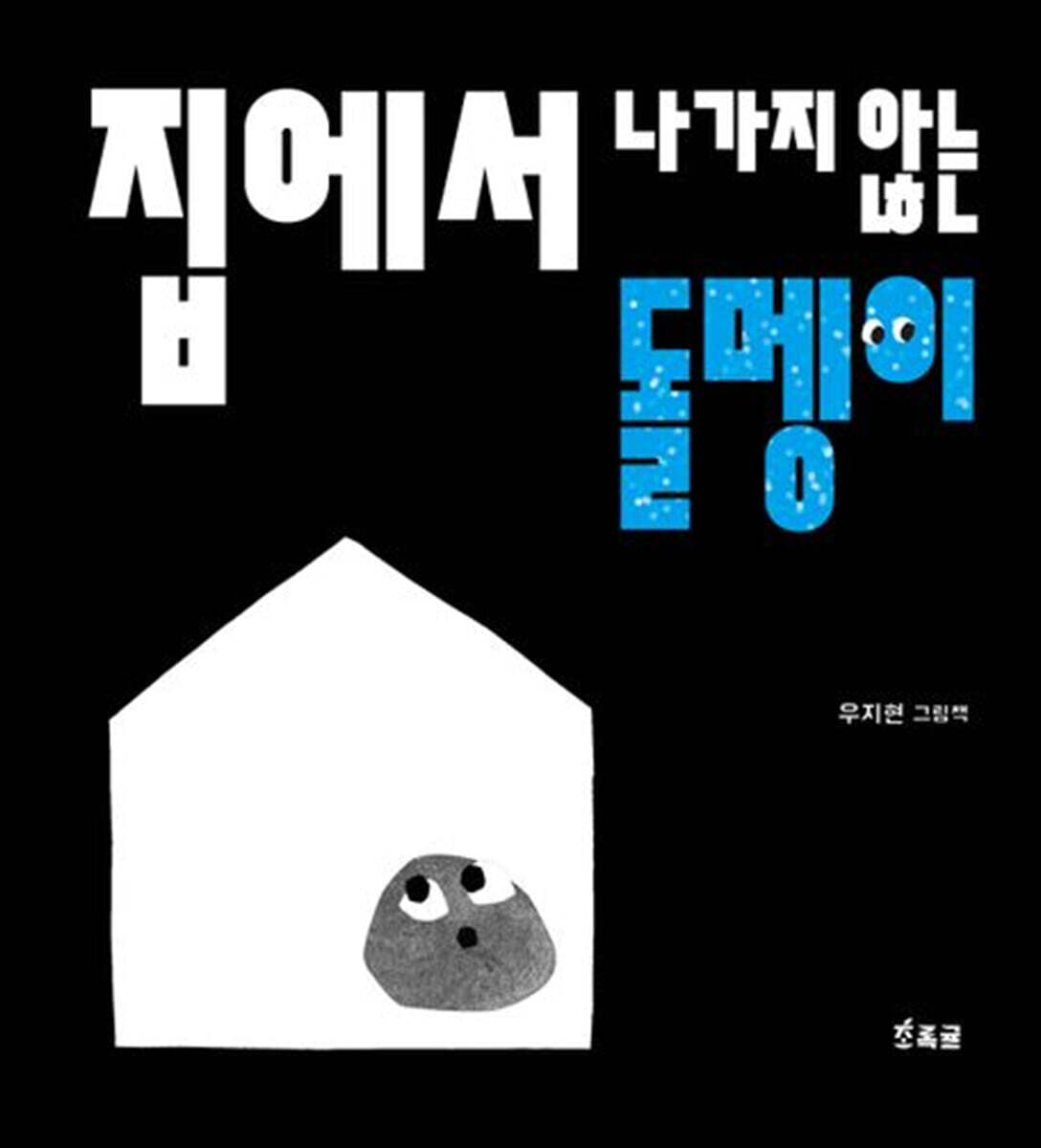
However, as can be seen on the cover, even though the main character Dolmeng is scared now, he does not lose his curiosity about the outside world.
If you look closely at the expression on the stone's face as it looks at the title, you can see its curiosity as if it's wondering if it should go out and have a look.
The author states that he created this book not only to encourage those who are physically unable to leave their homes, but also to all those who are afraid to approach others.
The courage to let go of excessive guard against others and approach one another
So, this book gives today's children, who may appear tough on the outside but are fragile and easily hurt on the inside, the courage to let go of their excessive wariness toward others and reach out to one another.
As rocks collide and stars flash before our eyes, this scene shows that sometimes, only through conflict can hearts open and relationships deepen.
I hope that "The Stone That Never Leaves the House" will serve as a valuable opportunity to broaden social understanding of reclusive loners by showing interest in them, sharing their concerns, and "empathizing and waiting" for them instead of "forcibly dragging them out."
Curriculum linkage
"Knowing and Respecting Myself" in the Social Relations section of the Kindergarten Nuri Curriculum
Elementary 2-1 Integrated 1.
me
Elementary Korean 2-1 2.
The fun of talking is slowly flowing
Elementary Morality 3-1 1.
Me and you, we together
In today's world, where children's social decline and the problem of "hikikomori" (elementary school hikikomori) are emerging as social issues beyond personal problems, this book delivers a lighthearted yet profoundly affectionate message.
The author of this book, Woo Ji-hyun, says, “We are all cowards, but let’s have the courage to come out into the world, and I dream of a world where there are more cowards who try to be brave.”
The issue of reclusive loners, which has emerged as a problem for society as a whole rather than an individual, is also addressed in various media, such as the drama 'Unknown Seoul'.
"The Pebble Who Never Leaves the House" delicately portrays the psychology of people who are afraid of communicating with others or reclusive loners through the cute pebble character.
The image of a snake coiling around the house visualizes the anxiety and fear that prevents the reader from leaving, allowing the reader to empathize with the protagonist.
However, as can be seen on the cover, even though the main character Dolmeng is scared now, he does not lose his curiosity about the outside world.
If you look closely at the expression on the stone's face as it looks at the title, you can see its curiosity as if it's wondering if it should go out and have a look.
The author states that he created this book not only to encourage those who are physically unable to leave their homes, but also to all those who are afraid to approach others.
The courage to let go of excessive guard against others and approach one another
So, this book gives today's children, who may appear tough on the outside but are fragile and easily hurt on the inside, the courage to let go of their excessive wariness toward others and reach out to one another.
As rocks collide and stars flash before our eyes, this scene shows that sometimes, only through conflict can hearts open and relationships deepen.
I hope that "The Stone That Never Leaves the House" will serve as a valuable opportunity to broaden social understanding of reclusive loners by showing interest in them, sharing their concerns, and "empathizing and waiting" for them instead of "forcibly dragging them out."
Curriculum linkage
"Knowing and Respecting Myself" in the Social Relations section of the Kindergarten Nuri Curriculum
Elementary 2-1 Integrated 1.
me
Elementary Korean 2-1 2.
The fun of talking is slowly flowing
Elementary Morality 3-1 1.
Me and you, we together
GOODS SPECIFICS
- Date of issue: August 20, 2025
- Format: Hardcover book binding method guide
- Pages, weight, size: 44 pages | 268g | 190*210*8mm
- ISBN13: 9791167553393
- ISBN10: 116755339X
- KC Certification: Certification Type: Conformity Confirmation
You may also like
카테고리
korean


korean

![GQ KOREA Mark (Monthly): December [2025]](http://librairie.coreenne.fr/cdn/shop/files/8ef265dbbfbf186523ed75ba7319009d.jpg?v=1765340328&width=3840)


