

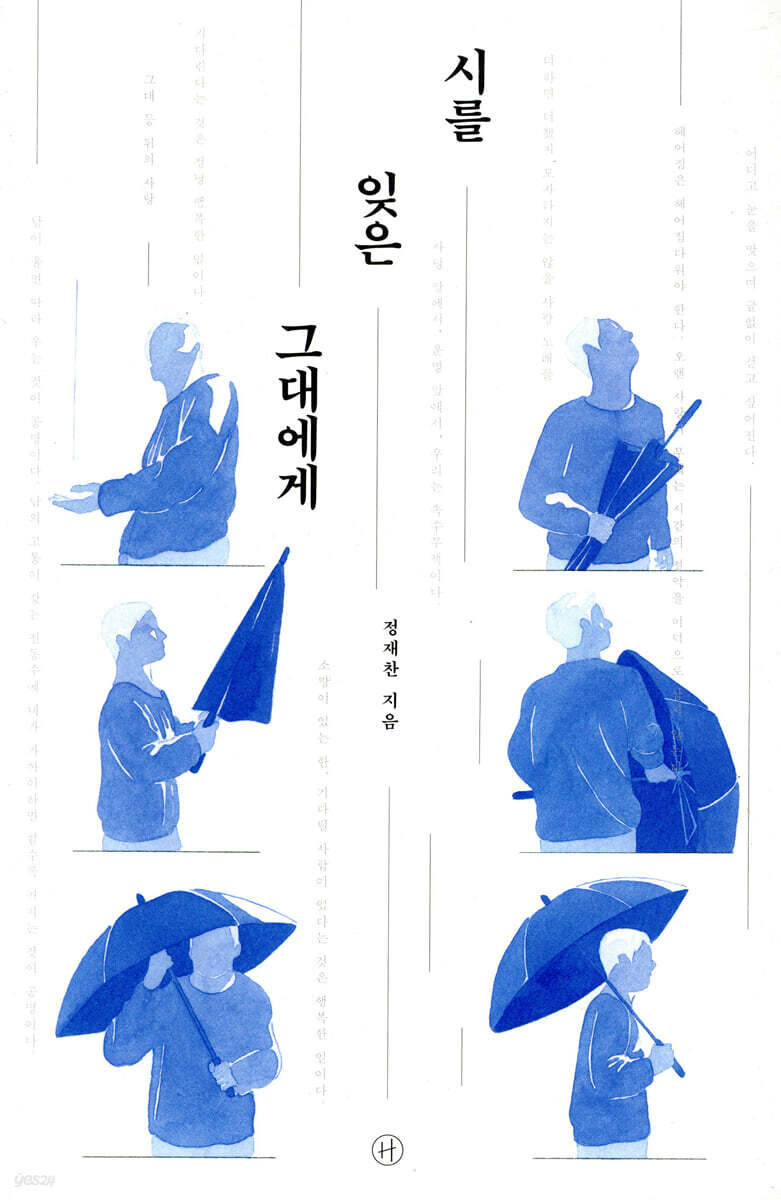
To You Who Forgot Poetry (Recovery Edition)
 |
Description
Book Introduction
“I was so moved that I almost cried, and so amazed that I got goosebumps!”
You, who have only studied poetry as a literature reference book for the entrance exam.
No matter how much I shout that the shell is gone and that only people have hope, there is not even a single room for me to lay my body down, and although I say I will burn with passion, there is no place calling me, the manager throws down the report at the end of the day, and tonight again, my salary is wiping through my bank account.
Still, let's not be poor in spirit, and there is someone who started reading poetry with engineering students, who are symbols of dry hearts, dreaming of Professor Keating in "Dead Poets Society."
Professor Jeong Jae-chan of Hanyang University's Department of Korean Language Education read the best modern poems of our time with his students, sometimes humming old-time pop songs, sometimes watching movies that became someone's memories, and sometimes adding a single curse word that cuts deeper than any other word.
The poem in that old textbook was revived as an immortal poem that moved even engineering students to tears.
At that moment, when the longing that has been building up in my heart suddenly pours out, poetry comes and youth begins again.
You who were frustrated in our happy youth, now is the time to meet real poetry.
You, who have only studied poetry as a literature reference book for the entrance exam.
No matter how much I shout that the shell is gone and that only people have hope, there is not even a single room for me to lay my body down, and although I say I will burn with passion, there is no place calling me, the manager throws down the report at the end of the day, and tonight again, my salary is wiping through my bank account.
Still, let's not be poor in spirit, and there is someone who started reading poetry with engineering students, who are symbols of dry hearts, dreaming of Professor Keating in "Dead Poets Society."
Professor Jeong Jae-chan of Hanyang University's Department of Korean Language Education read the best modern poems of our time with his students, sometimes humming old-time pop songs, sometimes watching movies that became someone's memories, and sometimes adding a single curse word that cuts deeper than any other word.
The poem in that old textbook was revived as an immortal poem that moved even engineering students to tears.
At that moment, when the longing that has been building up in my heart suddenly pours out, poetry comes and youth begins again.
You who were frustrated in our happy youth, now is the time to meet real poetry.
- You can preview some of the book's contents.
Preview
index
preface
1.
The Love Song of the Poor Reed
How Does Love Change? Shin Kyeong-rim's "Reed"
Poverty and Love Cannot Be Hidden, Shin Kyeong-rim's "Poor Love Song"
2.
On a starry night
The Age of Innocence by Bang Jeong-hwan, "Brother Star"
Where and what became Kim Kwang-seok's "In the Evening" and Yun Dong-ju's "Counting Stars at Night"
Lee Seong-seon's "One Star I Love" on a Starry Night
3.
About leaving
Beautiful Exit: Lee Hyeong-gi's "Fallen Flowers" and Bok Hyo-geun's "Magnolia"
The Wind Blows Kim Chun-soo's "Rain", "Wind", and "Flowers"
4.
Why are tears salty?
A Bowl of Udon, a Bowl of Soup Ham Min-bok, "Why Are Tears Salty?" and "That Day, I Was Filled with Sorrow"
Sorrow More Precious Than Love: Jeong Ho-seung's "Sorrow to Joy"
Still, only people are hope. Park No-hae's "Again," Jeong Ho-seung's "Become a Creator of Hope," Jeong Ji-won's "People Are More Beautiful Than Flowers."
5.
The love behind your back
A Happy Letter by Hwang Dong-gyu
The horizon behind Park Mok-wol (Background)
The Greatest Sky Is Always Behind You Kang Eun-kyo's "The Law of Love"
6.
I'll wait until I die, I'll wait until I die
Waiting for You by Hwang Ji-woo
Even if I wait to die, Picheon Deuk will die for "Waiting" and Kihyung Do will die for "Worrying about Mom."
Waiting for Death: Seo Jeong-ju's "Bride" and Jo Ji-hoon's "Stone Gate"
Kim Min-bu's "Death Poem"
7.
People who forgot the song
The Faint Shadow of an Old Love by Kim Gwang-gyu
Sister, you're alive! Hwang Ji-woo's "Finally, That Man in His 40s" and Kim Jong-sam's "Civilian"
I stopped singing Song Su-kwon's "Myeonminhoe Day"
8.
In the name of the father
Will I know tomorrow when I become a parent? Kim So-wol, "Parents" and "What I Know After Listening and Learning as a Child"
When I see my father in the mirror, Shin Kyeong-rim's "Father's Shadow"
9.
What should I do with this scattered heart?
Im is like a land that doesn't move, but Yoo Chi-hwan's "Longing 1", "Rock", and "Longing 2"
I was happy because I loved. Lee Young-do, Untitled 1, Yoo Chi-hwan, Happiness
10.
Winter, meeting a traveler
Wilhelm Müller's "Linden Tree" ("Winter Journey" and "The Pied Piper")
The Last Picnic in This World by Cheon Sang-byeong (Noble and Heavenly)
11.
It snows in the middle of the night, without a sound
The sound of a woman taking off her clothes in the distance, Kim Gwang-gyun's "Snowy Night"
Kim Gwang-gyun's "Poem on a Snowy Night" and "Snow Falling on Janggokcheonjeong" in Colonial Gyeongseong
12.
Clean cough, pure phlegm
Kim Soo-young's "Snow" and "Waterfall": A Criticism of Obvious Poetry
The Identity of Cough and Phlegm by Kim Soo-young (First, Let's Take That Picture and Use It as a Dirty Dish)
1.
The Love Song of the Poor Reed
How Does Love Change? Shin Kyeong-rim's "Reed"
Poverty and Love Cannot Be Hidden, Shin Kyeong-rim's "Poor Love Song"
2.
On a starry night
The Age of Innocence by Bang Jeong-hwan, "Brother Star"
Where and what became Kim Kwang-seok's "In the Evening" and Yun Dong-ju's "Counting Stars at Night"
Lee Seong-seon's "One Star I Love" on a Starry Night
3.
About leaving
Beautiful Exit: Lee Hyeong-gi's "Fallen Flowers" and Bok Hyo-geun's "Magnolia"
The Wind Blows Kim Chun-soo's "Rain", "Wind", and "Flowers"
4.
Why are tears salty?
A Bowl of Udon, a Bowl of Soup Ham Min-bok, "Why Are Tears Salty?" and "That Day, I Was Filled with Sorrow"
Sorrow More Precious Than Love: Jeong Ho-seung's "Sorrow to Joy"
Still, only people are hope. Park No-hae's "Again," Jeong Ho-seung's "Become a Creator of Hope," Jeong Ji-won's "People Are More Beautiful Than Flowers."
5.
The love behind your back
A Happy Letter by Hwang Dong-gyu
The horizon behind Park Mok-wol (Background)
The Greatest Sky Is Always Behind You Kang Eun-kyo's "The Law of Love"
6.
I'll wait until I die, I'll wait until I die
Waiting for You by Hwang Ji-woo
Even if I wait to die, Picheon Deuk will die for "Waiting" and Kihyung Do will die for "Worrying about Mom."
Waiting for Death: Seo Jeong-ju's "Bride" and Jo Ji-hoon's "Stone Gate"
Kim Min-bu's "Death Poem"
7.
People who forgot the song
The Faint Shadow of an Old Love by Kim Gwang-gyu
Sister, you're alive! Hwang Ji-woo's "Finally, That Man in His 40s" and Kim Jong-sam's "Civilian"
I stopped singing Song Su-kwon's "Myeonminhoe Day"
8.
In the name of the father
Will I know tomorrow when I become a parent? Kim So-wol, "Parents" and "What I Know After Listening and Learning as a Child"
When I see my father in the mirror, Shin Kyeong-rim's "Father's Shadow"
9.
What should I do with this scattered heart?
Im is like a land that doesn't move, but Yoo Chi-hwan's "Longing 1", "Rock", and "Longing 2"
I was happy because I loved. Lee Young-do, Untitled 1, Yoo Chi-hwan, Happiness
10.
Winter, meeting a traveler
Wilhelm Müller's "Linden Tree" ("Winter Journey" and "The Pied Piper")
The Last Picnic in This World by Cheon Sang-byeong (Noble and Heavenly)
11.
It snows in the middle of the night, without a sound
The sound of a woman taking off her clothes in the distance, Kim Gwang-gyun's "Snowy Night"
Kim Gwang-gyun's "Poem on a Snowy Night" and "Snow Falling on Janggokcheonjeong" in Colonial Gyeongseong
12.
Clean cough, pure phlegm
Kim Soo-young's "Snow" and "Waterfall": A Criticism of Obvious Poetry
The Identity of Cough and Phlegm by Kim Soo-young (First, Let's Take That Picture and Use It as a Dirty Dish)
Detailed image
.jpg)
Publisher's Review
1.
A Masterful Lecture on Modern Poetry for Engineering Students
- A lecture on modern poetry that satisfies all five senses by Professor Jae-chan Jeong of the Department of Korean Language Education at Hanyang University.
In a university lecture hall, students look as if they are possessed by something, shedding tears, sighing, and laughing.
And when the lecture ended, everyone applauded enthusiastically as if they had made a promise.
This is not a scene from a movie.
This is a scene that happened in a poetry lecture at a university.
The average middle and high school student completely loses interest in literature after going through literature classes that are like 'religious rituals'.
The teacher reads the poems, adding annotations as if he were a priest reading a scripture, and the students diligently write down and recite the annotations, gradually moving further and further away from the romance, beauty, and truth of the poems.
After graduating from school, you completely forget what poetry and novels are and just become busy making a living.
No, maybe we have never read poetry properly.
Professor Jeong Jae-chan of the Department of Korean Language Education at Hanyang University opened a liberal arts course titled "Reading Poetry in Cultural Fusion" based on his awareness of the problems facing our literature classrooms.
This class is mostly attended by students who have been relatively distant from poetry, such as those from engineering, medical, law, and business schools, rather than liberal arts departments.
The process of getting engineering students, who are "symbols of dry hearts" and enjoy answering questions with formulas or numbers, to read poetry was as difficult as teaching calculus to elementary school students.
"To You Who Forgot Poetry" is a book that compiles Professor Jeong Jae-chan's famous lectures on poetry reading that even brought these engineering students to tears.
"To You Who Forgot Poetry" is a poetry essay written based on the content of Professor Jeong Jae-chan's lecture, "Reading Poetry in Cultural Convergence," a poetry reading course for science and engineering students as part of Hanyang University's integrated liberal arts and science education program.
Professor Jeong Jae-chan's lecture, "Reading Poetry in Cultural Fusion," which aimed to return the joy of reading poetry to students who had become mentally impoverished due to focusing only on building up various qualifications and getting a job, received applause from students at every lecture and was selected as the best liberal arts lecture at Hanyang University.
What was it that made it so special?
In fact, the 46 poems covered in this book are very familiar to us.
This is because most of the modern and contemporary Korean poetry is something that you have seen at least once in middle and high school literature textbooks.
The 'eyes' in "Eyes are Alive" are read solely as a symbol of 'purity', and Kim So-wol's poetry is unconditionally interpreted as the longing of colonial intellectuals.
In order to vividly revive poems that were read as clichés in textbooks, such as Shin Kyeong-rim's "Reeds," Yun Dong-ju's "Starry Night," and Kim Chun-su's "Flowers," but are still considered some of Korea's best, in the lives of contemporary people, various cultural contents such as films, novels, popular songs, art songs, paintings, and photographs were mobilized in the lecture.
It was a special poetry reading that utilized not only sound and image, but also the senses of smell and touch.
This book sharply criticizes the solemnity of our literary education, which alienates readers from literature by simply repeating the language of criticism, and aims to teach us how to enjoy literature as if we were enjoying a festival.
It is my belief that rather than knowing a lot of literary works, you need to have one poem you really like so that you can find, read, and enjoy the work on your own.
Professor Jeong Jae-chan, who said, “I wanted to create a relationship where literature education thrives and literature thrives as well (during an interview),” experimented with a teaching method that allows students to develop the ability to read and write about their daily lives with poetry by utilizing content from various genres through several lectures, and the results were successful.
Students who were exhausted from studying and preparing for employment confessed that they felt resonated with poems from 20 or 50 years ago, as if they were reflecting their innermost thoughts, and that they felt healed through writing.
This was truly my first encounter with 'poetry'.
This book, which captures the vivid scenes of the famous lecture "Reading the Poetry of Cultural Fusion" that engineering students have responded to with a standing ovation since 2012, in a flowing style, transcends genre boundaries and expands humanistic horizons.
If we follow the essays of Professor Jeong Jae-chan, who is leaving, all those who have forgotten poetry like an 'engineering student' will rediscover the joy of poetry.
“It was a lecture that felt like watching a piece of performing art.
“It was ecstatic and really heart-fluttering.”
“Every class was so moving that it brought tears to my eyes, so awe-inspiring that it gave me goosebumps, and above all, it was always fun.”
“Of all the classes I took throughout elementary, middle, high school, and college, this was the most impressive and memorable.
“I was amazed at how his unique and fresh teaching method transformed poetry, which often seemed distant, into a fun and educational lesson.”
“It was a truly meaningful lecture.
It was the first time I had a lecture where I applauded spontaneously even though it wasn't the end of the lecture.
Poetry that I thought was difficult now feels closer.
The whole process of appreciating poetry along with movies and music and reflecting on the poetry through the poet's life was fascinating.
“Thank you for teaching me what true romance is and what love is.”
-From the lecture evaluations of Hanyang University students
2.
Immortal Masterpiece, Touching Everyone's Heart
Poetry as a cultural memory spanning all generations
People still feel a deep, heart-fluttering emotion when they read a short piece of writing and a photo discussing life and love.
It's about sharing short messages that spread through various social media platforms like Facebook and Twitter with strangers and feeling something that resonates in your heart.
However, I still feel distant from the orthodox literary genre of 'poetry'.
Wouldn't all Koreans, who received a literature education focused on college entrance exams, be intimidated by the very idea that there's a "correct" answer to interpreting poetry?
"To You Who Forgot Poetry" carefully selects modern and contemporary poems from literature textbooks that have been removed from people's hearts, and creates a thrilling ripple in the reading of poetry that is as predictable as a formula.
We are breathing new life into the 'immortal masterpieces' that captured the fiercest emotions of their time and were written in the most passionate moments, but which have been lost in textbooks.
This book demonstrates a special way of reading poetry.
When reading poet Hwang Dong-gyu's "Happy Letter," I sometimes sing singer Shin Seung-hun's "Invisible Love" with longing, and when reading a line from poet Shin Kyeong-rim's "Poor Love Song," I sometimes add a curse word.
Instead of textbook-like explanations like 'auditory visualization' or 'synesthetic imagery,' I believe that looking up a scene from an old advertisement, and singing a poem to intense rock music to understand the isolated feelings of poets during the Japanese colonial period, is a way to understand the voice conveyed by the poem more honestly and truthfully.
Whenever I look at the teacher's guide for the textbook that included this poem, and witness that the commentary included there still dominates the mainstream of almost all reference books dealing with this poem, my face burns.
According to him, the theme of this poem is 'warm humanity' or 'the warmth and beauty of human truth'.
(Omitted) If the theme of this poem is truly warm humanity, then this poem should be recited in a very soft and warm tone, but I simply cannot find a way to read this poem that way.
Especially in the last verse, which reaches a climax, I think the line, “Why don’t you know what love is just because you’re poor?” should be read as if you’re crying.
During class time, I actually read this poem with a swear word added at the end.
No matter how you look at it, the focus of this poem is not on the warm heart of the poor worker, but on the reality that made him give up everything simply because he was poor.
- From pages 25-26 of “The Love Song of the Poor Reed”
Just as the poet's pupils were dilated when he rediscovered the value of the eyes, our pupils as we read this poem should also be dilated.
Read it like this.
“The snow is alive! The fallen snow is alive!! The snow that fell on the yard is alive!!!” (omitted) In this passage, we should note that the intended audience of this poem was the ‘young poet.’
A young poet, like a rocker, must be like a young poet.
A young poet cannot sing songs and hum ballads like an old poet.
(Omitted) For true freedom, for true literature, poets, young poets, like the rockers who resisted the established culture, like the hippies who rebelled against modernization, must have the courage and action to spit.
- From pages 291-295 of “Clean Cough, Pure Phlegm”
So, let us break away from the habitual interpretation that mechanically links Sowol's sorrow to collective tradition or the sentiments of the colonial people.
His grievances are deeply personal.
It is also not an idea.
Listen carefully to the quality and depth of his desperate life contained in his poetry.
Shouldn't we first look upon Sowol's wounds, having a father who was unable to be a 'parent', as a 'father', and listen to his groans that flow out through his poetry? Isn't this the duty we owe the poet?
-From page 201, “In the Name of the Father”
Just as 'Immortal Songs' rewrote past songs with a contemporary sensibility, allowing all generations to communicate through one piece of music, 'To You Who Forgot Poetry' also says that it is important to 'upgrade' the interpretation of poetry and enjoy it together.
The universal emotions of longing, sadness, excitement, and anger contained in poetry allow people of different generations and classes to recall and heal memories, ultimately leading them to communicate as a single "cultural memory."
While popular songs, advertisements, and movies, often cited in lectures and books to enhance understanding of poetry, are closer to cultural legacies of the past, Professor Jeong Jae-chan confirmed that it is possible to build empathy across generations through the common sensibilities and universal emotions contained in poetry.
Students in their early 20s listened to the lecture with curious eyes, while those in their 40s and 50s applauded unanimously as they reminisced about the past.
This book, like Professor Keating in the movie Dead Poets Society, makes readers cry, laugh, and vent their frustrations, and tells stories of poetry, beauty, romance, and love.
His outstanding writing skills, sharp and rich, as if piercing the heart like a poet, have a different kind of magic than lectures.
Professor Jeong Jae-chan says he hopes that through this book, readers will feel as natural in conversing about poetry as they would in discussing popular songs or dramas.
Rather than reading the poem dogmatically with annotations on each verse, the book encourages reading the poem 'divergently', as if it were the way poetry is read.
This book, which shares with readers the deep tremors and resonance that only poetry can provide, based on original interpretations and a rich humanistic horizon, will make anyone who has once shed tears at a verse but has tried to turn away from the joy of reading poetry, calling it a luxury of emotion, pick up a poetry collection once again.
A Masterful Lecture on Modern Poetry for Engineering Students
- A lecture on modern poetry that satisfies all five senses by Professor Jae-chan Jeong of the Department of Korean Language Education at Hanyang University.
In a university lecture hall, students look as if they are possessed by something, shedding tears, sighing, and laughing.
And when the lecture ended, everyone applauded enthusiastically as if they had made a promise.
This is not a scene from a movie.
This is a scene that happened in a poetry lecture at a university.
The average middle and high school student completely loses interest in literature after going through literature classes that are like 'religious rituals'.
The teacher reads the poems, adding annotations as if he were a priest reading a scripture, and the students diligently write down and recite the annotations, gradually moving further and further away from the romance, beauty, and truth of the poems.
After graduating from school, you completely forget what poetry and novels are and just become busy making a living.
No, maybe we have never read poetry properly.
Professor Jeong Jae-chan of the Department of Korean Language Education at Hanyang University opened a liberal arts course titled "Reading Poetry in Cultural Fusion" based on his awareness of the problems facing our literature classrooms.
This class is mostly attended by students who have been relatively distant from poetry, such as those from engineering, medical, law, and business schools, rather than liberal arts departments.
The process of getting engineering students, who are "symbols of dry hearts" and enjoy answering questions with formulas or numbers, to read poetry was as difficult as teaching calculus to elementary school students.
"To You Who Forgot Poetry" is a book that compiles Professor Jeong Jae-chan's famous lectures on poetry reading that even brought these engineering students to tears.
"To You Who Forgot Poetry" is a poetry essay written based on the content of Professor Jeong Jae-chan's lecture, "Reading Poetry in Cultural Convergence," a poetry reading course for science and engineering students as part of Hanyang University's integrated liberal arts and science education program.
Professor Jeong Jae-chan's lecture, "Reading Poetry in Cultural Fusion," which aimed to return the joy of reading poetry to students who had become mentally impoverished due to focusing only on building up various qualifications and getting a job, received applause from students at every lecture and was selected as the best liberal arts lecture at Hanyang University.
What was it that made it so special?
In fact, the 46 poems covered in this book are very familiar to us.
This is because most of the modern and contemporary Korean poetry is something that you have seen at least once in middle and high school literature textbooks.
The 'eyes' in "Eyes are Alive" are read solely as a symbol of 'purity', and Kim So-wol's poetry is unconditionally interpreted as the longing of colonial intellectuals.
In order to vividly revive poems that were read as clichés in textbooks, such as Shin Kyeong-rim's "Reeds," Yun Dong-ju's "Starry Night," and Kim Chun-su's "Flowers," but are still considered some of Korea's best, in the lives of contemporary people, various cultural contents such as films, novels, popular songs, art songs, paintings, and photographs were mobilized in the lecture.
It was a special poetry reading that utilized not only sound and image, but also the senses of smell and touch.
This book sharply criticizes the solemnity of our literary education, which alienates readers from literature by simply repeating the language of criticism, and aims to teach us how to enjoy literature as if we were enjoying a festival.
It is my belief that rather than knowing a lot of literary works, you need to have one poem you really like so that you can find, read, and enjoy the work on your own.
Professor Jeong Jae-chan, who said, “I wanted to create a relationship where literature education thrives and literature thrives as well (during an interview),” experimented with a teaching method that allows students to develop the ability to read and write about their daily lives with poetry by utilizing content from various genres through several lectures, and the results were successful.
Students who were exhausted from studying and preparing for employment confessed that they felt resonated with poems from 20 or 50 years ago, as if they were reflecting their innermost thoughts, and that they felt healed through writing.
This was truly my first encounter with 'poetry'.
This book, which captures the vivid scenes of the famous lecture "Reading the Poetry of Cultural Fusion" that engineering students have responded to with a standing ovation since 2012, in a flowing style, transcends genre boundaries and expands humanistic horizons.
If we follow the essays of Professor Jeong Jae-chan, who is leaving, all those who have forgotten poetry like an 'engineering student' will rediscover the joy of poetry.
“It was a lecture that felt like watching a piece of performing art.
“It was ecstatic and really heart-fluttering.”
“Every class was so moving that it brought tears to my eyes, so awe-inspiring that it gave me goosebumps, and above all, it was always fun.”
“Of all the classes I took throughout elementary, middle, high school, and college, this was the most impressive and memorable.
“I was amazed at how his unique and fresh teaching method transformed poetry, which often seemed distant, into a fun and educational lesson.”
“It was a truly meaningful lecture.
It was the first time I had a lecture where I applauded spontaneously even though it wasn't the end of the lecture.
Poetry that I thought was difficult now feels closer.
The whole process of appreciating poetry along with movies and music and reflecting on the poetry through the poet's life was fascinating.
“Thank you for teaching me what true romance is and what love is.”
-From the lecture evaluations of Hanyang University students
2.
Immortal Masterpiece, Touching Everyone's Heart
Poetry as a cultural memory spanning all generations
People still feel a deep, heart-fluttering emotion when they read a short piece of writing and a photo discussing life and love.
It's about sharing short messages that spread through various social media platforms like Facebook and Twitter with strangers and feeling something that resonates in your heart.
However, I still feel distant from the orthodox literary genre of 'poetry'.
Wouldn't all Koreans, who received a literature education focused on college entrance exams, be intimidated by the very idea that there's a "correct" answer to interpreting poetry?
"To You Who Forgot Poetry" carefully selects modern and contemporary poems from literature textbooks that have been removed from people's hearts, and creates a thrilling ripple in the reading of poetry that is as predictable as a formula.
We are breathing new life into the 'immortal masterpieces' that captured the fiercest emotions of their time and were written in the most passionate moments, but which have been lost in textbooks.
This book demonstrates a special way of reading poetry.
When reading poet Hwang Dong-gyu's "Happy Letter," I sometimes sing singer Shin Seung-hun's "Invisible Love" with longing, and when reading a line from poet Shin Kyeong-rim's "Poor Love Song," I sometimes add a curse word.
Instead of textbook-like explanations like 'auditory visualization' or 'synesthetic imagery,' I believe that looking up a scene from an old advertisement, and singing a poem to intense rock music to understand the isolated feelings of poets during the Japanese colonial period, is a way to understand the voice conveyed by the poem more honestly and truthfully.
Whenever I look at the teacher's guide for the textbook that included this poem, and witness that the commentary included there still dominates the mainstream of almost all reference books dealing with this poem, my face burns.
According to him, the theme of this poem is 'warm humanity' or 'the warmth and beauty of human truth'.
(Omitted) If the theme of this poem is truly warm humanity, then this poem should be recited in a very soft and warm tone, but I simply cannot find a way to read this poem that way.
Especially in the last verse, which reaches a climax, I think the line, “Why don’t you know what love is just because you’re poor?” should be read as if you’re crying.
During class time, I actually read this poem with a swear word added at the end.
No matter how you look at it, the focus of this poem is not on the warm heart of the poor worker, but on the reality that made him give up everything simply because he was poor.
- From pages 25-26 of “The Love Song of the Poor Reed”
Just as the poet's pupils were dilated when he rediscovered the value of the eyes, our pupils as we read this poem should also be dilated.
Read it like this.
“The snow is alive! The fallen snow is alive!! The snow that fell on the yard is alive!!!” (omitted) In this passage, we should note that the intended audience of this poem was the ‘young poet.’
A young poet, like a rocker, must be like a young poet.
A young poet cannot sing songs and hum ballads like an old poet.
(Omitted) For true freedom, for true literature, poets, young poets, like the rockers who resisted the established culture, like the hippies who rebelled against modernization, must have the courage and action to spit.
- From pages 291-295 of “Clean Cough, Pure Phlegm”
So, let us break away from the habitual interpretation that mechanically links Sowol's sorrow to collective tradition or the sentiments of the colonial people.
His grievances are deeply personal.
It is also not an idea.
Listen carefully to the quality and depth of his desperate life contained in his poetry.
Shouldn't we first look upon Sowol's wounds, having a father who was unable to be a 'parent', as a 'father', and listen to his groans that flow out through his poetry? Isn't this the duty we owe the poet?
-From page 201, “In the Name of the Father”
Just as 'Immortal Songs' rewrote past songs with a contemporary sensibility, allowing all generations to communicate through one piece of music, 'To You Who Forgot Poetry' also says that it is important to 'upgrade' the interpretation of poetry and enjoy it together.
The universal emotions of longing, sadness, excitement, and anger contained in poetry allow people of different generations and classes to recall and heal memories, ultimately leading them to communicate as a single "cultural memory."
While popular songs, advertisements, and movies, often cited in lectures and books to enhance understanding of poetry, are closer to cultural legacies of the past, Professor Jeong Jae-chan confirmed that it is possible to build empathy across generations through the common sensibilities and universal emotions contained in poetry.
Students in their early 20s listened to the lecture with curious eyes, while those in their 40s and 50s applauded unanimously as they reminisced about the past.
This book, like Professor Keating in the movie Dead Poets Society, makes readers cry, laugh, and vent their frustrations, and tells stories of poetry, beauty, romance, and love.
His outstanding writing skills, sharp and rich, as if piercing the heart like a poet, have a different kind of magic than lectures.
Professor Jeong Jae-chan says he hopes that through this book, readers will feel as natural in conversing about poetry as they would in discussing popular songs or dramas.
Rather than reading the poem dogmatically with annotations on each verse, the book encourages reading the poem 'divergently', as if it were the way poetry is read.
This book, which shares with readers the deep tremors and resonance that only poetry can provide, based on original interpretations and a rich humanistic horizon, will make anyone who has once shed tears at a verse but has tried to turn away from the joy of reading poetry, calling it a luxury of emotion, pick up a poetry collection once again.
GOODS SPECIFICS
- Date of issue: March 16, 2020
- Page count, weight, size: 300 pages | 422g | 145*220*15mm
- ISBN13: 9788958628224
- ISBN10: 8958628227
You may also like
카테고리
korean


korean

![GQ KOREA Mark (Monthly): December [2025]](http://librairie.coreenne.fr/cdn/shop/files/8ef265dbbfbf186523ed75ba7319009d.jpg?v=1765340328&width=3840)


