

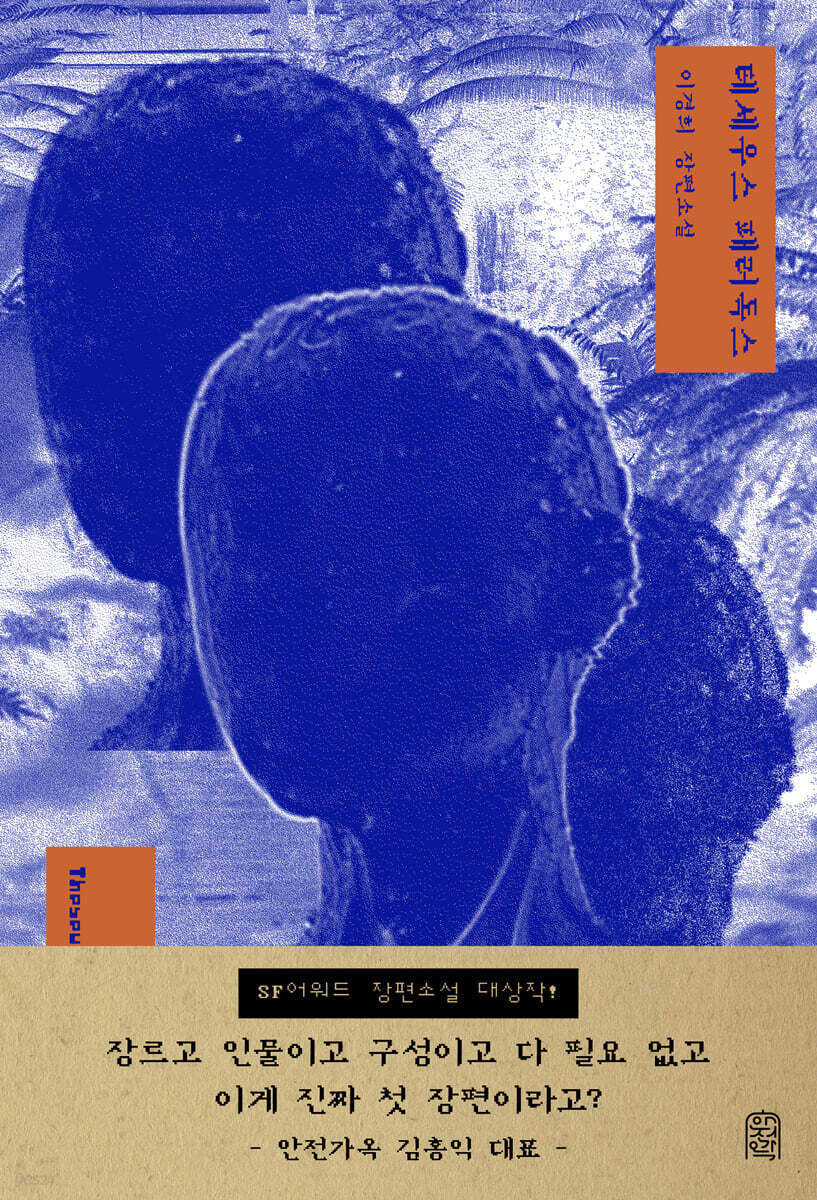
Theseus Paradox
 |
Description
Book Introduction
* Won the Grand Prize in the Novel Category at the SF Award for his debut work!
A powerful debut work that combines spectacle and depth of thought.
A novel that keeps you on your toes until the moment you put it down.
If you like cyberpunk, you won't be disappointed.
Readers described the novel 'Theseus Paradox' as follows.
It is difficult to express the position of author Lee Kyung-hee and this novel using the familiar criteria that have been used to classify them.
"Theseus Paradox" is a thrilling and action-packed plot that explores the very roots of humanity.
This is author Lee Kyung-hee's first full-length novel, first published in 2019 under the title 'The Ship of Theseus', and won the Grand Prize at the SF Award.
The judges at the time said of the novel, "Cyberpunk is a subgenre that many creators want to add to their menus, but when you actually put it on the chopping board and try to prepare it, it's like a fish that's difficult to peel off the plastic.
It's a feeling of satisfaction that comes from being treated by a great chef.
He praised it, saying, "The sophisticated plot that makes you turn the next page and the skill of persistently pursuing the topic and making you immerse yourself in the characters are the best."
Afterwards, the author became a notable name in Korean science fiction, winning the grand prize once again with the unanimous approval of the judges for his follow-up work, “Dolls in the Sand City.”
The conglomerate chairman who died in an accident,
Revived in a mechanical body, he confronts his 'original self'.
What would it take for a human being to be certain that 'I exist as myself'?
A continuous sense of self, a connection from the past to the present? A physical body? Or perhaps, memories accumulated over time? "Theseus Paradox" follows a man who, after death, is resurrected in a cybernetic body.
Set in a near future where technology can postpone death and even restore life, the novel relentlessly explores the fractures between body, mind, and identity.
A powerful debut work that combines spectacle and depth of thought.
A novel that keeps you on your toes until the moment you put it down.
If you like cyberpunk, you won't be disappointed.
Readers described the novel 'Theseus Paradox' as follows.
It is difficult to express the position of author Lee Kyung-hee and this novel using the familiar criteria that have been used to classify them.
"Theseus Paradox" is a thrilling and action-packed plot that explores the very roots of humanity.
This is author Lee Kyung-hee's first full-length novel, first published in 2019 under the title 'The Ship of Theseus', and won the Grand Prize at the SF Award.
The judges at the time said of the novel, "Cyberpunk is a subgenre that many creators want to add to their menus, but when you actually put it on the chopping board and try to prepare it, it's like a fish that's difficult to peel off the plastic.
It's a feeling of satisfaction that comes from being treated by a great chef.
He praised it, saying, "The sophisticated plot that makes you turn the next page and the skill of persistently pursuing the topic and making you immerse yourself in the characters are the best."
Afterwards, the author became a notable name in Korean science fiction, winning the grand prize once again with the unanimous approval of the judges for his follow-up work, “Dolls in the Sand City.”
The conglomerate chairman who died in an accident,
Revived in a mechanical body, he confronts his 'original self'.
What would it take for a human being to be certain that 'I exist as myself'?
A continuous sense of self, a connection from the past to the present? A physical body? Or perhaps, memories accumulated over time? "Theseus Paradox" follows a man who, after death, is resurrected in a cybernetic body.
Set in a near future where technology can postpone death and even restore life, the novel relentlessly explores the fractures between body, mind, and identity.
- You can preview some of the book's contents.
Preview
index
Part 1 Continuum
Part 2 Body
Part 3 Memory
Epilogue
Glossary of Terms
Author's Note
Producer's Note
Part 2 Body
Part 3 Memory
Epilogue
Glossary of Terms
Author's Note
Producer's Note
Into the book
Mijin paused the interview video and declared with a triumphant expression.
"everyone.
“We have conquered death.”
As if they had been waiting, applause and cheers erupted here and there.
--- p.28
If people start to believe that they can just be revived even if they die, how many people will easily throw away their lives?
How much consciousness is lost and reborn during the process of physical destruction and regeneration?
If all that disconnection and destruction means death… … .
Jin-hwan got goosebumps.
--- p.34
The thing that looked just like him smiled.
It was a natural, human smile that could not be expressed with a body that had become a machine.
It's not remote controlled.
It's not even artificial intelligence.
That's a living person.
I don't know who's inside though.
--- p.68
The DJs here are said to know how to mix extrasensory signal patterns that only physically augmented people can perceive.
When the DJ's real music starts behind the loud electro-new jazz beats, a small number of people with special receptors implanted in them fall into a state of extreme excitement even without alcohol or drugs.
--- p.87
Jin-Hwan imagined it.
Countless bodies stretch out into space, connected by a network.
One huge consciousness connected to those bodies.
What would it feel like to be liberated from a miserable body?
--- p.93
Do you know what it is? Find it and run away.
--- p.113
“This is your final warning.
“Don’t look at the original.”
--- p.211
Copying the original does not create a fake.
The truth is that there are only two.
--- p.216
While the limousine was moving, Memory practiced Continuum's expressions and speech in the mirror.
Having memorized every muscle movement for over a week, he was able to replicate Continuum's movements with a nanometer of accuracy.
Look at this.
What's different about me from the original?
What is the difference between this and the real thing?
--- p.323
Death has always been the most important issue for me.
Why does death exist?
Why are you afraid?
Why do you want to live?
Why should we live?
If you're going to die anyway, why shouldn't you die right now?
Every time, I was left floundering in endless fear.
--- From the author's note on p.341
Another element that creates 'fun' is a certain energy that only a debut work can have.
(...) It may be a bit raw, but its explosive energy draws the reader in.
This novel begins with Jin-hwan opening his eyes and races forward until the final moments unfold on Triplanet.
Of course, this doesn't mean that you should just run blindly.
You all know the tempo and pacing of K-dramas, right?
"everyone.
“We have conquered death.”
As if they had been waiting, applause and cheers erupted here and there.
--- p.28
If people start to believe that they can just be revived even if they die, how many people will easily throw away their lives?
How much consciousness is lost and reborn during the process of physical destruction and regeneration?
If all that disconnection and destruction means death… … .
Jin-hwan got goosebumps.
--- p.34
The thing that looked just like him smiled.
It was a natural, human smile that could not be expressed with a body that had become a machine.
It's not remote controlled.
It's not even artificial intelligence.
That's a living person.
I don't know who's inside though.
--- p.68
The DJs here are said to know how to mix extrasensory signal patterns that only physically augmented people can perceive.
When the DJ's real music starts behind the loud electro-new jazz beats, a small number of people with special receptors implanted in them fall into a state of extreme excitement even without alcohol or drugs.
--- p.87
Jin-Hwan imagined it.
Countless bodies stretch out into space, connected by a network.
One huge consciousness connected to those bodies.
What would it feel like to be liberated from a miserable body?
--- p.93
Do you know what it is? Find it and run away.
--- p.113
“This is your final warning.
“Don’t look at the original.”
--- p.211
Copying the original does not create a fake.
The truth is that there are only two.
--- p.216
While the limousine was moving, Memory practiced Continuum's expressions and speech in the mirror.
Having memorized every muscle movement for over a week, he was able to replicate Continuum's movements with a nanometer of accuracy.
Look at this.
What's different about me from the original?
What is the difference between this and the real thing?
--- p.323
Death has always been the most important issue for me.
Why does death exist?
Why are you afraid?
Why do you want to live?
Why should we live?
If you're going to die anyway, why shouldn't you die right now?
Every time, I was left floundering in endless fear.
--- From the author's note on p.341
Another element that creates 'fun' is a certain energy that only a debut work can have.
(...) It may be a bit raw, but its explosive energy draws the reader in.
This novel begins with Jin-hwan opening his eyes and races forward until the final moments unfold on Triplanet.
Of course, this doesn't mean that you should just run blindly.
You all know the tempo and pacing of K-dramas, right?
--- p.345 From “The Producer’s Note”
Publisher's Review
“What if I face another me?”
The questions are concise and the story is compelling.
(Cine21 Reporter Da-hye Lee)
"Theseus Paradox" is a science fiction novel about Seok Jin-hwan, the chairman of a large domestic company, who is involved in a major traffic accident and has his entire body replaced with a cybernetic body. He then encounters a being with the same face as himself.
In the near future, where every part of a human being can be copied and backed up like data, the world surrounding Seok Jin-hwan is in chaos.
It is difficult to acknowledge that a person with a robot-like appearance is 'the same person as before' just because they have memories, and it is also difficult to determine that a being with only a body is a 'main entity'.
In the process, Seok Jin-hwan must fight against those who threaten his identity and constantly struggle with himself.
He constantly doubts which being he should consider to be his true self and whether he is the original.
“Now he is a machine and I am a machine too.
But why is he the original and I am the fake? (...) I am the closest thing to the original.
“I am the only one who has fully preserved my memories and personality before the accident.” - From the book
A mega corporation that has mastered the technology of resurrection
The power struggle taking place within it
Personal confusion soon becomes intertwined with the power and conspiracy of the corporate giant, Triple Planet.
Triplanet aims to dominate the biotech market with its biotechnology that can revive the dead.
Chairman Seok Jin-hwan's resurrection is not a personal miracle, but a product of the ambitions and vested interests of a mega-corporation.
The crisis of personal identity expands into a power struggle that divides corporate and family lineages, and the story races forward with tension as greed for power, a struggle for succession between brothers, and the ethical vacuum of human experimentation intertwine.
A two thousand year old philosophy is revived,
Aiming at humans in the near future
『Theseus Paradox』 directly summons Plutarch's classic paradox, 'The Ship of Theseus', and substitutes it with the conflict between the body (flesh) and consciousness (memory/ego).
Avoid empty philosophical summaries and instead offer readers a narrative experience that raises questions.
The novel's unique appeal is doubled by combining the discussion of human identity that has continued since the movie [Blade Runner] with a Korean narrative.
The significance of this work becomes even more special in that it is a genre novel that precisely poses the question, "What defines humanity?" through its narrative, thereby creating a clear ripple within the reader.
How much must I preserve before I can believe that I am me?
Those who read the novel also think about the boundaries between continuity and discontinuity of existence.
The power of questions and narrative, proven by two awards, will further shake readers' inner selves in this revised edition.
The questions are concise and the story is compelling.
(Cine21 Reporter Da-hye Lee)
"Theseus Paradox" is a science fiction novel about Seok Jin-hwan, the chairman of a large domestic company, who is involved in a major traffic accident and has his entire body replaced with a cybernetic body. He then encounters a being with the same face as himself.
In the near future, where every part of a human being can be copied and backed up like data, the world surrounding Seok Jin-hwan is in chaos.
It is difficult to acknowledge that a person with a robot-like appearance is 'the same person as before' just because they have memories, and it is also difficult to determine that a being with only a body is a 'main entity'.
In the process, Seok Jin-hwan must fight against those who threaten his identity and constantly struggle with himself.
He constantly doubts which being he should consider to be his true self and whether he is the original.
“Now he is a machine and I am a machine too.
But why is he the original and I am the fake? (...) I am the closest thing to the original.
“I am the only one who has fully preserved my memories and personality before the accident.” - From the book
A mega corporation that has mastered the technology of resurrection
The power struggle taking place within it
Personal confusion soon becomes intertwined with the power and conspiracy of the corporate giant, Triple Planet.
Triplanet aims to dominate the biotech market with its biotechnology that can revive the dead.
Chairman Seok Jin-hwan's resurrection is not a personal miracle, but a product of the ambitions and vested interests of a mega-corporation.
The crisis of personal identity expands into a power struggle that divides corporate and family lineages, and the story races forward with tension as greed for power, a struggle for succession between brothers, and the ethical vacuum of human experimentation intertwine.
A two thousand year old philosophy is revived,
Aiming at humans in the near future
『Theseus Paradox』 directly summons Plutarch's classic paradox, 'The Ship of Theseus', and substitutes it with the conflict between the body (flesh) and consciousness (memory/ego).
Avoid empty philosophical summaries and instead offer readers a narrative experience that raises questions.
The novel's unique appeal is doubled by combining the discussion of human identity that has continued since the movie [Blade Runner] with a Korean narrative.
The significance of this work becomes even more special in that it is a genre novel that precisely poses the question, "What defines humanity?" through its narrative, thereby creating a clear ripple within the reader.
How much must I preserve before I can believe that I am me?
Those who read the novel also think about the boundaries between continuity and discontinuity of existence.
The power of questions and narrative, proven by two awards, will further shake readers' inner selves in this revised edition.
GOODS SPECIFICS
- Date of issue: October 15, 2025
- Page count, weight, size: 352 pages | 128*188*30mm
- ISBN13: 9791194891055
- ISBN10: 1194891055
You may also like
카테고리
korean


korean

![ELLE 엘르 스페셜 에디션 A형 : 12월 [2025]](http://librairie.coreenne.fr/cdn/shop/files/b8e27a3de6c9538896439686c6b0e8fb.jpg?v=1766436872&width=3840)


