

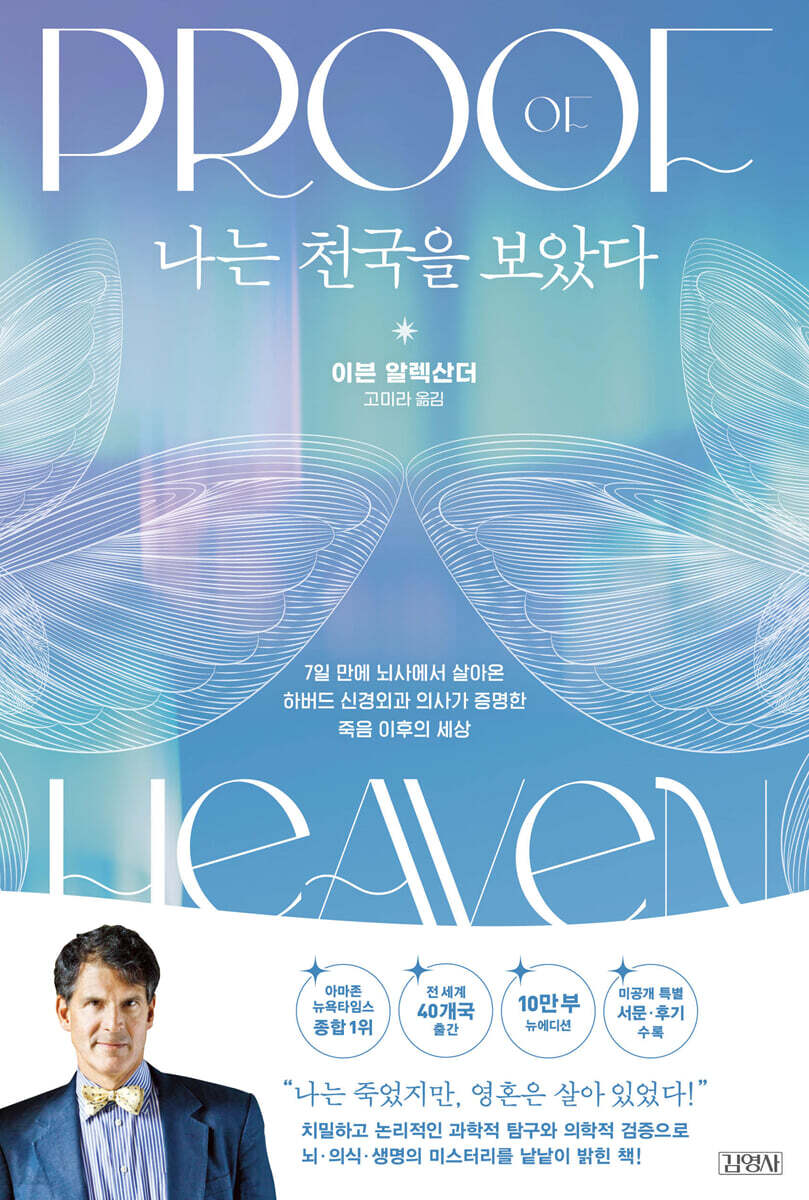
I Saw Heaven: A New Edition to Celebrate 100,000 Copies
 |
Description
Book Introduction
A record of a neuroscientist who experienced the world beyond death and returned from a brain-dead state with a 10% survival rate. A true story that vividly proves the reality of the soul, God, and the afterlife. “I was dead, but my soul was alive!” ★New edition celebrating 100,000 copies sold! Includes a special, unpublished preface and review by the author! A new edition of "I Saw Heaven," which has been a bestseller in all bookstores nationwide since its domestic publication in 2013 and has received much love from readers, has been published. This book is a report on a near-death experience actually experienced by a top neurosurgeon who lived with a more materialistic and scientific worldview than anyone else. This book, which proves the reality of heaven by revealing the mysteries of the brain, consciousness, and life through meticulous and logical scientific inquiry and medical verification, became a hot topic immediately after its publication, becoming an Amazon and New York Times bestseller and ranking first overall on Publisher's Weekly for 20 consecutive weeks. This revised edition includes a preface and postscript written by the author. In addition to answering the numerous questions I received from the public after the book's publication, I also organize thoughts I couldn't express at the time and share 10 ways to change the reader's life. His vivid and miraculous story will change the perspective on life and death for both intellectuals with a scientific and materialistic worldview and ordinary readers seeking the path to complete healing. |
- You can preview some of the book's contents.
Preview
index
A New Preface: A New World Unfolds Before Us
Introduction: About life and death, we can know what is true.
Chapter 1 Pain
Chapter 2 Flapping Like a Giant Fish
Chapter 3: The brain is destroyed
Chapter 4 Son Ibn
Chapter 5: The World Through the Eyes of an Earthworm
Chapter 6: The Anchor that Sustains Life
Chapter 7: Entering the Revolving Gate
Chapter 8: Israel Travels
Chapter 9: Meeting the Central Source
Chapter 10 What Really Matters
Chapter 11: The End of the Abyss
Chapter 12: Seeing the Great Love
Chapter 13: A Wednesday When Nothing Can Be Expected
Chapter 14: A Very Special Near-Death Experience
Chapter 15: The Brain Interferes with It
Chapter 16: Throwing a Rope into a Deep Well
Chapter 17: A Single Case
Chapter 18: Forgetting, Remembering
Chapter 19: No More Hiding
Chapter 20 The gates of heaven are closed
Chapter 21: A Rainbow Rises
Chapter 22: Six Faces
Chapter 23: The Last Night, the First Morning
Chapter 24: Return after 7 days
Chapter 25 Not Back to Reality Yet
Chapter 26: Announcement of a Miracle
Chapter 27 Finally Home
Chapter 28: Superpower Reality
Chapter 29: A Common Experience Confessed by Millions of People
Chapter 30: Return from the Dead
Chapter 31: Believers, Never Believers, and Those in Between
Chapter 32: Finally, Knowing God
Chapter 33: The Mystery of Consciousness
Chapter 34: The Final Dilemma
35 photos in one
New Review_10 Suggestions That Will Change Your Life
Acknowledgements
Appendix A
Appendix B
References
Eternia
Introduction: About life and death, we can know what is true.
Chapter 1 Pain
Chapter 2 Flapping Like a Giant Fish
Chapter 3: The brain is destroyed
Chapter 4 Son Ibn
Chapter 5: The World Through the Eyes of an Earthworm
Chapter 6: The Anchor that Sustains Life
Chapter 7: Entering the Revolving Gate
Chapter 8: Israel Travels
Chapter 9: Meeting the Central Source
Chapter 10 What Really Matters
Chapter 11: The End of the Abyss
Chapter 12: Seeing the Great Love
Chapter 13: A Wednesday When Nothing Can Be Expected
Chapter 14: A Very Special Near-Death Experience
Chapter 15: The Brain Interferes with It
Chapter 16: Throwing a Rope into a Deep Well
Chapter 17: A Single Case
Chapter 18: Forgetting, Remembering
Chapter 19: No More Hiding
Chapter 20 The gates of heaven are closed
Chapter 21: A Rainbow Rises
Chapter 22: Six Faces
Chapter 23: The Last Night, the First Morning
Chapter 24: Return after 7 days
Chapter 25 Not Back to Reality Yet
Chapter 26: Announcement of a Miracle
Chapter 27 Finally Home
Chapter 28: Superpower Reality
Chapter 29: A Common Experience Confessed by Millions of People
Chapter 30: Return from the Dead
Chapter 31: Believers, Never Believers, and Those in Between
Chapter 32: Finally, Knowing God
Chapter 33: The Mystery of Consciousness
Chapter 34: The Final Dilemma
35 photos in one
New Review_10 Suggestions That Will Change Your Life
Acknowledgements
Appendix A
Appendix B
References
Eternia
Into the book
“Even, speak up!” Holly shouted.
When I didn't respond, she called 911.
The emergency medical technicians arrived in less than 10 minutes and quickly loaded me into an ambulance and took me to the Lynchburg General Hospital emergency room.
If I had been conscious, I would have given her an accurate explanation of my condition as she waited in a state of panic for the ambulance.
But without a doubt, I had suffered some serious shock to my brain and was having a grand mal seizure.
I couldn't say anything.
For the next seven days, I existed only physically for Holly and her family.
For that week I couldn't remember anything about the world, and I had to gather information from others about the things that happened while I was unconscious.
My consciousness, my soul was gone.
--- p.31~32
Suddenly contracting a severe case of E. coli meningitis wasn't the only stunt I pulled on my first day in the hospital.
While in the emergency room, I howled and groaned like an animal for a full two hours before finally falling silent.
Then, out of nowhere, he is said to have shouted three words.
It was so clear that all the doctors and nurses there, and even Holly, who was standing a few steps away behind the curtain, could hear it clearly.
“God, save me!” Everyone ran towards me.
When they approached, I was already completely unresponsive.
I have no recollection of my time in the emergency room, including any screaming.
These three words were the last I spoke for the next seven days.
--- p.42
Something seemed to be pulling me.
It wasn't like someone was physically pulling my arm, it was more of a subtle feeling.
It was like a sudden change in mood when the sun suddenly disappeared behind the clouds.
I was moving away from the center and then coming back again.
The ink-clear darkness of the central source disappeared into the fresh, blue, and dazzling scenery of the gateway.
Below, the villagers appeared again, surrounded by trees, sparkling streams and waterfalls, while above them, angels flew in arches.
My companion was there too.
Even as I traveled to the central source, she was there the whole time in the form of a shining sphere.
But now, he had transformed back into human form and was wearing the beautiful clothes I had seen back then.
--- p.99
I opened my eyes.
Sylvia screamed shrilly.
As she later told me, what was just as shocking as the fact that I opened my eyes was the way I immediately looked around.
Up, down, this way, that way… It wasn't like an adult waking up from a seven-day coma, but like the eyes of a newborn baby.
It was the look in the eyes of someone who had just been born into this world and was looking around for the first time.
In some ways she was right.
As Sylvia recovered from the initial shock, she noticed that I was feeling agitated for some reason.
She ran out of the room and ran to Holly, who was still talking to Even in front of the window.
“Holly…Holly!” Sylvia shouted.
“He woke up.
"I'm awake! Tell Even that his father is back."
--- p.157
For most of the time I was in a coma, the primitive parts of my brain (those responsible for survival) were still functioning.
But the part that all neuroscientists describe as responsible for the unique aspects of human beings was completely absent.
This was evident from all my X-rays, hospital records, neurological exams—everything meticulously recorded during my week in the hospital.
So I immediately realized that my case was technically the most complete near-death experience, and perhaps the most compelling in modern history.
The most important thing about my case was not the content of my personal experience, but the fact that from a medical point of view it was utterly impossible to claim that all of this was simply a delusion.
--- p.185~186
Once the knowledge returned, I had to grapple with the fact that those seven days of experience were at odds with everything I had learned in 40 years about the human brain, the universe, and what constitutes reality.
At the time I fell into a coma, I was a worldly physician who had spent my life at some of the world's most prestigious research institutions, studying the relationship between the human brain and consciousness.
This doesn't mean I didn't believe in consciousness, but I did have a better grasp than the average person of how illogical it is to claim that consciousness exists (entirely!) independently.
When I didn't respond, she called 911.
The emergency medical technicians arrived in less than 10 minutes and quickly loaded me into an ambulance and took me to the Lynchburg General Hospital emergency room.
If I had been conscious, I would have given her an accurate explanation of my condition as she waited in a state of panic for the ambulance.
But without a doubt, I had suffered some serious shock to my brain and was having a grand mal seizure.
I couldn't say anything.
For the next seven days, I existed only physically for Holly and her family.
For that week I couldn't remember anything about the world, and I had to gather information from others about the things that happened while I was unconscious.
My consciousness, my soul was gone.
--- p.31~32
Suddenly contracting a severe case of E. coli meningitis wasn't the only stunt I pulled on my first day in the hospital.
While in the emergency room, I howled and groaned like an animal for a full two hours before finally falling silent.
Then, out of nowhere, he is said to have shouted three words.
It was so clear that all the doctors and nurses there, and even Holly, who was standing a few steps away behind the curtain, could hear it clearly.
“God, save me!” Everyone ran towards me.
When they approached, I was already completely unresponsive.
I have no recollection of my time in the emergency room, including any screaming.
These three words were the last I spoke for the next seven days.
--- p.42
Something seemed to be pulling me.
It wasn't like someone was physically pulling my arm, it was more of a subtle feeling.
It was like a sudden change in mood when the sun suddenly disappeared behind the clouds.
I was moving away from the center and then coming back again.
The ink-clear darkness of the central source disappeared into the fresh, blue, and dazzling scenery of the gateway.
Below, the villagers appeared again, surrounded by trees, sparkling streams and waterfalls, while above them, angels flew in arches.
My companion was there too.
Even as I traveled to the central source, she was there the whole time in the form of a shining sphere.
But now, he had transformed back into human form and was wearing the beautiful clothes I had seen back then.
--- p.99
I opened my eyes.
Sylvia screamed shrilly.
As she later told me, what was just as shocking as the fact that I opened my eyes was the way I immediately looked around.
Up, down, this way, that way… It wasn't like an adult waking up from a seven-day coma, but like the eyes of a newborn baby.
It was the look in the eyes of someone who had just been born into this world and was looking around for the first time.
In some ways she was right.
As Sylvia recovered from the initial shock, she noticed that I was feeling agitated for some reason.
She ran out of the room and ran to Holly, who was still talking to Even in front of the window.
“Holly…Holly!” Sylvia shouted.
“He woke up.
"I'm awake! Tell Even that his father is back."
--- p.157
For most of the time I was in a coma, the primitive parts of my brain (those responsible for survival) were still functioning.
But the part that all neuroscientists describe as responsible for the unique aspects of human beings was completely absent.
This was evident from all my X-rays, hospital records, neurological exams—everything meticulously recorded during my week in the hospital.
So I immediately realized that my case was technically the most complete near-death experience, and perhaps the most compelling in modern history.
The most important thing about my case was not the content of my personal experience, but the fact that from a medical point of view it was utterly impossible to claim that all of this was simply a delusion.
--- p.185~186
Once the knowledge returned, I had to grapple with the fact that those seven days of experience were at odds with everything I had learned in 40 years about the human brain, the universe, and what constitutes reality.
At the time I fell into a coma, I was a worldly physician who had spent my life at some of the world's most prestigious research institutions, studying the relationship between the human brain and consciousness.
This doesn't mean I didn't believe in consciousness, but I did have a better grasp than the average person of how illogical it is to claim that consciousness exists (entirely!) independently.
--- p.203~204
Publisher's Review
"Does life end with the death of the body? Where do we go after death?"
The true story of a Harvard neurosurgeon who experienced the world beyond death while in a brain-dead state and returned.
In October 2012, the American weekly news magazine Newsweek published an unusual cover story on a Harvard neurosurgeon's experience in the afterlife.
It was about a renowned neurosurgeon who, while brain dead, traveled to the spiritual world after death.
And the claim was that scientific inquiry and medical verification could prove that his experiences there were real.
The article quickly spread around the world and received an explosive response.
His near-death experience became a landmark event that overturned modern scientific orthodoxy about life and broke the medical taboo on death.
What on earth did he see in his brain-dead state? How credible can we be of his experience? Did he truly glimpse the secrets of consciousness that transcend matter?
The book, published immediately after the article, immediately rose to number one on Amazon's overall charts, the New York Times' overall charts, and Publisher's Weekly's overall charts for 20 consecutive weeks.
The book was published in 40 countries around the world, including France, Germany, Poland, and even Asia, and created a record-breaking craze everywhere.
This is the most talked about work in the world, 『I Saw Heaven』 (original title: Proof of Heaven).
In November 2008, Dr. Eben Alexander, a Harvard neurosurgeon, fell into a coma after contracting a very rare form of bacterial meningitis of unknown cause.
As a human, the part of the brain that controls thoughts and emotions is completely shut down.
He was so near death that doctors were finally about to stop treatment and declare him biologically dead.
But on the seventh day, he opened his eyes and came back to life.
It was completely impossible for him to recover from his illness.
It is a miracle that cannot be explained theoretically, as it is a return from the brink of death as judged by modern medicine.
But the real miracle lies elsewhere in his story.
He broke the scientific taboo on consciousness by having a near-death experience in which the brain completely shuts down.
Near-death experiences are not hallucinations created by the brain, and they have become definitive evidence that consciousness continues to exist even when the brain is turned off.
“Dr. Eben Alexander’s near-death experience is more remarkable than anything I have seen in my 40 years of research on near-death experiences.
He is a living witness to the afterlife.” _Raymond A.
Moody (MD, author of Life After Life)
“Do the afterlife, the soul, and God really exist? Does consciousness exist independently of the brain?”
A book that shines with meticulous and logical scientific inquiry, medical verification, deep and broad philosophical insight, and religious reflection!
While in a coma, Dr. Alexander encountered angelic beings from beyond this world and was guided into the deepest realms of the superphysical realm.
There he met and conversed with the divine source of the universe.
And we come to accept the existence of higher dimensional energies and the afterlife that were previously invisible to the scientific eye.
The process is vividly presented through scientific and medical research and verification.
And it adds philosophical insights on life and death, and religious reflections on God and the universe.
This book leads us to find answers to life's fundamental questions: where we come from and where we are going.
“Our life does not end with the death of our body or brain.
This book is a very compelling story about what awaits us in the afterlife.
“We have nothing to fear.”_Alan J.
Hamilton (surgeon, member of the American College of Surgeons)
Dr. Alexander received his medical degree from Duke University and conducted research in brain function mapping at the University of Virginia.
He later worked as a professor and physician at Brigham and Women's Hospital, Children's Hospital, and Harvard Medical School in Boston.
He is a world-renowned authority on brain medicine and a neurosurgeon with outstanding achievements in the field of brain and consciousness, having published over 150 papers in scientific journals and presented his research more than 200 times at international medical conferences.
Dr. Alexander, a leading neurosurgeon with a career spanning the world's most prestigious research institutions and hospitals, held a perspective that is often held by today's mainstream scientists.
He did not believe in consciousness, free will, or the existence of an immaterial soul.
They believed that matter on Earth was the only reality and that everything else (thoughts, consciousness, ideas, emotions, and the soul) was created from it.
That is, 'consciousness' is a product that arises from the biochemical function of the brain.
The same was true for near-death experiences.
Although thousands of people have reported near-death experiences, Dr. Eben Alexander, with his materialistic and scientific worldview, considered them impossible.
Although near-death experiences feel real, they are actually just illusions created by the brain under extreme stress.
He experiences a world beyond death after being brain dead for seven days and undergoes a great transformation as he comes back to life.
After his own near-death experience, he was forced to change his beliefs about the brain, consciousness, and life.
“Once the knowledge returned, I had to wrestle with the fact that those seven days of experience were at odds with everything I had learned in 40 years about the human brain, about the universe, about what constitutes reality.
At the time I fell into a coma, I was a worldly physician who had spent my life working at some of the world's most prestigious research institutions, studying the relationship between the human brain and consciousness.
“This does not mean that I did not believe in consciousness, but that I understood better than the average person how logically absurd it is to claim that consciousness exists (entirely!) independently.” (Main text, p. 203)
Dr. Alexander's story is not a fantasy.
He 'awakened' from the dream of life on earth during his seven days in a brain-dead state and experienced a greatly expanded consciousness in the afterlife.
It is said that the experience of life after death seemed so real and vast to him that life on earth seemed like nothing more than a dream.
His experiences are portrayed vividly and convincingly.
“The fact that this happened to Dr. Alexander, a neuroscientist, is nothing short of revolutionary.
Because it is something that no scientist or religious person can ignore or turn away from.
“This book, which illuminates the invisible spiritual world with scientific insight, is enough to resonate the intellect and spirituality of modern people.”_Jeon Se-il (Dean of the Cha Integrated Medical School)
"Can the mysteries of the brain, consciousness, and life be solved? Can science and spirituality coexist?"
Rewriting the science of life and death, body and mind!
This book is a report on the near-death experience of a leading neurosurgeon who lived with the most materialistic and scientific worldview of anyone, and thus has unparalleled value that could rewrite the history of medicine.
As such, it provides ample scientific information about the afterlife, and its meticulous and logical medical research and insights shine through.
His experiences provide important clues to understanding human consciousness.
Humans have consciousness independent of the brain, and in fact, consciousness is the basis of all existence.
It reveals the immaterial realm of the soul, God, and the afterlife, which mainstream scientists have denied from a materialistic perspective, and proves in detail that near-death experiences are not hallucinations created by the brain.
Does life end with physical death? Where do we go after death? Do the afterlife, soul, and God truly exist? Does consciousness exist independently of the brain? This book vividly illuminates the mysteries of the brain, consciousness, and life that modern science has yet to unravel.
So, can science and spirituality coexist? Dr. Alexander emphasizes that understanding the spiritual world and experiences is the most important task of science.
He used to think that any talk about heaven, God, or the soul was incompatible with medical knowledge, but now he is a doctor who believes that God and the soul are real and that death is merely a transition to another state.
Even scientists and doctors who do not believe in higher energies or an afterlife will eventually come to accept these ideas, concluding that spirituality and science must go hand in hand.
“It has become difficult to answer questions about the soul, the afterlife, reincarnation, God, heaven, etc. using existing scientific methods.
Because it is assumed that such a thing does not exist.
Likewise, 'standard' scientific research methods consistently rule out phenomena of extended consciousness such as remote viewing, psychic powers, psychokinesis, clairvoyance, telepathy, and precognition.
The main reason I doubted the reality of these things before I fell into a coma was not only because I had never properly experienced them, but also because they could not be explained by my simple scientific worldview." (Main text, pp. 207-208)
His vivid and miraculous story brings a warm feeling and thrill to not only intellectuals with a scientific and materialistic worldview, but also ordinary readers seeking a life of complete healing.
I highly recommend this book to anyone looking for a fresh perspective on life and death.
“This can be likened to the incident where a frog, who thought there was everything inside the well, learns through experience that there is a magnificent ocean outside the well.
Now, humans will come to realize that they are spiritual beings, not just the visible physical body.” _Jeong Hyeon-chae (Professor Emeritus, Seoul National University College of Medicine)
The true story of a Harvard neurosurgeon who experienced the world beyond death while in a brain-dead state and returned.
In October 2012, the American weekly news magazine Newsweek published an unusual cover story on a Harvard neurosurgeon's experience in the afterlife.
It was about a renowned neurosurgeon who, while brain dead, traveled to the spiritual world after death.
And the claim was that scientific inquiry and medical verification could prove that his experiences there were real.
The article quickly spread around the world and received an explosive response.
His near-death experience became a landmark event that overturned modern scientific orthodoxy about life and broke the medical taboo on death.
What on earth did he see in his brain-dead state? How credible can we be of his experience? Did he truly glimpse the secrets of consciousness that transcend matter?
The book, published immediately after the article, immediately rose to number one on Amazon's overall charts, the New York Times' overall charts, and Publisher's Weekly's overall charts for 20 consecutive weeks.
The book was published in 40 countries around the world, including France, Germany, Poland, and even Asia, and created a record-breaking craze everywhere.
This is the most talked about work in the world, 『I Saw Heaven』 (original title: Proof of Heaven).
In November 2008, Dr. Eben Alexander, a Harvard neurosurgeon, fell into a coma after contracting a very rare form of bacterial meningitis of unknown cause.
As a human, the part of the brain that controls thoughts and emotions is completely shut down.
He was so near death that doctors were finally about to stop treatment and declare him biologically dead.
But on the seventh day, he opened his eyes and came back to life.
It was completely impossible for him to recover from his illness.
It is a miracle that cannot be explained theoretically, as it is a return from the brink of death as judged by modern medicine.
But the real miracle lies elsewhere in his story.
He broke the scientific taboo on consciousness by having a near-death experience in which the brain completely shuts down.
Near-death experiences are not hallucinations created by the brain, and they have become definitive evidence that consciousness continues to exist even when the brain is turned off.
“Dr. Eben Alexander’s near-death experience is more remarkable than anything I have seen in my 40 years of research on near-death experiences.
He is a living witness to the afterlife.” _Raymond A.
Moody (MD, author of Life After Life)
“Do the afterlife, the soul, and God really exist? Does consciousness exist independently of the brain?”
A book that shines with meticulous and logical scientific inquiry, medical verification, deep and broad philosophical insight, and religious reflection!
While in a coma, Dr. Alexander encountered angelic beings from beyond this world and was guided into the deepest realms of the superphysical realm.
There he met and conversed with the divine source of the universe.
And we come to accept the existence of higher dimensional energies and the afterlife that were previously invisible to the scientific eye.
The process is vividly presented through scientific and medical research and verification.
And it adds philosophical insights on life and death, and religious reflections on God and the universe.
This book leads us to find answers to life's fundamental questions: where we come from and where we are going.
“Our life does not end with the death of our body or brain.
This book is a very compelling story about what awaits us in the afterlife.
“We have nothing to fear.”_Alan J.
Hamilton (surgeon, member of the American College of Surgeons)
Dr. Alexander received his medical degree from Duke University and conducted research in brain function mapping at the University of Virginia.
He later worked as a professor and physician at Brigham and Women's Hospital, Children's Hospital, and Harvard Medical School in Boston.
He is a world-renowned authority on brain medicine and a neurosurgeon with outstanding achievements in the field of brain and consciousness, having published over 150 papers in scientific journals and presented his research more than 200 times at international medical conferences.
Dr. Alexander, a leading neurosurgeon with a career spanning the world's most prestigious research institutions and hospitals, held a perspective that is often held by today's mainstream scientists.
He did not believe in consciousness, free will, or the existence of an immaterial soul.
They believed that matter on Earth was the only reality and that everything else (thoughts, consciousness, ideas, emotions, and the soul) was created from it.
That is, 'consciousness' is a product that arises from the biochemical function of the brain.
The same was true for near-death experiences.
Although thousands of people have reported near-death experiences, Dr. Eben Alexander, with his materialistic and scientific worldview, considered them impossible.
Although near-death experiences feel real, they are actually just illusions created by the brain under extreme stress.
He experiences a world beyond death after being brain dead for seven days and undergoes a great transformation as he comes back to life.
After his own near-death experience, he was forced to change his beliefs about the brain, consciousness, and life.
“Once the knowledge returned, I had to wrestle with the fact that those seven days of experience were at odds with everything I had learned in 40 years about the human brain, about the universe, about what constitutes reality.
At the time I fell into a coma, I was a worldly physician who had spent my life working at some of the world's most prestigious research institutions, studying the relationship between the human brain and consciousness.
“This does not mean that I did not believe in consciousness, but that I understood better than the average person how logically absurd it is to claim that consciousness exists (entirely!) independently.” (Main text, p. 203)
Dr. Alexander's story is not a fantasy.
He 'awakened' from the dream of life on earth during his seven days in a brain-dead state and experienced a greatly expanded consciousness in the afterlife.
It is said that the experience of life after death seemed so real and vast to him that life on earth seemed like nothing more than a dream.
His experiences are portrayed vividly and convincingly.
“The fact that this happened to Dr. Alexander, a neuroscientist, is nothing short of revolutionary.
Because it is something that no scientist or religious person can ignore or turn away from.
“This book, which illuminates the invisible spiritual world with scientific insight, is enough to resonate the intellect and spirituality of modern people.”_Jeon Se-il (Dean of the Cha Integrated Medical School)
"Can the mysteries of the brain, consciousness, and life be solved? Can science and spirituality coexist?"
Rewriting the science of life and death, body and mind!
This book is a report on the near-death experience of a leading neurosurgeon who lived with the most materialistic and scientific worldview of anyone, and thus has unparalleled value that could rewrite the history of medicine.
As such, it provides ample scientific information about the afterlife, and its meticulous and logical medical research and insights shine through.
His experiences provide important clues to understanding human consciousness.
Humans have consciousness independent of the brain, and in fact, consciousness is the basis of all existence.
It reveals the immaterial realm of the soul, God, and the afterlife, which mainstream scientists have denied from a materialistic perspective, and proves in detail that near-death experiences are not hallucinations created by the brain.
Does life end with physical death? Where do we go after death? Do the afterlife, soul, and God truly exist? Does consciousness exist independently of the brain? This book vividly illuminates the mysteries of the brain, consciousness, and life that modern science has yet to unravel.
So, can science and spirituality coexist? Dr. Alexander emphasizes that understanding the spiritual world and experiences is the most important task of science.
He used to think that any talk about heaven, God, or the soul was incompatible with medical knowledge, but now he is a doctor who believes that God and the soul are real and that death is merely a transition to another state.
Even scientists and doctors who do not believe in higher energies or an afterlife will eventually come to accept these ideas, concluding that spirituality and science must go hand in hand.
“It has become difficult to answer questions about the soul, the afterlife, reincarnation, God, heaven, etc. using existing scientific methods.
Because it is assumed that such a thing does not exist.
Likewise, 'standard' scientific research methods consistently rule out phenomena of extended consciousness such as remote viewing, psychic powers, psychokinesis, clairvoyance, telepathy, and precognition.
The main reason I doubted the reality of these things before I fell into a coma was not only because I had never properly experienced them, but also because they could not be explained by my simple scientific worldview." (Main text, pp. 207-208)
His vivid and miraculous story brings a warm feeling and thrill to not only intellectuals with a scientific and materialistic worldview, but also ordinary readers seeking a life of complete healing.
I highly recommend this book to anyone looking for a fresh perspective on life and death.
“This can be likened to the incident where a frog, who thought there was everything inside the well, learns through experience that there is a magnificent ocean outside the well.
Now, humans will come to realize that they are spiritual beings, not just the visible physical body.” _Jeong Hyeon-chae (Professor Emeritus, Seoul National University College of Medicine)
GOODS SPECIFICS
- Date of issue: January 15, 2024
- Page count, weight, size: 296 pages | 404g | 145*215*15mm
- ISBN13: 9788934968054
- ISBN10: 8934968052
You may also like
카테고리
korean


korean

![GQ KOREA Mark (Monthly): December [2025]](http://librairie.coreenne.fr/cdn/shop/files/8ef265dbbfbf186523ed75ba7319009d.jpg?v=1765340328&width=3840)


