

milestone
 |
Description
Book Introduction
The Spiritual Diary of Dag Hammarskjöld, the Second Secretary-General of the United Nations and Nobel Peace Prize Laureate
“Hammarkskjöld’s spiritual and political legacy still resonates deeply today, even amidst the violence and turmoil.”
― Korea's first complete Swedish translation
― Recommended by Kang Young-an, Ahn Moon-seok, Karl-Ulf Andersson, and Rowan Williams
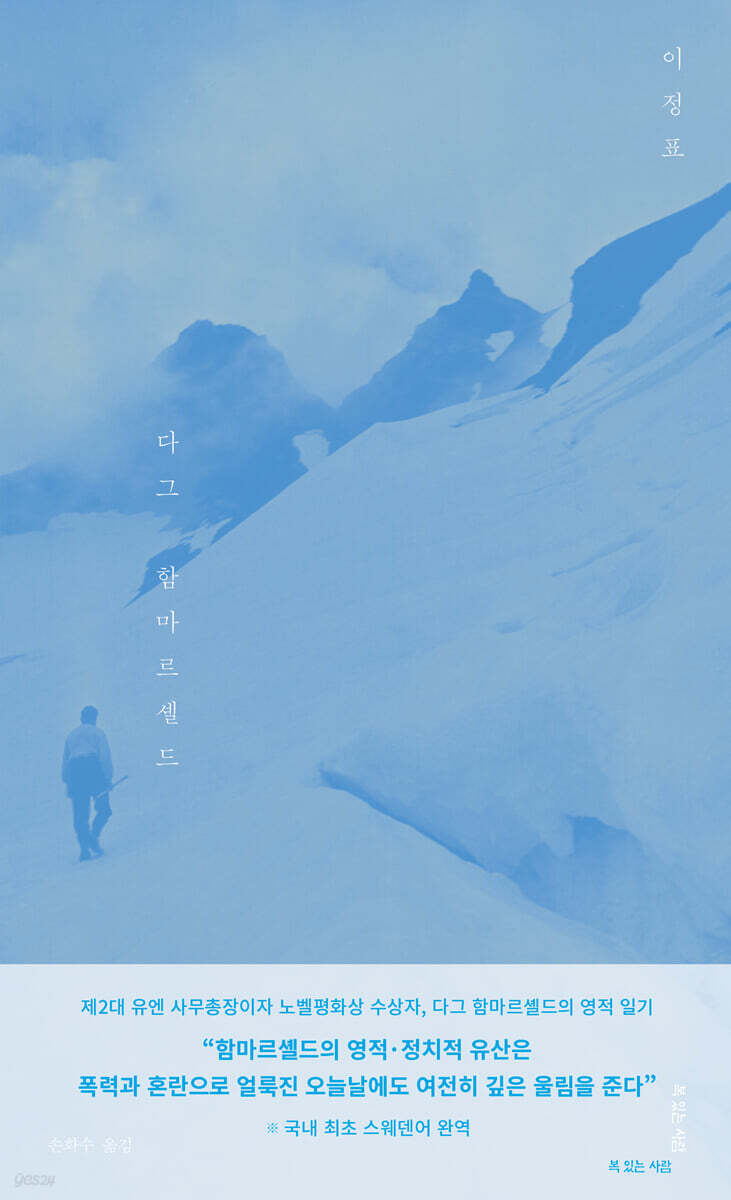
Like the footprints of someone who silently climbs an iceberg while crossing a crevasse.
A dazzling name tag, written under the light of social responsibility
A record of profound reflection, deep meditation, and true existence.
Dag Hammarskjold was an extraordinary international statesman and spiritual pilgrim who has been revered for centuries.
He died in September 1961 when his plane crashed near Ndola Airport in Zambia while he was on a mission to resolve the civil war in Congo, Africa.
The UN conducted three investigations at the time, but was ultimately unable to determine the cause of the crash.
Hammarskjöld was awarded the Nobel Peace Prize, breaking with the tradition of not awarding the prize to anyone who died that year.
John F.
Kennedy said of him, “Compared to him, I am a small person.
He was the greatest politician of our century,” he said.
After Dag Hammarskjöld's death, a manuscript titled "Milestones" was discovered in his New York home.
The fact that he, who stood at the forefront of international politics as the UN Secretary-General, had been recording his spiritual experiences in a diary for a long time was quite shocking to the world.
In the sealed letter, he called these records “a kind of ‘white paper’ on negotiations between myself and God.”
“Hammarkskjöld’s spiritual and political legacy still resonates deeply today, even amidst the violence and turmoil.”
― Korea's first complete Swedish translation
― Recommended by Kang Young-an, Ahn Moon-seok, Karl-Ulf Andersson, and Rowan Williams
Like the footprints of someone who silently climbs an iceberg while crossing a crevasse.
A dazzling name tag, written under the light of social responsibility
A record of profound reflection, deep meditation, and true existence.
Dag Hammarskjold was an extraordinary international statesman and spiritual pilgrim who has been revered for centuries.
He died in September 1961 when his plane crashed near Ndola Airport in Zambia while he was on a mission to resolve the civil war in Congo, Africa.
The UN conducted three investigations at the time, but was ultimately unable to determine the cause of the crash.
Hammarskjöld was awarded the Nobel Peace Prize, breaking with the tradition of not awarding the prize to anyone who died that year.
John F.
Kennedy said of him, “Compared to him, I am a small person.
He was the greatest politician of our century,” he said.
After Dag Hammarskjöld's death, a manuscript titled "Milestones" was discovered in his New York home.
The fact that he, who stood at the forefront of international politics as the UN Secretary-General, had been recording his spiritual experiences in a diary for a long time was quite shocking to the world.
In the sealed letter, he called these records “a kind of ‘white paper’ on negotiations between myself and God.”
- You can preview some of the book's contents.
Preview
index
Commentary
diary
1925-1930
1941-1942
1945-1949
1950
1951
1952
1953
1954
1955
1956
1957
1958
1959
1960
1961
main
annual report
diary
1925-1930
1941-1942
1945-1949
1950
1951
1952
1953
1954
1955
1956
1957
1958
1959
1960
1961
main
annual report
Into the book
now.
Right now, having overcome my fears of others, of myself, and of the dark underworld.
At the edge of wonder.
The familiar ends here.
But something beyond that fills me with the possibility of the source of my being.
The longing for openness is purified here.
Every action is preparation, every choice is a positive response to the unknown.
The obligations of superficial life have prevented me from moving toward depth, but I am slowly moving down, arming myself amidst the chaos.
To that place where the fragrance of white parasitic flowers holds the promise of new harmony.
At the edge of wonder.
--- p.107
The river of life that has flowed for millions of years, the flow of humanity that has continued for thousands of years.
Evil, death, suffering, sacrifice, and love.
What does "I" mean in the face of this immense current? Doesn't reason compel me to pursue my desires, my power, and the respect of others? Yet, I "know." Knowing yet not knowing.
From this perspective, everything is meaningless.
It is in this very realization that God is present.
--- p.116
Maintaining inner silence even in the midst of commotion.
To exist like moist soil, wide open and still, in the fertile darkness where rain falls and grain ripens.
Even in broad daylight, countless people sweep across the land, raising swirls of dust.
--- p.117
You are neither oil nor air.
It is just a point of combustion, a focus from which light is born.
You are just a lens placed in the flow of light.
Only through that light can we receive, give, and have.
If you try to save yourself by your own right, you are preventing the oil and air from meeting in the flame, and you are ruining the clarity of the lens.
Sanctification - becoming light or remaining in light, erasing oneself so that light can be born, gathered, and spread.
--- p.202
Life has value only through its content.
It's about doing something for others.
A life that is deemed worthless by others is more miserable than death.
So, in this great loneliness, serve everyone.
How immeasurably great is what has been given to me, and how insignificant is my 'sacrifice'.
--- p.215
Tired of people
I find loneliness
I don't even have the strength to fill it.
The wall of power
Come closer
In the waves of light
take a rest,
It will soon fall to pieces
It's going down like an ebb tide
From the lips
Leaving the pale beach
Into the bubble.
--- p.222
Humility is the opposite of self-abasement and self-promotion.
Humility is not comparing.
When you exist as yourself, you are neither better nor worse, nor greater nor less than anyone else.
Something like that.
Nothing and at the same time one with everything.
In this sense, humility is the perfect form of self-annihilation.
To empty oneself in humility, to become nothing, yet to personally embody the full weight and authority of the given task—this is the life attitude of a person who has been called.
A life of humility and freedom in communicating what one mediates in front of people, work, poetry and art, and simply and freely accepting what touches one's inner identity.
The winds of praise and blame, success and adversity, merely pass over this life, without upsetting its balance.
Right now, having overcome my fears of others, of myself, and of the dark underworld.
At the edge of wonder.
The familiar ends here.
But something beyond that fills me with the possibility of the source of my being.
The longing for openness is purified here.
Every action is preparation, every choice is a positive response to the unknown.
The obligations of superficial life have prevented me from moving toward depth, but I am slowly moving down, arming myself amidst the chaos.
To that place where the fragrance of white parasitic flowers holds the promise of new harmony.
At the edge of wonder.
--- p.107
The river of life that has flowed for millions of years, the flow of humanity that has continued for thousands of years.
Evil, death, suffering, sacrifice, and love.
What does "I" mean in the face of this immense current? Doesn't reason compel me to pursue my desires, my power, and the respect of others? Yet, I "know." Knowing yet not knowing.
From this perspective, everything is meaningless.
It is in this very realization that God is present.
--- p.116
Maintaining inner silence even in the midst of commotion.
To exist like moist soil, wide open and still, in the fertile darkness where rain falls and grain ripens.
Even in broad daylight, countless people sweep across the land, raising swirls of dust.
--- p.117
You are neither oil nor air.
It is just a point of combustion, a focus from which light is born.
You are just a lens placed in the flow of light.
Only through that light can we receive, give, and have.
If you try to save yourself by your own right, you are preventing the oil and air from meeting in the flame, and you are ruining the clarity of the lens.
Sanctification - becoming light or remaining in light, erasing oneself so that light can be born, gathered, and spread.
--- p.202
Life has value only through its content.
It's about doing something for others.
A life that is deemed worthless by others is more miserable than death.
So, in this great loneliness, serve everyone.
How immeasurably great is what has been given to me, and how insignificant is my 'sacrifice'.
--- p.215
Tired of people
I find loneliness
I don't even have the strength to fill it.
The wall of power
Come closer
In the waves of light
take a rest,
It will soon fall to pieces
It's going down like an ebb tide
From the lips
Leaving the pale beach
Into the bubble.
--- p.222
Humility is the opposite of self-abasement and self-promotion.
Humility is not comparing.
When you exist as yourself, you are neither better nor worse, nor greater nor less than anyone else.
Something like that.
Nothing and at the same time one with everything.
In this sense, humility is the perfect form of self-annihilation.
To empty oneself in humility, to become nothing, yet to personally embody the full weight and authority of the given task—this is the life attitude of a person who has been called.
A life of humility and freedom in communicating what one mediates in front of people, work, poetry and art, and simply and freely accepting what touches one's inner identity.
The winds of praise and blame, success and adversity, merely pass over this life, without upsetting its balance.
--- p.223
Publisher's Review
“This is a ‘white paper’ on negotiations between myself and God.”
Beginning with a poem written around 1925, the record moves through notebooks from the 1940s and 1950s and concludes with a poem written a few weeks before his death.
Rather than being written in the traditional diary format, it is written in the form of short stories, poems, aphorisms, and prayers, and is refined in poetic and philosophical language, possessing the conciseness and clarity of proverbs.
The sentences written over several decades demonstrate a process of constant self-reflection, determination, and inner growth.
This book contains profound reflections on existence, freedom, calling, path, and responsibility, along with a sense of loneliness that contrasts with his outward image as the Secretary-General of the United Nations, an attitude toward life that he regarded as a calling, and insights that seem to anticipate death.
“The longest journey is the journey inward.”
First published in 1963, this book has resonated deeply with readers worldwide, translating into over 20 languages. It guides readers on an inner journey while providing profound insights into the role and power of an individual in the world.
Some will read this book as a historical document, while others will find its depth as a spiritual meditation.
But above all, through this book, every reader will have the privilege of meeting an extraordinary person in person.
A timeless spiritual and intellectual legacy and a classic of our time!
Ambassador Carl-Ulf Andersson of Sweden to Korea said of the book, “His writing transcends time and embraces the tension between human doubt and professional duty, between inner silence and outer action.
“It is a spiritual and intellectual legacy that transcends the daily record, and remains a timeless work that contributes to both personal reflection and collective wisdom, while consistently inspiring readers seeking answers to questions of truth, responsibility, and the meaning of life.”
Through the life of a leader who struggled to balance his public life and spiritual journey amidst the turbulent world of history, this book serves as a classic on leadership and self-reflection for modern leaders, and resonates deeply with all those living amidst the anxieties of our time.
Beginning with a poem written around 1925, the record moves through notebooks from the 1940s and 1950s and concludes with a poem written a few weeks before his death.
Rather than being written in the traditional diary format, it is written in the form of short stories, poems, aphorisms, and prayers, and is refined in poetic and philosophical language, possessing the conciseness and clarity of proverbs.
The sentences written over several decades demonstrate a process of constant self-reflection, determination, and inner growth.
This book contains profound reflections on existence, freedom, calling, path, and responsibility, along with a sense of loneliness that contrasts with his outward image as the Secretary-General of the United Nations, an attitude toward life that he regarded as a calling, and insights that seem to anticipate death.
“The longest journey is the journey inward.”
First published in 1963, this book has resonated deeply with readers worldwide, translating into over 20 languages. It guides readers on an inner journey while providing profound insights into the role and power of an individual in the world.
Some will read this book as a historical document, while others will find its depth as a spiritual meditation.
But above all, through this book, every reader will have the privilege of meeting an extraordinary person in person.
A timeless spiritual and intellectual legacy and a classic of our time!
Ambassador Carl-Ulf Andersson of Sweden to Korea said of the book, “His writing transcends time and embraces the tension between human doubt and professional duty, between inner silence and outer action.
“It is a spiritual and intellectual legacy that transcends the daily record, and remains a timeless work that contributes to both personal reflection and collective wisdom, while consistently inspiring readers seeking answers to questions of truth, responsibility, and the meaning of life.”
Through the life of a leader who struggled to balance his public life and spiritual journey amidst the turbulent world of history, this book serves as a classic on leadership and self-reflection for modern leaders, and resonates deeply with all those living amidst the anxieties of our time.
GOODS SPECIFICS
- Date of issue: November 5, 2025
- Page count, weight, size: 332 pages | 382g | 125*205*20mm
- ISBN13: 9791170833024
- ISBN10: 1170833020
You may also like
카테고리
korean


korean

![GQ KOREA Mark (Monthly): December [2025]](http://librairie.coreenne.fr/cdn/shop/files/8ef265dbbfbf186523ed75ba7319009d.jpg?v=1765340328&width=3840)


