

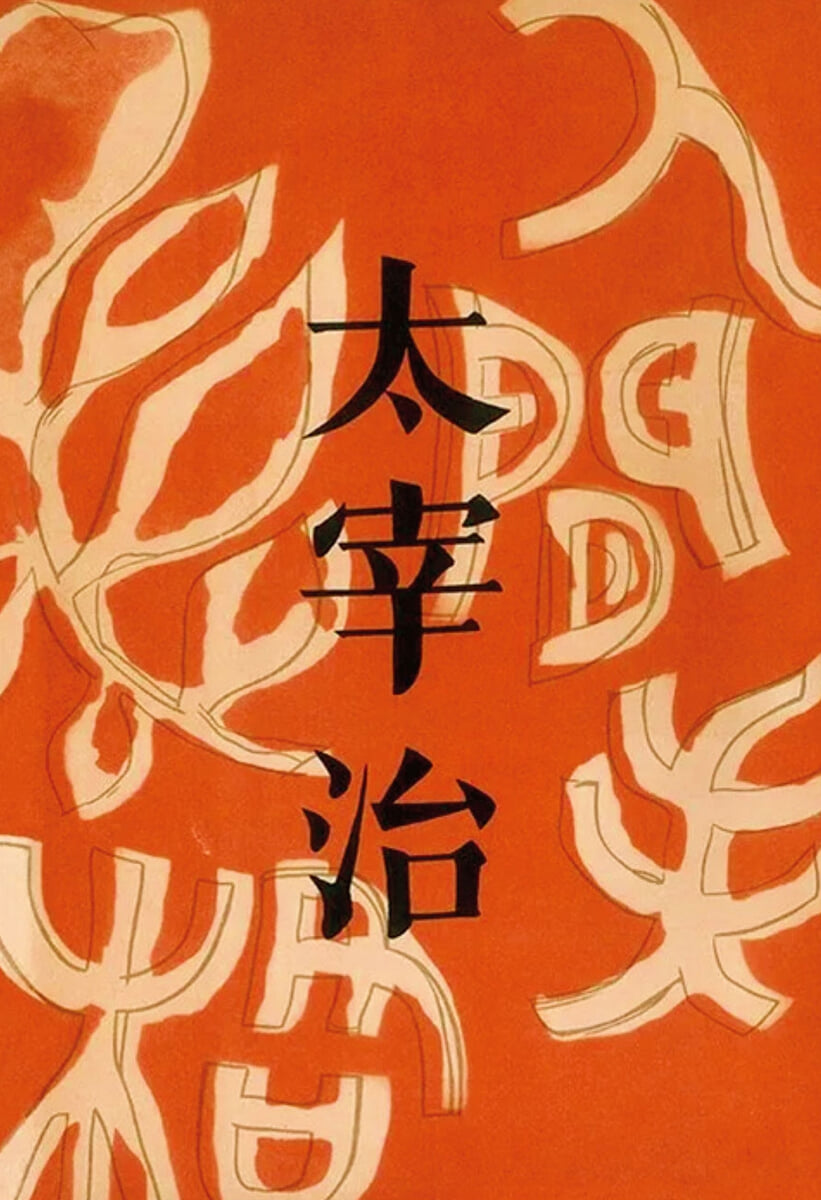
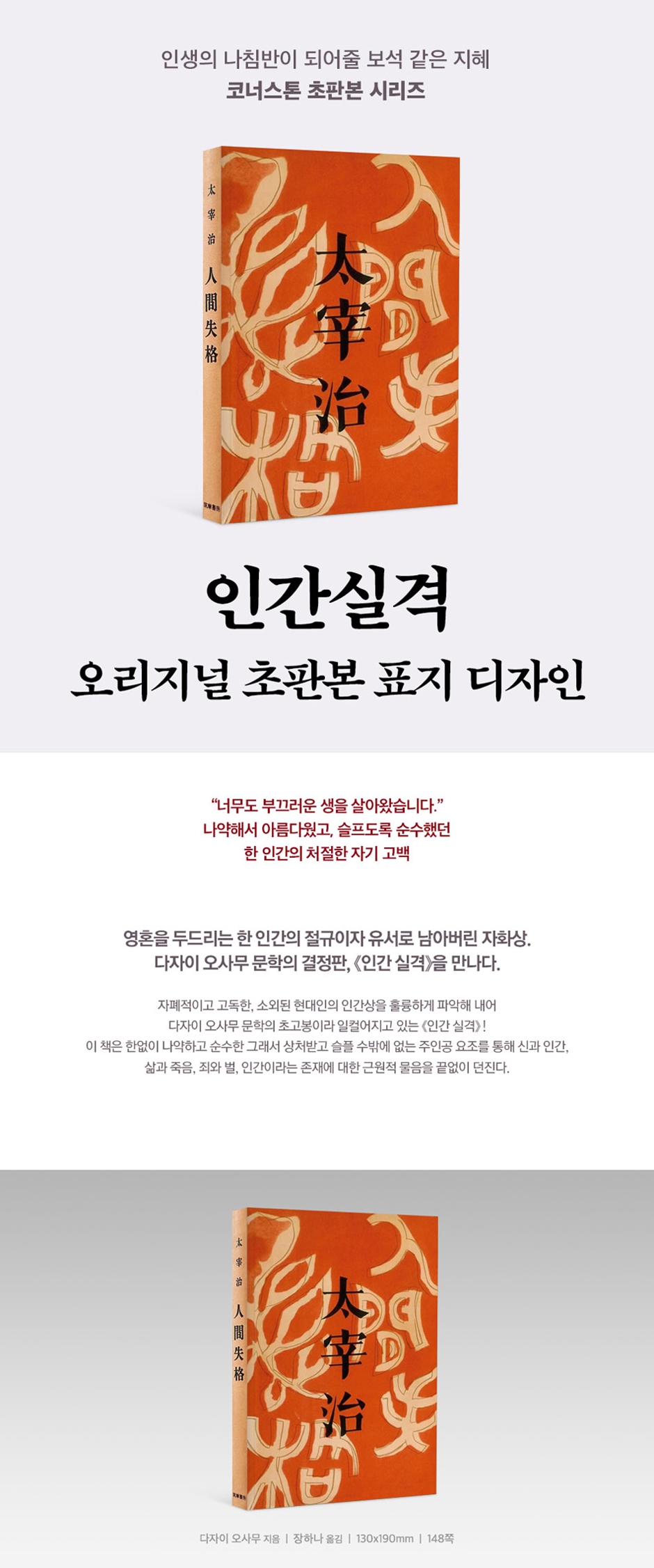
No Longer Human (Original First Edition Cover Design)
 |
Description
Book Introduction
“I have lived a life of such shame.”
A self-portrait that remains as a human cry and will that touches the soul.
Meet Osamu Dazai's definitive work, "No Longer Human."
Osamu Dazai's masterpiece, "No Longer Human," which was loved by readers around the world, depicts a character who yearned for the world and humanity more than anyone else, but was abandoned by the world due to his weakness and innocence, and was destroyed without even his qualifications as a human being.
This book, which has long been loved across generations and nationalities and is considered a rare work that unravels the very essence of human existence, was published by Cornerstone in 1948 with the original first edition cover.
"No Longer Human" can be considered Osamu Dazai's spiritual autobiography, and is considered the pinnacle of Osamu Dazai's literature, as it candidly portrays the unstable autism and alienated loneliness that we may all harbor within ourselves.
In particular, this book endlessly poses fundamental questions about God and humans, life and death, sin and punishment, and the very existence of humans, through the protagonist who is infinitely weak and pure, and therefore cannot help but be hurt and sad.
Osamu Dazai, who committed suicide at the age of 39, and "No Longer Human", which he left behind as a will.
Let's take a look at "No Longer Human," which has been a must-read for young people around the world for over 70 years.
A self-portrait that remains as a human cry and will that touches the soul.
Meet Osamu Dazai's definitive work, "No Longer Human."
Osamu Dazai's masterpiece, "No Longer Human," which was loved by readers around the world, depicts a character who yearned for the world and humanity more than anyone else, but was abandoned by the world due to his weakness and innocence, and was destroyed without even his qualifications as a human being.
This book, which has long been loved across generations and nationalities and is considered a rare work that unravels the very essence of human existence, was published by Cornerstone in 1948 with the original first edition cover.
"No Longer Human" can be considered Osamu Dazai's spiritual autobiography, and is considered the pinnacle of Osamu Dazai's literature, as it candidly portrays the unstable autism and alienated loneliness that we may all harbor within ourselves.
In particular, this book endlessly poses fundamental questions about God and humans, life and death, sin and punishment, and the very existence of humans, through the protagonist who is infinitely weak and pure, and therefore cannot help but be hurt and sad.
Osamu Dazai, who committed suicide at the age of 39, and "No Longer Human", which he left behind as a will.
Let's take a look at "No Longer Human," which has been a must-read for young people around the world for over 70 years.
index
Introduction 7
First Note 11
Second Note 27
Third Note 73
Review 133
Osamu Dazai Chronology 137
First Note 11
Second Note 27
Third Note 73
Review 133
Osamu Dazai Chronology 137
Detailed image
Into the book
Always trembling with fear of humanity, and lacking even the slightest confidence in my words and actions as a human being, I hid my private anguish in a small box in my heart, kept my depression and nervousness tightly concealed, and pretended to have only innocent optimism, gradually turning me into a ridiculous eccentric.
'It doesn't matter what, just make it funny.
Then people wouldn't really care if I was outside their so-called 'life'.
Anyway, you shouldn't bother them.
I am nothing.
It's the wind.
Thoughts like 'it's empty' grew like a snowball, and I desperately provided 'clown' service to the servants and maids who made my family laugh and were even more incomprehensible and fearful than my family.
--- pp.16-17
The definitions and morals that appear in ethics textbooks are of no interest to me.
To me, it is difficult to understand people who live brightly, clearly, and cheerfully, or who are confident that they can live while deceiving each other.
Humans never taught me that trick.
If only I had known that, I wouldn't have been so afraid of humans, and I wouldn't have had to do such desperate services.
I would not have to experience this hellish pain every night, standing in opposition to human life.
--- p.24
The emotion that came over me at that time was not anger, nor disgust, nor sadness, but a terrible fear.
And it wasn't a fear of graveyard ghosts or anything like that, but a primordial fear so harsh that you couldn't even utter a sound, like you would feel when encountering a white-robed spirit in a cedar forest in a shrine.
From that night on, my hair began to turn white, I lost confidence in everything, I became endlessly suspicious of people, and I was forever alienated from all hope, joy, and empathy in life.
Indeed, it was a defining event in my life.
I was hit squarely between the eyebrows, and from then on, no matter who I met, the wound from that time would sting.
--- p.114
It was a snowy night in Tokyo.
I was walking down a back alley in Ginza, drunk, humming softly, "This is a few hundred miles from my hometown, this is a few hundred miles from my hometown," kicking the falling snow with the tips of my shoes, when I suddenly threw up.
It was my first time coughing up blood.
A large Japanese flag appeared on the snow.
I crouched down for a while, scooping up a handful of unpolluted snow and washing it over my face, crying.
'It doesn't matter what, just make it funny.
Then people wouldn't really care if I was outside their so-called 'life'.
Anyway, you shouldn't bother them.
I am nothing.
It's the wind.
Thoughts like 'it's empty' grew like a snowball, and I desperately provided 'clown' service to the servants and maids who made my family laugh and were even more incomprehensible and fearful than my family.
--- pp.16-17
The definitions and morals that appear in ethics textbooks are of no interest to me.
To me, it is difficult to understand people who live brightly, clearly, and cheerfully, or who are confident that they can live while deceiving each other.
Humans never taught me that trick.
If only I had known that, I wouldn't have been so afraid of humans, and I wouldn't have had to do such desperate services.
I would not have to experience this hellish pain every night, standing in opposition to human life.
--- p.24
The emotion that came over me at that time was not anger, nor disgust, nor sadness, but a terrible fear.
And it wasn't a fear of graveyard ghosts or anything like that, but a primordial fear so harsh that you couldn't even utter a sound, like you would feel when encountering a white-robed spirit in a cedar forest in a shrine.
From that night on, my hair began to turn white, I lost confidence in everything, I became endlessly suspicious of people, and I was forever alienated from all hope, joy, and empathy in life.
Indeed, it was a defining event in my life.
I was hit squarely between the eyebrows, and from then on, no matter who I met, the wound from that time would sting.
--- p.114
It was a snowy night in Tokyo.
I was walking down a back alley in Ginza, drunk, humming softly, "This is a few hundred miles from my hometown, this is a few hundred miles from my hometown," kicking the falling snow with the tips of my shoes, when I suddenly threw up.
It was my first time coughing up blood.
A large Japanese flag appeared on the snow.
I crouched down for a while, scooping up a handful of unpolluted snow and washing it over my face, crying.
--- p.121
Publisher's Review
“I ask God.
Is trust a sin?
I ask God.
“Is non-resistance a sin?”
A desperate self-confession of a human being who was weak yet beautiful and sadly pure.
"No Longer Human" is written in the form of a memoir in which the main character, Yozo Oba, talks about his life.
The protagonist was born into a wealthy family, but was neglected by his parents, and lives with a fear of the world and people, unable to trust anyone.
He was more pure than anyone else, but because of that purity, he was unable to adapt to the world.
In particular, I feel fear about the existence of humans who can deceive others without any shame and live without getting hurt, and about the lives of such humans.
But he cannot turn away from the world.
Rather, they constantly court human life, struggle to adapt to the world, and are eventually betrayed by the world, stripped of their human qualifications, and destroyed.
Osamu Dazai's will and spiritual autobiography, "No Longer Human"
Born in 1909 in a remote area called Tsugaru, Aomori Prefecture, the son of a wealthy landowner, Osamu Dazai's life was constantly shadowed by alcohol, women, drug addiction, and attempted suicide, and he ended his life by jumping into the Tama River near the age of forty.
Before he died, he published the novel "No Longer Human," which seemed to be a direct account of his life, as if foreshadowing his own death.
In this book, he reveals the hypocrisy, evil, ugliness, and inhumanity that exist in the world through the process of frustration and defeat of the protagonist who is infinitely faithful to his inner truth, does not deceive himself, fears humans, yet constantly courts humans and the world.
In particular, through the life of the protagonist Yojo, a fool who is constantly hurt and even afraid of happiness, he confesses that the fear and hatred he has shown toward the world until now was ultimately a courtship and cry toward humanity.
Reading "No Longer Human" in the 21st Century
《No Longer Human》 became a bestseller immediately after its publication and continues to be loved by readers around the world.
Reading his works often leads one to become deeply immersed in literary sensibility, as Osamu Dazai's literature possesses a mysterious charm that transcends time and space and allows him to form a deep empathy with readers.
His last work, "No Longer Human," which was like a rite of passage for young Japanese people, especially during the post-war turmoil, is remembered as a masterpiece, delivering a weighty message to 21st-century readers who are contemplating the meaning of life and human existence in a modern society that is no different from the past.
Is trust a sin?
I ask God.
“Is non-resistance a sin?”
A desperate self-confession of a human being who was weak yet beautiful and sadly pure.
"No Longer Human" is written in the form of a memoir in which the main character, Yozo Oba, talks about his life.
The protagonist was born into a wealthy family, but was neglected by his parents, and lives with a fear of the world and people, unable to trust anyone.
He was more pure than anyone else, but because of that purity, he was unable to adapt to the world.
In particular, I feel fear about the existence of humans who can deceive others without any shame and live without getting hurt, and about the lives of such humans.
But he cannot turn away from the world.
Rather, they constantly court human life, struggle to adapt to the world, and are eventually betrayed by the world, stripped of their human qualifications, and destroyed.
Osamu Dazai's will and spiritual autobiography, "No Longer Human"
Born in 1909 in a remote area called Tsugaru, Aomori Prefecture, the son of a wealthy landowner, Osamu Dazai's life was constantly shadowed by alcohol, women, drug addiction, and attempted suicide, and he ended his life by jumping into the Tama River near the age of forty.
Before he died, he published the novel "No Longer Human," which seemed to be a direct account of his life, as if foreshadowing his own death.
In this book, he reveals the hypocrisy, evil, ugliness, and inhumanity that exist in the world through the process of frustration and defeat of the protagonist who is infinitely faithful to his inner truth, does not deceive himself, fears humans, yet constantly courts humans and the world.
In particular, through the life of the protagonist Yojo, a fool who is constantly hurt and even afraid of happiness, he confesses that the fear and hatred he has shown toward the world until now was ultimately a courtship and cry toward humanity.
Reading "No Longer Human" in the 21st Century
《No Longer Human》 became a bestseller immediately after its publication and continues to be loved by readers around the world.
Reading his works often leads one to become deeply immersed in literary sensibility, as Osamu Dazai's literature possesses a mysterious charm that transcends time and space and allows him to form a deep empathy with readers.
His last work, "No Longer Human," which was like a rite of passage for young Japanese people, especially during the post-war turmoil, is remembered as a masterpiece, delivering a weighty message to 21st-century readers who are contemplating the meaning of life and human existence in a modern society that is no different from the past.
GOODS SPECIFICS
- Date of issue: January 3, 2022
- Page count, weight, size: 148 pages | 130*190*20mm
- ISBN13: 9791190669603
- ISBN10: 1190669609
You may also like
카테고리
korean


korean

![GQ KOREA Mark (Monthly): December [2025]](http://librairie.coreenne.fr/cdn/shop/files/8ef265dbbfbf186523ed75ba7319009d.jpg?v=1765340328&width=3840)


