

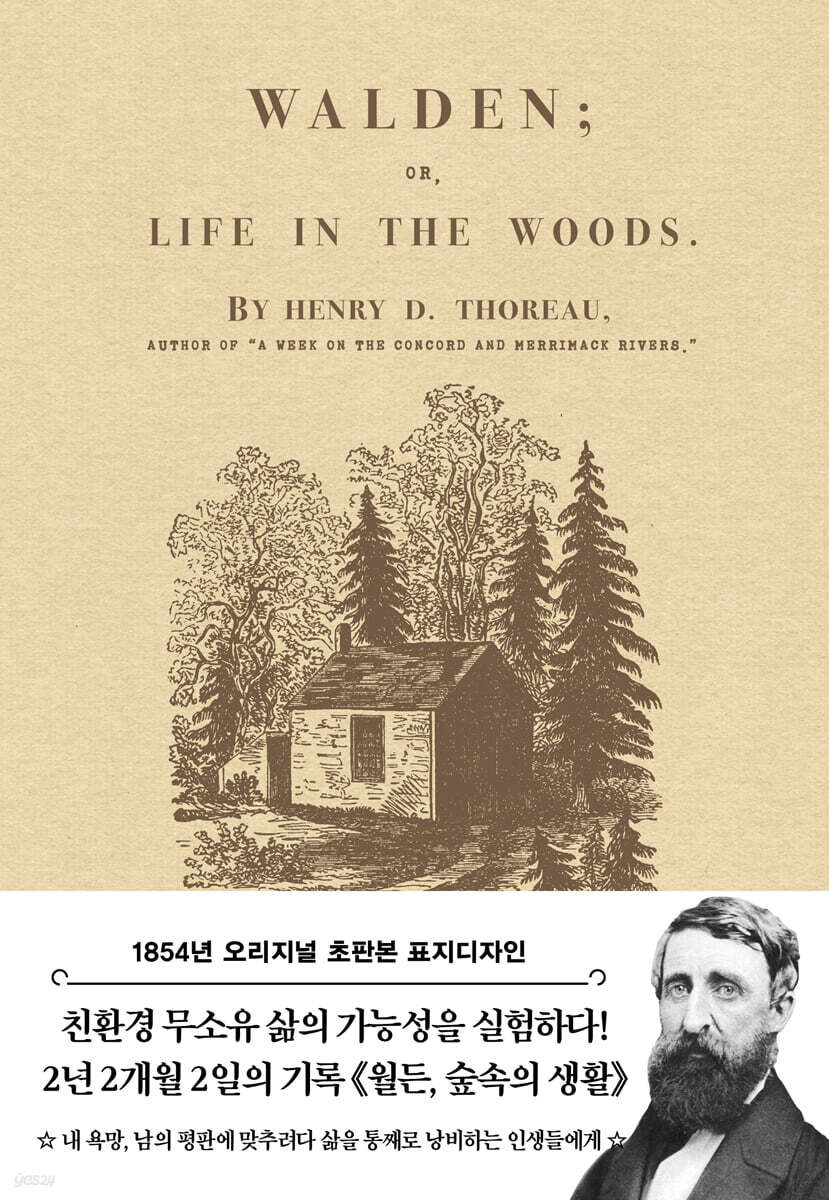
Walden First Edition: Original First Edition Design from 1854
 |
Description
Book Introduction
Experiment with the possibilities of an eco-friendly, ownership-free life!
Walden: A Record of Two Years, Two Months, and Two Days of Living Alone in the Woods
☆ Advice for those who waste their lives trying to live up to their desires and the reputations of others ☆
The country where the capitalist message of “Money is power!” is powerfully at work, the driving force that has reorganized the entire world into capitalism, is the United States.
However, in the early days of capitalism in the United States in the mid-to-late 1800s, there was already a warning that pierced through the dangers of 'humans subordinated to capital' and 'civilization destroying nature': Henry David Thoreau's 'Walden'.
While everyone praised the magical productivity of the Industrial Revolution, this is a truly pioneering book that sees the lives of individuals buried in lifelong debt and confronts the screams of nature being destroyed in the name of progress.
In addition, it is a wonderful, literary essay with sentences that delicately capture the tranquil scenery of Walden Pond and ethereal meditations drawn from deep solitude.
Let's take a look at the first edition of "Walden" presented by The Story.
Walden is the story of Thoreau living alone as a self-sufficient 'natural man' in a cabin by Walden Pond for about two years.
The diary, which was originally intended to be published as soon as he left the cabin, was postponed due to concerns about poor sales, and was later refined into an essay titled 'Four Seasons at Walden Pond (One Year),' which resulted in a higher literary quality.
But above all, what is remarkable about Walden is that it admonishes a society that encourages people to “be frugal and hard-working to become wealthy!” by admonishing them to “own less and work less!” and to work only six weeks a year and enjoy the joy of contemplation in nature during the rest of the time.
A full 170 years ago, an experiment was conducted that coincided with the breakthroughs (YOLO, returning to the countryside, etc.) being attempted by modern people weary of neoliberalism and unchecked development! Because of this groundbreaking nature, Walden remained overlooked for over 100 years after Thoreau's death. However, as human values trampled by industry were re-examined and introspection about the crisis facing humanity and the planet arose, it gained recognition as "the greatest masterpiece of American literature."
Walden: A Record of Two Years, Two Months, and Two Days of Living Alone in the Woods
☆ Advice for those who waste their lives trying to live up to their desires and the reputations of others ☆
The country where the capitalist message of “Money is power!” is powerfully at work, the driving force that has reorganized the entire world into capitalism, is the United States.
However, in the early days of capitalism in the United States in the mid-to-late 1800s, there was already a warning that pierced through the dangers of 'humans subordinated to capital' and 'civilization destroying nature': Henry David Thoreau's 'Walden'.
While everyone praised the magical productivity of the Industrial Revolution, this is a truly pioneering book that sees the lives of individuals buried in lifelong debt and confronts the screams of nature being destroyed in the name of progress.
In addition, it is a wonderful, literary essay with sentences that delicately capture the tranquil scenery of Walden Pond and ethereal meditations drawn from deep solitude.
Let's take a look at the first edition of "Walden" presented by The Story.
Walden is the story of Thoreau living alone as a self-sufficient 'natural man' in a cabin by Walden Pond for about two years.
The diary, which was originally intended to be published as soon as he left the cabin, was postponed due to concerns about poor sales, and was later refined into an essay titled 'Four Seasons at Walden Pond (One Year),' which resulted in a higher literary quality.
But above all, what is remarkable about Walden is that it admonishes a society that encourages people to “be frugal and hard-working to become wealthy!” by admonishing them to “own less and work less!” and to work only six weeks a year and enjoy the joy of contemplation in nature during the rest of the time.
A full 170 years ago, an experiment was conducted that coincided with the breakthroughs (YOLO, returning to the countryside, etc.) being attempted by modern people weary of neoliberalism and unchecked development! Because of this groundbreaking nature, Walden remained overlooked for over 100 years after Thoreau's death. However, as human values trampled by industry were re-examined and introspection about the crisis facing humanity and the planet arose, it gained recognition as "the greatest masterpiece of American literature."
- You can preview some of the book's contents.
Preview
index
Economics of Life
Where and for what did I live?
reading
sounds
solitude
visitors
soybean field
village
lakes
Baker Farm
Higher Law
Animal Friends
heating
Former residents and winter visitors
Winter animals
Lake in winter
spring
Conclusion
Commentary on the work
Henry David Thoreau Chronology
Where and for what did I live?
reading
sounds
solitude
visitors
soybean field
village
lakes
Baker Farm
Higher Law
Animal Friends
heating
Former residents and winter visitors
Winter animals
Lake in winter
spring
Conclusion
Commentary on the work
Henry David Thoreau Chronology
Into the book
What I'm about to tell you is about your current situation, especially your external circumstances and circumstances in this world and this town, why they are so bad, and whether there is any room for improvement.
(…) Some people are so poor that they struggle to make ends meet.
I'm trying to somehow find a job and get out of debt, but the debt is always reaching its limit.
Always promising, 'I'll pay you back tomorrow, I'll definitely pay you back tomorrow,' but today I die broke.
--- From "The Economics of Life"
It is entirely possible to build a home that is much more convenient and luxurious than the one you live in now.
But you have to admit that you don't have the capacity to do that right now.
Why do we always strive for more, but never learn to be content with less?
--- From "The Economics of Life"
I went into the forest as I intended, to live facing only the essence of life.
I wanted to know if I could learn everything there was to learn in life, and if, when death came, I would know that I had not lived in vain.
Life is so precious that I wouldn't want to live if it weren't for life.
I didn't want to live in resignation unless it was absolutely necessary.
I wanted to destroy everything that was not life and live resiliently like a Spartan.
--- From "Where and For What Did I Live"
Let's live simply, simply, simply! Please, let's not multiply our to-do list by a hundred or a thousand, but by reducing it to two or three.
Instead of counting to a million, count to six. Instead of three meals a day, eat only one meal when necessary.
Let's reduce the hundred dishes to five, and reduce the other dishes in that proportion.
(…) Why do we waste our lives so busily? It's as if we've decided to starve to death before we're even hungry.
They say that one stitch done on time will save nine stitches later, but they sew a thousand stitches today to save nine stitches tomorrow.
I work all day long but don't accomplish anything important.
--- From "Where and For What Did I Live"
I have always lamented that I am not as wise as I was the day I was born.
Intelligence is a great sword.
Delve deep into the secrets of all things, discern them, and separate them.
I will not keep my hands busy more than necessary.
My head is my hands and feet.
My instinct tells me that I dig with my head, just as some animals dig with their snouts and forelegs.
With this head, I'm going to dig into the surrounding mountains.
There must be a vein of gold somewhere around here.
Let's start mining right here.
--- From "Where and For What Did I Live"
I sat in a boat for hours fishing, relying on the moonlight in the middle of the night.
Occasionally, I could hear the soprano songs of owls and foxes, and occasionally, the shrill cry of an unknown bird could be heard nearby.
I anchored a hundred meters from the water's edge, surrounded by thousands of small bass and silvery piranhas, their tails slapping against the surface in the moonlight, and I communed with the mysterious night fish ten meters below with a long flax line.
(…) Especially on a dark night, when my mind wanders over vast, cosmological themes of other celestial bodies, it is a strange feeling to be suddenly awakened by the slight trembling of a fishing line and reconnect with nature.
It felt like I was casting a fishing line not only under the water but also into the air.
So I caught two fish with one hook.
--- From "Lake"
One of the inconveniences I experience from living in a small house is that it's difficult to keep enough distance between us when sitting across from guests and having a conversation about profound ideas using grandiose words.
(…) If you want to spread out sentences, you need to leave some space between them.
Even between individuals, as between nations, there is a need for a neutral zone of considerable size, as well as wide, natural boundaries.
One day I had the rather unique luxury of standing across a lake and chatting with a friend.
At home, we were all talking so close to each other that I couldn't really hear them.
It is impossible to speak low enough for the other person to listen.
It's like throwing two stones too close together into a still water surface, and the two ripples will disturb each other.
--- From "Visitors"
Then suddenly I heard the cry of an eagle owl nearby, a cry more intense and loud than any I had ever heard in the forest.
It was responding at regular intervals to the cry of the leader goose.
It was as if the intention was to show the invaders from Hudson Bay how great the Walden natives were, and thus drive them away beyond the horizon of Concord.
"What is your intention, to startle the forest fortress at this late hour of the night, dedicated to me? Get out, get out, owl!" Their conversation was a terrible dissonance.
--- From "Winter Animals"
About an hour after sunrise, the lake began to rumble under the influence of the sun's rays, which were slanted down from the hill.
I started stretching and yawning like someone who just woke up, and my body started moving more and more, and that continued for three or four hours.
(…) Fishermen said that the ‘thunder of the lake’ startles the fish and makes them not bite at all.
(…) Just as new buds sprout without fail in spring, the lake must also make a thunderous sound.
The earth is all alive and covered with sensitive protrusions.
(…) Some people are so poor that they struggle to make ends meet.
I'm trying to somehow find a job and get out of debt, but the debt is always reaching its limit.
Always promising, 'I'll pay you back tomorrow, I'll definitely pay you back tomorrow,' but today I die broke.
--- From "The Economics of Life"
It is entirely possible to build a home that is much more convenient and luxurious than the one you live in now.
But you have to admit that you don't have the capacity to do that right now.
Why do we always strive for more, but never learn to be content with less?
--- From "The Economics of Life"
I went into the forest as I intended, to live facing only the essence of life.
I wanted to know if I could learn everything there was to learn in life, and if, when death came, I would know that I had not lived in vain.
Life is so precious that I wouldn't want to live if it weren't for life.
I didn't want to live in resignation unless it was absolutely necessary.
I wanted to destroy everything that was not life and live resiliently like a Spartan.
--- From "Where and For What Did I Live"
Let's live simply, simply, simply! Please, let's not multiply our to-do list by a hundred or a thousand, but by reducing it to two or three.
Instead of counting to a million, count to six. Instead of three meals a day, eat only one meal when necessary.
Let's reduce the hundred dishes to five, and reduce the other dishes in that proportion.
(…) Why do we waste our lives so busily? It's as if we've decided to starve to death before we're even hungry.
They say that one stitch done on time will save nine stitches later, but they sew a thousand stitches today to save nine stitches tomorrow.
I work all day long but don't accomplish anything important.
--- From "Where and For What Did I Live"
I have always lamented that I am not as wise as I was the day I was born.
Intelligence is a great sword.
Delve deep into the secrets of all things, discern them, and separate them.
I will not keep my hands busy more than necessary.
My head is my hands and feet.
My instinct tells me that I dig with my head, just as some animals dig with their snouts and forelegs.
With this head, I'm going to dig into the surrounding mountains.
There must be a vein of gold somewhere around here.
Let's start mining right here.
--- From "Where and For What Did I Live"
I sat in a boat for hours fishing, relying on the moonlight in the middle of the night.
Occasionally, I could hear the soprano songs of owls and foxes, and occasionally, the shrill cry of an unknown bird could be heard nearby.
I anchored a hundred meters from the water's edge, surrounded by thousands of small bass and silvery piranhas, their tails slapping against the surface in the moonlight, and I communed with the mysterious night fish ten meters below with a long flax line.
(…) Especially on a dark night, when my mind wanders over vast, cosmological themes of other celestial bodies, it is a strange feeling to be suddenly awakened by the slight trembling of a fishing line and reconnect with nature.
It felt like I was casting a fishing line not only under the water but also into the air.
So I caught two fish with one hook.
--- From "Lake"
One of the inconveniences I experience from living in a small house is that it's difficult to keep enough distance between us when sitting across from guests and having a conversation about profound ideas using grandiose words.
(…) If you want to spread out sentences, you need to leave some space between them.
Even between individuals, as between nations, there is a need for a neutral zone of considerable size, as well as wide, natural boundaries.
One day I had the rather unique luxury of standing across a lake and chatting with a friend.
At home, we were all talking so close to each other that I couldn't really hear them.
It is impossible to speak low enough for the other person to listen.
It's like throwing two stones too close together into a still water surface, and the two ripples will disturb each other.
--- From "Visitors"
Then suddenly I heard the cry of an eagle owl nearby, a cry more intense and loud than any I had ever heard in the forest.
It was responding at regular intervals to the cry of the leader goose.
It was as if the intention was to show the invaders from Hudson Bay how great the Walden natives were, and thus drive them away beyond the horizon of Concord.
"What is your intention, to startle the forest fortress at this late hour of the night, dedicated to me? Get out, get out, owl!" Their conversation was a terrible dissonance.
--- From "Winter Animals"
About an hour after sunrise, the lake began to rumble under the influence of the sun's rays, which were slanted down from the hill.
I started stretching and yawning like someone who just woke up, and my body started moving more and more, and that continued for three or four hours.
(…) Fishermen said that the ‘thunder of the lake’ startles the fish and makes them not bite at all.
(…) Just as new buds sprout without fail in spring, the lake must also make a thunderous sound.
The earth is all alive and covered with sensitive protrusions.
--- From "Spring"
Publisher's Review
Owning anything costs money, and that cost is your life.
So decide.
Should we reduce our life or reduce our possessions?
“Be simple, be true, be close to nature!”
Henry David Thoreau graduated from Harvard University and returned to his hometown of Concord (a rural town north of Boston). He was shocked to discover that most of the farmers in the seemingly peaceful and leisurely rural area were actually tenant farmers, struggling their entire lives to pay land rent and household debts.
We also witness the bizarre phenomenon of surrounding forests being completely destroyed to build the railroad, the main artery of the Industrial Revolution, while the construction workers are miserably poor and the villagers are becoming even poorer as they sell crops in bulk and use the money to buy food.
Soro embarks on an experiment to find out, "Is a self-sufficient life impossible? Do people really need so much to survive?"
After he cut down a log and built a cabin on the shore of Walden Pond, he moved in alone and began to live a self-sufficient life, farming, fishing, and obtaining everything he needed for survival from nature for two years, two months, and two days (July 4, 1845 - September 6, 1847).
So decide.
Should we reduce our life or reduce our possessions?
“Be simple, be true, be close to nature!”
Henry David Thoreau graduated from Harvard University and returned to his hometown of Concord (a rural town north of Boston). He was shocked to discover that most of the farmers in the seemingly peaceful and leisurely rural area were actually tenant farmers, struggling their entire lives to pay land rent and household debts.
We also witness the bizarre phenomenon of surrounding forests being completely destroyed to build the railroad, the main artery of the Industrial Revolution, while the construction workers are miserably poor and the villagers are becoming even poorer as they sell crops in bulk and use the money to buy food.
Soro embarks on an experiment to find out, "Is a self-sufficient life impossible? Do people really need so much to survive?"
After he cut down a log and built a cabin on the shore of Walden Pond, he moved in alone and began to live a self-sufficient life, farming, fishing, and obtaining everything he needed for survival from nature for two years, two months, and two days (July 4, 1845 - September 6, 1847).
GOODS SPECIFICS
- Date of issue: April 15, 2025
- Format: Hardcover book binding method guide
- Page count, weight, size: 512 pages | 128*188*35mm
- ISBN13: 9791194591641
- ISBN10: 1194591647
You may also like
카테고리
korean


korean

![GQ KOREA Mark (Monthly): December [2025]](http://librairie.coreenne.fr/cdn/shop/files/8ef265dbbfbf186523ed75ba7319009d.jpg?v=1765340328&width=3840)


