

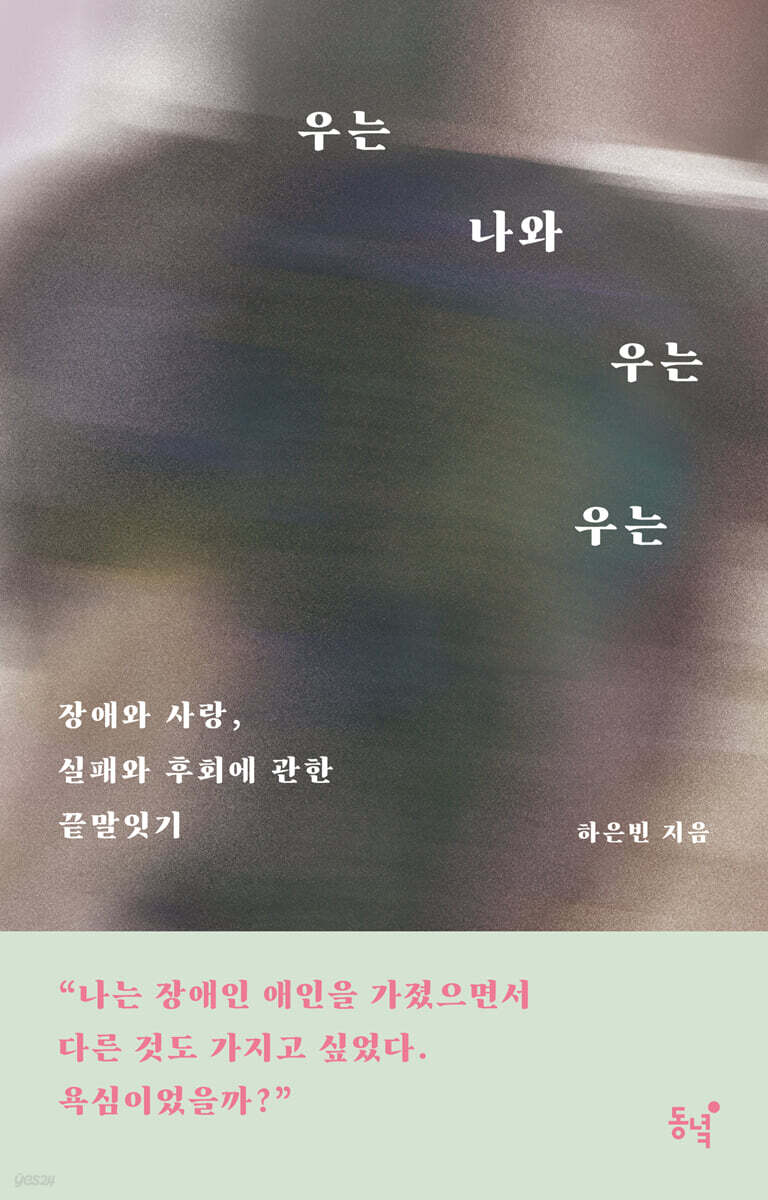
Me crying and the crying crying
 |
Description
Book Introduction
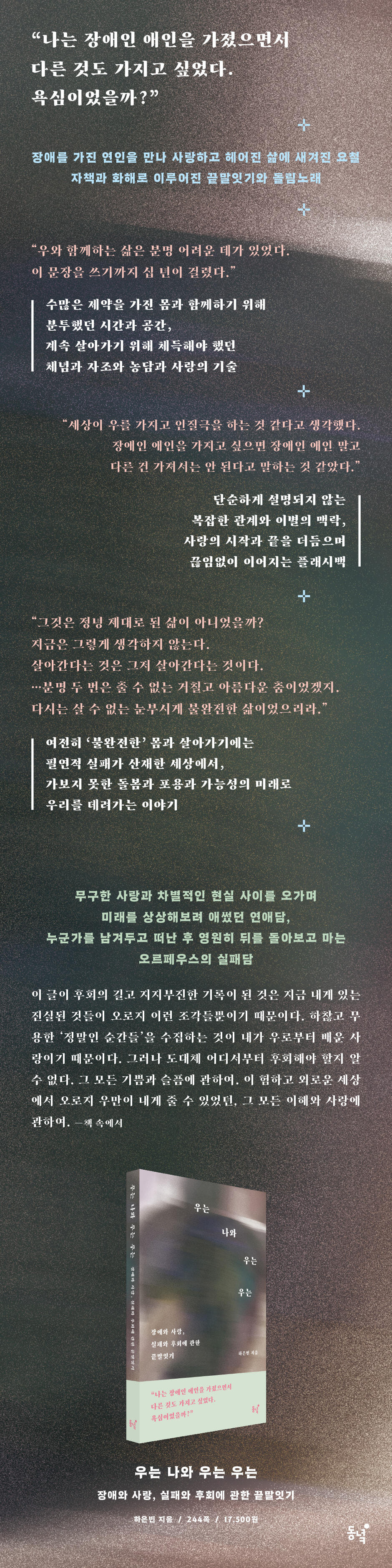
“I wanted to have something else, even though I had a disabled lover.
“Was it greed?”
The time I met, fell in love with, and broke up with a disabled lover, and the bumps and bruises etched into my life
A never-ending chain of words and rounds of self-reproach and reconciliation
This is the first book by Ha Eun-bin, who worked at the Disability Arts and Culture Research Institute 'Jit' and translated Eli Clare's 'Dazzlingly Imperfect' into Korean. It is also a book about her personal experience of wandering around the fringes of disability discourse after breaking up with her disabled lover.
It is also a story that takes readers into the lives of disabled bodies, bodies that face complex and intertwined difficulties, and makes them imagine a world of possibilities for care and life that we have yet to reach.
The authors, Eunbin and Woo, are ordinary lovers who met during their college years.
However, because Woo is disabled with muscular dystrophy and Eunbin is not disabled, their relationship is distorted, doubted, misinterpreted, and hindered by the world.
Eunbin faces stairs she cannot climb with her lover in an electric wheelchair, begins living with Woo's family in a 'barrier-free' school dormitory, watches Woo's muscular dystrophy progress while going to and from Severance Hospital, gets into trouble when his electric wheelchair runs out of power while traveling to Japan together, enjoys a 'staycation' together at the Conrad Hotel in Yeouido, attends the funeral of another friend with muscular dystrophy, loses contact with her family, takes up performing arts as a career, and appears in a documentary as a disabled-non-disabled couple.
Then one day, Eunbin breaks up with Woo after five years of dating.
After ending her long relationship with Woo, Eunbin looks back on the breakup for a long time, blaming herself and regretting it.
I spend a long time reflecting on how I really felt and how difficult it was, why I decided to break up so suddenly, where this love began, how it was twisted, how it was hurt, and where it ended.
With the belief that “regret is the truest thing,” we ponder the tangled thread of separation that is difficult to explain simply, and reflect on what brought this love to an end.
“Was it greed?”
The time I met, fell in love with, and broke up with a disabled lover, and the bumps and bruises etched into my life
A never-ending chain of words and rounds of self-reproach and reconciliation
This is the first book by Ha Eun-bin, who worked at the Disability Arts and Culture Research Institute 'Jit' and translated Eli Clare's 'Dazzlingly Imperfect' into Korean. It is also a book about her personal experience of wandering around the fringes of disability discourse after breaking up with her disabled lover.
It is also a story that takes readers into the lives of disabled bodies, bodies that face complex and intertwined difficulties, and makes them imagine a world of possibilities for care and life that we have yet to reach.
The authors, Eunbin and Woo, are ordinary lovers who met during their college years.
However, because Woo is disabled with muscular dystrophy and Eunbin is not disabled, their relationship is distorted, doubted, misinterpreted, and hindered by the world.
Eunbin faces stairs she cannot climb with her lover in an electric wheelchair, begins living with Woo's family in a 'barrier-free' school dormitory, watches Woo's muscular dystrophy progress while going to and from Severance Hospital, gets into trouble when his electric wheelchair runs out of power while traveling to Japan together, enjoys a 'staycation' together at the Conrad Hotel in Yeouido, attends the funeral of another friend with muscular dystrophy, loses contact with her family, takes up performing arts as a career, and appears in a documentary as a disabled-non-disabled couple.
Then one day, Eunbin breaks up with Woo after five years of dating.
After ending her long relationship with Woo, Eunbin looks back on the breakup for a long time, blaming herself and regretting it.
I spend a long time reflecting on how I really felt and how difficult it was, why I decided to break up so suddenly, where this love began, how it was twisted, how it was hurt, and where it ended.
With the belief that “regret is the truest thing,” we ponder the tangled thread of separation that is difficult to explain simply, and reflect on what brought this love to an end.
- You can preview some of the book's contents.
Preview
index
Prologue: Without parentheses or ellipses
Chapter 1: Real Moments
* Me crying and the crying crying
Chapter 2: A House Called Body
* Lovers of the End
Chapter 3: On That Fundamental Impossibility
* Please take care of Dong-i
Chapter 4 Fall, Winter, Spring, and Summer
* In place, in place
Chapter 5: Lovers Swim in a Bottomless Lake
* Diver's Lover
* Hug
Chapter 6 I didn't know I would become a traitor to that story.
* Revised diary
Chapter 7: Word Chain
* To Woo
Epilogue: Woo's life and my life
Chapter 1: Real Moments
* Me crying and the crying crying
Chapter 2: A House Called Body
* Lovers of the End
Chapter 3: On That Fundamental Impossibility
* Please take care of Dong-i
Chapter 4 Fall, Winter, Spring, and Summer
* In place, in place
Chapter 5: Lovers Swim in a Bottomless Lake
* Diver's Lover
* Hug
Chapter 6 I didn't know I would become a traitor to that story.
* Revised diary
Chapter 7: Word Chain
* To Woo
Epilogue: Woo's life and my life
Detailed image
Into the book
Writing about the sky is as difficult as looking up at the sun.
Wow, the time I spent was like hot sunlight, shining equally on everything inside me.
Everything that was born and raised inside me was bathed in that light.
Even after five years, the light is still so hot and dazzling that it is difficult to look at it properly for the time being.
--- p.17
I felt like the world was taking me hostage.
It seemed to say that if you want a disabled lover, you shouldn't have anything else but a disabled lover.
I wanted to have something else, even though I had a disabled lover.
Was it greed? The more I thought about it, the more I wanted to do it.
--- p.29
Wow, I was a noticeable lover wherever I went, a lover who received a lot of attention and attention.
If I had to pick a secret to its popularity, it would definitely be because of Woo's large and heavy electric wheelchair.
You are sitting and I am standing.
I walk in a crying wheelchair.
The person who cries is disabled and I am non-disabled.
The many cases this combination creates have become waves of events, big and small.
Some of them were somewhat within the expected range, some turned out to be overblown, but some came down in such a big way that it blew my mind away.
--- p.33~34
Because he could no longer live in the family home after graduation, Woo continued to take time off from school and postpone graduation.
One day, I had to leave my family life and find a home for my friend.
I used to lie down and browse real estate apps before going to bed.
Clean, tall, comfortable, bright, and expensive houses.
Old, spacious, rustic, familiar, old, cheap houses.
Someday, I wanted to find a house for the two of us to live in among the many houses in the world, but it didn't seem like I could ever enter any of the houses on my phone screen.
I had no idea where all those disabled people lived.
--- p.56
I don't know whether to consider it fortunate or unfortunate that we were among the luckiest cases.
Our daily lives are still difficult from the fundamental level, making it difficult to be conscious of privilege.
We have enjoyed a relatively abundant supply of rare intellectual and cultural resources that most people cannot enjoy.
At the same time, we wrestled with the most basic things most people take for granted: safety, mobility, and toileting.
We sometimes thought we were too noble for our station.
The fact that we were educated and intelligent, that we spoke a sophisticated language, was often a source of shame rather than pride.
--- p.90
I know that the hospital's measures have helped keep his body functioning and have been a great help in delaying his death.
Scoliosis surgery and respiratory medications have clearly extended the patient's lifespan.
But the treatment came with a not insignificant side effect, and Woo's life became as thin and thin as it was extended.
While the hospital dramatically improved Woo's life, it was often ignorant or incompetent in guiding him in a better direction, and sometimes it made his life more miserable and burdensome.
But if not the hospital, then where on earth can you turn?
--- p.104~105
If someone says they forgot something important, I would tell them that it was because they were dealing with pain.
No matter what he says, I will force the words into his hand and hold his fist tightly so that he cannot loosen it.
But it's hard to say that I forgot the time I had with Uwa.
I know very well that I burned every memory I could get my hands on to escape the pain.
Meanwhile, the best memories I had with Woo left me one by one.
--- p.180
I didn't know.
That I would become increasingly more and more strangely isolated.
That I wouldn't be able to properly see or even explain what the stones blocking me are.
That I am twisting my own fate with my own hands.
It was so lonely being the only two people in the world that I kept making noises.
It was a story that would continue to repeat itself, a story that would be misinterpreted in exactly the way I didn't want it to be.
Even though I knew everything, there was no other way.
I had to tell a story that no one else could tell.
Otherwise, I couldn't survive.
We had to somehow continue to live a life where no one lived for us.
--- p.185
One day, while drinking, I blurted out:
After breaking up with Woorang... ... Honestly, I was so devastated! And then, for someone who had a bad fate, I ended up crying so sadly.
I hated it because life had become more comfortable.
I hated it because I could take the bus, go up the stairs, and go wherever I wanted.
I was embarrassed about living in a bigger house and being able to do what I wanted.
All the freedoms and rights enjoyed apart from the law were shameful.
Living as myself was not a happy thing, but a shameless thing.
--- p.214
I used to think that the smallest of desires I had were dreams that were simply impossible to achieve.
Now that I look back, it wasn't really like that.
What I wished for was neither so great nor so extravagant, nor was it something I could not or would not do.
I know now that if I had tried, I would have done it.
If I had known then that I could have lived the life I wanted, I might have made different choices.
But I didn't know it then.
Wow, I was younger, inexperienced, poor, and dependent on the kindness and help of others.
I was much more accustomed to enduring, adapting to, and tolerating what wasn't working out than to pushing, trying, and pushing to make it happen.
It is absurd to see that our developed mind was not one of ambition but of shame, and that some of those desires were so small that we could only dream of them.
--- p.216
Were we really dying then? Was it truly a life not lived properly? I don't think so now.
To live is simply to live.
Even if I became poorer and poorer, even if I had great restrictions on my lifelong movement, even if I was forced into some other place, life would still be life.
As if it would have been raining in any body.
--- p.231
I feel a responsibility to add some sentences, even amidst this overwhelming sense of guilt and doubt, to stand on the side of those who live with blue bruises on their chests from beating their chests every day, saying that everything is their fault, but who in fact never had the ability or the will to do so, those exhausted and resigned people who knew there was no way out but could only continue to lead themselves to a worse direction.
Therefore, I write it down like this.
Because he was that kind of person, I was able to continue that kind of love.
Because he was that kind of kid, he was able to have some difficult love.
Even though that child was not on his own side, his love alone understood him.
Her love saved her life.
Wow, the time I spent was like hot sunlight, shining equally on everything inside me.
Everything that was born and raised inside me was bathed in that light.
Even after five years, the light is still so hot and dazzling that it is difficult to look at it properly for the time being.
--- p.17
I felt like the world was taking me hostage.
It seemed to say that if you want a disabled lover, you shouldn't have anything else but a disabled lover.
I wanted to have something else, even though I had a disabled lover.
Was it greed? The more I thought about it, the more I wanted to do it.
--- p.29
Wow, I was a noticeable lover wherever I went, a lover who received a lot of attention and attention.
If I had to pick a secret to its popularity, it would definitely be because of Woo's large and heavy electric wheelchair.
You are sitting and I am standing.
I walk in a crying wheelchair.
The person who cries is disabled and I am non-disabled.
The many cases this combination creates have become waves of events, big and small.
Some of them were somewhat within the expected range, some turned out to be overblown, but some came down in such a big way that it blew my mind away.
--- p.33~34
Because he could no longer live in the family home after graduation, Woo continued to take time off from school and postpone graduation.
One day, I had to leave my family life and find a home for my friend.
I used to lie down and browse real estate apps before going to bed.
Clean, tall, comfortable, bright, and expensive houses.
Old, spacious, rustic, familiar, old, cheap houses.
Someday, I wanted to find a house for the two of us to live in among the many houses in the world, but it didn't seem like I could ever enter any of the houses on my phone screen.
I had no idea where all those disabled people lived.
--- p.56
I don't know whether to consider it fortunate or unfortunate that we were among the luckiest cases.
Our daily lives are still difficult from the fundamental level, making it difficult to be conscious of privilege.
We have enjoyed a relatively abundant supply of rare intellectual and cultural resources that most people cannot enjoy.
At the same time, we wrestled with the most basic things most people take for granted: safety, mobility, and toileting.
We sometimes thought we were too noble for our station.
The fact that we were educated and intelligent, that we spoke a sophisticated language, was often a source of shame rather than pride.
--- p.90
I know that the hospital's measures have helped keep his body functioning and have been a great help in delaying his death.
Scoliosis surgery and respiratory medications have clearly extended the patient's lifespan.
But the treatment came with a not insignificant side effect, and Woo's life became as thin and thin as it was extended.
While the hospital dramatically improved Woo's life, it was often ignorant or incompetent in guiding him in a better direction, and sometimes it made his life more miserable and burdensome.
But if not the hospital, then where on earth can you turn?
--- p.104~105
If someone says they forgot something important, I would tell them that it was because they were dealing with pain.
No matter what he says, I will force the words into his hand and hold his fist tightly so that he cannot loosen it.
But it's hard to say that I forgot the time I had with Uwa.
I know very well that I burned every memory I could get my hands on to escape the pain.
Meanwhile, the best memories I had with Woo left me one by one.
--- p.180
I didn't know.
That I would become increasingly more and more strangely isolated.
That I wouldn't be able to properly see or even explain what the stones blocking me are.
That I am twisting my own fate with my own hands.
It was so lonely being the only two people in the world that I kept making noises.
It was a story that would continue to repeat itself, a story that would be misinterpreted in exactly the way I didn't want it to be.
Even though I knew everything, there was no other way.
I had to tell a story that no one else could tell.
Otherwise, I couldn't survive.
We had to somehow continue to live a life where no one lived for us.
--- p.185
One day, while drinking, I blurted out:
After breaking up with Woorang... ... Honestly, I was so devastated! And then, for someone who had a bad fate, I ended up crying so sadly.
I hated it because life had become more comfortable.
I hated it because I could take the bus, go up the stairs, and go wherever I wanted.
I was embarrassed about living in a bigger house and being able to do what I wanted.
All the freedoms and rights enjoyed apart from the law were shameful.
Living as myself was not a happy thing, but a shameless thing.
--- p.214
I used to think that the smallest of desires I had were dreams that were simply impossible to achieve.
Now that I look back, it wasn't really like that.
What I wished for was neither so great nor so extravagant, nor was it something I could not or would not do.
I know now that if I had tried, I would have done it.
If I had known then that I could have lived the life I wanted, I might have made different choices.
But I didn't know it then.
Wow, I was younger, inexperienced, poor, and dependent on the kindness and help of others.
I was much more accustomed to enduring, adapting to, and tolerating what wasn't working out than to pushing, trying, and pushing to make it happen.
It is absurd to see that our developed mind was not one of ambition but of shame, and that some of those desires were so small that we could only dream of them.
--- p.216
Were we really dying then? Was it truly a life not lived properly? I don't think so now.
To live is simply to live.
Even if I became poorer and poorer, even if I had great restrictions on my lifelong movement, even if I was forced into some other place, life would still be life.
As if it would have been raining in any body.
--- p.231
I feel a responsibility to add some sentences, even amidst this overwhelming sense of guilt and doubt, to stand on the side of those who live with blue bruises on their chests from beating their chests every day, saying that everything is their fault, but who in fact never had the ability or the will to do so, those exhausted and resigned people who knew there was no way out but could only continue to lead themselves to a worse direction.
Therefore, I write it down like this.
Because he was that kind of person, I was able to continue that kind of love.
Because he was that kind of kid, he was able to have some difficult love.
Even though that child was not on his own side, his love alone understood him.
Her love saved her life.
--- p.237
Publisher's Review
“Life with Woowa was definitely difficult.
“It took me ten years to write this sentence.”
The time and space I struggled to live with a body with numerous limitations,
The skills of resignation, self-mockery, and humor that I had to learn to keep living.
“The reason I stayed with Woo was not because I was particularly kind, or because he was extremely kind, or because there was something special about us, but because he made me laugh,” recalls author Eunbin.
Their first meeting, which began in a university theater club, was cute and fresh like any other couple.
But with Woo, Eunbin realizes that living with a disabled body means constantly struggling with the constraints of time and space.
Because there were few places accessible by electric wheelchair, I couldn't even eat as I pleased, let alone go on dates, and I couldn't even use the bathroom properly outside the house.
Because he had no place to live independently, he had to postpone graduation and live with his family in the school dormitory.
Although I attended a good university, I was unable to go on an exchange program or travel abroad, and even after being accepted to a public corporation, I was unable to take the express bus to receive training.
What is ordinary and easy for non-disabled people is something that requires constant fighting, effort, compromise, and giving up for disabled people.
The anecdotes Eunbin experiences with Woo realistically show the discrimination and exclusion that people with disabilities suddenly face in their daily lives, and the makeshift life that cannot anticipate or plan for a specific future.
The author also observes the side effects of the treatments and surgeries his lover received, and points out the limitations of medical care and treatment provided under the pretext of protecting the health and function of the disabled body.
“Giving up was the most useful way we could survive the incomprehensible daily life, and resignation was the first skill we had to learn to survive,” Eunbin reflects.
But that was the reason why I fell in love with you.
To survive the harsh daily life of crying, I learned to quickly forget bad things and invent jokes out of everything.
Eunbin recalls that it was precisely this kind of friendship that always saved her life, and that she desperately wanted to learn that life skill.
If I had to give up what was most precious to me in order to live as myself,
Where exactly should we turn back and start to regret?
But as her friends around her gradually establish stable lives and her future with Woo becomes more uncertain, Eunbin feels helpless and pessimistic.
I also feel fear when I see friends and acquaintances with muscular dystrophy around me fall into unconsciousness or die in accidents.
Eunbin had hoped for a space where Woo could live independently, a little time to imagine and explore other possibilities in life, but at the time, it seemed like nothing would come of it.
As they aspire to make a living as performing artists, which requires enormous time and effort, their relationship becomes strained when a documentary they appear in together is recreated in a way they did not want.
And then one day, Eunbin suddenly chooses to break up.
Living with a disabled partner was certainly challenging and required dedication.
Moreover, while those around them were increasingly moving into the future, Woo and Eunbin had to grapple with a discriminatory world and an uncertain future, dealing with basic issues such as movement, defecation, housing, and survival.
However, Eunbin still feels that the time she spent with Woo was the best she's ever had, and that she loved Woo's vulnerable and funny side the most.
And he believes that he has thrown away something essential and precious about himself in order to leave Woo.
Going back and forth through this contradiction, Eunbin wanders for a long time, wondering why that happened and how she could have prevented it from happening.
After leaving someone behind, I look back forever
Until we withdraw and expand the fences that defined life as 'life'
Imagining new possibilities for living with an 'imperfect' body
Eunbin reflects on the long time she spent with Woo, and says, “I wish I had had more opportunities to fail.”
“I wish I could have evoked joy rather than pain, love rather than duty,” he says.
Looking back after a long time, I realize that what I had hoped for in the past to be with Woo was neither vain nor impossible, and that no matter what environment or place Woo's body and life had arrived in, that life would have been complete.
I started writing precisely because I wanted to repent, to make peace with myself, and to understand and live with the end of this love.
This story is a love story that tries to imagine the future while moving between the most ordinary and innocent love and the discriminatory reality surrounding disability, and it is a story of Orpheus's failure to leave someone behind and look back forever.
Author Ha Eun-bin, who also translated Eli Clare's "Dazzlingly Imperfect," which deals with the ideology of healing and recovery in society and the medical system regarding disability, has been constantly wandering around the edges of discourse surrounding disability through the time and experiences she spent with Woo.
The author confesses that while love pushed his past self to the bottom of the world, it was that love that saved him.
Although this book takes the form of an essay filled with personal experiences, it can also be read as a story about living in relationship with bodies that are in poverty, queer, or have other minorities, including disabilities and illnesses.
In a world where living and relating with imperfect bodies is still fraught with inevitable failure, this story will transport us to a world of unexplored care and inclusion, a world of possibility, and allow us to imagine a new future.
“It took me ten years to write this sentence.”
The time and space I struggled to live with a body with numerous limitations,
The skills of resignation, self-mockery, and humor that I had to learn to keep living.
“The reason I stayed with Woo was not because I was particularly kind, or because he was extremely kind, or because there was something special about us, but because he made me laugh,” recalls author Eunbin.
Their first meeting, which began in a university theater club, was cute and fresh like any other couple.
But with Woo, Eunbin realizes that living with a disabled body means constantly struggling with the constraints of time and space.
Because there were few places accessible by electric wheelchair, I couldn't even eat as I pleased, let alone go on dates, and I couldn't even use the bathroom properly outside the house.
Because he had no place to live independently, he had to postpone graduation and live with his family in the school dormitory.
Although I attended a good university, I was unable to go on an exchange program or travel abroad, and even after being accepted to a public corporation, I was unable to take the express bus to receive training.
What is ordinary and easy for non-disabled people is something that requires constant fighting, effort, compromise, and giving up for disabled people.
The anecdotes Eunbin experiences with Woo realistically show the discrimination and exclusion that people with disabilities suddenly face in their daily lives, and the makeshift life that cannot anticipate or plan for a specific future.
The author also observes the side effects of the treatments and surgeries his lover received, and points out the limitations of medical care and treatment provided under the pretext of protecting the health and function of the disabled body.
“Giving up was the most useful way we could survive the incomprehensible daily life, and resignation was the first skill we had to learn to survive,” Eunbin reflects.
But that was the reason why I fell in love with you.
To survive the harsh daily life of crying, I learned to quickly forget bad things and invent jokes out of everything.
Eunbin recalls that it was precisely this kind of friendship that always saved her life, and that she desperately wanted to learn that life skill.
If I had to give up what was most precious to me in order to live as myself,
Where exactly should we turn back and start to regret?
But as her friends around her gradually establish stable lives and her future with Woo becomes more uncertain, Eunbin feels helpless and pessimistic.
I also feel fear when I see friends and acquaintances with muscular dystrophy around me fall into unconsciousness or die in accidents.
Eunbin had hoped for a space where Woo could live independently, a little time to imagine and explore other possibilities in life, but at the time, it seemed like nothing would come of it.
As they aspire to make a living as performing artists, which requires enormous time and effort, their relationship becomes strained when a documentary they appear in together is recreated in a way they did not want.
And then one day, Eunbin suddenly chooses to break up.
Living with a disabled partner was certainly challenging and required dedication.
Moreover, while those around them were increasingly moving into the future, Woo and Eunbin had to grapple with a discriminatory world and an uncertain future, dealing with basic issues such as movement, defecation, housing, and survival.
However, Eunbin still feels that the time she spent with Woo was the best she's ever had, and that she loved Woo's vulnerable and funny side the most.
And he believes that he has thrown away something essential and precious about himself in order to leave Woo.
Going back and forth through this contradiction, Eunbin wanders for a long time, wondering why that happened and how she could have prevented it from happening.
After leaving someone behind, I look back forever
Until we withdraw and expand the fences that defined life as 'life'
Imagining new possibilities for living with an 'imperfect' body
Eunbin reflects on the long time she spent with Woo, and says, “I wish I had had more opportunities to fail.”
“I wish I could have evoked joy rather than pain, love rather than duty,” he says.
Looking back after a long time, I realize that what I had hoped for in the past to be with Woo was neither vain nor impossible, and that no matter what environment or place Woo's body and life had arrived in, that life would have been complete.
I started writing precisely because I wanted to repent, to make peace with myself, and to understand and live with the end of this love.
This story is a love story that tries to imagine the future while moving between the most ordinary and innocent love and the discriminatory reality surrounding disability, and it is a story of Orpheus's failure to leave someone behind and look back forever.
Author Ha Eun-bin, who also translated Eli Clare's "Dazzlingly Imperfect," which deals with the ideology of healing and recovery in society and the medical system regarding disability, has been constantly wandering around the edges of discourse surrounding disability through the time and experiences she spent with Woo.
The author confesses that while love pushed his past self to the bottom of the world, it was that love that saved him.
Although this book takes the form of an essay filled with personal experiences, it can also be read as a story about living in relationship with bodies that are in poverty, queer, or have other minorities, including disabilities and illnesses.
In a world where living and relating with imperfect bodies is still fraught with inevitable failure, this story will transport us to a world of unexplored care and inclusion, a world of possibility, and allow us to imagine a new future.
GOODS SPECIFICS
- Date of issue: March 5, 2025
- Page count, weight, size: 244 pages | 340g | 128*200*18mm
- ISBN13: 9788972971542
- ISBN10: 8972971545
You may also like
카테고리
korean


korean

![GQ KOREA Mark (Monthly): December [2025]](http://librairie.coreenne.fr/cdn/shop/files/8ef265dbbfbf186523ed75ba7319009d.jpg?v=1765340328&width=3840)


