

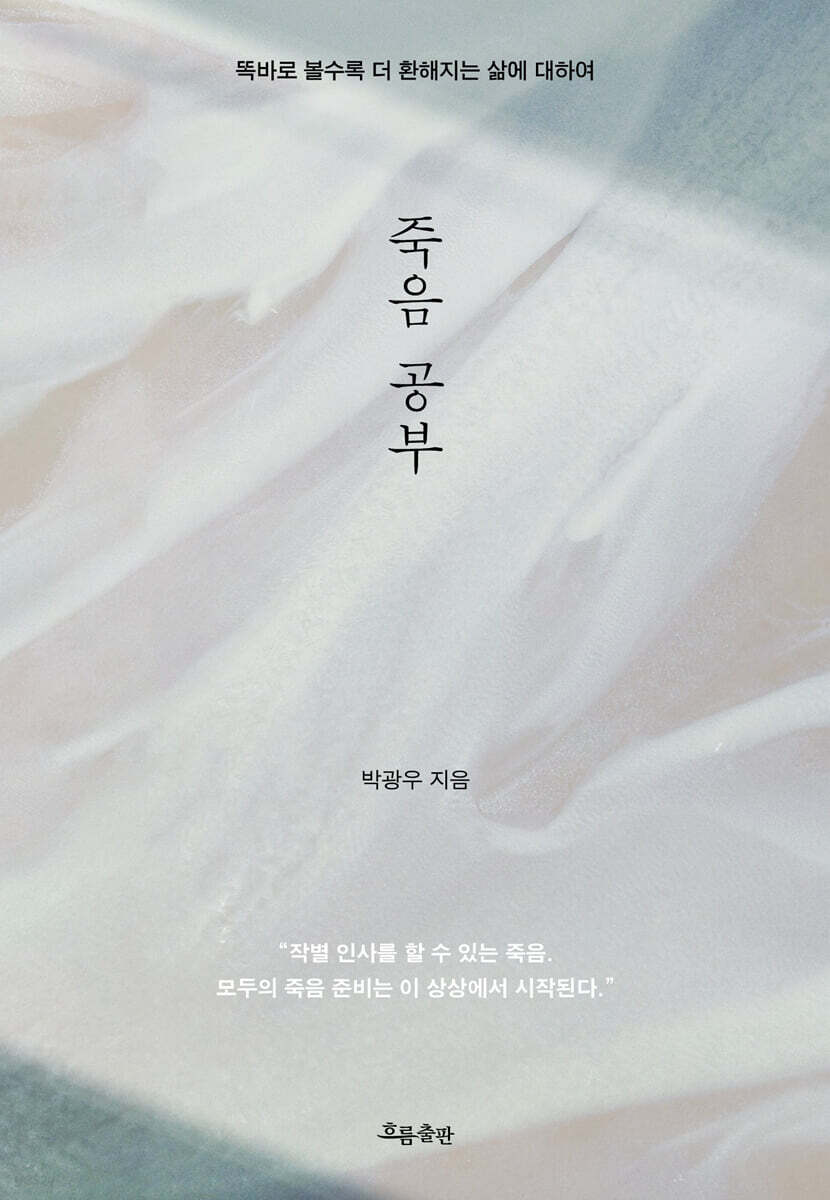
Study of death
 |
Description
Book Introduction
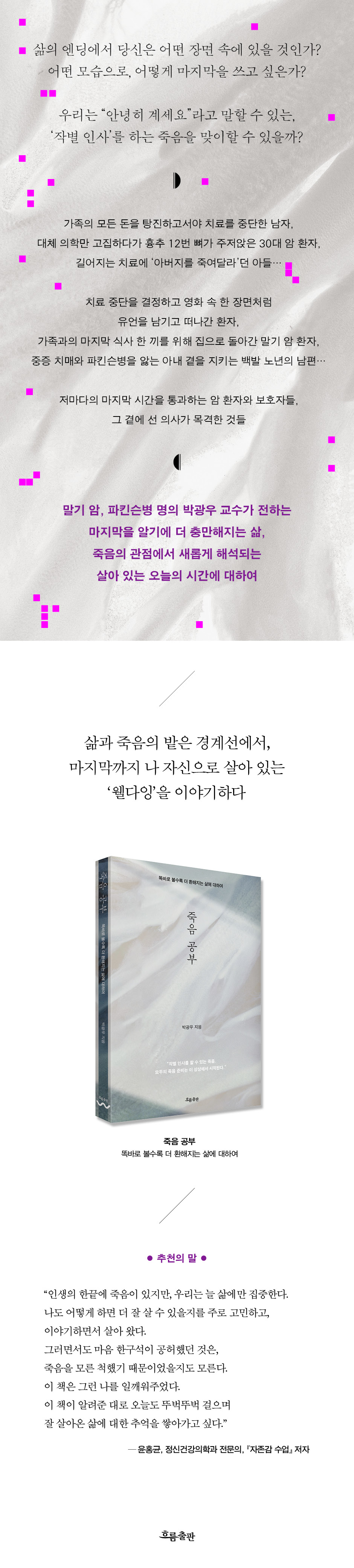
A life that becomes more fulfilling when you know the end, A new interpretation from the perspective of death About the time we live in today “To me, who only talks about how to live better, “A book that shows how important it is to think about death.” - Hong-gyun Yoon, author of "Self-Esteem Class" and a psychiatrist What kind of scene will you find yourself in at the end of your life? What kind of appearance, how do you want to write your final moments? If you were faced with death with the words, "There's not much time left," what would you do immediately? Can we face death with a "farewell," a "farewell" that allows us to say, "Goodbye"? “The more you look straight at death, the clearer life becomes.” Professor Park Kwang-woo, a neurosurgeon and radiation oncologist who has mainly treated terminal cancer and Parkinson’s disease for over 20 years, talks about why we need to think about, imagine, and worry more about death in this book, “Studying Death,” to live a more meaningful today. Through the stories of patients who go through times of illness and death that they did not know when they were healthy, we are able to imagine our own death scenes, and we are encouraged to think about today's ordinary day, which is filled with the knowledge of death again. We are caught up in our daily lives and do not think about the 'end' of this life. Then, at some point, when illness and death strike, patients become disappointed, despairing, pessimistic, and discouraged. Observing people making different choices in the face of death, the author asks how we will write the final chapters of our lives. A man who stopped treatment after squandering all of his family's money, a 30-year-old cancer patient whose 12th thoracic vertebra collapsed after insisting on alternative medicine, a son who asked to 'kill his father' due to prolonged treatment... However, some people write the last scene of their lives according to the definition of death they have always thought of and the imagination they have always had. While some patients decide to discontinue treatment, leave behind a will surrounded by their family, and depart like in a movie, there are also terminally ill cancer patients who return home for 'one last meal with their family' despite knowing what the outcome will be. “Death is real, it comes to everyone equally, and it is not far away. I wanted to talk about death, which is closer than we think. …If you think about and prepare for death, which may come at any moment, you will be able to overcome the vague fear and ignorance about death and focus on your present life. You will be able to experience the joys of life more deeply and become a more kind and considerate person to those around you. I hope that by facing death, I can perceive my own life more clearly and live it more abundantly. For me, this is well-being and a good death.” -Introduction Between fear and progress, surrounded by various scenes of death, the author says that he realized that he needed to 'study death' to look at death more clearly so that he could live and die as himself, clearly even in the fleeting moments. The author envisions a "dignified death" as a way to clearly face the dawn without being gripped by the fear of death, to clear away the clutter of daily life, to focus on the things we have neglected to observe and cherish during our lifetime, and to gather the scattered meaning of life. This book is a memoir written by the author after completing his clinical work, reflecting on what he saw, felt, and learned while with patients and their guardians. In the final moments of uncontrollable life and death, the field is a story about an attitude toward life that becomes more resolute and stronger in the knowledge of death, so that we can maintain our place with dignity even between the borders. |
- You can preview some of the book's contents.
Preview
index
Introduction | Between Well-dying and Well-being
Part 1 - Only the Dead Know Death
There may be one day left tomorrow / The spark does not go out easily / Even cancer needs counseling / Preparing for death / Daily life with illness / To hear voices / We all leave memories / Death faced alone / Faces of pain / The first and last treatment / Staying by the side / The best moment
Part 2 - Preparing for Death While Living
To her who can no longer take medicine / Aging and dying where she lived / The right to die / Hospice and prepared death / Just by breathing and being alive / Social death / Finding a place to be hospitalized / An excuse for the doctor / Growing old / Worry dolls in the hospital room / Funeral for the living day
Part 3: The more you look death in the eye, the clearer life becomes.
Imagining the last moment / The living must live / The doctor who became a cancer patient / Where should I receive treatment / The oblivion of death / Living well is dying well / Conditions for a happy ending / Just as there is no vessel that is absolutely unbreakable / The reason I give flowers to my mother on my birthday
Conclusion | A Life Like a Walking Tour
Part 1 - Only the Dead Know Death
There may be one day left tomorrow / The spark does not go out easily / Even cancer needs counseling / Preparing for death / Daily life with illness / To hear voices / We all leave memories / Death faced alone / Faces of pain / The first and last treatment / Staying by the side / The best moment
Part 2 - Preparing for Death While Living
To her who can no longer take medicine / Aging and dying where she lived / The right to die / Hospice and prepared death / Just by breathing and being alive / Social death / Finding a place to be hospitalized / An excuse for the doctor / Growing old / Worry dolls in the hospital room / Funeral for the living day
Part 3: The more you look death in the eye, the clearer life becomes.
Imagining the last moment / The living must live / The doctor who became a cancer patient / Where should I receive treatment / The oblivion of death / Living well is dying well / Conditions for a happy ending / Just as there is no vessel that is absolutely unbreakable / The reason I give flowers to my mother on my birthday
Conclusion | A Life Like a Walking Tour
Detailed image
Into the book
“Well-dying is defined as ‘dying well in comfort and happiness,’ unlike well-being, which means ‘living comfortably and happily.’
As a doctor who has witnessed patients' final moments on the borderline between life and death, I believe that well-dying is just as important as well-being, and furthermore, that well-dying and well-being are not different things.
“A well-dying life, which involves preparing well for death, is the same value that one finds at the pinnacle of well-being, having lived well throughout one’s life.”
---p.13 From "Introductory Remarks"
“I want to look after the lives of those left behind as much as I do the lives of the cancer patients I cared for.
I believe that doctors should not only treat patients, but also provide accurate information about 'resources' so that the patient's family and close friends can lead healthy lives.
…doctors are not gods.
What they say may not always be the right answer.
I just know a little more about what the patient will do in the future than the person himself because I have met and treated many people who have suffered from similar illnesses.
… Since no one can fully understand the suffering of the patient, it is my sincere heart as a doctor to help patients make the best choices possible, based on my medical knowledge.”
---pp.42~43 From “Cancer also needs counseling”
“Death comes with a completely different face from life.
When we face death unexpectedly, our bodies slowly break down and our hearts crumble.
When the fear of death comes in the name of pain, if I do not know the truth, my life is already gone.
“To avoid being swept away by emotions, you must know the ‘facts’ of death.”
---p.52 From “Preparing for Death”
“Regardless of the illness, I hope that the patient himself becomes the main agent in managing his illness.
Doctors do not know the psychological and physical suffering of their sick patients as perfectly as the patients do.
Since I can't feel it, I just try to understand it roughly and recommend appropriate treatment based on that understanding.
How can we feel the pain of a thorn stuck in someone else's hand?
…only the patient knows the daily life of a sick person.
The doctor is next.”
---p.59 From "Daily Life with Illness"
“After death, all that remains are the memories of those who remain.
I have witnessed countless deaths up close.
As I am always nearing death, sometimes I come to the realization that I may not be able to enjoy today's sunshine again tomorrow.
At times like that, all everyday scenes seem unfamiliar.
The daily life scenery that I encountered in such a new way is no longer something that I take for granted.
“For me, living each new day like that is ‘how to die well.’”
---p.72 From “We All Leave Memories”
“There are many different people and many different deaths in the hospital.
Death comes to everyone equally, but no one knows when or how it will come.
But what we can guess is that how we face such moments is determined by the way we live our lives.
… Only I can solve the task of death.
But having someone by your side or not makes you write the ending of your life in a different way.
…we can build that relationship while we are alive.
“That relationship also creates the scene of my death.”
---pp.81~82 From "Death Alone"
“I think it is a blessing to be able to live the rest of your life according to your own will (even if the process is difficult and arduous).
When I encounter patients who suddenly become vegetative due to a cerebral hemorrhage, who have to have a tube inserted through their nose and a hole in their throat, and cannot survive a single day without the help of others, I feel the importance of self-determination in treatment.
Just as it is difficult to hold one's breath just because one wants to die, it is difficult to choose death solely by one's own will.
But I believe that as humans, we can at least choose the process of death.”
---pp.95~96 From “The First and Last Treatment”
“I think about this when I see a guardian leaving the clinic door.
The doctor might be a worry doll.
For patients facing the inevitable disease of aging as a biological human being, and for guardians who feel fear and guilt as their patients gradually deteriorate, doctors may be the ones who carry their concerns, helping them make slightly better choices and escape the emotional swamp.”
---p.191 From "Worry Dolls in the Sickroom"
“If I had a choice between life and death, I would choose a funeral feast.
I want to call everyone who knows me and say goodbye.
What happens after death means nothing to me.
When I was alive, I would invite acquaintances over for a meal and say, “This is where you and I end up.
I want to say goodbye and say, “Thank you for everything, and live well.”
“It’s sad to part ways, but can’t we make it a happy day to celebrate a life well lived?”
---pp.197~199 From "Funerals of Living Days"
“Death is not something that comes comfortably after we have resolved everything.
In this world, there are only things done and things not done, there is no such thing as 'things intended to be done'.
The regrets of the living after a person's death about what they 'wanted to do' can never be rectified.
Having witnessed various death scenes more closely than anyone else, I always wonder what a good death is.
So I speak to those who have forgotten what comes after death, so that they can do what they were 'intended to do.'"
As a doctor who has witnessed patients' final moments on the borderline between life and death, I believe that well-dying is just as important as well-being, and furthermore, that well-dying and well-being are not different things.
“A well-dying life, which involves preparing well for death, is the same value that one finds at the pinnacle of well-being, having lived well throughout one’s life.”
---p.13 From "Introductory Remarks"
“I want to look after the lives of those left behind as much as I do the lives of the cancer patients I cared for.
I believe that doctors should not only treat patients, but also provide accurate information about 'resources' so that the patient's family and close friends can lead healthy lives.
…doctors are not gods.
What they say may not always be the right answer.
I just know a little more about what the patient will do in the future than the person himself because I have met and treated many people who have suffered from similar illnesses.
… Since no one can fully understand the suffering of the patient, it is my sincere heart as a doctor to help patients make the best choices possible, based on my medical knowledge.”
---pp.42~43 From “Cancer also needs counseling”
“Death comes with a completely different face from life.
When we face death unexpectedly, our bodies slowly break down and our hearts crumble.
When the fear of death comes in the name of pain, if I do not know the truth, my life is already gone.
“To avoid being swept away by emotions, you must know the ‘facts’ of death.”
---p.52 From “Preparing for Death”
“Regardless of the illness, I hope that the patient himself becomes the main agent in managing his illness.
Doctors do not know the psychological and physical suffering of their sick patients as perfectly as the patients do.
Since I can't feel it, I just try to understand it roughly and recommend appropriate treatment based on that understanding.
How can we feel the pain of a thorn stuck in someone else's hand?
…only the patient knows the daily life of a sick person.
The doctor is next.”
---p.59 From "Daily Life with Illness"
“After death, all that remains are the memories of those who remain.
I have witnessed countless deaths up close.
As I am always nearing death, sometimes I come to the realization that I may not be able to enjoy today's sunshine again tomorrow.
At times like that, all everyday scenes seem unfamiliar.
The daily life scenery that I encountered in such a new way is no longer something that I take for granted.
“For me, living each new day like that is ‘how to die well.’”
---p.72 From “We All Leave Memories”
“There are many different people and many different deaths in the hospital.
Death comes to everyone equally, but no one knows when or how it will come.
But what we can guess is that how we face such moments is determined by the way we live our lives.
… Only I can solve the task of death.
But having someone by your side or not makes you write the ending of your life in a different way.
…we can build that relationship while we are alive.
“That relationship also creates the scene of my death.”
---pp.81~82 From "Death Alone"
“I think it is a blessing to be able to live the rest of your life according to your own will (even if the process is difficult and arduous).
When I encounter patients who suddenly become vegetative due to a cerebral hemorrhage, who have to have a tube inserted through their nose and a hole in their throat, and cannot survive a single day without the help of others, I feel the importance of self-determination in treatment.
Just as it is difficult to hold one's breath just because one wants to die, it is difficult to choose death solely by one's own will.
But I believe that as humans, we can at least choose the process of death.”
---pp.95~96 From “The First and Last Treatment”
“I think about this when I see a guardian leaving the clinic door.
The doctor might be a worry doll.
For patients facing the inevitable disease of aging as a biological human being, and for guardians who feel fear and guilt as their patients gradually deteriorate, doctors may be the ones who carry their concerns, helping them make slightly better choices and escape the emotional swamp.”
---p.191 From "Worry Dolls in the Sickroom"
“If I had a choice between life and death, I would choose a funeral feast.
I want to call everyone who knows me and say goodbye.
What happens after death means nothing to me.
When I was alive, I would invite acquaintances over for a meal and say, “This is where you and I end up.
I want to say goodbye and say, “Thank you for everything, and live well.”
“It’s sad to part ways, but can’t we make it a happy day to celebrate a life well lived?”
---pp.197~199 From "Funerals of Living Days"
“Death is not something that comes comfortably after we have resolved everything.
In this world, there are only things done and things not done, there is no such thing as 'things intended to be done'.
The regrets of the living after a person's death about what they 'wanted to do' can never be rectified.
Having witnessed various death scenes more closely than anyone else, I always wonder what a good death is.
So I speak to those who have forgotten what comes after death, so that they can do what they were 'intended to do.'"
---p.213 From “The Living Must Live”
Publisher's Review
The field of life and death is at the border
Living as myself until the end
Talking about 'well-dying'
Professor Park Gwang-woo, a specialist in terminal cancer and Parkinson's disease, shares his thoughts.
Imagine Today's Death for a Better Life
At the end of life there is death.
But we live as if there is no 'death'.
Death is dark, sad, painful, and depressing, and talking about it is taboo.
But if we do not think about the end of a life of chance and the inevitable death, how will we face the inevitable death?
Professor Park Kwang-woo, a neurosurgeon and radiation oncologist, has observed the 'borderline period' between life and death for over 20 years as a doctor and as a human being.
Everyone reacted to this time differently.
They lived out the rest of their lives either flustered or afraid, or calmly and proudly.
Helping patients, their caregivers, and those facing death firsthand, the author himself began to reflect on the time in life when death was being re-aligned.
I wrote about various scenes of death so that I could live a day without regrets and thus face death without regrets.
“Death is not something that comes comfortably after we have resolved everything.
In this world, there are only things done and things not done, there is no such thing as 'things intended to be done'.
The regrets of the living after a person's death about what they 'wanted to do' can never be rectified.
Having witnessed various death scenes more closely than anyone else, I always wonder what a good death is.
So I speak to those who have forgotten what comes after death, so that they can do what they were meant to do.” - p. 213
A death that can say 'goodbye'
Everyone's preparation for death begins with this thought.
As a physician who has primarily cared for patients with terminal cancer, Parkinson's disease, and dementia, the author shares various stories of life and death that are unknown when one is healthy.
And, as the subject of life and the subject of illness, we provide specific medical knowledge so that patients can lead a 'daily life with illness.'
It also examines the medical realities that make it difficult to die with dignity, and discusses the social conditions that we must consider together to achieve a better death.
It also writes down the doctor's pledge to help patients who are lost in the midst of difficult decisions between life and death make the best decisions.
Today, while I am alive, I place myself in the place of death.
What is my definition of death?
My beloved family, friends, and relatives stand in a circle around me as I lie in bed.
I hold on to my fading consciousness and utter my last voice.
‘I’m sorry and thank you for everything. Take care.’ He slowly closes his eyes as if he’s falling asleep… .
This is the image that comes to mind when we think of 'death', but the author says that there is no such thing as a movie-like death.
The pain that strikes me is so vivid and sharp that I can't even sleep straight, and my consciousness is completely focused on the pain.
Some give up everything in the face of death, some cling to the unknown and dangerous hopes of a proven cure, and some try with all their might to say their final goodbyes.
The author has witnessed various choices made by patients with terminal cancer and Parkinson's disease, whose treatment goals are generally pain relief rather than complete cure.
And through the stories they tell, they define a dignified final moment, or 'well-dying,' as "a death in which one can say goodbye, like 'Goodbye.'"
And then he asks the reader a question.
What kind of memories can we leave behind for those who live after death? What image of death do we harbor? What "definition" will we give?
When you have your own definition of death, your actual death may be closer to that definition.
The author's writing, which examines death from various perspectives, including stories of patients' deaths, 'living funerals' that become a celebration, and the reality of death observed as closely as possible from a doctor's perspective, brings readers closer to the final moments of life.
“The patient, whose physical strength had rapidly declined, refused all treatment.
It was a decision that reflected his usual life philosophy of wanting to live a short and healthy life rather than a long and difficult life.
It may have been because he had studied pancreatic cancer and had a clear understanding of his condition during his long battle with the disease, or it may have been because the pain he had been experiencing was so unbearable that he could not continue living.
…I called the guardians together as the patient's consciousness gradually faded.
More than ten family members and relatives gathered around the patient and watched over his final moments.
“Like the main character in a drama, he left his last will and testament to his son.” - pages 20-22
“I feel dizzy.
My body feels like it's sinking into the bed.
Little by little, my vision starts to darken.
I feel so dizzy and weak that I can hardly even open my eyes.
Fortunately, I can see my family in the scenery I look at with my eyes wide open.
I feel relieved that there are people who will mourn and regret my death.
…it gets darker little by little.
Consciousness fades and the world becomes dark.
I want to scream out in fear, 'I don't want to die,' but my voice won't come out.
In the darkness that gradually engulfs me, there is an extreme silence.
In the world that is becoming dark, no sound can be heard.
Only when there was complete darkness and complete silence could I finally reach comfort.” - pp. 207-208
Finding direction in life based on facts
The End-of-Life Treatment Decision System and Cancer Counseling
South Korea's 2020 death statistics show that 77% of deaths occurred in hospitals and 16% occurred at home.
Until the 1980s, dying outside of home was considered a death by many, and most people prepared for the end of their lives at home.
However, as medical technology has advanced, ironically, hospitals have become places where people are saved, but also places where most people die.
The discussion on euthanasia began in 2008 following the "Grandma Kim case" at Severance Hospital, which led to the current life-sustaining treatment decision system, which allows terminally ill patients to choose not to receive meaningless life-sustaining treatment.
As of 2022, 104,000 life-sustaining treatment plans have been registered.
A time of life that is completed with dignity through a dignified death.
To make this momentous decision, we must understand the facts of the disease and re-direct the rest of our lives.
The author calmly tells the objective facts about the disease alongside the struggles of patients fighting the disease.
It introduces cancer counseling systems overseas and also raises questions about realistic issues that must be considered in the face of death.
We also consider the reality of Korean healthcare, which is concentrated in high-level general hospitals, the concerns of patients who go home after a five-minute consultation with questions and anxieties buried, and the difficulties of wandering around looking for a place to receive treatment.
Among the repeated worries about a good death
Questioning the role of doctors
What choices can patients make to achieve a "good death"? The author suggests using doctors as "navigators."
The author emphasizes again that while patients flock to the so-called "Big 5" hospitals and it is difficult for doctors and patients to have deep connections, doctors do their best to convey the most necessary and important information to patients in the most optimal and accurate manner within the short consultation time.
When cancer treatment is viewed as a game, patients may cross the finish line of complete recovery or struggle in the mud of relapse and metastasis.
To reach the finish line, you need a navigation system that clearly and consistently presents the goal, and that person is a doctor.
The author also asks whether doctors are not 'worry dolls'.
Just like a doll that takes care of your worries when you put it under your pillow, doctors are there to provide more accurate information to patients and their guardians who have to make difficult decisions, thereby pushing them in a better direction.
For patients facing the inevitable disease of aging as a biological human being, and for guardians who feel fear and guilt as their patients gradually deteriorate, doctors may be the ones who carry their worries so that they can make slightly better choices and escape the emotional swamp.
“I have seen countless deaths up close.
As I am always nearing death, sometimes I come to the realization that I may not be able to enjoy today's sunshine again tomorrow.
At times like that, all everyday scenes seem unfamiliar.
The daily life scenery that I encountered in such a new way is no longer something that I take for granted.
“For me, living each new day like that is ‘how to die well.’” - Page 72
As I recall death, this familiar day becomes a little more unfamiliar and new.
When we embrace death as our own, beyond vague fear and ignorance, we can write a more complete story of life that includes death.
When we remember that this life will end someday and realize how precious this moment is, our days will become more colorful and filled with deeper meaning.
Living as myself until the end
Talking about 'well-dying'
Professor Park Gwang-woo, a specialist in terminal cancer and Parkinson's disease, shares his thoughts.
Imagine Today's Death for a Better Life
At the end of life there is death.
But we live as if there is no 'death'.
Death is dark, sad, painful, and depressing, and talking about it is taboo.
But if we do not think about the end of a life of chance and the inevitable death, how will we face the inevitable death?
Professor Park Kwang-woo, a neurosurgeon and radiation oncologist, has observed the 'borderline period' between life and death for over 20 years as a doctor and as a human being.
Everyone reacted to this time differently.
They lived out the rest of their lives either flustered or afraid, or calmly and proudly.
Helping patients, their caregivers, and those facing death firsthand, the author himself began to reflect on the time in life when death was being re-aligned.
I wrote about various scenes of death so that I could live a day without regrets and thus face death without regrets.
“Death is not something that comes comfortably after we have resolved everything.
In this world, there are only things done and things not done, there is no such thing as 'things intended to be done'.
The regrets of the living after a person's death about what they 'wanted to do' can never be rectified.
Having witnessed various death scenes more closely than anyone else, I always wonder what a good death is.
So I speak to those who have forgotten what comes after death, so that they can do what they were meant to do.” - p. 213
A death that can say 'goodbye'
Everyone's preparation for death begins with this thought.
As a physician who has primarily cared for patients with terminal cancer, Parkinson's disease, and dementia, the author shares various stories of life and death that are unknown when one is healthy.
And, as the subject of life and the subject of illness, we provide specific medical knowledge so that patients can lead a 'daily life with illness.'
It also examines the medical realities that make it difficult to die with dignity, and discusses the social conditions that we must consider together to achieve a better death.
It also writes down the doctor's pledge to help patients who are lost in the midst of difficult decisions between life and death make the best decisions.
Today, while I am alive, I place myself in the place of death.
What is my definition of death?
My beloved family, friends, and relatives stand in a circle around me as I lie in bed.
I hold on to my fading consciousness and utter my last voice.
‘I’m sorry and thank you for everything. Take care.’ He slowly closes his eyes as if he’s falling asleep… .
This is the image that comes to mind when we think of 'death', but the author says that there is no such thing as a movie-like death.
The pain that strikes me is so vivid and sharp that I can't even sleep straight, and my consciousness is completely focused on the pain.
Some give up everything in the face of death, some cling to the unknown and dangerous hopes of a proven cure, and some try with all their might to say their final goodbyes.
The author has witnessed various choices made by patients with terminal cancer and Parkinson's disease, whose treatment goals are generally pain relief rather than complete cure.
And through the stories they tell, they define a dignified final moment, or 'well-dying,' as "a death in which one can say goodbye, like 'Goodbye.'"
And then he asks the reader a question.
What kind of memories can we leave behind for those who live after death? What image of death do we harbor? What "definition" will we give?
When you have your own definition of death, your actual death may be closer to that definition.
The author's writing, which examines death from various perspectives, including stories of patients' deaths, 'living funerals' that become a celebration, and the reality of death observed as closely as possible from a doctor's perspective, brings readers closer to the final moments of life.
“The patient, whose physical strength had rapidly declined, refused all treatment.
It was a decision that reflected his usual life philosophy of wanting to live a short and healthy life rather than a long and difficult life.
It may have been because he had studied pancreatic cancer and had a clear understanding of his condition during his long battle with the disease, or it may have been because the pain he had been experiencing was so unbearable that he could not continue living.
…I called the guardians together as the patient's consciousness gradually faded.
More than ten family members and relatives gathered around the patient and watched over his final moments.
“Like the main character in a drama, he left his last will and testament to his son.” - pages 20-22
“I feel dizzy.
My body feels like it's sinking into the bed.
Little by little, my vision starts to darken.
I feel so dizzy and weak that I can hardly even open my eyes.
Fortunately, I can see my family in the scenery I look at with my eyes wide open.
I feel relieved that there are people who will mourn and regret my death.
…it gets darker little by little.
Consciousness fades and the world becomes dark.
I want to scream out in fear, 'I don't want to die,' but my voice won't come out.
In the darkness that gradually engulfs me, there is an extreme silence.
In the world that is becoming dark, no sound can be heard.
Only when there was complete darkness and complete silence could I finally reach comfort.” - pp. 207-208
Finding direction in life based on facts
The End-of-Life Treatment Decision System and Cancer Counseling
South Korea's 2020 death statistics show that 77% of deaths occurred in hospitals and 16% occurred at home.
Until the 1980s, dying outside of home was considered a death by many, and most people prepared for the end of their lives at home.
However, as medical technology has advanced, ironically, hospitals have become places where people are saved, but also places where most people die.
The discussion on euthanasia began in 2008 following the "Grandma Kim case" at Severance Hospital, which led to the current life-sustaining treatment decision system, which allows terminally ill patients to choose not to receive meaningless life-sustaining treatment.
As of 2022, 104,000 life-sustaining treatment plans have been registered.
A time of life that is completed with dignity through a dignified death.
To make this momentous decision, we must understand the facts of the disease and re-direct the rest of our lives.
The author calmly tells the objective facts about the disease alongside the struggles of patients fighting the disease.
It introduces cancer counseling systems overseas and also raises questions about realistic issues that must be considered in the face of death.
We also consider the reality of Korean healthcare, which is concentrated in high-level general hospitals, the concerns of patients who go home after a five-minute consultation with questions and anxieties buried, and the difficulties of wandering around looking for a place to receive treatment.
Among the repeated worries about a good death
Questioning the role of doctors
What choices can patients make to achieve a "good death"? The author suggests using doctors as "navigators."
The author emphasizes again that while patients flock to the so-called "Big 5" hospitals and it is difficult for doctors and patients to have deep connections, doctors do their best to convey the most necessary and important information to patients in the most optimal and accurate manner within the short consultation time.
When cancer treatment is viewed as a game, patients may cross the finish line of complete recovery or struggle in the mud of relapse and metastasis.
To reach the finish line, you need a navigation system that clearly and consistently presents the goal, and that person is a doctor.
The author also asks whether doctors are not 'worry dolls'.
Just like a doll that takes care of your worries when you put it under your pillow, doctors are there to provide more accurate information to patients and their guardians who have to make difficult decisions, thereby pushing them in a better direction.
For patients facing the inevitable disease of aging as a biological human being, and for guardians who feel fear and guilt as their patients gradually deteriorate, doctors may be the ones who carry their worries so that they can make slightly better choices and escape the emotional swamp.
“I have seen countless deaths up close.
As I am always nearing death, sometimes I come to the realization that I may not be able to enjoy today's sunshine again tomorrow.
At times like that, all everyday scenes seem unfamiliar.
The daily life scenery that I encountered in such a new way is no longer something that I take for granted.
“For me, living each new day like that is ‘how to die well.’” - Page 72
As I recall death, this familiar day becomes a little more unfamiliar and new.
When we embrace death as our own, beyond vague fear and ignorance, we can write a more complete story of life that includes death.
When we remember that this life will end someday and realize how precious this moment is, our days will become more colorful and filled with deeper meaning.
GOODS SPECIFICS
- Date of issue: December 6, 2024
- Page count, weight, size: 252 pages | 298g | 135*195*16mm
- ISBN13: 9788965966753
- ISBN10: 8965966752
You may also like
카테고리
korean


korean

![GQ KOREA Mark (Monthly): December [2025]](http://librairie.coreenne.fr/cdn/shop/files/8ef265dbbfbf186523ed75ba7319009d.jpg?v=1765340328&width=3840)


