

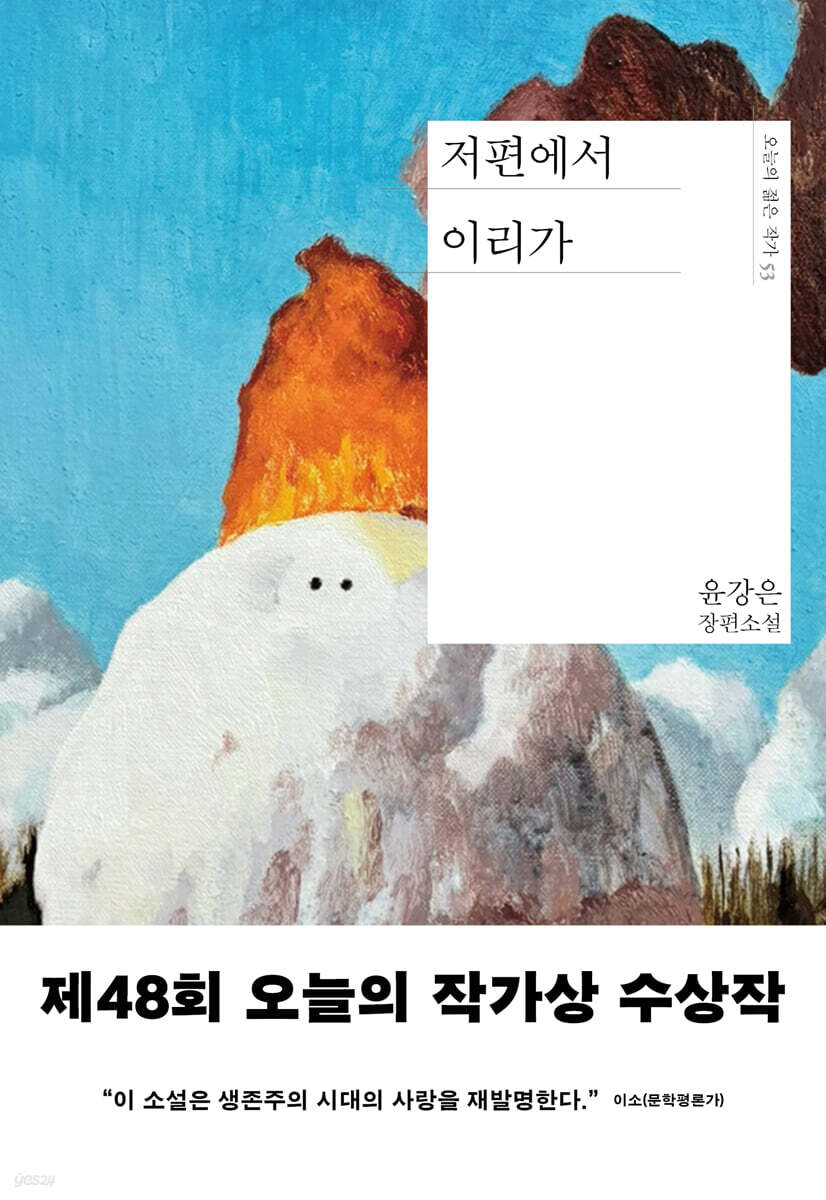
There's a wolf from over there
 |
Description
Book Introduction
“The howling of some beast was heard once more.
“From the other side, where we don’t know when we will arrive.”
The 48th Today's Writer Award Winner
★★ "This novel reinvents love in the age of survivalism." ─ Lee So (literary critic)
★★ "The world is a cruel place, but the hearts of those who travel the front lines are warm." ─ Jeong Yong-jun (novelist)
★★ "The interpretation and use of the Korean Peninsula as a space is new and fascinating." ─ Moon Ji-hyeok (novelist)
★★ "Instead of killing and dying to survive, we melt the ice of the apocalypse with affection." ─ Kim Hee-sun (novelist)
★★ "Even in an age when the word 'friend' has disappeared, we will never give up on friendship." ─ Park Hye-jin (literary critic)
The winner of the 48th Today's Writer Award, Yun Kang-eun's full-length novel "The Wolf from the Other Side" has been published in Minumsa's "Today's Young Writer" series.
"The Wolf from the Other Side" is the first award-winning work of the Today's Writer Award, which returned to the public contest format after a 10-year hiatus, and is Yoon Kang-eun's debut work.
Among the 330 or so works submitted to the Today's Writer Award, "The Wolf from the Other Side" was the only one that stood out.
This is because the compelling sentences, solid plot development, and characters with distinct personalities and vitality heralded the emergence of a new voice.
In particular, 'The Peninsula' received favorable reviews for its skillful use of various genre elements such as dystopia, fantasy, and thriller while portraying a realistic and three-dimensional world.
It was evaluated as a 'new Korean Peninsula' that was boldly discovered and illuminated only with a 'future perspective', free from the current perspective of being caught up in political and historical conflicts.
"The Wolf from Beyond" questions the most traditional and powerful names for "us"—"nation" and "people"—and imagines what lies beyond them.
The novel blurs the boundaries of "nation" by overlaying the apocalyptic landscape on the present-day Korean Peninsula, and repeatedly renews the boundaries of "us" by following the movements of five young men who run in search of hope in the apocalypse.
In this way, the 'Korean Peninsula' becomes not a fixed border dividing this side and that side, but a living, moving land that follows our feet.
And on that land, we experience our inherent freedom, yet we also face a heavy sense of responsibility toward the world.
In these times of global crisis, with climate crisis, war, and political conflict, "The Wolf from Beyond" presents us with a thread of hope we can and want to cling to, embedded in the apocalyptic landscape.
Hope is not somewhere far away, but right here, where we stand now.
“From the other side, where we don’t know when we will arrive.”
The 48th Today's Writer Award Winner
★★ "This novel reinvents love in the age of survivalism." ─ Lee So (literary critic)
★★ "The world is a cruel place, but the hearts of those who travel the front lines are warm." ─ Jeong Yong-jun (novelist)
★★ "The interpretation and use of the Korean Peninsula as a space is new and fascinating." ─ Moon Ji-hyeok (novelist)
★★ "Instead of killing and dying to survive, we melt the ice of the apocalypse with affection." ─ Kim Hee-sun (novelist)
★★ "Even in an age when the word 'friend' has disappeared, we will never give up on friendship." ─ Park Hye-jin (literary critic)
The winner of the 48th Today's Writer Award, Yun Kang-eun's full-length novel "The Wolf from the Other Side" has been published in Minumsa's "Today's Young Writer" series.
"The Wolf from the Other Side" is the first award-winning work of the Today's Writer Award, which returned to the public contest format after a 10-year hiatus, and is Yoon Kang-eun's debut work.
Among the 330 or so works submitted to the Today's Writer Award, "The Wolf from the Other Side" was the only one that stood out.
This is because the compelling sentences, solid plot development, and characters with distinct personalities and vitality heralded the emergence of a new voice.
In particular, 'The Peninsula' received favorable reviews for its skillful use of various genre elements such as dystopia, fantasy, and thriller while portraying a realistic and three-dimensional world.
It was evaluated as a 'new Korean Peninsula' that was boldly discovered and illuminated only with a 'future perspective', free from the current perspective of being caught up in political and historical conflicts.
"The Wolf from Beyond" questions the most traditional and powerful names for "us"—"nation" and "people"—and imagines what lies beyond them.
The novel blurs the boundaries of "nation" by overlaying the apocalyptic landscape on the present-day Korean Peninsula, and repeatedly renews the boundaries of "us" by following the movements of five young men who run in search of hope in the apocalypse.
In this way, the 'Korean Peninsula' becomes not a fixed border dividing this side and that side, but a living, moving land that follows our feet.
And on that land, we experience our inherent freedom, yet we also face a heavy sense of responsibility toward the world.
In these times of global crisis, with climate crisis, war, and political conflict, "The Wolf from Beyond" presents us with a thread of hope we can and want to cling to, embedded in the apocalyptic landscape.
Hope is not somewhere far away, but right here, where we stand now.
- You can preview some of the book's contents.
Preview
index
Here comes the 7
Author's Note 158
Preface by Lee So (literary critic)
A New Solidarity Imagined by the Subjects of the Anthropocene 162
Review Comment 167
Author's Note 158
Preface by Lee So (literary critic)
A New Solidarity Imagined by the Subjects of the Anthropocene 162
Review Comment 167
Into the book
The greenhouse village I returned to after a month was still the same.
It was quiet and peaceful.
Early in the morning, as we were preparing to set out again after a night's rest, we heard the cries of animals.
Inside the greenhouse were animals Yuan had never seen before, including cows, pigs, sheep, chickens, and goats.
Animals whose existence is known only through milk, eggs, and meat.
--- p.13
Most of the rivers on the Korean Peninsula are frozen, but people still name each district by its river.
Just as everyone still calls this land the ‘Korean Peninsula’ even though ‘Han’ no longer has any meaningful meaning.
The central region of the Korean Peninsula is called the 'Han River region'.
The northern part, which is the front line of the border connecting to the northern continent and confronting the continent's army, is called the 'Amnok River'.
Even now, when rivers are frozen and borders are blurred, the Korean Peninsula is still the Korean Peninsula, the Han River is still the Han River, and the Amnok River is still the Amnok River.
The Han River is the Han River.
The Amnok River is the Amnok River.
Hwarin continues to travel between the Han River and the Amnok River today.
--- p.15
If you climb to the highest point in the base, you can look out through the telescope at the distant snowy fields and the pure white horizon.
At times like that, you have to hold your breath.
Because every time you breathe, your thick breath spreads, clouding the telescope lens and obscuring your view.
The northern continent seen from the Yalu River was nothing more than a vast snowy field no different from the Korean Peninsula.
The host often stopped by the outpost and gazed north.
Even though they could see quite far ahead, it was impossible to observe the movements of the Continental Army.
Because the Continental Army's central base is very far from here.
(……) A slight strength was applied to the two hands of the person holding the telescope.
If the Continental Army has become so powerful, there is no hope for the Peninsular Army.
The peninsula army was becoming increasingly disorganized and weak.
--- pp.33-34
"excuse me."
Hwarin stopped walking at the sound of a loud voice.
I turned my head and saw a small child.
In the Han River area, all residents, especially children, were strictly prohibited from leaving their buildings alone except for authorized persons.
But somehow, Hwarin didn't feel like coaxing the child into the building.
This was because, even though there was no plausible basis for this, I was intuitively certain that the child did not belong to the Han River district.
The child standing alone with the Han River building behind him looked like a true stranger.
“Where are you from?”
Hwarin asked, but the child said something else instead of answering.
“I have a favor to ask.”
The child's eyes looking at Hwarin looked clear and indifferent at the same time.
“Will you find my body?”
--- pp.46-47
Don't slip.
That's the most important thing.
If you take just one wrong step and fall, you're finished.
No matter how agile and skillful your movements are, no matter how dazzlingly you swing your sword, no matter how mercilessly you stab your opponent with it, no matter how calm you are at the sight of your blood gushing out, the moment you fall off the glacier is the moment you die.
The instructors always taught the children like that and sent them up the glacier.
When the instructor shouted "ten men," the battle was fought that day until only ten men survived.
That's how the Continental Army's special forces were raised.
Baek Geon killed many of his friends on the glacier.
He killed his colleagues, not just his friends.
He killed not only his colleagues but also his competitors.
Baek Geon never used the word friend after realizing that they would soon face off on the glacier anyway.
--- p.50
It was a book containing illustrations and descriptions of various plants and animals.
It was a little over 700 pages long and contained records of about 140 species of plants and animals.
The recorded criteria is the point of extinction.
The preface states that he left behind drawings and texts of creatures that are sure to soon become extinct.
The author's prediction was almost correct.
Of the approximately 140 species of plants and animals currently listed in the bio-encyclopedia, Yu-an could hardly identify any.
Could the rest have been "extinct"? The book states that "extinction" means "completely vanished from the face of the Earth."
--- pp.55-56
Yuan went back to the very first chapter.
Now it was a memorized sentence.
“Believe in the power of memory.”
Perhaps a record left behind in desperation, trying to guess the future.
Yuan felt a pang in his chest, so he panted lightly and turned a few more pages.
I found an illustration depicting a familiar-looking seed of one of the plants that once grew, withered, and sprouted again on Earth.
(……) Yu-an thought back to the small nuts, or rather seeds, that he had been carrying around in his coat pocket for a while.
Although I couldn't taste it, I remembered the volume and texture it felt like when I held it in my hand.
Just by imagining it for a moment, the peach, one of the plants recorded in the Life Encyclopedia, became something Yuan knew, unlike other unfamiliar creatures.
It has become a truly tangible living being.
--- pp.132-133
I can hear it.
From far away, very far away, the howling of a strange beast is heard…
The howling of a strange beast, like the one I heard for the first time not long ago.
A howling sound of unknown origin, loud and menacing, sometimes mournful.
Hwarin began to walk slowly, following the echoing howling.
I resisted the temptation to just lie down and fall asleep, and kept walking.
It was quiet and peaceful.
Early in the morning, as we were preparing to set out again after a night's rest, we heard the cries of animals.
Inside the greenhouse were animals Yuan had never seen before, including cows, pigs, sheep, chickens, and goats.
Animals whose existence is known only through milk, eggs, and meat.
--- p.13
Most of the rivers on the Korean Peninsula are frozen, but people still name each district by its river.
Just as everyone still calls this land the ‘Korean Peninsula’ even though ‘Han’ no longer has any meaningful meaning.
The central region of the Korean Peninsula is called the 'Han River region'.
The northern part, which is the front line of the border connecting to the northern continent and confronting the continent's army, is called the 'Amnok River'.
Even now, when rivers are frozen and borders are blurred, the Korean Peninsula is still the Korean Peninsula, the Han River is still the Han River, and the Amnok River is still the Amnok River.
The Han River is the Han River.
The Amnok River is the Amnok River.
Hwarin continues to travel between the Han River and the Amnok River today.
--- p.15
If you climb to the highest point in the base, you can look out through the telescope at the distant snowy fields and the pure white horizon.
At times like that, you have to hold your breath.
Because every time you breathe, your thick breath spreads, clouding the telescope lens and obscuring your view.
The northern continent seen from the Yalu River was nothing more than a vast snowy field no different from the Korean Peninsula.
The host often stopped by the outpost and gazed north.
Even though they could see quite far ahead, it was impossible to observe the movements of the Continental Army.
Because the Continental Army's central base is very far from here.
(……) A slight strength was applied to the two hands of the person holding the telescope.
If the Continental Army has become so powerful, there is no hope for the Peninsular Army.
The peninsula army was becoming increasingly disorganized and weak.
--- pp.33-34
"excuse me."
Hwarin stopped walking at the sound of a loud voice.
I turned my head and saw a small child.
In the Han River area, all residents, especially children, were strictly prohibited from leaving their buildings alone except for authorized persons.
But somehow, Hwarin didn't feel like coaxing the child into the building.
This was because, even though there was no plausible basis for this, I was intuitively certain that the child did not belong to the Han River district.
The child standing alone with the Han River building behind him looked like a true stranger.
“Where are you from?”
Hwarin asked, but the child said something else instead of answering.
“I have a favor to ask.”
The child's eyes looking at Hwarin looked clear and indifferent at the same time.
“Will you find my body?”
--- pp.46-47
Don't slip.
That's the most important thing.
If you take just one wrong step and fall, you're finished.
No matter how agile and skillful your movements are, no matter how dazzlingly you swing your sword, no matter how mercilessly you stab your opponent with it, no matter how calm you are at the sight of your blood gushing out, the moment you fall off the glacier is the moment you die.
The instructors always taught the children like that and sent them up the glacier.
When the instructor shouted "ten men," the battle was fought that day until only ten men survived.
That's how the Continental Army's special forces were raised.
Baek Geon killed many of his friends on the glacier.
He killed his colleagues, not just his friends.
He killed not only his colleagues but also his competitors.
Baek Geon never used the word friend after realizing that they would soon face off on the glacier anyway.
--- p.50
It was a book containing illustrations and descriptions of various plants and animals.
It was a little over 700 pages long and contained records of about 140 species of plants and animals.
The recorded criteria is the point of extinction.
The preface states that he left behind drawings and texts of creatures that are sure to soon become extinct.
The author's prediction was almost correct.
Of the approximately 140 species of plants and animals currently listed in the bio-encyclopedia, Yu-an could hardly identify any.
Could the rest have been "extinct"? The book states that "extinction" means "completely vanished from the face of the Earth."
--- pp.55-56
Yuan went back to the very first chapter.
Now it was a memorized sentence.
“Believe in the power of memory.”
Perhaps a record left behind in desperation, trying to guess the future.
Yuan felt a pang in his chest, so he panted lightly and turned a few more pages.
I found an illustration depicting a familiar-looking seed of one of the plants that once grew, withered, and sprouted again on Earth.
(……) Yu-an thought back to the small nuts, or rather seeds, that he had been carrying around in his coat pocket for a while.
Although I couldn't taste it, I remembered the volume and texture it felt like when I held it in my hand.
Just by imagining it for a moment, the peach, one of the plants recorded in the Life Encyclopedia, became something Yuan knew, unlike other unfamiliar creatures.
It has become a truly tangible living being.
--- pp.132-133
I can hear it.
From far away, very far away, the howling of a strange beast is heard…
The howling of a strange beast, like the one I heard for the first time not long ago.
A howling sound of unknown origin, loud and menacing, sometimes mournful.
Hwarin began to walk slowly, following the echoing howling.
I resisted the temptation to just lie down and fall asleep, and kept walking.
--- p.146
Publisher's Review
The fall of the nation
In the age of mass extinction, the future Korean Peninsula is one where all resources have been depleted and technology has become obsolete.
This resembles the distant past that we are all familiar with.
A single, vast nation is divided into three smaller districts, information and supplies are transported by dog sled, and all supplies are obtained through human labor.
The three districts of the Korean Peninsula, including the 'Greenhouse Village', the 'Han River District', and the 'Amnok River Base', each have different political systems led by a 'village head', a 'district head', and a 'chief'.
The 'Greenhouse Village', built near the southern coastal greenhouse, produces various goods, including grains, meat, and other food, while the 'Hangang District', built around a panopticon-like building in the central region, primarily processes iron for military supplies.
The 'Amnok River Base', the front line bordering the continent, trains soldiers with supplies received from other areas to protect the territory.
The close cooperative relationship between the three regions, which had been maintained through the exchange of necessary materials, was suddenly destroyed by war.
The rules and order that supported each district disappear, and a race for survival begins on the harsh snowy plains.
People who cross borders
The characters in 'The Other Side' move between the inside and the outside of the border, or are on the border.
These include porters 'Yuan' and 'Hwarin' who travel between districts, soldiers 'Giju' and 'Baekgeon' who guard the front lines of the Korean peninsula, and 'Taeha' who crosses the border.
These five young men, all of the same age, rather than staying within the boundaries and following the order of their respective districts, move based on their intuition, which they have learned firsthand from encountering disasters and calamities directly outside the boundaries.
Porters who spend a full month traversing the snowy fields between the southern coast and the Yalu River on dog sleds endure natural disasters such as blizzards, heavy snow, whiteouts, and crevasses with their bare bodies, while soldiers build walls by carving ice without any technical equipment and prepare for war through physical training.
For these people, the end is not a sudden accident like war.
Rather, it feels like a cold air that has been seeping into my skin my entire life.
When their respective societies crumble and their chances of survival become slim, they take out the hope they have harbored in their hearts for as long as their premonition of the end.
Following the lead of his heart, he jumps across the border into the middle of an abandoned land.
A look into the future that illuminates us
The source of hope held by the characters in 'The Wolf from Beyond' lies in their belief in the primal 'life force'.
Through its vitality, the novel captures the possibility of our solidarity with non-humans as well as with humans.
Beyond the human order, it is the natural order of life, where all are equal before death.
Porter 'Yuan' looks through the 'Life Encyclopedia' he received from his dead friend whenever he has free time.
Through the book, which records mostly extinct plants and animals, Yuan recalls beings like 'seeds' that are buried as if they were dead, but are not dead.
The porter 'Hwarin' meets the ghost 'Ai' in the middle of a snowy field.
In the middle of a snowy field, following the child, he hears the howl of an unfamiliar beast and follows the signs of an invisible life form.
While porters 'Yuan' and 'Hwarin' seek out unknown possibilities, soldiers 'Giju', 'Baekgeon', and 'Taeha' follow their longing for friends and their earnest desire for life.
In this way, 『The Wolf from Beyond』 shines a bright light on us today through the perspective of the distant future, standing on the primal power that has been passed down from the distant past.
That there was hope along every path we took, and that as long as we live, that hope remains.
In the 'Preface'
In the Anthropocene, growth and survival, survival and solidarity are inseparable.
The era of survivalism has arrived.
Instead of inheriting and developing the legacy of their parents' generation, they find their own kind, cut themselves off from their hometown, and make repeated choices to survive.
The historical subject that will survive the age of ecological crisis, the subject of the Anthropocene that will break away from existing collectivism and form a new solidarity, has emerged.
(……) The novel never once belittles the desire to live, and instead of saying, “I will not run away,” it shouts, “Let us run away with all our might to survive.”
What matters is whose hand you hold, who you remember, and where you head.
Even in harsh times when survival has become the only value, they still question the meaning of life, doubt their identity, and never cease to remember those who have disappeared.
If survival is not to be shameless, if giving up survival is not to be the most ethical choice, a new survivalism that combines survival and love must be invented.
Survivalism, which begins with the question, "Why did I survive?" and remembers that there is no difference between the dead and the survivors.
It is not the cruelty of sacrificing the survival of others, nor the sense of duty of giving up my own happiness, but rather survival that mourns the past, imagines the future, and cultivates the present together.
- Lee So (literary critic)
In the 'Judges' comments
“Things that don’t go together coexist in an attractive way.
“The earth has collapsed, but the sky is blue; the world has been shattered terribly, but the people on the front lines are filled with warm hope.” - Jeong Yong-jun (novelist)
“The way the Korean Peninsula is being reinterpreted and utilized is attractive.
“The delicate power and rhythm of the sentences, the overall structure, the individuality and stories of the various characters, and above all, the warmth that never fades even in the snow and ice gave me a sense of warmth.” - Moon Ji-hyeok (novelist)
“Instead of fighting to survive and killing, the characters in ‘The Other Side’ try to maintain relationships somehow.
“It was a novel that made me hope that its heartbreaking warmth could melt even the ice of the apocalypse.” - Kim Hee-sun (novelist)
“This novel, closer to the destructive power of an icebreaker than the depth of a drilling rig, never gives up on friendship even in an age when the word “friend” has disappeared.
“We meet the ‘writer’ of ‘today’ in the bold movements that crisscross the Korean peninsula, the captivating howling that spreads behind it, and the strong will to survive but not be consumed by mere survival.” - Park Hye-jin (literary critic)
“The Wolf from Beyond” is memorable for its various attempts to reinvent love in the age of survivalism.
(……) I truly wanted to join the adventure of this work, which explores the necessary combination of survival and love in the age of survivalism.” - Lee So (literary critic)
In the age of mass extinction, the future Korean Peninsula is one where all resources have been depleted and technology has become obsolete.
This resembles the distant past that we are all familiar with.
A single, vast nation is divided into three smaller districts, information and supplies are transported by dog sled, and all supplies are obtained through human labor.
The three districts of the Korean Peninsula, including the 'Greenhouse Village', the 'Han River District', and the 'Amnok River Base', each have different political systems led by a 'village head', a 'district head', and a 'chief'.
The 'Greenhouse Village', built near the southern coastal greenhouse, produces various goods, including grains, meat, and other food, while the 'Hangang District', built around a panopticon-like building in the central region, primarily processes iron for military supplies.
The 'Amnok River Base', the front line bordering the continent, trains soldiers with supplies received from other areas to protect the territory.
The close cooperative relationship between the three regions, which had been maintained through the exchange of necessary materials, was suddenly destroyed by war.
The rules and order that supported each district disappear, and a race for survival begins on the harsh snowy plains.
People who cross borders
The characters in 'The Other Side' move between the inside and the outside of the border, or are on the border.
These include porters 'Yuan' and 'Hwarin' who travel between districts, soldiers 'Giju' and 'Baekgeon' who guard the front lines of the Korean peninsula, and 'Taeha' who crosses the border.
These five young men, all of the same age, rather than staying within the boundaries and following the order of their respective districts, move based on their intuition, which they have learned firsthand from encountering disasters and calamities directly outside the boundaries.
Porters who spend a full month traversing the snowy fields between the southern coast and the Yalu River on dog sleds endure natural disasters such as blizzards, heavy snow, whiteouts, and crevasses with their bare bodies, while soldiers build walls by carving ice without any technical equipment and prepare for war through physical training.
For these people, the end is not a sudden accident like war.
Rather, it feels like a cold air that has been seeping into my skin my entire life.
When their respective societies crumble and their chances of survival become slim, they take out the hope they have harbored in their hearts for as long as their premonition of the end.
Following the lead of his heart, he jumps across the border into the middle of an abandoned land.
A look into the future that illuminates us
The source of hope held by the characters in 'The Wolf from Beyond' lies in their belief in the primal 'life force'.
Through its vitality, the novel captures the possibility of our solidarity with non-humans as well as with humans.
Beyond the human order, it is the natural order of life, where all are equal before death.
Porter 'Yuan' looks through the 'Life Encyclopedia' he received from his dead friend whenever he has free time.
Through the book, which records mostly extinct plants and animals, Yuan recalls beings like 'seeds' that are buried as if they were dead, but are not dead.
The porter 'Hwarin' meets the ghost 'Ai' in the middle of a snowy field.
In the middle of a snowy field, following the child, he hears the howl of an unfamiliar beast and follows the signs of an invisible life form.
While porters 'Yuan' and 'Hwarin' seek out unknown possibilities, soldiers 'Giju', 'Baekgeon', and 'Taeha' follow their longing for friends and their earnest desire for life.
In this way, 『The Wolf from Beyond』 shines a bright light on us today through the perspective of the distant future, standing on the primal power that has been passed down from the distant past.
That there was hope along every path we took, and that as long as we live, that hope remains.
In the 'Preface'
In the Anthropocene, growth and survival, survival and solidarity are inseparable.
The era of survivalism has arrived.
Instead of inheriting and developing the legacy of their parents' generation, they find their own kind, cut themselves off from their hometown, and make repeated choices to survive.
The historical subject that will survive the age of ecological crisis, the subject of the Anthropocene that will break away from existing collectivism and form a new solidarity, has emerged.
(……) The novel never once belittles the desire to live, and instead of saying, “I will not run away,” it shouts, “Let us run away with all our might to survive.”
What matters is whose hand you hold, who you remember, and where you head.
Even in harsh times when survival has become the only value, they still question the meaning of life, doubt their identity, and never cease to remember those who have disappeared.
If survival is not to be shameless, if giving up survival is not to be the most ethical choice, a new survivalism that combines survival and love must be invented.
Survivalism, which begins with the question, "Why did I survive?" and remembers that there is no difference between the dead and the survivors.
It is not the cruelty of sacrificing the survival of others, nor the sense of duty of giving up my own happiness, but rather survival that mourns the past, imagines the future, and cultivates the present together.
- Lee So (literary critic)
In the 'Judges' comments
“Things that don’t go together coexist in an attractive way.
“The earth has collapsed, but the sky is blue; the world has been shattered terribly, but the people on the front lines are filled with warm hope.” - Jeong Yong-jun (novelist)
“The way the Korean Peninsula is being reinterpreted and utilized is attractive.
“The delicate power and rhythm of the sentences, the overall structure, the individuality and stories of the various characters, and above all, the warmth that never fades even in the snow and ice gave me a sense of warmth.” - Moon Ji-hyeok (novelist)
“Instead of fighting to survive and killing, the characters in ‘The Other Side’ try to maintain relationships somehow.
“It was a novel that made me hope that its heartbreaking warmth could melt even the ice of the apocalypse.” - Kim Hee-sun (novelist)
“This novel, closer to the destructive power of an icebreaker than the depth of a drilling rig, never gives up on friendship even in an age when the word “friend” has disappeared.
“We meet the ‘writer’ of ‘today’ in the bold movements that crisscross the Korean peninsula, the captivating howling that spreads behind it, and the strong will to survive but not be consumed by mere survival.” - Park Hye-jin (literary critic)
“The Wolf from Beyond” is memorable for its various attempts to reinvent love in the age of survivalism.
(……) I truly wanted to join the adventure of this work, which explores the necessary combination of survival and love in the age of survivalism.” - Lee So (literary critic)
GOODS SPECIFICS
- Date of issue: October 31, 2025
- Format: Hardcover book binding method guide
- Page count, weight, size: 172 pages | 270g | 128*188*15mm
- ISBN13: 9788937477379
- ISBN10: 8937477378
You may also like
카테고리
korean


korean

![GQ KOREA Mark (Monthly): December [2025]](http://librairie.coreenne.fr/cdn/shop/files/8ef265dbbfbf186523ed75ba7319009d.jpg?v=1765340328&width=3840)


