

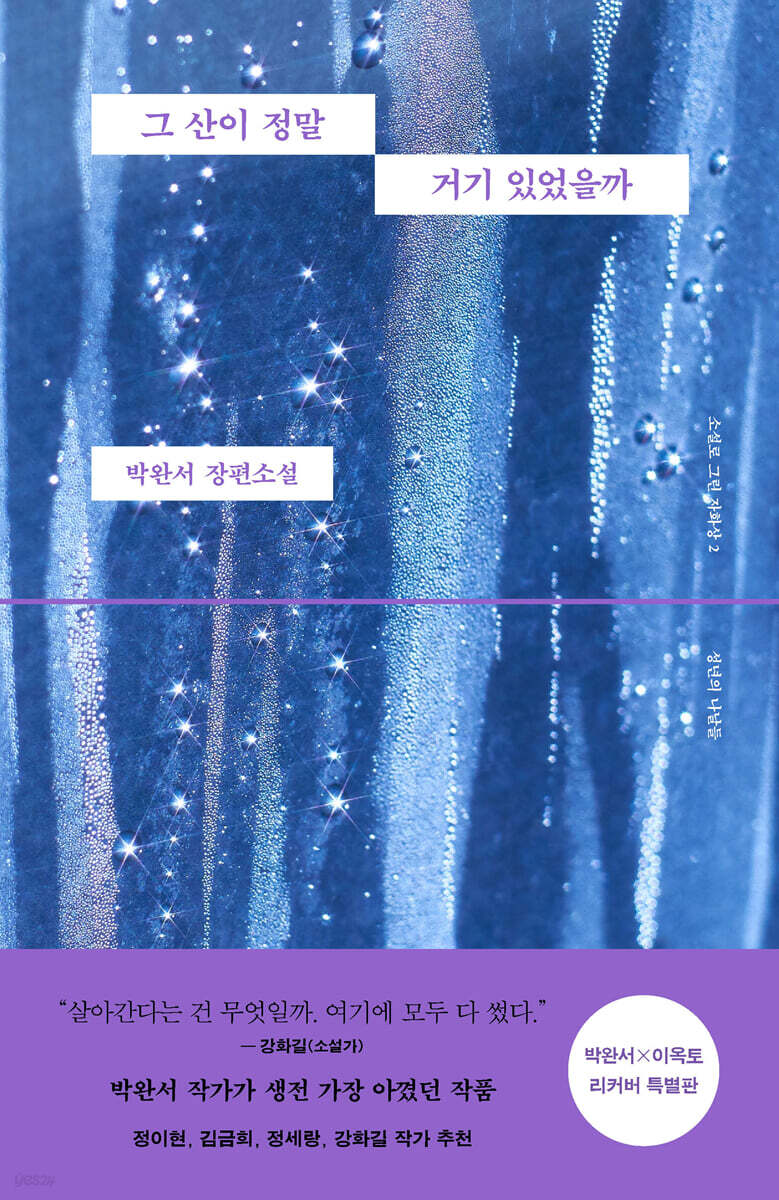
Was That Mountain Really There? (Park Wan-seo X Lee Ok-to Recover Special Edition)
 |
Description
Book Introduction
* Park Wan-seo × Lee Ok-to Recover Special Edition Published
* Recommended by authors Jeong I-hyeon, Kim Geum-hee, Jeong Se-rang, and Kang Hwa-gil
“What does it mean to live?
“I wrote it all here.”
-Kang Hwa-gil (novelist)
The work that author Park Wan-seo cherished most during her lifetime
A new encounter through collaboration with photographer Lee Ok-to
The representative works of Korean literary giant Park Wan-seo, the 'Self-Portrait in a Novel' series, 'Who Ate All the Singa?' and 'Was That Mountain Really There?' have been republished and are now available to readers in a special edition.
The cover and binding are redesigned with the work of photographer Lee Ok-to, who heated up the '2025 Seoul International Book Fair,' bringing back that intense yet beautiful space of memory.
"Was That Mountain Really There?" is a sequel to the unfinished "Who Ate All Those Singa?", and remains the work that author Park Wan-seo cherished most during her lifetime.
This novel, which covers the author's adult life from 1951, when he turned twenty, until his marriage in 1953, vividly and tearfully depicts the struggle to preserve the nobility of life despite the tragedy of family disintegration and loss of humanity amidst the intensifying war.
* Recommended by authors Jeong I-hyeon, Kim Geum-hee, Jeong Se-rang, and Kang Hwa-gil
“What does it mean to live?
“I wrote it all here.”
-Kang Hwa-gil (novelist)
The work that author Park Wan-seo cherished most during her lifetime
A new encounter through collaboration with photographer Lee Ok-to
The representative works of Korean literary giant Park Wan-seo, the 'Self-Portrait in a Novel' series, 'Who Ate All the Singa?' and 'Was That Mountain Really There?' have been republished and are now available to readers in a special edition.
The cover and binding are redesigned with the work of photographer Lee Ok-to, who heated up the '2025 Seoul International Book Fair,' bringing back that intense yet beautiful space of memory.
"Was That Mountain Really There?" is a sequel to the unfinished "Who Ate All Those Singa?", and remains the work that author Park Wan-seo cherished most during her lifetime.
This novel, which covers the author's adult life from 1951, when he turned twenty, until his marriage in 1953, vividly and tearfully depicts the struggle to preserve the nobility of life despite the tragedy of family disintegration and loss of humanity amidst the intensifying war.
- You can preview some of the book's contents.
Preview
index
Author's Note
I had a dream, I hope I never dream again
Just don't cross the Imjin River
Crazy White Magnolia
Sometimes even a snail gets angry
Death in Midsummer
winter tree
Men outside the door
Epilogue
Commentary by Lee Nam-ho (Professor, Korea University, Literary Critic)
Kim Geum-hee (novelist) reading Park Wan-seo again now
I had a dream, I hope I never dream again
Just don't cross the Imjin River
Crazy White Magnolia
Sometimes even a snail gets angry
Death in Midsummer
winter tree
Men outside the door
Epilogue
Commentary by Lee Nam-ho (Professor, Korea University, Literary Critic)
Kim Geum-hee (novelist) reading Park Wan-seo again now
Detailed image

Into the book
The years I lived through, of course, would be a very common personal history, but when I unfolded it, I found that the weft of the times had been woven together in such a reckless way that I could not weave the pattern I wanted.
That part is a personal story, but it is also something that can be shared by anyone who lived in the same era, and it is also a part that contains the foundation of the current well-being world, so I reveal it despite my shame.
'That's how we lived.'
While trying to evoke a sense of sadness toward this peaceful era, the speed of change is so dazzling and the power of forgetting is so powerful that I sometimes wonder if such harsh times really existed. My own memory sometimes becomes doubtful, and the futility of such an endeavor makes me feel a pang of sadness. This is one of the difficulties I had while writing.
--- From the author's note
“It sounds better than stealing.” Olke had already made all the preparations.
It seemed like I had found every tool in the house: a chisel, pliers, chisels, screwdrivers, hatchets, and so on.
If you don't steal, you might as well kill.
While living without electric lights, our eyes were bright like those of owls.
It wasn't a full moon, but there was a moon, and the snow that covered the frozen roads and roofs of every house looked solid, as if it would never melt.
The severe cold weather continued.
As I stepped outside, the cold itself seemed to be dazzling, as if it were brightness itself.
The shame and fear of what you were about to do would have made it difficult to be more bright.
Olke, who was in the lead, headed towards the higher slope.
--- From "I Dreamed, I Never Dream Again"
My brother was a natural thinking reed to me.
He was now training himself and his family hard to become fat pigs.
As he became more talkative, his taciturn demeanor disappeared, and he became timid and miserable.
The ideological front my brother crossed was beyond my imagination from the beginning, but whenever I saw him like this, I would shiver at the cruel and sinister destructive power of that front.
It was not a line that a weak idealist like my brother could carelessly cross.
How can a person change like that?
Even if my brother had returned with his face missing, it would have been easier to find similarities than with my brother now.
--- From "I Dreamed, I Never Dream Again"
I lay alone in my blanket, trembling with despair and anger.
This damn country was truly scary.
What made them tremble was not the strong dictatorship or the powerful People's Army.
How can you be so perfectly and naturally innocent?
About the age-old truth that humans must eat to live.
How can we not be afraid of those who force citizens to enjoy art instead of food when they face the fear of starvation?
It seemed like it would be less scary if they had injected poison into me.
Because that was the worst treatment I've ever received since I was at least acknowledged as human.
Murder is also a form of communication between humans.
This was a world where communication was impossible.
How did our family end up trapped in this terrible world?
--- From "Don't Cross the Imjin River"
It was a sunny day, and it seemed much easier to dry diapers outside than to leave them in the diaper rack.
I was spending my free time in a remote house a little way from the village that had been completely burned down, and I was walking among the beautiful piles of ashes, captivated by the silence that enveloped the village.
I saw flower buds swelling on a bare tree branch standing next to the kimchi storage jar.
It was a magnolia tree.
It was just a change that made the hard outer bark look softer, but I knew that if this tree felt the slightest hint of spring, it would swell uncontrollably.
Even though I didn't see that crazy bloom, I felt like I saw it, and before I knew it, I let out a scream, "Oh my, this kid must be crazy."
But in reality, it wasn't a personification of a tree, it was me who became a tree.
It was a cry of shock at the atrocious, mad deeds of humankind that I witnessed as I woke up from a long winter's sleep as a tree.
--- From "Crazy White Magnolia"
As I entered this village, I started catching crabs as the children had taught me.
The net was not suitable for catching and confining them, so I sometimes let them go, and sometimes got stabbed here and there, and brought them home, and I just poured a little soy sauce on them and fried them in a thick iron pot.
There has never been such a delicacy in the world.
I didn't realize how fresh the meat tasted after such a long time.
The traces of the fight left all over his body made the taste even more delicious.
We conquered that rough and tough shell without mercy like devils and devoured its flesh until our bellies burst.
It was the most delicious and most miserable meal I have ever had, one that I will never forget for decades to come.
--- From "Crazy White Magnolia"
My mother proudly encouraged my brother to walk.
My brother walked in front of us on the stone steps almost to the middle gate and then came back.
Olke's eyes turned red.
Should we walk one more time? This time, my brother volunteered to go all the way to Jungmun and back.
I counted with my eyes the number of family members participating in this touching scene several times.
There were twelve people.
The family of Gaeseong's uncle must be seven people.
As expected, the certificate was missing.
Olke seemed completely oblivious.
Even if there were twelve people, they were all my children, and I wouldn't notice if one or two more people were added or subtracted, it was a large family.
It was impossible for me to notice that at least one of my cousins-in-law was missing.
Grandmother was the first to scold them, saying that they didn't even know that they had given up a family member.
That's what it was like.
Only then could I believe I was back home, and I collapsed on the floor, breathing a sigh of relief.
I already knew, Myeongseo didn't tell me that he had visited me.
You shouldn't tell anyone, because it's a confession of love that goes much deeper than friendship between siblings.
--- From "Sometimes Even a Rake Gets Angry"
I didn't hate it one bit.
I was worried, but my heart was pounding and my mind was racing, as if I had stepped into a completely new world.
Now I was sick of being a shadow.
My mother had lost her only son, so what joy could she hope for in the future? My sister-in-law had also become a widow, so living without dying would have been the best option, but for me, there were plenty of possibilities for happiness.
I thought that the period of compulsory military service that I had been doing with my mother and Olke was enough.
For the first time in a long time, I could definitely feel the will to live stretching pleasantly within me.
Even though I felt like I had been through everything, I was only twenty-one years old.
He was incredibly young.
--- From "Winter Tree"
When it comes to making friends, I only make friends who don't chatter too much and who don't feel burdened even when they keep their mouths shut.
It's not that I didn't have any close friends or friends who would fall down, but at some point I would quietly withdraw. I'm not sure if it was because I got tired of them or because I was afraid of getting tired of them.
Most girls have one or two close friends who always stick together and wait for them to go together if their cleaning times don't match up. If they get left out, it's a common experience in school to have friends, but I was more used to going alone.
On the way to or from school, if a friend I wasn't very close with was walking ahead of me, I would deliberately slow down to avoid walking with them.
I didn't want to be arrested.
Being conscious of others was a kind of constraint for me.
It may seem like I'm a terrible selfish person who hates caring about others, but I think it's a habit that was already formed in my childhood.
That part is a personal story, but it is also something that can be shared by anyone who lived in the same era, and it is also a part that contains the foundation of the current well-being world, so I reveal it despite my shame.
'That's how we lived.'
While trying to evoke a sense of sadness toward this peaceful era, the speed of change is so dazzling and the power of forgetting is so powerful that I sometimes wonder if such harsh times really existed. My own memory sometimes becomes doubtful, and the futility of such an endeavor makes me feel a pang of sadness. This is one of the difficulties I had while writing.
--- From the author's note
“It sounds better than stealing.” Olke had already made all the preparations.
It seemed like I had found every tool in the house: a chisel, pliers, chisels, screwdrivers, hatchets, and so on.
If you don't steal, you might as well kill.
While living without electric lights, our eyes were bright like those of owls.
It wasn't a full moon, but there was a moon, and the snow that covered the frozen roads and roofs of every house looked solid, as if it would never melt.
The severe cold weather continued.
As I stepped outside, the cold itself seemed to be dazzling, as if it were brightness itself.
The shame and fear of what you were about to do would have made it difficult to be more bright.
Olke, who was in the lead, headed towards the higher slope.
--- From "I Dreamed, I Never Dream Again"
My brother was a natural thinking reed to me.
He was now training himself and his family hard to become fat pigs.
As he became more talkative, his taciturn demeanor disappeared, and he became timid and miserable.
The ideological front my brother crossed was beyond my imagination from the beginning, but whenever I saw him like this, I would shiver at the cruel and sinister destructive power of that front.
It was not a line that a weak idealist like my brother could carelessly cross.
How can a person change like that?
Even if my brother had returned with his face missing, it would have been easier to find similarities than with my brother now.
--- From "I Dreamed, I Never Dream Again"
I lay alone in my blanket, trembling with despair and anger.
This damn country was truly scary.
What made them tremble was not the strong dictatorship or the powerful People's Army.
How can you be so perfectly and naturally innocent?
About the age-old truth that humans must eat to live.
How can we not be afraid of those who force citizens to enjoy art instead of food when they face the fear of starvation?
It seemed like it would be less scary if they had injected poison into me.
Because that was the worst treatment I've ever received since I was at least acknowledged as human.
Murder is also a form of communication between humans.
This was a world where communication was impossible.
How did our family end up trapped in this terrible world?
--- From "Don't Cross the Imjin River"
It was a sunny day, and it seemed much easier to dry diapers outside than to leave them in the diaper rack.
I was spending my free time in a remote house a little way from the village that had been completely burned down, and I was walking among the beautiful piles of ashes, captivated by the silence that enveloped the village.
I saw flower buds swelling on a bare tree branch standing next to the kimchi storage jar.
It was a magnolia tree.
It was just a change that made the hard outer bark look softer, but I knew that if this tree felt the slightest hint of spring, it would swell uncontrollably.
Even though I didn't see that crazy bloom, I felt like I saw it, and before I knew it, I let out a scream, "Oh my, this kid must be crazy."
But in reality, it wasn't a personification of a tree, it was me who became a tree.
It was a cry of shock at the atrocious, mad deeds of humankind that I witnessed as I woke up from a long winter's sleep as a tree.
--- From "Crazy White Magnolia"
As I entered this village, I started catching crabs as the children had taught me.
The net was not suitable for catching and confining them, so I sometimes let them go, and sometimes got stabbed here and there, and brought them home, and I just poured a little soy sauce on them and fried them in a thick iron pot.
There has never been such a delicacy in the world.
I didn't realize how fresh the meat tasted after such a long time.
The traces of the fight left all over his body made the taste even more delicious.
We conquered that rough and tough shell without mercy like devils and devoured its flesh until our bellies burst.
It was the most delicious and most miserable meal I have ever had, one that I will never forget for decades to come.
--- From "Crazy White Magnolia"
My mother proudly encouraged my brother to walk.
My brother walked in front of us on the stone steps almost to the middle gate and then came back.
Olke's eyes turned red.
Should we walk one more time? This time, my brother volunteered to go all the way to Jungmun and back.
I counted with my eyes the number of family members participating in this touching scene several times.
There were twelve people.
The family of Gaeseong's uncle must be seven people.
As expected, the certificate was missing.
Olke seemed completely oblivious.
Even if there were twelve people, they were all my children, and I wouldn't notice if one or two more people were added or subtracted, it was a large family.
It was impossible for me to notice that at least one of my cousins-in-law was missing.
Grandmother was the first to scold them, saying that they didn't even know that they had given up a family member.
That's what it was like.
Only then could I believe I was back home, and I collapsed on the floor, breathing a sigh of relief.
I already knew, Myeongseo didn't tell me that he had visited me.
You shouldn't tell anyone, because it's a confession of love that goes much deeper than friendship between siblings.
--- From "Sometimes Even a Rake Gets Angry"
I didn't hate it one bit.
I was worried, but my heart was pounding and my mind was racing, as if I had stepped into a completely new world.
Now I was sick of being a shadow.
My mother had lost her only son, so what joy could she hope for in the future? My sister-in-law had also become a widow, so living without dying would have been the best option, but for me, there were plenty of possibilities for happiness.
I thought that the period of compulsory military service that I had been doing with my mother and Olke was enough.
For the first time in a long time, I could definitely feel the will to live stretching pleasantly within me.
Even though I felt like I had been through everything, I was only twenty-one years old.
He was incredibly young.
--- From "Winter Tree"
When it comes to making friends, I only make friends who don't chatter too much and who don't feel burdened even when they keep their mouths shut.
It's not that I didn't have any close friends or friends who would fall down, but at some point I would quietly withdraw. I'm not sure if it was because I got tired of them or because I was afraid of getting tired of them.
Most girls have one or two close friends who always stick together and wait for them to go together if their cleaning times don't match up. If they get left out, it's a common experience in school to have friends, but I was more used to going alone.
On the way to or from school, if a friend I wasn't very close with was walking ahead of me, I would deliberately slow down to avoid walking with them.
I didn't want to be arrested.
Being conscious of others was a kind of constraint for me.
It may seem like I'm a terrible selfish person who hates caring about others, but I think it's a habit that was already formed in my childhood.
--- From "The Men Outside the Door"
Publisher's Review
“It’s great that there is a next generation that will accept the space of my vivid memories.
“It can’t be anything but a privilege to be a writer.”
A collaboration between Park Wan-seo's masterpiece, beloved by 1.7 million people, and photographer Lee Ok-to.
The giant's sentence still lives and breathes
Author Park Wan-seo's autobiographical novel series, "Self-Portrait Drawn in a Novel," is now reborn with a new cover and is now meeting readers here again.
The autobiographical novels written by the author, who passed away in 2011 at the age of 80, based on his own experiences, 『Who Ate All Those Singa?』(1992) and 『Was That Mountain Really There?』(1995), have sold over 1.7 million copies since their publication over 30 years ago, and are beloved as representative steady sellers in Korean novels and must-reads for middle and high school students.
And in the summer of 2025, two of Park Wan-seo's representative works met with the work of photographer Lee Ok-to, who created a buzz by creating the open run scenery of the '2025 Seoul International Book Fair', and were reborn as the 'Park Wan-seo x Lee Ok-to Recover Special Edition'.
Author Lee Ok-to, who is well known to readers for the cover photo of the re-cover edition of 『The Vegetarian』 (Han Kang), has brought to life the story of that season in the work, which cannot be returned to but lives and breathes forever in our memories, with fresh and transparent images in this special re-cover edition.
The water-colored meadow scenery on the cover of 『Those Many Singas…』 evokes brilliant memories of my childhood in Bakjeokgol, and the cover of 『That Mountain Really…』, which captures the cold, frosty car window, evokes hope and humanity that do not fade even in the storms of history.
“I didn’t want to wear out.
“I wanted to be free and grow.”
A desperate self-confession rescued from the years of oblivion,
Park Wan-seo's most beloved work during her lifetime
"Was That Mountain Really There?" is the second story in a series of autobiographical novels written by author Park Wan-seo, who has used her own experiences as material for her novels, "relying purely on memory."
This work, which vividly and tearfully depicts the space of life under a distorted ideological conflict, is the sequel to the unfinished 『Who Ate All the Singa』, and remains the work that the author loved most during his lifetime.
This novel, which covers the life of the protagonist, 'I', from 1951, when he entered adulthood at the age of twenty, until his marriage in 1953, contains a desperate self-confession about the time when the brilliance of his childhood lost its light in the midst of the turbulent whirlpool of war and he had to struggle for survival.
While vividly depicting the terrifying scene of an ideological war, it also captures moments of longing for life and survival.
This work, which boldly depicts the tragic breakdown of a family's history amidst the turbulent times of post-war Korea, is itself praised as a historical record.
Fitting perfectly with the subtitle, “A Self-Portrait Drawn in a Novel,” the story she tells about her time in her twenties is a work that shows that an individual’s experiences can become a record in the vast flow of history.
“Even though I felt like I had been through everything, I was only twenty-one years old.
“I was crazy young.”
The essence of Park Wan-seo's testimonial literature, with its sharp wit and vivid descriptions.
The story of a woman who survived a twisted era.
In "Was That Mountain Really There," which vividly depicts the horrific scene in Korea immediately after the war and is called the essence of Park Wan-seo's style of testimony literature, the story unfolds as a sensitive and impressionable twenty-year-old endures the barbaric time of war.
In the midst of a war where today's neighbors literally become tomorrow's enemies, twenty-year-old Park Wan-seo begins to yearn for living, enduring, and the thrill of life.
The novel begins with a scene where the older brother is unable to escape due to a gunshot wound to his leg, and is the story of a family that ultimately survives with their mother, older brother, nephew, and sister-in-law.
The confusion she feels in the midst of war and the hardship she goes through to feed her family are closer to anger than pain.
She struggled to survive and maintain even a minimal amount of human dignity, and finally met and fell in love with a man who brought her to tears.
This is an autobiographical novel, a family novel, and a women's novel that contains the story of an individual, a family, and a society that desperately endured and overcame the unavoidable suffering of the times from 1951 to 1953.
The years I lived through, of course, would be a very common personal history, but when I unfolded it, I found that the weft of the times had been woven together in such a reckless way that I could not weave the pattern I wanted.
That part is a personal story, but it is also something that can be shared by anyone who lived in the same era, and it is also a part that contains the foundation of the current well-being world, so I reveal it despite my shame.
- From the author's note
"It demonstrates the most profound compassion that literature can achieve" (Kim Geum-hee)
The splendid legacy of Korean literature you shouldn't miss now.
The true taste of literature from Park Wan-seo's life
What this novel shows is not just the story of a family surviving the horrors of war.
It also shows that behind the tragic history of war, there was a history of solidarity among the survivors.
Although reality is a war zone where theft and lies are rampant, where one must survive by throwing away one's dignity in life, and where one is not even allowed the leisure or time to mourn one's dead brother, the warmth of Madam Gureongjae, who gives walnut oil and emergency medicine to a total stranger's newborn baby, and the strong solidarity of Geun-suk's older sister, who tells her to take her time and walk normally, are present in it all.
That mountain really existed.
That kind of world, the intimate solidarity of someone who turns their back on someone who is crying, the love that takes off “their own fur gloves” and puts them on the toes of someone who is trembling because life is difficult, the fierce will of beings who hold onto each other and want to remain human even in a miserable and miserable reality.
So, walk without fear, say the people depicted by Park Wan-seo.
Just like my older sister Geun-suk whispered to me as we crossed the middle of the floating bridge after having fled together and returned across the Han River, so don't rush and walk slowly and normally.
― Rereading Park Wan-seo now, from “Don’t Hurry, Walk Slowly and Ordinarily,” by Kim Geum-hee (novelist)
"Was That Mountain Really There?" is a work that demonstrates the power of individual experiences to become precious and great historical records in the great flow of history, and it is a novel that vividly depicts the "real problems of life" beneath the shaky ideology, such as disillusionment with humanity, confusion of values, meanness, and distorted ethics felt during war, with her own solid and seasoned sentences.
This novel contains the story of her debut at the age of forty with "Namok" and the burning of her soul in numerous works.
I hope you can feel the vibrant life, youth, and will to live in her determination to grow freely, never to be worn down by any storms or hardships in the world of the novel.
That is why this novel remains a masterpiece even decades after its publication and why it is loved by many readers.
Although she has left us, let us once again meet her books, which still provide strong hope to countless readers and junior writers.
“It can’t be anything but a privilege to be a writer.”
A collaboration between Park Wan-seo's masterpiece, beloved by 1.7 million people, and photographer Lee Ok-to.
The giant's sentence still lives and breathes
Author Park Wan-seo's autobiographical novel series, "Self-Portrait Drawn in a Novel," is now reborn with a new cover and is now meeting readers here again.
The autobiographical novels written by the author, who passed away in 2011 at the age of 80, based on his own experiences, 『Who Ate All Those Singa?』(1992) and 『Was That Mountain Really There?』(1995), have sold over 1.7 million copies since their publication over 30 years ago, and are beloved as representative steady sellers in Korean novels and must-reads for middle and high school students.
And in the summer of 2025, two of Park Wan-seo's representative works met with the work of photographer Lee Ok-to, who created a buzz by creating the open run scenery of the '2025 Seoul International Book Fair', and were reborn as the 'Park Wan-seo x Lee Ok-to Recover Special Edition'.
Author Lee Ok-to, who is well known to readers for the cover photo of the re-cover edition of 『The Vegetarian』 (Han Kang), has brought to life the story of that season in the work, which cannot be returned to but lives and breathes forever in our memories, with fresh and transparent images in this special re-cover edition.
The water-colored meadow scenery on the cover of 『Those Many Singas…』 evokes brilliant memories of my childhood in Bakjeokgol, and the cover of 『That Mountain Really…』, which captures the cold, frosty car window, evokes hope and humanity that do not fade even in the storms of history.
“I didn’t want to wear out.
“I wanted to be free and grow.”
A desperate self-confession rescued from the years of oblivion,
Park Wan-seo's most beloved work during her lifetime
"Was That Mountain Really There?" is the second story in a series of autobiographical novels written by author Park Wan-seo, who has used her own experiences as material for her novels, "relying purely on memory."
This work, which vividly and tearfully depicts the space of life under a distorted ideological conflict, is the sequel to the unfinished 『Who Ate All the Singa』, and remains the work that the author loved most during his lifetime.
This novel, which covers the life of the protagonist, 'I', from 1951, when he entered adulthood at the age of twenty, until his marriage in 1953, contains a desperate self-confession about the time when the brilliance of his childhood lost its light in the midst of the turbulent whirlpool of war and he had to struggle for survival.
While vividly depicting the terrifying scene of an ideological war, it also captures moments of longing for life and survival.
This work, which boldly depicts the tragic breakdown of a family's history amidst the turbulent times of post-war Korea, is itself praised as a historical record.
Fitting perfectly with the subtitle, “A Self-Portrait Drawn in a Novel,” the story she tells about her time in her twenties is a work that shows that an individual’s experiences can become a record in the vast flow of history.
“Even though I felt like I had been through everything, I was only twenty-one years old.
“I was crazy young.”
The essence of Park Wan-seo's testimonial literature, with its sharp wit and vivid descriptions.
The story of a woman who survived a twisted era.
In "Was That Mountain Really There," which vividly depicts the horrific scene in Korea immediately after the war and is called the essence of Park Wan-seo's style of testimony literature, the story unfolds as a sensitive and impressionable twenty-year-old endures the barbaric time of war.
In the midst of a war where today's neighbors literally become tomorrow's enemies, twenty-year-old Park Wan-seo begins to yearn for living, enduring, and the thrill of life.
The novel begins with a scene where the older brother is unable to escape due to a gunshot wound to his leg, and is the story of a family that ultimately survives with their mother, older brother, nephew, and sister-in-law.
The confusion she feels in the midst of war and the hardship she goes through to feed her family are closer to anger than pain.
She struggled to survive and maintain even a minimal amount of human dignity, and finally met and fell in love with a man who brought her to tears.
This is an autobiographical novel, a family novel, and a women's novel that contains the story of an individual, a family, and a society that desperately endured and overcame the unavoidable suffering of the times from 1951 to 1953.
The years I lived through, of course, would be a very common personal history, but when I unfolded it, I found that the weft of the times had been woven together in such a reckless way that I could not weave the pattern I wanted.
That part is a personal story, but it is also something that can be shared by anyone who lived in the same era, and it is also a part that contains the foundation of the current well-being world, so I reveal it despite my shame.
- From the author's note
"It demonstrates the most profound compassion that literature can achieve" (Kim Geum-hee)
The splendid legacy of Korean literature you shouldn't miss now.
The true taste of literature from Park Wan-seo's life
What this novel shows is not just the story of a family surviving the horrors of war.
It also shows that behind the tragic history of war, there was a history of solidarity among the survivors.
Although reality is a war zone where theft and lies are rampant, where one must survive by throwing away one's dignity in life, and where one is not even allowed the leisure or time to mourn one's dead brother, the warmth of Madam Gureongjae, who gives walnut oil and emergency medicine to a total stranger's newborn baby, and the strong solidarity of Geun-suk's older sister, who tells her to take her time and walk normally, are present in it all.
That mountain really existed.
That kind of world, the intimate solidarity of someone who turns their back on someone who is crying, the love that takes off “their own fur gloves” and puts them on the toes of someone who is trembling because life is difficult, the fierce will of beings who hold onto each other and want to remain human even in a miserable and miserable reality.
So, walk without fear, say the people depicted by Park Wan-seo.
Just like my older sister Geun-suk whispered to me as we crossed the middle of the floating bridge after having fled together and returned across the Han River, so don't rush and walk slowly and normally.
― Rereading Park Wan-seo now, from “Don’t Hurry, Walk Slowly and Ordinarily,” by Kim Geum-hee (novelist)
"Was That Mountain Really There?" is a work that demonstrates the power of individual experiences to become precious and great historical records in the great flow of history, and it is a novel that vividly depicts the "real problems of life" beneath the shaky ideology, such as disillusionment with humanity, confusion of values, meanness, and distorted ethics felt during war, with her own solid and seasoned sentences.
This novel contains the story of her debut at the age of forty with "Namok" and the burning of her soul in numerous works.
I hope you can feel the vibrant life, youth, and will to live in her determination to grow freely, never to be worn down by any storms or hardships in the world of the novel.
That is why this novel remains a masterpiece even decades after its publication and why it is loved by many readers.
Although she has left us, let us once again meet her books, which still provide strong hope to countless readers and junior writers.
GOODS SPECIFICS
- Date of issue: August 18, 2025
- Page count, weight, size: 380 pages | 442g | 130*200*23mm
- ISBN13: 9788901296913
- ISBN10: 8901296918
You may also like
카테고리
korean


korean

![ELLE 엘르 스페셜 에디션 A형 : 12월 [2025]](http://librairie.coreenne.fr/cdn/shop/files/b8e27a3de6c9538896439686c6b0e8fb.jpg?v=1766436872&width=3840)


