

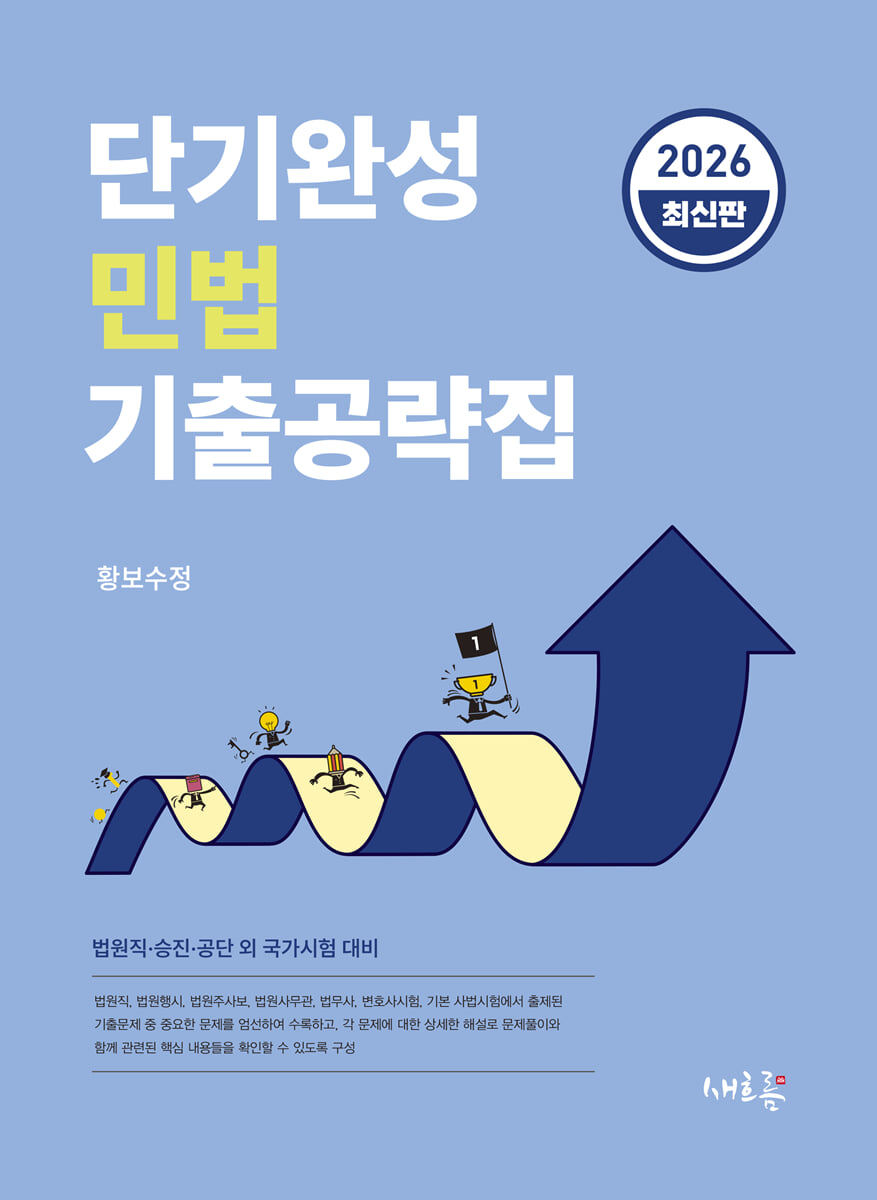
2026 Short-Term Civil Law Exam Study Guide
 |
Description
Book Introduction
This newly revised "Short-term Civil Law Practice Test Collection" is a practice test collection for preparing for national exams such as court positions, promotions, and public corporation exams. It contains carefully selected and explained past questions from all civil service and certification exams that use civil law as a subject, such as the court position exam, court administrative exam, court clerk exam, court clerk exam, judicial scrivener exam, and bar exam.
Not only will you be able to review the theories you've studied in the textbook and understand exam trends, but you'll also be able to proactively prepare for similar and new problems in real-world situations through detailed explanations.
Not only will you be able to review the theories you've studied in the textbook and understand exam trends, but you'll also be able to proactively prepare for similar and new problems in real-world situations through detailed explanations.
- You can preview some of the book's contents.
Preview
index
[Part 1 General Provisions of Civil Law]
CHAPTER 01 Introduction to Civil Law
Section 1. Significance of Civil Law
Section 2 Courts of the Civil Code
Section 3 Basic Principles of Civil Law
Section 4 Interpretation and Scope of Effect of the Civil Code
CHAPTER 02 General Rights
Section 1 Legal Relationships and Rights and Obligations
Section 2 Principle of Good Faith and Prohibition of Abuse of Rights
CHAPTER 03 Subject of Rights
Section 1 Introduction
Section 2 Natural Persons
Section 3 Corporations
CHAPTER 04 Objects of Rights
Section 1 Introduction
Section 2 Objects
Section 3 Real and Personal Property
Section 4: Main and secondary objects
Section 5: Raw materials and fruits
CHAPTER 05 Changes in Rights
Section 1 Introduction
Section 2 Legal Acts
Section 3 Period and Statute of Limitations
[Part 2 Property Law]
CHAPTER 01 General Theory of Property Law
Section 1 General Property Law
Section 2 Changes in Property Rights
Section 3 Extinction of Property Rights
CHAPTER 02 Basic Property Rights
Section 1 Right of possession
Section 2 Ownership
CHAPTER 03 Limited Real Rights
Section 1 Usufruct
Section 2 Security Interest
[Part 3: Law of Obligations]
CHAPTER 01 General Theory of Bond Law
Section 1 Introduction to the Law of Obligations
Section 2 Purpose of Bonds
Section 3 Effect of Bonds
Section 4. Number of creditors and debtors
Section 5 Transfer of claims and assumption of debts
Section 6 Extinction of Debt
CHAPTER 02 General Theory of Bond Law
Section 1 Contract Law
Section 2 Statutory Obligations Act
[Part 4 Family Law]
CHAPTER 01 General Theory
CHAPTER 02 RELATIONSHIPS
CHAPTER 03 MARRIAGE
CHAPTER 04 Parents and Children
CHAPTER 05 Inheritance
CHAPTER 06 The Will
CHAPTER 07 Oil reserves
CHAPTER 01 Introduction to Civil Law
Section 1. Significance of Civil Law
Section 2 Courts of the Civil Code
Section 3 Basic Principles of Civil Law
Section 4 Interpretation and Scope of Effect of the Civil Code
CHAPTER 02 General Rights
Section 1 Legal Relationships and Rights and Obligations
Section 2 Principle of Good Faith and Prohibition of Abuse of Rights
CHAPTER 03 Subject of Rights
Section 1 Introduction
Section 2 Natural Persons
Section 3 Corporations
CHAPTER 04 Objects of Rights
Section 1 Introduction
Section 2 Objects
Section 3 Real and Personal Property
Section 4: Main and secondary objects
Section 5: Raw materials and fruits
CHAPTER 05 Changes in Rights
Section 1 Introduction
Section 2 Legal Acts
Section 3 Period and Statute of Limitations
[Part 2 Property Law]
CHAPTER 01 General Theory of Property Law
Section 1 General Property Law
Section 2 Changes in Property Rights
Section 3 Extinction of Property Rights
CHAPTER 02 Basic Property Rights
Section 1 Right of possession
Section 2 Ownership
CHAPTER 03 Limited Real Rights
Section 1 Usufruct
Section 2 Security Interest
[Part 3: Law of Obligations]
CHAPTER 01 General Theory of Bond Law
Section 1 Introduction to the Law of Obligations
Section 2 Purpose of Bonds
Section 3 Effect of Bonds
Section 4. Number of creditors and debtors
Section 5 Transfer of claims and assumption of debts
Section 6 Extinction of Debt
CHAPTER 02 General Theory of Bond Law
Section 1 Contract Law
Section 2 Statutory Obligations Act
[Part 4 Family Law]
CHAPTER 01 General Theory
CHAPTER 02 RELATIONSHIPS
CHAPTER 03 MARRIAGE
CHAPTER 04 Parents and Children
CHAPTER 05 Inheritance
CHAPTER 06 The Will
CHAPTER 07 Oil reserves
Publisher's Review
preface
This book was created to provide accurate past exam questions and explanations to test takers preparing for civil law exams such as the Court Clerk Exam, the Bar Exam, the Judicial Scrivener Exam, and the Court Civil Service Exam, allowing them to anticipate trends in exam questions and the questions that will be on the exam next year.
I hope that through this collection of past exam questions, you will develop statistical thinking and ultimately develop the belief that "only what is expected will come out."
You need to find the killing points through past exam questions. Past exam questions do not only refer to the court clerk exam, but also include various exams such as the bar exam, judicial scrivener exam, existing bar exam, and administrative officer exam.
The most difficult questions are those in the bar exam and the attorney exam.
However, as you may have noticed in this year's exam, the issues that were not well-received in the court-related exams have already been tested in other civil law exams.
Also, it will be more helpful in the actual exam if you approach the previous exam questions in an integrated question format rather than a text format.
[Characteristics of this textbook]
1.
We have included all the important questions from the previous exams of the Court Clerk Examination, Court Civil Service Examination, Court Clerk Examination, Court Clerk Examination, the existing Bar Examination, Bar Examination, and Judicial Scrivener Examination, so that even case law texts that were not included at all in the Court Clerk Examination can feel like they were previously included in other exams.
2.
All the latest past exam questions, including the 2025 Court Clerk Examination and the 2024 and 2025 Judicial Scrivener Examinations, are included.
3.
As of October 2025, all case law required for the exam, including the revised case law of the full bench, has been included with commentary.
4.
I have provided commentary on the common parts of the exam by referring to the basic textbooks of Professors Jiwon Lim, Hyungbae Kim, and Junho Kim.
5.
We have included commentary on recently enacted and revised laws.
[Features of this revised edition]
We have deleted exam questions from various certification exams, such as the Certified Labor Attorney and Patent Attorney exams, that were included in the existing exam collection.
The court-related exams were also supplemented with new questions, excluding questions from before 2009.
Important past exam questions have been repeatedly included and reflected in new exam questions, so this comprehensively revised edition will provide sufficient preparation.
How to Use This Textbook
1.
When studying the basic civil law book, please keep it next to you and use it to determine the direction of the questions.
You will be able to understand the textbook more clearly.
2.
When reading the textbook and solving other problem books, please refer to this textbook first to understand the general framework of the questions.
3.
Please be sure to review this collection of past exam questions right before next year's exam.
In exams, things that always appear are repeated.
If you know this fact quickly, you can get a high score on the civil law exam next year.
4.
Students preparing for the bar exam are strongly encouraged to check out this collection of past exam questions, as well as the questions from next year's bar exam (scheduled for January).
What I want to tell you as you read this textbook is that we forget.
That's why you have to keep repeating it.
In the end, those who do not tire of repetition will eventually pass.
Passing is achieved when you feel as if you took the exam without taking it, thanks to this textbook.
I hope that through this textbook, you will be able to transform passive learning into active practice of the basics.
I hope that reading this textbook, listening to the lectures, and checking the importance will be helpful until the last moment of the exam.
As a civil service exam taker, always check to see if the path you are on is helpful at this very moment.
You should review past exam questions to see if you are vaguely indulging in the false sense of satisfaction that comes from quantity, or if you are neglecting the articles, legal principles, and precedents that you really need to know.
We know that miracles happen not because we believe in them, but because we believe in them.
And I firmly believe in the sequence in which wounds become flowers.
Please make it happen.
Dreams shine brighter when they come true.
I hope, even in my dreams, that you all pass the exam on the first try.
As I write this introduction, there are some people I would like to express my gratitude to.
I would like to express my sincere gratitude to Jinpyo, who always plays with his beloved mother; to our Supreme Team professors, who allow us to teach with joy and camaraderie; to Jong-eun Lee, CEO of Saehureum Publishing, who always advises me on how to produce good manuscripts and puts all his effort into publishing even late manuscripts; and to the editor-in-chief, who supplemented the commentary and put in all his effort.
October 23, 2025
Hwangbo Soo-jung
This book was created to provide accurate past exam questions and explanations to test takers preparing for civil law exams such as the Court Clerk Exam, the Bar Exam, the Judicial Scrivener Exam, and the Court Civil Service Exam, allowing them to anticipate trends in exam questions and the questions that will be on the exam next year.
I hope that through this collection of past exam questions, you will develop statistical thinking and ultimately develop the belief that "only what is expected will come out."
You need to find the killing points through past exam questions. Past exam questions do not only refer to the court clerk exam, but also include various exams such as the bar exam, judicial scrivener exam, existing bar exam, and administrative officer exam.
The most difficult questions are those in the bar exam and the attorney exam.
However, as you may have noticed in this year's exam, the issues that were not well-received in the court-related exams have already been tested in other civil law exams.
Also, it will be more helpful in the actual exam if you approach the previous exam questions in an integrated question format rather than a text format.
[Characteristics of this textbook]
1.
We have included all the important questions from the previous exams of the Court Clerk Examination, Court Civil Service Examination, Court Clerk Examination, Court Clerk Examination, the existing Bar Examination, Bar Examination, and Judicial Scrivener Examination, so that even case law texts that were not included at all in the Court Clerk Examination can feel like they were previously included in other exams.
2.
All the latest past exam questions, including the 2025 Court Clerk Examination and the 2024 and 2025 Judicial Scrivener Examinations, are included.
3.
As of October 2025, all case law required for the exam, including the revised case law of the full bench, has been included with commentary.
4.
I have provided commentary on the common parts of the exam by referring to the basic textbooks of Professors Jiwon Lim, Hyungbae Kim, and Junho Kim.
5.
We have included commentary on recently enacted and revised laws.
[Features of this revised edition]
We have deleted exam questions from various certification exams, such as the Certified Labor Attorney and Patent Attorney exams, that were included in the existing exam collection.
The court-related exams were also supplemented with new questions, excluding questions from before 2009.
Important past exam questions have been repeatedly included and reflected in new exam questions, so this comprehensively revised edition will provide sufficient preparation.
How to Use This Textbook
1.
When studying the basic civil law book, please keep it next to you and use it to determine the direction of the questions.
You will be able to understand the textbook more clearly.
2.
When reading the textbook and solving other problem books, please refer to this textbook first to understand the general framework of the questions.
3.
Please be sure to review this collection of past exam questions right before next year's exam.
In exams, things that always appear are repeated.
If you know this fact quickly, you can get a high score on the civil law exam next year.
4.
Students preparing for the bar exam are strongly encouraged to check out this collection of past exam questions, as well as the questions from next year's bar exam (scheduled for January).
What I want to tell you as you read this textbook is that we forget.
That's why you have to keep repeating it.
In the end, those who do not tire of repetition will eventually pass.
Passing is achieved when you feel as if you took the exam without taking it, thanks to this textbook.
I hope that through this textbook, you will be able to transform passive learning into active practice of the basics.
I hope that reading this textbook, listening to the lectures, and checking the importance will be helpful until the last moment of the exam.
As a civil service exam taker, always check to see if the path you are on is helpful at this very moment.
You should review past exam questions to see if you are vaguely indulging in the false sense of satisfaction that comes from quantity, or if you are neglecting the articles, legal principles, and precedents that you really need to know.
We know that miracles happen not because we believe in them, but because we believe in them.
And I firmly believe in the sequence in which wounds become flowers.
Please make it happen.
Dreams shine brighter when they come true.
I hope, even in my dreams, that you all pass the exam on the first try.
As I write this introduction, there are some people I would like to express my gratitude to.
I would like to express my sincere gratitude to Jinpyo, who always plays with his beloved mother; to our Supreme Team professors, who allow us to teach with joy and camaraderie; to Jong-eun Lee, CEO of Saehureum Publishing, who always advises me on how to produce good manuscripts and puts all his effort into publishing even late manuscripts; and to the editor-in-chief, who supplemented the commentary and put in all his effort.
October 23, 2025
Hwangbo Soo-jung
GOODS SPECIFICS
- Date of issue: November 18, 2025
- Page count, weight, size: 914 pages | 188*257*40mm
- ISBN13: 9791162937525
- ISBN10: 1162937521
You may also like
카테고리
korean


korean

![GQ KOREA Mark (Monthly): December [2025]](http://librairie.coreenne.fr/cdn/shop/files/8ef265dbbfbf186523ed75ba7319009d.jpg?v=1765340328&width=3840)


