

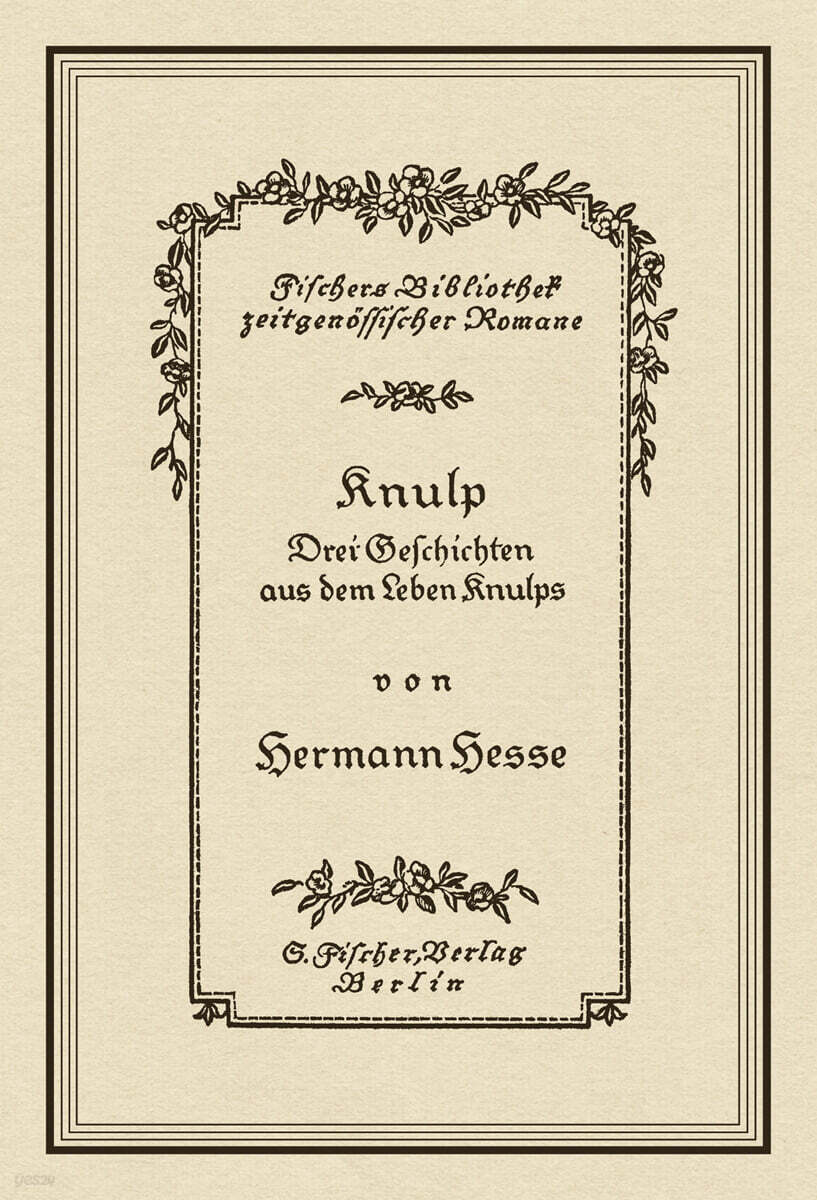
First edition Knulp
 |
Description
Book Introduction
'Love this friend Knulp just the way he is!
'Don't criticize or pity me, just look at me as a harmless and free life!'
Awakening the longing for freedom through the life of a lonely wanderer
"Knulp," a novel that questions a society that judges people solely on their abilities or incompetence.
A representative work of the mid-period of Hermann Hesse, the Nobel Prize-winning author of "Demian" and "The Glass Bead Game"
The protagonist, Knulp, drops out of school as a child, runs away from home, and wanders for a while before returning to his hometown.
Old friends, curious and saddened by the sudden disappearance of a model student who attended a prestigious Latin school, welcome Knulp's visit, still preserving his freedom and romance, but also trying to show off their stable jobs and families to him.
Knulp, too, refuses to bear the heavy burden of responsibility his friends shoulder, but sometimes feels miserable about his own life.
Moreover, death was now approaching him as the price for his 'free wandering'.
On a snowy mountain path, Knulp asks God what meaning his life has...
This is a lyrical and romantic novel depicting the life of a lonely wanderer, and it is a work that gives a glimpse into the young Hesse, who was deeply contemplating what kind of life he should live.
It took eight years to complete (My Recollections of Knulp in 1908, Early Spring in 1913, and The End in 1914) and was published in 1915 as Knulp with the subtitle “Three Stories from the Life of Knulp.”
It was the most popular work until the publication of "Demian", and although it contains philosophical content, it has the great charm of being read in a light and brisk manner.
The author contrasts the lives of ordinary people who have adapted to their daily lives with those of Knulp, a wanderer who lives in circles, unable to set foot in that world or to completely leave it, and poses a question to the reader.
Which life is better? Is Knulp a free man, or is he simply a loser in society, a wandering, sad person? The author doesn't take a position on which life is better or more correct.
However, he later wrote this in a letter to a reader (1935):
Even if he is not a 'useful' person, if he does not harm others, he should be able to find his 'place' in society. Instead of 'judging' him as weak and useless, just 'love' him.
'Don't criticize or pity me, just look at me as a harmless and free life!'
Awakening the longing for freedom through the life of a lonely wanderer
"Knulp," a novel that questions a society that judges people solely on their abilities or incompetence.
A representative work of the mid-period of Hermann Hesse, the Nobel Prize-winning author of "Demian" and "The Glass Bead Game"
The protagonist, Knulp, drops out of school as a child, runs away from home, and wanders for a while before returning to his hometown.
Old friends, curious and saddened by the sudden disappearance of a model student who attended a prestigious Latin school, welcome Knulp's visit, still preserving his freedom and romance, but also trying to show off their stable jobs and families to him.
Knulp, too, refuses to bear the heavy burden of responsibility his friends shoulder, but sometimes feels miserable about his own life.
Moreover, death was now approaching him as the price for his 'free wandering'.
On a snowy mountain path, Knulp asks God what meaning his life has...
This is a lyrical and romantic novel depicting the life of a lonely wanderer, and it is a work that gives a glimpse into the young Hesse, who was deeply contemplating what kind of life he should live.
It took eight years to complete (My Recollections of Knulp in 1908, Early Spring in 1913, and The End in 1914) and was published in 1915 as Knulp with the subtitle “Three Stories from the Life of Knulp.”
It was the most popular work until the publication of "Demian", and although it contains philosophical content, it has the great charm of being read in a light and brisk manner.
The author contrasts the lives of ordinary people who have adapted to their daily lives with those of Knulp, a wanderer who lives in circles, unable to set foot in that world or to completely leave it, and poses a question to the reader.
Which life is better? Is Knulp a free man, or is he simply a loser in society, a wandering, sad person? The author doesn't take a position on which life is better or more correct.
However, he later wrote this in a letter to a reader (1935):
Even if he is not a 'useful' person, if he does not harm others, he should be able to find his 'place' in society. Instead of 'judging' him as weak and useless, just 'love' him.
index
early spring
My recollections of Knulp
end
Commentary: Please love this friend, Knulp, just as he is!
About the life and works of Hermann Hesse
Hermann Hesse Chronology
My recollections of Knulp
end
Commentary: Please love this friend, Knulp, just as he is!
About the life and works of Hermann Hesse
Hermann Hesse Chronology
Into the book
This friend who wants to be nothing more than an observer in life.
Rotfuss couldn't tell whether to call it greed or humility.
In fact, someone who has worked hard and built a foundation will be better off in many ways.
But in return, you will never be able to have such soft and beautiful hands, nor walk with such light and refreshing steps.
--- pp.37-38 From "Early Spring"
“Everyone has a soul, and it cannot be confused with another person’s soul.
Two people can walk towards each other, talk together, and also sit close to each other.
But the two souls are like flowers, each rooted in its own place, so they cannot come close to each other.
If we want to get closer to each other, we have to leave our roots, and that is impossible.
Flowers can send their fragrance and seeds to others with their feelings, but it is not the flowers that can do this; it is the wind that makes sure the seeds go to the right place.
The wind can go wherever it wants to go.” -
-- p.92 From "My Recollections of Knulp"
The life documented in this official notebook was in fact a fabrication of Knulp's own making, and he had been precariously maintaining a fictional existence by employing hundreds of techniques to make it appear as if he had lived such a life.
(...) People accepted him with generosity and patience, just as a cute cat is accepted as a member of the family in a harmonious family home.
Just as a cat lives among people who are hard-working but have a hard life, he lives like a gentleman, acting with dignity and carefree elegance, without doing anything.
--- pp.19-20 From "Early Spring"
I felt a little inclined to despise the words of the leatherman Lotfus, who had been quite boastful about the happiness of home and marriage.
He thought that no matter how loudly someone boasted about their happiness or virtue, it was usually not true.
The same was true of the religious beliefs that the tailor shop owner once had.
You may be able to laugh or sympathize with other people's foolish actions.
However, we must not interfere with each other's path and leave it as it is.
--- p.60 From “Early Spring”
“When I see fireworks in the night sky, I think there is nothing more beautiful than that.
It's the sight of blue and green fireworks shooting up into the air in the dark of the night, just as they are at their most beautiful, they quickly disappear in a small parabola.
When I see something like that, I feel happy but also anxious at the same time.
Because joy and anxiety go hand in hand, they feel more beautiful when they are fleeting rather than lasting.
Isn't that so?" (…)
I didn't know what to add.
At the time, I had not yet experienced the pain that was hidden in any human relationship.
Moreover, it was a time when I had never experienced that no matter how intimate a relationship people had with each other, there was always an abyss between them, and that only affection, and that only through an emergency bridge at every moment, could cross that gap.
--- p.81 From “My Recollections of Knulp”
“It’s not worth thinking about it carefully.
Because people don't act the way they think.
In fact, I don't think deeply about it at all and just go my own way step by step, just as my heart desires.
Friendship and love will be like that too.
“In the end, each person has his own world for himself and cannot share it with others.”
--- p.83 From “My Recollections of Knulp”
“What I’m saying is, if I find something that I believe to be true, I will follow it too.”
"Yes, that's true! But the truth is, even if you discovered a single piece of wisdom every day, you'd discard it the next day and never consider it wisdom again."
--- p.96 From “My Recollections of Knulp”
"Why didn't I learn anything from all that and become a more genuine human being? I had plenty of time to do so." (…)
"What's the use of lamenting? Don't you really see that everything was just right, and that nothing could have been otherwise? Wouldn't you like to be a respectable gentleman by now, a factory owner, with a wife and children, leisurely reading the weekly newspaper in the evenings? Even if you were, wouldn't you be right back in the woods, sleeping with foxes, setting bird traps, or taming lizards?
Look! I needed you just the way you were.
In my name you have wandered, and each time you have awakened in those who have settled down a little the longing for 'freedom'.
In my name you have done foolish things and become a laughing stock to people.
In other words, I myself am both a laughing stock and a loved one within you.
So you are my son, my brother, and my alter ego.
“Everything you have tasted and experienced, I was with you, within you.”
Rotfuss couldn't tell whether to call it greed or humility.
In fact, someone who has worked hard and built a foundation will be better off in many ways.
But in return, you will never be able to have such soft and beautiful hands, nor walk with such light and refreshing steps.
--- pp.37-38 From "Early Spring"
“Everyone has a soul, and it cannot be confused with another person’s soul.
Two people can walk towards each other, talk together, and also sit close to each other.
But the two souls are like flowers, each rooted in its own place, so they cannot come close to each other.
If we want to get closer to each other, we have to leave our roots, and that is impossible.
Flowers can send their fragrance and seeds to others with their feelings, but it is not the flowers that can do this; it is the wind that makes sure the seeds go to the right place.
The wind can go wherever it wants to go.” -
-- p.92 From "My Recollections of Knulp"
The life documented in this official notebook was in fact a fabrication of Knulp's own making, and he had been precariously maintaining a fictional existence by employing hundreds of techniques to make it appear as if he had lived such a life.
(...) People accepted him with generosity and patience, just as a cute cat is accepted as a member of the family in a harmonious family home.
Just as a cat lives among people who are hard-working but have a hard life, he lives like a gentleman, acting with dignity and carefree elegance, without doing anything.
--- pp.19-20 From "Early Spring"
I felt a little inclined to despise the words of the leatherman Lotfus, who had been quite boastful about the happiness of home and marriage.
He thought that no matter how loudly someone boasted about their happiness or virtue, it was usually not true.
The same was true of the religious beliefs that the tailor shop owner once had.
You may be able to laugh or sympathize with other people's foolish actions.
However, we must not interfere with each other's path and leave it as it is.
--- p.60 From “Early Spring”
“When I see fireworks in the night sky, I think there is nothing more beautiful than that.
It's the sight of blue and green fireworks shooting up into the air in the dark of the night, just as they are at their most beautiful, they quickly disappear in a small parabola.
When I see something like that, I feel happy but also anxious at the same time.
Because joy and anxiety go hand in hand, they feel more beautiful when they are fleeting rather than lasting.
Isn't that so?" (…)
I didn't know what to add.
At the time, I had not yet experienced the pain that was hidden in any human relationship.
Moreover, it was a time when I had never experienced that no matter how intimate a relationship people had with each other, there was always an abyss between them, and that only affection, and that only through an emergency bridge at every moment, could cross that gap.
--- p.81 From “My Recollections of Knulp”
“It’s not worth thinking about it carefully.
Because people don't act the way they think.
In fact, I don't think deeply about it at all and just go my own way step by step, just as my heart desires.
Friendship and love will be like that too.
“In the end, each person has his own world for himself and cannot share it with others.”
--- p.83 From “My Recollections of Knulp”
“What I’m saying is, if I find something that I believe to be true, I will follow it too.”
"Yes, that's true! But the truth is, even if you discovered a single piece of wisdom every day, you'd discard it the next day and never consider it wisdom again."
--- p.96 From “My Recollections of Knulp”
"Why didn't I learn anything from all that and become a more genuine human being? I had plenty of time to do so." (…)
"What's the use of lamenting? Don't you really see that everything was just right, and that nothing could have been otherwise? Wouldn't you like to be a respectable gentleman by now, a factory owner, with a wife and children, leisurely reading the weekly newspaper in the evenings? Even if you were, wouldn't you be right back in the woods, sleeping with foxes, setting bird traps, or taming lizards?
Look! I needed you just the way you were.
In my name you have wandered, and each time you have awakened in those who have settled down a little the longing for 'freedom'.
In my name you have done foolish things and become a laughing stock to people.
In other words, I myself am both a laughing stock and a loved one within you.
So you are my son, my brother, and my alter ego.
“Everything you have tasted and experienced, I was with you, within you.”
--- pp.155-156 from "The Bell"
GOODS SPECIFICS
- Date of issue: March 28, 2025
- Page count, weight, size: 196 pages | 128*188*20mm
- ISBN13: 9791194591412
- ISBN10: 1194591418
You may also like
카테고리
korean


korean

![GQ KOREA Mark (Monthly): December [2025]](http://librairie.coreenne.fr/cdn/shop/files/8ef265dbbfbf186523ed75ba7319009d.jpg?v=1765340328&width=3840)


