

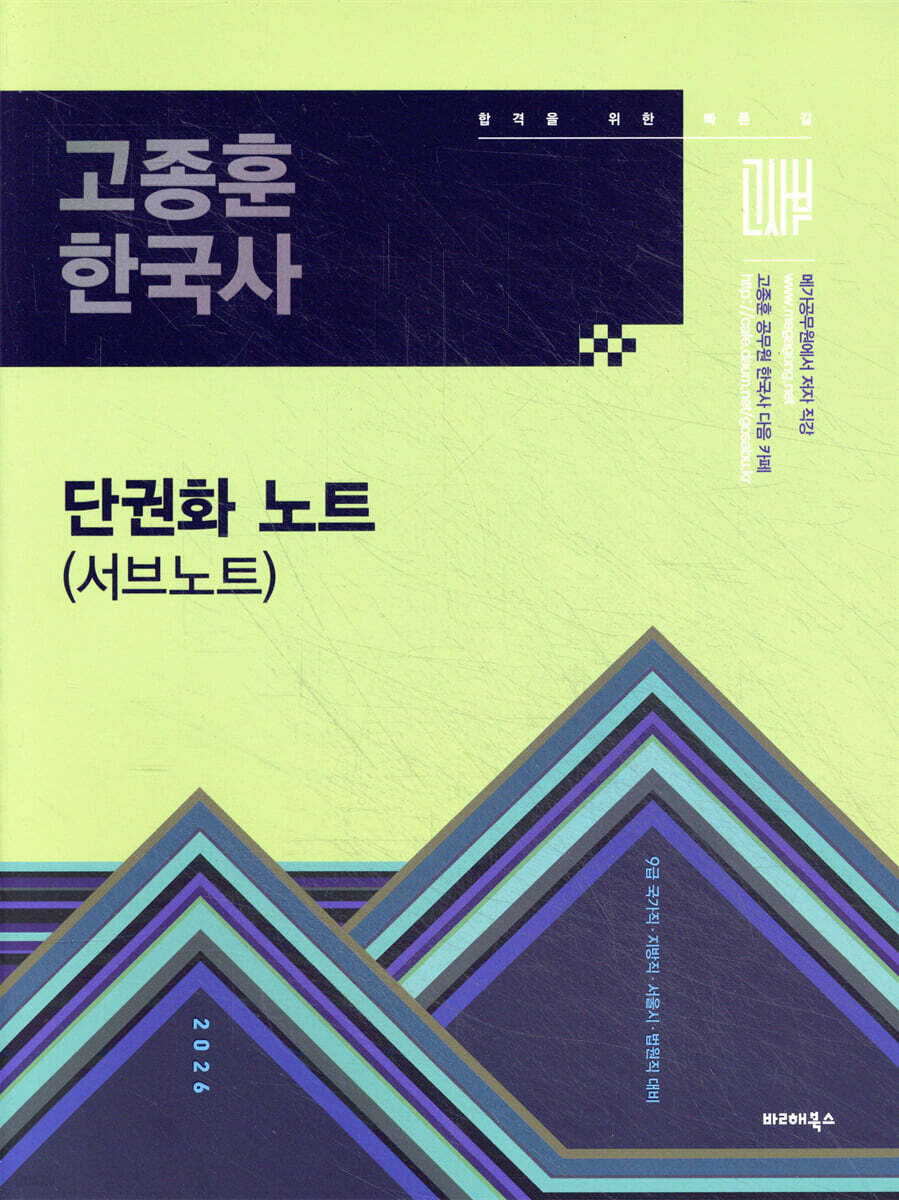
2026 Go Jong-hoon's Korean History Single-Volume Notes (Sub-Notes)
 |
Description
Book Introduction
This book is a “single-volume notebook” that complements the descriptive basic textbook.
It is used as a supplementary textbook in the concept section (2800 minutes) lecture, and as the main textbook in the super-speed concept section (1600 minutes) and final compression theory (800 minutes) lectures.
It is used as a supplementary textbook in the concept section (2800 minutes) lecture, and as the main textbook in the super-speed concept section (1600 minutes) and final compression theory (800 minutes) lectures.
- You can preview some of the book's contents.
Preview
index
Ⅰ.
Gojoseon and the Early States......4
Ⅱ.
Ancient Korean history...........14
Ⅲ.
Korean medieval history...........42
Ⅳ.
Early modern times.............68
V.
Late modern times.............96
Ⅵ.
Modern Korean History..........124
Ⅶ.
History of the Independence Movement..........150
Ⅷ.
Modern Korean History..........176
Appendix...................196
Gojoseon and the Early States......4
Ⅱ.
Ancient Korean history...........14
Ⅲ.
Korean medieval history...........42
Ⅳ.
Early modern times.............68
V.
Late modern times.............96
Ⅵ.
Modern Korean History..........124
Ⅶ.
History of the Independence Movement..........150
Ⅷ.
Modern Korean History..........176
Appendix...................196
Publisher's Review
Korean history has a range of questions.
Unlike the Korean and English subjects, the Korean history test has a scope.
If we analyze the recent civil service exam (grade 9, court) Korean history test, 99% of the questions are based on high school Korean history.
If you study only the high school Korean history section thoroughly, you can easily secure a score of 95-100 on the 9th grade and the court exam.
Also, the number of problems that require presenting research materials (sources, maps, photographs, tables) is gradually increasing.
Rather than knowledge-based questions requiring simple memorization, questions that ask whether the student has a clear understanding of the concept are the mainstream.
Unlike Korean or English language subjects, Korean history is a subject that you gradually become familiar with by establishing a theoretical framework, repeating it, and solving problems.
You must study the high school Korean history curriculum thoroughly and repeatedly.
In the process, you can solve past exam questions from the past 4-5 years, and if you have repeated them enough, you can raise your sense of the actual exam through modified past exam questions or mock exams.
The moment you broaden your scope to catch the rare perfect score prevention questions, test takers will lose their bearings and start wandering.
This book will serve as a guide for students studying Korean history for various public exams.
Textbooks designed for listening to lectures
This book is a “single-volume notebook” that complements the descriptive basic textbook.
It is used as a supplementary textbook in the concept section (2800 minutes) lecture, and as the main textbook in the super-speed concept section (1600 minutes) and final compression theory (800 minutes) lectures.
The super-speed concept and final compression theorem clearly demonstrate the highest value pursued by our lab: 'suitability for exams.'
I sincerely hope that many people will use this book to obtain the "maximum benefit per hour" from various public Korean history exams.
Unlike the Korean and English subjects, the Korean history test has a scope.
If we analyze the recent civil service exam (grade 9, court) Korean history test, 99% of the questions are based on high school Korean history.
If you study only the high school Korean history section thoroughly, you can easily secure a score of 95-100 on the 9th grade and the court exam.
Also, the number of problems that require presenting research materials (sources, maps, photographs, tables) is gradually increasing.
Rather than knowledge-based questions requiring simple memorization, questions that ask whether the student has a clear understanding of the concept are the mainstream.
Unlike Korean or English language subjects, Korean history is a subject that you gradually become familiar with by establishing a theoretical framework, repeating it, and solving problems.
You must study the high school Korean history curriculum thoroughly and repeatedly.
In the process, you can solve past exam questions from the past 4-5 years, and if you have repeated them enough, you can raise your sense of the actual exam through modified past exam questions or mock exams.
The moment you broaden your scope to catch the rare perfect score prevention questions, test takers will lose their bearings and start wandering.
This book will serve as a guide for students studying Korean history for various public exams.
Textbooks designed for listening to lectures
This book is a “single-volume notebook” that complements the descriptive basic textbook.
It is used as a supplementary textbook in the concept section (2800 minutes) lecture, and as the main textbook in the super-speed concept section (1600 minutes) and final compression theory (800 minutes) lectures.
The super-speed concept and final compression theorem clearly demonstrate the highest value pursued by our lab: 'suitability for exams.'
I sincerely hope that many people will use this book to obtain the "maximum benefit per hour" from various public Korean history exams.
GOODS SPECIFICS
- Date of issue: July 7, 2025
- Page count, weight, size: 200 pages | 192*258*20mm
- ISBN13: 9791161012520
- ISBN10: 1161012524
You may also like
카테고리
korean


korean

![GQ KOREA Mark (Monthly): December [2025]](http://librairie.coreenne.fr/cdn/shop/files/8ef265dbbfbf186523ed75ba7319009d.jpg?v=1765340328&width=3840)


