

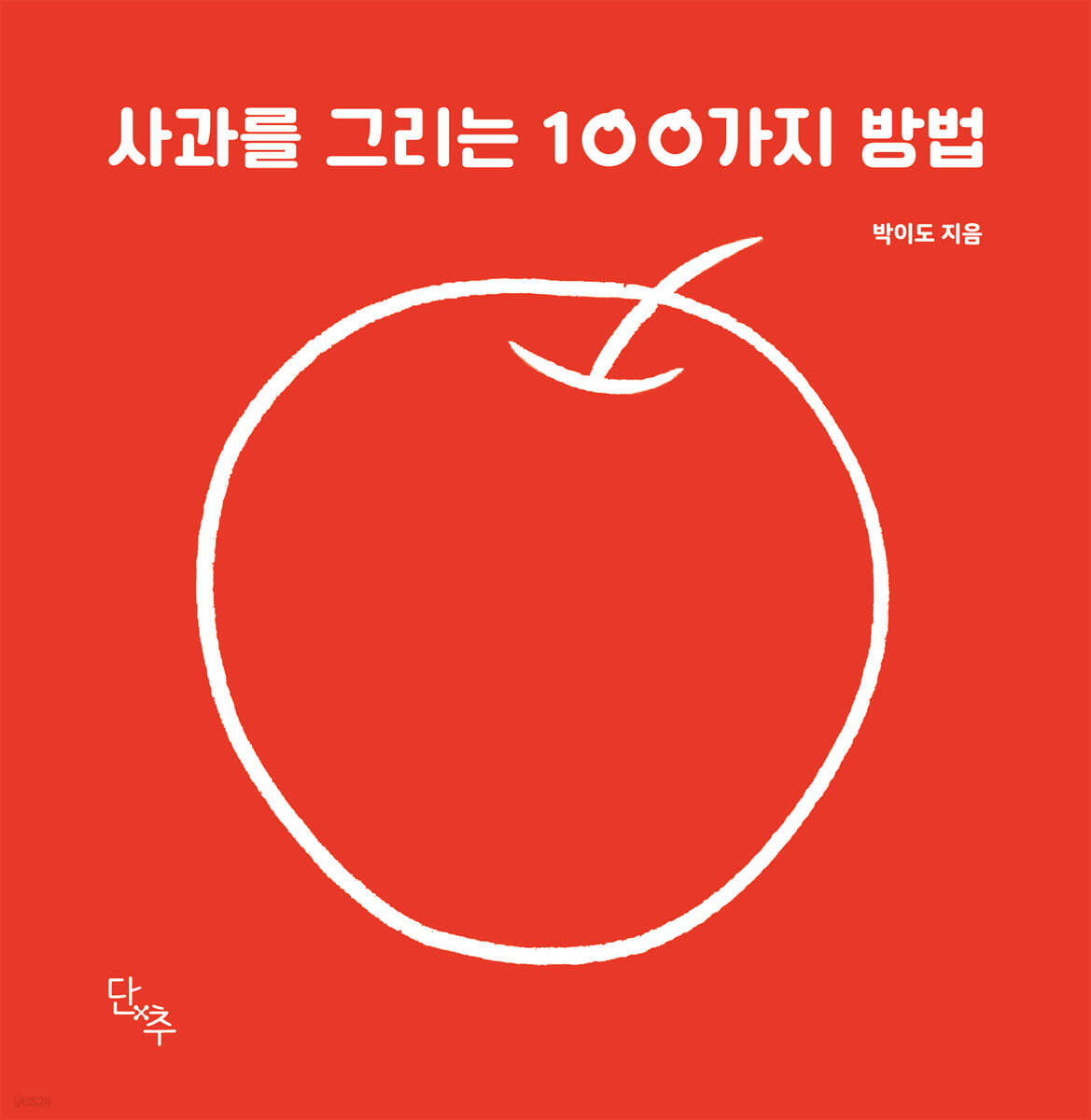
100 Ways to Draw an Apple
 |
Description
Book Introduction
This is a picture book that helps children break out of the frame of drawing and express themselves creatively and freely.
Children who enjoyed drawing in their early years often lose confidence when they reach the age of 7 to 9 as they compare themselves to and evaluate their friends.
This book explores various techniques and approaches using the familiar apple as a subject for such children, helping them rediscover the joy of seeing and expressing the world through their own perspectives through the process of transforming points, lines, colors, shapes, structures, and stories.
We talk about how to draw, but paradoxically, we convey that there is no one way (correct answer) to drawing.
Children who enjoyed drawing in their early years often lose confidence when they reach the age of 7 to 9 as they compare themselves to and evaluate their friends.
This book explores various techniques and approaches using the familiar apple as a subject for such children, helping them rediscover the joy of seeing and expressing the world through their own perspectives through the process of transforming points, lines, colors, shapes, structures, and stories.
We talk about how to draw, but paradoxically, we convey that there is no one way (correct answer) to drawing.
- You can preview some of the book's contents.
Preview
Detailed image

Publisher's Review
Why do children stop drawing?
The first thing that inspired author Park I-do to write this book was a student's words.
At a special lecture held at an art museum, a middle school student spoke cautiously.
“I’m sorry I can’t draw well.” The moment he heard those words, the artist fell into deep thought.
Why do we have to apologize for drawing ourselves? Since when did "drawing" become an object of evaluation rather than a form of free expression?
When we are young, everyone draws freely.
But as time goes by, 'comparison' and 'evaluation' begin, and children find drawing increasingly difficult and eventually give up.
The moment you become conscious of other people's gaze, the joy of drawing disappears.
But does drawing necessarily have to be "good"? Isn't it more important to freely express yourself through your own unique perspective and sensibility? Artist Park I-do wrote this book in the hopes that children will feel comfortable drawing again, and that they will have the courage to create their own art, not according to the standards of others.
To draw, to express
《100 Ways to Draw an Apple》 is the first picture book by contemporary artist Park I-do.
Designed for my daughter and all children who love to draw, this book begins with the question, “Why do we always draw the same apple?”
Using the simple and familiar apple as a subject, he explores new perspectives by changing the lines, transforming the composition, adding color, and deconstructing the shape.
This is not just an art book, but also an experiment in freedom of expression and self-discovery.
Artist Park I-do says, “When I was young and my emotions were overflowing, I comforted myself by drawing.”
Painting is a tool for expressing joy and sadness, anger and excitement, and a process of building one's own world.
This book will serve as a guide to help all children freely express their feelings and thoughts.
Infinite possibilities in the simple form of an apple
Apples have been an important subject in art history.
Many painters, including Paul Cézanne and René Magritte, experimented with their own artistic language using apples.
Artist Park I-do encourages children to experiment with various ideas through the simple form of an apple.
Overlapping apples, halved apples, floating apples, apples drawn with dots, apples expressed only with lines… Through various experiments, children discover ‘their own way of expressing themselves’ rather than ‘drawing well.’
This book does not impose any particular art technique.
Rather, I want to say that although we are talking about “how to draw an apple,” paradoxically, there is no way to draw it.
“I hope you can find your own way and express yourself freely in any way you want,” he said.
Rather than simply a drawing book, it is designed to allow children to enjoy the process of exploring and discovering on their own.
100 meanings, the process of filling them in
Although the title of the book includes the number "100," the book is not actually filled with 100 methods.
And there's no need to do that.
The number '100' does not represent a complete answer, but rather symbolizes endlessly expanding possibilities.
The last page of this book is open.
Readers will begin to draw in their own way by following the methods in the book.
Ultimately, it is the readers who complete this book.
Anyone can draw.
《100 Ways to Draw an Apple》 is not just a book for children.
It can also be a great introductory book for adults who want to start drawing but lack the courage.
Through this book, we once again realize that it is not important to draw 'well' but to draw 'in your own way'.
You don't have to read the book from beginning to end.
Just open the page you like and draw an apple as soon as it comes to mind.
Everyone, adults and children alike, can express themselves in their own way.
Painting is not just for those with special talent.
I hope that through this book, more people will be able to enjoy painting again.
The first thing that inspired author Park I-do to write this book was a student's words.
At a special lecture held at an art museum, a middle school student spoke cautiously.
“I’m sorry I can’t draw well.” The moment he heard those words, the artist fell into deep thought.
Why do we have to apologize for drawing ourselves? Since when did "drawing" become an object of evaluation rather than a form of free expression?
When we are young, everyone draws freely.
But as time goes by, 'comparison' and 'evaluation' begin, and children find drawing increasingly difficult and eventually give up.
The moment you become conscious of other people's gaze, the joy of drawing disappears.
But does drawing necessarily have to be "good"? Isn't it more important to freely express yourself through your own unique perspective and sensibility? Artist Park I-do wrote this book in the hopes that children will feel comfortable drawing again, and that they will have the courage to create their own art, not according to the standards of others.
To draw, to express
《100 Ways to Draw an Apple》 is the first picture book by contemporary artist Park I-do.
Designed for my daughter and all children who love to draw, this book begins with the question, “Why do we always draw the same apple?”
Using the simple and familiar apple as a subject, he explores new perspectives by changing the lines, transforming the composition, adding color, and deconstructing the shape.
This is not just an art book, but also an experiment in freedom of expression and self-discovery.
Artist Park I-do says, “When I was young and my emotions were overflowing, I comforted myself by drawing.”
Painting is a tool for expressing joy and sadness, anger and excitement, and a process of building one's own world.
This book will serve as a guide to help all children freely express their feelings and thoughts.
Infinite possibilities in the simple form of an apple
Apples have been an important subject in art history.
Many painters, including Paul Cézanne and René Magritte, experimented with their own artistic language using apples.
Artist Park I-do encourages children to experiment with various ideas through the simple form of an apple.
Overlapping apples, halved apples, floating apples, apples drawn with dots, apples expressed only with lines… Through various experiments, children discover ‘their own way of expressing themselves’ rather than ‘drawing well.’
This book does not impose any particular art technique.
Rather, I want to say that although we are talking about “how to draw an apple,” paradoxically, there is no way to draw it.
“I hope you can find your own way and express yourself freely in any way you want,” he said.
Rather than simply a drawing book, it is designed to allow children to enjoy the process of exploring and discovering on their own.
100 meanings, the process of filling them in
Although the title of the book includes the number "100," the book is not actually filled with 100 methods.
And there's no need to do that.
The number '100' does not represent a complete answer, but rather symbolizes endlessly expanding possibilities.
The last page of this book is open.
Readers will begin to draw in their own way by following the methods in the book.
Ultimately, it is the readers who complete this book.
Anyone can draw.
《100 Ways to Draw an Apple》 is not just a book for children.
It can also be a great introductory book for adults who want to start drawing but lack the courage.
Through this book, we once again realize that it is not important to draw 'well' but to draw 'in your own way'.
You don't have to read the book from beginning to end.
Just open the page you like and draw an apple as soon as it comes to mind.
Everyone, adults and children alike, can express themselves in their own way.
Painting is not just for those with special talent.
I hope that through this book, more people will be able to enjoy painting again.
GOODS SPECIFICS
- Date of issue: January 31, 2025
- Format: Hardcover book binding method guide
- Page count, weight, size: 104 pages | 404g | 178*188*15mm
- ISBN13: 9791189723422
- KC Certification: Certification Type: Conformity Confirmation
You may also like
카테고리
korean


korean

![GQ KOREA Mark (Monthly): December [2025]](http://librairie.coreenne.fr/cdn/shop/files/8ef265dbbfbf186523ed75ba7319009d.jpg?v=1765340328&width=3840)


