

Harmonious life
 |
Description
Book Introduction
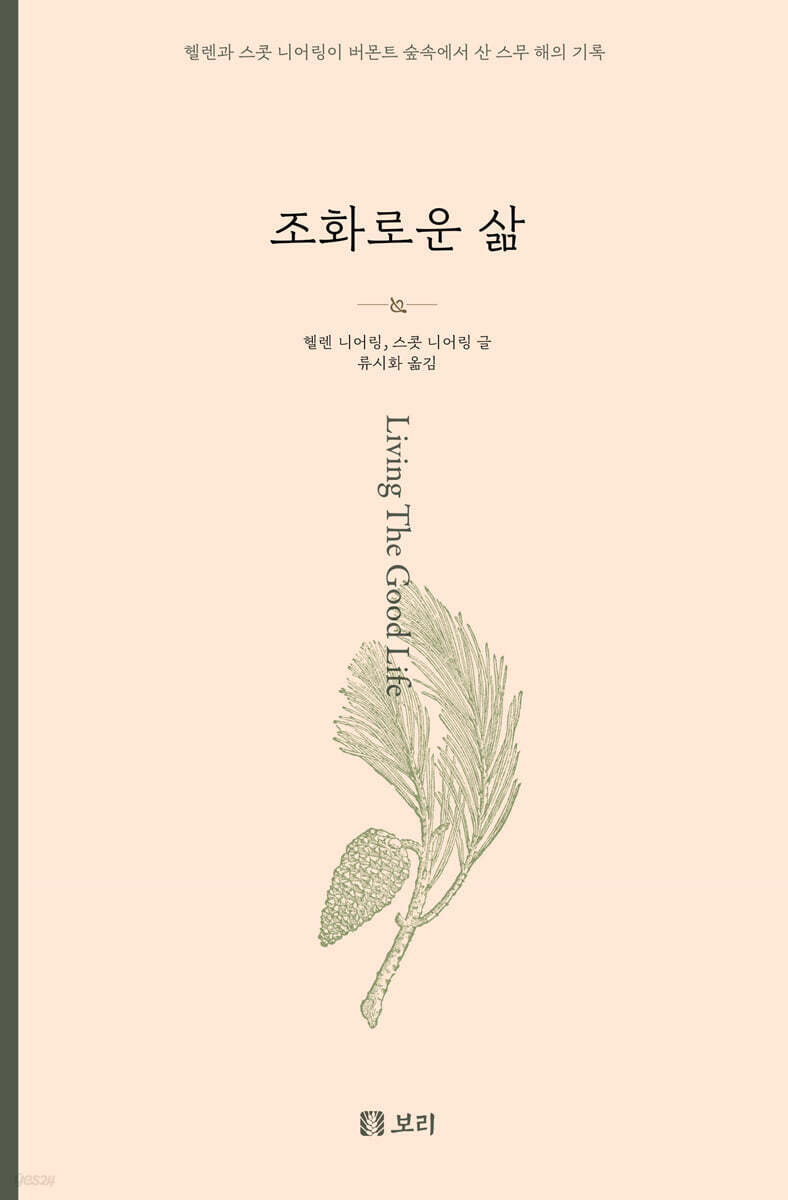
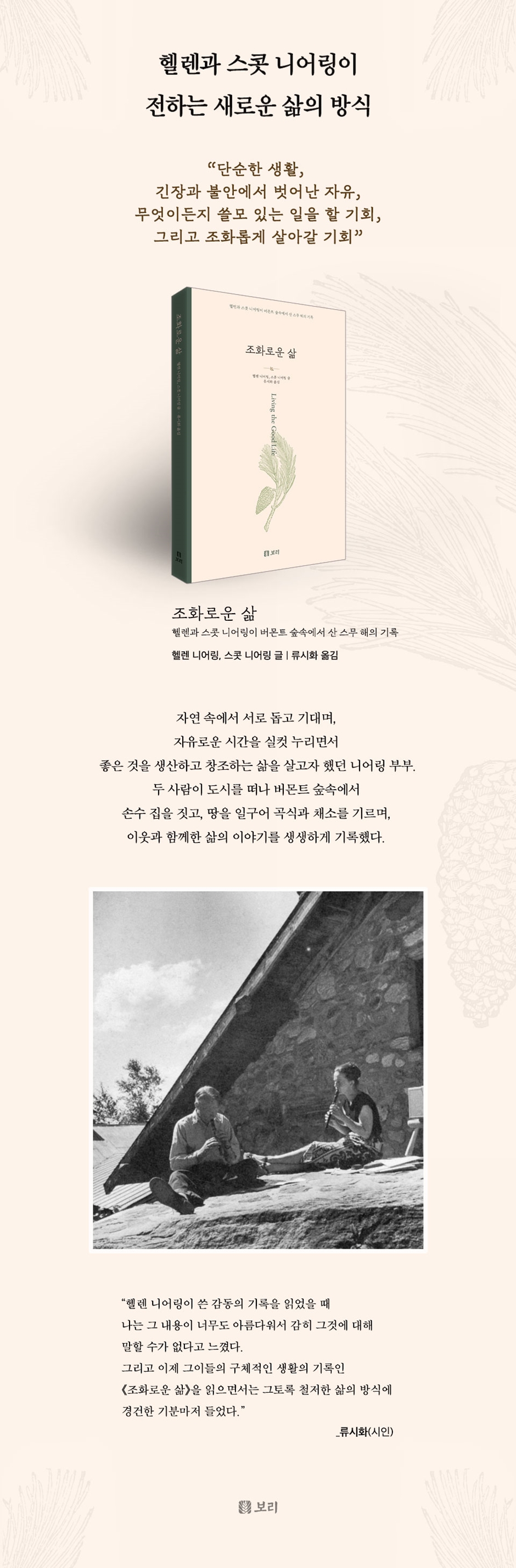
To mark the 40th anniversary of Scott Nearing's death, a revised edition of "The Harmonious Life" has been published. Helen and Scott Nearing leave New York for a rural Vermont village, believing that Western civilization offers no one a safe life. The Nearing couple wanted to live a life where they could help and rely on each other in nature, enjoy free time to the fullest, and each produce and create good things. This book chronicles the twenty years spent in Vermont by two people who worked hard to achieve their life goals. In "Beautiful Life, Love, and the End," you can vividly experience the story of two people building a stone house with their own hands, cultivating crops, and living with their neighbors, which you have never seen before. |
- You can preview some of the book's contents.
Preview
index
Preface 4
In Search of a Harmonious Life 13
Principle 33 of Life
Building a House 69
Farming 101
What to Eat 129
Housekeeping 169
People Living Together 185
What Vermont Did and Didn't Do 217
Helen Nearing's Words 240
Translator's Note 242
Translator's Note 245
In Search of a Harmonious Life 13
Principle 33 of Life
Building a House 69
Farming 101
What to Eat 129
Housekeeping 169
People Living Together 185
What Vermont Did and Didn't Do 217
Helen Nearing's Words 240
Translator's Note 242
Translator's Note 245
Detailed image
Into the book
Simplicity, quiet living, worthwhile work, and harmony are not just values of life.
However, it is an important ideal and goal that anyone who wants to live a harmonious life should naturally pursue in a satisfactory natural and social environment.
--- p.17
The purpose of our economic activities is not to make money, but to make a living.
You can't eat money, you can't wear money, you can't sleep with money.
Money is merely a medium of exchange.
It is a medium for obtaining the necessities of life.
What matters is what we eat, drink, and wear, not the money we can exchange for it.
And like anything else, there's a price to pay for getting money.
--- p.36
We can say clearly:
If we eat what comes from nature and eat only a little of one food, there is almost nothing left for the housewife to do.
Eat vegetables and fruits, but eat them as they are, grown in nature, with the freshness of the field, and stick to the principle of eating only one or two of them at a time.
Then you too will agree with our argument that eating simply is good.
--- pp.160~161
This eating habit is simple, inexpensive, and helpful for your lifestyle.
Of course, modern people in the 20th century don't usually eat like this.
As civilization has developed, many things have changed, and the way people eat has also completely changed.
We have moved from a time when we obtained the necessities of life from the mountains, fields, kitchens, and family members to an era where everything is obtained through factories and large corporations.
We brought the center axis back to the ground.
We got food from the land and ate it.
I also found that the food was plentiful, delicious, and nutritious.
We didn't pay any doctor because we maintained good health by eating this kind of food.
--- p.166
The market economy uses loud propaganda to lure consumers into buying things they neither need nor want.
And they force people to sell their labor to buy these things.
Since our goal was to escape the exploitation that comes with selling our labor, we were as careful not to fall into the temptations of the market as a wise rat is careful not to fall into a trap.
--- p.175
This experience has reminded us that to successfully build a collaborative community, we must first achieve a common ground of spirit.
Agreeing on the purpose and method is not enough.
But even this was not done properly in our valley.
For a community to continue to work together, there must be a shared spirit of acceptance among all its members.
--- p.205
We definitely enjoyed life in Vermont.
Because living in Vermont, I was always in contact with nature, knew the power of nature well and was able to adapt to it, still worked with my hands, and was not dragged into a life of strict discipline.
--- p.218
What makes life abundant is not possessions and accumulation, but hope and effort.
Because we think this way, even if there is no chance of success, we will try to find a way not only for the two of us to make a living, but also for society as a whole to live well together.
However, it is an important ideal and goal that anyone who wants to live a harmonious life should naturally pursue in a satisfactory natural and social environment.
--- p.17
The purpose of our economic activities is not to make money, but to make a living.
You can't eat money, you can't wear money, you can't sleep with money.
Money is merely a medium of exchange.
It is a medium for obtaining the necessities of life.
What matters is what we eat, drink, and wear, not the money we can exchange for it.
And like anything else, there's a price to pay for getting money.
--- p.36
We can say clearly:
If we eat what comes from nature and eat only a little of one food, there is almost nothing left for the housewife to do.
Eat vegetables and fruits, but eat them as they are, grown in nature, with the freshness of the field, and stick to the principle of eating only one or two of them at a time.
Then you too will agree with our argument that eating simply is good.
--- pp.160~161
This eating habit is simple, inexpensive, and helpful for your lifestyle.
Of course, modern people in the 20th century don't usually eat like this.
As civilization has developed, many things have changed, and the way people eat has also completely changed.
We have moved from a time when we obtained the necessities of life from the mountains, fields, kitchens, and family members to an era where everything is obtained through factories and large corporations.
We brought the center axis back to the ground.
We got food from the land and ate it.
I also found that the food was plentiful, delicious, and nutritious.
We didn't pay any doctor because we maintained good health by eating this kind of food.
--- p.166
The market economy uses loud propaganda to lure consumers into buying things they neither need nor want.
And they force people to sell their labor to buy these things.
Since our goal was to escape the exploitation that comes with selling our labor, we were as careful not to fall into the temptations of the market as a wise rat is careful not to fall into a trap.
--- p.175
This experience has reminded us that to successfully build a collaborative community, we must first achieve a common ground of spirit.
Agreeing on the purpose and method is not enough.
But even this was not done properly in our valley.
For a community to continue to work together, there must be a shared spirit of acceptance among all its members.
--- p.205
We definitely enjoyed life in Vermont.
Because living in Vermont, I was always in contact with nature, knew the power of nature well and was able to adapt to it, still worked with my hands, and was not dragged into a life of strict discipline.
--- p.218
What makes life abundant is not possessions and accumulation, but hope and effort.
Because we think this way, even if there is no chance of success, we will try to find a way not only for the two of us to make a living, but also for society as a whole to live well together.
--- p.237
Publisher's Review
A bestseller that has been consistently loved for over half a century,
A revised edition is published 23 years after Scott Nearing's death to mark his 40th anniversary.
First published in 1954, "The Harmonious Life," which has resonated deeply with people around the world for over half a century, has been republished in a revised edition to commemorate the 40th anniversary of Scott Nearing's death.
In this revised edition, you can find a new translator's note from author Ryu Si-hwa, delivered for the first time in twenty-three years.
Scott and Helen Nearing, practical naturalists, vegetarians, environmentalists, pacifists, and farming activists.
In 1932, at the height of the Great Depression, the two men, convinced that Western civilization could not guarantee a safe life for anyone, abandoned their New York life and moved to a rural village in the Vermont woods.
The Nearings sought to overcome the pressures of society and maintain their physical health, mental stability, and sanity within society.
All they wanted was to put down roots and live a simple, satisfying life.
As time passes and experience grows, the Nearings develop principles and goals to uphold.
This book is a kind of report on the life they chose: 'a life where we help and rely on each other in nature, enjoy free time to the fullest, and each produce and create good things.'
The Nearings, who resisted materialism and lived in harmony with nature.
The principles of harmonious life they preach
Helen Nearing, who was born into a wealthy family and once interacted with the world-renowned thinker Jiddu Krishnamurti.
Scott Nearing, a former university professor born to a capitalist family, grew up with a deep interest in the lives of the poor.
The meeting between the two people was eye-catching in itself.
But what made their lives last longer in the world's memories was the twenty years they spent in Vermont, the setting of this book.
The Nearings dreamed of a life outside the capitalist society that fosters competition, greed, exploitation, and coercion.
They had three goals in mind when they left the city.
First, build an independent economy so that you can live a life free from recession.
Second, living off the land, growing your own food, and maintaining a healthy life.
Third, live righteously, thinking of society, and escaping from various terrible exploitations.
In the Vermont forests, they till the land, build stone houses, and live a simple life without owing anyone anything.
Unlike the city, he insisted on a quiet and simple life without a telephone or radio.
But he did not live an isolated life.
They always thought about working for society in that space and tried to live by the principles of life that they considered most important.
Six months of the year were spent working to make a living, and the remaining six months were spent enjoying leisure activities such as research, travel, writing, conversation, and lectures.
And they always treated people who came to visit them as an open space.
The couple lived a fulfilling life, living steadfastly and joyfully, adhering to the principle that "life should be fulfilling."
In this book, the life of the Nearings has a powerful impact on people living busy lives in the city today.
By abandoning the city life of success and advancement, and following their path of "having less but being more faithful" and contributing to the world, you will discover the value of a "harmonious life."
A way of life that allows one to live in harmony with nature, self-sufficiency, and unity.
While "Beautiful Life, Love, and the End" focused on the lives and love of Scott and Helen, "A Harmonious Life" details the lives and adventures of two people who created a village community in Vermont.
The Nearings take care of their own food, clothing, and shelter to ensure their lives are not shaken by the recession and unemployment.
Vermont, with its distinct seasons and pristine nature, was ideal for realizing this alternative, and the valley became the Nearings' laboratory.
The Nearings' purpose in working in Vermont was not to make money, but to make a living.
In a capitalist society, they presented a new way of life without saving money.
They did not pay attention to comfort, convenience, and luxuries, and they protected resources and produced and consumed only what was needed.
They made the necessities of life as much as possible by hand, and bartered with their neighbors for other necessities.
This was also the case in building a house.
They built the stone house by hand over 11 years using stones and rocks found in nature.
Additionally, the barren and harsh Vermont land was transformed into fertile soil without using any chemical fertilizers or animal waste.
They harvested an abundance of vegetables, grains, and fruits from their fields, and when there were any leftover vegetables or grains, they shared them with their neighbors and friends as much as they needed.
The book details how the Nearings settled in Vermont, how they began making maple syrup and sugar, how they built their homes, how they farmed, how they grew their own food, how they managed their household, the neighbors they met in Vermont, and what they achieved and what they didn't achieve.
You can vividly see the Nearing couple, who are self-sufficient while also striving to make society a better place to live.
◆ From the author's note
Living a harmonious life.
It has been a goal of many people for a long time.
Scott and I have been involved in that work for the past half century.
In the grand scheme of things, our contribution may not have been much.
But we started it with a serious heart and have continued it with unwavering joy for over fifty years.
Harmonious living is best attempted by like-minded couples or groups.
Above all, you must have a goal to achieve together and the ability and perseverance to tackle the tasks necessary for life.
I work the fields alone, carry firewood, take care of the household, and live in nature with a sense of fulfillment and purpose.
And so, I am ending my life with a once wonderful companion.
Even after we leave this world, our fellow humans living in nature will continue to pursue a harmonious life.
We hope that the efforts we put into building our homes and writing our books will be of some help to others on their paths.
◆ From the 'Translator's Note' in the correction board
Living in a city or building a stone house in the countryside doesn't necessarily make a difference in your life.
Scott Nearing says that living a more correct, quieter, and more valuable life, and having time to question, reflect, and look deeply into your own life, is already a healthy life.
It is not possessions and accumulation that make life abundant, but dreams and effort.
A life well lived and well-spent at any moment, any day, any month, any year.
Even now, twenty-three years after I first translated and introduced 『A Harmonious Life』, I still recommend it to everyone.
No, it's life.
A revised edition is published 23 years after Scott Nearing's death to mark his 40th anniversary.
First published in 1954, "The Harmonious Life," which has resonated deeply with people around the world for over half a century, has been republished in a revised edition to commemorate the 40th anniversary of Scott Nearing's death.
In this revised edition, you can find a new translator's note from author Ryu Si-hwa, delivered for the first time in twenty-three years.
Scott and Helen Nearing, practical naturalists, vegetarians, environmentalists, pacifists, and farming activists.
In 1932, at the height of the Great Depression, the two men, convinced that Western civilization could not guarantee a safe life for anyone, abandoned their New York life and moved to a rural village in the Vermont woods.
The Nearings sought to overcome the pressures of society and maintain their physical health, mental stability, and sanity within society.
All they wanted was to put down roots and live a simple, satisfying life.
As time passes and experience grows, the Nearings develop principles and goals to uphold.
This book is a kind of report on the life they chose: 'a life where we help and rely on each other in nature, enjoy free time to the fullest, and each produce and create good things.'
The Nearings, who resisted materialism and lived in harmony with nature.
The principles of harmonious life they preach
Helen Nearing, who was born into a wealthy family and once interacted with the world-renowned thinker Jiddu Krishnamurti.
Scott Nearing, a former university professor born to a capitalist family, grew up with a deep interest in the lives of the poor.
The meeting between the two people was eye-catching in itself.
But what made their lives last longer in the world's memories was the twenty years they spent in Vermont, the setting of this book.
The Nearings dreamed of a life outside the capitalist society that fosters competition, greed, exploitation, and coercion.
They had three goals in mind when they left the city.
First, build an independent economy so that you can live a life free from recession.
Second, living off the land, growing your own food, and maintaining a healthy life.
Third, live righteously, thinking of society, and escaping from various terrible exploitations.
In the Vermont forests, they till the land, build stone houses, and live a simple life without owing anyone anything.
Unlike the city, he insisted on a quiet and simple life without a telephone or radio.
But he did not live an isolated life.
They always thought about working for society in that space and tried to live by the principles of life that they considered most important.
Six months of the year were spent working to make a living, and the remaining six months were spent enjoying leisure activities such as research, travel, writing, conversation, and lectures.
And they always treated people who came to visit them as an open space.
The couple lived a fulfilling life, living steadfastly and joyfully, adhering to the principle that "life should be fulfilling."
In this book, the life of the Nearings has a powerful impact on people living busy lives in the city today.
By abandoning the city life of success and advancement, and following their path of "having less but being more faithful" and contributing to the world, you will discover the value of a "harmonious life."
A way of life that allows one to live in harmony with nature, self-sufficiency, and unity.
While "Beautiful Life, Love, and the End" focused on the lives and love of Scott and Helen, "A Harmonious Life" details the lives and adventures of two people who created a village community in Vermont.
The Nearings take care of their own food, clothing, and shelter to ensure their lives are not shaken by the recession and unemployment.
Vermont, with its distinct seasons and pristine nature, was ideal for realizing this alternative, and the valley became the Nearings' laboratory.
The Nearings' purpose in working in Vermont was not to make money, but to make a living.
In a capitalist society, they presented a new way of life without saving money.
They did not pay attention to comfort, convenience, and luxuries, and they protected resources and produced and consumed only what was needed.
They made the necessities of life as much as possible by hand, and bartered with their neighbors for other necessities.
This was also the case in building a house.
They built the stone house by hand over 11 years using stones and rocks found in nature.
Additionally, the barren and harsh Vermont land was transformed into fertile soil without using any chemical fertilizers or animal waste.
They harvested an abundance of vegetables, grains, and fruits from their fields, and when there were any leftover vegetables or grains, they shared them with their neighbors and friends as much as they needed.
The book details how the Nearings settled in Vermont, how they began making maple syrup and sugar, how they built their homes, how they farmed, how they grew their own food, how they managed their household, the neighbors they met in Vermont, and what they achieved and what they didn't achieve.
You can vividly see the Nearing couple, who are self-sufficient while also striving to make society a better place to live.
◆ From the author's note
Living a harmonious life.
It has been a goal of many people for a long time.
Scott and I have been involved in that work for the past half century.
In the grand scheme of things, our contribution may not have been much.
But we started it with a serious heart and have continued it with unwavering joy for over fifty years.
Harmonious living is best attempted by like-minded couples or groups.
Above all, you must have a goal to achieve together and the ability and perseverance to tackle the tasks necessary for life.
I work the fields alone, carry firewood, take care of the household, and live in nature with a sense of fulfillment and purpose.
And so, I am ending my life with a once wonderful companion.
Even after we leave this world, our fellow humans living in nature will continue to pursue a harmonious life.
We hope that the efforts we put into building our homes and writing our books will be of some help to others on their paths.
◆ From the 'Translator's Note' in the correction board
Living in a city or building a stone house in the countryside doesn't necessarily make a difference in your life.
Scott Nearing says that living a more correct, quieter, and more valuable life, and having time to question, reflect, and look deeply into your own life, is already a healthy life.
It is not possessions and accumulation that make life abundant, but dreams and effort.
A life well lived and well-spent at any moment, any day, any month, any year.
Even now, twenty-three years after I first translated and introduced 『A Harmonious Life』, I still recommend it to everyone.
No, it's life.
GOODS SPECIFICS
- Date of issue: February 10, 2023
- Page count, weight, size: 248 pages | 436g | 148*225*15mm
- ISBN13: 9791163142805
- ISBN10: 1163142808
You may also like
카테고리
korean


korean

![GQ KOREA Mark (Monthly): December [2025]](http://librairie.coreenne.fr/cdn/shop/files/8ef265dbbfbf186523ed75ba7319009d.jpg?v=1765340328&width=3840)


